
 4.9 (400+
reviews)
4.9 (400+
reviews)
Introduction
Medical device companies don’t simply sell devices, they are managing complex ecosystems of patient education, clinician training, field support, complaints handling and post-market surveillance. In this context, an AI chatbot for medical device companies is not simply an FAQ widget; it is the digital control center that quietly coordinates customer engagement, field operations, and regulatory and compliance.
Post-market surveillance requires that all adverse events, complaints and corrective actions be captured, triaged and escalated with the relevant time stamps and context. A medical device artificial intelligence chatbot can normalize that capture across all types of communication (web, phone/IVR, SMS, portals), collect and pre-fill the regulatory data elements, and hand-off seamlessly to humans with a complete transcript to have Quality and Regulatory teams audit-ready without additional heroics.
Impact snapshot:
- Increased Productivity: AI in healthcare communication will eliminate repetitive administrative tasks and free up medical clinicians and commercial teams to work on higher-value tasks.
- Trust and Support: Conversational AI provides faster answers, consistent post-sale support, and structured logging of complaints, thereby building customer trust.
- Strategic Impact: AI chatbots are now becoming a core layer of engagement, linking fascinations between frontline engagement to automation, to quality, and business outcomes for a number of device manufacturers.
What is an AI Chatbot for Medical Device Companies?
An AI chatbot for medical device companies is a domain-tuned assistant for MedTech, administering scheduling, technical triage and assessment, patient education, billing inquiries, and field collaboration across web, SMS, and voice. It can speak medical language, utilize HIPAA regulatory principles (BAA condense, PHI use), and transfer information via CRM/EHR so they remain up to date with less errors and can implement error-prone workflows addressing both patient safety and regulations.
Why Do Medical Device Professionals Need an AI Chatbot?
The Challenges:
- Post-Sales Support: Call centers are inundated with simple repetitive questions about how to use, maintain, or troubleshoot a device.
- Compliance, Data Capture: Complaint responses and post-market surveillance require detail-structured, timely capture, and address all of that a burden if manual.
- Sales and Training Questions: There are rarely, if ever, instantaneous or centralized answers at the time of need for field reps or clinical educators during patient cases or education sessions.
- Customer & Physician Communication: Hospitals and clinics have come to expect 24*7 responsiveness on multiple communication channels, therefore inconsistencies in communication and message will erode their trust in you and your brand.
The Solutions Offered by AI Chatbots:
- 24/7 On-Demand Support: Medical device companies can provide around-the-clock AI customer support to minimize wait times, standardize responses, and deflect low-level tickets.
- Automated Data Capture: Bots will fill out complaint forms, attach logs/photos, and send to the quality management system, improving the AI chatbot for regulatory compliance for medical devices.
- Improved Education & Onboarding: Deliver contextual training clips, instructions for use (IFUs), risk warnings, and quick tips in-channel.
- Increased Customer Lifetime Value (CLV): If customers get better support, it leads to improved device utilization, fewer returns, and greater customer loyalty and conviction.
- Field Force Enablement: AI virtual assistant for medical device companies embedding reps with instant access to specifications, competitive comparisons, and checklists mid-interaction.
AI Chatbot Types for Medical Device Companies
The multifold nature of conversational AI applicable to medical device companies offers many unique applications.
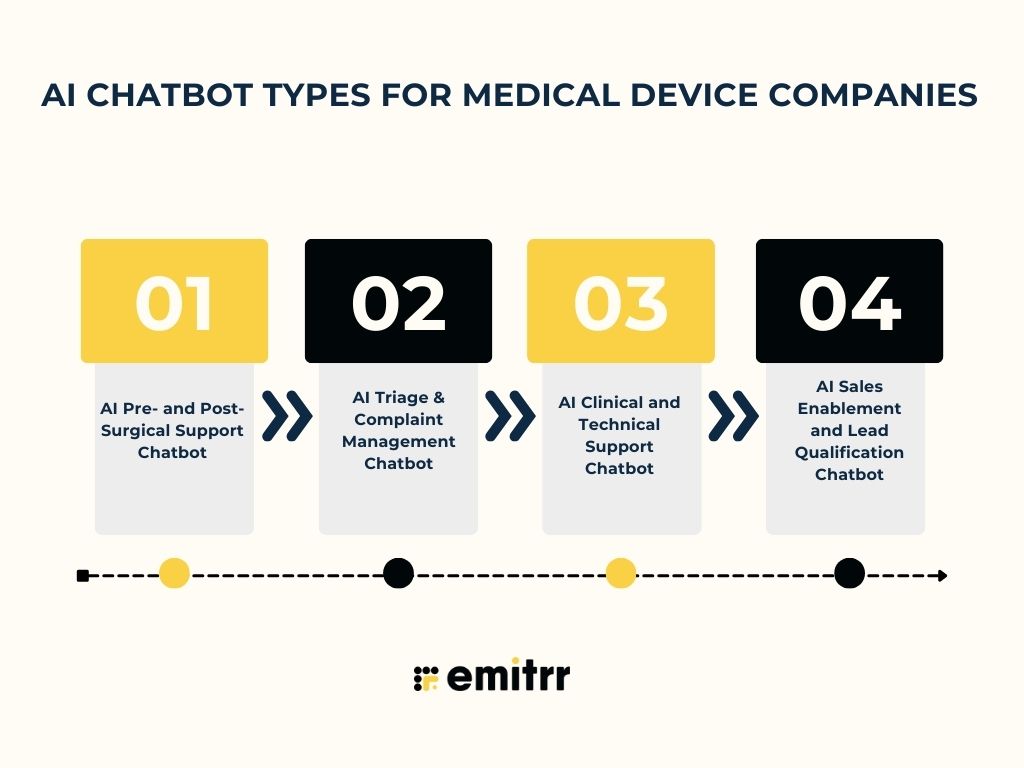
AI Pre- and Post-Surgical Support Chatbot:
- About: A bot designed to help patients at every step of using a designated device, from pre-op preparation to post-op recovery.
- Use Cases: Sending patients the pre-operative checklists for an implant, reminding patients to use the post-operative device (like a continuous passive motion machine), and answering patients’ questions about pain management or physical therapy. A chatbot could also include video demonstrations that guide a patient through using a home therapy device.
- Benefits: Decreased patient anxiety, increased compliance with requisite care pathways, and decreased burden of direct support calls, making it a valuable component of customer engagement in medical devices.
AI Triage & Complaint Management Chatbot:
- About: A bot that specializes in collecting and triaging customer complaints and Adverse Event Reports.
- Use Cases: Responding to a customer’s inquiry about a device malfunction and, if it’s a serious malaise, automatically send them to a human agent and also log the event into a complaint management report for post-market surveillance.
- Benefits: Faster complaint processing, improved AI Chatbot for regulatory compliance related to medical devices, and strengthened patient safety by creating a clear, auditable trail.
AI Clinical and Technical Support Chatbot:
- About: An internal or external-facing bot that pulls together technical information for clinicians, sales reps and hospital staff. The chatbot will be seen as the ultimate technical support tool for medical device technical support.
- Use Cases: Answer questions about a device’s specifications, provide the appropriate troubleshooting steps for a technical issue and act as a virtual training assistant during product rollouts.
- Benefits: Reduces clinical specialists’ time spent with manual support, enhances staff training, and assists in eliminating misuse of devices.
AI Sales Enablement and Lead Qualification Chatbot:
- About: A chatbot embedded on a company’s website that is used to engage and qualify potential leads (e.g., hospital procurement managers). This is an important tool in the chatbot for medical device sales and support.
- Use Cases: Answer high-level questions about the company’s product line, schedule a demo with a sales rep, and collect contact information for future contacts.
- Benefits: Improves a company’s lead generation, automates sales team workflow, and ensures only qualified leads are passed to the sales team, maximizing the efficiency of the team’s leads.

Key Features to Include in an AI Chatbot for Medical Device Companies
- AI Agent: An advanced, HIPAA-compliant AI agent should be able to learn from every interaction, adjust based on new information, and operate according to the organization to tackle as many tasks as possible, without being reliant on a person for resolution.
- HIPAA and GDPR Compliant: This is the most critical feature, and the platform must have a signed Business Associate Agreement (BAA), along with end-to-end encryption.
- CRM and EHR integration: If the AI platform integrates with existing technology such as Salesforce, Epic or Cerner, this is critical to maintain a seamless data flow and consistent view of customer encounters.
- Voice-Enabled: This is critical for healthcare AI chatbots especially, as they provide hands-free support to clinical employees especially in busy environments or for patients with diminished ability to navigate a platform.
- Natural Language Processing (NLP): The bot must understand complicated medical terms and the nuances of patient and customer interaction in order to accurately and consistently answer questions.
- Customizable Chat Flows: The ability to build specific conversation paths for each different use case (for example, patient, physician or sales lead).
- Detailed Analytics and Reporting Features: A dashboard to track how many conversations were held, the most frequently asked questions, user satisfaction, etc., to evaluate how the platform is being used and continuously improve.
- Human Handoff Features: The bot must be aware when a conversation needs to be handed off to a live agent dialog for complex matters or when a user demands it.
Integration & Compliance Considerations
Integration
- Prefer open APIs, webhooks, and healthcare standards (FHIR/HL7). Medical device chatbots should be able to enable bi-directional flows, e.g. chatbot → CRM lead, chatbot → QMS incident, chatbot → status back to service teams; so, data moves automatically, consistently, and traceably.
Compliance:
- Having a HIPAA-compliant chatbot is essential: signed BAA, encryption in transit/at rest, restricted access, and audit trails. These measures can protect PHI and offer regulated auditing evidence (FDA) during compliance audits.
How to Select the Right AI Chatbot for Your Medical Device Company?
- Determine Your Goals: Be as specific as possible regarding outcomes (20% cost reduction, etc.), shortening complaint cycles, and increasing training completion.
- Understand your Integrations: Map your EHR/CRM/QMS and confirm common integrations or API connectivity.
- Compliance Comes First: Require BAA, security certificates, and healthcare references.
- Scalability: Must be able to support multiple products, multiple geographies, multiple languages, and extensive conversation volumes.
- Ask for a Demo: Verify that you can validate real use cases end to end; measure deflection, cycle times, CSAT, and data quality.
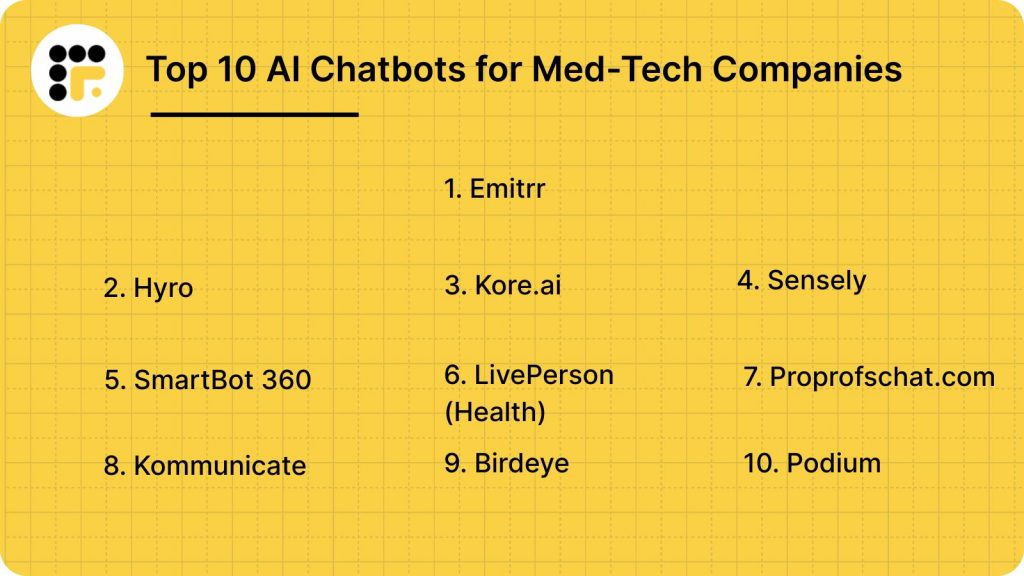
Top 10 AI Chatbots for Med-Tech Companies
- Emitrr
- Hyro
- Kore.ai
- Sensely
- SmartBot 360
- LivePerson (Health)
- Proprofschat.com
- Kommunicate
- Birdeye
- Podium
1. Emitrr
Overview:
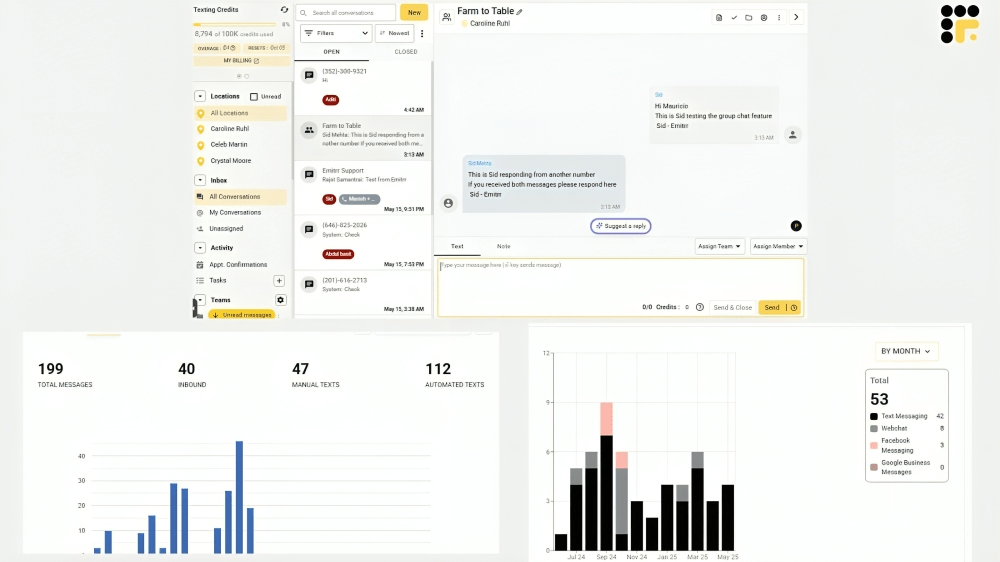
Emitrr has provided a comprehensive all-in-one AI platform for accelerating MedTech communication that automates patient/provider communication from voice, chat, and two-way texting. This holistic approach encompasses everything from scheduling to triage and analytics, all in one interconnected solution. Healthcare providers trust Emitrr because of the innovative way it streamlines, increases efficiency, and engages active minimal-interaction with patients at scale. Emitrr provides a transparent and unified toolbox to empower active patient engagement across platforms.
Features of Emitrr:
- Custom Chat Flows for Healthcare: Customize chat flows created for the healthcare area to drive patient engagement and experiences.
- Voice-Enabled Scheduling & Symptom Capture: Patients can schedule an appointment or report symptoms using a voice-enabled person.
- AI-Driven Front Desk Operations: Seamlessly acts as an intelligent virtual receptionist assistant and answers calls and inquiries.
- Two-Way Texting & Virtual Receptionist: Personalize conversations and automate reminders via direct SMS texting.
- Automated Triage Flows: Automate a patient’s symptoms assessments and how to direct patients within workflow using intelligent automation.
- Analytics on Scale: Report on communication trends and chats by using the reports.
- 500+ EHR Integrations: Instantly link to leading healthcare systems with ease and keep workflows unified.
Pros of Emitrr:
- Automated scheduling, follow-ups, and reminders.
- Minimum manual effort and maximize patient engagement.
- Fast integration into existing tech stack.
- Trustworthy system used by 1,000+ customers.
- 5-star rated support.
Cons of Emitrr:
- Some advanced features are still in process and will be available within a few days.
Emitrr Pricing:
Assumed: tiers–Basic, Professional, Enterprise
Emitrr Reviews:
4.8/5
Emitrr Support Channels:
Live chat, email, phone, 24/7 support, and onboarding assistance.
2. Hyro
Overview:
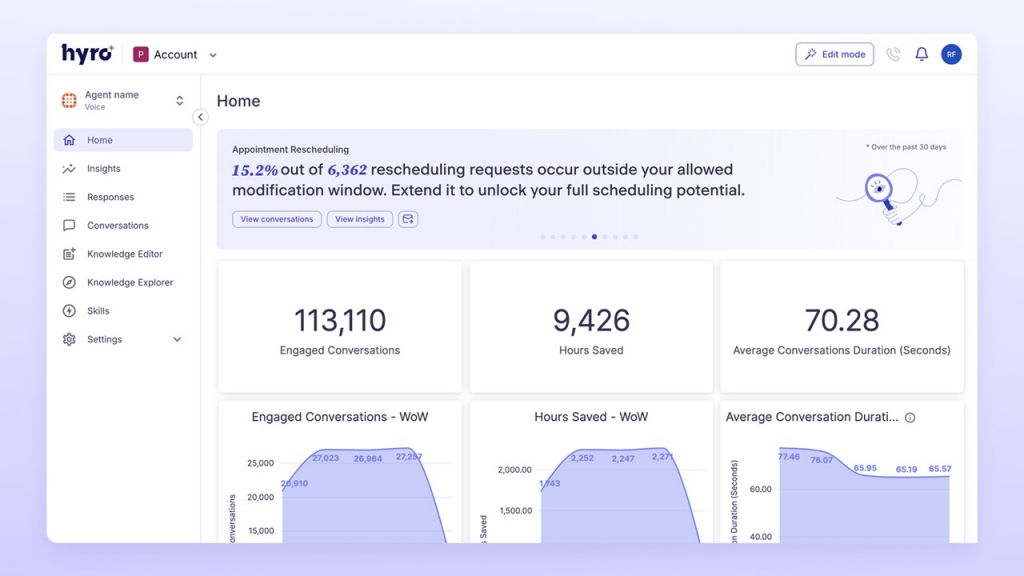
Hyro specializes in conversational AI in healthcare, with an emphasis on hospitals and large health systems. Hyro’s platform employs a unique NLU model to autonomously “ingest” content existing on the company’s website/digital assets by autonomously “reading” it and representing that knowledge such that it can accurately answer questions without training in a training environment.
Features of Hyro:
- Dynamic Conversational AI: Has the ability to learn from your website, documents, and content to provide accurate responses.
- AI-Based Call Routing & Handling: Ability to automate call deflection, routing, and call handling.
- Voice Assistant for IVR/Phone: Conversational voice assistant to enhance patient telephone or IVR experience.
- Multiple Use Cases: schedule appointments, answer frequently asked questions, search for providers and wayfinding.
- No-Code Flow Editor: Build and modify chatbot flows without code and technical expertise.
- EHR/CRM Integrations: Integrates with leading healthcare and enterprise systems.
- Analytical Dashboards: Measure performance statistics to improve patient communication.
Pros of Hyro:
- Speed of Value – automated ingestion means fast time-to-value
- Enterprise-ready with multiple sites
- Reduced manual Intent maintenance
Cons of Hyro:
- It may be heavy for smaller firms
- Customization of the deep private data process may take additional work
Hyro Pricing:
Custom pricing for enterprise
Hyro Reviews:
4.7/5
Hyro Support Channels:
Dedicated account management, documentation, and technical support
3. Kore.ai
Overview:
Kore.ai has an enterprise-grade, no-code platform for complex conversational AI solutions. Its platform can scale in many ways to build complex virtual assistants. It is capable of managing a wide variety of business processes, from patient assistance to sales enablement to internal knowledge bases for medical device companies.
Features of Kore.ai:
- No/Low-Code Assistant Designer: Create complex, healthcare, AI assistants without a lot of coding.
- Omnichannel Engagement: Send messages over chat, voice, email, and SMS.
- NLU and Machine Learning: Recognizes medical terms and patient nuances for accurate answers.
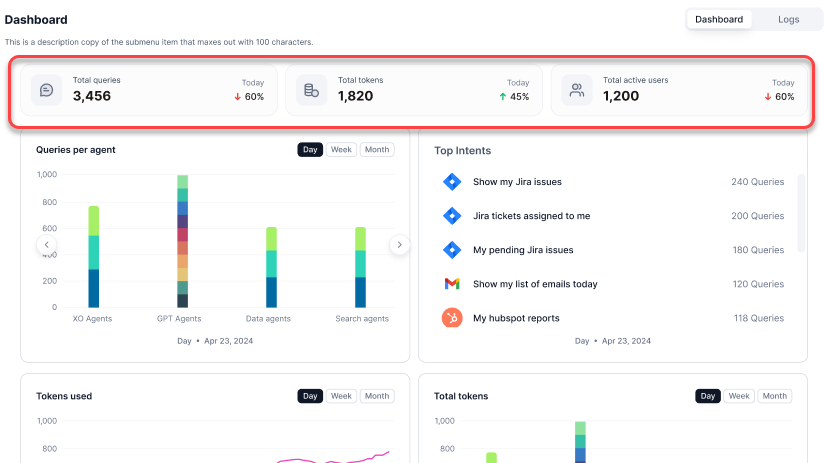
- Analytics and Reporting Tools: Capture and measure performance with built-in reports and dashboards.
- HIPAA-Compliance and Security: Data is encrypted at rest and in-transit.
- Voice Biometrics and Secure Authentication: Increase security with advanced identity verification.
- Broad Enterprise Integrations: Integrates with EHR (Electronic Health Records), CRM (Customer Relationship Management), and other enterprise technology.
Pros of Kore.ai:
- Highly configurable for regulated use cases
- Mature security/governance and observability capabilities
- Can scale across products and regions
Cons of Kore.ai:
- Complex for teams using enterprise platforms for the first time
- Enterprise pricing with enterprise implementation effort
Kore.ai Pricing:
Custom pricing for enterprise
Kore.ai Reviews:
4.6/5
Kore.ai Support Channels:
Enterprise-focused support, knowledge base, and solution services.
4. Sensely

Overview:
Sense.ly develops a virtual nurse avatar to support patient engagement and remote patient monitoring. Their avatar is specifically designed for personalized and empathetic support, making Sense.ly a great option for medical device companies focused on aiding their patients post-surgical or in the management of chronic disease.
Features of Sensely:
- Virtual Nurse Avatar: Empathy-driven digital nurse for guided conversations.
- Remote Patient Monitoring: Collect and track data for patient management.
- Medication and Appointment Reminders: Automate nudges to ensure adherence.
- Custom Education, Symptom Checks: Provide tailored educational material and guided assessment.
- Video and Voice Communication: Real-time interactive support.
- EHR connectivity: Data is synced directly into patient records.
- HIPAA Compliant Secure Messaging: Provides messaging platform for patients that is secure and compliant.
Pros of Sensely:
- High patient engagement and brand affinity
- Good for longitudinal programs and RPM
- Helps to standardize educational and follow-up experiences
Cons of Sensely:
- Not a full contact-center replacement
- Administrative/billing depth is limited
Sensely Pricing:
It has custom pricing
Sensely Reviews:
4.3/5
Sensely Support Channels:
Email, phone, implementation resources
5. SmartBot 360
Overview:
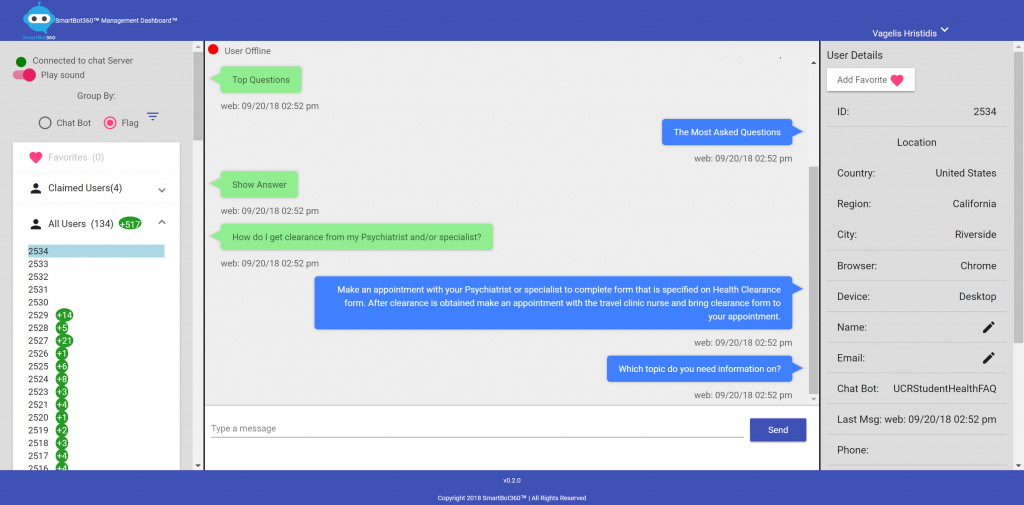
SmartBot 360 is a HIPAA-compliant AI chatbot platform to create, generate leads, service customers, and book patient or customer appointments in the healthcare space. Their customized no-code advanced chatbot platform and solutions can easily be tailored to fit a medical company’s clinic needs or a medical device company’s needs.
Features of Smartbot 360:
- Compliant Platform with HIPAA Compliance: Support BAA to meet regulations.
- Drag-and-Drop Chatbot Builder: Create chatbots with visual, no-code tools.
- Automated Appointment Scheduling: Allow patients to book and schedule appointments along with their own appointment reminders.
- Secure Data Forms: Collect medical and patient information using encrypted data forms.
- Wide Integrations: Connect to EHR, CRM, and other business applications.
- AI Conversational Flows: Route the patient to triage and engage in support questions.
- Analytics Dashboard: Report on chatbot performance, and patient engagement.
Pros of SmartBot 360:
- Strong focus on HIPAA compliance makes it a comfortable, compliant solution for the healthcare industry.
- Easy to build, and the no-code builder gives you the power to deploy anything fast!
- Provides a wide-ranging flow from lead capture to customer support.
- Reasonably priced for small to medium companies.
Cons of SmartBot 360:
- May not have the same degree of robust, enterprise-grade options, like larger platforms, including voice assistance.
- More focused on clinically based feature set and needs, versus complex technical support on a device.
Smartbot 360 Pricing:
Tiered pricing by usage and features.
Smartbot 360 Reviews:
4.2/5
SmartBot 360 Channels:
Online documentation, support via email, and live chat.
6. LivePerson (Health)

Overview:
As an established leader in the field of conversational AI and messaging solutions for customer service, LivePerson provides an enterprise platform that enables companies to develop and deploy rich AI chatbots that can interact simultaneously with a large number of conversations across communication channels. This makes LivePerson particularly attractive for the world’s largest medical device companies that support thousands of customers.
Features of LivePerson:
- Scalable Conversational AI: Enterprise ready messaging, workflows, and automation.
- Omnichannel Messaging: Streamline all messaging through web, sms, social platforms, and apps.
- Human Handoff & Routing: Smoothly route and transition from bots to agents in conversations.
- Agent-Assist & Automation: Give human agents guidance and AI-based recommendations to help them.
- Analytics & Governance Tools: Observatory on performance tracking, governance compliance, and more.
- HIPAA-Compliant Business: Compliant with HIPAA compliance and meets the data protection requirements for healthcare.
- EHR/CRM Connector: Connect to leading practice and enterprise systems.
Pros of LivePerson:
- Proven at a very high volume
- Strong analytics and agent assist
- Ongoing platform improvements and acknowledgments
Cons of LivePerson:
- Specialization in healthcare may have some configuration
- Pricing can be premium for smaller teams
LivePerson Pricing:
Tiered + custom enterprise
LivePerson Reviews:
4.4/5
LivePerson Support Channels:
24/7 support, documentation,LivePerson customer success center
7. Proprofschat.com

Overview:
ProProfschat.com provides a simple yet efficient way for your leads to grow, support to automate, and a personal touch through customizable chatbots. ProProfs chat’s biggest benefit is that it’s easy to use, and it integrates with different tools to streamline your operations.
Features of ProProfschat.com:
- Grow Leads & Sales: you can customize the bot to ask multiple-choice, multiple, and open-ended questions to qualify leads, schedule demos, and collect contact.
- Automated Customer Support Anytime: It is a great solution for answering frequently asked questions and reducing tickets.
- Train AI Chatbot with Your Own Data: You can train the bot on your website, on your knowledge base, or on documents you upload to the chatbot, so that it will provide accurate responses on-brand.
- Connect with Help Desk: It has seamless integration with ProProfs Help Desk, so you can automate ticket creation and routing.
- Smart Handoff: The bot can hand off chats to live human agents. The bot will do this strategically, when the user has had enough or is in need of detailed support.
- Chatbot Customization: The platform has an easy-to-use dashboard to customize chat flows and the look of your bot.
Pros of ProProfschat.com:
- Easy to set up and use if you are not too technical.
- This platform heavily emphasizes lead generation and sales.
- Seamless integration with its own help desk and knowledge base.
- Cost-effective for small to mid-sized businesses.
Cons of ProProfschat.com:
- It does not include unique, built-in features for highly regulated industries like the medical device industry (custom configuration may be required).
- Its features are more general-based than healthcare-based.
ProProfschat.com Pricing:
Tiered based on features and usage.
ProProfschat.com Reviews:
4.0/5
ProProfschat.com Support Options:
Live chat, email, and an extensive knowledge base.
8. Kommunicate
Overview:
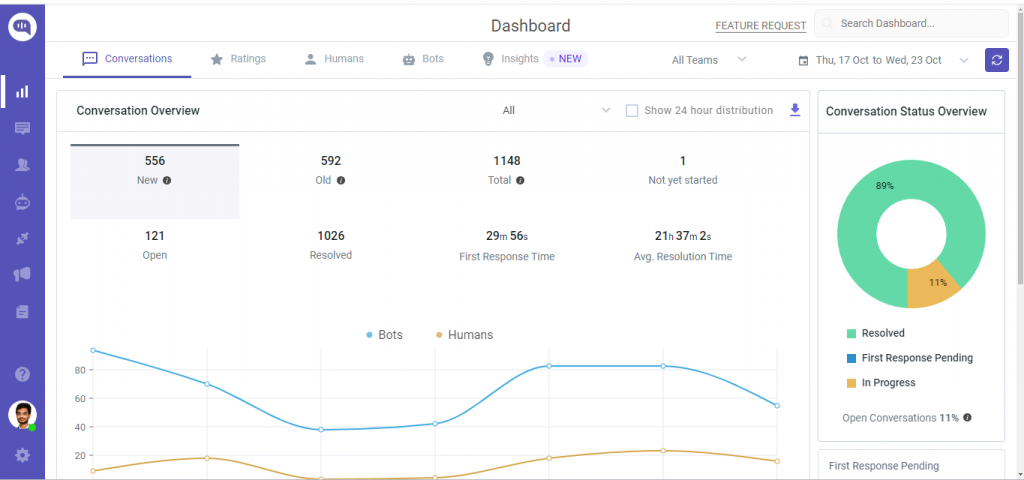
Kommunicate makes it easy to take customer interactions to the next level with generative AI chatbots. They provide a simple-to-use platform that allows businesses to train a chatbot using their existing knowledge bases, including documents and website content, to facilitate instant and personalized support.
Features of Kommunicate:
- Custom Generative AI Chatbot Based on Knowledge Source: Train it by posting your website URL, connected knowledge base or documents (PDF/spreadsheets).
- Personalize Your Generative AI Chatbot: Direct the chatbot to respond in the correct brand voice with RAG (Retrieval-Augmented Generation), And send unknown questions to human agents.
- 24/7 Best-in-Class Customer Service Via Chatbots: Offers human-like interaction on websites, apps (iOS, Android), or platforms such as WhatsApp or Messenger.
- Smart Escalation: Escalates difficult questions to humans and defuses easy ones.
- Strong LLMs: Employ top models from OpenAI, Gemini, Anthropic, or be integrated with Dialogflow, Watson, or Amazon Lex.
Pros of Kommunicate:
- Great for quickly training a bot on existing content, which will shorten your deployment period.
- Great customization features mean you can align your brand voice and control the final response to users.
- Access to omnichannel communication for a consistent customer experience.
Cons of Kommunicate:
- Although it integrates with other systems, the platform itself is not specifically designed for healthcare so you will want to ensure, independently, a Business Associate Agreement (BAA), and HIPAA compliance.
- Some of the more advanced options may be challenging to set up without technical knowledge.
Kommunicate Pricing:
Stacked pricing based on user licenses and functionalities.
Kommunicate Reviews:
4.3/5
Kommunicate Support Channels:
Live chat, email, extensive docs, community forums.
9. Birdeye

Overview:
Birdeye is a focused online reputation management and customer experience roundup tool. Though not your traditional chatbot, the AI-driven message platform manages patient discussions, appointment scheduling, and review requests. It is a good option for medical device companies that rely heavily on positive online reviews and patient feedback to inspire trust.
Features of Birdeye:
- AI Messaging for Patients: Engage patients with AI-powered messaging automation.
- Review and Survey: Engagement in their feedback request automated post visit.
- Unified Inbox: Manage all communication channels and chat history in a shared SMS inbox.
- Reputation Management & Listings: Help clinics manage their online presence, reputation, and reviews.
- Practice Management Integration: Connect to EMR/PMS and other practice management applications so that the clinic can load workflows.
- HIPAA-Compliant Messaging: Keeps patient communications secure.
- Analytics on Feedback: Delivers insight into reviews and patient satisfaction.
Pros of Birdeye:
- Outstanding means to build and manage a positive online reputation.
- Great ability to increase review volume and positive feedback.
- Straightforward to use and implement quickly.
Cons of Birdeye:
- Not quite the same sophisticated AI capabilities as platforms dedicated to chatbots.
- Less focused on complex triage or technical support.
Birdeye Pricing:
Pricing is tiered, dependent on feature set and locations.
Birdeye Reviews:
4.7/5
Birdeye Support Channels:
Phone, email, and live chat support.
10. Podium
Overview:
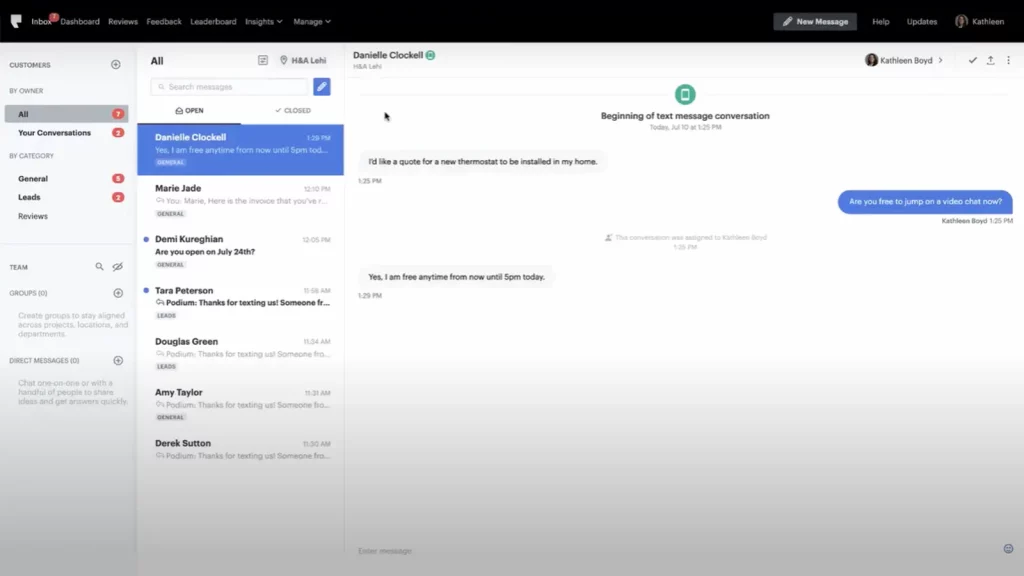
Podium is a customer communication and marketing platform that helps businesses facilitate customer interaction and manage their online reputation. It provides a messaging platform that utilizes AI technology to allow medical device companies to deal with customer inquiries, collect leads, and collect payment all within a single “inbox” that is easy to use.
Features of Podium:
- AI-Driven Messaging: Created for patient support and lead conversion.
- Unified Inbox: Consolidates all communication into a central location.
- Payment Collection and Invoicing: Makes billing easy with secure payment options and a digital payment framework.
- Review and Feedback Tools: Automates the collection of reviews and management of reputation.
- Chat Widget for Your Website: Communicates directly with visitors in chat in real-time.
- CRM and PMS Integrations: Integrates with practice management and customer systems.
Pros of Podium:
- Easy-to-understand platform for all customer interactions
- Strong emphasis on lead conversions and collecting revenues
- Simple to set up and simple to use
Cons of Podium:
- Not a full-service AI chatbot for more complex tasks
- Focused on marketing and sales and not on deep clinical support.
Podium Pricing:
Tiered pricing per system with different clinical and marketing features.
Podium Reviews:
4.5/5
Podium Support Channels:
Phone, email, and live chat inquiries.
Why Emitrr is The Best AI Chatbot for Medical Device Companies
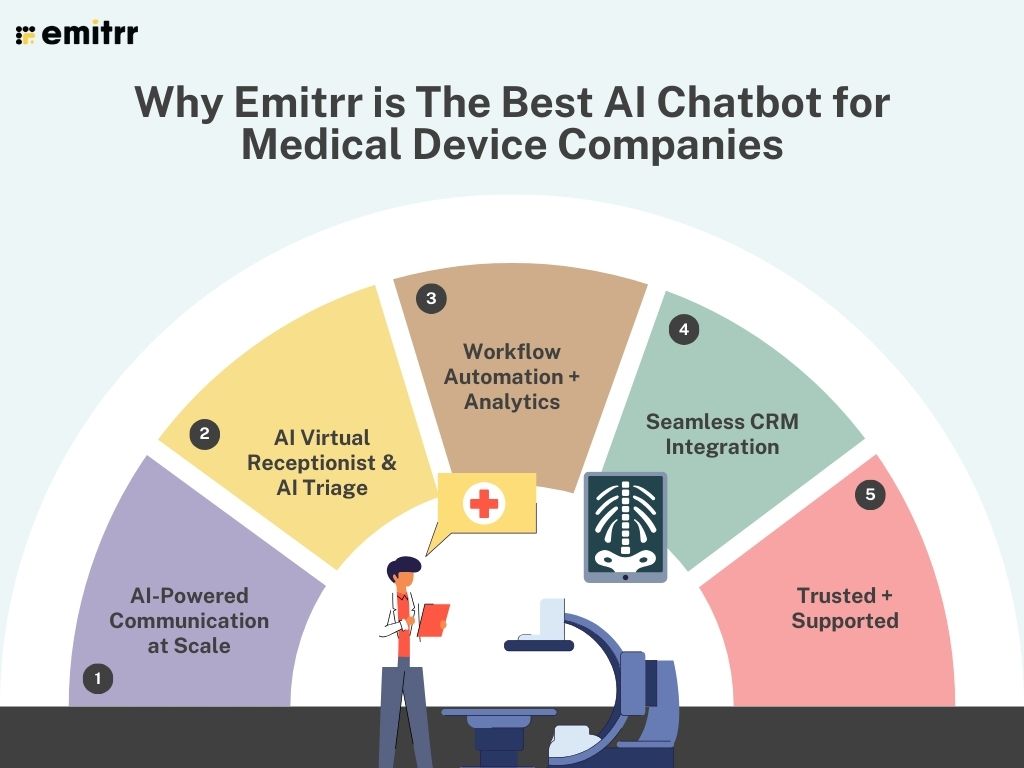
- AI-Powered Communication at Scale: Emitrr automated scheduling, follow-ups, reminders, review requests, and missed-call conversion via voice and SMS to reduce the amount of repetitive workload while increasing responsiveness for patients, clinicians, and channel partners. Two-way texting allows conversations to flow without phone tag, while AI-based call handling using Emitrr means that every call is either answered, routed, or transcribed for follow-up.
- AI Virtual Receptionist & AI Triage: Emitrr’s virtual receptionist can respond to FAQs, capture symptoms, and escalate any red flags to live agents. This includes the ability to customize chat flows so you can provide tailored journeys, whether for patients, clinicians, distributors, or biomed teams.
- Workflow Automation + Analytics: Emitrr decreases friction across the lifecycle of the device, from web form to text engagement and automated reminders and rescheduling. Analytics provide insight into deflection rates, response times, and campaign performance, linking automation to measurable outcomes.
- Seamless CRM Integration: Emitrr has 500+ integrations, reducing change management and expediting rollouts for both the distributed device portfolio and partner networks.
- Trusted + Supported: Emitrr is used throughout healthcare and services, and supported by responsive, high-touch support – essential in regulated environments.
In short, Emitrr is an AI chatbot for medical device customer service and technical support. Emitrr combines voice, chat, and SMS support with triage, automation, and analytics, making Emitrr a reasonable first choice for AI-enabled customer experience in medical devices and medical device support automation.
FAQs
Ans: Faster responses, consistent education, structured complaint capture, and less call volume; all lead to greater customer satisfaction and improved compliance readiness.
Ans: Select vendors who will sign BAAs, can provide encryption and audit trails, and who will integrate with quality management systems. Chatbots do not eliminate your regulatory obligations; rather, they help you operationalize them.
Ans: Field teams: they can provide support details, troubleshooting trees, and RMA intake. Patient support: bots can provide usage help and pre-/post-op instructions, triage intake, and billing Q&A.
Ans: Yes, initiate with just one high-value journey (complaints intake/demos and schedules), quantify the impact (deflection, CSAT, cycle time), and scale from there.
Conclusion
The next competitive advantage in MedTech isn’t just better devices, but better conversations about the devices. A modern chatbot for medical device companies can bring sales, service, education, and compliance into one trusted experience. From an AI chatbot for medical device manufacturers (field enablement) to an AI chatbot for customer service for medical device manufacturers (patient and clinic enablement), the future winners will combine a HIPAA-compliant AI chatbot for medical device companies with solid integrations and analytics.
Of the current options, Emitrr has it all with AI virtual receptionists, AI triage, two-way chatting, workflow automation, and broad integrations into a flat stack that changes disjointed conversations into measurable outcomes. Curious to explore what Emitrr has in store for you? Book a quick demo to learn more!