
 4.9 (400+
reviews)
4.9 (400+
reviews)
The hospitality industry has been through a tremendous digital revolution in the past years, an evolution that was greatly accelerated by the COVID-19 pandemic. Hotels now have to revamp their services to meet today’s customer requirements, deal with increasing operational costs, and address competition from digital-first platforms.
On the other hand, AI (Artificial Intelligence) is indeed turning the tide in this new economy. The guests are now asking for a highly customized and touchless experience, which starts at the time of booking and ends at check-out. While housing managers are obliged to implement more optimized resources, business process reengineering essentials, and also not compromise the service quality that is supported by the initial budget. The owners prefer to use the bought applications well and do not put a priority on customer service. But if the business giant (COVID-19 pandemic) makes a dramatic change, it’s not just about automating tasks, but also about agility, efficiency, and guests’ satisfaction.
AI helps the hotel industry to bridge the gap between difficulties in providing customer needs and the technology that offers a faster, easier, and more human-based service by means of translation, transcription, and sentiment analysis, and even the voice reporting. Other than that, it is no longer just about the automation of tasks but also about improving the levels of agility, efficiency, and guest satisfaction.
Types of AI Used in Hotels
Artificial Intelligence in the hotel industry is not singular but rather a combination of different technologies that are used both on the guest’s side and in the back office to make operations better. These are the main types of AI that are commonly used across the hotel industry today:
Machine Learning
Machine Learning is mostly used for the examination of historical and current data to forecast future trends. This software excels in several areas, including:
- Pricing strategies and revenue management that are smart and dynamic
- Anticipating guest behavior and booking patterns
- Forecasting demand and occupancy
Natural Language Processing (NLP)
NLP enables AI to understand, interpret, and respond to human language. It is used for the following:
- Chatbots and virtual assistants
- Review and analysis of feedback
- Guest communication in multiple languages
Computer Vision
This technique of AI makes it possible for the system to recognize and understand visual information, just as humans can. A list of the most common hotel realizations is the following:
- Facial recognition for safe check-in.
- Surveillance and control of security.
- Smart access for rooms and facilities
Robotics & RPA
Automation and robots handle repetitive or physical tasks. Major examples:
- Concierge robots for directions or amenities assistance
- Automated room assignment based on occupancy
- Inventory and logistics automation of hotel supplies
Generative AI
One of the most recent exciting trends, generative AI generates content from inputs and context. Hotels can utilize it for:
- Writing guest messages, responses, and service scripts
- Personalizing promotion offers and booking confirmations
Benefits of AI in Hotels
AI is not just a technology upgrade — it’s a strategic tool that facilitates almost every aspect of hotel operations, from front-of-house services to back-of-house operations. Here’s how AI is creating real business value across the hospitality landscape:
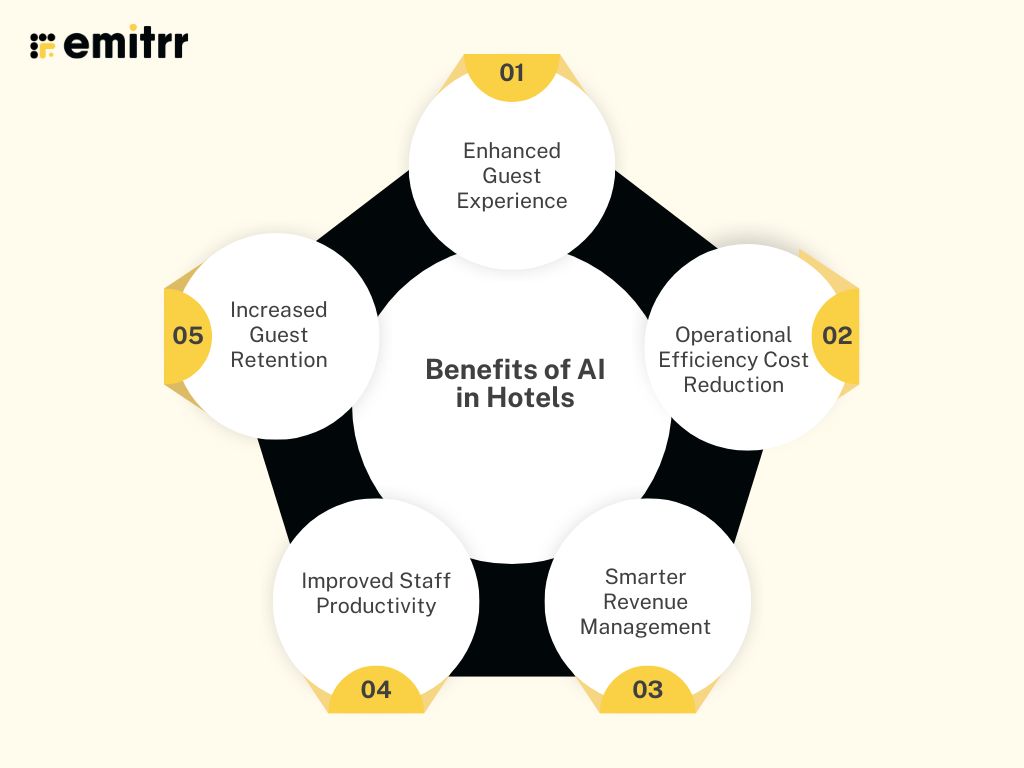
1. Enhanced Guest Experience
Artificial intelligence used in some of the guest services like 24/7 chatbots, smart room preferences, and language translation are the very tools that a difference in the delivery of a customer-centered stay. Platforms such as Emitrr’s AI Concierge are becoming popular due to their quick responses to FAQs, room service requests, and local recommendations.
2. Operational Efficiency Cost Reduction
AI is not limited to a person’s mind but is also expanding in the field of industry as it has been able to possess the capability to automate processes. This can be seen as the best example of how a human being can collaborate with AI to produce a seamless work result. While technology continues to advance, human creativity remains unmatched in the workplace.
3. Smarter Revenue Management
Dynamic pricing is made possible through AI, as it not only takes demand trends into account but also gathers data on weather, events, local competitors’ prices, and booking windows. The program called IDeaS Revenue Solutions suggests that the best results are achieved by adjusting room prices on the spot to recover the revenue per available room (RevPAR).
4. Improved Staff Productivity
Training people to do the same work is ineffective. It is about time we embrace the automation of the low margin decision-making activities by building an AI algorithm, which will save effort and time on the one hand, and will still provide a personal experience to the customers.
5. Increased Guest Retention
AI systems keep a record of what their guests like during their visits and produce offers or upgrades specifically tailored to their needs. It can also find out guests who are at risk (for instance, by their negative sentiment in their reviews or messages) and correct their concerns before worsening the situation, which in the long run will have a positive impact on both customer loyalty and the brand reputation.
| Benefit | Description |
| Enhanced Guest Experience | Personalized, faster, and more seamless stays |
| Operational Efficiency | Automation of repetitive and time-consuming tasks |
| Revenue Management | Smarter dynamic pricing and demand forecasting |
| Staff Productivity | Reduces workload and improves task allocation |
| Guest Retention | Anticipates guest needs and fosters long-term loyalty |
Use Cases of AI in Hotels
Artificial Intelligence is changing every chat point of the hotel guest journey from pre-booking to post-stay engagement. Here are the some significant use cases:
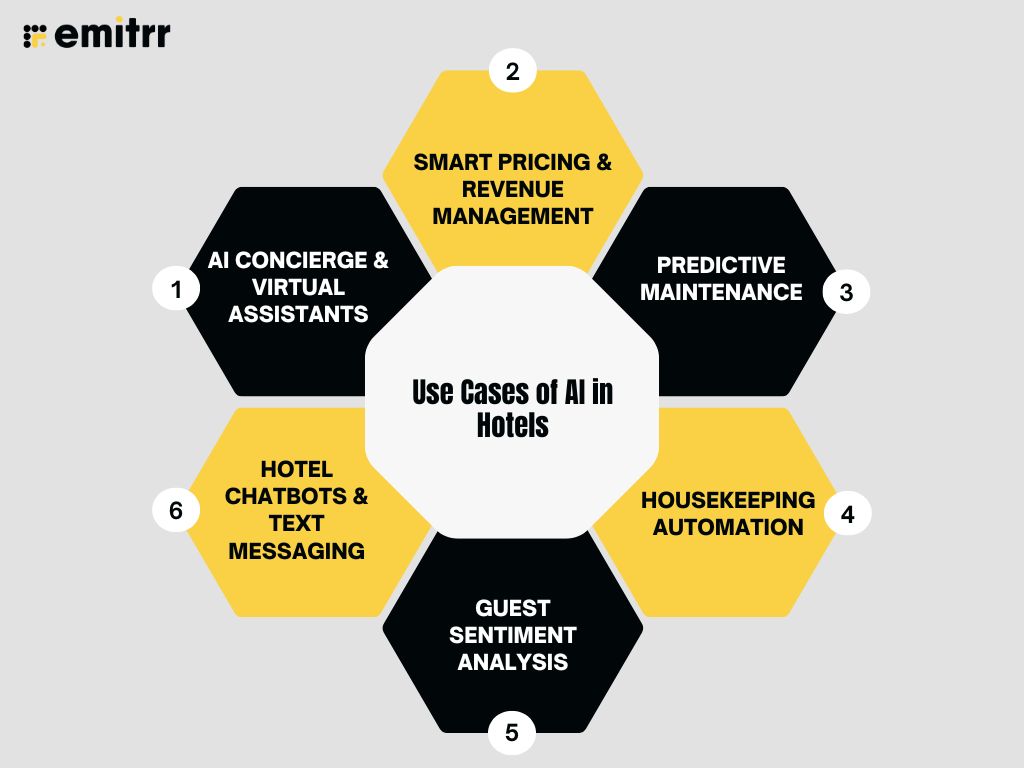
a. AI Concierge & Virtual Assistants
Artificial intelligence-driven robotic concierges can undertake a vast number of chores constantly, for instance:
- Guiding FAQs (check-in times, amenities, Wi-Fi access)
- Suggesting restaurants, local attractions, and services
- Reserving bookings and setting up room service
- Issuing instant notifications (delayed flights, the weather, events)
This reduces the front desk’s workload and provides speedier yet predictable and consistent customer service.
If you want to know more about AI receptionists (such as healthcare), you can watch this informative video:
b. Smart Pricing & Revenue Management
The AI algorithms take into account competitor pricing, seasonality, and historical booking patterns to dynamically adjust room rates in addition to the real-time market data for:
- Optimizing room rates on the go
- Filling low-season rooms
- Achieving high RevPAR
Hotels are thus able to get the most out of the market, the shifting market, and remain profitable as well.
c. Predictive Maintenance
The new model consists of AI-enabled IoT sensors, which are responsible for the surveillance of:
- Elevators
- HVAC systems
- Plumbing, they predict and detect equipment failures before they even appear and they also perform time-based maintenance so as to eliminate potential downtime and reduce the chance of customer complaints.
d. Housekeeping Automation
AI and data analytics contribute to efficient housekeeping by:
- Predicting peak checkout times
- Prioritizing room cleaning accordingly to the occupancy and the guests’ preferences
- Allocating housekeeping staff in an effective manner
The situation results in quicker turnarounds in the room and less burden on the workers.
e. Guest Sentiment Analysis
AI tools scour the web for online reviews, surveys, and social media to:
- Track how guests feel in the moment
- Spot the same problems over and over (e.g., noise, staff behavior, cleanliness)
- Recommend what the service could be based on the identified problems
As a result, this method enables hotel managers to get a head start by responding positively and thus secure the good name of their brands.
f. Hotel Chatbots & Text Messaging
Hotel chatbots are employed in websites, messaging platforms, or SMS to allow real-time guest service through:
- Real-time guest interaction (bookings, inquiries, complaints)
- Automatic responses to common questions
- Via the internet, chat, and SMS, upselling is possible (late checkout, spa appointments)
What are the reasons for this?
Contemporary travelers are more likely to choose immediate, non-app communication. Hotel text messaging applications act as their customers’ simple and compact CRMs, thus eluding the app fatigue, and the customer’s loyalty is further improved.
Challenges of AI Adoption in Hotels
Though it is well known that AI is going to transform the way the hotel industry works, one can’t overlook the fact that AI introduction in the field is full of difficulties that hotels have to find a way to solve:
High Initial Investment and Implementation Costs
First of all, the cost of AI implementation is quite daunting as it often requires significant financial outlays. These cover the acquisition of expensive software and hardware, the modernization of existing systems, and the training of employees. These are the expenses that small and medium hotels will struggle the most with, thus entering the competition with powerful worldwide chain hotels, which, besides many other things, will continue to outspend them in technological hospitality.
Data privacy and regulatory compliance
AI systems collect and analyze a substantial amount of user data that may raise doubts about the security of personal information. On their part, hotels must follow all laws and regulations, such as the General Data Protection Regulation, that will stop the leakage of their guests’ private details. Since the rules have to be obeyed, the non-observance of them might cause negative legal and reputational consequences for the hotel.
Staff Resistance to Technology and Professional Skill Shortages
There is a dark side to the coin. The biggest fear that every hotel staff member has with the introduction of AI is job loss and job reassignment. Furthermore, the biggest challenge may be the shortage of the needed skills for proper AI system operation and administration. To tackle these problems, it is required to develop training courses that are full and clear on the subject of AI’s role in improving the human element, and at the same time, not having it as a substitute for workers.
Integration with Legacy Systems
The main situation in the hotel field is that many hotels use old-fashioned systems that seem to be incompatible with modern AI. This indicates that the incorporation of AI into existing infrastructures is a complex and lengthy process that will inevitably involve significant changes or even the overhauling of some current systems. To add to the challenge, this kind of integration might even put off the process of AI implementation and make matters harder (costlier), which, in turn, might bring the situation closer to being out of control.
Maintaining the Human Touch
Although AI has the potential to streamline operations as well as increase tailored services, one should not forget that it can also come with a risk of reducing the human factor that is the core of the hospitality industry. Depending on machines to carry out most of the tasks may mean that the customers’ experiences will not be personal. Being able to optimize the use of technology and at the same time keep up the personal touch are indispensable conditions to satisfy guests’ needs.
By proactively addressing these challenges through strategic planning, investment in training, and thoughtful integration of AI technologies, hotels can harness the benefits of AI while preserving the core values of hospitality.

How AI-Based Communication in Hotels Differs from Traditional Communication
| Aspect | Traditional Communication | AI-Based Communication |
| Reply Mechanism | Manual replies by hotel staff, often delayed during peak hours | Automated responses and immediate availability of 24/7 through AI tools such as Emitrr’s Hotel Chatbot & Texting App |
| Message Personalization | Generic, non-contextual templates are used across guests | AI applies the data about the customer (guest preferences, booking data, past interactions) to have a relevant and personalized conversation. |
| Speed & Efficiency | Slower response time; staff availability can be a bottleneck | Fast messaging, also, the AI can handle hundreds of queries in seconds. |
| Language Capability | Restricted to the staff’s spoken languages | Conversational AI achieves the elimination of language barriers by employing state-of-the-art NLP that, in turn, enables multilingual support. |
| Consistency of Service | Varies by staff member, time of day, or training level | Emitrr’s AI-powered chatbot guarantees that the communication throughout is of the same tone, has empathy, and brand voice regardless of the customers’ queries and staff’s perceptions. |
| Guest Experience | Reactive and often impersonal communication | Engage proactively through the use of data and upsell suggestions, reminders, and feedback collection powered by data. |
Why Emitrr Matters in AI Communication for Hotels
To begin with, Emitrr has:
- AI Concierge & Chatbots: Automatically responds, manages the ordering process, and illustrates the needed services
- Text Messaging Platform: Instant communication through text in a download-free era (bypassing app fatigue)
- Smart Replies: Recommend the best possible next message based on what the guest has communicated
- Tone Modifiers: “Make it Crisp” or “Make it Empathetic” depending on the guest’s tone and mood
Where Does AI Overtake Humans in Hotel Operations?
Handling repetitive queries
For instance, AI-based applications such as Emitrr can answer customer questions instantly about check-in/out times, breakfast hours, or amenity details. This will stop hotels from becoming 24/7 support centers while the pressure on the front desk staff will be greatly cut down.
Real-time multilingual guest support
NLP-programmed AI chatbots can effectively converse with guests in several languages so that guests feel at home in other places and encounter no linguistic barriers at a foreign destination.
Analyzing vast data for predictive insights
Hotels can use machine learning ML to forecast, forecast demand, and optimize inventory. The use of real-time data from ML ensures all decisions are made, that would take people a great deal of time is done instantly.
Hyper-personalized marketing & pricing
Artificial intelligence-powered systems regulate room rates and direct their advertisements in accordance with the browsing and purchasing behavior of the user and the demand of the season. Furthermore, Emitrr is a useful tool for creating and sending out targeted and timely promotions to ensure that the guests still book directly through the hotel.
Where Do Humans Still Overtake AI in Hotels?
Handling complex guest issues or emotional conversations
In the case of sensitive customer issues or when emotions such as anger or grief are deeply involved, even an AI programmed with standard replies can be of no value. Human empathy is an essential and irreplaceable quality for addressing these issues comfortably and effectively.
Personal touch during luxury check-ins or concierge services
At the high-end hotels, customers not only expect a personal touch, but they also like a bit of storytelling, wearing a smile, and receiving special attention which only capable staff can give.
Creative problem solving
In those instances where AI is neither familiar with nor able to address a given problem, or where there are sudden emergent VIP requirements, AI is not fit since it cannot provide the required service. These are the scenarios in which human imagination and bargaining skills are the only indispensable tools.
Managing staff and guest relationships
The relatively young concept of guest experiences, if it is to become an integral part of the hospitality industry, will require leaders to employ social skills, of course. It’s about team morale, staff leadership, customer loyalty, as well as creating and nurturing relationships with returning satisfied guests. By design, such types of activities belong to the domain of emotional intelligence, which is where AI still does not keep up.
Striking the Right Balance: Humans + AI in Hospitality
The future of the hospitality industry lies in effectively managing both AI and human service. With its immense capability of doing things faster and processing a lot of data, AI is apt for keeping the hospitality industry in a state of flow, whereas human staff members are most suitable for tasks such as intelligence, empathy, and creativity; they can bring qualitative aspects to service.
Emitrr, among other such companies, is not only automating routine tasks, sending out personalized messages, and enabling the staff to cultivate guest loyalty, but they are also the harbingers of delight. A digital-human interface to the human manned approach will be a true combination of a hotel’s efficiency and warmth.
Why Hotels Need AI Now More Than Ever
Increased competition in online booking platforms
The number of online travel agencies (OTA) and hotel aggregators, which have been on top of the trend, has given travelers an extended library to pick from. Hotels have to not only struggle with the cost but the pace, comfort, and personalization they offer to the guests as well. AI is the trump card for hotels that can create the most attention by automating dynamic prices, crafting personalized bundles, and boosting sales through AI-driven communication software like Emitrr.
Rising labor costs & high attrition in hospitality staff
There has been a shortage of workforce and the rising need for better remuneration post-COVID, which together have caused a surge in the operational costs that the hotel owners can’t simply ignore. The tools based on AI can undertake repetitive tasks like booking confirmations, inquiries of guests, and replies to reviews, as well as these, can radically cut the use of front-desk staff and ensure that the service remains unvaryingly assured throughout the staff turnover.
Need for faster, scalable guest experiences
The modern-day travelers expect immediate reaction, smooth check-ins, and personalized suggestions. Hotels can use AI-powered chatbots and virtual assistants, which will provide the best round-the-clock service, be it through channels such as SMS, WhatsApp, or web chat, without the guests feeling overwhelmed, and also be able to switch the services off and on on the basis of the guests’ need without developing application aversion.
Real-time insights for proactive decision-making
The hotel industry usually sticks to reports with past data instead of using AI which gives exploitative information on a real-time basis. In contrast, AI provides up-to-the-minute data so that hoteliers can take actions about changing prices, inventory control, and other aspects as soon as the situation alters, which results in not only more satisfied guests but also achieving a competitive margin.
Why Emitrr is the Ideal AI Platform for Hotels
Emitrr not only offers improvements in the contents of the text. Emitrr provides other AI-driven digital transformation tools to address the implementation of a wide spectrum of hotel operations, such as AI Concierge Service, Multilingual Support, Seamless Integration, and 24/7 Availability. These are the services that the digital transformation tools of Emitrr can work with.
AI Concierge Service: This connects guests to a virtual assistant who manages regular customer inquiries like making reservations, case requests, and suggesting places to go, but in a local style. This way, the hotel guests are given the immediate service they need and given a better experience.
Multilingual Support: Solves the language barrier when staff use a language that is comfortable for guests, which in turn, helps the latter comprehend and participate in all the services provided by the hotel, hence it can enhance the inclusive nature of the hotel business.
Seamless Integration: Adds the layer of AI technology on top of existing hotel systems like Hotel Property Management Systems (PMS) and customer/CRM software; therefore the combined process is efficient and unified. Enthusiastic workflow is therefore guaranteed.
24/7 Availability: Allows guests to get help whenever they need it and improves flexibility and, consequently, the loyalty of the guests.
When the guests’ routine tasks are automated, they become more efficient in their interaction with the automated process, and they can, consequently, direct their time to more personalized guest interactions which, in turn, will significantly improve the quality of the services offered.
Deployment Update: AI Text Enhancement Features Are Now Live on Production!
Emitrr is excited to announce that our AI-powered text enhancement features are now live, bringing smart communication directly into your hotel workflows.
What’s Live:
- Help Me Write: Generate full messages from prompts (e.g., room service replies, booking responses).
- Enhance:
- Make it Crisp – Shortens and sharpens messages.
- Make it Empathetic – Adds warmth for guest relations.
- Suggest a Reply: Auto-replies based on incoming guest messages.
Feature Details:
- Help Me Write: Converts intent into full guest messages.
- Enhance: Choose tone modifications for pre-typed text.
- Suggest a Reply: Ideal during peak check-in/out hours for staff efficiency.
Watch how Emitrr’s AI texting assistant “Sarah” works in this quick demo:
Note: These features are exclusive to Emitrr’s Professional Plans.
Addressing Industry Challenges
Emitrr replies to the problems faced by the guests in the hospitality industry, including quick changes in personnel, high staff turnover, increasing operational costs, and faster guest service. This can be done by:
Reducing Operational Load: Automates repetitive tasks, decreasing the reliance on manual processes and reducing the potential for human error.
Enhancing Guest Satisfaction: Provides timely and personalized responses, meeting guests’ expectations for swift and attentive service.
Improving Staff Efficiency: Allows staff to focus on complex tasks and high-touch interactions, improving job satisfaction and reducing burnout.
These solutions not only improve operational efficiency but also contribute to a more satisfying work environment for staff and a superior experience for guests.
Future of AI in the Hotel Industry
Hyper-personalized, AI-powered guest journeys
From AI and robots to AI-powered Avatars, the future of the hospitality industry is all about hyper-personalized and AI-driven guest journeys. This is the stage where hotels can finally say goodbye to the one-size-fits-all concept and welcome fully customized experiences, even welcoming guests knowing their name. The trick is simple – it’s all about the data being collected through smart technologies and transformed into personalized services through algorithms.
Robotic process automation (RPA) for back-office ops
There is a current trend in the hotel industry, and that is the application of RPA (Robotic Process Automation) technology in the back office of hotels. An increasing number of hotels are utilizing robotics to save time and improve the accuracy of their work. Outsmarting human capabilities, the robots are undertaking such functions as vendor inquiries, payroll processing, pay stub creation, procurement, and reporting, making human resources free to get engaged with strategy and customer issues. This makes it possible to cut costs, ensure quality, and increase productivity all at the same time.
Voice AI & smart room integration
Voice recognition technology is at the heart of the revolution in the way guests interact with their environment when they use hotel rooms. Guests are now able to give voice commands and regulate most of the activities that happen in the room. The functionalities of the conversational systems are continuously enhanced; therefore, the dialogues with natural language that the guests will likely be able to have with them will be fully available. This ensures that guests have a comfortable and enjoyable stay.
Fully autonomous check-in/check-out processes
The solution of no-contact check-in and check-out that is being offered through self-service kiosks and phone applications may be extended further and become fully autonomous. In the future, with the help of AI, guests are recognized by their faces, the keys are automatically dispatched, and the room is notified in advance to avoid any delay on their arrival. The complete process would then be hands-free and real-time, with guests taking only a few seconds to complete it, and both the guest and the hotel would achieve higher satisfaction and workflow speed.
Blockchain + AI for secure guest identity and payment systems
The hotel technology of the future is firmly based on the interconnection between AI and blockchain. AI, in combination with blockchain, brings about real-time fraud detection improvement, whereas the latter is responsible for data transparency and security. They jointly establish such an environment as a safe one for identity verification, loyalty program, and contactless payment management.
Frequently Asked Questions (FAQs)
Yes. Most AI solutions for the hospitality industry are provided as scalable, subscription-based software (SaaS), and thus are within the budget of small and mid-sized hotels. Such tools deliver substantial efficiency benefits without necessitating high initial investments, with costs ranging between $100 and $5,000 per month for overall AI tools.
No, AI generally supplements human work, not supplants it. It executes repetitive tasks and data analysis, releasing staff to concentrate on high-value, empathetic guest engagement and sophisticated problem-solving, improving service quality overall.
Yes, legitimate AI tools place utmost importance on data security. Hotels need to select providers that strictly comply with data protection laws such as GDPR, ensuring strong security practices and openness to safeguard guest information and build trust.
AI adoption in hotels can yield significant ROI, with some studies suggesting an average of 250% within two years. This comes from revenue optimization (dynamic pricing), operational efficiency (automation), cost savings (predictive maintenance), and enhanced guest satisfaction leading to loyalty and repeat business.
Indeed. Artificially intelligent tools, particularly those utilizing Natural Language Processing (NLP), can converse in many languages more effectively. They provide real-time translations and multi-language support across various mediums to provide guests with consistent support in their desired language.
Conclusion
The hospitality industry is undergoing a major restructuring, and AI is the main engine. AI is the principal source to enrich customer interaction, reduce operational costs, produce sales, and sustain many of the loyal people who would leave if AI were just a toy. Hotels that start using AI capabilities right now are not standing up to on-par competition, they are the ones that are redefining quality, productivity, and personal treatment.
Platforms such as Emitrr do the job and do it smoothly by meshing AI-featured communication tools into the day-to-day work of a hotel, enabling teams to give prompt replies, be more customer-centric, and run more intelligently. If you’re a small country hotel or a hotel chain, implementing AI today can protect your business from future changes, free your staff from mundane duties, and offer professional assistance to every guest touchpoint that you get.
Take the lead and get in touch with Emitrr today to schedule a demo and get firsthand knowledge of how AI can change the way your hotel runs your business!