
 4.9 (400+
reviews)
4.9 (400+
reviews)
Introduction
Radiology today still leans heavily on manual work. A radiologist looks at hundreds of images a day, makes notes, and sends reports. The process works, but it’s slow. Sometimes cases pile up. Sometimes important findings are missed because of fatigue or sheer volume.
Now imagine this. You’re reviewing a CT scan at 6 p.m., your tenth case in the last hour. Just as you’re about to move on, an AI system flags a tiny spot you almost missed. It suggests, “Possible early-stage lesion. Needs review.” You zoom in, check, and realize it’s right! That’s AI in action.
When you use AI tools for radiology, everything moves faster. Reports are ready sooner. Urgent cases get highlighted right away, and the everyday stuff is handled automatically. That way, radiologists can spend their time where it really counts, on the complex calls that need their judgment. It feels like having a reliable teammate who’s always on and never needs a break.
Benefits of AI for Radiologists
Radiology is changing fast. The mix of a skilled radiologist and AI tools is making work faster, sharper, and more accurate. Here’s how the benefits of AI in radiology show up in everyday practice.
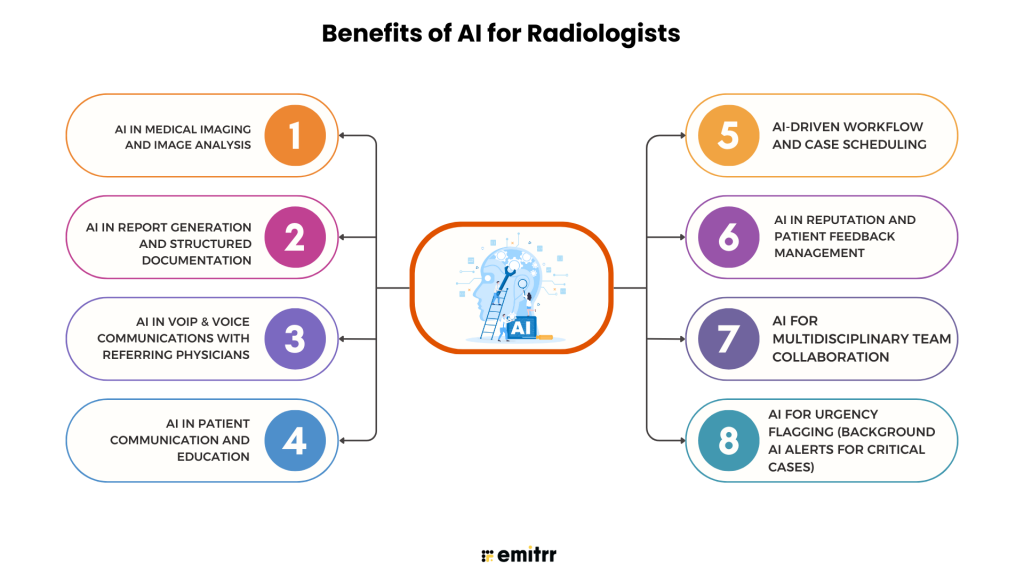
AI in Medical Imaging and Image Analysis
AI in radiology healthcare speeds things up big time. Scans that used to take hours can now be checked in seconds. Radiologist AI works like an extra set of eyes, stepping in when you’ve got too many cases on your plate. It can flag anything unusual, measure structures, and even compare scans right away. From spotting early signs of cancer to picking up tiny fractures, AI applications in radiology help you read with more accuracy and confidence.
AI in Report Generation and Structured Documentation
Report writing eats up a lot of time in radiology. With AI for radiology, draft reports are created automatically based on findings. It takes care of the groundwork for you. The sections are already organized, the details filled in, and even the wording drafted. All you need to do is review and tweak. The hard part’s already done!
AI in VOIP & Voice Communications with Referring Physicians
Talking with referring physicians is extremely important, but calls can easily get confusing. With AI tools for radiology, those VOIP calls become smarter, they get easily transcribed, important points are highlighted, and urgent updates are shared right away. So if a critical case pops up, the right doctor gets the right info without delay. That means less back-and-forth and faster, more coordinated care.
AI in Patient Communication and Education
A lot of patients walk out of imaging centers not fully sure about what comes next. AI in radiology can step in here by sending automatic follow-up messages that explain prep steps for upcoming scans or post-scan care in plain, easy-to-understand language. It can also take care of reminders and rescheduling, easing the load on your front desk. When patients experience this level of guidance and support, they’re so much more likely to come back and even recommend your services. That trust goes a long way in shaping a better overall experience.
AI-Driven Workflow and Case Scheduling
Radiology schedules are never set in stone. Emergencies come in, routine scans get delayed, and suddenly a slot opens up. Rather than everyone scrambling, AI just steps in, sorts the list, moves urgent scans to the front, and shifts work around automatically. Things keep flowing, patients get seen sooner, and your team isn’t stuck digging out from a mountain of backlogs. In busy departments, that means faster reporting and smoother operations.
AI in Reputation and Patient Feedback Management
Reputation matters in radiology. AI makes it easy to send patients feedback requests right after visits, encouraging quick reviews. It also monitors online platforms, flagging negative comments so you can step in fast. Over time, this builds a stronger online presence and trust with both patients and referring physicians. In a crowded market, these reviews can really give you the edge.
AI for Multidisciplinary Team Collaboration
Complex cases involve several specialists. AI applications in radiology bring images, notes, and updates together in one place so everyone stays aligned. It tracks inputs from different team members and keeps them organized. No more endless email threads or repeated meetings. With everyone looking at the same data, decisions happen faster and no detail slips through the cracks.
AI for Urgency Flagging (Background AI Alerts for Critical Cases)
Some scans can’t wait, and missing them can be really dangerous. With AI running quietly in the background, it can spot red flags like a brain bleed or clot right away. Those cases jump to the top of your list so you see them first. It’s not taking your place, just giving you a safety net so nothing urgent slips through the cracks. For your patients, that speed can ultimately change outcomes.
Use Cases of AI for Radiologists
Radiologists don’t just read scans, there’s a whole mix of tasks that fill up the day. And the best AI for radiology software can contribute to every part of that workflow. Here’s where AI-tools for radiology really shine.
AI in Diagnostic Imaging Interpretation (Error Reduction & Quality Assurance)
Looking at scan after scan can be tiring, and tired eyes miss things. This is where radiologist AI tools step in, scanning images pixel by pixel, and flagging anything unusual. It’s like having a colleague double-check your work instantly. The AI can even compare current images with past ones to spot tiny changes over time. You still make the final call, but it means fewer “oops, how did we miss that?” moments. This combo of radiologist and AI leads to more accurate reports and better patient outcomes.
AI in Communication with Patients and Clinicians
Radiology isn’t just about the images, it’s about getting the right information to the right person at the right time. AI in radiology can shoot out instant updates, letting patients know, “Your scan is ready, here’s what to expect,” and pinging doctors when a report’s uploaded. It can even turn medical jargon into plain English, so patients actually get what’s happening. Everyone stays in the loop, and you skip the endless game of phone tag.
AI in Automation of Routine Administrative Tasks
Every radiologist knows the paperwork grind – coding, billing, insurance forms. AI tools for radiology can handle a lot of this without you lifting a finger. They can auto-fill forms, generate billing codes from reports, and send them to the right department. This means less time buried in admin work and more time doing the actual job you trained for. Plus, it reduces errors that could delay payment.
AI in Teleradiology and Remote Consultations
Remote work is a big part of the future of AI in radiology. AI can help in teleradiology by sorting and routing cases to the right radiologist, even if they’re in another city or country. It can pre-analyze the images before they even hit your screen, so you start with the most important details highlighted. This speeds things up and makes working across time zones a lot smoother.
AI in Predictive Analytics for Disease Progression
Sometimes the key to treatment is spotting a change early. AI in radiology can help you see the bigger picture over time. Say a tiny nodule has been showing up in scans and getting a little bigger with each one, AI will catch that trend right away. It’s like having an extra set of eyes keeping track, so you don’t miss changes that really matter. This allows you to flag the case for closer follow-up or faster intervention. It’s like having a future-looking tool in your kit.
AI in Reducing Burnout by Handling Low-Complexity Cases Automatically
Not every case needs deep analysis. Some are pretty routine, like a normal chest X-ray for a healthy patient. AI in radiology healthcare can read, classify, and clear these simple cases automatically, sending you only the ones that need a closer look. This takes a big load off and helps you focus your mental energy where it really matters. It’s a burnout buster that also keeps turnaround times short.
Challenges of AI Adoption for Radiologists
AI is exciting, no doubt about it. But when it comes to using AI in radiology healthcare every day, it’s not always smooth sailing. There are still a few bumps in the road to work through.
Integration with Existing PACS (Picture Archiving and Communication System) and RIS (Radiology Information System) Systems
Most radiology departments already have PACS and RIS in place, and they’re not always flexible. Adding AI tools for radiology into the mix can feel like trying to upgrade an old car with a brand-new engine. It’s totally possible, but it might take some work. Systems need to “talk” to each other without slowing down your workflow. If the integration is clunky, it can end up adding extra steps instead of saving time. That’s why picking the right AI vendor and ensuring compatibility from day one is so important.
Data Privacy and HIPAA Compliance
Radiology deals with sensitive patient data, and keeping it secure isn’t optional. Any AI applications in radiology have to meet strict HIPAA rules. That means secure servers, encrypted data transfers, and strict access controls. If the AI platform isn’t airtight on privacy, it’s a no-go. You also need to make sure patients trust the system. if they don’t feel their data is safe, adoption will be harder.
Bias in AI Models Due to Limited Training Data
AI is only as good as the data it learns from. If an AI radiologist system hasn’t looked at scans from all kinds of patients, it might miss things or get them wrong for certain groups. That can create gaps in care. The fix is simple: companies need to be upfront about how their AI is trained and keep adding more diverse data so the system gets smarter and fairer over time.
Need for Continuous AI Model Training and Updates
Medicine changes fast, and so do imaging technologies. If your AI radiology platform isn’t updated regularly, it could start missing new patterns or using outdated reference data. AI needs ongoing training to stay sharp. If you stop updating it, the system can fall behind and start missing things. That won’t only slow you down but can also affect accuracy, which ultimately defeats the purpose of using AI in the first place!

How Is AI-Based Communication in Radiology Different from Traditional Communication?
Back then, radiology communication meant phone calls, faxes, and long email chains. It worked, but it was slow and things often got missed. With AI in radiology healthcare, updates go out right away, messages stay clear, and no one’s left hanging. The result? Faster care, less confusion, and a smoother experience for both patients and providers.
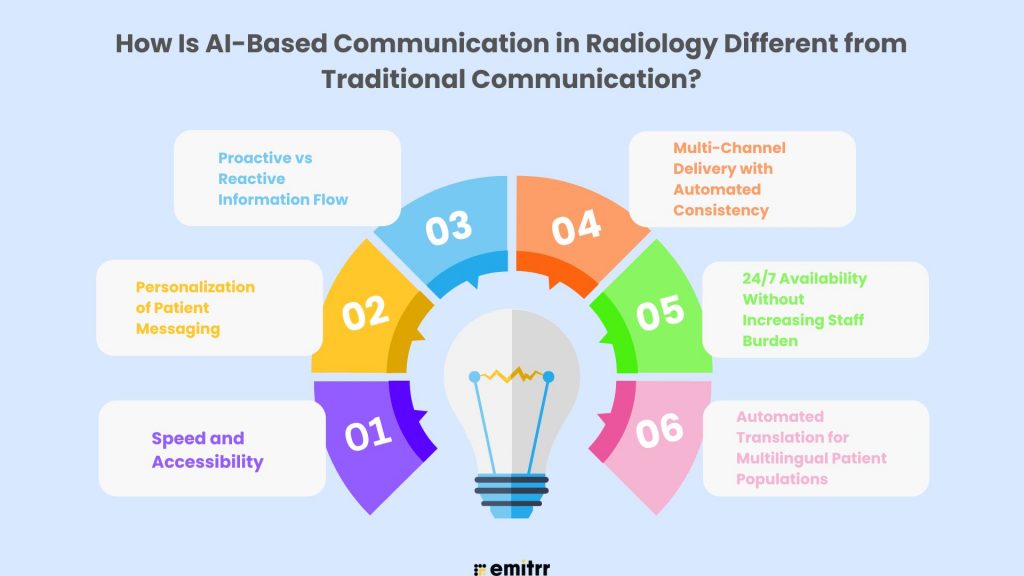
Speed and Accessibility
Traditional updates could take hours or even days to reach the right person. AI tools for radiology send instant text alerts, results, or updates the moment something changes, without you having to make a single call. Everyone single stakeholder, right from the radiologist to the referring physician can see it in real time. Patients also get notified faster, which means less sitting around worrying about results. Speed isn’t just about convenience here, it can be the difference between catching something early or too late.
Personalization of Patient Messaging
Generic follow-up letters don’t answer every patient’s needs. AI applications in radiology can tailor messages based on the patient’s scan type, history, and preferred language. This way, a patient getting an MRI gets different, more relevant information than someone coming in for a CT scan. Personalization makes instructions easier to follow and reduces post-visit confusion. It also helps your patients feel like their care is designed just for them, which eventually builds trust in your practice.
Proactive vs Reactive Information Flow
Old-school communication was reactive you only shared updates when someone called or emailed to ask. AI for radiology flips that by automatically sending updates the moment there’s a change or a critical finding. No chasing, no follow-ups, no delays. This proactive style keeps the workflow moving and ensures no important detail gets lost. Patients and physicians feel informed without having to ask.
Multi-Channel Delivery with Automated Consistency
AI for healthcare helps keep everyone on the same page, no matter the channel – email, text, or a secure portal. Patients hear one thing, doctors hear the same thing, and there’s no confusion in between. That kind of consistency cuts down on mistakes and makes updates easier to follow. Plus, patients get to choose how they want to be reached, which makes the whole experience feel smoother and more personal.
24/7 Availability Without Increasing Staff Burden
With AI, your communication lines never close. A radiologist AI system can confirm appointments, send prep instructions, or answer FAQs at any hour, even on weekends or holidays. Patients get help when they need it, without adding after-hours shifts for your staff. This always-on support makes your practice more responsive and approachable. For urgent situations, it can also bridge the gap until a live follow-up happens.
Automated Translation for Multilingual Patient Populations
Not every patient speaks the same language, and medical instructions can be tricky even in someone’s first language. AI can translate messages instantly while keeping the medical meaning accurate. This allows you to communicate clearly with a wider patient base without hiring dedicated translators for every language. It also improves patient safety by reducing the risk of misunderstandings. In diverse communities, this is a game changer for accessibility and trust.
Where Does AI Overtake Humans in Radiology?
Some parts of the job are better suited to machines. AI can work non-stop, process massive amounts of data, and deliver results faster than any human could without losing focus. That’s why it makes such a valuable teammate for radiologists.
Speed of Image Processing
AI can scan through hundreds or even thousands of images in seconds. What might take you an hour to review, it can process in under a minute. This doesn’t mean AI will replace radiologists, but it does mean it can take over the heavy lifting of initial review. By handling the bulk of image sorting and flagging, AI lets you focus on interpreting the most important findings. This speed is especially valuable in emergency settings where every minute counts.
Detection of Subtle Patterns Across Large Data Sets
AI has the advantage of having “seen” millions of cases during its training. That allows it to spot extremely subtle changes that might look normal to the human eye. It could be a tiny shadow, a pattern in texture, or a slight size change over time. You still decide whether that detail matters, but AI makes sure you don’t miss it. This is especially powerful in early disease detection, where small findings make a big difference.
Automated Scheduling and Case Prioritization
In a busy radiology department, deciding which case gets read first can be a challenge. AI can sort the worklist based on urgency, moving emergency cases to the top and routine scans further down. This means a stroke patient isn’t stuck waiting behind a scheduled follow-up. It’s a small shift that can have a huge impact on patient outcomes. AI-powered smart scheduling takes away the mental load of constantly reorganizing your day.
Real-Time Communication of Critical Findings (Instant Alerts to Referring Physicians)
When something urgent is found, time is everything. AI can instantly send an alert to the referring physician while you’re still reviewing the case. This way, they can start planning the next steps before the full report is even ready. It closes the gap between detection and action, which can be life-saving. It also reduces the risk of important findings getting lost in email chains or delayed callbacks.
Where Do Humans Overtake AI in Radiology?
AI is powerful, but there are parts of radiology it just can’t do. These areas rely on human judgment, empathy, and experience.
Contextual Interpretation of Complex Cases
Not every abnormality is a problem, and not every “normal” scan means the patient is healthy. AI can point out findings, but it doesn’t always understand the bigger picture. You can connect the dots between a patient’s history, symptoms, and imaging results in a way AI can’t. Sometimes this context completely changes the diagnosis or treatment plan. That’s why your role is irreplaceable.
Empathy and Patient Reassurance
Patients often have fears and questions that need more than a data-driven answer. AI can send follow-up messages, but it can’t read a patient’s body language or respond with compassion in real time. When delivering sensitive results, your tone, choice of words, and ability to reassure make all the difference. This human connection builds trust in a way AI simply can’t replicate.
Ethical Decision-Making in Borderline Diagnoses
Some findings fall into a gray area where guidelines aren’t crystal clear. AI will give you probabilities and pattern matches, but it can’t weigh the ethical implications. Should you order more tests? Should you watch and wait? These decisions involve balancing risks, patient preferences, and medical ethics — all of which require human judgment.
Balancing Patient Preferences with Clinical Urgency
Sometimes the patient’s wishes don’t match the urgency of their case. A scan might show something that needs immediate attention, but the patient may want to delay for personal reasons. AI can’t navigate that kind of conversation. You can explain the risks, listen to concerns, and find a plan that respects the patient while still protecting their health. That balance is something only a human can achieve.
Why Radiology Practices Need AI
Radiology practices today are under more pressure than ever, higher patient volumes, fewer staff, and growing expectations for speed and accuracy. This is where AI in radiology healthcare makes a real difference.
Managing Increasing Imaging Volumes with Fewer Radiologists
Imaging volumes keep going up, but the number of radiologists isn’t growing at the same pace. AI for radiology can handle a lot of the repetitive work, like flagging abnormal scans, sorting cases by urgency, and managing workflow. This means each radiologist can review more cases without sacrificing accuracy. Instead of spending time on routine scans, you can focus on the complex ones. It helps your team stay productive without feeling overwhelmed.
Improving Turnaround Times for Reports
Long wait times for reports can frustrate patients and slow down treatment plans. Radiologist AI tools can pre-analyze images and even draft structured reports, cutting hours, sometimes days from the process. The radiologist still reviews and finalizes everything, but the grunt work is done upfront.Faster reports keep referring doctors happy and give patients the answers they need sooner. In urgent situations, that speed can even lead to life-saving care.
Enhancing Accuracy and Reducing Litigation Risk
Missed findings are a risk for every radiologist, especially when fatigue sets in. AI applications in radiology act like a safety net, scanning every image for patterns that could signal a problem. This second review helps catch details that might otherwise be overlooked. More accurate reports reduce the risk of misdiagnosis, which also lowers the chance of legal disputes. It’s a win for both patient safety and professional protection.
Expanding Service Reach Through Teleradiology
Not every hospital or clinic has a radiologist on-site 24/7. AI in radiology healthcare makes it easier to deliver services remotely through HIPAA-compliant telehealth platforms. It can pre-sort and pre-analyze scans so that off-site radiologists only see prioritized work. This keeps turnaround times short and allows you to offer your expertise to facilities in other regions. It’s a way to grow your reach without physically expanding.
Streamlining Pre-Authorization and Insurance Approvals
Paperwork slows everyone down, especially when it comes to insurance. AI tools for radiology can automatically generate documentation for pre-authorizations, code scans correctly, and submit information to payers. This reduces delays, improves approval rates, and gets patients into scans faster. It also means less back-and-forth between your team and insurance companies. The result is smoother operations and better cash flow.
Improving Staff Retention by Reducing Burnout
Radiology can be mentally exhausting, and burnout is a real threat to retention. By letting AI take on repetitive, low-complexity work, your staff can focus on cases that challenge and engage them. This keeps morale higher and helps avoid the fatigue that leads to turnover. Happier radiologists are more productive, more collaborative, and more likely to stay with your practice. Over time, that stability benefits both patient care and the business side of the practice.
Future of AI in Radiology
The future of AI in radiology isn’t just about faster scans. It’s about changing how radiologists train, share information, and even communicate with patients. Here’s what’s coming next.
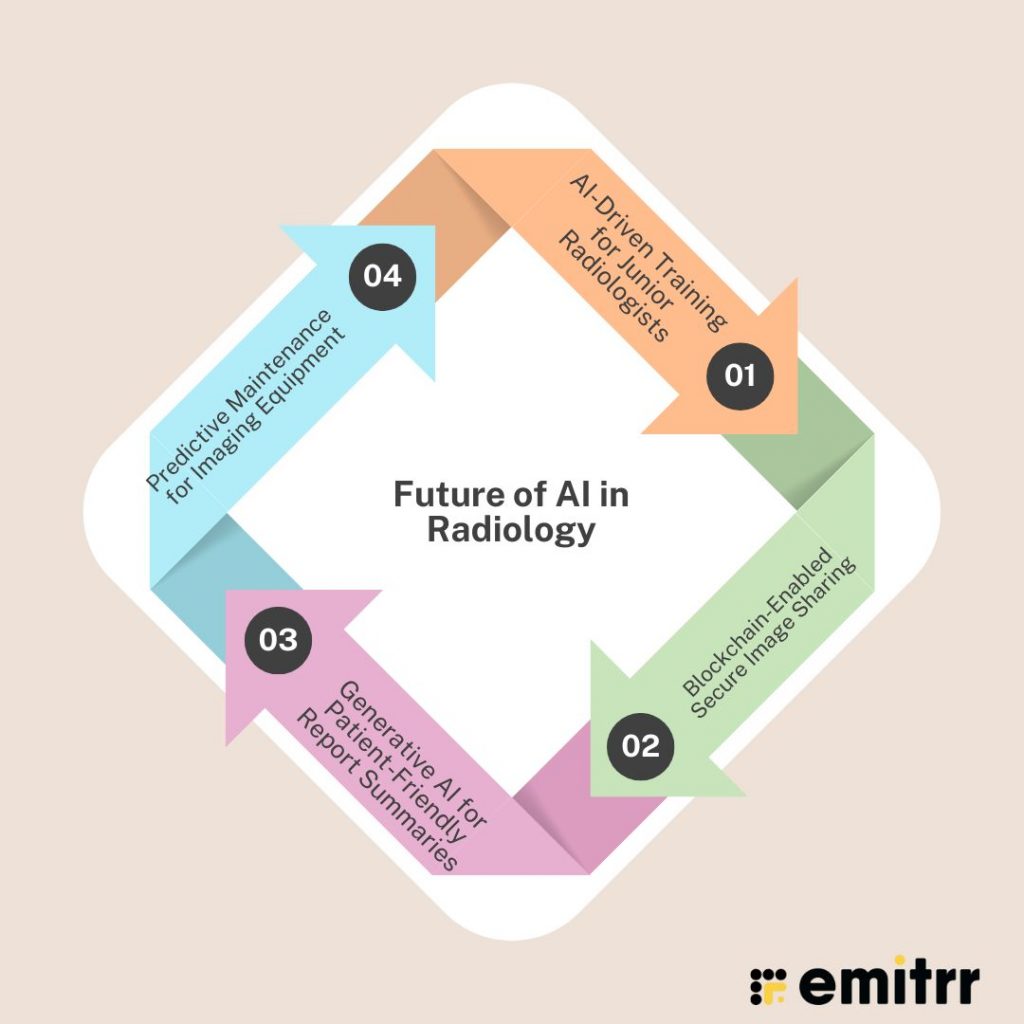
AI-Driven Training for Junior Radiologists
Learning radiology takes years, and the early days are filled with challenging cases and steep learning curves. AI for radiology can act as a virtual mentor for junior radiologists by providing instant feedback on reads, pointing out missed findings, and showing relevant reference cases. It can even simulate rare or complex conditions so trainees get exposure they might not see in day-to-day work. This kind of guided learning speeds up skill development without compromising patient care. In the long run, it helps create a new generation of radiologists who are both tech-savvy and highly skilled.
Blockchain-Enabled Secure Image Sharing
Sharing patient scans between facilities can be slow and risky without the right security. Blockchain technology could change that by creating a secure, tamper-proof record of every transfer. When combined with AI applications in radiology, it ensures images reach the right person instantly, without the risk of alteration or data breaches. This is especially valuable in teleradiology, where files move between locations all the time. It keeps patient data safe and makes collaboration smoother across different hospitals and clinics.
Generative AI for Patient-Friendly Report Summaries
Radiology reports are often full of medical terms that patients don’t understand. In the future of AI in radiology healthcare, generative AI could rewrite these reports in simple, everyday language. Imagine a patient getting a clear summary like, “Your scan shows no signs of major issues, your doctor will review a few minor points with you.” This helps reduce anxiety, improves patient engagement, and cuts down on follow-up calls just to clarify results. Better communication means happier, more informed patients.
Predictive Maintenance for Imaging Equipment
Nothing disrupts a radiology schedule like a broken MRI or CT scanner. AI-powered predictive maintenance uses data from the machines to spot issues before they cause downtime. It might flag that a part is wearing out or that a calibration is due, letting you fix it before it fails. This keeps schedules on track and avoids rescheduling patients, which can hurt both care timelines and revenue. Over time, it also reduces repair costs by catching problems early.
Why Emitrr AI Is the Best AI Tool for Radiologists
Running a radiology practice means your day can get hectic fast! Calls coming in, patients needing reminders, urgent scans that can’t wait, and a mountain of admin work on top. Emitrr takes a lot of that off your shoulders. It keeps things running smoothly behind the scenes so you and your team can focus on reading scans and caring for patients. Here’s how it makes a difference:
- Always-on appointment handling: The AI SMS and Voice Agents can book, reschedule, and confirm patient appointments anytime, even after hours.
- Instant follow-up on missed calls: If a call comes in while you’re busy, Emitrr automatically sends a text to the patient so they’re not left hanging.
- Smart call routing: Patients get connected to the right person straight away, without being passed around.
- Real-time queue management: Calls are answered instantly, updates are shared, and patients are kept in the loop without adding to your team’s workload.
- Call summaries without the extra work: Every call can be recorded and summarized for you, so your team stays on the same page.
- Automatic review and feedback requests: Patients get a quick follow-up asking for reviews, helping you boost your online presence.
- Campaigns that run themselves: From reminders to patient outreach, Emitrr creates and sends messages that feel personal without extra effort.
- Easy patient re-engagement: If a patient hasn’t replied, Emitrr sends a friendly nudge to get the conversation going again.
- Consistently high uptime: Reliable performance means your patient communication is never interrupted.
- Dedicated customer support: A responsive support team is there to help whenever you need it.
- Scales with your practice: Whether you’re a single-location clinic or part of a multi-site network, Emitrr adapts to your needs.
- Secure and compliant: HIPAA-compliant systems keep patient data protected at all times.
FAQs
No, not at all! AI radiology tools are great at speed and pattern recognition, but they still can’t match a human’s judgment, empathy, and ability to handle complex cases. Think of AI as an assistant, not a replacement.
Pretty accurate when trained well, often spotting patterns humans might miss. Still, results are best when a radiologist reviews them for context and clinical relevance.
Absolutely. Emitrr is HIPAA-compliant, uses secure message encryption, and ensures all communications stay private. You can safely use it for both patient and physician conversations without worrying about breaches.
It can help boost revenue by reducing missed appointments, improving turnaround times, and attracting more referrals. Faster, better communication often leads to happier patients and more repeat business.
Yes! Emitrr works just as well for single-location clinics as it does for large hospital networks. It’s designed to scale with your needs, so you get all the benefits without the complexity.
Conclusion
If you’re wondering will AI replace radiologist, the clear answer is no! AI in radiology isn’t about replacing you. It’s about helping you work faster, smarter, and with less stress. With Emitrr AI handling patient communication, follow-ups, and scheduling, you can spend more time focusing on what matters most: Accurate diagnoses and great patient care. It also keeps your practice running smoothly 24/7, without burning out your team.
From instant alerts to multilingual patient updates, the right AI tools can transform how you connect with both patients and referring physicians. And with Emitrr AI, you get a solution that’s built for the pace and precision radiology demands.
Book your free demo with Emitrr today and see how effortless radiology communication can be!