
 4.9 (400+
reviews)
4.9 (400+
reviews)
Introduction
Artificial Intelligence (AI) is revolutionising the restaurant industry by automating tasks such as managing bookings and orders, as well as handling customer inquiries, without requiring increased staffing needs. It doesn’t matter if you are operating a quick‑service outlet, a fine‑dining venue, or a cloud kitchen; AI-powered platforms can increase efficiency, responsiveness, and customer satisfaction.
Mordor Intelligence states that the AI segment of the food and beverage market was valued at USD 13.39 billion in 2025 and is projected to reach USD 67.73 billion by 2030, growing at a CAGR of 38.3%. This means that the industry is going to focus more and more on technology.
This guide will demonstrate to you how AI-boosted communication far surpasses traditional methods in various aspects such as speed, accuracy, and consistency. Restaurant managers will learn the features to ask for when it comes to AI software, why Emitrr is necessary for all restaurant types, as well as how the benefits of the system lead to lower costs, easier bookings, and more satisfied customers.
Benefits of AI for Restaurants
Implementing AI can completely change the way a restaurant services its customers, interacts with them, and increases its turnover. AI can make a measurable difference if you are working in/owning a QSR, fine dining, or cloud kitchen.
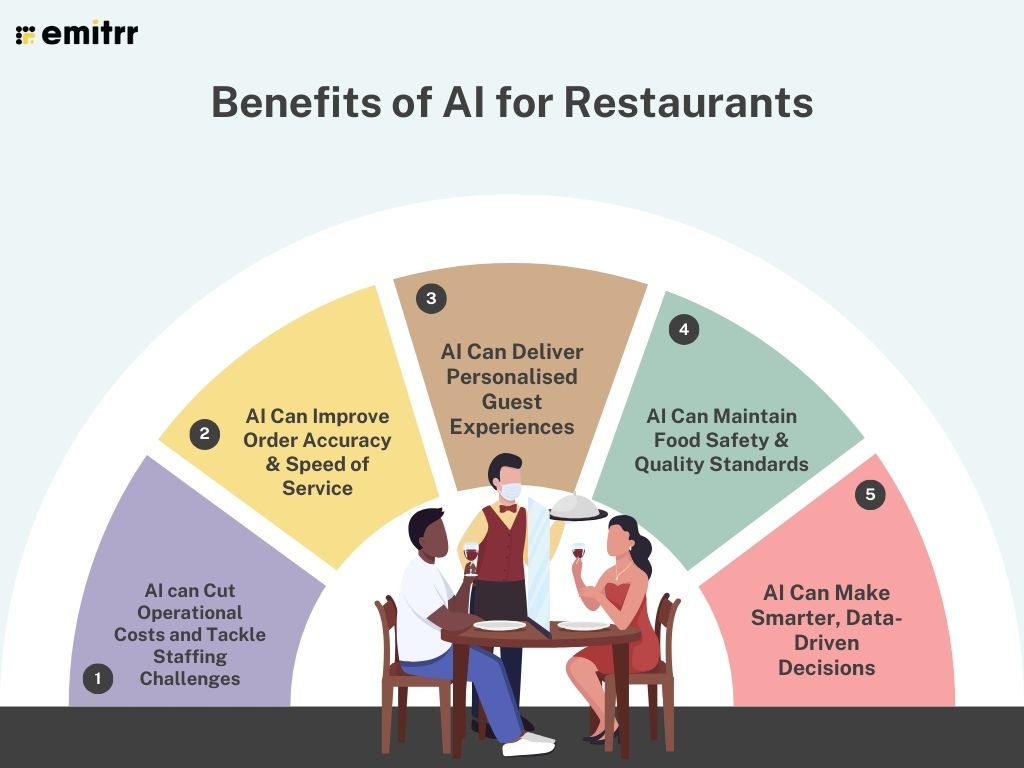
AI can Cut Operational Costs and Tackle Staffing Challenges
Several restaurant automation tools keep the employees free of unnecessary manual operational, repetitive, and time-consuming tasks that are usually done by humans, such as answering phone calls, managing reservations, and responding to order inquiries. Such streamlining not only lowers labour costs but also ensures that your operations continue to function trouble-free even during times of limited staff.
AI Can Improve Order Accuracy & Speed of Service
The reasons behind a customer leaving negative remarks about your products are that the order was incorrect or there was a delay in delivery, which can lead to poor customer reviews. AI-based systems integrate seamlessly with your POS and ordering platforms, enhancing communication accuracy, providing real-time updates, and processing orders faster, especially during peak times.
AI Can Deliver Personalised Guest Experiences
Using AI tools to explore previous orders, the consumer’s preferences, and behavioural details to a personalised point. This can be achieved by sending the custom promotion, or smart menu suggestions or noting the special requests of the customer. This leads to a loyal customer base and encourages frequent customers to visit often.
AI Can Maintain Food Safety & Quality Standards
With AI solutions, no human is explicitly needed to monitor temperatures, ingredient expiry dates, and kitchen cleanliness in real-time, thus saving time and effort. Instant notification of any violation of food safety regulations is sent, which helps to maintain the quality of dishes.
AI Can Make Smarter, Data-Driven Decisions
Restaurant operators with AI analytics can make decisions based on facts in all areas of operations, predict busy times, manage the number of staff, monitor the performance of the menu, and fine-tune the advertising campaigns. By transforming data into insight, AI removes uncertainty and leads to profits.

Types of AI Technologies in Restaurants
The restaurant industry is not only about delicious food and good service anymore; it’s also about smart technology. AI has been driving a silent revolution in kitchens and dining rooms across the globe that is unlocking new levels of efficiency, accuracy, and personalisation. Below are the major AI technologies that are mopping up restaurant operations for redefinition:
AI-powered POS systems
Intelligent POS systems of today have become nerve centres, in addition to their payment processing function. AI-backed platforms are designed to connect with inventory, kitchen displays, and CRM seamlessly, thus enabling them to perform tasks like menu updating, stock checking, and the most selling dish, all automatically. The upshot: Operations that are more efficient, less prone to errors, and provide better sales analysis.
Chatbots & virtual assistants
The work of AI-powered chatbots is to support customers without the intervention of the people who are responsible for the provision of customer service. This can be done through the handling of customer FAQs, providing an online reservation system, taking in food orders, and collecting feedback. They are always online and have the ability to ensure that they respond to the customers on time without the need for them to use the human workforce, which may end up being a problem due to various reasons, such as shifts or breaks of the workers or low staff.
Voice recognition systems
Voice AI is revolutionising the high-traffic ordering channels like drive-thrus and call-in systems. For instance, the leaders in fast-food industries such as Wendy’s, White Castle, and Taco Bell have installed voice bots to help them take more orders in a shorter period without compromising on the accuracy factor, even during the busiest times. In addition, these systems can suggest the products that complement the ones chosen by the customer during a transaction.
Computer vision
Computer vision AI that “sees” through cameras is also being implemented to observe how food is being made, guarantee the observance of hygienic conditions, and even check if the serving is consistent. Domino’s uses this process to ensure that the pizza meets the brand’s standards across all outlets. Other brands, on the other hand, use it to check if the kitchen is clean and if the customers do not cause too much commotion.
Robotics
The kitchen is no longer an area of science fiction for robots. Robotic technologies such as Miso Robotics’ Flippy and Dexai’s Alfred serve as co-pilots who handle the tasks of grilling, frying, and meal assembling. That means the staff are able to focus on hospitality and speed. They not only assist with the cooking part, but they also try to perform table service and cleaning tasks.
Predictive analytics
AI can predict with accuracy what the peak hours will be, what will be the preferred menu items, and the quantity of ingredients needed by using the data of historical sales and external data (for example, weather, festivals, or holidays). In this way, restaurants can be sure that they will not waste food, will have the optimal number of staff on duty, and will also be able to decide which promotions to run and when.
Dynamic pricing engines
AI empowers digital menu boards to change prices and even highlight the items that are more in demand based on different aspects like time, customer demographics, or inventory levels. This real-time pricing strategy, which is already very popular in e-commerce, is now being adopted by QSRs and fast-casual restaurants.
AI in staff scheduling
It is very important to try to save labour costs and at the same time to keep the service of good quality. AI scheduling tools collect the data about footfall, reservations, and sales patterns to decide the ideal number of workers both in the kitchen and service, thus avoiding both understaffing and overstaffing, keeping in mind employee satisfaction.
These AI technologies, from smart kitchens to personalised customer journeys, are enabling restaurant businesses to become more agile, profitable, and future-proof. It is the right moment for everyone, from a single-location café to a global QSR brand, to consider how AI can open new efficiency opportunities and raise the dining experience to its highest level.
AI Use Cases in the Restaurant Industry
AI in restaurants is changing the game for operations both at the back and at the front of the house, and also for the customers! These AI apps are helping to drive efficiency, lower costs, and increase customer satisfaction by providing speedy and more personalised experiences.
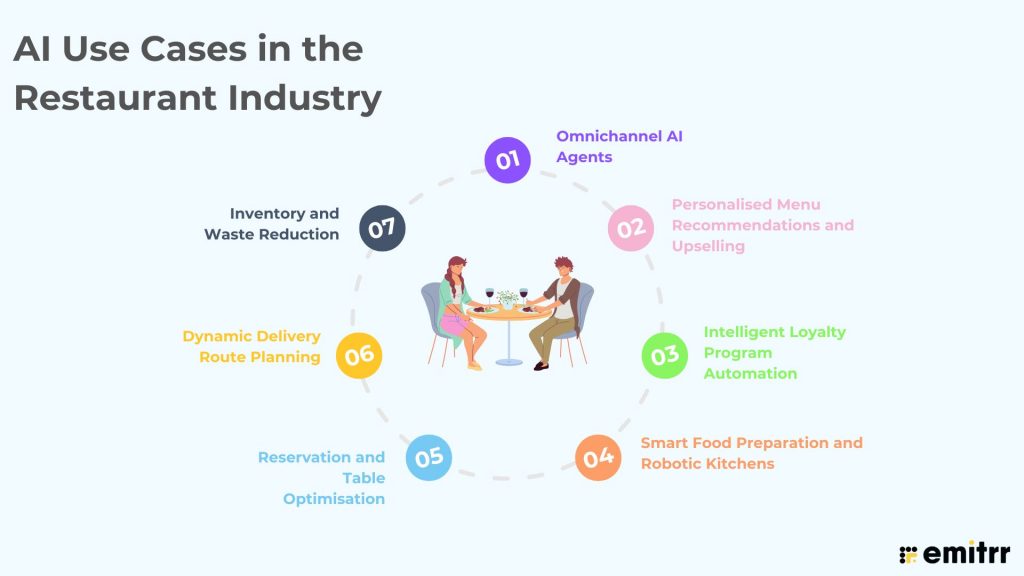
1. Omnichannel AI Agents
Automated AI agents take care of consumer engagements across all channels, such as social media, website, personal restaurant number, etc. They can answer questions or even suggest a recommendation based on the customer’s query. Besides, they have the possibility to change the number of people working during different periods of time based on the data received from the sensors, thus providing uninterrupted service to customers.
2. Personalised Menu Recommendations and Upselling
AI algorithms analyse customer order history, dietary choices, and average expenses to create menu recommendations that fit the customer’s preferences/ wants. This one-to-one has a positive impact on guest satisfaction and also results in an increase in the average order value via targeted upselling. E.g.: If a customer always orders a pizza, AI will automatically highlight if a new Pizza place has opened up or a restaurant has a new Pizza dish.
3. Intelligent Loyalty Program Automation
Machine learning and predictive analytics enable AI-driven loyalty programs to give customers rewards and promotions that are personalised based on their behaviour. Such a move helps to retention, retention, the encouragement of trips, and to make sure that the time value is maximised. E.g.: A customer can be engaged with a ‘ buy one, get one’ coupon to a frequent visitor or a dessert offer to someone who always orders a meal.
4. Smart Food Preparation and Robotic Kitchens
In addition to robotic arms assisting with monotonous prep jobs like computer vision, a defect in a food product can be detected by AI, thus ensuring consistent quality and quickening kitchen operations. These technologies help maintain standards while increasing throughput.
5. Reservation and Table Optimisation
AI reservation tools forecast busy hours, make the best use of seating arrangements, and handle the waitlist, thus minimising wait times for the customers. This not only facilitates a more efficient service flow but also ensures that guests have a pleasant experience.
6. Dynamic Delivery Route Planning
AI route optimisation tools dynamically change for traffic, weather, and demand situations. This increases shipping efficiency, lowers fuel consumption, and keeps the freshness of the products intact, making it efficient for restaurants with delivery services.
7. Inventory and Waste Reduction
Real-time inventory tracking and demand prediction with high accuracy are the main features of AI-enabled forecasting instruments. This eliminates over-ordering, food wastage becomes low, and menu planning becomes easier to implement, leading to higher profitability. E.g., if bad weather is expected in the coming days, the system can highlight reducing fresh produce orders to prevent spoilage.
Challenges & Limitations of AI in Food Service
AI undoubtedly contributes greatly to the restaurant sector, but on the other hand, it also carries along new problems and challenges, which can be seen as a dark side of technology use. Managers can benefit a lot from identifying the problem areas in implementing technology.
- High Upfront Investment and Uncertain ROI
The initial expenses of buying and setting up AI-based hardware and software are very high. The return period of these investments in the case of small or mid-tier restaurants is not clear; thus, the decision to invest can be weakened.
- Integration with Legacy Systems
The eateries that rely on traditional POS or old-fashioned kitchen management systems may find it difficult to connect them to new AI solutions. This may lead to inefficiencies and limited access to data or even a costly system change if it cannot be avoided.
- Limited Technical Expertise in Small Teams
Smaller restaurants may lack in-house technical staff to oversee AI implementation and maintenance. Without proper training or support, the effectiveness of AI tools can be significantly reduced.
- Risk of Overdependence on Automation
Small eateries are likely to lack technical staff internally to implement AI and also to provide the necessary maintenance. The lack of training or continuous support will decrease the AI tool’s productivity.
- Privacy and Data Security Concerns
Since AI relies extensively on customer data for targeted marketing, restaurants must ensure that they have adequate security measures in place to protect customer data from being misused. If a security breach occurs, besides the legal consequences, customers’ trust will disappear, and they will be the ones to lose.
Traditional Communication vs. AI-Powered Communication in Restaurants
| Aspect | Traditional Communication | AI-Powered Communication |
| Speed & Availability | It might only be accessible during business hours and thus be based on human availability for responses. | 24/7 operational with an instant response, which ensures that the customer will always have someone to attend to their query, no matter what time it is. |
| Consistency in Interaction | Mood, training, and workload of staff are factors that determine how interaction occurs. In addition, there is the risk of inconsistent information. | Every time, AI solutions maintain brand voice in the same way, and thus, they do not lose the standard of the company. |
| Personalization Capabilities | Staff generally need to remember things from their memory or rely on notes written by hand; personalisation of communication might thus be sporadic and of a low level. | Combining data mining and AI to deliver individualised content is the new reality, and the technology enables us to do that for millions of users all around the world simultaneously. |
| Handling Volume & Scalability | At peak times, the restaurant usually is not in a position to take all the calls, thus some clients may experience that their call is dropped or their call will be answered later than usual. | Multiple requests can be processed at the same time, and this will not affect either the quality or the speed of the service. |
| Cost Efficiency Over Time | Increased expenses from staffing requirements, overtime, and errors, along with limited automation. | Automating repetitive tasks helps reduce labour costs and enhances return on investment (ROI) through scalable AI solutions. |
| Accuracy of Information Sharing | Human errors can sometimes lead to misinformation or missed details. | Accurate, real-time information sharing based on integrated systems and data validation. |
| Workload & Burnout | Increased expenses resulting from staffing requirements, overtime, and errors, along with limited automation. | Decreases employee workload by addressing routine queries, enabling staff to concentrate on complex and value-added interactions. |
| System Integration (POS, CRM, etc.) | Systems are usually independent from one another with minimal integration; thus, there is a need for the inefficiency of double or multiple manual data entries. | The aim of this is to achieve a smooth integration that will lead to a better flow of data and balance operations in POS, CRM, and reservation systems. |
| Data Collection & Insights | Inefficient data gathering happens when the data collection process is limited and done manually, which can also lead to inaccuracy. | AI will gather, process, and analyse the data automatically, thus offering more accurate and timely insights for decision-making and designing promotions for personalised messaging. |
| Multi-Channel Communication | Communication is mostly limited to phone or in-person, fragmented across platforms. | Supports SMS, voice calls, chatbots, social media, and email, providing a unified and seamless customer communication experience. |
Human vs. AI in Restaurant Operations: Who Excels Where?
AI is making a buzz in the food service industry, but it is not aiming to eliminate the human touch. The future of dining establishments, however, is in a partnership between humans and machines. Here’s where each one shines:
Where AI Wins In Restaurant Operations
- Speed and Consistency
Systems driven by AI can handle orders, update menus, and regulate workflows faster than humans; hence, they can deliver the same quality even during rush hours and data peaks.
- Data Handling
Processing sales data, predicting consumer behaviour, and more – AI can do all of that in real time, thus it can help business owners to make smarter decisions.
- 24/7 Availability
Examples of such tools include chatbots, self-ordering kiosks, and automated delivery systems. They do not stop at any time during the day or night; hence, customers can place an order or get help at any time, and the restaurant will still prevail without increasing the staff costs.
Where Humans Lead in Restaurant Operations
- Creativity in Culinary Innovation
Though AI is capable of adjusting recipes to fit data characteristics, the creativity in terms of taste, presentation, and storytelling is still a human chef’s forte.
- Empathy and Hospitality
A human waiter can identify a customer’s mood, make personalised suggestions, and turn even an ordinary meal into an extraordinary dining experience.
- Complex Problem-Solving
When things go wrong unexpectedly, like a last-minute big group or broken equipment, it’s quick, gut decision-making that AI can’t imitate, most often needed.
The Balanced View: Collaboration, Not Replacement
The most prosperous restaurants are leveraging the synergy whereby the AI performs the monotonous and data-intensive jobs, while humans are engaged in creative, emotional, and service excellence tasks. In addition to making work more efficient, this balance goes a long way to conserving the heart and soul of hospitality.
Why Restaurants Need AI Now
Operating a restaurant in the present-day market requires more than merely a good culinary team. The whole world, shaped by soaring prices, also has a big impact on the foodservice industry. The changing customer expectations and tougher competition have also played their part. Here is a list of reasons why AI is no longer just a handy tool, but a must-have one:
- Rising Labour Costs & Staffing Challenges (post-pandemic reality)
Just a little while after the pandemic, restaurants were dealing with the cost of food and labour that skyrocketed exponentially. Labour costs have gone up drastically. Hereby, restaurant operators are forced to find ways to keep their business going without losing service quality. AI tools such as self-order kiosks, chatbot reservation systems, and robotic assistants alleviate repetitive tasks and thus facilitate labour reduction without jeopardising levels of service.
- Customers want Faster, personalised, Digital Experiences.
Customers expect smooth, tailor-made services in the present time. They do not mind if those services are, for instance, smart recommendations based on their dining history, AI-assisted reservation systems, or the possibility of placing the order first in a digital way. By doing so, the restaurants might attract customers to come back and still allow each one of them to feel like a part of their community. A 2024 survey found that 94% of restaurant leaders believe AI is essential to stay competitive in this evolving landscape.
- A Real Advantage in Operational Efficiency
AI enables businesses to reduce costs by leveraging automation and forecasting based on data. Accurate demand forecasting facilitates stock control, eliminates waste, and optimises workforce utilisation, resulting in up to 30% efficiency improvements, improved order accuracy, and the best use of resources.
- The Shift to Online Orders, Delivery, and Virtual Kitchens
Digital dining is certainly not a fad – it is here to stay! The increase in delivery, ghost kitchens, and virtual brands implies that restaurants have to manage growing volumes of remote orders efficiently. AI, which includes voice-activated ordering and intelligent routing, facilitates this transition while also ensuring that operations remain efficient and flexible.
Why Emitrr is the Ideal AI Platform for Restaurant Operations
The implementation of AI is not just about the mere addition of technology but rather the empowerment of your team through the use of tools that improve visitor satisfaction, simplify activities, and increase your business’ profitability Hence, Emitrr differentiates itself by performing as a 24/7 digital team member, thus allowing restaurants to be responsive and productive during low staff periods without any increase in staff numbers.
1. AI-Powered Support for Modern Restaurants
Emitrr is a digital receptionist that can autonomously handle reservations, queries, and general communication with clients, all without any disruption in the flow. The staff will better use their time on the floor and not get bogged down with desk work. It is particularly made to let the workers of the company skip the hours of work that take up their time while performing repetitive tasks.
2. Multi-Channel AI Communication
From text to voice, Emitrr has it all covered under one software:
- AI SMS Agent: Administers bookings, waitlists, reminders, and feedback by simple text messages in the most natural way possible.
- AI Voice Agent: The line is managed intelligently by taking the queries and reservations at times, even when the team isn’t online.
3. Intelligent Call Handling & Recovery
No more missed revenue from unanswered calls:
- Real-time call answering: Real-time call answering and smart queue management ensure calls land where they should, without making the customers wait for a long time.
- Smart routing: Smart routing ensures that the customer is directed to the most suitable team every time.
- Missed-call auto follow-up: If a call is missed, the auto follow-up by SMS will take care of the guest inquiry without any text going unstimulated.
4. Personalised Engagement & Marketing
Emitrr makes it easy to connect with guests:
- AI SMS campaigns: Generate AI SMS campaigns like e.g., promotions, loyalty messages, or event invites, which are personalised to each customer’s preference.
- Automated nudges and replies: Automated prompts and answers guarantee that the audience will be involved without increasing the workload of the staff.
All marketing texting is done by AI in a smart and human-like manner, so communication looks personal.
5. Scalable for Every Restaurant Format
Emitrr works with you and for you, no matter whether you are a cloud kitchen, a quick service chain, or a fine dining restaurant:
- Supports multiple roles: Supports multiple roles such as locations, staff roles, and call routing paths, etc.
- Smartphone trees: A smartphone tree and tailored extensions can be managed simultaneously by a department or outlet.
6. Operational Efficiency & Insights
Emitrr enables safer and easier operations with automation:
- Records and summarises calls: Emitrr rewrites and summarises calls, thus allowing your team to be synced in coordination.
- Digital forms and SMS feedback: It collects the guest information seamlessly and correctly, ensuring there is no paperwork required.
- Rule engine: The rule engine is the heart of workflow automation, along with functionalities that can be activated automatically, e.g. sending a message when a no-show occurs or when a form is submitted.
7. Why Emitrr Outshines the Competition
Every platform provides unique features, but Emitrr offers an additional benefit:
- Combined voice and text automation: A single tool that combines automated speech and text functionalities.
- Learning AI: AI-powered learning that continues to improve not just with one-time programming but rather with every engagement.
- Trusted in multiple service industries, Such as real estate, home services, hospitals, insurance, etc. Emitrr is built for communication-first operations.
Watch the complete Emitrr AI playlist →
Future Trends in Restaurant AI
The restaurant sphere is changing at a rapid pace, with technology playing a crucial role in revolutionising the industry. One of the revolutions must be the innovative use of artificial intelligence (AI).
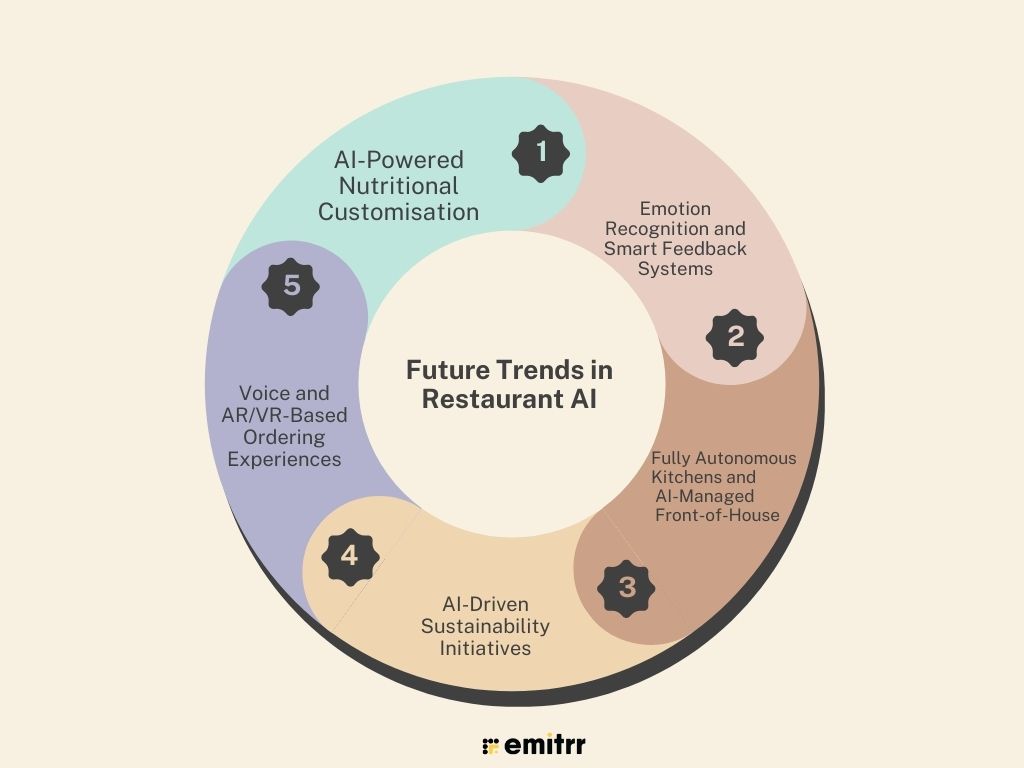
1. AI-Powered Nutritional Customisation
As people become more health-oriented, AI will allow completely personalised food choices that will comply with individual dietary needs, allergies, and fitness targets. Therefore, a user-friendly menu is not something to be surprised at. Instead, it will be a web adaptation system presenting the most suitable culinary profiles from an optimisation perspective, not only related to health but also to flavour.
2. Emotion Recognition and Smart Feedback Systems
One of the future AI systems will gauge the emotions that a customer is experiencing through facial expressions or speech, and then, based on it, provide an immediate service upgrade. Smart feedback tools will continuously prompt possible areas for improvement, creating a hotel stay that keeps evolving.
3. Fully Autonomous Kitchens and AI-Managed Front-of-House
Robotic chefs and AI-powered kitchen management tools will plan every meal served to customers with precision and consistency. On the other hand, AI-controlled front-of-house operations will facilitate seating arrangements, order-taking, and customer relations; thus, staff members will be liberated from the tedious cycle and free to attend to the customers faster.
4. AI-Driven Sustainability Initiatives
AI will be the pivotal agency in the restaurant industry where energy is optimised and food waste is minimised. Software powered with the latest technology and predictive algorithms will be the providers that not only contribute to lowering restaurants’ environmental footprint but also their cost.
5. Voice and AR/VR-Based Ordering Experiences
Growing voice-assisted technologies and augmented or virtual reality will make it easier for clients to get what they desire in a more interactive, immersive, and convenient way. Imagine being able to preview dishes virtually before placing your order, or using voice commands for a hands-free dining experience.
FAQs
AI has been designed to assist, rather than to replace, the workforce. What it does is to facilitate the automation of less creative, yet necessary, time-consuming tasks, for instance, taking orders, answering phones, or managing schedules. So the rest of the staff are freed by AI to do what they are best at, to provide a higher level of service, to engage in more personal interaction with the customer, and to do the tasks that require creativity or are more manual. A perfect example is the restaurants that have implemented AI strategically to address the shortage of the labour force instead of the other way around.
Depending on your requirements, the minimum cost can be as low as $30 and up per month. Micro-businesses in the food sector can make a start by going for affordable tools such as AI chatbots or scheduling software. On the other hand, a bigger investment that may include kitchen robotics or integrated analytics platforms will require a few thousand dollars. Vendors, on the other hand, may have different modular or subscription-based pricing, which can make AI affordable even in times of financial constraint.
AI products are aimed at working well with your current POS systems. Most of the AI solutions are developed in a way that is compatible with APIs, which gives them the ability to be linked to your current business without causing any downtime. In case of a chatbot that links with your online ordering system or an analytics tool that syncs with your sales data, you may still upgrade your technological tools without completely getting rid of your existing ones.
Big and small brands have already seen results.
To ensure consistent pizza quality, Domino’s has implemented AI cameras.
Wendy’s and White Castle installed voice AI at drive-thrus to improve speed and accuracy and less wait time for customers.
Chatbots are being used by local cafes to manage their reservation system and upselling 24/7.
AI continues to prove its worth across all sectors, from quick-service chains to speciality restaurants.
The development of AI tools conforms to strict data privacy and security guidelines. In the case of most reliable AI providers, such implementations as data encryption, use of secure APIs, and adherence to data privacy laws like GDPR or CCPA are some of the basic requirements. Vendors’ accountability and data governance should be tested before proceeding. With a trusted provider, customer information is always safe, even when AI is being employed for the benefit of the consumer.
Conclusion
Embracing AI in the restaurant industry is no longer a dream; it’s already today’s reality to remain competitive, efficient, and customer-oriented. From automating processes to personalising guest experiences, AI allows restaurants to thrive in today’s fast-food age.
With Emitrr’s intelligent, scalable, and intuitive AI solution, your restaurant can automate tedious work, enhance communication, and make more informed decisions, all without having to increase staff. Whether a bustling cloud kitchen, quick-service retail, or fine dining restaurant, Emitrr offers to expand your business and wow your customers. Start your AI journey today at Emitrr and transform how you serve, connect, and grow.