
 4.9 (400+
reviews)
4.9 (400+
reviews)
Introduction to Artificial Intelligence in Hospitals
AI is changing hospitals at a fast pace by enhancing diagnostics, automating processes, and improving communication with patients. With increases in patient volumes, staff shortages, and demands for quicker, personalised treatment, hospitals are embracing AI to bridge critical gaps.
Why now? Diagnostic delays are on the increase as data volumes increase – AI enables medical images to be interpreted 150x faster than human radiologists. Simultaneously, automation aids burdened personnel and enables 24/7 patient engagement in the form of virtual assistants, intelligent scheduling, and real-time triage.
Adoption is speeding up: more than 60% of developed-world hospitals are now testing AI solutions like Emitrr for clinical and administrative functions. From eliminating inefficiencies to enhancing outcomes, AI is no longer a choice it’s becoming a requirement.
In this guide, we examine what hospitals are doing with AI today, how they’re benefiting, and what the future promises.
What is AI for Hospitals?
AI in hospitals works like a smart helper. It supports doctors by guessing what patients might need and helps them make better decisions. It also cuts down waiting times by handling appointments and fixing schedules on its own. Chatbots can answer simple patient questions anytime, which saves time for staff. AI also makes sure things like beds, staff, and equipment are used properly, without waste. Overall, it helps hospitals run better and faster, so doctors and nurses can focus more on caring for patients instead of getting stuck with routine work.
Why Hospitals Need AI
Hospitals are now under increasing pressure to accomplish more with less — handle increasing patient volumes, overcome staffing issues, and provide quicker, customised care. Artificial Intelligence (AI) is no longer a mere science fiction; it’s a real-world solution enabling healthcare systems to think, act, and interact smarter, quicker, and more efficiently.
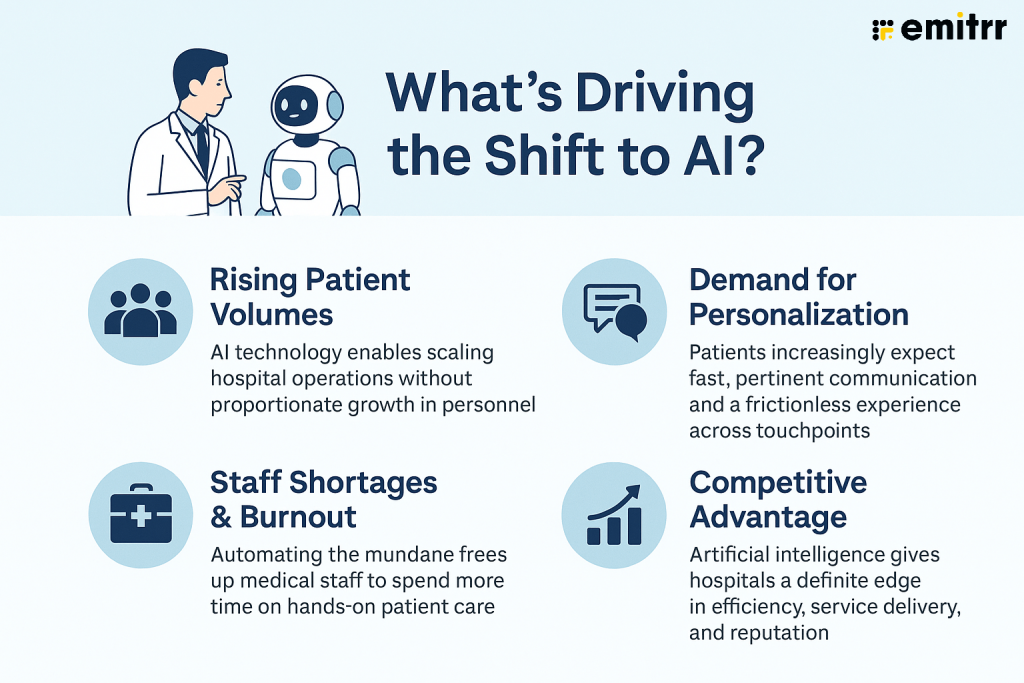
What’s Driving the Shift to AI?
- Rising Patient Volumes: AI technology enables scaling hospital operations without proportionate growth in personnel.
- Staff Shortages & Burnout: Automating the mundane frees up medical staff to spend more time on hands-on patient care.
- Demand for Personalisation: Patients increasingly expect fast, pertinent communication and a frictionless experience across touchpoints.
- Competitive Advantage: Artificial intelligence in hospitals have a definite advantage in terms of efficiency, service delivery, and reputation.
Take a look at this video to see the top 5 AI tools for doctors:
How Does AI-Based Communication in Hospitals Differ from Traditional Communication?
Hospitals are fast-paced, high-pressure environments where communication must be timely, clear, and scalable. Traditional communication methods are mostly manual, fragmented, and staff-dependent, often falling short. Artificial intelligence in hospitals introduces automation, consistency, and responsiveness that transform how hospitals operate.
Manual outreach vs. streamlined patient engagement
Traditional communication relies heavily on staff to make phone calls, send reminders, and provide printed instructions. This often leads to delays, missed information, or no-shows. With hospital automation with AI, patients automatically receive appointment reminders, pre-visit instructions, post-discharge follow-ups, and medication alerts via SMS or voice, ensuring engagement without adding to staff workload.
Limited hours vs. 24/7 responsiveness
Most hospital teams can only respond during business hours, and after-hours inquiries often go unanswered. AI communication tools, like virtual receptionists and chatbots, offer 24/7 availability, handling patient queries, appointment requests, and basic support at any time of day or night.
Call transfers vs. Smart department routing
Traditional systems often involve bouncing calls from one desk to another to reach the correct department, wasting valuable time. AI-driven VoIP systems and intelligent routing ensure every call reaches the right care team immediately, improving internal coordination between departments like nursing, diagnostics, pharmacy, and administration.
Repetitive tasks vs. automated workflows
Staff spend hours on repetitive tasks like confirming appointments, verifying insurance, and collecting paperwork. Artificial intelligence in hospitals automates these workflows, reducing paperwork handling, improving accuracy, and freeing up staff to focus on patient care.
Inconsistent messaging vs. Standardized communication
In traditional setups, the quality and accuracy of communication can vary depending on who’s handling it. AI ensures every patient receives consistent, pre-approved automated text messaging for things like test prep, hospital protocols, or care plans, minimizing confusion and compliance risks.
No visibility vs. Real-time communication insights
Conventional systems offer little to no tracking, there’s no easy way to know if a message was received, missed, or acted upon. AI platforms provide real-time reporting on delivery rates, engagement, call volumes, and follow-up completion, helping hospitals make data-backed decisions to improve operations.

What Challenges are Hospitals Facing, and How is AI Solving Those?
Let’s encounter the major challenges that are faced by hospitals and see how AI is solving them:
Data overload and management
Challenge: Hospitals handle tons of patient data every day, from medical reports and test results to doctor notes and prescriptions. It’s hard for staff to keep up with so much information.
Reason: Data is often stored in different places or formats, making it hard to find what’s needed quickly. Important details might get missed, leading to delays or errors in care.
AI Solution: AI in hospital management helps by organizing and sorting this massive data quickly. It picks out the most important details, highlights trends, and presents clear summaries to doctors, helping them make faster, better decisions.
Lack of personalized Care
Challenge: Many hospitals follow a general treatment approach for all patients, but not everyone responds the same way. What works for one may not work for another.
Reason: It’s tough for doctors to manually analyze each patient’s lifestyle, medical history, and even genetic makeup in a short time. Time pressure and large patient numbers make it harder.
AI Solution: AI studies individual patient data, including age, habits, genetics, and past records, to suggest more personalized treatment plans. This approach leads to better recovery, fewer side effects, and more patient satisfaction.
Medical errors and treatment gaps
Challenge: Mistakes like wrong medication, incorrect dosage, or missed diagnoses still happen, even in top hospitals. These errors can harm patient safety.
Reason: Healthcare workers are often under pressure, handling many patients with limited time. Human error is natural when multitasking or working long hours.
AI Solution: AI in hospital management systems acts as a safety net. They cross-check medication lists, flag inconsistencies, and review symptoms to catch things doctors might miss. This double-checking system reduces errors, improves accuracy, and ensures safer care for all patients.
Patient non-compliance
Challenge: Some patients don’t follow their treatment properly; they skip medicines, miss follow-ups, or ignore health advice, which slows down recovery.
Reason: Patients often forget, don’t fully understand instructions, or stop treatment once they feel better. Some patients might ignore reminders or lack the support they need post-discharge.
AI Solution: AI tools send timely reminders, answer patient queries, and offer friendly nudges to stick to the plan. These tools also track progress and help doctors stay updated, improving treatment results and building better patient habits.
Chronic disease management
Challenge: Chronic illnesses like diabetes, high blood pressure, or asthma need ongoing care and close monitoring, which can be exhausting for patients and healthcare providers.
Reason: Doctors can’t check in on every patient daily, and patients might not report early warning signs until things get worse. Small changes may go unnoticed.
AI Solution: AI in patient care tracks health data in real-time using wearable devices or apps. It alerts doctors to sudden changes, offers health tips, and suggests changes in treatment. This helps manage chronic diseases better and keeps patients safer at home.
Staff burnout
Challenge: Doctors, nurses, and staff often feel drained, emotionally and physically, because of long shifts, high stress, and increasing patient loads.
Reason: A lot of time is spent on paperwork, data entry, and scheduling, leaving little time for actual patient care. This nonstop cycle leads to frustration and burnout.
AI Solution: AI in patient care reduces this load by automating routine tasks like managing appointments, organizing records, and handling basic queries. This allows staff to focus more on patients and feel less stressed, creating a healthier work environment.
Inconsistent patient outcomes
Challenge: Patients with similar illnesses sometimes get different results depending on the hospital, staff experience, or even the location. This inconsistency can be unfair and harmful.
Reason: Not all hospitals have access to the same tools, training, or data. Some may rely more on traditional methods or lack enough staff, leading to uneven care.
AI Solution: AI uses evidence-based guidelines and the latest research to guide treatments. It provides real-time suggestions to doctors and helps standardize care, ensuring every patient gets the best treatment possible, no matter where they are.
Benefits of Using AI in Hospitals
Here are some of the best benefits of artificial intelligence in healthcare:
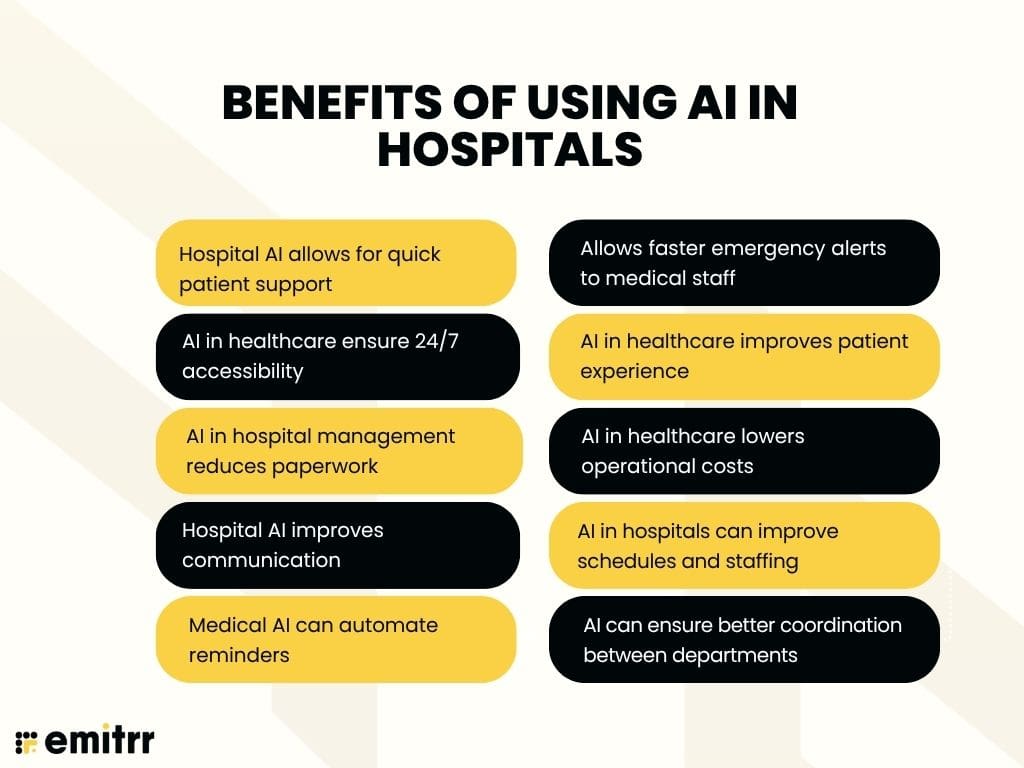
Hospital AI allows for quick patient support
Patients often have simple but urgent questions, like checking appointment times or understanding their reports. With AI communication in hospitals, responses are instant, accurate, and available anytime. This reduces confusion and helps patients feel cared for, even when the staff is busy.
AI in healthcare ensure 24/7 accessibility
One of the top benefits of AI in hospitals is its 24/7 availability. Hospitals don’t sleep, and neither does AI. Patients can book appointments, check timings, or get answers even at midnight. Artificial intelligence in healthcare keeps things moving around the clock, cutting down wait times and keeping everything organized without human delays.
AI in hospital management reduces paperwork
Handling bills, forms, and reports can take up a lot of time. With AI handling the admin work, hospitals can say goodbye to long queues and endless paperwork. Communication AI in hospitals makes it easier for both staff and patients by digitizing everyday processes.
Hospital AI improves communication between doctors, nurses & patients
Important updates like test results, next steps, or changes in care can reach the right people instantly. Communication AI in hospitals ensures everyone stays on the same page, leading to better teamwork and fewer misunderstandings in patient care.
Medical AI can automate reminders
Missed appointments or skipped meds can delay recovery. AI tools send timely reminders via text or calls, helping patients stay on track. This small step leads to better health outcomes, making AI in healthcare a quiet hero in patient recovery.
Allows faster emergency alerts to medical staff
In critical situations, every second matters. Communication AI in hospitals can instantly alert the right staff when there’s an emergency. Whether it’s a sudden drop in vitals or a bed becoming available, alerts go out fast and precisely.
AI in healthcare improves patient experience
Patients like feeling informed but not overwhelmed. Communication AI in healthcare uses simple texts, calls, or emails to keep them updated. It’s easy, friendly, and doesn’t require downloading apps or filling out long forms, just helpful info when needed.
AI in healthcare lowers operational costs
From sending appointment reminders to updating patient records, AI communication in hospitals reduces the need for manual work. This not only saves time but also helps hospitals cut down on extra costs, letting them invest more in quality care.
AI in hospitals can improve schedules and staffing
Managing who works where and when is a big task. Artificial intelligence in healthcare can look at current demands and suggest the best staffing plans. AI in healthcare ensures the right people are in the right place, preventing burnout and improving care.
AI can ensure better coordination between departments
When different teams in a hospital work in sync, everything runs smoother. Communication AI in hospitals makes it easier to share updates between departments- like radiology, surgery, and pharmacy– so patients move through the system quickly and safely.
Use Cases of AI in Healthcare
Thanks to the advancements of artificial intelligence, via machine learning, natural language processing, and computer vision, efficiencies and accuracy in hospitals are reached to record levels never seen before. Here are some top use of ai in hospitals:
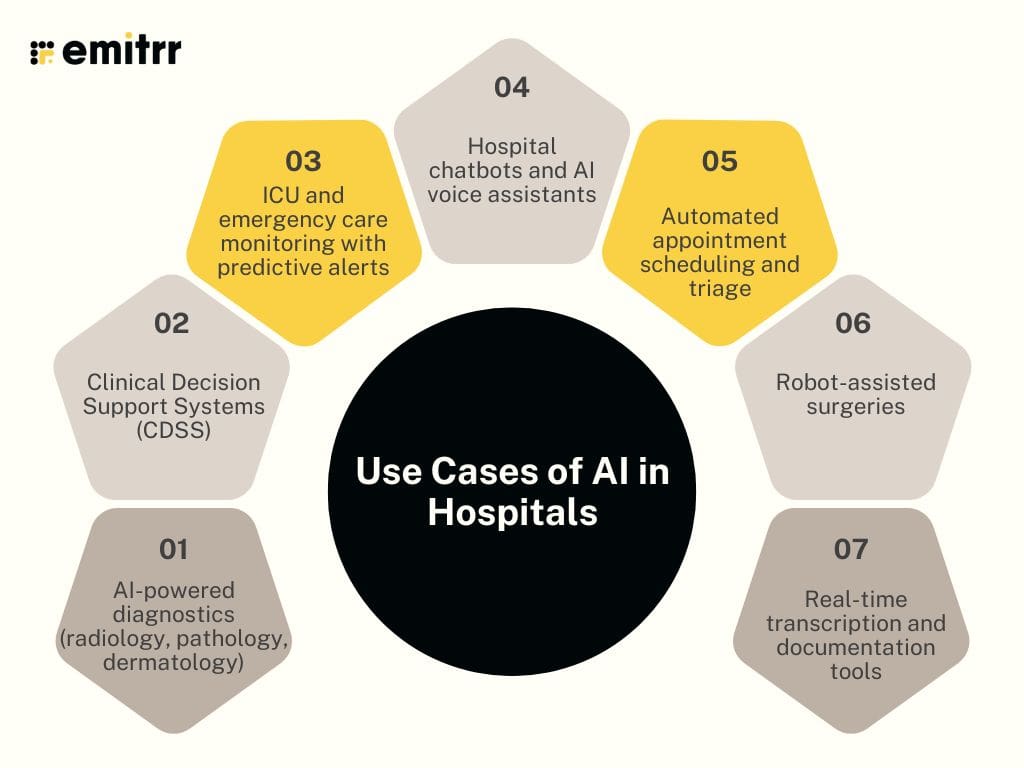
AI in medical imaging (radiology, pathology, dermatology)
With the help of AI technologies, medical images (like X-rays, CT scans, MRIs (in radiology), tissue samples (in pathology), and skin lesions (in dermatology)) are being analysed. AI in radiology or diagnostic imaging AI can reveal hidden abnormalities and detect unusual patterns that may be overlooked by humans, resulting in more timely and accurate diagnoses.
Example: Google’s LYNA (Lymph Node Assistant) improves the accuracy and reduces the cases of false negatives in the diagnosis of metastatic breast cancer by pathologists.
AI for diagnostics
AI for diagnostics or clinical decision support systems (CDSS) can collect and analyse patient data from electronic health records (EHRs), laboratory tests, and medical literature to give further insights for doctors to make better, real-time decisions. This can help in the stages of diagnosis, drug interactions, and devising treatment plans based on the individual needs of the patient.
Example: AI is integrated by companies like Medscape so that they can provide doctors with data and decision support tools at the point of care.
AI in patient triage (ICU and emergency care monitoring)
AI systems can continuously read and track patients’ vital and physiological data in intensive care units (ICUs) and emergency departments. They help to give early alarms to the doctors when they recognize slight changes from the minimum and maximum values of the readings and determine patterns that indicate the onset of the disease, thus providing a window for timely interventions and saving lives.
Example: Emitrr might work to alert medical staff on call immediately, should a critical AI-generated alert for patient status occur.
AI in After-hour queries (Hospital chatbots & AI voice assistants)
Also, AI-powered chatbots and voice assistants can handle communication flow, respond to inquiries, familiarize patients with hospital services, book appointments, and give both pre- and after-care advice related to a patient.
Example: Emitrr provides an AI-powered communication platform that can act as a hospital chatbot, answering patient inquiries, providing appointment reminders, and offering support via text messaging.
AI in automated appointment scheduling
Artificial intelligence algorithms can make appointments more efficient by taking into account factors such as doctors’ availability, patients’ urgency, and resource allocation. AI in triage can analyse the symptoms and medical history of a patient to rank cases according to their severity and thus ensure that the patients are served promptly.
Example: Emitrr can use scheduling systems to send automatic appointment confirmations, reminders, and follow-up messages to patients via SMS. This reduces patient non-attendance and improves process efficiency.
AI in robot-assisted surgeries
Although not fully automated, AI is a helpful tool in assisting in robot-assisted surgeries by giving surgeons instant feedback, increasing precision, and facilitating surgical plans.
Example: The da Vinci Surgical System is one of the famous robotic surgery systems where changes and improvements are being made continuously. It also uses AI for more capabilities.
AI in real-time transcription and documentation
English language processing (NLP) tools, the technology of which is IQ by AI, can convert live communication between the patient and the physician into text in real-time and create notes and documentation such as clinical records, which can be used as another way of reducing clinicians’ administrative burden.
Example: Emitrr can be automated to make summaries or key information and even send them to patients or other members of the health care team, affected privacy and security are maintained.
Thanks to AI, hospitals and patient care are going to the next level, being more accurate in the diagnosis, having efficient clinical decision-making processes, achieving higher-level workflow organisation, and finally, a patient-centered experience is made a reality. Platforms like Emitrr are said to be the most significant contributors of AI technology for communication and automation in the healthcare industry.
Where Does AI Overtake Humans in Hospitals?
It’s important to realise that AI in hospitals is not about replacing the precious experience of healthcare professionals.
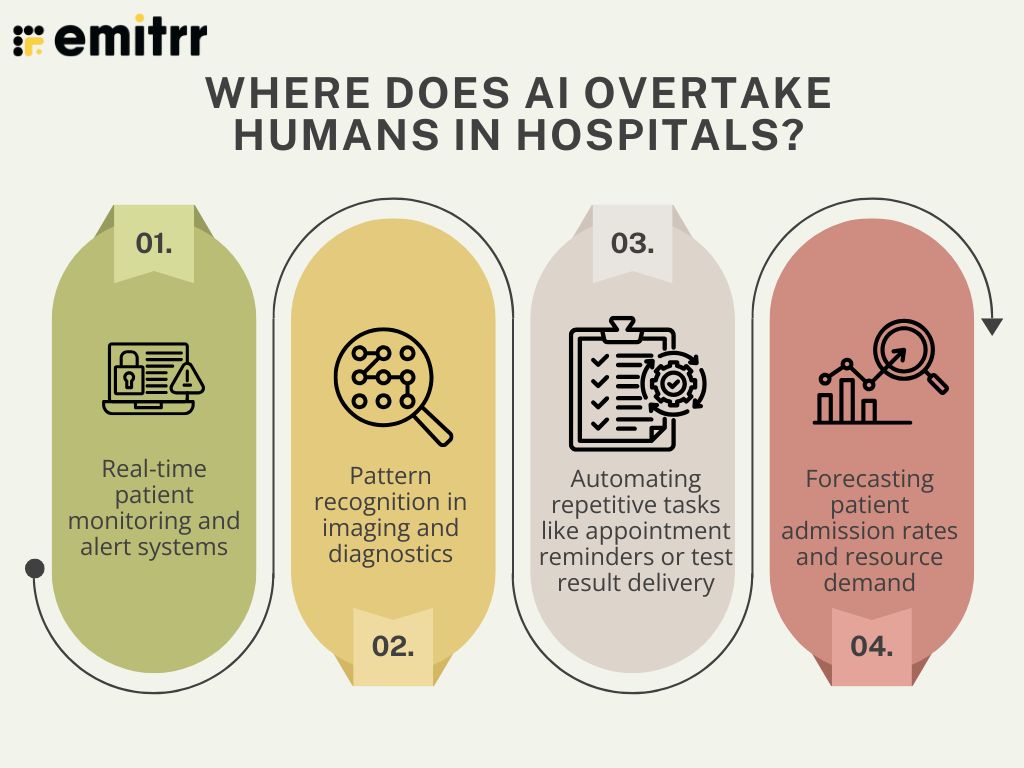
Real-time patient monitoring and alert systems
AI is particularly good at continuously monitoring streams of patient data in acute care environments such as ICUs and emergency departments. By automatically recognising subtle but critical changes in vital signs and clinical parameters, AI-based systems can often detect early warning signs of deterioration more quickly and more accurately than human observation alone.
Pattern recognition in imaging and diagnostics
The capacity of AI programs to recognise subtle patterns in clinical images is revolutionising diagnosis. In specialities such as radiology, pathology, and dermatology, AI can interpret scans, tissue samples, and skin pictures with a degree of accuracy that, in most cases, is equal to or better than that of skilled experts.
Automating repetitive tasks like appointment reminders or test result delivery
Hospitals process a high amount of repetitive communication work. Platforms enabled by AI can automate these interactions, including appointment reminders, delivering routine test results, and handling FAQs.
Solutions such as Emitrr automate appointment reminders via SMS, post-care follow-up, and the delivery of critical patient instructions, resulting in increased patient compliance and less administrative workload.
Forecasting patient admission rates and resource demand
AI’s analytical potential also includes forecasting patient admissions, emergency room traffic, and hospital bed and other resource demand. Based on historical data and current indicators, AI algorithms can offer reliable predictions, allowing hospitals to plan optimal staffing, resource allocation, and anticipate potential spikes in demand.
Instant response to patient queries
Patients don’t like waiting, especially when they’re sick or stressed. AI-powered chatbots can answer basic questions like appointment availability, visiting hours, or how to refill a prescription instantly, day or night. This helps hospitals stay responsive even during weekends, holidays, or off-hours without burning out the staff.
Reducing human error
Doctors and nurses are under pressure and juggling multiple things at once, so mistakes can happen. AI helps reduce errors by double-checking medication doses, alerting staff about missed tests, or ensuring patient data is correctly recorded. It adds an extra layer of safety and precision to routine processes.
Handling large volumes of calls and messages
During peak hours, hospitals get flooded with calls and messages. Humans can only do so much at once. AI systems can talk to hundreds of patients at the same time, answering FAQs, updating appointment statuses, and logging calls. That means no one is left hanging or forgotten.
Where Do Humans Still Overtake AI in Hospitals?
While AI shows excellent performance in data-based work, personal doctors are still indispensable in such areas as empathy, judgment, and holistic thinking. These are the areas where humans are still at the lead:
Delivering empathetic and complex patient care
AI doesn’t have emotions. A human healthcare provider can serve with understanding, deep listening, and being able to answer the emotional and psychological needs of patients, as well as being, despite everything, human themselves.
Making ethical decisions in high-stakes medical cases
In such situations as complex or morally ambiguous (e.g., the end-of-life care, treatment denial, or resource allocation), clinical workers make decisions by the analysis not only of clinical records but also of cultural, ethical, and emotional factors that AI cannot navigate or understand.
Building trust and emotional connection with patients
A good relationship between the patient and the doctor is dependent on trust, body language, and human communication—qualities without which patient compliance, satisfaction, and human healing are impossible and which are not replicated by AI tools.
Interpreting ambiguous symptoms in rare or nuanced cases
When the symptoms are not clear and don’t fit the pattern, or they have more comorbidities and/or psychosocial factors, experienced clinicians can only rely on their intuition, experiences, and what they understand in that situation. AI is not good at the outliers and edge cases that are different from the data it has been trained with.
How Can Different Hospital Teams Benefit From AI?
Here is a detailed list of different sections of hospital management where they can infuse artificial intelligence for hospitals:
Front Desk & Reception Staff
- AI receptionists handle high call volumes, route calls accurately, and answer common queries (visiting hours, department locations, insurance policies) without human intervention.
- Missed-call-to-text automation ensures every call gets a response, even during peak hours or lunch breaks.
- Appointment confirmations, check-in instructions, and rescheduling are fully automated via text or voice.
Nurses & Clinical Support Teams
- Automated check-in reminders and post-discharge instructions reduce manual coordination.
- Text-based symptom tracking and patient status updates streamline follow-up efforts.
- AI voice tools can handle non-urgent triage questions, freeing nurses for clinical care.
Doctors & Specialists
- AI-powered communication systems handle appointment reminders, follow-ups, and report notifications.
- Smart voicemail transcription and tagging help keep providers updated without constant back-and-forth calls.
- Automated SMS can notify doctors when lab reports or scans are ready for review—saving time during rounds.
Outpatient & Day Surgery Units
- Pre-surgical prep instructions and fasting guidelines are delivered via automated texts or calls.
- AI handles recovery check-ins post-surgery, flagging patients who need nurse follow-up.
- Last-minute reschedules or cancellations are quickly managed via SMS links, reducing no-shows and gaps in scheduling.
Diagnostics & Radiology Departments
- Scan prep instructions, arrival protocols, and contrast-related guidelines are delivered via text.
- VoIP-based routing ensures that referring physicians and patients connect to the right team without delays.
- Post-scan follow-ups and survey links can be automated for feedback and experience tracking.
Pharmacy Teams
- AI systems send refill reminders and medication availability alerts directly to patients via SMS.
- Common drug interaction questions or insurance eligibility can be answered via auto-response.
- Real-time coordination with inpatient units or clinics is streamlined through smart routing.
Emergency Department Teams
- AI tools can auto-notify families about patient intake, bed assignments, or delays.
- Internal call routing ensures EMS, triage, and trauma teams connect instantly—minimizing call transfers.
- Discharge instructions and follow-up reminders are sent automatically after patient handover.
Billing & Insurance Teams
- Text-based billing reminders and balance alerts reduce overdue payments and patient confusion.
- Automated follow-ups for insurance documents or missing forms prevent claim delays.
- Patients can self-verify coverage or eligibility through AI-driven phone or chat workflows.
IT & Operations Teams
- AI centralizes communication logs across departments, reducing tech support requests for scattered tools.
- Performance analytics offer real-time insight into communication trends, bottlenecks, and missed touchpoints.
- Integrations with EMR/PMS tools simplify data sync and reduces duplication.
How to Implement AI in Your Hospital?
Here’s how to get started with AI in your hospital practice:
Figure Out Where You Need Help
Before jumping in, take a close look at where your hospital struggles most. Is scheduling a mess? Are patients waiting too long? AI in hospitals can help with specific issues like appointment management, faster diagnosis, or reducing paperwork, but only if you know where to use it. Start small and smart.
Choose the Right AI Tools
Not every hospital needs the fanciest technology. Think about your goals. Do you want better patient support, quicker reports, or automated admin work? There are many types of AI in hospitals today, so pick the one that fits your hospital’s size, needs, and budget without overcomplicating things.
Get Your Team on Board
Even the best AI tools won’t work if your team doesn’t use them properly. Doctors, nurses, admin staff, and even part-timers need to understand how the AI works and how it helps. Provide simple training sessions, answer their questions, and show them how AI in hospitals makes their jobs easier, not harder.
Make Sure It Fits with What You Already Have
You don’t need to tear everything down to start using AI. The best AI tools should work smoothly with your current systems, like patient record software, billing platforms, or appointment schedulers. That way, communication flows naturally, and AI in hospitals enhances, rather than complicates, your workflow.
Check and Improve Regularly
Once AI is in place, don’t just leave it running on autopilot. Keep an eye on how things are going, what’s working, what’s not, and how your staff and patients feel about it. Regularly tweak and update the system. AI in hospitals gets smarter with time, especially when it’s supported by real feedback.
Why is Emitrr One of the Best AI-powered Hospital Systems
With the growing complexity of hospital operations, efficient communication is critical. Emitrr’s hospital AI solutions features are now live in production — purpose-built to support healthcare teams in delivering timely, clear, and compassionate patient communication. Here are the top reasons why Emitrr is one of the top AI-powered hospital systems:
AI Text Enhancement Features Are Now Live on Production
Emitrr’s new suite of hospital AI solutions is designed to streamline message creation while ensuring clarity, empathy, and responsiveness — all within a HIPAA-compliant environment.
What’s Live:
- Help Me Write
- Enhance
- Suggest a Reply
Feature Table:
| Feature | Function | Example Use in Hospitals |
| Help Me Write | Generates patient-friendly messages | Post-discharge care instructions |
| Enhance (Crisp, Empathetic) | Tone and clarity adjustment | Notifications for critical updates |
| Suggest a Reply | Smart reply suggestions | Answering patient reschedule requests |
Note: Available on Emitrr’s Professional plans
Demo videos available on request
Take a look at what more Emitrr AI can do:
Emitrr is not just a communication tool — it’s a complete AI platform designed for hospital workflows:
- Hospital Phone System Integration: Connects seamlessly with your existing infrastructure to handle high call volumes, route queries, and ensure no call goes unanswered.
- AI-Powered Scheduling Assistant: Reduces no-shows, balances appointments, and keeps calendars optimised — without manual back-and-forth.
- Hospital Paging System Modernisation: Replaces outdated pagers with smart, mobile-friendly notifications for real-time team coordination.
- Reputation Management: Automates review generation, monitoring, and response, helping hospitals maintain a strong online presence.
- Smart VoIP for Front Desks: Handles routine queries, directs calls intelligently, and ensures faster responses to patient needs.
Emitrr empowers hospitals to communicate better, operate smarter, and elevate patient satisfaction — all with the reliability and scalability of AI.
AI in Hospitals & HIPAA Compliance: Ensuring Patient Data Privacy
As hospitals increasingly adopt AI-powered tools to improve care and operational efficiency, safeguarding patient data remains non-negotiable. Compliance with the Health Insurance Portability and Accountability Act (HIPAA) is essential for any AI solution handling protected health information (PHI).
What Is HIPAA and Why Does It Matter?
The Health Insurance Portability and Accountability Act (HIPAA) is a federal law in the United States designed to protect sensitive patient information. It sets the bar for how healthcare providers and their partners should store, access, transmit, and secure health records. HIPAA compliance among AI tools in hospitals will ensure the patient’s trust, legal protection, and ethical integrity.
Key HIPAA Requirements for AI:
| HIPAA Requirement | What It Means for AI Tools |
| Privacy Rule | AI tools should use, access, and process only patient data that is necessary to perform the job. |
| Security Rule | AI platforms must use different techniques (e.g., encryption, access control, secure storage) to secure electronic PHI (ePHI). |
| Breach Notification Rule | If there is a data breach, AI suppliers should immediately contact covered entities and start reaction and compliance procedures. |
| Business Associate Agreement (BAA) | The AI companies must be ready to sign BAAs with hospitals, showing that both are responsible for HIPAA compliance and data protection. |
How AI Tools Ensure HIPAA Compliance
The Emitrr platform is a typical example of modern AI built for healthcare. This platform abides by multi-level data security best practices like the ones from the US Department of Health and Human Services (HHS) and further adds:
- End-to-end encryption of messages and data in transit and at rest.
- Role-Based Access Controls to restrict data access to authorised users only.
- Audit Trails and Logging for monitoring data access and usage.
- Secure APIs that integrate with hospital systems without exposing PHI.
- Signed BAAs to formalise compliance accountability between the vendor and the healthcare provider.
Emitrr and HIPAA: Emitrr was designed with HIPAA compliance in perspective that ensured the safe automation of the communication between hospitals and patients, which saves by no means the breach of privacy.
Future of AI in Hospitals
When discussing the future of AI in healthcare, we don’t merely acknowledge its potential; we are actively experiencing the changes that technology is bringing to hospitals. Here are some points where AI is the way to go:
Integration of AI with IoT for real-time remote patient monitoring.
AI connected IoT devices can be used for the constant monitoring of the patient’s health condition and to react on time as soon as any issues occur in the patient’s health.
Use of virtual assistants and avatars for post-operative care
Now that hospitals can use AI-driven robots and virtual assistants, they can be with the patient through the whole period of recovery, from supplying the patient with medication reminders to conducting regular check-ins about patient health, and even wellness education.
Expansion of AI-augmented robotic surgeries
Humans are making use of AI technology for various purposes like the improvement of procedures less invasive approach, more accurate in their outcomes provided, and less time-consuming.
Secure data sharing through AI-blockchain collaboration
AI in combination with blockchain technology helps to prevent unauthorised and false persons from accessing patients’ data, which ensures the confidentiality of patients’ data. In addition, Blockchain makes data available only to authorised persons; that is, the doctor and patient have immediate access to data, which allows for more accurate diagnoses and precise treatment plans.
Adaptive learning algorithms that refine diagnostic accuracy over time
According to the healthcare reports, AI models are learning from the data of patients in various institutions of the medical field. They are going deeper and achieving the right diagnostic results and treatments for the patients.
Frequently Asked Questions on AI in Hospitals
No. The AI system is not created to be a substitute for the health professionals. It is like an assistant working alongside the doctors to do tasks like diagnosis and analysis, making it possible for the medical practitioners to interact with the patient, attend to complex cases, and care for the patients in a more empathetic way.
Trustworthy AI tools for hospitals give the highest importance to the security of the solution and comply with regulations such as HIPAA. They do that by way of measures such as end-to-end encryption, role-based access controls, and safe data storage of the patients’ information.
If we are taking hospitals as an example, the revenue part can be viewed as getting benefits from making work easier (e.g., it takes less time for all activities if the scheduling system is carried out in an efficient way), higher accuracy due to a lack of human errors, better patient and staff enthusiasm and dedication to the work, resource utilization made to the best, and the possibility of spending less money overall.
Yes. Today’s AI platforms are quite adaptable to easily connect with the present hospital systems such as Electronic Health Records (EHRs), scheduling software, and communication platforms via secure APIs.
The departments that are most preferred are those that are engaged in radiology (image analysis), pathology (diagnostics), front office (scheduling and communication), emergency departments (triage and prediction), as well as the rest of the departments focused on operational efficiency and patient engagement.
AI tools can send reminders, answer common questions, manage appointments, and even check in with patients after their visit. This saves time and keeps communication smooth without overwhelming the staff.
Yes, many small hospitals can afford to use AI today. A lot of modern AI tools are designed to be scalable and budget-friendly. You don’t need a massive investment to start- many systems offer pay-as-you-go or modular pricing. Plus, AI often saves money long-term by reducing admin work, preventing errors, and improving patient flow.
AI is improving patient care by making diagnoses more accurate, predicting health issues before they happen, automating administrative tasks, and helping doctors make better decisions faster.
There are concerns about the privacy of patient data, bias in AI systems, and whether AI will replace doctors. It’s important to make sure AI systems are used responsibly and don’t replace the human touch in healthcare.
Some of the challenges include concerns about data privacy, high costs of AI technology, and the need to train staff to use these tools properly. Hospitals also face difficulties integrating AI into their existing systems.
Conclusion
AI has firmed its grip on healthcare and is influencing hospitals on how they run their operations, as well as how staff members interact and take care of patients all the more so. Admission representatives use Emitrr to speed up the process of taking the patient’s data and reducing the time for patient wait in the clinic and at the same time not losing the quality of the process. If you are planning on lowering the work burden, increasing client happiness, and being in line with the laws, you should start thinking of AI-powered communication right now.
Explore Emitrr or book a demo today to see how your hospital can benefit.Don’t get left behind — start using Emitrr or schedule a demo today to learn how AI will help you scale your operations and better serve customers.