
 4.9 (400+
reviews)
4.9 (400+
reviews)
Physicians spend around 35% of their time documenting patient data, posing a significant burden on healthcare professionals and keeping them from patient care. But with growing demands to cut costs, improve care, and meet strict regulations, healthcare providers need smarter solutions.
That’s where AI medical documentation comes into play. From automating medical notes to streamlining electronic health records (EHR), AI is transforming how clinics work behind the scenes. In fact, about 75% of US hospitals are already tapping into AI to manage medical data more efficiently.
In this guide, we will break down how AI documentation is making life easier for healthcare professionals, improving patient care, and setting a new standard for modern clinical practices.
Understanding Medical Documentation
Now, let’s understand the fundamentals of medical documentation. Medical documentation is basically the written record of everything that happens during patient care. From their symptoms and diagnoses to the treatments given and follow-up plans, it captures the entire patient journey. These records help doctors, nurses, and specialists stay aligned ensuring nothing important gets missed along the way.
Medical documentation is a crucial part of healthcare operations. Accurate documentation supports insurance claims, reduces the risk of legal issues, and keeps things organized for future visits. And with so many moving parts in clinical care, clear and consistent documentation can seriously improve how smoothly a practice runs.
Good medical documentation must include:
- Patient details: Name, age, and contact information
- Medical history: Past Illness, allergies, medications
- Visit notes: Current symptoms, test results, and findings
- Diagnosis & treatment plan: What has been identified and how it will be treated
- Follow-ups: Progress updates and future instructions
Medical documentation isn’t just paperwork, it lays a foundation for safe, effective, and coordinated care in healthcare.
The Rising Concerns in Medical Documentation
When we think about healthcare, it’s all about healthcare professionals diagnosing patients, nurses providing patient care, and teams working together to save lives. But behind all of this, there’s another side to the story: the medical paperwork.
While proper documentation is critical for accurate diagnoses, treatment planning, legal protection, and billing, it presents many ongoing challenges that weigh heavily on clinicians and healthcare organizations alike.
Let’s take a closer look at some of the posed challenges in medical documentation.
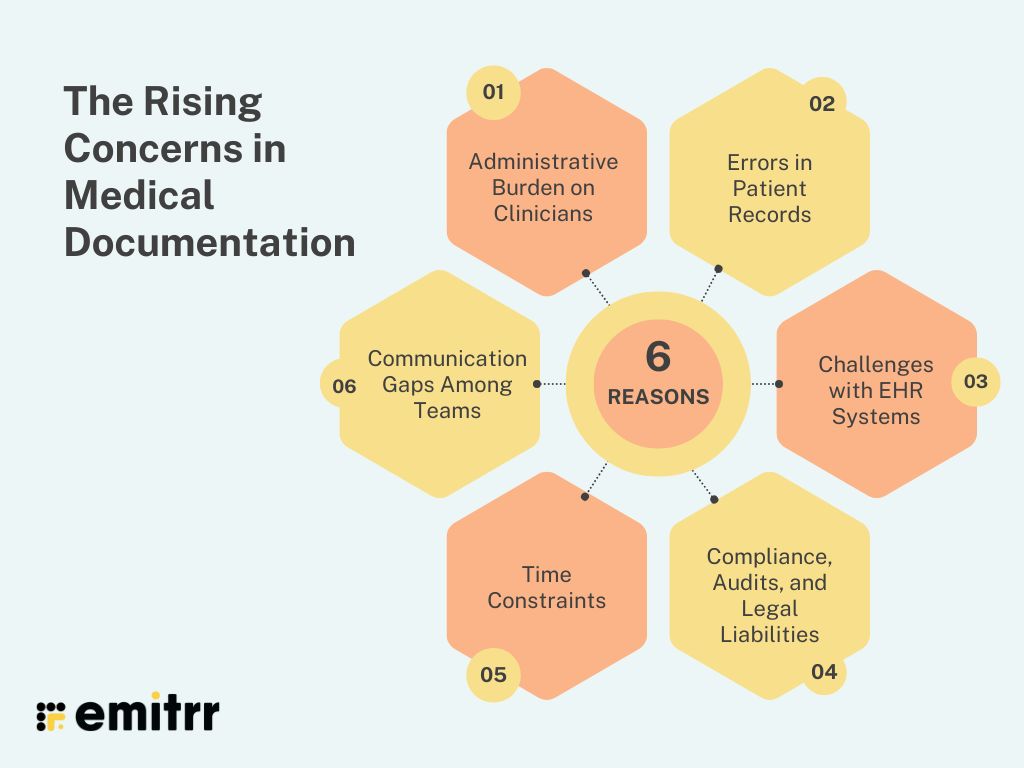
Administrative Burden on Clinicians
Studies show that clinicians can spend more than half their day documenting patient details, updating records, and managing reports. That’s valuable time taken away from actual patient care.
Because of no proper structure in place, there is constant multitasking between patient care and record keeping. This, in turn, contributes to rising rates of clinical and physical burnout and job dissatisfaction.
Many healthcare professionals feel overwhelmed by documentation demands, especially when required to enter repetitive or non-clinical data that adds little value to patient outcomes.
Errors in Patient Records
Errors occur for multiple reasons, including high workload, time pressure, and heavy reliance on manual documentation. When documentation is rushed or incomplete, critical information can be missed. Then there come human factors like fatigue and cognitive overload that add to the probability of errors in patient records.
These inaccuracies in medical records can lead to misdiagnoses, medication errors, and inappropriate treatments, compromising patient safety. These errors also lead to complications in insurance claims and expose healthcare providers to legal and financial penalties.
Challenges with EHR Systems
Electronic Health Records (EHRs) were meant to make life easier, right? Well, not always. While EHRs have made patient data more accessible, many clinicians find them clunky, confusing, and frustrating to use. Complex layouts, slow systems, and constant updates can slow down workflows instead of speeding them up.
On top of that, not all EHR systems talk to each other. This means important patient information sometimes gets stuck in one system while another team is left out of the loop. This can affect the quality of care.
Compliance, Audits, and Legal Liabilities
Healthcare records aren’t just for patient care, they are also legal documents. If something isn’t documented correctly, it can cause serious issues during audits, insurance reviews, or even in court cases.
Missing a note or skipping details can lead to hefty penalties or legal trouble.
This is why there’s a lot of pressure on healthcare providers, who have to juggle accurate documentation with treating patients, managing emergencies, and staying on top of regulations.
Time Constraints
Let’s face it, there’s barely enough time in a day for clinicians to check on all patients, let alone sit down to carefully document everything. When you are constantly racing between patient rooms, procedures, and meetings, documentation can feel like one more impossible task.
And when notes get delayed and rushed, important information can be forgotten, putting patient safety and care continuity at risk.
Communication Gaps Among Teams
In a hospital or clinic, care is rarely handled by just one person. It’s a team effort, and clear communication is key. But when documentation is inconsistent, incomplete, or hard to follow, it can lead to misunderstanding, missed updates, and even treatment delays.
For example, if one doctor’s note isn’t properly recorded or a specialist’s advice isn’t visible to the rest of the team, it can disrupt patient care and lead to avoidable mistakes.
These challenges might not grab headlines, but they have a huge impact on healthcare workers and patients alike. Thankfully, with new technology like AI medical documentation tools, there’s hope for a smoother, safer, and more efficient way forward.
The Role of AI in Medical Documentation
Clinical documentation has long been a source of strain for healthcare providers. Physicians spend an average of 16 minutes per patient visit updating electronic health records (EHRs). That adds up quickly, contributing to burnout and taking valuable face time away from patients. Enter AI medical documentation, a significant solution designed to ease this burden.
AI technology uses natural language processing (NLP) and machine learning to automate clinical note-taking, extract key patient data, and reduce errors. Tools like AI ambient clinical documentation systems passively capture doctor-patient conversations and instantly convert them into structures, HIPAA-compliant records. As highlighted by the University of Chicago Medicine, these tools are not only saving time but also improving record accuracy and enhancing the provider experience.
With nearly 75% of US hospitals already adopting AI to process clinical data, according to the American Hospital Association, it’s clear AI in healthcare is just a passing trend; it’s a crucial shift in modern healthcare.

How AI is Addressing Challenges in Medical Documentation
Clinical documentation has long been a friction point in healthcare, plagued with time-consuming process errors and communication gaps. Now, AI medical documentation tools are stepping in with smart, content-aware solutions that go beyond simple average automation.
Let’s see how AI is actively solving these persistent problems with practical applications and evidence-backed benefits.
Reducing Administrative Burden Through Automation
Physicians spend nearly 50% of their day on EHR and desk work, an overwhelming administrative load that eats into time. AI is changing this by taking over routine and frequently repeated tasks.
- Ambient Clinical documentation: AI tools “listen” to clinician and patient conversations and automatically convert them into structured clinical notes.
- Smart Charting Assistants: AI suggests diagnosis codes, procedure entries, and medication orders based on the conversation and medical history.
- Auto-populating forms: AI systems can pre-fill insurance, consent, and patient intake forms using existing EHR data
This enables clinicians to take a breather and free up their valuable time, reducing any burden and cognitive load.
Maintaining Accuracy and Consistency in Documentation
Insufficient documentation leads to serious downstream problems like incorrect diagnoses, billing errors, and potential malpractice. AI addresses this in multiple ways:
- Natural Language Processing (NLP): AI with NLP capabilities transforms scattered doctor notes and voice recordings into structured, standardized data formats.
- Error Detection and Alerts: AI automatically scans notes for any errors, such as a mismatch between diagnosis and prescription medication. It quickly prompts for correction before submission.
- Template standardization: AI-driven templates ensure documentation follows the best practices. It captures all necessary data points for clinical care and billing.
Studies show a 19% to 92% reduction in documentation time with AI assistance, along with improvements in accuracy and completeness.
Improving EHR Usability
Traditional EHRs are infamous for being cumbersome, with poor user interfaces that frustrate clinicians. AI is transforming this by:
- Smarter navigation: AI prioritizes and surfaces suitable patient data. For example, past lab results when ordering new tests) without any additional clicks.
- Predictive Data suggestions: Based on clinical context and past notes, AI can suggest possible diagnoses or treatment orders.
- Auto-generated dashboards: AI quickly recognizes EHR displays based on specialty-specific workflows, ensuring clinicians see the most critical data first.
Ensuring Compliance and Audit Readiness
Non-compliant or missing documentation can trigger insurance denials, legal liability, and failed audits. AI systems strengthen compliance by:
- Regulatory checklists: AI ensures all required documentation elements for billing and care delivery are captured
- Audit-ready reports: No more unstructured reports. AI generates notes that are automatically organized and coded according to payer and regulatory requirements, reducing the risk of any audit penalty.
- Real-time alerts: If key elements(like patient consent or a diagnostic justification) are missing, AI prompts the provider to add them before closing the record.
Saving Time and Resources
AI is significantly reducing the time clinicians spend on documentation and offering great patient engament solutions. This helps them to invest more time in patient care or invest more time per counter. According to the American Hospital Association, 75% of U.S. hospitals now use AI for clinical data management.
How it helps:
- Fewer charting hours: AI handles most of the documentation during the patient visit itself
- Reduces overtime: Physicians spend less time after hours finishing charts.
- Lower third-party transcription costs: AI medical scribes replace human scribes in many healthcare settings
Facilitating better Team communication
Healthcare is a team sport, and delays or errors in documentation can trouble team coordination. AI improves team communication by:
- Real-time data updates: AI systems instantly update patient records as soon as new data is captured
- Automated notifications: AI alerts care teams when new notes, lab results, or orders are added, keeping everyone aligned
- Cross-Platform integration: AI tools are smart in syncing data across EHRs, scheduling systems, and billing platforms, reducing information silos.
For example, in emergency care, AI-powered systems can immediately relay critical lab results or imaging reports to the attending physician and specialists, reducing treatment delays.
Recommended for watching: Top 5 AI Tools Transforming Healthcare Businesses
Strategic Ways to Improve AI in Medical Documentation
While AI medical documentation tools have shown commendable results, their true potential lies in how thoughtfully they are integrated into clinical environments. To make AI adoption seamless and effective, a healthcare organization must approach it strategically. Let’s see how:

Align AI Integration with Clinical Workflows
AI solutions are built to work with clinicians and not throw them into confusion. Here’s how you can make sure to use its real value:
- Conduct workflow mapping before implementation to identify where AI can naturally assist (like during patient consultations or after visit summaries)
- Prioritize tools with ambient documentation and real-time charting assistance that adapts to different specialties and practice styles.
Why it matters: When AI complements existing workflows, adoption rates and documentation quality improve dramatically.
Invest in Training and Quality Management
Everyone requires skilled users and oversight to offer the best possible results. You cannot expect overnight results from just an automated tool.
- Conduct regular training for clinicians, coders, and administrative staff on AI tools’ working, limitations, and other crucial considerations.
- Appoint AI documentation quality managers to review AI-generated records, ensuring accuracy, compliance, and clinical relevance.
- Encourage a feedback loop where providers can report AI errors or inefficiencies to continuously fine-tune the system.
Why it matters: Properly trained teams reduce the risk of AI-generated errors and contribute to better care coordination.
Focus on Data Quality and Standardization
Remember, AI performance is only as good as the data it processes.
- Implement structured data entry templates and standardized terminology access EHR systems.
- Use AI tools equipped with Natural Language Processing (NLP) to convert scattered notes into clean and usable data.
- Keep doing regular audits and clean any existing clinical documentation to eliminate outdated information, if any.
Why it matters: If your data is standardized and high-quality, it automatically leads to better outcomes for clinical support and accuracy in results.
Secure Compliance with Privacy and Security Regulations
In healthcare, you must protect data like your own. When patient data is at stake, privacy cannot be tampered with.
- Choose AI vendors who meet HIPAA compliance, GDPR, and regional health data standards
- Use AI systems with end-to-end encryption, strict access controls, and audit logs
- Conduct routine security checks to pinpoint any pain points in the AI data flow
Why it matters: Ensuring privacy builds patient trust and reduces legal risks.
Use Generative AI for Structured Documentation
Generative AI isn’t confined to creative writing, it now assists in structuring clinical records as well.
- Tools like ambient AI scribes can generate SOAP notes, discharge summaries, and referral letters directly from patient-clinician conversations.
- Generative AI can design structure templates for clinical coding, medication reconciliation, and diagnostic summaries.
- Pair these tools with clinician oversight to ensure correct clinical judgment is present.
Why it matters: It boosts documentation speed and completeness without sacrificing accuracy or clinical context.
Why Emitrr is the best AI Medical Documentation Software
In a crowded AI market of medical documentation solutions, Emitrr stands out for its focus on simplicity, speed, and smooth integration. It is designed specifically to reduce administrative workload and enhance clinical documentation accuracy. Let’s see how:
- Read-Time Ambient Documentation: Emitrr uses cutting-edge AI-powered ambient scribing that listens to patient clinical conversations and generates accurate SOAP notes, visit summaries, and care plans. This helps physicians to focus entirely on patient care.
- HIPAA-Compliant and Secure: Privacy and data security go hand in hand and it’s non-negotiable in healthcare. We understand this significance and thus offer encrypted, secure data handling, ensuring patient information is always protected.
- EHR Integration: Unlike many other platforms requiring tedious manual workarounds, Emitrr integrates smoothly with major Electronic Health Record (EHR) systems. This helps physicians to automatically populate records without double-entry, saving time and reducing errors.
- Customizable templates and smart promts: Emitrr comes with a range of customizable documentaion templates and real-time AI promts to ensure that no critcial details are missed at all.
- 24/7 support and user-friendly interface Emitrr is built for ease-of use. With an intuitive dashboard and responsive customer support team available around the clock to assist with any technical ussues or onboarding.
FAQs
Ai captures, transcribes, and structures clinical notes in real time, automating documentation tasks within Electronic Health Records (EHRs).
Yes, it reduces administrative workload, speeds up note-taking, and allows clinicians to focus more on patient care.
AI streamlines data entry, improves accuracy, and minimizes redundancies, saving valuable time during and after patient visits.
Basic platform navigation, data privacy protocols, and workflow integration practices are typically covered during onboarding.
Key concerns here include data privacy, algorithms, bias, patient consent, and ensuring human oversight remains in clinical decision making.
Conclusion
As healthcare continues to evolve, the ability to document clinical encounters accurately, securely, and efficiently is a necessity. While AI medical documentation is already changing how healthcare professionals manage their workflows, the future lies in platforms that continuously adapt to meet growing clinical demands.
Emitrr makes that decision simple. With advanced AI documentation tools, seamless EHR integrations, and upcoming AI SOAP note features, it’s the one platform built to handle it all. Book a demo today to explore how Emitrr can transform your medical documentation process.