
 4.9 (400+
reviews)
4.9 (400+
reviews)
Introduction
Referral intake is a critical process in healthcare that ensures patients receive timely specialist care, diagnostic services, or treatment support. Despite the availability of advanced digital communication tools, many healthcare organizations continue to rely on fax-based referral intake workflows. While fax once served as a reliable communication method, modern healthcare demands faster, more secure, and more transparent referral management processes.
Healthcare practices today operate in an environment that requires real-time collaboration, patient-centric communication, and seamless data integration. Traditional fax workflows struggle to meet these expectations, often leading to operational inefficiencies and compromised patient experiences. Understanding why fax persists and where it fails helps healthcare providers identify opportunities to improve referral workflows using modern communication platforms.
What Is Fax-Based Referral Intake in Healthcare?
Fax-based referral intake is a traditional healthcare workflow where patient referrals, medical records, and supporting documents are sent between providers through fax machines or electronic fax systems. In this process, referring providers share patient information via fax, and receiving practices manually review, verify, and enter referral details into their systems before scheduling appointments or initiating care.
Typically, the workflow begins when a referring provider prepares referral documentation and sends it via fax to another healthcare practice. The receiving team monitors incoming faxes, extracts patient and clinical details, and records the information into their EHR or practice management system. Fax has historically played a significant role in healthcare HIPAA-compliant communication because it was considered reliable, widely accessible, and compliant with data-sharing standards before modern digital communication solutions became available.

Why Does Fax-Based Referral Intake Still Exist?
Fax-based referral intake continues to be widely used across healthcare due to familiarity, perceived compliance reliability, and universal accessibility. Many healthcare organizations still depend on fax because of legacy infrastructure limitations, integration challenges, and operational resistance to digital workflow transformation.
Long-Standing Trust in Fax Communication
Healthcare organizations have relied on fax communication for decades, making it a deeply embedded workflow. Providers trust fax because it creates physical documentation and has historically been considered reliable for transmitting patient records between different healthcare practices and departments.
Legacy Compliance Perception
Fax has traditionally been viewed as a compliant healthcare communication method when used appropriately. Many providers continue to believe fax meets regulatory standards, reinforcing its continued use even though modern digital communication platforms now offer stronger security, tracking, and compliance capabilities.
Outdated Infrastructure
Many healthcare organizations still operate legacy systems that lack modern referral automation or integration capabilities. Upgrading infrastructure requires significant investment, technical resources, and workflow redesign, which discourages practices from transitioning away from familiar fax-based communication processes.
Resistance to Workflow Change
Transitioning to digital referral systems requires staff training, operational adjustments, and workflow restructuring. Healthcare teams often resist change due to concerns about productivity disruptions, learning curves, and temporary process slowdowns during the implementation of new referral technologies.
Universal Accessibility
Fax remains widely accessible across healthcare facilities regardless of technological maturity. Small practices, large hospitals, and specialty clinics can all exchange referrals using fax without requiring advanced digital platforms, making it a universally accepted communication method across healthcare networks.
Compatibility Across Systems
Fax does not require software integration or technical compatibility between healthcare systems. This allows providers using different EHR platforms or practice management systems to exchange patient referral documents easily, avoiding the interoperability challenges often associated with digital communication solutions.
Why Fax-Based Referral Intake Fails in Modern Healthcare?
Healthcare communication has rapidly evolved with the adoption of cloud platforms, automation tools, integrated EHR systems, and patient engagement software. Practices now require communication tools that provide real-time data sharing, centralized tracking, and automation capabilities.
Fax-based referral workflows fail because they cannot support these technological advancements. Modern healthcare practices need advanced communication platforms like Emitrr that automate referral intake, streamline communication between providers and patients, and improve operational transparency while maintaining compliance and security standards.
What Are the Major Problems With Fax-Based Referral Intake?
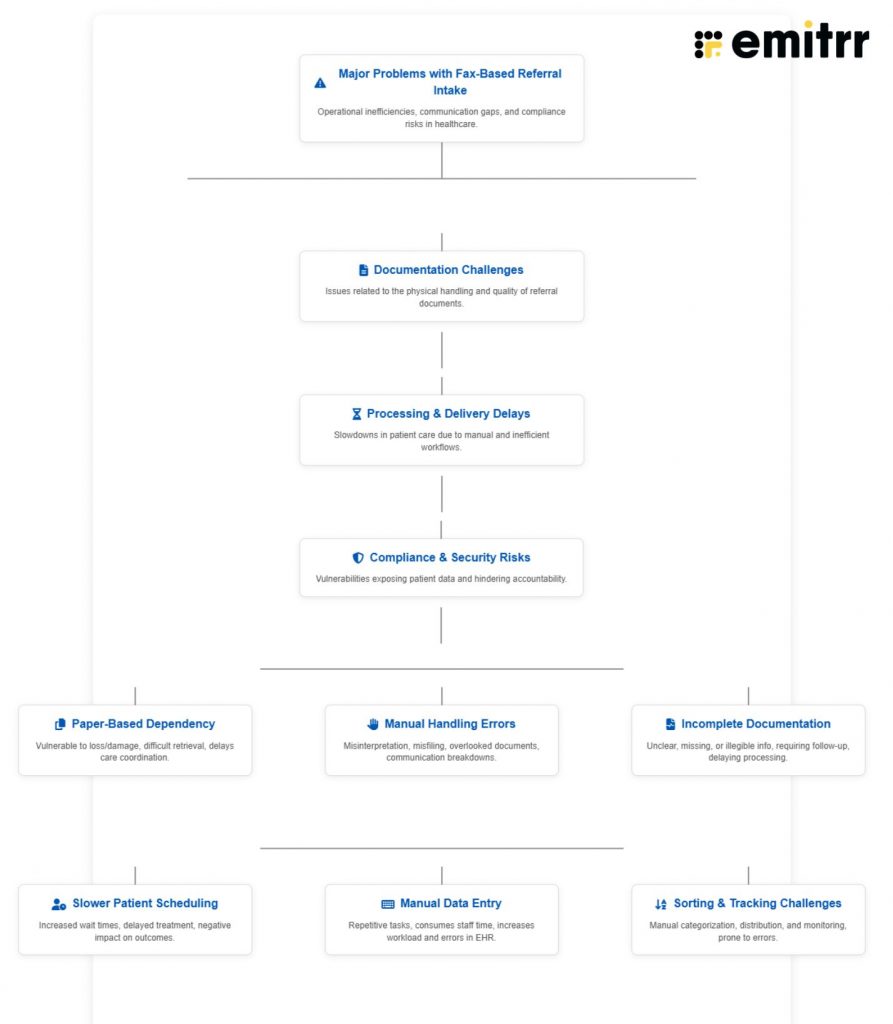
Fax-based referral workflows create significant operational inefficiencies, communication gaps, and compliance risks in modern healthcare environments. As patient volumes and coordination requirements increase, HIPAA-Compliant Virtual Faxing often results in lost referrals, delayed care delivery, administrative overload, and limited visibility into referral tracking.
Paper-Based Dependency
Fax-based referrals rely heavily on physical or scanned documents, which are vulnerable to loss, damage, or misplacement. Paper-based storage also makes retrieval difficult, increasing the chances of missing referrals and delaying patient care coordination across departments.
Manual Handling Errors
Staff must manually review and process faxed referrals, increasing the risk of misinterpretation, misfiling, or overlooked documents. Human errors during sorting, verification, or documentation entry can lead to missed referrals and communication breakdowns between healthcare providers.
Incomplete Referral Documentation
Fax transmissions often include unclear, missing, or illegible information due to poor print quality or transmission failures. Staff must spend additional time contacting referring providers to obtain missing details, delaying referral processing and slowing patient intake workflows.
Delayed Referral Processing
Manual fax review, verification, and data entry significantly slow referral workflows. Administrative teams must sort documents, validate patient information, and update internal systems, creating bottlenecks that delay provider review and patient online appointment scheduling.
Slower Patient Scheduling and Treatment
Inefficient referral intake processes increase patient wait times and delay treatment initiation. Patients may experience extended delays in receiving specialist consultations or diagnostic services, negatively impacting care outcomes and patient satisfaction.
Manual Data Entry
Administrative teams must manually transfer referral details from fax documents into EHR or practice management systems. This repetitive process consumes valuable staff time, increases operational workload, and raises the likelihood of data entry errors affecting patient records.
Sorting and Tracking Challenges
Fax-based referrals require staff to categorize, distribute, and track documents across departments manually. Without automated tracking tools, practices often rely on HIPAA-compliant fax cover sheet or paper logs, making referral monitoring time-consuming and prone to errors.
Increased Staffing Requirements
Managing fax-based referral workflows requires additional administrative staff to handle document processing, follow-ups, and tracking. Increased staffing demands raise operational costs and reduce overall practice efficiency.
Lack of Centralized Tracking
Fax systems do not provide centralized referral dashboards, making it difficult to track referral progress in real time. Practices struggle to monitor referral completion, patient scheduling, and provider follow-ups without unified tracking systems.
Difficulty Monitoring Referral Status
Providers often lack visibility into referral outcomes, appointment status, or patient progress. Limited monitoring capabilities reduce accountability and make it challenging to identify delays, missed referrals, or workflow inefficiencies.
Risk of Misdirected Faxes
Fax documents can be accidentally sent to incorrect numbers or departments, exposing confidential patient information. Misdirected referrals create serious privacy risks and may result in compliance violations or data breach incidents.
Lack of Audit Trails
Traditional fax systems provide minimal tracking or documentation of referral communication history. Without audit trails, healthcare organizations face challenges in verifying communication accuracy, monitoring workflow performance, or demonstrating compliance during HIPAA compliance audits.
Potential HIPAA Vulnerabilities
Although fax can meet compliance requirements when properly managed, it lacks advanced encryption, monitoring, and access control features. These limitations increase the risk of unauthorized access, data exposure, and compliance gaps in healthcare communication workflows.
How Fax-Based Intake Impacts Patient Experience
Fax-based referral intake negatively affects patient experience by creating communication delays, limiting transparency, and reducing no-shows coordination between healthcare providers. Manual referral workflows often prevent patients from receiving timely updates, scheduling appointments quickly, or experiencing seamless care transitions between providers.
Slower Response Time
Fax-based workflows require manual referral processing, verification, and scheduling coordination, which significantly delays response times. Patients often wait longer to receive appointment confirmations or treatment updates, leading to delays in care and reduced confidence in healthcare service delivery.
Increased Patient Frustration
When referral processing takes longer due to manual fax workflows, patients frequently need to follow up with providers multiple times. Lack of timely updates and scheduling delays creates frustration, confusion, and dissatisfaction with the overall healthcare experience.
Lack of Automated Updates
Fax-based referral systems do not support automated notifications or real-time status updates. Patients and referring providers remain unaware of referral progress, appointment scheduling, or required documentation, creating communication gaps throughout the referral journey.
Poor Referral Transparency
Patients often lack visibility into whether their referral has been received, reviewed, or scheduled. Limited transparency increases uncertainty, causes repeated patient inquiries, and reduces trust in healthcare providers and administrative processes.
Fragmented Communication
Fax communication often operates separately from other healthcare communication channels, leading to disconnected referral workflows. Providers, administrative staff, and patients may rely on different systems, resulting in inconsistent messaging and incomplete information sharing.
Reduced Collaboration Between Providers
Fax-based referrals limit real-time collaboration between referring and receiving providers. Without streamlined communication tools, providers may struggle to exchange updates, clarify clinical details, or coordinate patient treatment plans effectively, impacting overall care quality.
What Are the Hidden Costs of Fax-Based Referral Intake?
Fax-based referral intake creates several hidden financial and operational costs that healthcare practices often overlook. Beyond equipment expenses, manual referral workflows increase staffing demands, reduce patient intake efficiency, and limit revenue growth due to delayed or missed referral opportunities.
Paper, Hardware, and Maintenance Expenses
Fax-based workflows require continuous spending on paper, toner, machine maintenance, and technical support. Over time, these recurring expenses increase operational costs, especially for high-volume practices that handle large numbers of referral documents daily.
Staffing and Administrative Overhead
Managing fax referrals requires significant administrative involvement, including document sorting, verification, and manual data entry. Increased staffing requirements and extended processing time raise labor costs while reducing productivity and operational efficiency across healthcare practices.
Lost Referral Opportunities
Missed, delayed, or misplaced fax referrals can result in lost patient opportunities. When referrals are not processed quickly, patients may seek care from alternative providers, directly impacting practice revenue and reducing long-term patient retention.
Reduced Patient Intake Efficiency
Slow fax-based referral workflows limit a practice’s ability to manage higher patient volumes. Inefficient intake processes create scheduling delays, reduce appointment availability, and restrict practice scalability, ultimately affecting revenue growth and service expansion.
What Are the Modern Alternatives to Fax-Based Referral Intake?
Modern healthcare communication platforms replace fax-based referral workflows by automating referral capture, improving communication, and integrating referral data directly into healthcare systems. These digital solutions help practices streamline operations, improve referral tracking, and enhance patient and provider collaboration.
Automated Referral Capture
Digital referral intake platforms automatically collect referral data from multiple communication channels such as online forms, messaging systems, and integrated provider portals. This eliminates manual document handling, reduces processing errors, and ensures referral information is captured accurately and efficiently.
Real-Time Tracking and Reporting
Digital systems provide centralized dashboards that allow practices to monitor referral progress instantly. Healthcare teams can track referral status, identify delays, and analyze performance metrics, improving workflow transparency and enabling faster referral processing and patient scheduling.
Instant Notifications
Automated communication platforms send real-time notifications to providers and patients regarding referral status, appointment scheduling, and required documentation. Instant updates improve communication efficiency, reduce follow-ups, and help ensure patients receive timely care.
Patient and Provider Communication Automation
Automated messaging solutions enable consistent communication through SMS, messaging platforms, or digital portals. These systems reduce administrative workload by automatically sending reminders, referral confirmations, and follow-up messages to patients and healthcare providers.
EMR/EHR Integration
Digital referral platforms integrate seamlessly with Electronic Medical Records and Electronic Health Record systems. Integration ensures referral data is automatically transferred and stored within existing healthcare systems, improving accuracy and eliminating duplicate data entry.
Centralized Referral Dashboards
Modern referral management systems provide centralized dashboards that display referral pipelines, patient status, and provider updates. These dashboards improve referral visibility and allow healthcare teams to manage referral workflows efficiently from a single interface.
Automated Intake Forms
Digital intake solutions allow patients and referring providers to submit structured referral information through online forms. Automated forms ensure complete data collection, reduce documentation errors, and accelerate referral processing and appointment scheduling.
How Can Healthcare Practices Transition Away From Fax-Based Referral Intake?
Healthcare practices can successfully replace fax-based referral workflows by adopting digital referral automation platforms, improving internal processes, and training staff to manage modern communication systems. Transitioning to automated referral intake improves efficiency, reduces errors, and enhances patient care coordination.
Workflow Evaluation
Healthcare organizations should analyze their current referral processes to identify bottlenecks, manual inefficiencies, and communication gaps. Evaluating workflows helps practices understand where delays occur and determines the specific features required in digital referral automation solutions.
Selecting Referral Automation Software
Practices should choose referral automation platforms that integrate with existing EHR systems, communication tools, and scheduling workflows. Selecting the right software ensures seamless data transfer, reduces implementation complexity, and supports long-term operational efficiency improvements.
Staff Training and Implementation
Successful transition requires structured staff training programs and gradual implementation strategies. Educating administrative and clinical teams helps reduce workflow disruption, improves adoption rates, and ensures teams can efficiently manage digital referral intake processes.
Automated Triaging
Automation platforms categorize and prioritize referrals based on urgency, specialty, and treatment requirements. Automated triaging ensures critical cases are addressed quickly and reduces manual referral sorting workload for administrative teams.
Referral Routing
Digital referral systems automatically route referrals to appropriate providers, departments, or specialists. Automated routing eliminates manual distribution errors, speeds up referral processing, and improves coordination across healthcare teams.
Real-Time Communication
Automation platforms enable instant communication between providers, administrative staff, and patients throughout the referral process. Real-time updates improve transparency, reduce follow-ups, and enhance overall patient experience.
Analytics and Performance Monitoring
Modern referral automation tools provide performance dashboards that track referral conversion rates, processing times, and workflow efficiency. These insights help healthcare practices identify opportunities for improvement and optimize referral management strategies.
See how AI is changing healthcare:
How Emitrr Helps Replace Fax-Based Referral Intake
Emitrr helps healthcare practices eliminate manual fax referral workflows by providing a centralized, automated communication and referral management platform. It streamlines referral intake, improves provider and patient communication, and enhances visibility while maintaining healthcare compliance standards.
HIPAA-Compliant Communication
Emitrr offers secure messaging with end-to-end encryption, role-based access controls, and detailed audit trails. These features help healthcare organizations protect patient data, maintain regulatory compliance, and ensure safe HIPAA-compliant communication between providers, staff, and patients.
Automated Referral Intake and Routing
Emitrr automatically captures referral information from digital channels such as online forms, messaging, and provider submissions. The platform intelligently routes referrals to appropriate departments or specialists, reducing manual intervention and improving referral processing speed.
Real-Time Referral Tracking
Emitrr provides centralized dashboards that allow healthcare teams to monitor referral progress at every stage. Automated status updates improve referral visibility, reduce missed referrals, and help practices track patient scheduling and treatment timelines efficiently.
Patient and Provider Communication Automation
Emitrr enables automated communication through SMS and messaging channels to send referral confirmations, appointment reminders, and follow-up notifications. This improves engagement, reduces administrative workload, and ensures consistent communication throughout the patient referral journey.
EHR Integration
Emitrr integrates seamlessly with Electronic Health Record and practice management systems, allowing automatic transfer of referral data. This eliminates duplicate data entry, improves documentation accuracy, and streamlines referral workflow automation across healthcare operations.
Watch how Emitrr’s AI Agent Sarah makes client communication, bookings, and follow-ups effortless with smart, automated two-way texting and multi-channel engagement.
Key Takeaways
- Fax-based referral intake remains widely used due to legacy infrastructure and familiarity across healthcare networks.
- Fax workflows create delays, lost referrals, and significant administrative inefficiencies.
- Manual referral systems negatively impact patient experience and care coordination.
- Digital referral intake solutions improve tracking, communication, and operational performance.
- Healthcare practices are transitioning toward automated, integrated referral management platforms to improve efficiency and patient outcomes.
Frequently Asked Questions (FAQs)
Many healthcare providers continue using fax due to familiarity, perceived compliance security, and compatibility with legacy systems.
Fax can be compliant when used properly, but it lacks modern tracking, encryption, and monitoring capabilities required for advanced compliance.
Common risks include lost referrals, delayed patient care, administrative inefficiencies, and potential data privacy concerns.
Digital systems accelerate scheduling, provide automated updates, and improve transparency throughout the referral journey.
Costs vary based on platform selection, implementation complexity, and integration requirements, but digital systems often reduce long-term operational expenses.
Healthcare organizations should prioritize automation, real-time tracking, compliance features, EHR integration, and communication capabilities.