
 4.9 (400+
reviews)
4.9 (400+
reviews)
Introduction
Secure communication in healthcare has become more important than ever before. Healthcare providers handle vast amounts of Protected Health Information (PHI) daily, including patient records, prescriptions, lab results, insurance details, and billing data. Any breach or unauthorized access to this information can have serious legal, financial, and reputational consequences.
Despite technological advancements, many healthcare organizations still rely on traditional communication methods like fax, while others have shifted toward email in healthcare communication due to its speed and convenience. However, not all communication channels are equally secure or compliant.
This leads to a critical question: Fax vs email in healthcare, which is more secure and HIPAA-compliant?
In this comprehensive guide, we’ll explore fax vs email security, analyze risks, compare compliance requirements, and help you determine the best approach for secure healthcare communication.
Why Secure Communication Matters in Healthcare
Secure communication is the backbone of modern healthcare operations. Every interaction involving patient data must comply with strict regulations like HIPAA to ensure PHI protection and maintain patient trust. Healthcare data is extremely valuable, which makes the industry a prime target for cybercriminals. A single lapse in healthcare data security can result in:
- Data breaches in healthcare, exposing sensitive patient information
- Heavy HIPAA penalties and fines
- Legal consequences and lawsuits
- Loss of patient trust and brand reputation
Understanding How Fax Works
Traditional Fax Technology
Traditional fax in healthcare operates through Public Switched Telephone Networks (PSTN), which are essentially dedicated phone lines. When a fax is sent, the document is converted into signals and transmitted directly to the recipient’s fax machine.
This method offers a few inherent security advantages:
- Point-to-point transmission reduces interception risks
- No reliance on internet connectivity
- Limited exposure to cyberattacks
Because of this closed-loop system, traditional fax has long been considered a secure communication method in healthcare, especially for transmitting PHI. However, while fax avoids internet-based threats, it is not completely risk-free and lacks modern security features.
Modern Cloud Faxing
With the rise of digital transformation, cloud fax solutions (also known as online faxing or HIPAA-compliant fax) have revolutionized how faxing works. Unlike traditional machines, secure faxing solutions operate over the internet but incorporate advanced security features such as:
- End-to-end encryption to protect data during transmission and storage
- Secure cloud storage for easy access and retrieval
- Detailed audit trails for compliance and monitoring
- Role-based access controls to restrict unauthorized access

Understanding How Email Works
Basic Email Infrastructure
Email operates using internet-based protocols like SMTP (Simple Mail Transfer Protocol). When you send an email, it travels through multiple servers before reaching the recipient. It may be temporarily or permanently stored on different systems, and copies may exist on the sender and recipient devices
This multi-step process increases the attack surface, making email more vulnerable to interception, hacking, and unauthorized access. This is why email security in healthcare requires additional safeguards beyond standard configurations.
Email in Healthcare Communication
Despite its risks, email in healthcare communication is widely used due to its:
- Speed and convenience
- Ease of sharing attachments
- Ability to facilitate collaboration
However, standard email is not inherently HIPAA-compliant. Without proper encryption and security measures, email can expose sensitive data and lead to healthcare data breaches. This makes it essential to understand the risks associated with fax vs email in healthcare.
Security Risks of Email in Healthcare
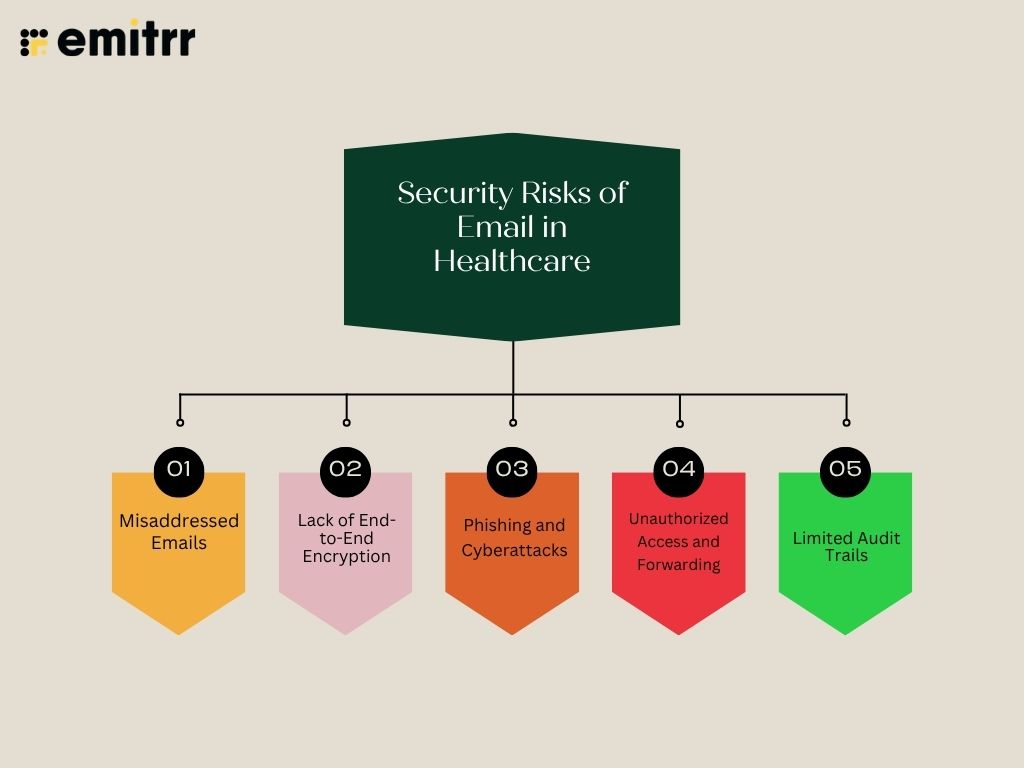
Misaddressed Emails
One of the most common risks in email communication in healthcare is human error. A simple typo in the recipient’s address can send PHI to the wrong person. Unlike some messaging platforms, emails cannot always be recalled, making this a serious PHI protection risk.
Lack of End-to-End Encryption
Most standard email services rely on Transport Layer Security (TLS), which only encrypts data during transmission. However, emails may not be encrypted at rest, attachments can remain unprotected, and recipients may access emails on unsecured devices. This makes email encryption in healthcare incomplete unless additional tools are used.
Phishing and Cyberattacks
Email is the most common entry point for healthcare cybersecurity threats, including phishing attacks targeting staff, malware infections, and ransomware attacks. Cybercriminals often exploit email vulnerabilities to gain access to entire healthcare systems.
Unauthorized Access and Forwarding
Emails can be forwarded without restrictions, downloaded and stored locally, and accessed across multiple devices. This lack of control increases the risk of unauthorized PHI access, especially in large healthcare organizations.
Limited Audit Trails
Tracking who accessed, downloaded, or forwarded an email is difficult with standard systems. This creates challenges for compliance monitoring, incident investigation and audit readiness.
Security Risks of Traditional Fax
While fax vs email security in healthcare discussions often position fax as a safer option, traditional fax systems are not fully secure or HIPAA compliant. These legacy systems lack modern safeguards, making them vulnerable to errors, unauthorized access, and PHI exposure risks. Understanding these fax security risks in healthcare is essential for maintaining compliance and protecting patient data.
Misdialed Fax Numbers
One of the biggest risks in traditional fax machines in healthcare is human error. Entering the wrong fax number can send sensitive patient information to unintended recipients, leading to serious HIPAA violations and data breaches.
Physical Document Exposure
Traditional faxing often involves printed documents, which creates physical security risks in healthcare settings. Faxed papers can be left unattended on machines or accessed by unauthorized individuals in shared spaces, leading to unauthorized PHI access.
Lack of Advanced Tracking
Traditional fax systems provide only basic delivery confirmations, with no detailed audit logs or tracking capabilities. This makes it difficult for healthcare organizations to monitor who accessed or handled sensitive data, creating challenges in HIPAA compliance and reporting. Without proper tracking, identifying and resolving healthcare data breaches becomes much harder.
Outdated Technology
Legacy fax systems lack essential security features such as encryption, secure storage, and access controls, making them unsuitable for modern healthcare cybersecurity needs. These outdated technologies are more vulnerable to data interception and unauthorized access, increasing fax security risks in healthcare.
The Shift Toward Digital Faxing in Healthcare
The healthcare industry is increasingly adopting digital fax solutions to meet growing demands for speed, security, and HIPAA-compliant communication. This shift reflects the need for more efficient, scalable, and secure ways to handle sensitive patient information while reducing reliance on outdated systems.
7.1 Changing Communication Needs in Healthcare
- Increasing data volume: Healthcare providers handle large amounts of patient data daily, making secure data transmission more critical than ever.
- Need for faster workflows: Real-time communication is essential for care coordination, pushing the need for faster and more efficient healthcare communication systems.
- Compliance expectations evolving: Stricter regulations like HIPAA require advanced safeguards, increasing demand for secure and compliant communication tools.
7.2 How Faxing Has Evolved
- From physical machines to digital interfaces: Faxing has moved from standalone machines to cloud-based platforms accessible from multiple devices.
- Internet-enabled fax transmission: Modern systems use the internet for faster, more reliable, and encrypted fax communication.
- Reduced dependency on hardware: Digital faxing eliminates the need for physical machines, reducing maintenance costs and improving flexibility.
7.3 Capabilities of Modern Faxing Systems
- Encrypted transmission and storage: Ensures PHI protection by securing data both in transit and at rest, supporting HIPAA-compliant faxing.
- End-to-end encryption: Advanced systems use strong encryption protocols to prevent interception and unauthorized access during fax transmission.
- Controlled access to documents: Role-based permissions ensure only authorized users can view, send, or manage sensitive information.
- Multi-factor authentication (MFA): Adds an extra layer of security, reducing the risk of unauthorized system access.
- Activity tracking and logs: Detailed audit trails provide visibility into who accessed or sent documents, helping with compliance reporting and audits.
- Automated workflows: Enable features like auto-routing, scheduling, and notifications, improving efficiency in healthcare communication workflows.
- Integration with digital healthcare systems: Seamlessly connects with EHRs, CRMs, and other tools to streamline data exchange and reduce manual work.
- Cloud-based storage: Secure cloud environments ensure easy access, backup, and retrieval of faxed documents without physical storage risks.
- Error reduction features: Built-in validations, contact directories, and confirmation alerts help minimize human errors like misdialing.
- Scalability and remote access: Allows healthcare providers to send and receive faxes from anywhere, supporting growing operational needs and remote teams.
Fax vs Email vs Modern Fax: Comparison Table
| Feature | Traditional Fax | Online/Cloud Fax | |
| Transmission Method | Point-to-point (PSTN) | Multi-server (internet-based) | Encrypted internet-based |
| Encryption | No built-in encryption | Partial (TLS only) | End-to-end encryption |
| Cyberattack Risk | Low | High (phishing, malware) | Low |
| Human Error Risk | Misdialing | Misaddressed emails | Reduced (validation controls) |
| Access Control | Limited | Limited | Role-based access |
| Audit Trails | Minimal | Limited | Detailed logs & tracking |
| Data Storage | Physical papers | Multiple servers/devices | Secure cloud storage |
| HIPAA Compliance | Possible with safeguards | Requires strict setup | Designed for compliance |
HIPAA Compliance: Fax vs Email
When evaluating fax vs email security in healthcare, compliance with HIPAA is a critical factor. Both fax and email can be used for transmitting Protected Health Information (PHI), but their level of compliance depends on how they are implemented and secured.
Is Fax HIPAA-Compliant?
Yes, fax in healthcare is generally considered HIPAA compliant because it follows established workflows for secure information exchange. However, compliance depends on implementing proper safeguards to prevent unauthorized access and PHI exposure.
- Verifying recipient fax numbers before sending
- Placing fax machines in secure, restricted locations
- Limiting access to authorized personnel only
Fax continues to be widely used for transmitting sensitive documents such as:
- Medical records
- Prescriptions
- Insurance and billing documentation
Is Email HIPAA-Compliant?
Email can be HIPAA compliant, but only when strict security measures are in place. Without these safeguards, email becomes a major healthcare data security risk due to its vulnerability to interception and unauthorized access.
- End-to-end encryption for secure transmission
- Strong access controls and authentication
- Signed Business Associate Agreements (BAA) with service providers
Without proper configuration, email can expose sensitive data, making secure email communication in healthcare more complex to manage.
Why Emitrr Is the Best Solution for Secure Healthcare Communication
Healthcare communication today is often scattered across multiple tools—fax machines, email systems, calling platforms, and messaging apps. This not only slows down operations but also increases the risk of HIPAA violations and data breaches.
Emitrr solves this problem by bringing everything together into a single, secure, and healthcare-focused communication platform, helping providers streamline workflows while ensuring complete compliance.
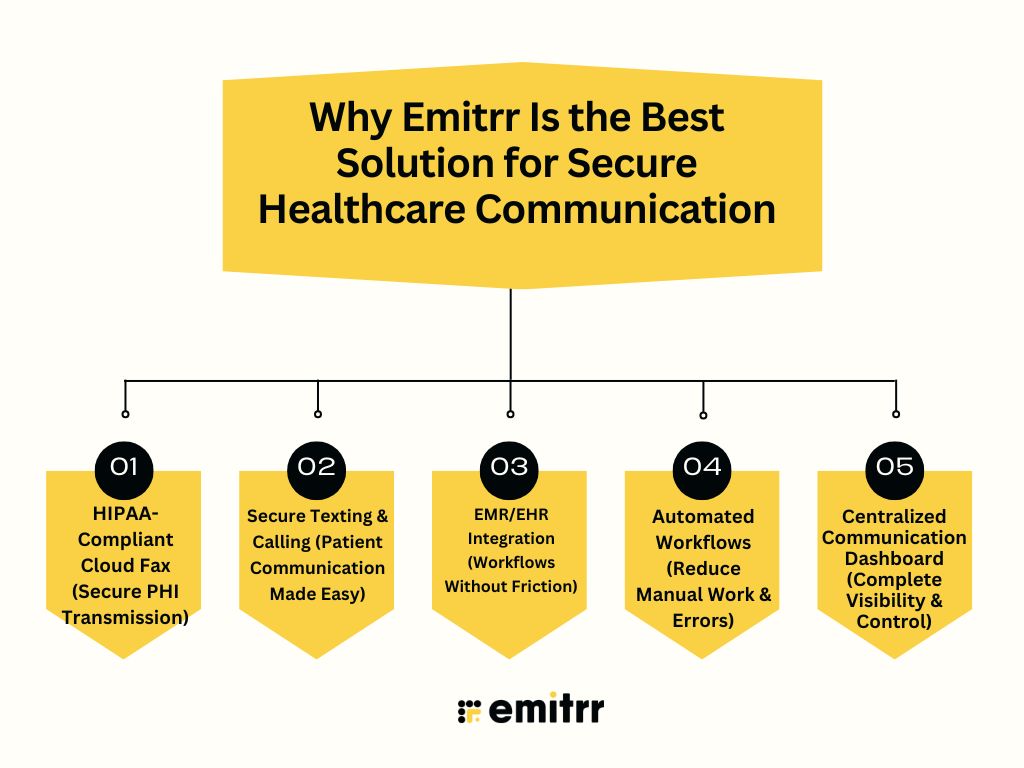
HIPAA-Compliant Cloud Fax (Secure PHI Transmission)
Emitrr modernizes traditional faxing by offering a fully HIPAA-compliant faxing solution designed for secure transmission of sensitive patient data. Instead of relying on outdated machines or manual processes, healthcare providers can send and receive documents digitally with end-to-end encryption and built-in compliance safeguards.
Secure Texting & Calling (Patient Communication Made Easy)
With Emitrr, healthcare providers can communicate with patients through secure texting and calling without worrying about privacy concerns. The platform enables HIPAA-compliant SMS and voice communication, making it easy to send appointment reminders, follow-ups, and important updates.
EMR/EHR Integration (Workflows Without Friction)
Emitrr seamlessly integrates with existing EMR/EHR systems, allowing healthcare providers to manage communication directly within their workflows. This eliminates the need to switch between multiple platforms or manually update patient information. By syncing communication data with patient records, Emitrr ensures better coordination among teams, faster access to information, and a more efficient operational flow across the organization.
Automated Workflows (Reduce Manual Work & Errors)
Manual communication processes can be time-consuming and prone to human error. Emitrr addresses this by enabling automated workflows that streamline routine tasks such as sending reminders, patient follow-ups, and document sharing. With automation in place, healthcare providers can ensure timely and consistent communication while significantly reducing administrative burden.
Centralized Communication Dashboard (Complete Visibility & Control)
Emitrr provides a centralized communication dashboard where all interactions, fax, SMS, and calls can be managed in one place. This unified view allows healthcare teams to track conversations in real time, monitor performance, and maintain detailed audit trails for compliance purposes.
With role-based access controls and secure data handling, the platform ensures that only authorized personnel can access sensitive information, giving providers complete visibility and control over their communication processes.
FAQs: Fax vs Email in Healthcare
Yes, traditional fax is generally considered more secure than standard email because it uses direct, point-to-point transmission and does not rely on the internet. However, modern online faxing offers even stronger security with encryption, access controls, and audit trails.
Yes, email can be HIPAA-compliant, but only if it includes safeguards such as end-to-end encryption, secure access controls, and a signed Business Associate Agreement (BAA). Without these, email is not considered secure for transmitting PHI.
Email is less secure because it travels through multiple servers, can be intercepted, and is highly vulnerable to phishing attacks, misaddressing, and unauthorized access. Fax, on the other hand, typically uses direct transmission, reducing exposure.
Yes, online faxing is designed to support secure healthcare communication. It typically includes features like encryption, access controls, secure storage, and activity tracking, making it suitable for handling sensitive patient data.
Hospitals continue to use fax because it is widely accepted for compliance, easy to use, and aligns well with existing healthcare workflows. It is also perceived as more secure than standard email for sharing sensitive information.
The safest methods include using secure communication systems that offer encryption, access controls, and compliance safeguards. This can include advanced faxing systems or properly configured secure email platforms.
Traditional fax relies on physical machines and phone lines, while online fax uses internet-based systems with enhanced features like encryption, digital storage, and audit logs, making it more adaptable to modern healthcare needs.
Conclusion
When it comes to fax vs email in healthcare, the decision ultimately comes down to balancing security, compliance, and efficiency. Traditional fax offers a more controlled, direct method of communication but lacks the flexibility and advanced safeguards needed today. Email, while convenient and widely used, introduces significant risks unless properly secured with encryption and strict access controls. As healthcare communication continues to evolve, relying solely on either method without modernization can leave gaps in both security and workflow efficiency.
Platforms like Emitrr are helping bridge this gap by bringing together secure faxing, encrypted messaging, and streamlined communication workflows into one compliant system. Instead of choosing between outdated or risky options, healthcare providers can adopt solutions that align with modern security standards while improving day-to-day operations.
If you’re looking to upgrade your communication stack, book a demo now!!