
 4.9 (400+
reviews)
4.9 (400+
reviews)
Introduction
In today’s fast-paced world, communication is key, especially in healthcare. Patients expect quick, convenient ways to connect with their providers, and texting has become a popular channel. But is your practice using texting in a way that keeps patient information safe and private? If you’re not careful, you could be violating the Health Insurance Portability and Accountability Act (HIPAA), leading to hefty fines and damaged trust.
So, how can you harness the power of texting while staying on the right side of the law? It all comes down to understanding and implementing a robust HIPAA-compliant texting checklist. This isn’t just about ticking boxes; it’s about building a secure communication ecosystem that protects sensitive patient data, known as Protected Health Information (PHI). Let’s dive into what makes texting HIPAA compliant and create your go-to checklist.
Key Takeaways
- Standard SMS is NOT HIPAA Compliant: Always use a dedicated, secure platform for any healthcare-related texting.
- PHI Protection is Key: Any message containing patient identifiers linked to health information is PHI and requires protection.
- Business Associate Agreements (BAAs) are Mandatory: Ensure your texting vendor signs a BAA.
- Patient Consent is Crucial: Obtain explicit consent and honor opt-out requests promptly.
- Technology + Policy + Training = Compliance: A multi-faceted approach is necessary for success.
- Audit Trails are Essential: Track all communication for accountability and security.
- Consequences of Non-Compliance are Severe: Fines, legal action, and reputational damage are significant risks.
What Exactly is HIPAA and Why Does It Matter for Texting?
HIPAA, the Health Insurance Portability and Accountability Act, is a U.S. law enacted in 1996. Its primary goal is to protect sensitive patient health information from being disclosed without the patient’s consent or knowledge. Think of it as the rulebook for how healthcare providers, insurance companies, and their business associates must handle and secure PHI.
Protected Health Information (PHI) includes any data that can identify a patient and relates to their past, present, or future health status, healthcare services, or payment for healthcare. This can range from names and phone numbers to medical records, appointment details, and insurance information.
When it comes to texting, even seemingly innocuous messages can contain PHI. For example, a simple appointment reminder like, “Hi Sarah, your dental appointment is tomorrow at 3 PM,” contains Sarah’s name (an identifier) and her appointment (health-related information). Therefore, it’s PHI and must be handled according to HIPAA rules.
Failing to comply with HIPAA can result in serious consequences, including:
- Hefty Fines: Penalties can range from hundreds to millions of dollars, depending on the severity and nature of the violation. The U.S. Department of Health and Human Services, through its Office for Civil Rights (OCR), enforces these penalties.
- Legal Action: Patients or the government can take legal action against non-compliant organizations.
- Reputational Damage: A breach of patient privacy can severely damage a healthcare provider’s reputation and erode patient trust.
- Operational Disruption: Investigations and mandatory corrective actions can disrupt daily operations.

The Core HIPAA Rules You Need to Know
To build your compliant texting strategy, you need a basic understanding of the core HIPAA rules:
- The Privacy Rule: This rule sets national standards for protecting individuals’ medical records and other personal health information. It governs how PHI can be used and disclosed, and it gives patients rights over their health information. For texting, this means sharing PHI only when necessary for treatment, payment, or healthcare operations, and respecting patients’ communication preferences.
- The Security Rule: This rule focuses on protecting electronic PHI (ePHI) created, received, maintained, or transmitted by a covered entity. It requires administrative, physical, and technical safeguards. For texting, this is crucial. It means using encrypted communication channels, secure systems, and controlling who has access to the information.
- The Breach Notification Rule: If a breach of unsecured PHI occurs, this rule requires covered entities to notify affected individuals without unreasonable delay, and no later than 60 days after discovery. It also requires notification to the HHS Secretary and, in some cases, the media.
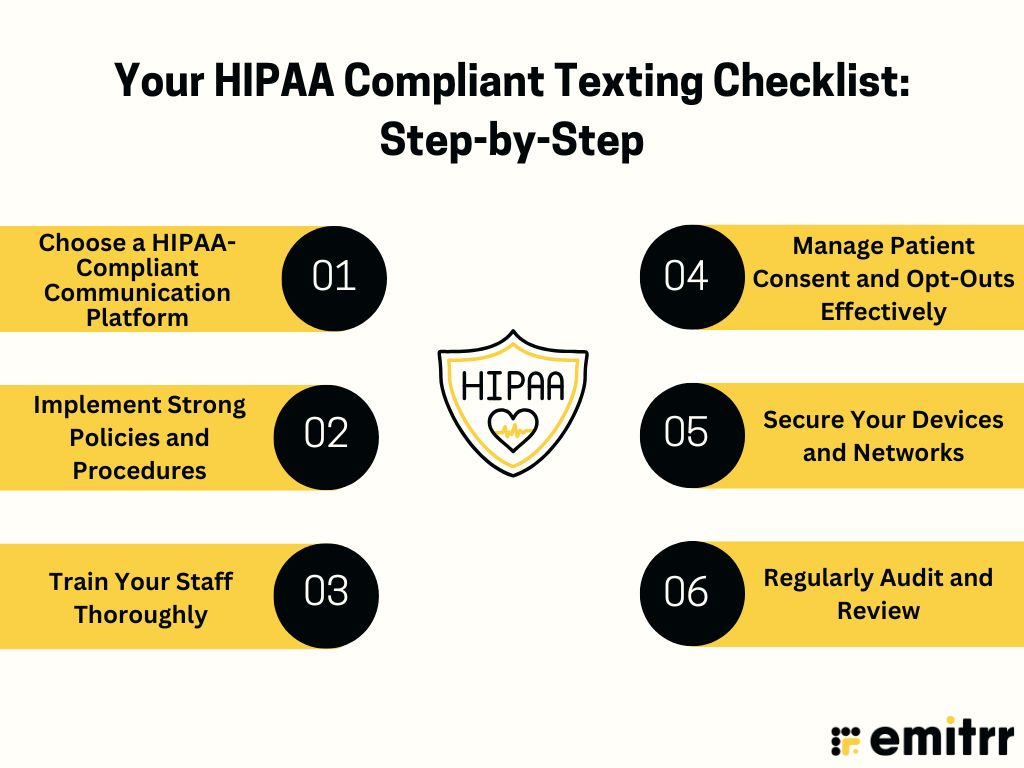
Your HIPAA Compliant Texting Checklist: Step-by-Step
Creating a HIPAA-compliant texting strategy involves more than just choosing a platform. It requires a holistic approach that includes policies, procedures, and the right technology. Here’s a detailed checklist to guide you:
1. Choose a HIPAA-Compliant Communication Platform
This is arguably the most critical step. Standard SMS messaging apps are not HIPAA compliant. They lack the necessary encryption and security features.
- Does the platform offer end-to-end encryption? This ensures that messages are protected from the moment they are sent until they are received, preventing unauthorized access during transmission.
- Does the platform provide secure user authentication? Look for features like strong password policies, multi-factor authentication (MFA), and role-based access controls.
- Does the platform offer audit trails? You need to be able to track who sent what message, when, and to whom. This is essential for accountability and for investigating any potential breaches. For example, call center speech analytics software can also provide valuable insights into communication patterns, though it’s distinct from direct texting compliance.
- Does the platform store data securely? Data should be encrypted both in transit and at rest.
- Does the platform offer secure messaging features? This includes two-way secure messaging, automated appointment reminders, and the ability to send secure attachments.
- Will the vendor sign a Business Associate Agreement (BAA)? A BAA is a legally binding contract that outlines how the vendor will protect PHI on your behalf. This is mandated by the HIPAA Omnibus Rule. Any vendor handling PHI on your behalf must sign a BAA. Platforms like Emitrr offer HIPAA-compliant voicemail script solutions that are built with compliance in mind.
2. Implement Strong Policies and Procedures
Technology alone isn’t enough. You need clear policies to guide how your staff uses the communication platform.
- Develop a comprehensive Communication Policy: This policy should clearly define acceptable use of the texting platform, outlining what kind of information can be shared via text and what should be avoided.
- Establish Access Controls: Define who in your organization is authorized to send and receive patient messages. Implement role-based access so staff only have access to the information necessary for their job functions.
- Create a Minimum Necessary Policy: Ensure staff only share the minimum amount of PHI required to achieve the communication’s purpose. For instance, don’t send a full medical history when a simple appointment confirmation is needed.
- Define Data Retention Policies: How long will messages be stored? Ensure your retention policy aligns with legal requirements and organizational needs.
- Outline a Breach Response Plan: What steps will your organization take if a data breach occurs? This plan should include reporting procedures, communication strategies, and remediation steps.
- Establish Patient Consent Procedures: Obtain explicit consent from patients before initiating text message communications. Clearly explain what they are consenting to, how often they can expect messages, and how they can opt-out. This is crucial for adhering to the Privacy Rule.
3. Train Your Staff Thoroughly
Even the best technology and policies are ineffective if staff aren’t properly trained.
- Provide comprehensive HIPAA training: Ensure all staff members understand HIPAA regulations, their responsibilities, and the importance of protecting PHI.
- Train staff on the specific texting platform: Users must know how to use the platform securely and effectively according to your established policies. This includes understanding encryption, access controls, and audit logs.
- Educate on identifying PHI: Staff should be able to recognize what constitutes PHI in text messages.
- Train on consent and opt-out procedures: Ensure staff know how to obtain and document patient consent and how to process opt-out requests promptly.
- Conduct regular refresher training: HIPAA regulations and technology evolve, so ongoing training is essential.
4. Manage Patient Consent and Opt-Outs Effectively
Patient consent is a cornerstone of HIPAA-compliant communication.
- Obtain Written Consent: Always get written consent from patients before sending them text messages, especially for appointment reminders or other health-related information. Clearly state what they are agreeing to receive.
- Inform Patients About Opt-Out: Patients have the right to opt-out of receiving text messages at any time. Make this process clear and easy for them.
- Document Consent and Opt-Outs: Maintain accurate records of which patients have consented to receive texts and which have opted out. Your communication platform should facilitate this.
- Respect Opt-Out Requests Immediately: Once a patient opts out, ensure they stop receiving text messages promptly. Failure to do so can be a violation.
5. Secure Your Devices and Networks
Compliance extends beyond the communication platform itself.
- Secure all devices used for communication: This includes company-issued and personal devices (if allowed under policy) used to access the HIPAA-compliant texting platform. Implement screen locks, strong passwords, and encryption on mobile devices.
- Protect your network: Ensure your office network is secure with firewalls, antivirus software, and regular security updates.
- Control physical access: Limit physical access to servers and devices that store PHI.
6. Regularly Audit and Review
Compliance is an ongoing process, not a one-time task.
- Conduct regular audits of your texting system: Review audit logs to check for any suspicious activity or policy violations.
- Perform periodic risk assessments: Identify potential vulnerabilities in your communication systems and processes.
- Review and update policies regularly: Ensure your policies remain current with HIPAA regulations and technological advancements. For example, strategies to boost your dentistry practices’ business presence might involve new communication channels that need to be assessed for compliance.
The Benefits of HIPAA Compliant Texting
Implementing a HIPAA-compliant texting strategy offers significant advantages beyond just avoiding penalties:
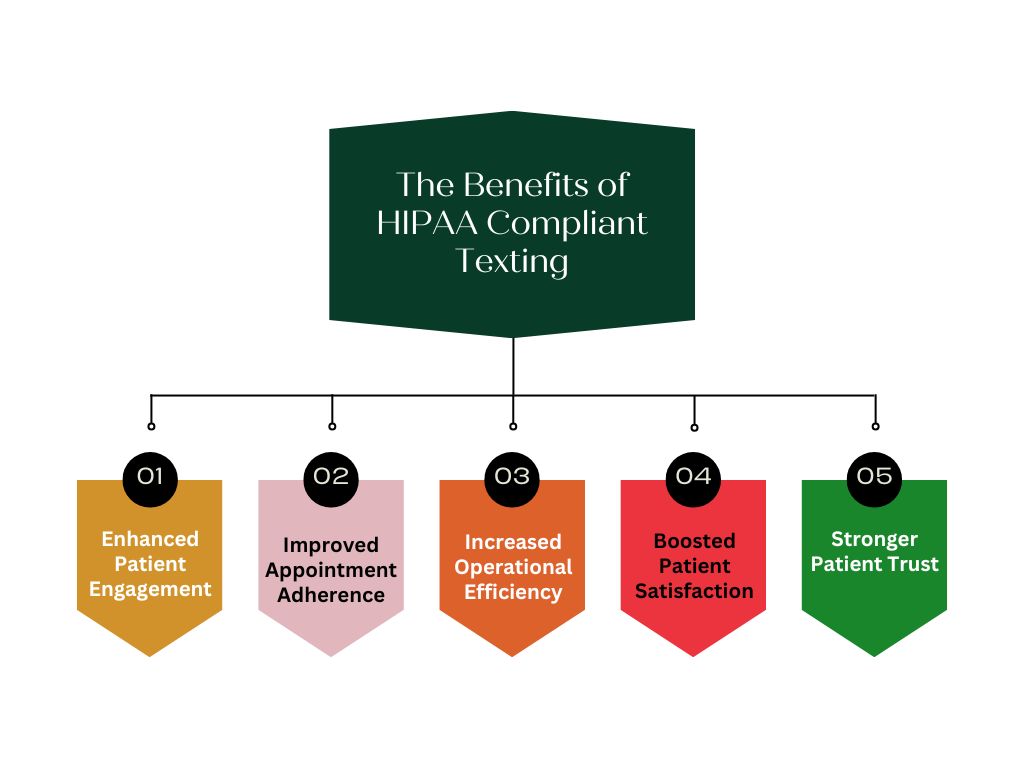
- Enhanced Patient Engagement: Patients appreciate the convenience and speed of text communication.
- Improved Appointment Adherence: Timely reminders sent via secure text can significantly reduce no-show rates.
- Increased Operational Efficiency: Automating appointment reminders and other routine communications frees up staff time.
- Boosted Patient Satisfaction: Offering modern, secure communication methods improves the overall patient experience.
- Stronger Patient Trust: Demonstrating a commitment to privacy and security builds confidence.
Addressing Common Concerns and Pitfalls
- “Can I just use my regular phone?” Absolutely not. Standard phone texting is not secure and does not offer encryption or audit trails necessary for HIPAA compliance.
- “What about appointment reminders?” These are considered PHI if they contain identifiable patient information. They must be sent through a HIPAA-compliant platform.
- “What if a staff member texts from a personal device?” This is a major risk. Your policies must explicitly prohibit this and emphasize the use of the approved, secure platform. If it happens, it could trigger a breach investigation.
- “Is it okay to send photos or videos?” If these contain PHI, they must be sent through your secure, HIPAA-compliant platform.
Frequently Asked Questions (FAQs)
A1: No, standard SMS text messages are generally not considered HIPAA compliant because they are not encrypted and lack the necessary security safeguards. Any message containing identifiable patient information (like name and appointment date) is PHI and must be sent through a secure, HIPAA-compliant platform.
A2: A Business Associate Agreement (BAA) is a contract between a covered entity (like a healthcare provider) and a business associate (like a texting service vendor) that outlines how the business associate will protect PHI on behalf of the covered entity. HIPAA requires that if a vendor handles PHI, they must sign a BAA.
A3: You must obtain explicit consent from patients before sending them text messages. This consent should ideally be in writing and clearly state what type of messages they will receive, how often, and that standard messaging rates may apply. Patients must also be informed of their right to opt-out at any time.
A4: If unsecured PHI is compromised through text messages, your organization must follow the HIPAA Breach Notification Rule. This typically involves notifying affected individuals without unreasonable delay (no later than 60 days), reporting the breach to the U.S. Department of Health and Human Services (HHS), and potentially notifying the media. This can lead to significant fines and reputational damage.
A5: Yes, there are many communication platforms designed specifically for healthcare that are built with HIPAA compliance in mind. These platforms offer features like end-to-end encryption, audit trails, secure messaging, and the ability to sign BAAs. It’s crucial to vet these platforms carefully. For instance, comparing options like Textmagic Vs Simpletexting can help you understand the features needed for compliance.
A6: Penalties for HIPAA violations can be severe. They are tiered based on culpability and range from $100 to $50,000 per violation, with annual maximums for each tier potentially reaching $1.5 million or more. In addition to fines, violations can lead to legal action, mandatory corrective action plans, and significant damage to an organization’s reputation.
Conclusion
In the digital age, secure patient communication is paramount. Texting offers incredible convenience, but it must be implemented with a deep understanding of HIPAA regulations. By following this comprehensive HIPAA-compliant texting checklist—from selecting the right technology and establishing clear policies to training your staff and managing consent—you can confidently leverage the power of text messaging. This ensures you protect your patients’ sensitive information, maintain their trust, and safeguard your practice from the severe consequences of non-compliance. Remember, compliance isn’t just a regulatory burden; it’s a fundamental aspect of providing excellent, trustworthy healthcare.