
 4.9 (400+
reviews)
4.9 (400+
reviews)
Introduction
A text message feels harmless. It is quick, familiar, and often the fastest way to reach a patient. But in healthcare, that small message carries weight. The moment a practice texts a patient, it takes responsibility for protecting sensitive information and patient privacy.
If patient texts are sent without the right safeguards, protected health information (PHI) can be exposed in seconds. And when compliance is ignored, the impact is not minor. Practices can face regulatory penalties, legal consequences, and long-term damage to patient trust.
For Athenahealth practices, patient texting cannot be treated casually. It must be secure, compliant, and intentional. In this blog, we break down what safe patient texting really means, the challenges practices face, and how integrating Athenahealth with Emitrr supports secure, compliant patient communication.
What Makes Patient Texting Safe and Compliant?
Patient texting is only safe when it is designed with privacy as its priority. In healthcare, compliance is not about checking boxes. It is about controlling how information is shared, who can access it, and how every interaction is recorded.
Consider a front desk staff member who texts a patient from their personal phone to quickly resolve an issue. The message sits in the phone’s regular SMS app, unencrypted, and visible on the lock screen. The phone is later lost. That single message, sent with good intentions, now becomes a potential HIPAA violation. With a compliant texting solution, that message would have been sent through a secure text messaging for healthcare, logged automatically, and inaccessible outside authorized systems.
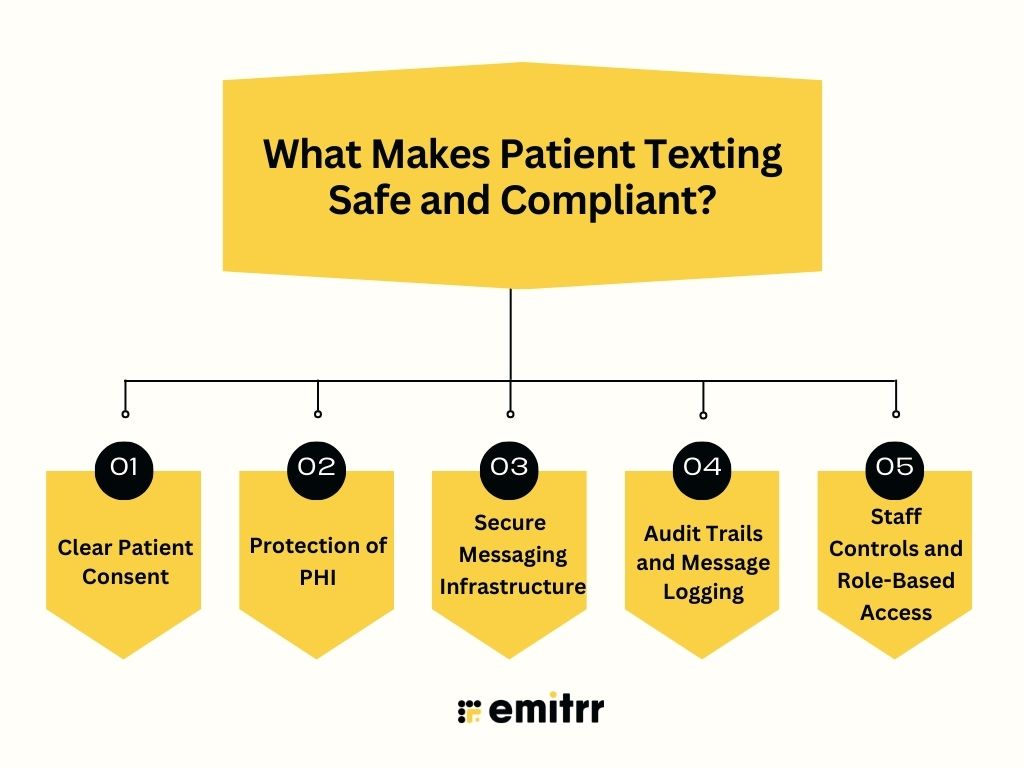
Here are the core elements that make patient texting safe and compliant:
1. Clear Patient Consent
Before any message is sent, patients must explicitly agree to receive texts. This consent should be documented, easily managed, and allow patients to opt out at any time. Without proper consent, even a harmless message can become a compliance violation.
2. Protection of PHI
Compliant texting ensures that PHI should be limited to what is necessary, sent through secure systems, and protected from unauthorized access. Practices must have clear guidelines on what can and cannot be shared over text.
3. Secure Messaging Infrastructure
Safe patient texting requires encryption, controlled access, and authentication. Messages should not live on personal devices or open messaging apps. Only authorized staff should be able to send, view, or respond to patient texts.
4. Audit Trails and Message Logging
Every patient interaction should be traceable. A HIPAA-compliant texting for patient platform automatically logs messages, timestamps, and user activity. This is critical for accountability, internal reviews, and responding to audits or compliance inquiries.
5. Staff Controls and Role-Based Access
Not every team member needs the same level of access. Safe texting platforms allow practices to define who can send messages, who can view conversations, and who can manage consent. This reduces the risk of accidental exposure or misuse.
Watch how easy it is to text patients directly from Athenahealth the compliant way –
Challenges Athenahealth Practices Face with Patient Texting
While the Athenahealth patient portal offers secure messaging and essential self-service features, it was not built to support real-time, high-engagement patient texting. As a result, practices often face these challenges:
- Portal Messaging Is Not the Same as Texting: Secure Athenahealth Patient Portal messages require patients to log in, navigate the interface, and check notifications. Many patients simply do not do this regularly, which leads to delayed responses and missed communication.
- Low Patient Engagement with Portals: Even though portals provide access to records, bills, and scheduling, most patients use them passively or infrequently. This limits their effectiveness for time-sensitive communication that needs immediate attention.
- No Native Two-Way SMS Experience: Athenahealth messaging does not offer built-in, two-way patient texting that feels as simple as standard SMS. Practices that want to reach patients quickly often resort to external tools or manual workarounds.
- Risk of Staff Using Unapproved Messaging Methods: When portal communication feels slow or ineffective, staff may turn to personal phones or regular SMS to get quick responses. This introduces compliance risks and removes visibility and control from the practice.
- Fragmented Communication Channels: Patient conversations can end up spread across the portal, phone calls, emails, and informal texts. This fragmentation makes it difficult to maintain a complete communication record or ensure consistent messaging.
- Limited Support for Proactive Outreach: Portals are designed for reactive use. They work well when patients log in on their own, but are less effective for proactive reminders, follow-ups, or outreach that requires higher response rates.
- Accessibility and Usability Barriers: Not all patients are comfortable using portals due to limited digital literacy, accessibility challenges, or inconsistent internet access. Texting remains more universally accessible, but Athenahealth alone does not fully address this gap.
- Documentation and Compliance Gaps: When texting happens outside approved systems, messages are not automatically logged in the patient record. This creates audit, compliance, and accountability challenges for the practice.
These limitations push Athenahealth practices into a difficult position. They need the immediacy and engagement of texting, but they also need to maintain privacy, control, and compliance. This is where a compliant texting solution integrated with Athenahealth becomes essential.

Best Practices for Compliant Patient Texting
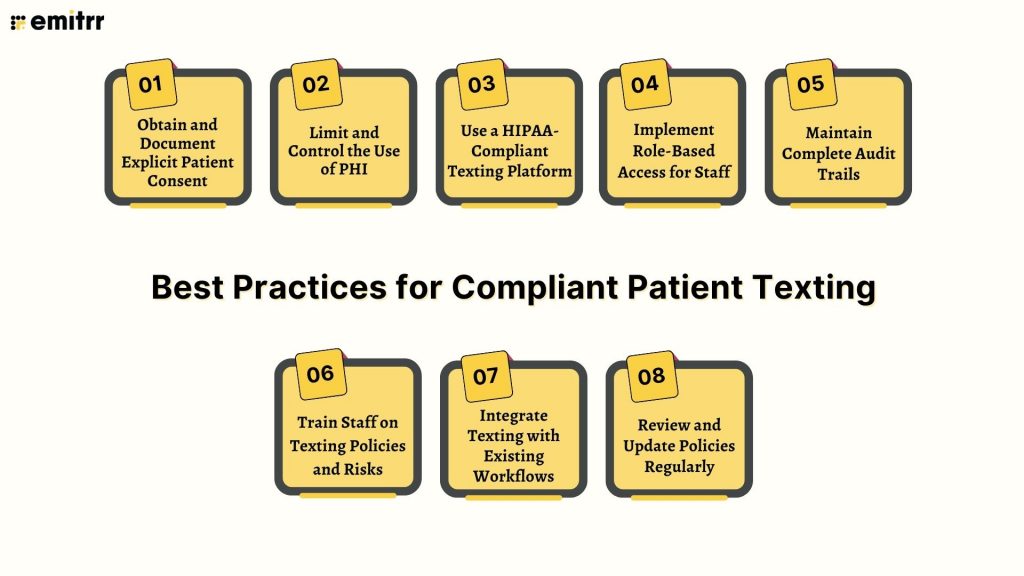
Compliant patient texting is not just about the technology you use. It also depends on how your practice defines policies, trains staff, and manages patient communication day to day.
Obtain and Document Explicit Patient Consent
Patients must clearly opt in before receiving text messages. Consent should be captured in a structured way, stored securely, and easy to update. Practices should also provide simple opt-out options and respect patient preferences at all times.
Limit and Control the Use of PHI
Only include the minimum necessary information in text messages. Practices should define clear internal guidelines around what is appropriate to send via text and what should be handled through more secure channels like the patient portal or phone calls.
Use a HIPAA-Compliant Texting Platform
Texting should happen through a system designed for healthcare, not personal phones or standard SMS apps. A compliant platform supports HIPAA-compliant patient communication by ensuring encryption, access controls, and secure message handling across the organization.
Implement Role-Based Access for Staff
Not every staff member needs the same messaging permissions. Role-based access helps reduce errors by limiting who can send messages, view conversations, or manage patient consent. This also improves accountability.
Maintain Complete Audit Trails
Every message sent or received should be automatically logged with timestamps and user details. Audit trails are essential for internal reviews, compliance audits, and responding to patient inquiries or disputes.
Train Staff on Texting Policies and Risks
Staff should understand both how to use the texting system and why compliance matters. Regular training helps prevent accidental disclosures, improper wording, or the use of unapproved communication channels.
Integrate Texting with Existing Workflows
Patient texting should fit naturally into existing systems like Athenahealth. When conversations are connected to patient records and workflows, practices can maintain consistency, reduce manual work, and improve oversight.
Review and Update Policies Regularly
Regulations, workflows, and patient expectations evolve. Practices should periodically review their texting policies, patient texting templates, and access controls to ensure ongoing compliance and effectiveness.
Following these best practices allows Athenahealth practices to use patient texting as a reliable communication channel without compromising privacy or regulatory obligations.
Checklist to Choose the Right Patient Texting Solution
Use this checklist to evaluate whether a patient texting solution is truly built for healthcare compliance and real-world practice needs.
- HIPAA Compliance: Secure messaging, encryption, access controls, and a signed BAA.
- Consent Management: Built-in patient opt-in and opt-out tracking.
- PHI Protection: Controls over what can be shared via text and how messages are handled.
- Audit Trails: Automatic logging of all messages, timestamps, and user activity.
- Role-Based Access: Clear permissions to limit who can send or view patient texts.
- Athenahealth Integration: Syncs patient data and fits into existing workflows.
- Two-Way Texting: Simple SMS replies without requiring portal logins.
- Automation with Oversight: Reminders and follow-ups without losing compliance control.
- Patient Accessibility: Works on any device, no apps or logins required.
- Ease of Use and Scalability: Simple for staff, scalable as the practice grows.
Integrate Athenahealth with Emitrr for Safe and Compliant Patient Texting
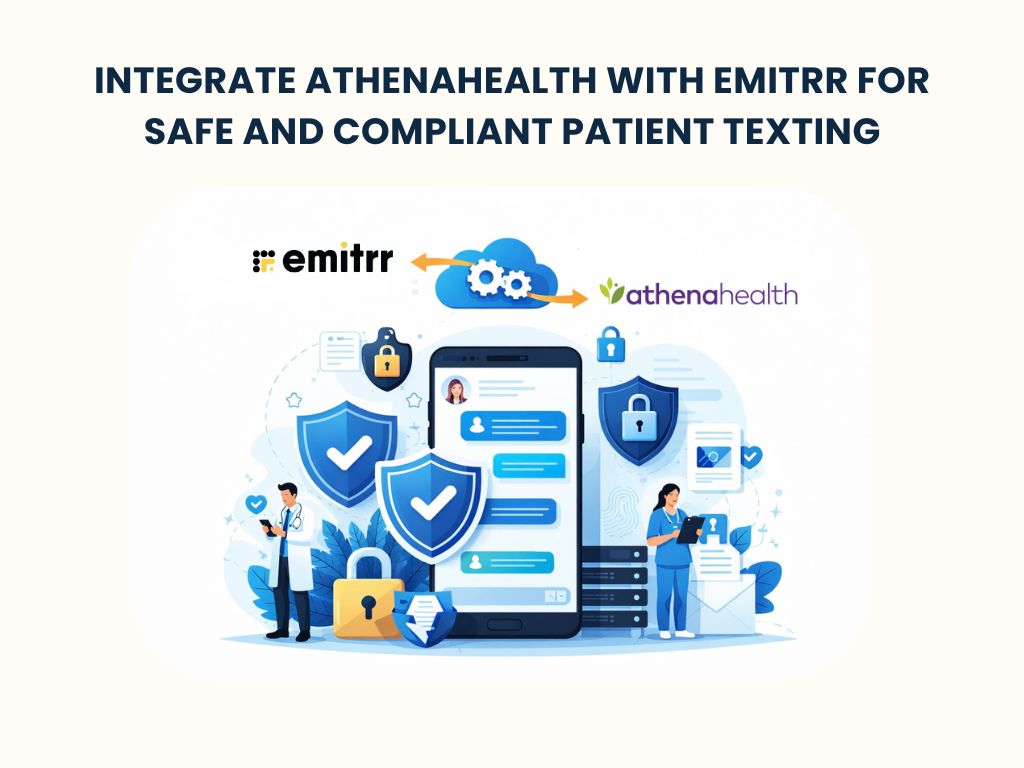
Patient communication should be easy for patients and controlled for practices. But for many Athenahealth users, texting often sits at the intersection of convenience and compliance risk. Portals are secure but slow to drive engagement, while regular SMS is fast but difficult to govern in a healthcare environment.
Emitrr specifically addresses this gap. By integrating with Athenahealth, it enables practices to communicate with patients through text without stepping outside compliance boundaries. The integration connects patient conversations to existing systems, reduces reliance on manual workarounds, and supports a more consistent, compliant approach to patient communication.
This integration allows Athenahealth practices to use texting as a reliable communication channel and maintain the structure, oversight, and accountability healthcare demands.
HIPAA-Compliant Communication
HIPAA-compliant communication ensures every patient text is sent through a secure system built for healthcare privacy. Messages are protected by design, reducing the risk of PHI exposure and compliance gaps.
Two-Way Texting
Two-way texting allows patients to reply to messages as easily as they would to any regular text. This makes communication faster and more natural without relying on portals or phone calls.
Conversations Logged Back Into Athenahealth
With conversations logged back into Athenahealth, every patient text is automatically tied to the correct patient record. This creates visibility and accountability without manual documentation.
Bi-Directional Data Synchronization
Bi-directional data synchronization keeps patient and appointment information aligned between Athenahealth and Emitrr. This ensures messages are always based on accurate, up-to-date data.
Text from Within Athenahealth
Texting from within Athenahealth allows staff to communicate with patients inside their existing workflows. There is no need to switch tools or use personal devices.
Targeted and Bulk Outreach Campaigns
Targeted and bulk outreach campaigns make it easy to reach specific patient groups or send messages at scale, while maintaining control, clarity, and compliance.
Automate Patient Notifications via SMS
Automating patient notifications via SMS helps practices send routine updates without manual effort. This improves consistency and reduces staff workload.
Automatically Send Review Requests
Automatically sending SMS review requests helps practices collect feedback at the right moment, improving response rates and patient insight.
Automated Appointment Communications
Automated appointment communications handle confirmations, text reminders for appointment, and follow-ups, helping reduce no-shows and missed appointments.
Schedule-Based Texting
Schedule-based texting sends messages at predefined times based on appointments or workflows. This ensures patients receive communication when it is most relevant.
Together, these capabilities are what make Emitrr one of the most effective patient texting solutions for Athenahealth practices!
Find out how Emitrr AI agent Sarah makes texting effortless –
Frequently Asked Questions
Athenahealth offers secure portal messaging, but it does not provide native two-way SMS texting. Practices typically use a HIPAA-compliant texting solution integrated with Athenahealth for patient texting.
Yes, patient texting can be HIPAA-compliant if proper safeguards are in place, including patient consent, secure message handling, and audit trails.
Use a HIPAA-compliant texting platform such as Emitrr, limit the use of PHI, obtain patient consent, and ensure all messages are logged and access-controlled.
HIPAA-compliant texting services are designed specifically for healthcare and provide encryption, audit logs, and BAAs. Emitrr is one such solution that supports compliant patient texting and Athenahealth integration.
Sending PHI via regular SMS or personal devices, accessing patient data without authorization, and failing to secure or document patient communications.
The safest way is through a secure patient portal or a HIPAA-compliant texting platform like Emitrr that integrates with Athenahealth and maintains compliance.
Conclusion
Compliant patient texting is essential in healthcare, not just for meeting regulations but for protecting patient trust. When texting is done right, it becomes a safe, reliable way to communicate without putting privacy or compliance at risk.
For Athenahealth practices, integrating the right solution makes all the difference. Integrate Athenahealth with Emitrr to supercharge your patient texting with secure, compliant communication that fits healthcare workflows. See how it works with a free demo today.