
 4.9 (400+
reviews)
4.9 (400+
reviews)

Introduction
In the high-stakes world of health care, a referral is more than a slip of paper or digital file; it’s a baton being exchanged in a relay where the goal line is patient recovery. Yet, in many practices, that baton is dropped in the transition.
Statistics indicate that more than 50% of patient referrals never even turn into an appointment being scheduled. Why? The referral intake process is a fragmented, manual, and slow-moving machine. For a specialty practice, these “leaks” are not merely lost revenue; they’re failures in the continuum of care.
This guide dives deep into referral intake in healthcare, including the traditional workflow, bottlenecks common to it, and how modern automated referral intake is changing the game for practices.
AI Summary
Referral intake in healthcare is the process of receiving, validating, and preparing referrals for scheduling. While many practices still rely on manual workflows involving fax, phone calls, and administrative coordination, these methods create bottlenecks and delay patient care. This guide explains the referral intake workflow step-by-step, highlights common challenges, and demonstrates how automated referral intake solutions like Emitrr streamline scheduling, filter complete referrals, eliminate phone dependency, and improve provider communication.
What is Referral Intake in Healthcare?
Referral intake in healthcare refers to the process of receiving, reviewing, validating, documenting, and preparing referrals for scheduling within a practice’s system.
Referral intake represents simply the first phase of the greater referral management lifecycle. Referral management tracks scheduling, status updates, and performance reporting, while referral intake is simply the mode that receives and prepares the data for action.
Without a strong referral intake workflow, referrals can be delayed, lost, or mishandled, directly affecting patient satisfaction and practice revenue.
The Traditional Referral Intake Workflow: A Step-by-Step Breakdown
We need to start with a standard referral intake workflow before understanding how we can make the process better. In most contemporary workflows using an EHR such as Athenahealth, the steps occur in a specific order that depends on humans to execute.
Step 1: Receiving the Referral (The Omni-Channel Challenge)
Referrals can arrive in a dizzying number of ways to your practice. Unlike a regular appointment request, a physician referral intake can include clinical documentation, prior authorizations, and diagnostic notes. These come via:
- Digital/Cloud Fax: Still the “King” of healthcare communication.
- SMS/Text Messaging: Newer Trends are evolving with fast evaluations through secure text messaging.
- Email: Most commonly used for communications that don’t involve PHI or attachments of protected health information.
- Phone Calls/Voicemails: Direct peer-to-peer communication between providers
Step 2: Verticalized Administrative Review and Triage
When that referral lands in the system (or a fax tray), an administrator attached to that specific channel is assigned to review the data. They check for:
- Is this patient one we are meant to care for?
- Is the referring provider part of our network or an established partner?
- Is the documentation legible?
- If the referral is valid, the admin “accepts” it and sends it up into the Referral Coordinator queue.
Step 3: Build Charts and Validate Data
The most crucial person in the intake process is the Referral Coordinator. Their main job is to connect the incoming message with the EHR. This involves:
- Creating the Patient Chart: Manually entering the Minimum Data (Patient Name and Date of Birth).
- Attaching Documentation: Uploading the fax, call transcript, or email to the new chart.
- Data Scrubbing for Scheduling: In order to schedule the patient, the coordinator needs to ensure they have the required data: Physical Address, Phone Number, and Active Insurance.
- Insurance Red Flag: In advanced systems, red flags in the EHR will alert one to inactive or ineligible insurance. This is an essential step; the Referral Coordinator cannot advance to scheduling until these financial clearances are resolved.
Step 4: The “Phone Tag” Phase
When the chart is up to date, the coordinator calls the patient. This is historically where the process breaks down. Coordinators spend hours leaving voicemails, waiting for callbacks, and trying to find a time that works for the patient.
Step 5: Closing the Case and “Thank You”
Once the patient is reached and an appointment is set, the coordinator closes the referral case. To maintain good relationships with the referring practice, they send a “Thank you for your referral” message. This keeps the referring doctor in the loop and prevents their staff from calling your office to ask, “Did you ever see my patient?”
Step 6: Navigating to the Patient Chart
After closing the case, the referral record is transferred from the “Referral Bucket” to its indefinite home, the permanent “Patient Chart”, marking both the completion of intake and the start of clinical care.

The Operational Gaps in Manual Intake
While the workflow above is logical, it is fraught with inefficiencies that lead to referral leakage.
The Bandwidth Bottleneck
Referral coordinators are overstretched. If a practice gets 50 referrals in a day, and it takes three phone attempts to reach each patient, that’s 150 calls for scheduling alone.
Incomplete Information
When you schedule a patient but learn only once they show up that their insurance status is inactive or there’s no address on file, that creates “last mile” friction.
Delayed Real-Time Tracking
It is virtually impossible to identify which referrals are “stuck” in the phone-tag phase without a medical referral tracking system.
Manual Communication
The first thing that gets dropped when things are busy is sending “Thank You” notes to referring providers, which leads to strained professional relationships.
Enter Emitrr: The Future of Automated Referral Intake
Emitrr doesn’t simply “send a text”, it serves as an intelligent agent that knows the context of the referral.
Intelligent Data Filtering
The AI agent has been instructed to only act on “Complete Charts.” It checks the EHR for a physical address, a valid phone number, and active insurance. If the data doesn’t exist, it won’t waste resources on outreach, simply flagging the chart to be filled out by a coordinator.
Autonomous SMS-Based Scheduling
Instead of the coordinator totally losing track of time (playing a form of tag between when they call and when you pick up), Emitrr initiates an SMS conversation via machine intelligence.
- Location Preference: The AI discusses with the patient which location is most convenient for them.
- Slot Optimization: It analyzes the real-time provider calendar and provides the first available slot.
- Flexibility with Patient: If slot one is not available, it gives an alternative to find a match.
Automatic Provider Assignment
The Emitrr agent then automatically assigns the correct provider in EHR based on the location and time slot chosen by the patient. This frees the coordinator from needing to cross-reference spreadsheets or physician preferences manually.
Why Your Practice Needs an Automated Referral Intake Agent
Adopting automated referral intake is more than a software purchase; it’s a re-engineered growth prospect for your practice.
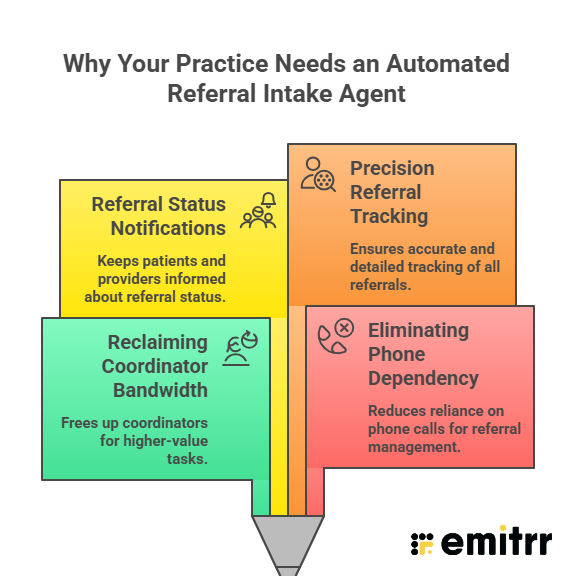
Reclaiming Coordinator Bandwidth
The Referral Coordinator’s job ends the moment the patient’s chart is made. They don’t have to be on the phone 70% of their day. This enables them to concentrate on higher-value work, for example, addressing complex insurance disputes or building stronger relationships with referring physician offices.
Eliminating Phone Dependency
In 2026, patients will not take calls from unknown numbers. With AI-powered SMS scheduling, you engage patients where they already are. The texting open rate is nearly 98%, so your patient referral intake conversion occurs in minutes, not days.
Referral Status Notifications: Closing the Loop
One of the major complaints from referring MDs is about the “black hole” created by referrals. They refer to a patient and never get a response. Emitrr offers automated status updates. The referring provider can be automatically notified when the appointment is scheduled by this AI. This visibility solidifies your physician referral intake pipeline, basically guaranteeing that you are their “preferred” specialist.
Precision Referral Tracking
Your medical referral tracking system becomes a data goldmine with a digital-first approach. You can now see just how many referrals came in, how many were missing, insurance information, and the average time it took for the AI to book the appointment.
Scaling with Patient Referral Software
In multi-location practices or larger health systems, this dependence on manual intake is a path to a plateau. Enhanced coordination of care is a good thing, but you don’t scale a practice by adding more coordinators each time the referral volume goes up.
A centralized patient referral software solution, such as Emitrr, enables you to streamline thousands of intakes at multiple locations with a small back-office team. It maintains that each and every patient receives the same high-quality outreach, no matter which clinic they were referred to.
Key Takeaways
- Referral intake is the first step; referral management is the full lifecycle.
- Intake focuses on receiving, verifying, and documenting referrals within the EHR.
- Referral management ensures conversion, tracking, and closed-loop communication.
- Manual intake processes create bottlenecks, leading to significant referral leakage.
- Closed-loop referral management improves provider relationships and captures lost revenue.
- Automation transforms physician referral management efficiency by handling the “last-mile” scheduling.
- Multi-location practices require centralized healthcare referral management software to maintain data integrity and patient experience.
FAQs
Referral intake is the “entry” phase during which data gets into the EHR. Referral management is a complete lifecycle process from tracking the appointment, closing the loop, and analyzing conversion rates.
Centralize all incoming faxes, texts, and calls into one digital dashboard. Automating patient outreach with AI-driven SMS instead of manual phone calls is the fastest way to boost efficiency.
Leakage occurs when referred patients never make an appointment, typically the result of slow follow-up. Avoid it by sending automated software to baseball patients immediately via text while their medical needs are basically top-of-mind.
Identifying insurance beforehand can eliminate “last-mile” friction and denials for out-of-budget billing. Using the EHR to flag ineligible insurance at intake protects your practice and clears patients before they hit the schedule.
Yes. AI agents such as Emitrr scan through the patient charts for completeness of data and text to patients autonomously to determine location and time convenience before assigning to the appropriate provider without human intervention.
Conclusion
Transitioning from a manual referral intake model to an automated referral intake model is no longer a luxury; it’s now a competitive imperative. Instead, you can tap into technology to sift through information, book via SMS, and update referring providers so your practice can finally close the loop on patient care.
When you remove the friction from the intake process, you don’t just see more patients; you provide a better experience for the people who matter most: the patients seeking care and the providers trusting you with their referrals. Emitrr is your one-stop solution for all that you need. Book a demo today.