
 4.9 (400+
reviews)
4.9 (400+
reviews)
Introduction
If you handle referrals the “old-school” way, you’re probably losing money and time. Studies show that around 30%-50% of outpatient specialty referrals never get completed, which shows the drop-off problem is very real. Not because your team is doing a bad job. But because manual processes create delays, missed follow-ups, and messy handoffs. And referrals are super sensitive to speed.
The longer a referral waits, the chances are it won’t turn out to be a booked appointment. But a referral intake software changes that. It centralizes everything, automates follow-ups, and gives you clear visibility – so your team works smarter and fewer opportunities slip away!
In this guide, we’ll compare referral intake software vs manual intake. We’ll also explore where automation truly makes a difference, when upgrading becomes the smarter move, and how Emitrr helps you automate referral intake without losing the human touch.
AI Summary
Manual referral intake feels simple, but it quietly drains time and revenue through delays, missed calls, and human error. Referral intake software automates follow-ups, centralizes communication, and improves conversion rates – which directly impacts ROI. If referral volume matters to your business, automation isn’t just convenient. It’s revenue protection.
Understanding Manual Referral Intake
Manual referral intake is exactly what it sounds like. A referral comes in through phone, fax, or email, and someone on your team reads it, writes it down, enters it into your system, and then follows up with the patient or customer. If things get busy, it simply waits. Manual intake also relies heavily on “tribal knowledge.” Your best coordinator knows how to interpret messy referrals and who to call. That works – until they’re out sick, overwhelmed, or leave!
What Manual Referral Intake Looks Like in Day-to-Day Operations
Day to day, manual intake usually follows a predictable pattern:
- Referral Received: A call, fax, or email comes in with patient details.
- Manual Entry: Someone reads it and enters the information into your PMS or spreadsheet.
- First Call Attempt: The team reaches out to the patient to schedule.
- Voicemail Loop: If there’s no answer, a voicemail is left.
- Repeat Follow-Up: Another call is made later, depending on availability.
- Manual Notes: Updates are logged manually after each interaction.
Every step requires human attention. Every step adds time. And with ongoing high call volumes, staff get stretched thin.

How Manual Intake Impacts Revenue and Outcomes
Manual intake slows things down by design. Each step adds friction. Read the fax. Enter the data. Call the patient. Wait. Call again. Even strong teams can’t eliminate the natural delays built into manual systems. Those delays don’t just affect workflow. They directly affect revenue. When response time increases, conversion decreases. And when conversion drops, revenue follows.
Here’s how manual intake impacts revenue and outcomes:
- Reduced Conversion: Slower follow-ups lower the chances of turning referrals into scheduled appointments.
- Increased Drop-Off: The longer patients wait, the more likely they are to seek care elsewhere.
- Lost Lifetime Revenue: Missed referrals mean losing repeat visits and long-term value. Estimates suggest 10% to 30% of potential revenue can disappear this way.
- Higher Labor Costs: Staff spend hours managing callbacks and corrections instead of revenue-driving work.
Fixing these issues costs time. And when follow-ups are delayed, referrals quietly slip away.
Where Manual Referral Processes Usually Break Down
Manual systems tend to break under pressure. A busy Monday. A staff shortage. A sudden spike in referrals.
The weakest points are usually predictable:
- Missed Calls: No one available to answer reminder calls, and no automatic follow-up to recover the opportunity.
- Inbox Overload: Emails or faxes sit too long without review.
- Manual Handoffs: One person assumes that someone else followed up.
- Incomplete Details: Missing documentation slows everything down.
- Delayed Contact: Hours or days pass before the first follow-up.
Manual systems also lack visibility. They don’t naturally show you what’s stuck. If a referral stalls, you may not know until it’s too late. And once that momentum is gone, it’s hard to recover.
Understanding Referral Intake Software
Referral intake software manages everything that happens between “a referral comes in” and “that referral turns into revenue.” Instead of relying on sticky notes, scattered inboxes, or someone’s memory, it creates one structured system to capture, track, and follow up on referrals. Nothing depends on who’s on shift. Nothing depends on remembering to call someone back later. The system does the tracking for you.
What Referral Intake Software Looks Like in Day-to-Day Operations
With referral intake software, daily operations become more predictable and visible.
Here’s what that typically looks like:
- Referral Capture: Calls, texts, digital forms, or partner submissions are automatically logged into one centralized system.
- Smart Routing: Referrals are assigned to the correct person or department without manual sorting.
- Instant Confirmation: Automatic responses go out immediately, so the patient knows their referral was received.
- Automated Follow-Ups: If there’s no response, reminders are triggered without staff having to remember.
- Real-Time Tracking: Your team can see whether the referral is pending, scheduled, or completed at any moment.
- Status Visibility: Everyone sees the same information. No guessing. No double-checking spreadsheets.
This is what people mean when they talk about “closing the referral loop.” It’s not just receiving referrals. It’s tracking them all the way to completion.
How Referral Intake Software Impacts Revenue and Outcomes
Referral intake affects revenue directly. You either convert the referral into a booked appointment or completed service, or you don’t.
Software improves that conversion in several ways:
- Faster Response: Immediate follow-up increases the likelihood of booking.
- Reduced Errors: Structured forms prevent missing or incorrect information.
- Better Visibility: If a referral stalls, you see it and fix it quickly.
- Higher Completion Rates: Automated reminders reduce drop-off.
Beyond revenue, speed in referral intake affects the entire experience. When patients hear back quickly, care starts sooner, and everything feels smooth and reliable. That builds trust with both patients and referral partners.
Where Referral Intake Software Breakdowns Usually Occur
Even with software in place, breakdowns can still happen. They just look different. They don’t usually happen because of missed sticky notes or forgotten voicemails. They happen when the system isn’t fully set up, monitored, or integrated correctly.
Common weak spots include:
- Poor Configuration: Automation rules aren’t set up properly, so referrals don’t get routed or followed up on the right way.
- Ignored Alerts: Notifications come in, but no one is assigned clear ownership.
- Integration Gaps: The software doesn’t sync cleanly with your CRM, EHR, or scheduling system, creating data silos.
- Incomplete Digital Forms: If forms aren’t structured clearly, patients may still submit partial information.
- Lack of Monitoring: Dashboards exist, but no one regularly reviews referral status or conversion rates.
Speed is still critical. Even with automation, if alerts go unchecked or workflows aren’t optimized, delays creep in. The difference is that with software, you at least have visibility. You can see where referrals stall and fix it quickly. The real risk isn’t the software itself. It’s treating it like a “set it and forget it” tool instead of an active part of your workflow.
Manual Intake vs Referral Intake Software: Core Differences
Here’s the simplest way to think about it: manual intake runs on memory and effort. Software runs on systems and automation.
| Area | Manual referral intake | Referral intake software |
| Intake channels | Phone, fax, email, sticky notes, spreadsheets | Centralized SMS inbox, logged calls/texts/messages |
| Speed to follow-up | Depends on staff availability | Automated, instant or scheduled follow-ups |
| Data capture | Manual entry, copy/paste | Forms + structured fields + auto-sync |
| Visibility | Limited, often “ask the person who handled it” | Real-time status tracking and dashboards |
| Error risk | Higher (typos, lost docs, duplicates) | Lower (validation, templates, automation) |
| Compliance & auditing | Harder to prove what happened | Logs and audit trails for calls/messages/status |
| Scalability | Breaks under volume and staffing limits | Built to scale across teams/locations |
| Patient/customer experience | More waiting, more phone tag | Faster responses, clearer next steps |
| Revenue impact | More leakage, more drop-off | Higher conversion and completion, less leakage |
ROI Breakdown of Manual Referral Intake
Manual intake does feel free because you are not really paying for any software. There is no subscription, no dashboard, no login. But the cost shows up in other ways. It shows up in staff time, delayed follow-ups, small mistakes, and referrals that quietly slip away.
Labour Costs and Staff Time
Manual intake depends entirely on people. Even if it only takes ten to fifteen minutes per referral, those minutes add up fast when volume increases. And your team is not just handling referrals. They are also answering calls, managing the front desk, checking insurance, and handling daily operations. Referral intake becomes another layer of work that stretches capacity. Over time, you either pay for more staff hours or risk burnout and backlog.
Referral Delays and Lost Revenue
Manual systems naturally slow things down. That delay matters more than most people realize. The longer someone waits to hear from you, the less likely they are to book. They may call another provider. They may lose urgency. They may simply forget. Every delay reduces conversion, and lower conversion directly impacts revenue.
Error Correction and Rework Costs
Manual intake also increases the chance of errors. A phone number gets typed incorrectly. Insurance details are incomplete. The same referral is entered twice. These are small mistakes, but they create extra work. Fixing them requires more calls, more messages, and more staff time. Rework rarely feels dramatic, but it drains productivity in the background. When this happens repeatedly, it becomes a hidden operational cost.
Impact on Experience and Brand Trust
Patients and partners do not separate referral intake issues from your overall service. If scheduling takes too long or communication feels inconsistent, it reflects on your organization. Slow or messy intake can make your team appear harder to work with, even if the care itself is excellent. Over time, that affects trust. And when trust drops, referrals often follow.
ROI Breakdown of Referral Intake Software
Yes, software has a cost. There’s usually a subscription and some setup involved. But ROI isn’t about avoiding expenses. It’s about stopping losses. The better question is not “does it cost money?” It’s “does it recover more than it costs?” Referral intake software drives ROI by saving staff time, improving conversion, and preventing revenue from quietly slipping away.
Initial Software and Setup Costs
Most referral intake platforms involve a subscription and onboarding period. There may be a configuration to connect with your CRM, EHR, or scheduling system. That upfront effort can feel like friction. But unlike manual processes, the system doesn’t get tired, overwhelmed, or inconsistent. Once set up, it runs the same way every time. That consistency alone removes a lot of the hidden cost built into manual intake.
Time Saved Through Automation
Automation handles the repetitive pieces that slow teams down. It captures referral information consistently. It sends confirmations instantly. It reminds patients to schedule. It alerts staff when something is pending. That means your team isn’t manually checking inboxes or chasing updates all day. The time saved turns into real operational value.
Improved Conversion and Completion Rates
This is where ROI becomes more visible. Software increases the number of referrals that actually convert into appointments or completed services. When follow-up happens quickly and consistently, more people respond. When reminders are automated, fewer referrals stall. When the system tracks status in real time, fewer cases disappear. Completion improves because friction decreases. Your team doesn’t have to remember every step. The process guides both sides forward.
Revenue Recovery From Faster Follow-Ups
Speed plays a huge role in conversion. The faster someone hears from you, the more likely they are to engage. Referral intake software responds instantly. It can send confirmation messages right away. It can trigger follow-ups automatically. It can convert missed calls to texts and turn them into conversations. That speed alone can recover revenue that would otherwise be lost. Even improving follow-up by a small percentage can create a noticeable financial impact over time.
Referral Intake Software vs Manual Intake: ROI Comparison
Let’s suppose you handle around 150-250 referrals per month, assuming each completed referral is worth meaningful revenue to your organization. Now let’s look at how the two models compare:
| ROI Area | Manual Intake | Referral Intake Software | What Changes |
| Staff Time Per Referral | Easily 10-20 minutes | Under 2 minutes | Automation removes repetitive steps |
| Monthly Staff Hours | High and inconsistent | Lower and predictable | Time savings scale with volume |
| Labor Cost Impact | Hidden but rising | Reduced over time | Saved hours create capacity |
| First Response Speed | Same day or delayed | Immediate or near-instant | Faster contact improves conversion |
| Referral Tracking | Manual spreadsheets or notes | Real-time dashboard | Nothing slips unnoticed |
| Referral Completion | Dependent on staff availability | More consistent follow-up | Higher completion rates |
| Missed Call Recovery | Often lost | Automated text/call-back | Fewer lost opportunities |
| Process Visibility | Reactive | Proactive | You see bottlenecks early |
| Software Cost | No subscription | Monthly subscription | Predictable expense vs hidden leakage |
| Revenue Protection | Limited | Actively protected | Faster follow-up drives recovery |
If referrals matter to your revenue, delays and leakage become expensive fast. And the bigger your volume, the bigger the gap becomes between manual effort and automated systems.
When Manual Referral Intake Still Makes Sense
In some situations, manual intakes work just fine. The key is knowing when it truly fits your current stage and when it starts holding you back.
Low Referral Volumes
If you only receive a handful of referrals each month, you may not feel enough friction to justify software. A simple tracker and a disciplined follow-up routine can work at this stage. The process stays manageable because volume is low. However, even small teams need clear ownership and consistent follow-up. Manual systems can still break down if no one is clearly responsible.
Short-Term or Temporary Operations
If you are running a short-term clinic, a temporary project, or a pilot program, investing in software may not make sense yet. In these cases, a tight process is more important than technology. Same-day follow-up, one person accountable, and a shared referral log can keep things under control. The goal is speed and clarity, not complexity. Once the operation becomes permanent or expands, that’s when structure matters more.
Early-Stage Teams
New practices often start manually because they are still figuring things out. You may not fully understand your referral patterns yet. You’re testing workflows, adjusting roles, and learning what works. Jumping into automation too early can sometimes add confusion. It’s often smarter to establish a clear process first, then automate once patterns become predictable.
Highly Relationship-Driven or Informal Referral Flows
Some referral networks run almost entirely on trust and strong personal connections, including word-of-mouth referrals. It may be as simple as a partner texting you a patient name and trusting you to handle the rest. In these environments, too much structure can feel unnecessary. However, even relationship-based referrals benefit from tracking behind the scenes. A simple system ensures you protect that relationship by never missing follow-up.
When Referral Intake Software Becomes Essential
There comes a point when manual systems stop being manageable. That’s when software shifts from being optional to being protective.
High-Volume Referral Environments
As referral volume increases, manual systems start to strain. Calls stack up. Faxes sit longer. Follow-ups get delayed. Even strong teams struggle to keep up when volume grows. Speed becomes harder to maintain, and slower response times directly impact conversion. At higher volumes, automation stops being a luxury and becomes a safeguard.
Healthcare, Specialty Clinics, and Complex Services
Healthcare and specialty referrals often involve documentation, privacy policies, insurance coordination, and scheduling complexity. There are simply more moving parts. The more complex the referral, the easier it is for something to slip through. Software adds structure and visibility to these multi-step processes. That visibility prevents breakdowns before they turn into lost revenue.
Teams Struggling With Follow-Ups
If your team often says things like “Did anyone call them back?” or “I thought someone handled that,” it’s a workflow issue. Those moments are signs of missing visibility. Manual systems rely heavily on memory and communication. Software creates automatic reminders, tracking, and status updates. It doesn’t replace your team. It supports them, so nothing quietly disappears.
Multi-Location or Multi-Team Operations
Once more than one team handles referrals, consistency becomes difficult. Different staff members follow slightly different steps. Tracking becomes scattered. Ownership gets blurry. Software creates standardization across teams and locations. Everyone follows the same workflow, uses the same SMS templates, and sees the same dashboard.
How Emitrr Supports Automated Referral Intake
Emitrr isn’t about replacing your team. It’s about removing the friction that slows them down. Emitrr brings structure and speed into the process so referrals move forward instead of sitting in limbo.
Centralised Inbox for Referral Calls, Texts, and Messages
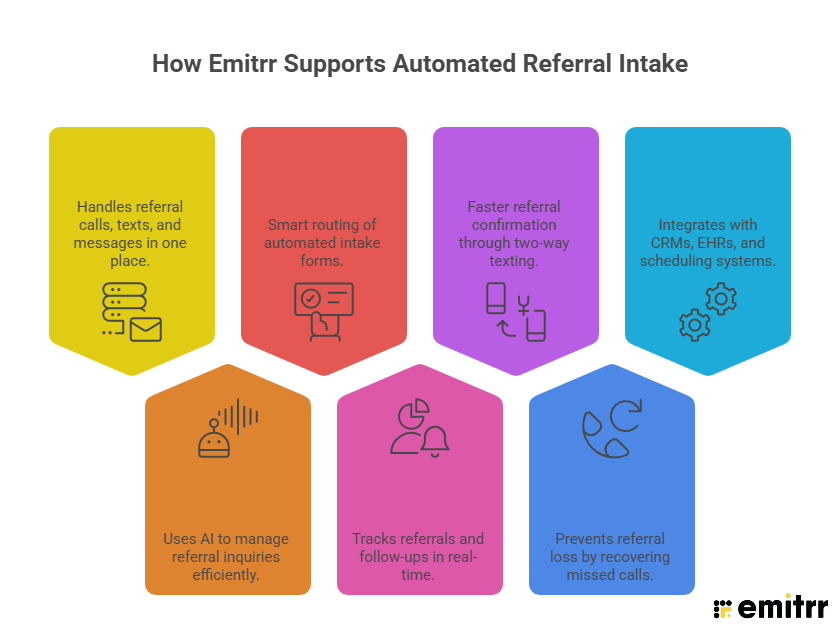
Referral conversations often live in too many places. Some are in voicemail. Some in email. Some in-text threads. Some are written on paper. That’s where things fall through the cracks. Emitrr centralizes everything into one shared inbox so your team can see every referral conversation in one place. No switching tools. No guessing who responded last.
AI-Powered Call Handling for Referral Inquiries
Missed calls are one of the biggest silent revenue leaks. If someone calls to refer or schedule and no one answers, momentum drops instantly. Emitrr’s AI receptionist helps answer calls, capture details, and respond even when your team is busy. That means referral inquiries don’t just go to voicemail and disappear. It keeps conversations moving even outside normal business hours.
Automated Intake Forms with Smart Routing
Referral paperwork is often messy. Missing information leads to back-and-forth calls and delays. Emitrr allows you to use structured intake forms that capture the right details from the start. That reduces rework and manual data cleanup. Smart routing then sends each referral to the right person automatically, so nothing waits in the wrong inbox.
Real-Time Referral Tracking and Follow-Ups
One of the biggest challenges with manual intake is visibility. You don’t always know what’s pending or stuck. Emitrr gives you real-time tracking so you can see referral status at a glance. You know what’s booked, what’s waiting for contact, and what needs attention. Instead of reacting late, your team can act early.
Two-Way Texting for Faster Referral Confirmation
Phone tag slows everything down. Texting removes that friction. Emitrr enables two-way texting so you can confirm appointments, answer quick questions, and follow up instantly. Patients are more likely to respond quickly to a text than a voicemail. Faster replies mean faster scheduling and fewer stalled referrals.
Missed-Call Recovery to Prevent Referral Loss
Missed calls happen. The real problem is what happens next. Emitrr automatically sends a text when a call is missed, keeping the conversation alive instead of letting it go cold. That immediate touchpoint increases the chance the referral stays engaged. It turns what would have been a lost opportunity into an active conversation.
Integrations with Existing CRMs, EHRs, and Scheduling Systems
Software only works if it fits into your existing workflow. Emitrr integrates with common CRMs, EHRs, and scheduling systems so you don’t have to copy and paste information between platforms. Referral data stays aligned across tools. That reduces manual entry and lowers the risk of errors. Instead of adding complexity, it simplifies the stack you already use.
Real-World ROI Scenarios
ROI doesn’t look the same for every organization. It depends on your volume, complexity, and how referrals currently flow through your team.
Healthcare and Specialty Clinics
Specialty clinics often deal with layered referrals. They may receive documentation through fax, email, and phone, and then need to coordinate scheduling, insurance, and follow-ups. With so many moving parts, small delays turn into bigger bottlenecks. Staff spend time chasing paperwork instead of moving patients forward. In this environment, ROI usually shows up through faster scheduling, less administrative back-and-forth, and clearer tracking so referrals don’t quietly stall.
Dental and Medical Practices
In dental and medical offices, referrals often blend with general inquiries. A referral might come from another provider, but it could also come from a high-intent phone call or online form. Missed calls become expensive quickly. If you recover even a portion of those missed opportunities, the revenue impact becomes noticeable. Add automated reminders and faster confirmations, and you reduce no-shows while increasing completed appointments.
Home Services and Field Operations
In-home services and referrals move fast. They come from past customers, partner contractors, property managers, or online listings. If someone calls and no one answers, they usually move on to the next provider. There’s rarely a second chance. In this world, ROI comes from speed. The faster you respond, the higher your chances of winning the job.
Multi-Location Service Businesses
Multi-location teams often struggle with consistency. One location follows up immediately. Another waits until the next day. That inconsistency affects referral partners and brand perception. Centralized inboxes and automated routing create standard workflows across every location. ROI here shows up in performance stability, reduced leakage, and less reliance on one person who “knows how everything works.”
Key Takeaways
- Revenue Engine: Referral intake directly drives revenue, but it can also quietly leak it when follow-ups are slow or inconsistent.
- Manual Friction: Manual processes create delays, rework, and missed handoffs that reduce completion rates over time.
- Automation Advantage: Referral intake software improves ROI by saving staff time and increasing the number of completed referrals.
- Speed Matters: Faster response dramatically improves connection and booking chances, while delays reduce conversion.
- Messaging Impact: Automated texting and reminders help improve attendance and reduce drop-offs.
- Missed Call Risk: Unanswered calls often mean lost revenue, making missed-call recovery a powerful ROI lever.
- Measure First: Track referral volume, response time, completion rates, missed calls, and staff hours to see where revenue may be slipping.
ROI Becomes Clear: Once you identify the leak points, the decision to automate usually becomes much easier.
FAQs
In most cases, yes! Manual systems hide costs in slow follow-ups, missed calls, and staff time. When volume grows, the ROI becomes obvious because automation protects revenue instead of leaking it.
Absolutely! Emitrr is built to integrate with your communication layer and connect with scheduling and record systems. The real benefit comes when calls, texts, and intake forms flow directly into your existing workflow without manual copying.
The biggest risk is silent loss. Referrals don’t fail loudly – they just fade when follow-up is slow, or information is missing. By the time you notice, the opportunity is already gone.
Not at all. Automation handles confirmations, reminders, and repetitive follow-ups. Your team still manages real conversations. In fact, automation gives them more time to be thoughtful instead of rushed.
Yes, small teams can benefit from it, especially when time and bandwidth are tight. Automation helps reduce missed calls, speed up follow-ups, and keep referrals organized without adding headcount.