
 4.9 (400+
reviews)
4.9 (400+
reviews)
Introduction
In today’s fast-moving healthcare environment, the phrases “referral intake” and “referral management” are commonly used in place of one another. But to a practice manager or clinical director, distinguishing between the two is like saying no more chaos in our front office and time to develop into a professional high-growth organization.
The larger that healthcare organizations expand over multiple sites, the more complex it becomes to track what takes a patient from ‘referred’ to ‘treated’. Without a defined system for intake and management, practices risk inducing “referral leakage,” in which patients fall through the cracks of a fragmented system. That’s where this guide comes in; it will go into deep detail on both areas, concluding with a neat and clear referral management workflow and how automation can transform the way you work.
This guide will dive deep into both concepts, providing a clear referral management workflow and showing how automation can revolutionize your operations.
AI Summary
If you’re confused about the difference between referral intake and referral management, you’re not alone. While the two terms are often used interchangeably, they represent very different stages of the patient journey. Referral intake focuses on receiving, verifying, and entering referral data into the system. Referral management, on the other hand, governs the entire lifecycle of a referral from intake to appointment completion and status updates. In this guide, we break down the differences, compare workflows, highlight operational gaps, and explain how automated referral management platforms like Emitrr transform manual processes into scalable, closed-loop systems.
Defining the Terms: Referral Intake vs. Referral Management
What is Referral Intake?
Referral intake refers to the tactical “front lines” of patient referral receipt. Consider it the “digital front door.” It is that instant message when a fax machine beeps, or an email lands in your inbox, or a digital file arrives from your EHR system. The foremost objective of intake should be data collection and verification. It’s a part of the larger process, which is medical referral management.
What is Referral Management?
Referral management refers to the overall process and system tracking a patient through referral from initial request to final appointment, concluding with the feedback loop back to the referring provider. It’s all about visibility, optimization, and relationships. A referral management platform that’s worth it won’t just check off the box that a patient is there, but gets those appointments scheduled and seen, and keeps the referring physician in the loop.
Referral Intake vs. Referral Management: Comparison Table
| Criteria | Referral Intake | Referral Management |
| Definition | Process of receiving and documenting referrals | End-to-end oversight of the referral lifecycle |
| Scope | Limited to entry & validation | Covers intake to appointment completion |
| Scheduling | Usually manual | Automated or integrated |
| Provider Assignment | Manual | Automated & rules-based |
| Status Tracking | Minimal | Real-time tracking |
| Communication | Manual notifications | Automated notifications |
| Reporting | Limited | Advanced analytics & dashboards |
| Scalability | Low | High |
| Closed Loop Capability | No | Yes (closed loop referral management) |
The Standard Referral Intake Process: A Step-by-Step Analysis
In the vast majority of multi-location practices, however, referral management means an administrative-heavy lift. It’s important to understand this manual process in order to determine the value that AI and automation can bring.
Multi-Channel Receipt
A referral may come in from several old/new sources (Fax, SMS, E-mail , or Phone calls/voicemails). This phenomenon represents the primary barrier to referral management in healthcare.
Administrative Review
It gets the referral in its EHR (say, athenahealth). The incoming channel is reviewed by an administrator, and the valid referrals are filtered and directed to a ‘Referral Coordinator’.
Chart Creation
The Referral Coordinator generates the new patient chart. At the very least, you need to have:
The Referral Coordinator creates a new patient chart. At a minimum, this requires the Patient Name and Date of Birth. However, for the referral to move to the next stage, the coordinator must attach the source document (the fax or transcript) and verify:
- Address and Phone Number: Essential for outreach.
- Insurance Validation: This is a huge point of friction. Today’s systems highlight insurance that isn’t eligible in red. These are the “red flags” that need to be sorted out, manually, even before a patient can be approached for scheduling.
Outreach and Scheduling (The Traditional Bottleneck)
The coordinator starts a “phone tag” by calling the patient multiple times to coordinate a time that fits across several locations and provider schedules.
Closing the Case
When the appointment is scheduled, the coordinator manually transmits a “Thank you” message to the referring provider. When staff are busy working out if their patient was seen by the consultant, referring doctors have no knowledge of whether or not names are being checked every day.
Archiving
The case is transferred from a “referral bucket” to the permanent patient record.

Why Referral Intake is More Challenging for Multi-Location Practices
When a practice manages from five, ten, or fifty locations, the patient referral system is bound to fail.
Different Intake Procedures Across Locations
An organization that lacks a unified referral management system could vary greatly in the way in which faxes or emails are routed within each office. One site may prioritize same-day referrals, while another may queue them automatically. This variation results in a “postcode lottery” of the quality of care for patients.
High Referral Traffic and Administrative Overload
Multi-location organizations are a classic example of becoming a victim of their own success. With increased volume, the manual work of physician referral management becomes a full-time job for dozens of physicians. With hundreds of different referral requests going to the “Referral Bucket” in the EHR, eventually, errors due to human nature start cropping up.
Lack of Centralized Visibility
For example, when a “Location A” Referral Coordinator has too many referrals, but there is light scheduling in “Location B”, traditional systems may not provide for balancing the load. This results in a central lack of visibility for the management to see where the bottlenecks are within the referral process.
Real-World Impact: The Bottom Line and Visits
Inefficiencies in patient referral management aren’t just an administrative headache, they are a financial drain.
Longer Wait Times and Lost Opportunities
If a referral sits in a fax tray for three days before being entered into the EHR, that patient is likely to call a competitor. In the age of instant gratification, a slow referral intake process is a direct cause of lost patient acquisition opportunities.
Reduced Provider Utilization
(The most expensive thing in a practice is the provider. The practice is losing thousands of dollars in billable hours each week, because if the automated referral management system doesn’t fill their slots, it often does. After all, the coordinators are still on the phone with insurance companies.
Fragmented Patient Journeys
Today’s patients demand a “seamless” experience. If they need to say their insurance information three times because the referral intake form was incomplete or the coordinator missed the attached fax, trust eroded before they walk through your door.
Why Manual and Fax-Based Systems Fail in 2026
While the healthcare industry is undergoing digital transformation, many practices still operate on a “Fax and Hope” model, receiving referrals through fax machines, emails, or voicemails and relying on manual follow-ups to move them forward. Manual medical referral management is still not working for multi-location practices because of these practical and financial factors:
Inefficient Staff
Administrative staff are forced to constantly review faxes, retype patient information into the EHR, verify insurance information, and call for scheduling. These manual processes are time-consuming, they put project staff at risk for human error, and they won’t allow the team to shift its focus to higher-value coordination activities.
Documentation Loss
Faxed files disappear into the ether, printed documents are filed in the wrong folder, emails get lost among other emails and messages on people’s email accounts (especially those who receive dozens or even hundreds a day), and voicemails can be deleted by accident. A lack of centralized referrals management can lead to dropped referrals, missed appointments, delayed care access, and lost revenue potential.
Inability to Scale
As the number of referrals increases, manual processes reach a tipping point. The cost of adding staff (for each incremental increase in referrals) to process the new referral business becomes too great, and ultimately, the cost to process the referral business exceeds the revenue received for them. Most manual processes just don’t work with more than one site.
No “Closed Loop”
Manual systems often do not offer a closed-loop referral management process where referring physicians receive automatic notification about the status of their orders or whether the patient was contacted, scheduled, or seen. Without regular communication and transparency, referrers lose faith in your practice and stop referring patients altogether, eroding their resources and undermining long-term growth.
How Emitrr AI Transforms the Referral Lifecycle
Emitrr changes the game by replacing it right at the time when a patient chart is generated. It elevates the referral process from simple outbound order intake to sophisticated, automated referral management.
The Emitrr AI Agent Workflow
After the Referral Coordinator does the high-level work of creating the chart and checking insurance, AI then takes over “the grunt work” of scheduling.
Intelligence Filtering
Emitrr targets only charts that are 100% filled out (including Address, Phone, & Active Insurance. This way , the AI never wastes effort reading “junk” referrals.
Artificial Intelligence-Powered SMS Scheduling
No more phone tag, when Emitrr sends an SMS. The AI agent requests the location choice of patients and brings up a first available time. If the patient is busy, then the A.I. recommends alternatives.
Automatic Provider Assignment
Based on the location and time selected, Emitrr assigns the correct provider in the EHR instantly.
Problems Solved by the AI Agent:
- Bandwidth: The Referral Coordinator’s role now stops at “Chart Creation”. They no longer talk on the phone for six hours a day.
- No More Phone Dependency: SMS Scheduling’s response rate is 4x higher than phone calls.
- Automatic Status Notifications: Emitrr automatically sends ‘Thank You’ and status updates to the referring provider, without requiring human intervention to manage physician referral.
Here is a slightly more comprehensive version, keeping the same sentence structure and flow:
Key Features to Look for in Healthcare Referral Management Software
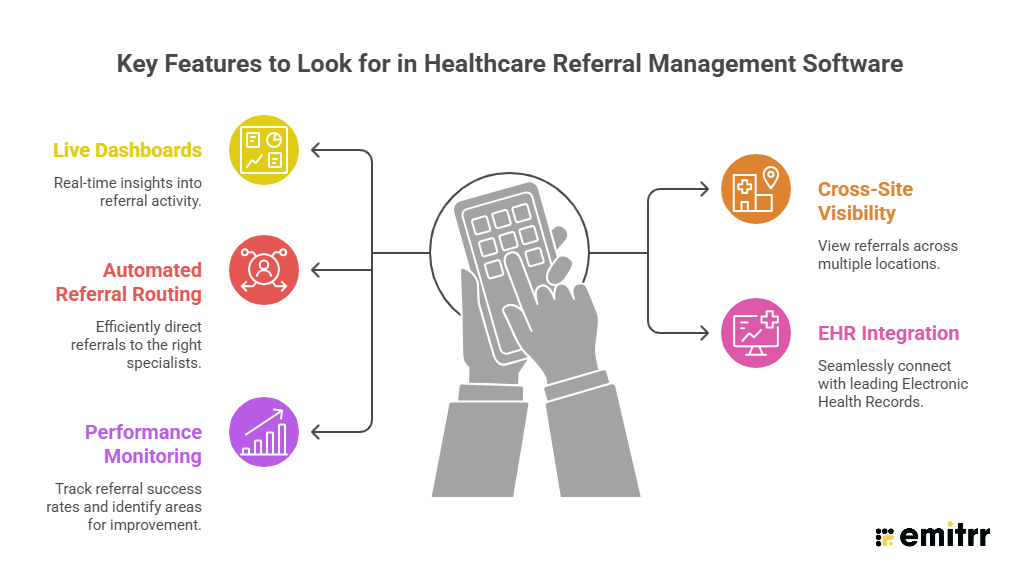
If you’re considering an upgrade for your patient referral management system, look out for these features:
Live Dashboards
Instant visibility into how many referrals are currently in “Intake”, “Contacted”, or “Scheduled, enabling your team to identify bottlenecks fast and take action before delays occur that affect patient care.
Cross-Site Visibility
The opportunity to smoothly re-route a referral from an overbooked clinic to one with underutilization, to allow optimal provider usage across sites, minimize patient waiting times, and have equitable patient loads among your locations.
Automated Referral Routing
Direct the patient without staff mediation to the appropriate specialist, department, or location based on diagnosis, urgency, insurance, and date of availability to reduce manual errors and scheduling delays.
Integration with Leading EHRs
Including athenahealth, Epic, and/or eClinicalWorks, so referral intake information easily moves into patient charts without extra effort or the possibility of duplication, significantly reducing documentation error and enhancing care coordination.
Performance Monitoring
Broad analytics that showcase referral conversion rates, scheduling times, and which referring providers are among their “VIPs”, adding the most volume, and identify relationships that might need to be rekindled.
Key Takeaways
- Referral intake is the first step; referral management is the full lifecycle.
- Intake focuses on receiving and documenting referrals.
- Referral management ensures conversion, tracking, and communication.
- Manual intake processes create bottlenecks and referral leakage.
- Closed-loop referral management improves provider relationships and revenue.
- Automation transforms physician referral management efficiency.
- Multi-location practices require centralized healthcare referral management software.
Frequently Asked Questions
With many locations comes fragmented data and processes. It is far more difficult to manage 500 referrals for one discipline that are spread out over 10 offices because there has to be an approach to this where the tracking and resource allocation have a centralized means.
The option of the ‘human factor’ is to “forget to update a status.” In addition, a real-time electronic referral management system populates the EHR with updates and alerts to providers and prevents patients from being allowed to linger in “pending” status.
It is the process of ensuring that the referring provider is notified once the patient has been seen. This “closes the loop” on the care journey and is essential for maintaining strong professional relationships and patient safety.
Yes. Today, healthcare referral management software such as Emitrr is built to sit on top of your EHR (like athenahealth), and it will pull chart data and push scheduled appointments back into the system without you having to manually enter that data.
No. It empowers them. It puts an end to the monotonous calls made and voicemails left, freeing up your coordinator to work on complex insurance resolutions and high-level provider relationships.
Conclusion
Referral intake is the necessary, yet basic, initial step in gathering patient information, but it’s a well-thought-out referral management strategy that truly propels practice growth and ensures no patient is overlooked. Transitioning from a fragmented, manual system to an AI-driven, automated workflow allows your team to focus on clinical excellence rather than administrative phone tag.
By bridging the gap between intake and scheduling, you can eliminate referral leakage, strengthen your provider network, and deliver a seamless patient journey across every location. Ready to transform your front-office operations and scale with ease? Book a demo today to see the Emitrr difference in action.