
 4.9 (400+
reviews)
4.9 (400+
reviews)
Introduction
Nonprofits thrive on community, and the community thrives on communication. The better your nonprofit connects with people, the greater the impact it can make. It’s a sure-shot way to turn a good cause into a full-blown movement.
And, in the world we live in — where everyone’s glued to their cell phones — texting is your launchpad for making connections that are quick, personal, and uber-effective.
Texting for nonprofits involves writing short, crisp messages to your target audience while keeping the emotional quotient just right and evoking a sense of purpose and responsibility. Unlike emails that might get buried or social media posts that vanish in the scroll, texting is an excellent way to ping someone and instantly grab their attention.
Texting is a no-brainer for nonprofits; however, it isn’t as easy as ABC. Balancing emotion with strategy requires more than just stringing a few words together, which is why AI-based texting services like Emitrr spring into action.
This guide is a playbook for nonprofits trying to nail texting. It also explores the role of AI in significantly improving the quality and agility of nonprofit communication and how embracing a solution like Emitrr can make all the difference.
So, if you’re ready to write texts that hit home, spark action, and grow your community, look nowhere else.
Importance of Texting for Nonprofits
Texting is a nonprofit’s frontline communicator, and the numbers attest to it.
Research tells that 99% of text messages from organizations people care about are opened, with 90% being read within three minutes. Comparatively, emails have a 21.33% open rate, squashing chances of success by a two-third.
An average American checks his phone 205 times a day on average, and 76% almost immediately right after receiving a notification. These stats show why texting can be a catalyst for nonprofit communications, grabbing attention and driving action.
To cite a real-world example: during a UK televised appeal, text-to-donate campaigns raised over £10 million in one night, showing the power of SMS for fundraising.
Comparison with Other Communication Channels
Texting eclipses other channels like email, social media, phone calls, and direct mail on multiple fronts. Let’s understand why it’s a standout for nonprofit organizations.
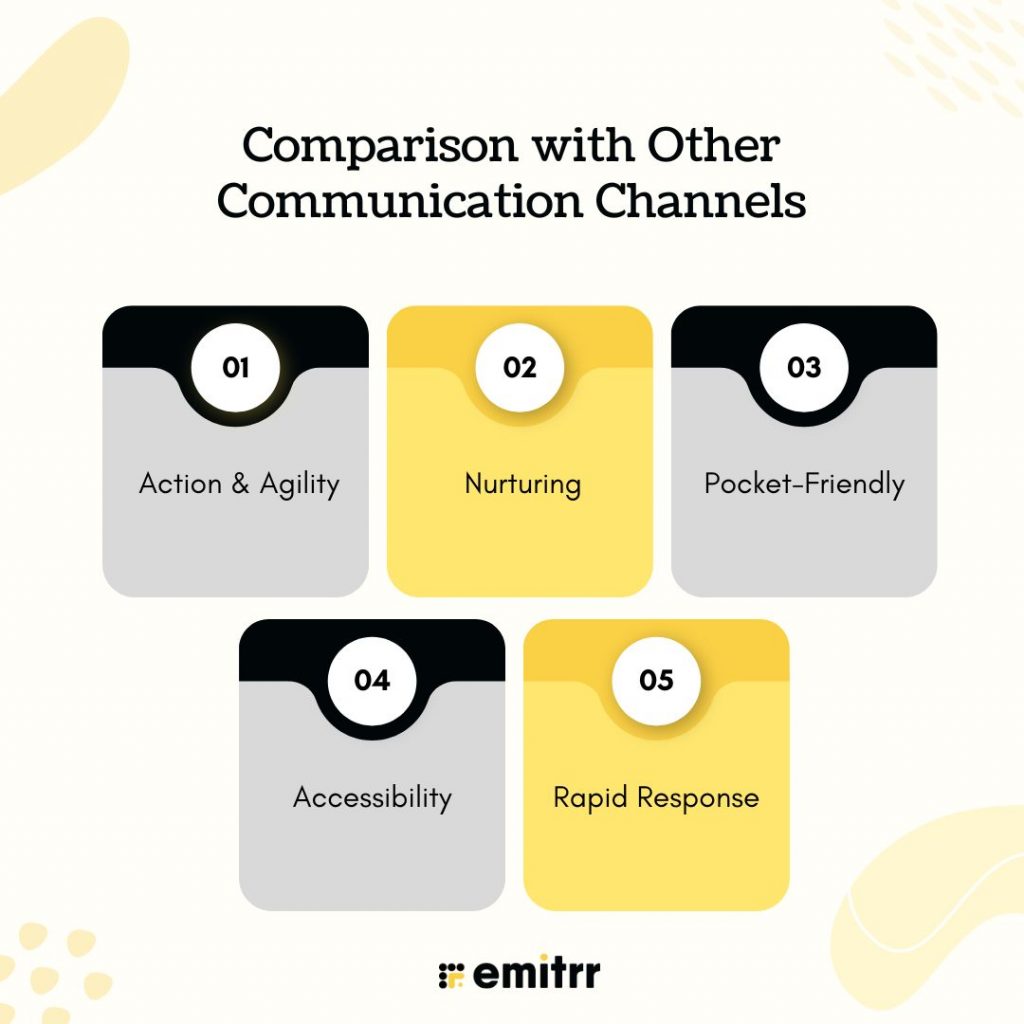
1. Action & Agility
Texting’s synonymous with immediate action. Texts are read instantly and trigger responses, making them ideal for urgent updates, volunteer mobilization, and donation drives. It’s a sure-shot way to spur engagement and boost event turnout.
2. Nurturing
Texting feels personal. It allows two-way communication, making supporters feel seen and heard. Using an SMS, you can thank donors or address questions from volunteers as quick as a flash. It feels more interactive than any other channel, like emails or social media.
3. Pocket-Friendly
Texting doesn’t cost an arm and a leg, even when you choose to leverage a platform like Emitrr. It isn’t pricey, connects with your target audience with a hint of personalization, and drives your cause, all without stretching your dollars.
4. Accessibility
Texting works for everyone, from tech-savvy younger folks to older supporters with basic phones. It doesn’t need internet access, unlike social media or email, making it inclusive and far-reaching.
5. Rapid Response
When speed matters, like during disaster relief or urgent advocacy, texting’s instant delivery and high open rates make it the go-to choice. It’s ideal for mobilizing volunteers or rallying donors fast, surpassing slower channels like email or mail.
Texting shines out as a success-driver for nonprofits. Its versatility and engagement make it a “must-have” for nonprofits looking to leave an indelible mark.

Benefits of Texting for Nonprofits
Let’s quickly understand how texting can supercharge nonprofit communications across the board.
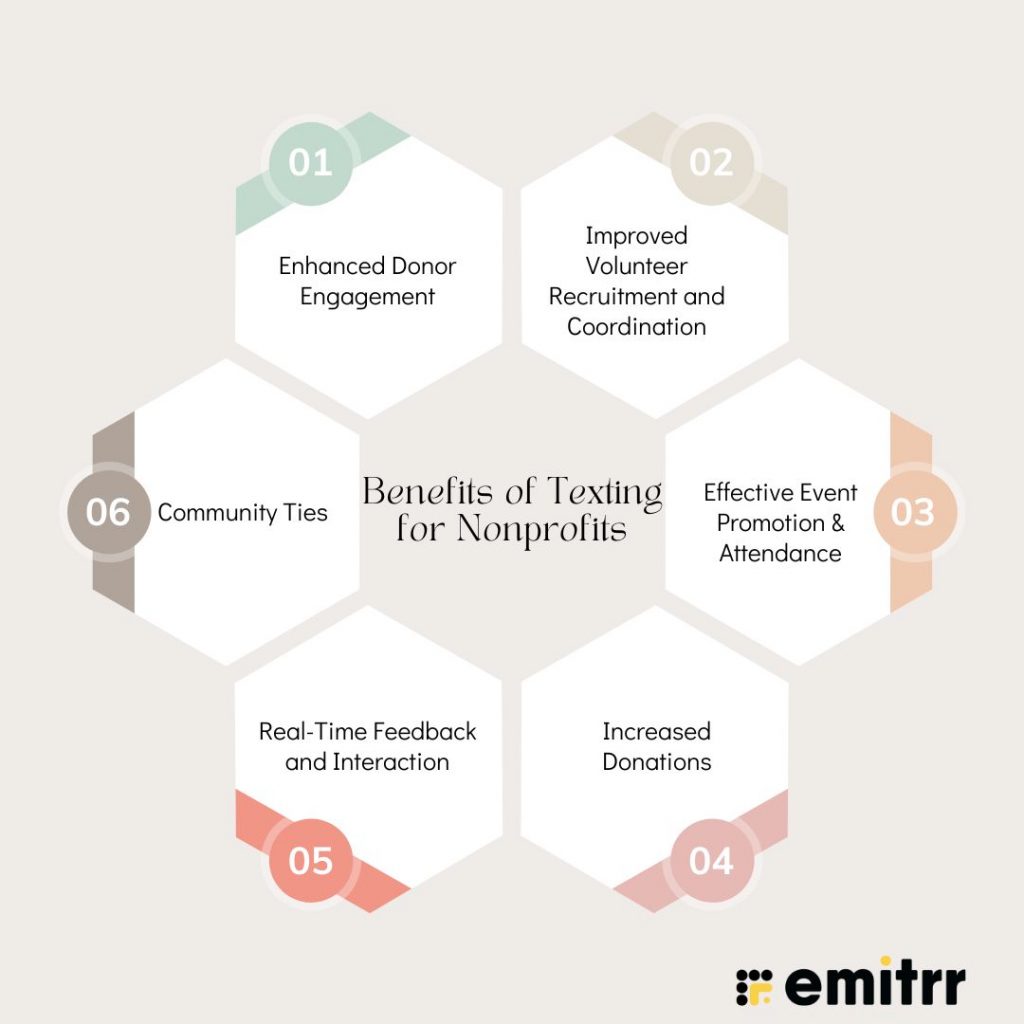
1. Enhanced Donor Engagement
Texting revs up donor participation, making them feel noticed and valued. It’s direct, personalized, and lays the groundwork for immediate connection. With a little strategy at hand, nonprofits can use texts as a key to building stronger connections, encouraging fundraising, and instilling a sense of community — all while saving money and resources. What’s more? Using texts, nonprofits can send urgent appeals, event reminders, stewardship and thank you messages, along with tossing in fun quizzes, volunteer gigs, and stories of impact. In short, texting can go a long way in ensuring you’ve a squad.
2. Improved Volunteer Recruitment and Coordination
With texting, managing volunteers is no longer a logistical nightmare. In fact, it’s effortless. Nonprofits can curate and send recruitment messages to rally like-minded individuals or quickly coordinate with ongoing supporters to sync schedules. Need to tackle a sudden change in plans or send a last-minute reminder? Just text. Zero hassle, zero stress. Texting is an excellent way to communicate shift changes, update meeting points, or share real-time updates during events, ensuring everyone’s on the same page and engaged with the cause with minimal friction.
3. Effective Event Promotion & Attendance
Getting the word out and filling seats for your events can be a slog, but texting plays along. Craft crisp, catchy promotional texts or reminders to keep your supporters in the loop. Fire off registration links, last-minute updates, and personalized nudges to ensure your event gets the traction and footfall it deserves. By pushing out RSVP texts, you can cut down on no-shows and keep the energy up. All in all, texting is a surefire way to boost attendance and make your campaigns a true success under your belt.
4. Increased Donations
Texting can effectively multiply your donations and strengthen your causes like never before. Nonprofits can replace done-to-death donation forms with succinct, powerful texts to engage and build relationships with donors without overwhelming them with details. You can reach your donor with targeted appeals or stories that show their bucks at work, significantly impacting their willingness to give more and touch more lives. Besides, texting can reach a wider audience, including those who may feel uncomfortable with online donations. According to Bloomerang, with text-to-give setups, donors can contribute quickly and easily by sending a keyword or simply an emoji.
5. Real-Time Feedback and Interaction
Want the tea on what your supporters think? Texting’s your go-to for gaining feedback fast. Send quick surveys and polls to find out what your supporters—or the community at large—really think, and you might get replies pronto. You can also chat with supporters in real time to better understand the prevailing market dynamics. Texting is also a great way for nonprofits to gather insights about their events. After an event, texting attendees for feedback can be beautifully leveraged to level up your next one. Stay plugged into your audience’s needs and boost engagement and interaction on the go.
6. Community Ties
Texting plays a cardinal role in building stronger, more connected communities. By sharing impact stories, inspiring updates, or a simple note of appreciation to supporters who acted as a rock and made their valuable contributions, nonprofits can nurture a community that beats biases and truly belongs.
It becomes a dynamic communication channel that reinforces a sense of unity, cultivates trust, and sparks lasting relationships within your community.
Use Cases of Texting for Nonprofits
Texting’s promise for nonprofits, indubitably, is maybe the best-kept secret. But, not anymore!
Below is a complete lowdown on the practical, real-world use cases of texting that have helped nonprofits elevate their communication. If you run a nonprofit and are curious to learn how texting can be a differentiator for your organization, read through to the end of this section.
1. Fundraising
Texting adds an element of speed and convenience to fundraising campaigns, keeping those donation boxes ringing. Why? Because it’s direct, fast, real-time and prompts people to take action with minimal investment. Text-to-give campaigns ask donors to text a keyword to a shortcode, triggering a donation via phone bill or a link—simple, quick, and uber-effective with the right marketing.
2. Emergency Alerts and Updates
Another texting use case for nonprofits is sending emergency alerts and updates, helping nonprofits mobilize the right kind of support in no time. In times of natural calamities like earthquakes or urgent community needs, nonprofits can send short and crisp texts to the people associated with them and ask for help. These messages may include safety instructions, updates on disaster response efforts, or appeals for specific items.
3. Volunteer Management
Asking for support and contributions is an integral part of any nonprofit’s modus operandi, and texting helps in a big way. Nonprofits can create simple messages to recruit help, plan a rendezvous, and share key campaign details. These messages can even include links for event sign-ups or newly announced volunteer positions. Texting also allows them to notify volunteers about schedules, training sessions, or last-minute needs such as equipment or extra help for a food drive.
4. Advocacy and Awareness Campaigns
Nonprofits can use text messaging to drive advocacy by including links that prompt supporters to sign petitions or reach out to lawmakers. Sharing powerful personal stories or impactful statistics helps raise awareness and motivates recipients to take action or spread the word. For example, an environmental nonprofit might send a text alert about a campaign focused on combating environmental degradation.
5. Community Building and Engagement
Texting, hands down, feels more personal and purposeful than any other form of communication, making it an effective tool for nonprofits working towards the greater good. By crafting messages, nonprofits can share success stories, inspiring supporter experiences, or invitations to virtual or in–person events. Quick polls or quizzes via mass texts can also facilitate engagement and involvement on a massive scale.
6. Feedback and Survey Collection
Text messaging offers a quick and effective way to gather feedback and conduct surveys that can help nonprofits refine their programs. Short post-event surveys can capture opinions, gauge satisfaction, and inform future planning. Regular feedback strengthens programs by keeping them aligned with supporters needs.
7. Educational Content Distribution
Breaking educational content into bite-sized texts makes it more accessible and easier to engage with. Nonprofits can share quick tips, relevant facts, or mission-related insights like health advice from a healthcare nonprofit, along with links to deeper resources such as blog posts, videos, or webinars.
8. Event Reminders and Follow-Ups
Texting for nonprofits’ events is a god-send. Nonprofits can send timely reminders with key event details like time, location, or virtual access links and follow up with thank-yous, highlights, or photo recaps to maintain engagement after the event. Think participation at your events is waning? Simply put down a text and circulate, inserting a link or directions to the venue for ease.
9. Donor Thank-You and Appreciation Texts
Sending prompt and personal thank-you texts can help fuel and build lasting donor relationships. A simple message of appreciation can reinforce the impact of their gift and encourage continued support. Using texting, nonprofits can also highlight specific results their donations enabled or celebrate donor milestones.
Best Practices for Texting in Nonprofits
Texting might seem like a cookie-cutter job, but it really isn’t. When planned and executed the right way, its power is immense. Here are a few insights into the best practices that can help you implement texting in the most efficient way possible.
1. Craft your messages to be concise, friendly, and action-driven.
To ensure captured responses to the messages, texts should be brief—not exceeding 160 characters, and contain only one call to action, such as donating, signing up, or sharing a campaign. The tone should be friendly, as if you’re speaking for your nonprofit organization. For example, you can send: “Be a part of an effort to feed 100 families during Thanksgiving. Donate now.”
Do not use terms that belong to marketing language or make it sound like a promotion all the time. The option of subscription should always be complemented with an easy way to unsubscribe, such as “Reply STOP to be removed from the list,” since it can help establish trust and also comply with rules and regulations.
2. Send texts at the right time and frequency to avoid overwhelming recipients.
This is because timing is important in order to avoid interfering with people’s daily activities that make them happy in one way or another. For notifications, texts should be sent during business hours, which are 9 AM to 8 PM of the recipient’s local time, with mid-morning (10–11 AM) or early evening (6–7 PM) proving to be the most effective.
The frequency of texts should be limited to 2–4 messages a month for the general public, while more frequent messages may be acceptable for campaigns with special needs, such as disasters.
Use response rates to determine the right frequency of your communication to the audience, and when giving options for the updates during sign-up, they should include monthly, event-based, among others.
3. Personalize your messages to strengthen supporter relationships.
The policy of personalization helps to engage supporters, as everyone feels that they are important to the particular organization. You should use the first name of the recipient where possible, like “Hi Sarah, Your support can touch lives.”
Categorize the recipients into groups according to their behavior or interests, like donors, volunteers, or event follow-up, and send intended messages. For instance, when passing a note of gratitude to the last few donors, post: “Thanks for your $50 gift, John! It funded 10 meals.”
4. Ensure your messages are delivered reliably by following best practices.
When done right, deliverability will help ensure your texts get to your supporters’ phones. Choose your texting platform carefully—it is suggested to work with a carrier-provided platform to prevent spamming.
It would be best to always use a short code or a 10-digit long code because random phone numbers may get blocked. Do not keep old numbers on your list, as everyone may not be interested in your call, so be sure to update the list occasionally.
5. Use A/B testing to identify which messages perform best.
A/B testing allows enhancing the texts for further effectiveness. Test one variable at a time only. In this case, message wording like “Donate now!” vs. “Give today!”, call to action, or send time.
Communicate with two posts, one post for each group, make a small survey, and measure click-through rates or response rates. When it is used in a texting platform service, the performance of the campaign should be assessed, and only the effective elements be used in the future for that campaign. Always test your message, but do not test it too frequently, as this will only discourage your audience.
6. Enhance engagement with multimedia content, but use it thoughtfully.
While images and GIFs or even short videos can help increase engagement, there should be concern when using multimedia messages (MMS). It is possible to try to utilize visuals that are related to your mission, such as a recent beneficiary’s photo or a short video of gratitude to the donors.
Limit image files to below 600 KB and videos to less than 30 seconds in length to reduce carriers’ potential blocking of content. Always start experimenting with MMS with a few recipients, as some providers or older models may not recognize multimedia messages. It is crucial to have text that is readable for screen readers when using CSS animations.
Challenges of Texting for Nonprofits
Texting for nonprofits comes with its set of unique challenges. Five of them are outlined below.
1. Managing Opt-Out Rates
High opt-out rates can shrink a nonprofit’s texting audience, reducing campaign impact. Supporters may unsubscribe if texts feel too frequent, irrelevant, or pushy. Offering clear opt-in choices, such as selecting topics (e.g., donations vs. volunteer opportunities), helps tailor messages.
Including an easy opt-out option, like “Text STOP to unsubscribe,” is legally required and builds trust. Nonprofits should also monitor opt-out trends using their texting platforms to identify problem areas, such as overly aggressive campaigns.
2. Overcoming Message Filtering
Message filtering by carriers or phone settings can prevent texts from reaching supporters, undermining campaigns. Carriers may flag texts as spam if they come from unfamiliar numbers, contain suspicious links, or include certain keywords (e.g., “free” or “win”). For example, a nonprofit using a shared short code might be blocked if another user on the same code violates carrier rules.
To avoid this, nonprofits should use a reputable texting platform with strong carrier relationships, such as Emitrr, and opt for dedicated short codes or 10-digit long codes to maintain a consistent sender identity.
Testing messages across different carriers and avoiding spam-like language also helps. Encouraging supporters to save the nonprofit’s number or reply to confirm delivery can reduce filtering. Regular list maintenance, such as removing inactive or invalid numbers, improves deliverability rates.
3. Protecting Data Privacy
Texting campaigns require collecting phone numbers and other personal details, raising privacy concerns. Many countries enforce specific regulations, such as the Telephone Consumer Protection Act (TCPA) in the United States and the General Data Protection Regulation (GDPR) in Europe. These laws prohibit advertising without prior opt-in consent and require secure data storage and transfer.
Any data leakage or abuse, such as sharing contact lists, can erode supporter trust and may attract legal consequences. To prevent privacy breaches, nonprofits should use secure mobile applications that offer encryption and privacy settings.
Regularly review data handling procedures and train staff to avoid mistakes, such as exporting contact lists to insecure devices. Consulting legal advisors is essential when targeting international audiences to ensure compliance with applicable laws.
4. Training Staff and Volunteers on Texting Protocols
A lack of staff or volunteer training can result in inappropriate or non-compliant text messages being sent. Program administrators should establish clear texting guidelines that cover legal requirements, platform usage, and approved message types. Offer brief, actionable training sessions or video tutorials for ongoing reference, and provide pre-written scripts for common messages such as event reminders.
Designate a responsible person to oversee texting efforts and require that all messages be approved before sending. Consider using platforms that include compliance features like automatic opt-out handling.
5. Addressing Language and Cultural Barriers
Nonprofits often serve diverse communities, so messages must be culturally and linguistically appropriate. Poor translations can confuse non-English speakers or fail to resonate with certain cultural groups. For example, a fundraising text referencing a U.S. holiday like Thanksgiving may be ineffective or misunderstood by international audiences.
Translations may require multiple revisions to maintain cultural accuracy, which can be time-consuming for smaller organizations. To address this, segment audiences by language or region and use professional translation services for key campaigns.
Steps to Set Up SMS Texting with Emitrr
Emitrr is a powerful, feature-rich AI-based texting platform that helps nonprofits streamline communication through SMS texting and automation. This guide explains how, as a nonprofit, you can integrate Emitrr with operational workflows and improve texting by a mile.
Getting Started with Emitrr-Led SMS Texting for Nonprofits
1. Sign Up for Emitrr: Visit the Emitrr website to create an account using your nonprofit’s details and a verified phone number. The process is quick and user-friendly, with support available via phone (+1-210-941-4696) or email (support@emitrr.com).
2. Choose a Plan: Emitrr offers custom pricing—contact their sales team for nonprofit-specific options. Consider user count, message volume, and needed features like automation or CRM integration.
3. Configure Your Settings: Add your business phone number, assign roles, and create message templates. Integrate with tools like your CRM to sync contact data and track interactions.
4. Send Your First Text: Use the dashboard to send personalized or bulk messages. Schedule texts or automate campaigns like event reminders. Emitrr’s interface makes it easy to track sent messages and responses, helping you gauge engagement. This step marks the start of leveraging SMS to connect with your community effectively.
Integrating Emitrr with Your Nonprofit’s Tools
Emitrr’s AI texting platform is designed with user-centricity in mind. From beginners to tech mavens, everyone across every scale of technical knowledge can quickly learn the ropes and start using Emitrr from the get go.
However, to provide a starting point to nonprofits, we’ve outlined how Emitrr works alongside legacy or proprietary infrastructure.
1. Wide Integration Support
Emitrr can work in synergy with multiple tools via Zapier, making it a versatile, adaptable resource. It sits well with platforms like HubSpot, Jotform, Slack, Google Calendar, and many more, automating end-to-end texting, reducing manual workload, and improving efficiency.
2. Unified CRM Syncing
Integrating Emitrr with your CRM (e.g., HubSpot) helps nonprofits sync volunteer, donor, and campaign-based data in real-time, while allowing 360-degree visibility into texting pipelines as are. Every SMS interaction is logged, offering a single source of truth for contacts, engagement ratios, and future prospects.
3. Smarter Fundraising Follow-Ups
Working with fundraising tools — while simplifying and accelerating texting for nonprofits — Emitrr opens up opportunities to boost donor relations. Using the tools, you can trigger automatic thank-you texts or donation confirmations right after contributions, keeping donors engaged and saving your team time.
4. Volunteer Communication Automation
Emitrr is compatible with several volunteer management systems, automation shift confirmations, reminders, and updates. Whether you’re using spreadsheets, forms, or dedicated platforms, Emitrr via Zapier links them seamlessly and works in harmony, boosting turnout and reducing back-and-forth, especially important for time-sensitive nonprofit events.
5. Workflow Automation Made Easy
With Emitrr, you can easily set up texts triggered by form submissions, bookings, or calendar events. For example, when a form is submitted via Jotform or a meeting is scheduled in Calendly, Emitrr can automatically send a confirmation or reminder. Our tool handles the follow-up so you don’t have to.
6. Custom Triggers for Personalized Messaging
With Zapier, you can define exactly when and how Emitrr communicates. Triggers might include new CRM entries, form responses, or appointment bookings. These prompts initiate personalized messages or bulk texts. From confirming participation to sending event updates, these custom workflows enable timely, tailored outreach with no manual steps.
7. Maintain Smooth Operations
To maintain performance, regularly check your Zapier integrations. Look for errors or failed zaps and retest your workflows as needed. Emitrr’s support team is available 24/7 to help troubleshoot issues. Reliable integration ensures data flows correctly and campaigns run without interruption, so your nonprofit stays efficient, responsive, and well-connected with your community.
FAQs
Nonprofits must comply with the Telephone Consumer Protection Act (TCPA) by obtaining prior express consent from recipients before sending texts, providing a clear opt-out mechanism in every message, and maintaining accurate records of opt-ins and opt-outs. They should also ensure data security and regularly audit their messaging practices to stay compliant with regulations.
To begin texting, nonprofits should select a reputable texting service provider, register their brand and campaign for A2P 10DLC messaging (if in the US), build an opt-in subscriber list through various channels, create compliant message templates including opt-out instructions, and conduct test campaigns before launching to their audience.
Texting costs typically include one-time fees for brand and campaign registration, monthly fees for phone numbers and campaign maintenance, per-message charges that vary by volume and provider (often discounted for nonprofits), and additional carrier fees; international texting usually incurs higher per-message costs, which vary significantly by country and platform.
The effectiveness of a texting campaign can be measured by tracking open rates, click-through rates, opt-out rates, and conversion rates such as donations or event sign-ups, along with gathering subscriber feedback to optimize messaging strategies and improve future campaign performance.
While texting can reach international audiences, nonprofits must ensure their chosen platform supports global messaging, be prepared for higher costs, comply with local regulations, use proper international formatting and language localization, and consider alternative messaging apps like WhatsApp for more cost-effective and engaging communication abroad.
Conclusion
Texting is, in all likelihood, an underrated tool for nonprofits. When combined with a touch of smart strategy and AI, it can jumpstart engagement and drive impact to unprecedented levels. Add a personal touch, and there’s no limit to how far your nonprofit can go.
Don’t miss out on Emitrr’s potential as your go-to AI-powered texting platform. From fundraising to event promotion, our tool supports the full range of nonprofit needs. And, with continuous advancements swirling in, texting could very well become the true north star for your organization. Explore more here!