
Introduction
Top-performing businesses are now relying on AI IVR systems to handle routine customer interactions, freeing up human agents for more complex cases. These systems don’t just manage calls; they streamline the entire voice support workflow.
If you’re looking to reduce drop-offs and improve service speed without growing your team, choosing the right AI IVR is critical. Below, we’ve listed the 7 best AI IVR solutions in 2025, based on performance, scalability, and real-world use cases.
What is an AI IVR System?
An AI IVR system is an advanced, AI-powered version of traditional Interactive Voice Response (IVR) systems. Unlike standard IVR systems, which rely on pre-recorded scripts and touch-tone inputs, AI IVR systems utilise conversational AI and machine learning to understand and respond to natural language queries. These systems can perform tasks such as answering customer inquiries, processing requests, and even handling complex scenarios without human intervention.
Key components of an AI IVR system:
- Natural Language Processing (NLP): Allows the system to understand and process human speech.
- Speech Recognition: Converts spoken words into actionable data.
- Machine Learning: Continuously improves the system based on customer interactions.
- Intelligent Routing: Directs customers to the most appropriate agent or resource based on the interaction.
Benefits Of An AI IVR System
AI IVR systems offer numerous advantages over traditional IVR systems, making them a preferred choice for businesses seeking to enhance their customer service experience.
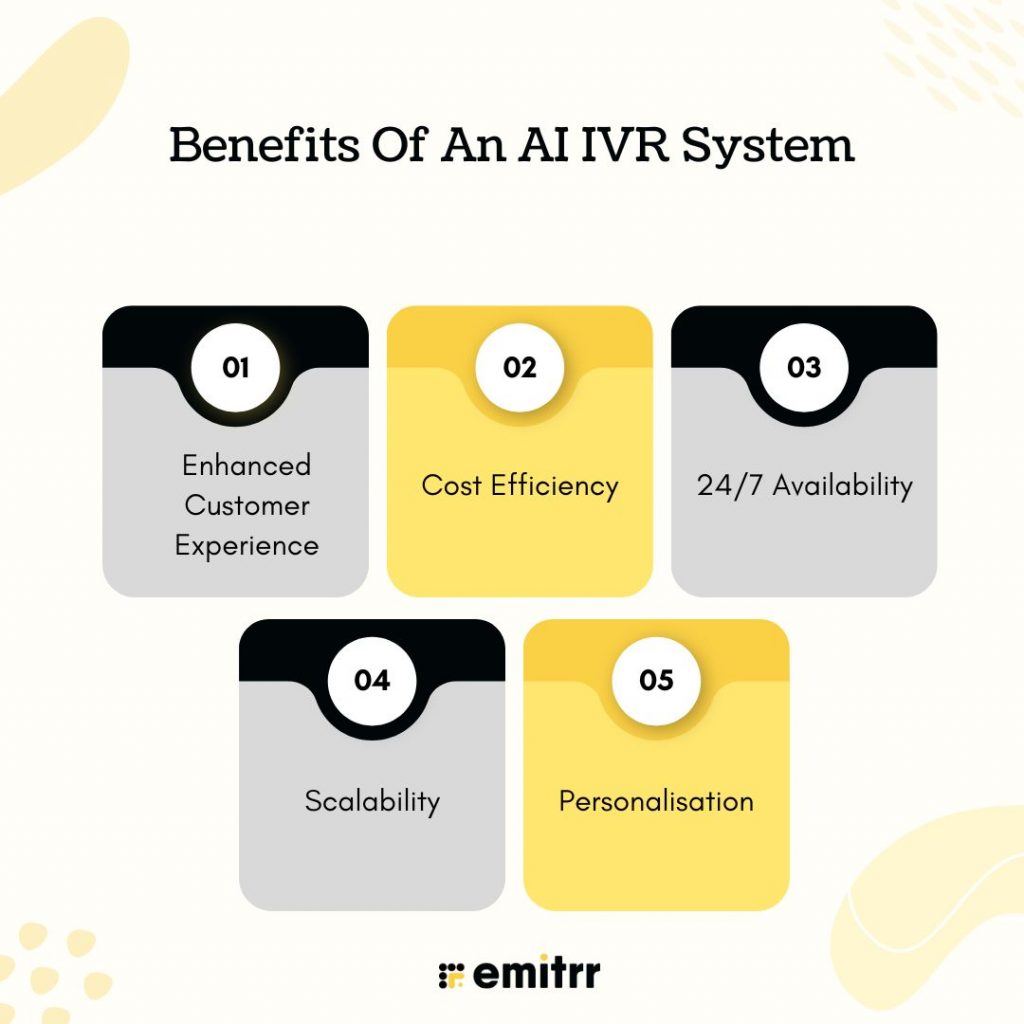
- Enhanced Customer Experience: AI IVR systems understand natural language, allowing customers to interact more intuitively. This reduces frustration and leads to a smoother experience.
- Cost Efficiency: By automating many customer service processes, businesses can reduce labour costs and free up agents for more complex tasks.
- 24/7 Availability: AI IVR systems can operate around the clock, offering customers immediate assistance whenever needed.
- Scalability: As businesses grow, AI IVR systems can easily scale to accommodate increased volumes of customer interactions without additional resources.
- Personalisation: With advanced data analytics, AI IVR systems can personalise responses based on customer history and preferences.
How Does an AI IVR System Work?
AI IVR systems utilise a combination of technologies such as NLP, speech recognition, and machine learning to understand and respond to customer queries. The workflow typically follows this sequence:
- Customer Initiates Call: The customer calls in and is greeted by the AI IVR system.
- Speech Recognition and NLP Processing: The system listens to the customer’s input and processes it using speech recognition and NLP.
- Intent Recognition: AI interprets the intent behind the query and determines the appropriate response or action.
- Action Execution: The system either provides an answer or routes the customer to the most suitable department or agent.
- Machine Learning: The system learns from each interaction to improve accuracy and customer satisfaction in future interactions.
Smallest.ai Pulse provides low-latency speech-to-text capabilities for real-time IVR systems and voice applications. It can help teams transcribe customer conversations, capture spoken inputs, and power responsive automated call and conversational AI workflows.
Key Differences Between a Traditional IVR System and an AI IVR System
Some key differences between a traditional and an AI-powered IVR system are:
| Feature | Traditional IVR | AI IVR System |
| Input Method | Uses touch-tone or voice commands from predefined scripts | Uses natural language understanding and voice recognition |
| Complex Queries | Struggles with complex or multi-step requests | Handles complex queries effectively through AI and NLP |
| Flexibility | Limited to programmed responses | Learns from customer interactions and adapts over time |
| Customer Experience | It can be frustrating due to limited options and rigid scripts | Provides a more personalised and seamless experience |
| Cost and Scalability | Requires more agents as volume increases | Scales easily without additional resources needed |
Features to Look for in Your Ideal AI IVR System
When selecting an AI IVR system, businesses should focus on several critical features to ensure they get the best solution for their needs:
- Multichannel Support: AI IVR systems should handle multiple communication channels, such as voice, email, and chat.
- Natural Language Processing (NLP): This ensures the system can understand and respond to complex customer inquiries.
- Advanced Routing: The system should have intelligent call routing that directs customers to the right agent or department.
- Personalisation: The system should be able to personalise interactions based on customer data and history.
- Scalability: The system should easily scale as your business grows, without the need for a significant increase in resources.
- Customizable Analytics: Look for systems that offer detailed analytics for optimizing service.
- Integration Capabilities: Ensure the system can integrate seamlessly with your existing CRM and business tools.
Watch this quick video to understand what to look for before switching to an AI IVR system:
Top 7 AI IVR Systems for 2025
In 2025, the AI IVR landscape is expected to evolve, with companies seeking smarter, more intuitive solutions for their customer service needs. Below are the Top 7 AI IVR systems that are anticipated to lead the market.
1. Emitrr
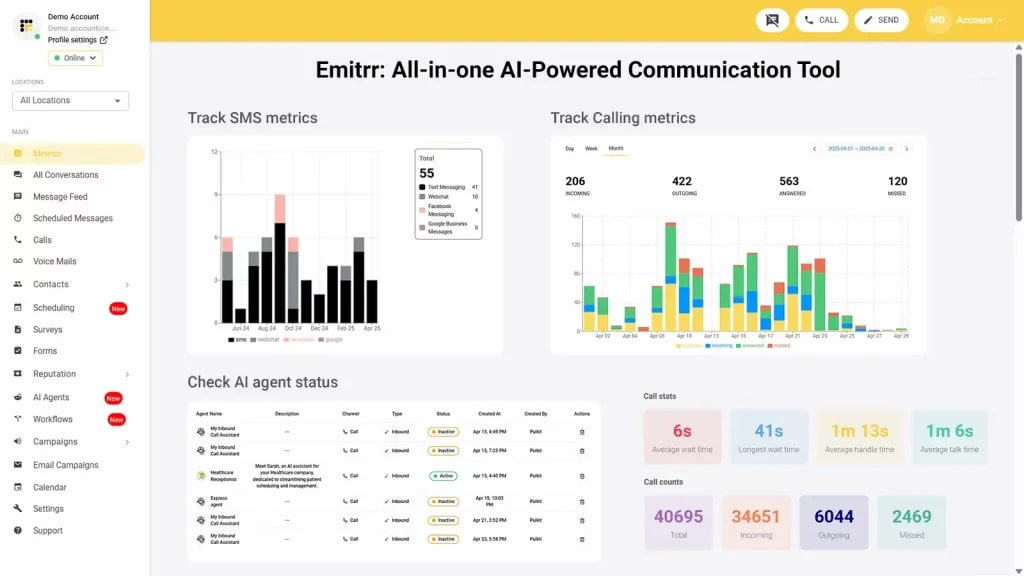
Emitrr is an innovative AI IVR system that leverages conversational AI to provide a seamless customer experience. Its capabilities extend beyond traditional IVR functionalities, offering businesses powerful tools for automating and personalising customer service.
Features:
- Natural Language Processing (NLP): Enables customers to interact using natural language.
- Voice Recognition: Understands and processes voice inputs with high accuracy.
- Omnichannel Integration: Works across multiple channels, including voice, chat, and email.
- Personalised Interactions: AI learns customer preferences to tailor responses.
- 24/7 Availability: Never offline, ensuring continuous support.
- Real-Time Analytics: Provides businesses with data to optimise customer interactions.
- Customizable Routing: Directs inquiries to the most appropriate agent or resource.
- AI Agent: Create and configure your own smart AI Agent; set a customized greeting message and prompt, add knowledge base and specific actions for the agent.
Pros:
- Highly scalable for businesses of any size.
- Flexible, with customisable workflows and integrations.
- Improves customer satisfaction by reducing wait times.
Cons:
- More interesting AI IVR capabilities are in the pipeline and will be launched soon!
Support Channels: Email, phone, live chat on the website, extensive knowledge base, FAQS, and SMS support.
Pricing Plans:
- Standard Plan ($20/user/month): Includes 1,000 minutes, mobile app, call routing, queues, recording, and business hours routing. Best for teams needing essential call management without extra cost.
- Professional Plan ($25/user/month): Adds IVR, call transcription, auto-text for missed calls, conference calling, and HIPAA compliance. Ideal for businesses that need advanced tools for better service and secure communication.
Emitrr also offers a free demo to help you decide if it’s the right fit for your business.
Reviews: 4.7 out of 5 stars on G2

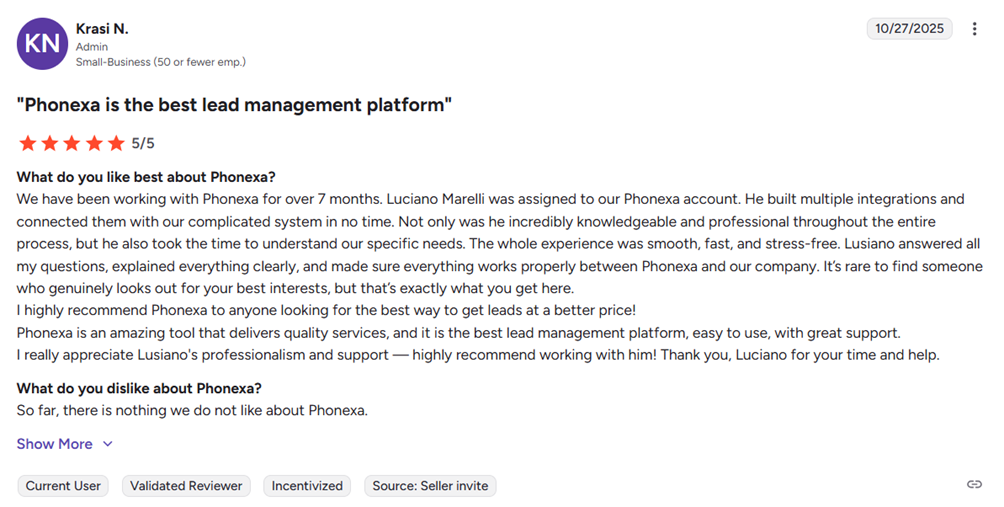
2. Phonexa
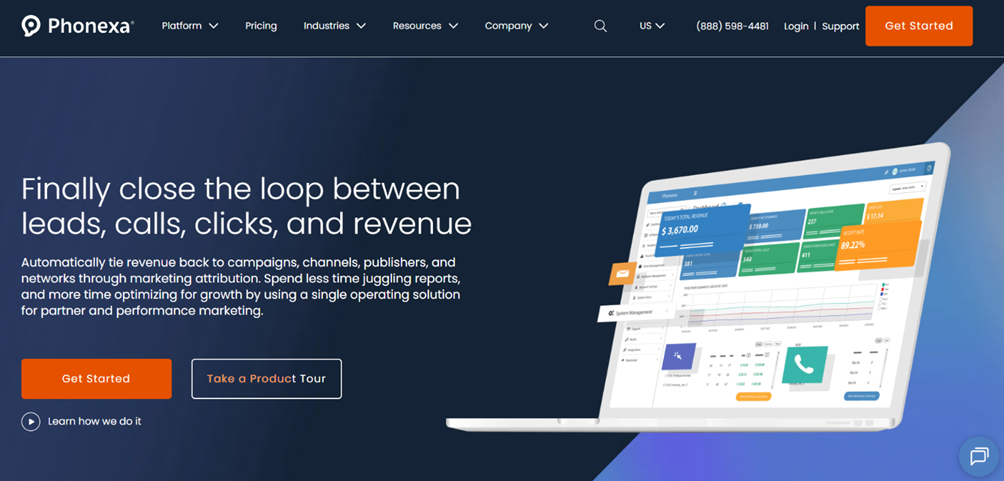
Phonexa is an enterprise-grade tracking and distribution platform for calls, leads, fraud, and compliance, in addition to a fully integrated stack of tools that enable marketers to track and optimize performance.
At the core of the Phonexa ecosystem are LMS Sync for intelligent lead management and lead distribution, and Call Logic for advanced call tracking, routing, AI Call Agents, and pay-per-call campaigns, each enhanced by automation and real-time analytics.
Features:
- AI Call Agents: Phonexa’s AI Call Agents ensure personalized, human-like conversations that imitate the most successful practices of human agents, leading to a more precise lead qualification and independent issue resolution.
- Custom Call Processing within AI-powered IVR: Phonexa’s IVR system can deliver contextualized responses on top of pre-scripted replies, providing additional flexibility and personalization.
- Industry-Specific Responses: AI Call Agents can be trained on industry-specific data sets to provide in-depth responses, and you can set specific guardrails to keep the conversation on topic and within reasonable limits at all times.
- Real-Time Call Screening: With Phonexa, you can screen inbound phone calls in real-time, accepting the calls that match your qualification criteria and rejecting or flagging mismatched, irrelevant, low-quality, or downright fraudulent calls.
- Call Recordings: Having records of inbound & outbound business phone calls keeps you legally protected and lets you get back to a specific call for reevaluation or compliance confirmation.
Pros:
- Powerful ecosystem for phone calls and leads
- One of the most advanced AI-powered IVRs in the market
- In-depth real-time reports and call flow customization
Cons:
- Extensive learning is required before you can get the most out of Phonexa
Support Channels: email, live chat, and phone support
Pricing Plans: Lite at $250 per month, Premium at $500 per month, Enterprise at $1,000 per month, and Custom upon request.
Reviews and Ratings: 4.9 out of 5 stars on G2
3. Sprinklr
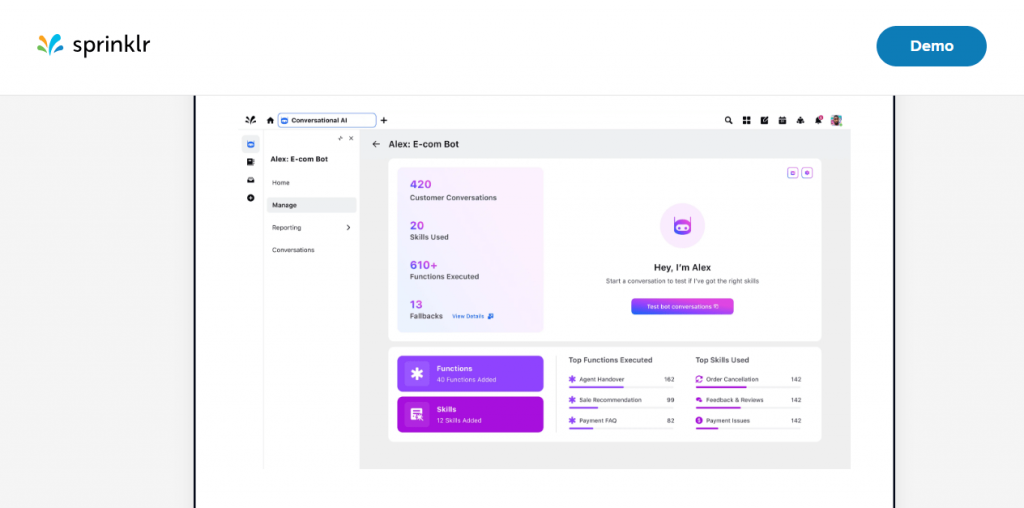
Sprinklr is an AI-powered IVR system designed for businesses looking to deliver superior customer experiences. Known for its enterprise-grade capabilities, Sprinklr leverages AI and machine learning to streamline customer interactions.
Features:
- Omnichannel Support: Handles customer interactions across multiple channels, including social media.
- AI-Powered Speech Analytics: Analyzes customer sentiment and feedback in real-time.
- Automated Response Generation: AI creates accurate responses based on customer input.
- Integration with CRM: Ensures a personalised experience by syncing with existing CRM systems.
- Scalability: Easily handles increased call volumes without additional resources.
- Data Privacy Compliance: Adheres to industry standards to ensure customer data protection.
- Advanced Reporting Tools: Provides actionable insights to improve service efficiency.
Pros:
- Excellent at handling complex, multi-channel interactions.
- Scalable, making it ideal for large businesses.
- Strong reporting and analytics tools.
Cons:
- Requires significant setup time for enterprise-level configurations.
- Premium pricing may be a barrier for small businesses.
- Steep learning curve for new users.
Support Channels: Email, live chat, and phone support.
Pricing Plans: Sprinklr offers tailored pricing depending on your business requirements. To get a quote, you’ll need to reach out to their team directly. A 30-day free trial is also available.
Reviews and Ratings: 4.3 out of 5 stars on G2.
4. CloudTalk
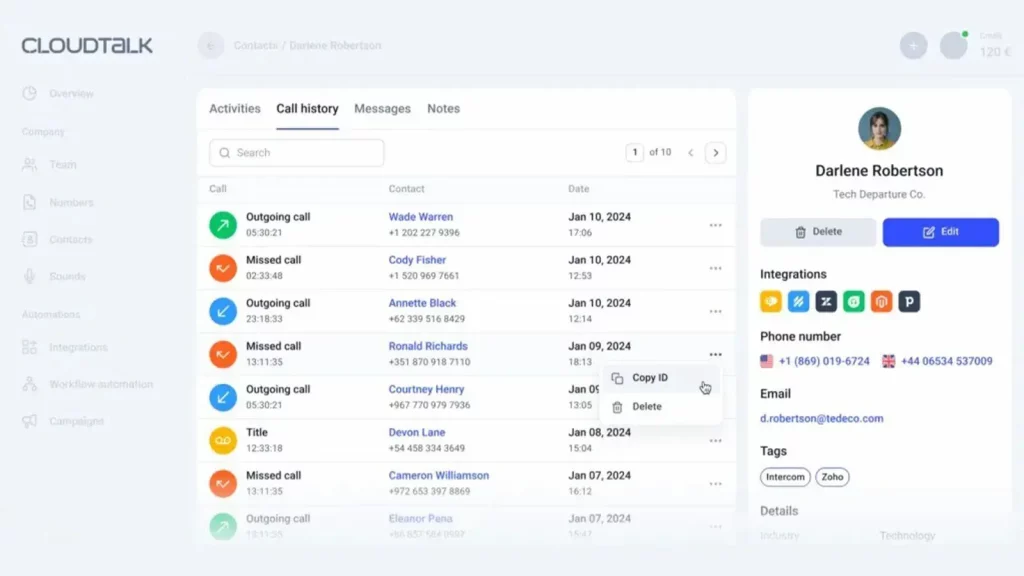
CloudTalk is an AI-based IVR system that integrates seamlessly with existing business communication tools. With its emphasis on AI-driven customer service, CloudTalk provides a modern solution for managing customer inquiries.
Features:
- Smart Call Routing: Directs customers to the appropriate agent based on their needs.
- AI-Driven Analytics: Provides actionable insights to optimise customer service operations.
- Voice Recognition: Recognises customer requests and responds intelligently.
- Customisable Greetings and Call Flows: Allows businesses to tailor interactions.
- Integration with CRMs: Syncs seamlessly with major CRM platforms.
- Multichannel Support: Handles interactions across voice, email, and chat channels.
- Advanced Security Features: Ensures customer data privacy and protection.
Pros:
- Highly customisable, allowing businesses to create tailored solutions.
- Easy to integrate with existing systems.
- Provides actionable analytics for service improvement.
Cons:
- Pricing can be steep for smaller businesses.
- It may require training for employees to use it effectively.
- Limited advanced features in lower pricing tiers.
Support Channels: 24/7 customer support through live chat and email.
Pricing Plans:
- Starter Plan ($25/user/month – billed annually) Includes unlimited calls to the US & Canada or 500 domestic minutes/month for UK & EU per user. Comes with international numbers, call recording, ACD, and a softphone app.
- Essential Plan ($29/user/month – billed annually) adds IVR, skill-based routing, AI smart queueing, advanced analytics, integrations, and global SMS. Includes 1,000 domestic minutes/month for UK & EU per user and 24/7 live support.
- Expert Plan ($49/user/month – billed annually) Unlocks unlimited UK & EU domestic calls, power dialers, Salesforce integration, live call monitoring, mandatory tagging, and WhatsApp messaging.
- Custom Plan (Contact for pricing) Offers tailored solutions with unlimited global calls, custom onboarding, enterprise security, SLA, and developer support.
CloudTalk also offers a free demo to help you evaluate the right plan for your AI IVR and cloud communication needs.
Reviews and Ratings: 4.4 out of 5 stars on G2
5. Zendesk
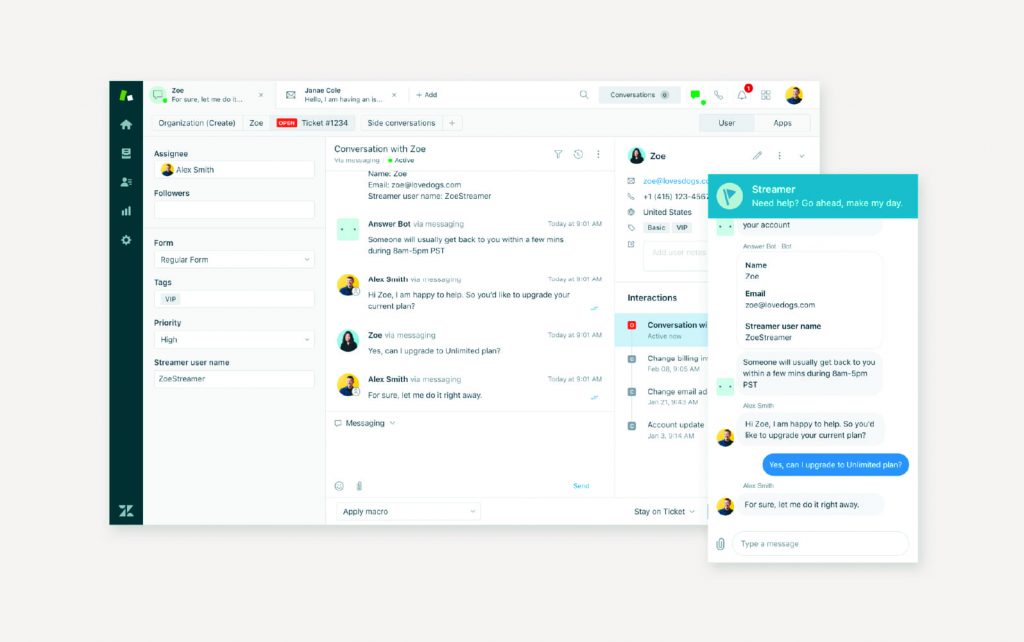
Zendesk is one of the most recognised names in customer support, and its AI-powered IVR system is no exception. Known for its intuitive interface and scalability, Zendesk provides businesses with an intelligent solution for customer service automation.
Features:
- AI Chatbots: Automate customer service with AI chatbots that handle basic inquiries.
- Omnichannel Communication: Supports voice, email, chat, and social media interactions.
- Intelligent Call Routing: Ensures that customer inquiries are directed to the right agent.
- Real-Time Analytics: Provides detailed reports on call performance and customer satisfaction.
- AI-Powered Self-Service: Allows customers to resolve issues on their own through an intelligent knowledge base.
- Personalised Interactions: Uses customer data to personalise interactions.
- Seamless Integrations: Works with a variety of third-party applications.
Pros:
- Excellent for businesses seeking a scalable solution.
- Strong integrations with various business tools.
- Well-suited for omnichannel support.
Cons:
- Complex pricing structure.
- Requires integration with other Zendesk products for full functionality.
- Customer support may be slow during peak times.
Support Channels: 24/7 support via email, live chat, and phone.
Pricing Plans:
- Support Team Plan ($19/agent/month – billed annually)
Includes a streamlined ticketing system, email support, social channel integration (Facebook & X), and predefined automation rules. Agents get a unified workspace with customer history and basic analytics. - Suite Team Plan ($55/agent/month – billed annually)
Adds AI agents, live chat, a help centre, proactive messaging, WhatsApp and Instagram support, call routing, ticket creation via phone, voicemail, and call recordings. - Suite Professional Plan ($115/agent/month – billed annually)
Builds on Suite Team with live and custom analytics, SLA management, multilingual content, customer satisfaction surveys, skills-based routing, IVR, and HIPAA compliance. - Suite Enterprise Plan (Custom pricing)
Includes advanced change management tools like audit logs, sandbox, approval workflows, dynamic workspaces, and up to 300 help centres. Also offers business rule analysis and ticket queue management.
Zendesk also offers a demo and custom onboarding to help you find the right plan for your support team.
Reviews and Ratings: 4.3 out of 5 stars on G2
6. Twilio

Twilio offers a flexible AI IVR system with robust voice capabilities. Known for its developer-friendly approach, Twilio allows businesses to build custom IVR solutions that leverage the latest AI technology.
Features:
- Programmable Voice: Customizes voice interactions to match business needs.
- Natural Language Processing: Understands and processes customer input.
- AI-Powered Call Routing: Directs customers to the right agent based on their needs.
- Scalable Cloud-Based Platform: Easily handles increased traffic.
- Omnichannel Support: Works across voice, SMS, and chat applications.
- Customizable Analytics: Provides insights into customer behaviour and service efficiency.
- Integration with Third-Party Applications: Easily integrates with CRMs and other business tools.
Pros:
- Highly flexible and customisable for developers.
- Scalable for businesses of all sizes.
- Strong API capabilities.
Cons:
- Requires technical knowledge for setup.
- It can be costly for smaller businesses.
- Support may be limited to developers rather than end-users.
Support Channels: Email, chat, and developer support are available.
Pricing Plans:
- Free
Sign up with no credit card required and access Twilio’s core communication tools, including SMS, voice, email, and WhatsApp. Ideal for developers or startups testing and building communication flows. - Pay-as-You-Go
Only pay for what you use with flexible, usage-based pricing across all Twilio products. Includes programmable messaging, voice calls, video, email, and more. - Volume Discounts (Contact Sales)
As your usage grows, Twilio offers custom pricing and volume discounts across communication APIs, security, and verification tools. Get support for custom SLAs and enterprise-scale requirements.
Reviews and Ratings: 4.2 out of 5 stars on G2
7. Aircall
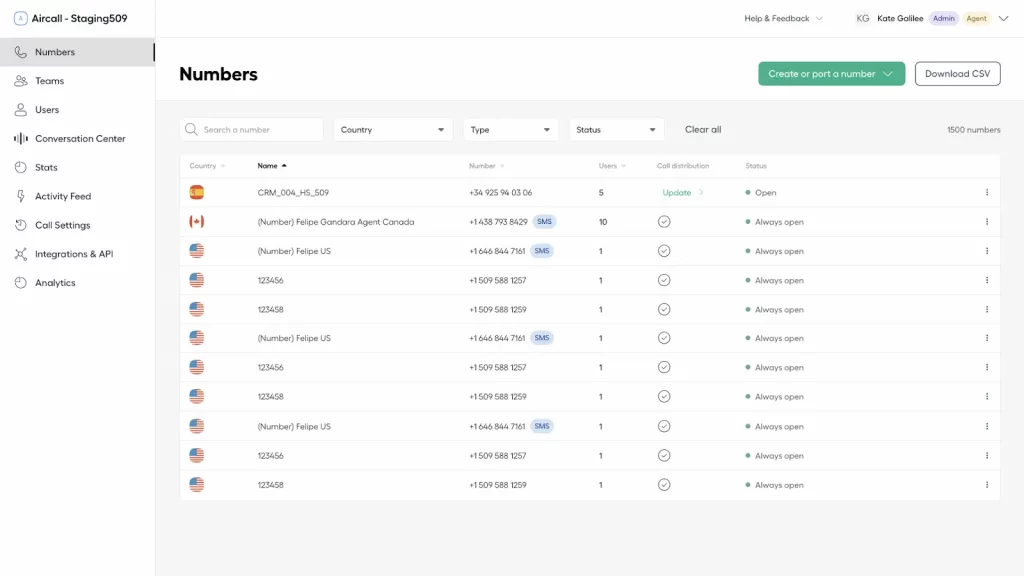
Aircall offers a cloud-based, AI-powered IVR system designed for businesses that need an intuitive, scalable solution for managing customer calls. With features like AI-driven routing and analytics, Aircall offers businesses the tools they need to improve customer satisfaction.
Features:
- AI Call Routing: Uses AI to direct calls to the appropriate agent.
- Omnichannel Support: Handles customer inquiries via voice, email, and chat.
- Speech Analytics: Provides insights into customer sentiment and behaviour.
- Customisable Call Flows: Tailor call flows based on business needs.
- Integration with CRM Tools: Seamlessly integrates with leading CRM platforms.
- Real-Time Data and Reporting: Provides actionable insights into call centre performance.
- Easy Setup: Quick and easy deployment with minimal configuration.
Pros:
- Easy to implement with minimal training required.
- Strong integration with popular CRM tools.
- Highly scalable for growing businesses.
Cons:
- Limited advanced features in basic pricing plans.
- Some users report issues with call quality in certain regions.
- Premium pricing may be prohibitive for smaller businesses.
Support Channels: 24/7 support via chat, phone, and email.
Pricing Plans:
- Essentials ($30 per license per month, billed annually)
Key features include 100+ integrations and API access, unlimited inbound calls (toll-free excluded), IVR, call recording, click-to-dial, SMS and MMS support, desktop and mobile softphone access, and unlimited simultaneous outbound calls.
- Professional ($50 per license per month, billed annually)
Includes everything in Essentials, plus Salesforce integration, mandatory call tagging, advanced analytics and live monitoring, smart routing with queue call-back, Power Dialer, Voicemail Drop, and enhanced support features.
- Custom (Minimum 25 licenses, contact sales for details).
Includes everything in Professional, plus unlimited outbound calls, custom onboarding, access to API developer support, Service Level Agreement (SLA), and Single Sign-On (SSO).
Reviews and Ratings: 4.3 out of 5 stars on G2
How Do You Choose the Right AI IVR System for Your Business?
When choosing an AI IVR system, consider the following factors:
- Assess Your Business Needs: Understand the volume of customer interactions and the complexity of queries to select an appropriate system.
- Evaluate IVR System Features: Check for features like omnichannel support, natural language processing, and real-time analytics.
- Consistent Scalability: Ensure the system can scale without significant resource investment.
- Cost Vs. ROI: Consider both the upfront cost and the long-term return on investment.
- Vendor Reputation: Look for reputable IVR solution providers with positive customer reviews and support channels.
- Integration Capabilities: Ensure compatibility with your existing software stack.
Why Is Emitrr the Best AI IVR Platform?
Emitrr leads the pack because it’s designed for small, service-focused businesses that rely heavily on phone calls but don’t have time for manual follow-ups or missed opportunities. Unlike traditional IVR tools that frustrate users with long menus, Emitrr acts more like a smart, conversational agent, resolving real customer needs without the hassle.
- Conversational IVR That Works: Emitrr uses AI to understand what callers want. Whether it’s booking an appointment, checking business hours, or answering insurance questions, the system responds naturally—no rigid menu trees or confusing options.
- Instant Missed Call Responses: If a call goes unanswered, Emitrr sends an automatic two-way SMS to keep the conversation going. It’s a simple but powerful way to stay connected with customers, even outside office hours.
- Appointment Handling Made Easy: Emitrr lets customers schedule, reschedule, or get reminders—without waiting on hold. It reduces no-shows and keeps your calendar organised, all through voice or text interactions.
- Easy Automation for Small Teams: You don’t need IT support to get value out of Emitrr. Automations like voicemail drops, canned responses, follow-ups, and bulk SMS are all built for busy teams with limited tech resources.
- Smart Routing + Multi-User Access: Every call or message is routed to the right person automatically. Plus, your whole team can access the system, so no customer query slips through the cracks.
FAQs
Emitrr is one of the top-rated AI IVR platforms, offering advanced features like hyper-personalised customer experiences, multi-channel communication, and seamless integrations. It provides 24/7 reliable support and enterprise-grade security, making it an excellent choice for businesses looking to optimise customer interactions.
Yes, modern IVR systems often use AI to enhance customer interactions. AI-powered IVR uses technologies like Natural Language Processing (NLP) and machine learning to understand customer inputs, personalise responses, and offer smarter, more efficient solutions compared to traditional IVR.
An automated IVR system interacts with customers via pre-recorded or AI-powered responses. It automates tasks like call routing, appointment scheduling, and answering FAQs without human intervention, improving efficiency and reducing wait times for customers.
NLP IVR refers to IVR systems that use Natural Language Processing (NLP) to understand and process spoken language. This technology allows customers to interact with the system using natural language, making the experience more intuitive compared to traditional IVR systems that rely on fixed options.
AI enhances IVR systems by enabling natural language understanding, predictive analytics, and machine learning. It allows systems to interpret more complex inquiries, provide personalised responses, route calls intelligently, and continuously improve performance based on customer data and interactions.
Traditional IVR relies on rigid menu-driven systems with limited interaction, while AI IVR uses NLP and machine learning to enable more natural, flexible conversations. AI IVR can understand context, personalise responses, and continually improve, providing a more efficient and user-friendly experience.
Yes, AI IVR can handle complex customer inquiries by using advanced NLP and machine learning algorithms to understand context and respond accurately. If necessary, it can escalate calls to human agents, ensuring that complex issues are addressed efficiently and effectively.
AI IVR personalizes interactions by analysing customer data, including previous interactions, preferences, and behaviour. This allows the system to offer tailored responses, anticipate customer needs, and provide a more engaging experience, enhancing customer satisfaction and loyalty.
Industries like healthcare, finance, telecommunications, e-commerce, and retail benefit greatly from AI IVR. These industries typically handle large volumes of customer inquiries, and AI IVR systems help streamline operations, improve customer service, and enhance efficiency through automation.
Conclusion
Choosing the right AI IVR system depends on what you want to achieve — faster call handling, better customer service, or smoother agent workflows. Each platform listed here brings its strengths, whether it’s smarter call routing, easier integrations, or better self-service options.
Focus on the features that matter most to your business. Test a few through free trials or demos if you can. A system like Emitrr, for instance, gives you a simple and effective way to manage high call volumes, reduce wait times, and keep your customer service team focused on the conversations that need a human touch.

 4.9 (400+
reviews)
4.9 (400+
reviews)