
Introduction
If your nonprofit struggles to communicate effectively, it may not be fully living up to its mission. Nonprofit communication has experienced a tidal change over the years, but the fundamentals—text messaging and voice calls—remain as effective as ever. Sure, everyone’s mobilizing emails and social media, voicemail systems have never lost their charm.
Unfortunately, too many nonprofits are either still sleeping on them or haven’t quite gotten the hang of them. Luckily for you, we’ve created a guide that’s legit packed with real nonprofit voicemail message templates you can actually use to spark interest and action. Plus, we’ve covered all the insider tips for setting up voicemail systems.
With our insights, not only will you look trustworthy and reliable, but you’ll also be able to leave the intended impact—without breaking the bank.
So, let’s dive right in!
Why Voicemail Are Essential for Nonprofit Communication
The real strength of voicemail messages lies in their ability to connect with your donors and volunteers on a personal level.
Unlike emails that seem ruthlessly professional and social media posts that sink into the void of nothingness, texts and voicemails hit the right chord and strike a one-on-one connection that actually binds and builds. From rallying supporters to thanking donors for generous contributions, texts and voicemail messages are the right mechanism, making people feel like an integral part of the whole system. After all, the whole point behind running a nonprofit is creating touchpoints that make people feel connected to your mission.
Besides, voicemail communication tools are extremely budget-friendly. Once you set up a good voicemail system, it runs on auto-pilot. Plus, integration is never a fuss. Both approaches play nice with your existing software estate, which means you get the complete visibility of each supporter and shape communications ever smarter.
Long story short: voicemail messages pack a lot of punch. And, these areas are exactly the ones where most nonprofits falter. If you’re a nonprofit and your communication isn’t hitting the mark, fret not. With the right strategy and tools, you can turn every voicemail into a powerful touchpoint. We’re here to help.

Getting Started: Setting Up Voicemail Systems for Your Nonprofit
This is your starting point for creating voicemail messages that leave a mark on your target audience. Check out our templates—use them as-is or tailor them to suit your voice.
Top Voicemail Templates
1. General Inquiries
Nonprofits experience a stream of callers asking for general updates. They must curate professional phone greetings that route callers efficiently while promoting key organizational touchpoints.
“Thanks for calling [Organization Name], where we [brief mission]. Your call matters to us! Press 1 for donations, 2 for volunteer info, 3 for programs, or 0 to talk to someone. You can also visit [website] or email [general email]. Thanks for supporting [cause]!”
“Hi there! Thanks for wanting to support [Organization Name]. We’re so grateful for donors like you! For quick donations, go to [website]. Questions about giving options or want to chat with our team? Leave your name, number, and best time to call. We’ll get back to you within 24 hours!”
“You’ve reached [Organization Name]’s info line! We’d love to tell you about our work in [cause area]. Check out [website] for programs, events, and volunteer opportunities. Want printed stuff or a presentation? Leave your name, address, phone, and what you need. We’ll follow up in 48 hours!”
2. After-Hours and Out-of-Office
Here, nonprofits are responsible for creating time-sensitive messaging that manages expectations and provides alternative contact options when unavailable.
“You’ve reached [Organization Name]. We’re open [days and times]. Emergency? Call [emergency number] or contact [emergency service]. For everything else, leave a detailed message with your name, number, and what you need. We’ll call back next business day. Check out [website] for immediate info!”
“Thanks for calling [Organization Name]! We’re closed for [Holiday Name] and back [return date]. Our team’s enjoying family time – hope you are too! Urgent stuff? Email [emergency email] or visit [website]. We’ll handle all messages when we’re back. Happy [Holiday]!”
“Hi! [Organization Name] is closed from [start date] through [end date] for [reason]. We’re [brief explanation]. Urgent matters? Contact [alternative contact]. Otherwise, leave a message and we’ll respond when we return on [date]. Thanks for your patience!”
3. Department-Specific
Because nonprofits have multiple departments, each attracting different kinds of questions, they need customized voicemail messages for areas like fundraising, volunteering, and programs.
“You’ve reached Development at [Organization Name]! We love connecting generous people with meaningful impact opportunities. Interested in monthly giving, major gifts, planned giving, or corporate partnerships? Leave your name, contact info, and interests. We’ll follow up in 24 hours. Quick donations at [website]!”
“Welcome to Volunteer Services at [Organization Name]! We have amazing opportunities for individuals, families, groups, and corporate teams in [cause area]. Current needs: [brief mention of 2-3 opportunities]. Leave your name, phone, email, and availability. Apply online at [website]. We’ll contact you within a week!”
“You’ve reached Programs at [Organization Name]. We provide [brief program description] to [target population] in [service area]. For eligibility, applications, or to schedule services, leave your name, contact info, and specific needs. Immediate help at [website] or [program email]. We’ll respond in two business days!”
4. Campaigns and Events
As the name suggests, it involves building voicemail systems centered around campaigns and events that can help boost registration and participation in specific initiatives.
“Thanks for your interest in [Event Name] on [Date]! This will be an incredible evening supporting [cause]. Tickets are $[price] including [what’s included]. Register now at [website] or call [number] during business hours. Space is limited! Questions about sponsorship? Leave a detailed message!”
“You’ve reached [Campaign Name] info! We’re raising $[amount] by [date] to [specific impact]. Currently at [percentage]% thanks to amazing people like you! Give by texting [amount] to [number] or visit [website]. Questions about giving levels or updates? Leave your message!”
“Thanks for considering an auction donation for [Event Name]! Last year donors like you helped us raise $[amount]. We need [types of donations]. For guidelines, tax receipts, and pickup, visit [website] or leave your name, business, contact info, and donation details. We’ll follow up in a week!”
5. Holidays and Special Situations
This involves seasonal and crisis-related messaging that maintains connection during special circumstances and rally support response.
Thanksgiving Message
“Happy Thanksgiving from [Organization Name]! We’re especially thankful for supporters like you. This year you helped us [specific achievement]. Offices closed November [dates], but you can still give at [website]. Grateful for you every day!”
Year-End Giving
“As we wrap up [year], [Organization Name] is grateful for your amazing support! You helped us [major achievements]. With [days] left in the year, consider a tax-deductible gift that will [impact]. Give at [website] or call [number]. Here’s to an impactful [next year]!”
Crisis Response
“[Organization Name] is responding to [crisis/disaster] in our community. We’re providing [specific services]. Need help? Call our emergency line at [number] or visit [emergency website]. Support relief efforts at [disaster fund website]. We’re stronger together!
Best Practices for Nonprofit Voicemail Communication
Having a few voicemail templates on hand is a great way to jumpstart your nonprofit’s communication. But following best practices is what truly doubles the impact. After all, it’s not just about doing things the “right” way. It’s about doing them in a way that ensures results, compliance, and lasting value.
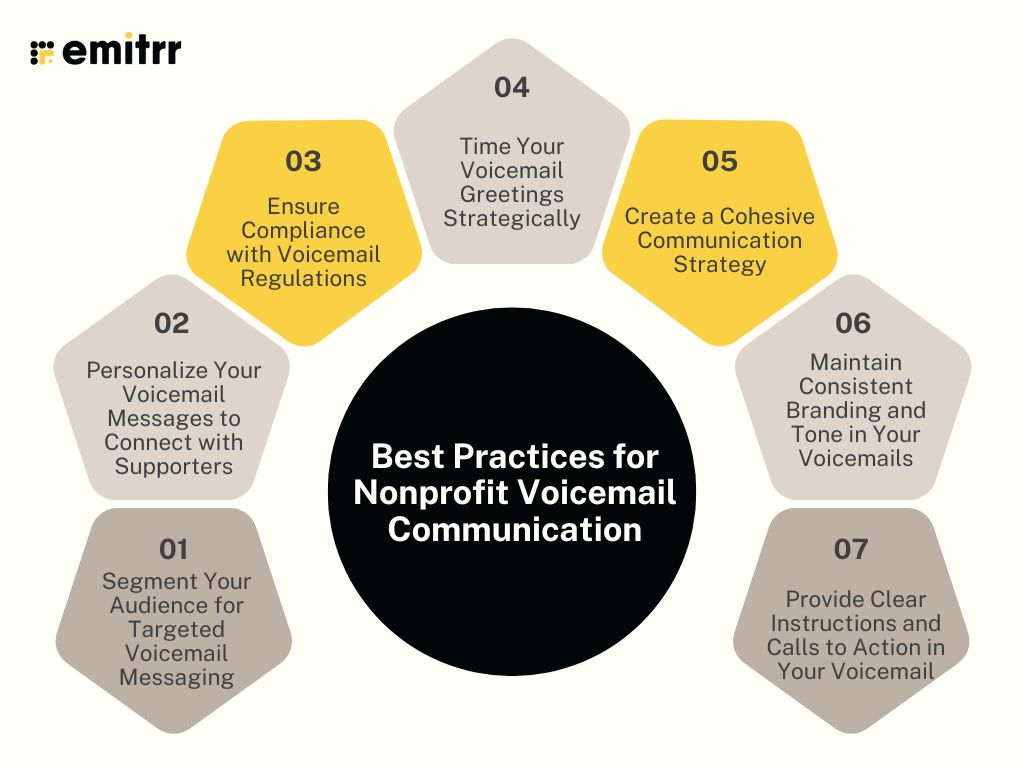
1. Segment Your Audience for Targeted Voicemail Messaging
Avoid crafting generic voicemail greetings for everyone. Instead, categorize your audience into specific groups based on factors like their location, preferred methods of support, and interests. For example, the greeting for donors should differ from the one for volunteers. By customizing your messages to align with what individuals genuinely care about, you’re far more likely to capture their attention and encourage a response.
2. Personalize Your Voicemail Messages to Connect with Supporters
Standardized voicemail greetings can harm your nonprofit’s reputation. Take the time to develop voicemail systems that foster a sense of connection rather than distancing supporters. Incorporate details such as what they have donated to or volunteered for, making the message feel personal and relevant. When supporters sense you’re addressing them directly, they’re more likely to feel valued.
3. Ensure Compliance with Voicemail Regulations
In today’s dynamic communication landscape, it’s crucial to get consent before leaving voicemails and to clarify what recipients can expect from your messages. Strive to cultivate lasting relationships instead of overwhelming your audience. Keep a record of how and when they opted in, and provide straightforward options for opting out. Regularly review your processes to ensure they remain current and compliant with legal standards.
4. Time Your Voicemail Greetings Strategically
The timing of your messages can be just as important as their content. Most recipients are more receptive to voicemails during mid-morning to early afternoon on weekdays. Avoid leaving messages too early or too late in the day. If you’re promoting an event, space out voicemails to prevent flooding your supporters with information all at once. Also, consider timing around seasons, holidays, and school breaks.
5. Create a Cohesive Communication Strategy
Ensure that all your communications, including voicemails, are integrated into a singular strategic plan. Rather than delivering the same message across various channels or sending mixed signals to supporters, develop a coordinated approach that leverages each platform’s strengths. Keep your messaging consistent and aligned with your nonprofit’s overarching goals.
6. Maintain Consistent Branding and Tone in Your Voicemails
Your tone, voice, and style should be uniform across all communications, whether in voicemails or other messaging platforms. This consistency allows recipients to instantly recognize your messages and builds credibility. Use similar language, greeting styles, and branding elements to present a polished and professional image of your nonprofit.
7. Provide Clear Instructions and Calls to Action in Your Voicemail
Avoid leaving your supporters guessing about how to respond. Ensure your voicemails communicate clear, concise messaging. Clearly outline what you want them to do, how they can do it, and why it’s important. Incorporate relevant contact information and testing elements to ensure everything works smoothly. The easier you make it for someone to act, the more likely they are to follow through.
Measuring the Success of Your Voicemail Campaigns
Creating messages is great, but do you know which metrics to track to ensure they’re well received in the market? In the section below, we’ll tell you how you can measure the success of your voicemail communications.
1. Track Engagement Metrics
Utilize engagement data from your voicemail campaigns to assess the effectiveness of your messages. Monitor key metrics such as opens and callbacks to identify which formats and timings resonate with your audience. In your voicemail systems, analyze the impact of different prompts and call volumes on response rates to refine message delivery and allocate staffing resources effectively.
2. Monitor Conversion Rates
To gauge the impact of your messaging, keep track of how often your communications lead to specific actions, such as event sign-ups or involvement in advocacy efforts. Dissect these conversion rates by audience segments or message types, and test various formats to continuously improve your messaging effectiveness and deepen audience engagement.
3. Calculate Return on Investment (ROI)
Analyzing ROI is essential for understanding the efficiency of your nonprofit’s communication efforts. This evaluation helps ascertain whether your outreach initiatives justify the costs involved. Track both short-term outcomes and long-term benefits to see how your voicemail campaigns contribute to your overarching goals and enhance supporter engagement.
4. Assess Donor and Volunteer Retention
One of the most important metrics of success is the retention rate of donors and volunteers. Monitor trends to determine how your communication strategies affect continued engagement. Analyze which types of messages and their frequencies inspire the desired responses and encourage participation. Identify potential issues causing unsubscribes or negative feedback, and make necessary adjustments to your approach.
5. Gather and Analyze Feedback
Gain valuable insights into your audience by collecting and evaluating feedback on your voicemail campaigns. Analyzing patterns in survey responses can reveal what aspects of your messaging are effective and which may need improvement. Use these insights to enhance the design, timing, and delivery of your messages tailored to different supporter groups.
How Can Emitrr Help Strengthen the Quality and Quantity of Nonprofit Texting?
Emitrr is the leading texting and VoIP service for nonprofits, offering a comprehensive feature set, from personalized messaging to reputation management to VoIP. By leveraging these features and tools, nonprofits can likely achieve higher engagement, stronger donor relationships, and increased fundraising success.
Here’s a closer look at what Emitrr is truly capable of.
1. Personalized Messaging: Emitrr enables nonprofits to tailor messages to individual supporters, fostering stronger connections. This personalization strengthens supporter bonds by making communications more relevant and impactful, potentially increasing donation rates and loyalty.
2. Two-Way Texting: The platform simplifies two-way texting, allowing direct engagement with donors and volunteers in real time. This feature facilitates quicker responses, builds trust, and enhances dialogue, crucial for maintaining active supporter relationships.
3. Advanced Analytics: Emitrr provides detailed texting analytics, enabling nonprofits to monitor campaign performance, measure engagement levels, and refine strategies. This data-driven approach helps organizations optimize their communication efforts for better outcomes, such as higher response rates and effective fundraising campaigns.
4. Mass Texting: Emitrr supports sending messages to thousands of contacts instantly, ideal for donation appeals, event promotions, and community outreach. This capability ensures broad reach with minimal effort, amplifying the nonprofit’s visibility and impact. It also includes text-enabling landlines for community outreach, expanding communication channels.
5. Automated Scheduling: Emitrr allows nonprofits to automate reminders for volunteer activities and schedule texts for donation drives or events. This feature, implied in scheduling texts for fundraisers and events, ensures timely communication without manual oversight, reducing no-shows and improving event attendance.
6. Seamless Integration: With integration capabilities for over 500 tools, Emitrr enables nonprofits to manage all communications from a single platform. This streamlined workflow enhances efficiency, allowing organizations to connect with existing systems like CRMs and reduce operational friction.
7. Reputation Management: Emitrr includes tools to boost trust and credibility, such as ensuring professional and consistent communication practices. This feature is vital for maintaining donor confidence, especially in an era where transparency and reputation are critical.
FAQs
A professional voicemail greeting should clearly state your organization’s name, mission, and offer next steps. Keep it short but informative include office hours, alternative contact options, or emergency info when needed. Use warm, professional language that reflects your values. Update greetings regularly and test all menu options. Tailor messages by department or function to better guide callers.
Conclusion
Remember, results-driven nonprofit communication rests on a strong foundation of technology. It’s about building genuine relationships with people who care about your cause and want to make a difference. Tools like Emitrr help facilitate community building by enabling nonprofits to create impactful voicemail messages.
With AI-powered automation, intelligent response handling, and seamless integration, Emitrr empowers your nonprofit to streamline operations from the ground up, while enhancing communication. And you? You can stay focused on taking your mission to a global scale.


 4.9 (400+
reviews)
4.9 (400+
reviews)