

Introduction
As customer interactions become increasingly important, call center analytics has emerged as a game-changer for businesses striving to improve customer experience and operational efficiency. It’s no longer just about counting call volumes or tracking durations—it’s about deriving actionable insights that empower better decisions, faster resolutions, and happier customers.
In this complete guide, we’ll unpack what call center analytics really means, why it’s more than just call tracking, and how it’s helping modern businesses improve their customer experience. We’ll also look at how platforms like Emitrr are simplifying this complex field by providing intuitive call center analytics dashboards, real-time tracking, and AI-powered features for businesses of all sizes.
What is Call Center Analytics?
Call center analytics is the process of gathering, measuring, and analyzing data from various customer interactions within a call center. It goes beyond just monitoring voice calls — it includes insights from SMS, chat conversations, CRM logs, and ticketing systems. The goal is to understand customer behavior, improve agent performance, and enhance overall customer experience.
Key data sources include:
- Voice Calls: Data is gathered through call recording and analytics tools and voice analytics call center software that help identify patterns such as customer sentiment, call duration, and resolution rates.
- SMS and Messaging Platforms: Analyze text-based communication to understand tone, keywords, and resolution efficiency.
- Live Chat Interactions: Tracks chat transcripts to evaluate how quickly and effectively agents respond in real-time.
- CRM Logs and Customer History: Combines data about previous customer interactions, preferences, and issues to build a more complete customer profile.
- Ticketing Systems: Offers insight into issue types, resolution times, and escalation rates to identify process improvements.

Why Call Center Analytics is Important
Call center analytics isn’t just a backend process—it directly impacts both the customer expeStreamlines the customer experience and the productivity of the support team.
Enhances Customer Satisfaction
Through call center data analytics and sentiment analysis call center software, companies can detect service congestion, monitor customer moods, and streamline their method, resulting in quicker resolution and happier, more loyal customers.
Better Agent Performance and Training
With comprehensive call center data insights, managers can identify performance gaps, provide specific coaching, and establish quantifiable goals to enable the delivery of consistent, high-quality service on every communication channel.
Reduces Operation Expenses
Call center analytics functionality allows for improved staffing choices, lowers average handle time, and reduces call escalations, which subsequently lowers operating costs while improving or equaling service levels.
Enables Proactive Customer Care
Through the use of call center predictive analytics, businesses can predict customer issues from trends in historical data and take measures proactively before matters become severe, which enhances customer trust and retention.
Facilitates Data-Driven Decision-Making
Businesses do not rely on intuition but instead utilize call center metrics, analytics, and reporting to inform decisions. This results in more intelligent investments, better workflows, and a more tactical approach to customer care.
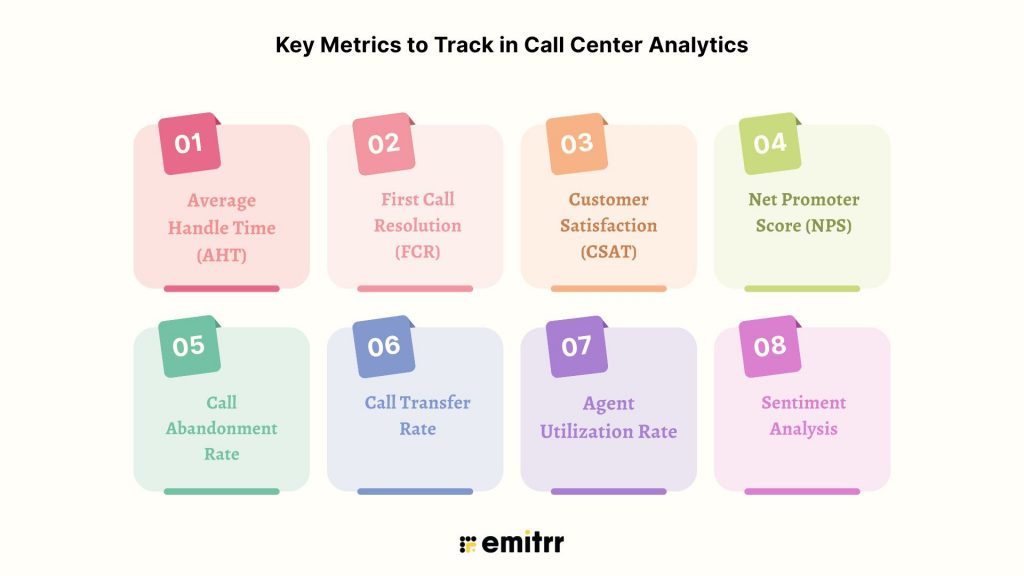
Key Metrics to Track in Call Center Analytics
Tracking the right call center analytics metrics is essential for optimizing performance and improving customer experience.
Average Handle Time (AHT)
AHT measures the average time spent on each call, including talk, hold, and after-call work. Lower AHT reflects efficient handling, helping reduce wait times and improving overall call center data analysis for resource planning and staffing.
First Call Resolution (FCR)
FCR tracks the percentage of issues resolved on the initial call, which directly impacts customer satisfaction and operational efficiency. Higher FCR rates indicate strong agent skills and effective contact center analytics practices.
Customer Satisfaction (CSAT)
CSAT scores, gathered from post-interaction surveys, reveal customers’ happiness with support services. These insights guide improvements and are often integrated into call center analytics dashboards for real-time monitoring and reporting.
Net Promoter Score (NPS)
NPS measures the likelihood of customers recommending your service. This key performance indicator reflects long-term loyalty and service quality, complementing other call center metrics, analytics, and reporting efforts.
Call Abandonment Rate
This metric shows how many customers hang up before reaching an agent. High abandonment signals issues like understaffing or complex IVR flows, highlighting areas for improvement via call center data analytics.
Call Transfer Rate
Frequent transfers may indicate ineffective call routing or insufficient agent knowledge. Monitoring this rate helps identify training needs and enhances call center analytics capabilities for smoother customer journeys.
Agent Utilization Rate
This measures the proportion of time agents spend actively handling calls versus idle time. Optimizing utilization improves productivity, reduces burnout, and supports better contact center data analytics for workforce management.
Sentiment Analysis
Using voice analytics call center tools and call recording analytics, sentiment analysis assesses customer emotions during calls. This provides valuable context for interactions, helping tailor responses and improve overall customer experience.
Types of Call Center Analytics
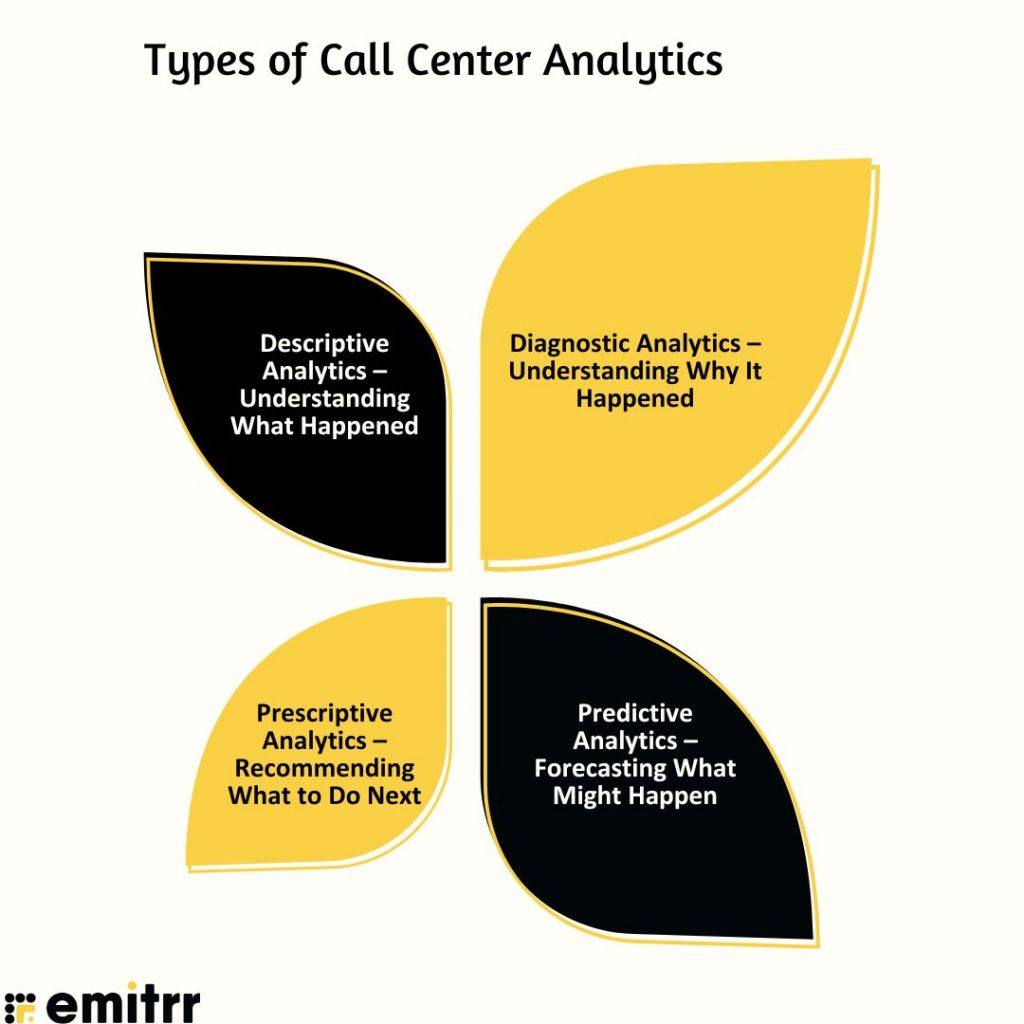
Understanding different call center analytics types helps businesses optimize both customer experience and operational efficiency.
Descriptive Analytics – Understanding What Happened
This type provides a clear summary of past performance, including call volumes, average handle times, and customer satisfaction scores. It forms the foundation for deeper call center data analysis and reporting, showing what occurred historically.
Diagnostic Analytics – Understanding Why It Happened
Diagnostic analytics digs into the root causes behind trends such as low CSAT or agent performance issues. It leverages contact center data analytics to identify underlying problems for targeted improvements and better support strategies.
Predictive Analytics – Forecasting What Might Happen
This approach uses advanced call center predictive analytics to forecast future customer behavior, call volumes, or potential issues. AI and machine learning help anticipate challenges, enabling proactive service and resource planning.
Prescriptive Analytics – Recommending What to Do Next
Prescriptive analytics goes beyond forecasting to recommend actionable steps, like adjusting agent scripts or shift schedules. These insights optimize operations by leveraging comprehensive call center analytics capabilities and enhancing decision-making.
Tools and Technologies Used in Call Center Analytics
Modern call center analytics rely on diverse tools and technologies to deliver actionable insights efficiently. These include:
Speech and Voice Analytics Tools
These tools analyze tone, speech patterns, keywords, and silences in calls using call recording analytics to reveal customer sentiment, detect compliance issues, and improve agent interactions through detailed voice analytics call center insights.
Text and Sentiment Analysis
Applied across SMS and chat platforms, these tools use contact center data analytics to evaluate customer emotions and engagement levels, helping businesses understand customer mood and improve communication strategies beyond voice interactions.
Machine Learning for Predictive Insights
Machine learning models process vast amounts of call center phone data analytics to detect patterns, predict call volumes, and identify anomalies. This enables proactive decisions and enhances service with intelligent call center predictive analytics.
Dashboards and Reporting Software
Platforms like Emitrr’s call center analytics dashboard consolidate data from multiple sources into customizable, real-time reports, empowering managers to monitor key metrics and streamline call center metrics analytics and reporting.
Omnichannel Integration Platforms
Platforms such as Emitrr unify communication channels—voice, SMS, chat—into one platform, simplifying call center data analysis and enabling seamless tracking, reporting, and improved customer experience through an integrated analytics solution.
How to Integrate Call Center Analytics into Your Company
Successful implementation of call center analytics demands precise objectives, the correct tools, and ongoing team participation.
1. Define Business Objectives and KPIs
Begin by recognizing key performance metrics such as FCR, CSAT, and NPS that are most important. Align your call center metrics, analytics, and reporting with these goals to measure success effectively.
2. Collect and Centralize Data from All Channels
Aggregate data from voice calls, SMS, chat, and CRM systems into a unified platform. Using a contact center analytics solution like Emitrr ensures seamless call center data analysis across channels.
3. Select Analytics Tools That Fit Your Needs
Choose scalable tools that offer call recording and analytics, sentiment analysis, call center capabilities, and omnichannel tracking to maximize insights and streamline your operations effectively.
4. Train Your Support Team on Data Literacy
Equip agents and supervisors with knowledge of essential metrics and how to interpret reports. Improving data literacy boosts agent engagement and empowers data-driven decision-making in the contact center.
5. Regularly Review Reports and Iterate Improvements
Establish routine reviews of your call center analytics dashboard data. Use these insights to continuously refine workflows, enhance customer experience, and optimize team performance over time.
Common Challenges and How to Overcome Them
Implementing call center analytics often faces hurdles, such as:
Data Fragmentation Across Systems
Disconnected tools and multiple platforms create data silos and blind spots. Emitrr’s centralized call center analytics capabilities unify data streams for comprehensive and accurate call center data analysis.
Low Agent Engagement with Data
When agents find metrics confusing or irrelevant, engagement drops. Gamifying performance and using intuitive call center analytics dashboards makes data accessible, motivating agents to improve productivity and customer service.
Lack of Real-Time Insights
Delayed data slows decision-making and response. Real-time call center analytics dashboards empower managers and agents to act swiftly, instantly improving customer experience and operational efficiency.
Manual Reporting Fatigue
Generating reports manually is time-consuming and error-prone. Automating report generation and scheduling insights delivery helps leadership focus on strategic actions, supported by reliable call center metrics, analytics, and reporting.
Emitrr simplifies contact center data analytics by automating tagging, providing customizable dashboards, and enabling easy integration. It helps teams overcome challenges and harness the full power of call center data analytics.
Benefits of Call Center Analytics with Emitrr
Emitrr offers powerful call center analytics features that streamline operations and enhance customer interactions. Some benefits of these include:
Centralized Communication and Analytics Dashboard to Reduce Silos
Emitrr’s unified call center analytics dashboard consolidates voice, SMS, chat, and CRM data, eliminating silos and enabling a 360-degree view of customer interactions for smarter decision-making.
Integrated SMS and Voice Tracking
By combining call recording and analytics with SMS tracking, Emitrr delivers comprehensive contact center analytics, capturing every customer touchpoint in real time across multiple channels.
Auto-Tagging and Sentiment Scoring for Faster Insights
Emitrr uses advanced sentiment analysis call center tools to automatically tag conversations and score customer emotions, allowing teams to identify urgent issues and improve service quality quickly.
Custom Reports Tailored to Your KPIs and Goals
With Emitrr, you can generate personalized call center metrics, analytics, and reporting focused on your unique KPIs, helping managers track performance and drive continuous improvements effectively.
- Scalable Platform for Both Startups and Large Enterprises
Emitrr’s flexible architecture supports businesses of all sizes, offering scalable call center analytics capabilities that grow with your needs, from small teams to enterprise-level contact centers.
Case Study
Octomaids, a cleaning services provider, faced the challenge of high missed call volume (about 20 calls/day), which is causing lost revenue and poor customer communication across multiple channels.
Solution:
Emitrr’s unified communication platform integrates web chat, texting, missed call follow-ups, and appointment reminders, centralizing client interactions and enabling 100% call handling.
Results:
- 50% reduction in inbound call volume.
- 100% of calls answered via text follow-ups and webchat conversion.
- Faster query resolution with multi-channel communication.
- Improved operational efficiency through a centralized analytics dashboard.
Frequently Asked Questions (FAQ)
A: Call tracking logs simple call facts such as duration and source, whereas call center analytics gives greater insights into agent performance, customer sentiment, and end-to-end journey.
A: Yes, small businesses receive rich insights with scalable platforms like Emitrr, ensuring advanced call center analytics features are affordable and simple to deploy.
A: Yes. A call center analytics dashboard in real time enables fast decision-making and quicker issue resolution, enhancing customer experience and business efficiency.
A: Investing in call center data analytics lowers cost, increases agent productivity, enhances customer satisfaction, and generates higher retention and revenue growth.
A: Emitrr combines voice analytics call center software, SMS, auto-tagging, and customizable dashboards, providing complete, actionable contact center data analytics for groups.
A: Monitor Average Handle Time (AHT), First Call Resolution (FCR), and Customer Satisfaction (CSAT) because they have direct bearing on customer happiness and business success.
A: The majority of companies see quantifiable gains in efficiency and customer satisfaction between one to three months after achieving solid call center analytics.
A: No. With Emitrr’s automation and easy-to-use features, small teams can also seamlessly manage in-depth call center data analysis without new personnel.
Conclusion
Call center analytics is no longer optional—it’s essential. From improving team performance to creating exceptional customer journeys, it offers a strategic edge in today’s experience-driven economy.
With tools like Emitrr, businesses can begin small, scale quickly, and make every interaction count. By focusing on the right call center metrics, using smart tools, and continuously improving, you’ll build a support function that delights customers and empowers teams.
Want to explore how Emitrr can power your call center analytics dashboard? Book a demo today or contact our team for more insights.


 4.9 (400+
reviews)
4.9 (400+
reviews)