

Introduction
Traditional voicemail systems dump everything into one big pile. Emergency calls sit next to routine appointment confirmations. Hot sales leads get buried under vendor check-ins. Meanwhile, your customers are getting frustrated, and you’re losing money on the table.
Voicemail triaging changes everything. Companies using these systems see response times drop by 75%. Customer satisfaction scores jump 40%. And what totally turns the scales in their favor is that they usually pay for themselves within six months through pure efficiency gains.
This guide breaks down exactly why digital triage crushes traditional systems across seven key areas. You’ll walk away with:
- A look at the role and significance of voicemail triaging.
- How voicemail triaging fits into a diverse range of needs.
- Why Emitrr is the indisputable voicemail triaging partner you can trust.
Once you see how this telephone triage technology works, you’ll wonder how you ever managed without it.
What is Voicemail Triaging and How Does It Transform Business Communications?
At its core, voicemail triaging is a smart message management approach that listens, analyzes, and routes voicemails in real time depending on a host of factors, including urgency, content, and context.
Unlike the old-fashioned process of listening through a pile of voicemails manually, triaging introduces automation, intelligence, and immediacy.
Voicemail triaging automatically sorts, prioritizes, and routes your messages based on what people actually say. The system listens to each voicemail, figures out what it’s about, decides how urgent it is, and sends it to the right person.
So, manual sorting and missed opportunities = zero, nil, nada!
Core Components of an Effective Voicemail Triaging System
A strong voicemail triaging system typically includes:
- Speech-to-text transcription for quick scanning and documentation.
- Natural language processing (NLP) to detect urgency, sentiment, and context.
- Smart routing rules that send messages to the right team or person automatically.
- Visual voicemail dashboards for managers and teams to track and resolve messages in real time.
- Integration hooks for CRMs, ERPs, help desks, and practice management tools.
With triage calls in action, businesses seize the opportunity to build a leaner communication pipeline that keeps teams aligned and customers engaged.

Traditional Voicemail vs. Voicemail Triaging: Key Distinctions
Traditional voicemail has a no-fuss modus operandi: record the message and hope for someone to read and respond to it. It treats every message the same. First in, first out. Doesn’t matter if it’s a medical emergency or someone asking about your hours.
This is exactly where things age. On the contrary, voicemail triaging actually thinks. It analyzes content, understands context, and makes smart decisions about where each message should go. Urgent stuff gets immediate attention. Routine questions go to the right department. Complex issues reach specialists who can actually help.
The difference shows up in your response accountability too. Traditional systems rely on people remembering to check messages and hoping nothing falls through the cracks. Triaging systems track everything automatically and alert you when responses are overdue.
So, the difference is clear as a crystal: one waits for action. The other drives it.
The Critical Problems with Traditional Voicemail Systems
Voicemail systems of yesteryear have been shunned by customers for a volley of reasons. Across all walks of life, users have dubbed them inefficient, annoying, and unbearingly slow. Why? Here’s the low-down.

1. Message Overload and Inbox Management Challenges
Your brain shuts down after reviewing 20 messages in a row. Studies prove it. Accuracy drops 23% when you’re processing large batches of voicemails. Important details get missed. Urgent messages get delayed. Routine stuff gets way too much attention just because it happened to be next in line.
2. Delayed Response Times and Customer Frustration
That urgent call from Friday afternoon? You find it Monday morning. Weekend messages wait until Tuesday. Holiday calls might not get answered for a week. Your customers expect responses within two hours these days. Traditional voicemail makes that impossible during busy periods.
3. Lack of Priority Classification in Standard Voicemail
Emergency calls wait behind appointment confirmations. Hot sales leads sit under routine vendor check-ins. Time-sensitive partnership opportunities get buried in the queue. When everything has the same priority, nothing has priority.
4. Resource Allocation Inefficiencies with Linear Processing
Your senior people waste time on basic questions that junior staff could handle. Complex technical issues that need specialists get reviewed by whoever checks messages first. Nobody’s working on what they’re actually good at. It’s like using a surgeon to take temperatures.
5. Security and Compliance Limitations of Traditional Systems
Most traditional voicemail lacks proper encryption, access controls, or audit trails. If you’re in healthcare, finance, or any regulated industry, this creates serious compliance risks. Data retention policies become impossible to enforce automatically. Access logs don’t exist.
How Voicemail Triaging Solves Challenges to Revolutionize Message Management
Voicemail triaging has emerged as a kind of “Holy Grail,” tackling the very challenges people with traditional voicemail systems have long struggled with. Here’s how.
1. Intelligent Priority Classification Algorithms
The system analyzes vocal stress, keywords like “emergency” or “urgent,” caller history, and context clues. Machine learning improves accuracy over time by studying your feedback and response patterns. Priority levels go beyond just urgent/not urgent to match your business complexity.
2. Automated Categorization Based on Content Analysis
Natural language processing recognizes your business vocabulary, department names, and service types. The system picks up on both obvious clues and subtle context hints. Categories trigger the right workflows automatically – sales inquiries start lead processes, support requests create tickets.
3. Real-Time Routing to Appropriate Personnel
Smart routing considers who’s available, what they’re good at, current workload, and past performance. During busy times, work spreads evenly. When specialists aren’t around, it finds backup options with proper escalation procedures. Geographic factors get handled for global teams.
4. Integration with CRM and Business Management Systems
APIs connect with your existing tools seamlessly. When customers call, the system pulls their history, current projects, and account status automatically. New inquiries create CRM records. Support requests generate tickets. Sales leads trigger qualification workflows. Everything flows together.
5. Advanced Analytics and Reporting Capabilities
Real-time dashboards show current queues, response times, and team performance. Historical analysis reveals communication trends and peak periods for better planning. Performance goes beyond speed to include quality, satisfaction scores, and resolution effectiveness.
Proven Benefits of Implementing Voicemail Triaging
Implementing voicemail triaging unlocks clear, measurable gains that directly impact service, speed, and business outcomes. Let’s walk you through some of the salient benefits of adopting triaging phone calls over traditional voicemails.
1. Dramatic Reduction in Response Times
Emergency messages get 60-80% faster responses. Routine inquiries process more efficiently without the bottlenecks. Automated handling takes care of simple stuff instantly, freeing up people for complex issues that actually need human attention.
2. Improved Customer Satisfaction Scores
Post making a pivot to voicemail triaging systems, satisfaction typically jumps 25-40% after implementation. Customers get responses from knowledgeable people who have their context ready. Proactive updates and acknowledgments keep everyone informed. The whole experience feels more professional and organized.
3. Enhanced Operational Efficiency and Cost Savings
Most companies see 30-50% reduction in message handling time after embracing voicemail triaging. That translates directly to labor cost savings. People focus on high-value work instead of sorting through voicemails. ROI usually hits within 6-12 months, then keeps compounding.
4. Better Resource Utilization and Staff Productivity
With triage phone calls at the vanguard, employees have more time in hand to do what actually matters. Specialists handle specialist work. Junior people manage appropriate inquiries. Workload gets balanced automatically instead of some people drowning while others sit idle. Teams develop deeper expertise in their focus areas while staying aware of broader patterns.
5. Increased Revenue Through Faster Lead Processing
Voicemail triaging has an incredible reputation for simplifying and accelerating the sales domain. Sales response times improve 50-70%. That translates to 15-25% better conversion rates depending on your industry. The system also identifies upselling opportunities and expansion possibilities that might get missed in traditional processing.
Technology Features That Make Voicemail Triaging Superior
Voicemail triaging brings a bonanza of benefits. But the pressing question is: what technologies power the core of what’s rightly lauded as the game-changer in communication management? Let’s find out.

1. AI-Powered Speech Recognition and Transcription
Modern engines hit 95%+ accuracy across different accents, speaking speeds, and audio quality. Real-time processing means instant transcription. Continuous learning builds custom vocabulary for your business terms, names, and industry language.
2. Machine Learning for Continuous Improvement
Algorithms analyze your patterns, routing decisions, and outcomes to optimize performance automatically. User feedback teaches the system your preferences. Predictive capabilities develop over time to anticipate peak periods and potential issues.
3. Natural Language Processing for Context Understanding
Advanced NLP goes beyond keywords to understand actual meaning, intent, and emotional tone. The system recognizes temporal references, relationship indicators, and procedural language. Sentiment analysis identifies frustrated customers or escalation situations.
4. Multi-Channel Integration Capabilities
Connects voicemail with email, text, web chat, and social media for unified communication management. Cross-channel data synchronization keeps customer context consistent everywhere. Workflow automation triggers appropriate processes regardless of communication channel.
5. Cloud-Based Scalability and Reliability
Automatic scaling handles volume fluctuations without manual intervention. 99.9% uptime guarantees with redundant processing and instant failover. Geographic distribution supports global operations while maintaining centralized management and reporting.
6. Sentiment Analysis for Emotional Context Detection
Algorithms assess emotional tone through vocal patterns, word choice, and speaking pace. Different types of negative sentiment get different handling – frustration versus urgency require different approaches. Handlers get emotional context before responding.
7. Predictive Analytics for Proactive Response Planning
Historical analysis predicts future trends, peak periods, and potential challenges. Forecasting models consider seasonal patterns, business cycles, and external factors. Proactive alerts warn about capacity issues before they impact performance.
8. Multi-Language Support and Global Scalability
Native speech recognition and NLP for multiple languages. Automatic language detection routes to appropriate handlers. Cultural context understanding goes beyond translation to include communication styles and business etiquette.
9. Mobile App Integration and Remote Management
Full system access through mobile apps with push notifications for urgent messages. Remote administration keeps operations running from anywhere. Customizable notification preferences balance responsiveness with productivity.
Watch this video to find out things you must know about voicemail transcription:
Real-World Use Cases of Voicemail Triaging
Across industries, voicemail triaging is quietly powering smoother, faster communication. Here’s where voicemail triaging steps in and makes a real difference.
1. Emergency Services and Crisis Management Scenarios
Emergency services rely on voicemail triaging to handle crisis communication efficiently. It picks up on urgent keywords, escalates critical messages, and routes them to the right people fast. During disasters, when call volumes spike, it helps prioritize emergencies, coordinate resources, and maintain communication flow. It’s especially helpful in multi-agency responses where quick, accurate info-sharing is key.
2. High-Volume Customer Support Operations
Support centers handling thousands of daily inquiries benefit from automatic categorization and specialist routing. Voicemail triaging helps professionals sort issues, route them to the right specialists, and manage workload across large teams. It helps maintain service quality, cut response times, and avoid unnecessary transfers. Complex product environments with multiple support tiers get sophisticated routing based on issue complexity and customer status.
3. Sales Lead Qualification and Hot Prospect Identification
Sales teams use voicemail triaging to fast-track high-potential leads while maintaining comprehensive follow-up for all prospects. The system scans voicemails for buying signals, urgency, and key qualifiers, then scores and routes leads based on geography, industry, or rep assignment, keeping teams focused on top prospects while ensuring follow-ups aren’t missed. Territory management routes lead to appropriate representatives automatically.
4. Appointment Scheduling and Rescheduling Automation
Healthcare practices and professional services automate scheduling workflows to reduce administrative overhead. Integration with calendar systems enables availability checking and appointment confirmation. Complex scenarios involving multiple practitioners get handled automatically with voicemail triaging working in silence.
5. After-Hours Service Request Processing
Businesses offering after-hours support use voicemail triaging to flag urgent requests and queue routine ones. Integrated with on-call schedules, it routes emergencies to the right staff and tracks SLA compliance through automated alerts and response logs—ensuring critical needs are met without unnecessary disruptions.
6. Complaint Resolution and Escalation Management
Customer complaints get sophisticated prioritization based on severity, customer importance, and resolution complexity. Regulatory compliance triggers specific handling procedures and documentation. Retention risk assessment identifies high-risk situations needing executive attention.
7. Multi-Location Business Communication Coordination
Franchises and multi-location businesses harness the value of voicemail triaging to manage local and corporate inquiries. It routes messages by location, shares capacity across branches, and offers centralized reporting for better oversight. This helps balance workloads while maintaining consistent service quality across sites.
8. Seasonal Business Peak Period Management
Retail and hospitality businesses handle dramatic volume fluctuations automatically while maintaining service quality. Temporary staffing integration enables rapid capacity scaling. Historical analytics inform strategic planning for future peak periods.
9. Remote Team and Distributed Workforce Support
Distributed teams use voicemail triaging to keep communication flowing across time zones and work hours. It routes based on availability and expertise, while team collaboration tools and reporting features improve visibility, workload balance, and performance tracking.
10. Vendor and Supplier Communication Prioritization
Supply chain management prioritizes vendor communications based on relationship importance and operational impact. Contract compliance monitoring recognizes compliance-related messages automatically. Strategic relationship analytics provide insights into communication patterns and relationship health.
11. Invoice and Payment Query Processing
Accounts departments manage payment-related communications efficiently through automatic categorization and routing. Cash flow optimization prioritizes payment-related messages for rapid resolution. Compliance requirements get automated documentation and audit trails.
12. Technical Support Ticket Creation and Routing
Technology companies automatically generate support tickets and route technical issues to appropriate specialists. Escalation management recognizes severity indicators for senior technical attention. Knowledge base integration suggests relevant documentation automatically.
13. Marketing Campaign Response Management
Marketing departments manage campaign responses through automatic categorization and routing to appropriate teams. Campaign effectiveness measurement tracks response patterns and conversion rates. Lead nurturing automation ensures consistent follow-up regardless of response timing.
Future Trends in Voicemail Triaging Technology
The landscape of voicemail triaging is evolving as we speak. Here’s a detailed explanation on what it might look like in the next five years.
1. Voice AI and Conversational Analytics Evolution
AI capabilities will be advancing toward automatic response drafting, intelligent callback scheduling, and proactive customer outreach. Conversational analytics will include personality assessment and communication style preferences. Real-time coaching will help handlers optimize response approaches.
2. Integration with Unified Communications Platforms
Comprehensive integration will create seamless experiences across voice, video, text, email, and collaboration platforms. Intelligent channel switching will recommend optimal communication methods automatically. Workflow orchestration will adapt communication approaches based on situation analysis.
3. Blockchain for Enhanced Security and Verification
Blockchain integration will provide immutable audit trails and ensure compliance with regulatory requirements. Message authenticity verification will prevent spoofing through digital signatures. Smart contract automation will enforce service level agreements automatically.
4. IoT Integration for Context-Aware Triaging
Internet of Things devices will provide additional context for message analysis and routing decisions. Predictive maintenance will correlate equipment data with voicemails to identify potential failures. Location-based intelligence will optimize resource allocation for field service operations.
5. Predictive Customer Behavior Modeling
Machine learning will analyze communication patterns to predict future customer behavior and service needs. Churn prediction will identify at-risk customers for proactive retention efforts. Opportunity identification will recognize upselling potential based on communication analysis.
How Emitrr’s Voicemail Triaging Can Help You Sharpen Your Care Communication
Emitrr’s voicemail triaging has been at the epicentre of attention for how it streamlines communication management via a blend of new-generation technologies, including big data, automation, and AI & ML.
It automatically converts incoming voicemails into searchable, real-time text transcriptions. Users receive instant alerts for missed calls and can scan messages quickly to assess urgency. Transcriptions are stored securely, integrated with CRM/workflow tools, and even trigger follow-up actions like SMS responses or ticket routing. Built for efficiency and HIPAA-sensitive environments, it ensures no important call slips through while streamlining team workflows.
If you’re looking for a reason to choose Emitrr as your go-to voicemail triaging service partner, we’ll give you the reasons.
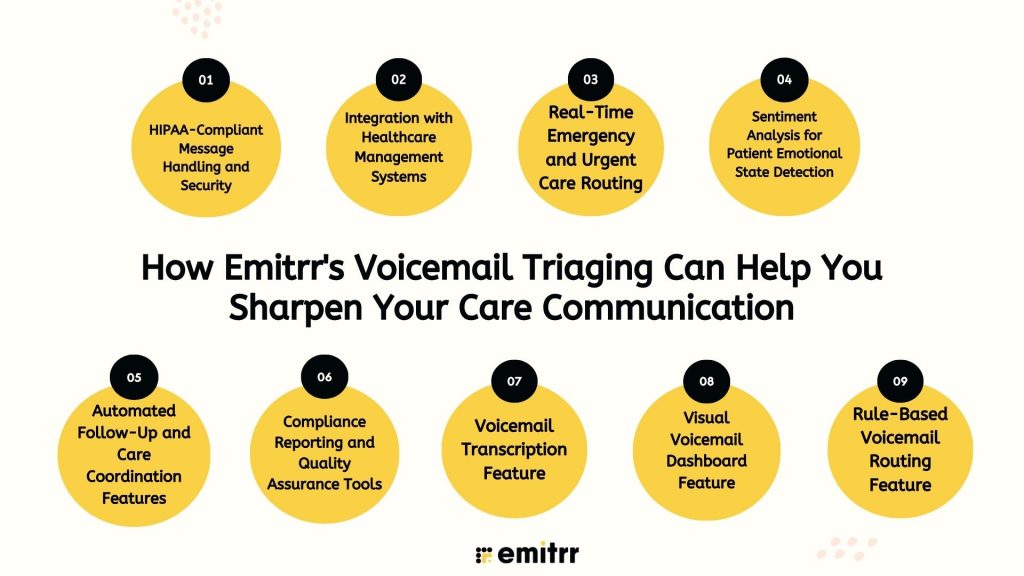
1. HIPAA-Compliant Message Handling and Security
Emitrr meets healthcare’s strict security requirements with end-to-end encryption, role-based access controls, and comprehensive audit trails. Business associate agreements ensure regulatory compliance. Data lifecycle management handles retention and disposal according to organizational policies.
Learn more about HIPAA compliant texting in this video:
2. Integration with Healthcare Management Systems
Seamless connections with electronic health records and practice management systems create unified patient communication experiences. Patient context gets retrieved automatically when messages arrive. Clinical workflows optimize based on provider schedules and expertise areas.
3. Real-Time Emergency and Urgent Care Routing
Healthcare environments distinguish between medical emergencies and routine urgent requests automatically. On-call rotation management integrates with physician scheduling for continuous coverage. Clinical decision support provides relevant protocols and guidelines.
4. Sentiment Analysis for Patient Emotional State Detection
Patient communications get analyzed for emotional context affecting response approaches. Anxiety, frustration, and pain levels inform clinical decisions. Risk assessment identifies mental health crisis indicators requiring immediate intervention.
5. Automated Follow-Up and Care Coordination Features
Care coordination maintains consistent communication across providers and treatment phases. Medication adherence support includes automatic reminders and monitoring. Chronic disease management enables proactive check-ins between appointments.
6. Compliance Reporting and Quality Assurance Tools
Emitrr’s comprehensive reporting demonstrates regulatory compliance and supports quality improvement. Quality assurance workflows monitor communication standards automatically. Risk management identifies patterns indicating potential liability or safety concerns.
7. Voicemail Transcription Feature
Emitrr comes equipped with highly accurate transcription that handles specialized medical terminology with HIPAA-compliant processing. Medical vocabulary databases recognize pharmaceutical names and clinical procedures. Electronic health record integration enables automatic documentation.
8. Visual Voicemail Dashboard Feature
Emitrr’s dashboard and data visualization capabilities are a class-apart. Real-time dashboards provide visibility into patient communication queues and care team workload. Patient communication history helps identify patterns and support needs. Performance metrics support quality management and improvement initiatives.
9. Rule-Based Voicemail Routing Feature
Sophisticated routing rules customize message handling based on clinical priorities and provider expertise. Clinical protocol integration aligns with established guidelines and care pathways. Flexible configuration adapts to specific organizational workflows.
FAQs
Initial costs run 40-60% higher than traditional voicemail, but ROI typically hits within 6-12 months through efficiency gains. Small businesses might pay $200-500 monthly, while enterprises could invest $5,000-15,000 based on size and features. Total ownership costs often become lower when considering productivity improvements.
Modern systems integrate with most existing phone infrastructure through standard APIs and protocols. Integration typically takes 2-4 weeks depending on complexity. Compatibility assessments evaluate specific requirements before implementation begins.
Implementation ranges from 4-12 weeks depending on organization size. Small businesses might complete setup in 2-3 weeks, while enterprises could need 3-4 months. Phased rollouts let you start benefiting while completing full deployment.
Multiple safeguards prevent misclassification including confidence scoring and manual review flags. Continuous learning analyzes mistakes to improve future accuracy. Time-based escalation automatically elevates messages that haven’t received responses within specified timeframes.
Faster response times (50-75% improvement), knowledgeable handlers, and personalized service drive satisfaction increases of 25-40%. Customers reach appropriate specialists who understand their needs rather than getting generic responses requiring additional follow-up.
Enterprise systems include comprehensive redundancy with 99.9% uptime guarantees and automatic failover within minutes. Disaster recovery procedures maintain basic functionality during major infrastructure failures. Communication continuity plans ensure customers can still leave messages during outages.
Extensive customization allows organizations to define specific routing rules, priority criteria, and categorization schemes matching their unique requirements. Advanced configuration supports sophisticated business logic including multi-tier escalation and external system integration. Professional services help design optimal rule sets.
Conclusion
Voicemail triaging brings structure to voicemail chaos. It listens, sorts, prioritizes, and routes messages in real time so nothing slips through the cracks. Teams stay responsive. Customers feel heard. Workflows move faster. The system takes what used to be a backlog and turns it into a steady stream of action.
With AI and automation doing the heavy lifting, your team can focus on what actually needs their attention. It’s the kind of upgrade that enhances every corner of communication.
If voicemail triaging looks like a fix to your communication woes, book a 20-min demo with Emitrr and take the first step towards sharpening your brand’s edge in the market. Connect with us today.


 4.9 (400+
reviews)
4.9 (400+
reviews)