
Introduction
Ineffective communication in healthcare continues to exact a heavy toll, both financially and operationally, on the healthcare industry. According to a 2023 Ponemon Institute study, communication breakdowns contribute to $1.7 billion in annual malpractice costs in the U.S., while a 2024 Healthcare IT News survey found that 65% of healthcare providers experience delays in patient care due to outdated phone systems. These challenges highlight the urgent need for modern solutions like Voice over Internet Protocol or VoIP for doctors, which transmits voice data over the internet, delivering cost-effective, secure, and feature-rich communication tailored to medical practices.
VoIP for doctors has presented itself as a game-changer that companies have had to contend with regarding inefficient communication using the old phone lines. Being a change innovation, VoIP for doctors helps improve patient care, improves workflow, and governs the Health Insurance Portability and Accountability Act (HIPAA). VoIP for healthcare satisfies the intricate coverage of medical communication, including safe contact with patients to smooth geographic points of convergence.
This comprehensive handbook investigates why medical professionals should look at specialized VoIP for healthcare and digital patient intake forms, their vast advantages, as well as their successful implementations, regulations and security considerations, and upcoming healthcare phone system trends that will dominate the field of medical communication.
Why Doctors Need a Specialized VoIP Phone System
Traditional healthcare phone systems, which are built on legacy Private Branch Exchange (PBX) technology, are the major reason for misalignment with the dynamic needs of modern medical practices. Traditional PBX systems require significant upfront investment in hardware, such as servers, handsets, and wiring, with installation costs often exceeding $10,000 for mid-sized practices, according to a 2024 Gartner report.
Ongoing maintenance contracts and per-minute long-distance charges further inflate expenses, with small practices spending. VoIP phone systems for healthcare, particularly cloud-based phone system for healthcare, reduces upfront costs and offer predictable monthly subscriptions while making the healthcare phone system a cost-effective alternative.
Also, the legacy phone systems for medical offices struggle to manage high call volumes, which often result in busy signals, dropped calls, or long hold times. A 2023 J.D. Power survey found that 40% of patients abandoned calls due to wait times, contributing to missed appointments and an estimated $150 billion in annual revenue losses for U.S. practices, per a 2023 MGMA report.
Higher-order call routing and Interactive Voice Response (IVR) systems provided by the healthcare phone system would ensure that patients do not take too long to reach the staff, hence, possible situations of abandonment are minimized and access is enhanced. VoIP for pharmacies is one example of how modern systems handle such challenges effectively.
Traditional phone systems for healthcare — staff coordination barriers — is another issue that most of the medical office phone system healthcare companies face. Multi-site or distant practices often have major problems in scheduling, patient updates, or call transfers.
Conventional systems need to place individual office lines that add to complexity and costs. Virtual VoIP for doctors eliminates multi-site practices due to centralized directories and call transfers, as healthcare phone system allows the transfer of calls and virtual meetings, resulting in real-time cross-site cooperation.
What’s more? Conducting such an emergency, such as directing care to a patient in distress, priority call routing, active instant conferencing, or mobile access, is important; these are lacking in the traditional systems. Such deferrals may slow down the responses and thus affect the outcomes of patients. Healthcare phone systems provide rapid-response services, which means that only urgent calls will have priority and will be allocated to the available providers immediately.
Want to learn more about HIPAA-compliant phone system? Check out this video:
Benefits of Medical VoIP Systems
VoIP software for doctors designed for healthcare offer transformative benefits that enhance operational efficiency, patient care, and financial performance. Here’s an in-depth exploration of the amazing benefits of the best HIPAA-compliant VoIP hospital phone systems for healthcare:

Operational Efficiency
VoIP phone systems for healthcare make the communication process less cumbersome through a lack of complicated online hardware implementation and support. Cloud-based phone systems for healthcare are are sometimes quick to put up and require little as far as infrastructure. Setting up cloud-based phone system for healthcare is a lot simpler. The reduced design would enable practices to place their resources on actual patient care rather than on telecommunications devices.
Enhances Patient Care
Routing of calls 24/7 on the best phone systems for small medical offices means that patients can single out providers or on-call staff at any time, eliminating delays in care. IVR systems can be used to direct patients to the correct department (e.g., scheduling, billing, or clinical support) and keep the patient frustrated to a minimum.
A research survey conducted by Healthcare IT News in 2024 indicated that patient satisfaction scores jumped by 20 percent in the practices utilizing VoIP, as a result of the increased accessibility and shortened reaction time. Connection to an Electronic Health Record (EHR) will grant providers access to patient data when making calls and facilitate a more informed and personalized consultation.
Operational Flexibility
The best phone systems for small medical offices enable remote employees and multilocation business environments, which is crucial in the era of 30 percent or more healthcare workers working at least part-time remotely, according to a 2024 AMN Healthcare survey. Coordination delays can be eliminated since unified communication platforms facilitate easy transfer of calls, common directories, and cross-site meetings. As an example, a multi-specialty clinic is capable of forwarding a patient call made in one office to a specialist in another office and retaining the same pleasurable experience.
HIPAA-Compliant Phone System Offers Advanced Features
VoIP systems offer tools that traditional phones lack, including:
- Call Analytics: The best phone systems for small medical offices monitor volume of calls, wait time, and performance of staff to streamline operations. An example is that analytics can determine the peak hours of calls, and thus, better scheduling of staff can be made.
- Automated Attendants: The best VoIP for medical offices aids the callers with automated menus (e.g., Press 1 to make the appointment, press 2 to address billing). Save up to 25 percent of front-desk efforts, according to a report published by Frost & Sullivan in 2024.
- EHR and CRM Integration: The best VoIP for medical offices integrates with solutions such as Epic or Salesforce so that patient information is available in real-time when making calls to make workflows more effective and care delivery enhanced.
- Voicemail-to-Email: Cloud phone system for healthcare transcribes voicemails, or send them in an audio file, directly to providers’ inboxes, helping to cut down on response times by 15 percent, according to a 2024 Nuance study.
Scalable
VoIP systems grow effortlessly with your practice. Adding new users or lines is as simple as updating a subscription, with no hardware upgrades or technician visits required. This scalability offered by the cloud phone system for healthcare is ideal for practices expanding to new locations or hiring additional staff.
Offers Mobility
Medical office phone system apps allow providers to make and receive calls from smartphones, tablets, or laptops, ensuring accessibility whether at the clinic, hospital, or home. This is particularly valuable for on-call physicians or those managing telehealth services, with 38% of patient visits now conducted virtually, per 2024 CMS data. Mobile apps also support secure messaging and file sharing, enhancing collaboration.

Use Cases of VoIP for Doctors and Medical Officers
Phone system for medical office versatility makes phone system for medical office a powerful tool for addressing diverse healthcare communication needs. Below are seven practical applications of the cloud phone system for healthcare, each designed to enhance efficiency and patient care.
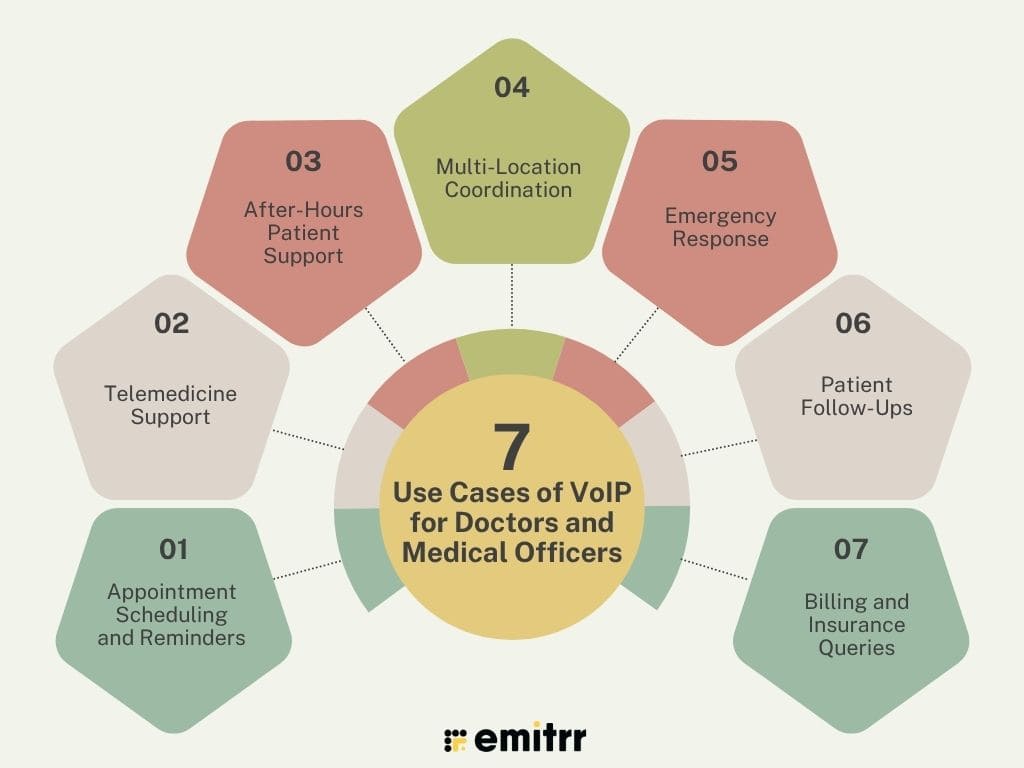
Appointment Scheduling and Reminders
VoIP for healthcare systems can be coupled with software to automatically confirm and remind about appointments using the phone or text. No-show is a significant challenge in the operations of medical practices, and automated reminders are able to significantly reduce that. As an example, patients can be called in advance by a VoIP system with the options of confirming an appointment, rescheduling, and talking to personnel. This automation offered by the cloud phone system for healthcare liberates the time of personnel and enhances the effectiveness of the practice.
Telemedicine Support
A cloud phone system for healthcare can be interfaced with telehealth initiatives such as Zoom for Healthcare to have secure voice and video conferencing. In the age of rising telehealth popularity, medical phone service guarantees stable, HIPAA-secure telehealth communications. To give an example, a provider may start a video consultation using a medical office phone system and have patient data available through the EHR integration, simplifying the workflow on virtual consultations.
After-Hours Patient Support
The call routing aspect of medical phone service means the urgent patient inquiry is directed to the on-call providers, round-the-clock. To illustrate, a patient with a side effect of medication may go to the main phone and after a few seconds, they may be connected to a nurse practitioner, which helps to improve access to care and prevent unnecessary cases in the emergency room. Such a capacity has the effect of upholding patient confidence and guarantees the interventions are made in time.
Supports Multi-Location Coordination
Phone system for medical office allows combining communication between different clinics, as employees can communicate with one patient, share records, or make virtual meetings without the assistance of external tools. To a multi-specialty practice, this implies that front-desk personnel in one office can hand off the call of a patient to a specialist in another office, leaving the call experience untouched. This integration offered by the medical phone service decreases the communication slowdown and enhances the cooperation between the staff.
Emergency Response
The priority call routing and group calling functionality in VoIP provide quick coordination in the event of an emergency. As an example, a trauma team may be notified through one VoIP office call, and the instant conferencing links a team of specialists in different locations. This is important in cultures where delayed response matters because it would deprive patient outcomes through fast and balanced reaction.
Follow-Ups
Automated VoIP systems facilitate follow-up calls to check on post-treatment outcomes, improving care continuity. For instance, a system can prompt patients to report recovery progress, flagging responses for clinician review. This feature offered by medical phone service reduces manual follow-up tasks and enhances patient engagement while supporting better adherence to treatment plans.
Billing and Insurance Queries
Phone system for medical office routes billing inquiries to dedicated staff, reducing front-desk bottlenecks. Integration with billing software allows staff to access account details during calls, resolving issues more efficiently. For example, a patient calling about a billing dispute can be routed to a specialist who reviews their account in real time, improving satisfaction and reducing resolution times.
Sound professional every time. Download voicemail greeting templates for doctors now.
HIPAA Compliance for Voice Communications
HIPAA compliance is a foundational requirement for healthcare VoIP systems, as they handle protected health information (PHI). Standard phone systems for medical office services, designed for industries like retail or hospitality, often lack the security measures needed to safeguard PHI.
Below is a comprehensive breakdown of compliance requirements that the best HIPAA-compliant VoIP phone systems for healthcare must adhere to:
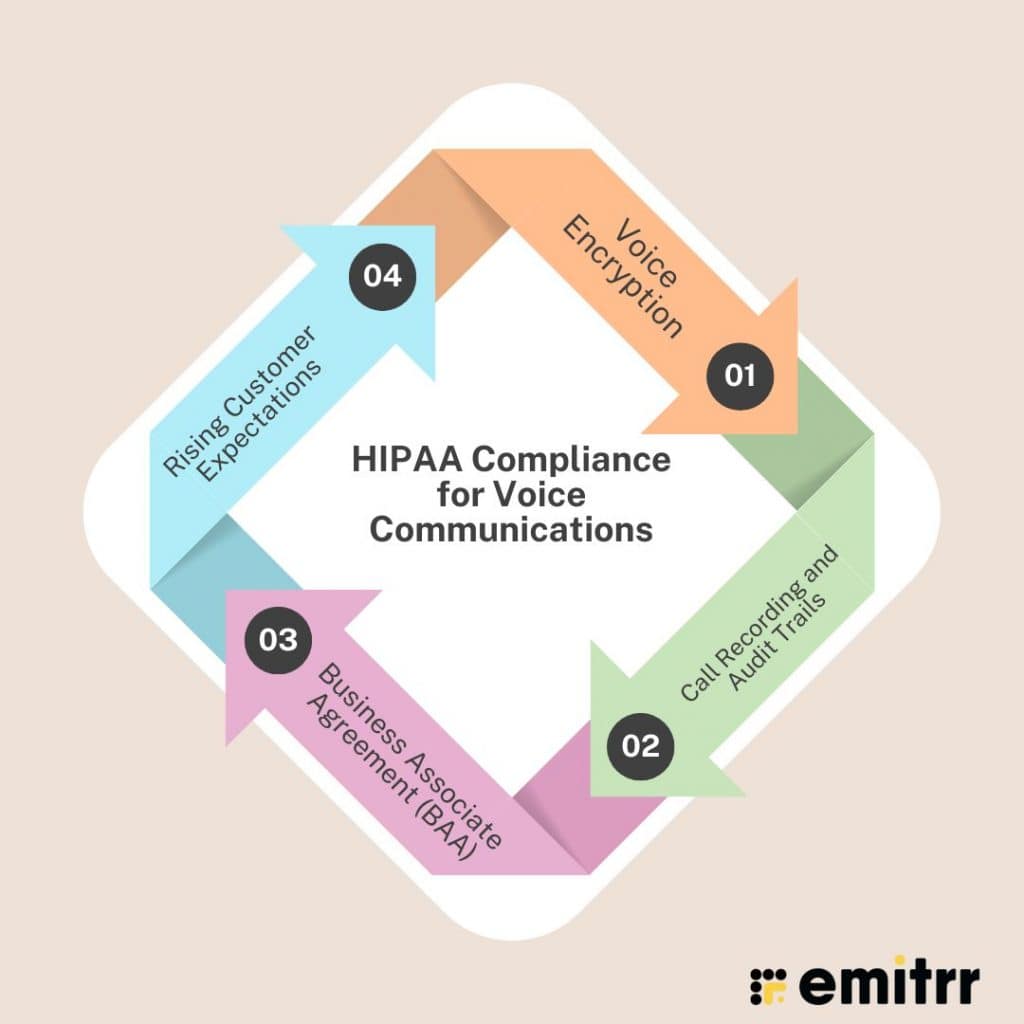
Voice Encryption
HIPAA mandates end-to-end encryption for voice communications to prevent unauthorized access to PHI. Advanced encryption standards are widely used by compliant VoIP providers to secure calls. Secure Real-Time Transport Protocol (SRTP) ensures that voice data remains confidential during transmission, protecting against eavesdropping or interception.
Call Recording and Audit Trails
For practices that record calls for training, quality assurance, or documentation, medical phone service must maintain secure, auditable logs. These records are critical during HIPAA audits, which can occur randomly or following a complaint. Logs must include call details such as time, duration, and participants and be stored in encrypted formats to prevent tampering. Providers should retain logs for the required duration per HIPAA requirements.
Business Associate Agreement (BAA)
VoIP providers handling PHI must sign a BAA, a legal contract outlining their responsibility to comply with HIPAA safeguards. The BAA ensures providers implement security measures, train staff on HIPAA requirements, and report breaches promptly. Without a BAA, practices assume full liability for any data breaches caused by the provider, exposing them to significant legal and operational risks.
Legal Implications
Non-compliance with HIPAA can result in severe penalties and substantial regulatory consequences. Beyond regulatory issues, breaches can lead to reputational damage, loss of patient trust, and potential lawsuits. Organizations must prioritize secure healthcare communication systems to avoid these significant risks, as unsecured communication represents a major vulnerability in healthcare data protection.
Security and Privacy Considerations
Beyond HIPAA compliance, medical phone service systems must incorporate comprehensive security measures to protect patient data and maintain operational integrity. Here’s a detailed examination:
Voice Encryption Standards
Advanced encryption ensures calls are secure from eavesdropping or interception. Providers should also use SRTP and Transport Layer Security (TLS) to protect voice and signaling data. Regular security audits help identify vulnerabilities in encryption protocols, ensuring ongoing protection against emerging threats.
Network Security
Robust network defenses are critical to prevent cyberattacks, which represent a significant threat to healthcare organizations. Firewalls, intrusion detection and prevention systems (IDPS), and virtual private networks (VPNs) protect VoIP systems from threats like DDoS attacks or malware. Providers should segment the phone system for medical office traffic on dedicated VLANs to isolate it from other network activity, reducing the risk of unauthorized access.
Access Control and Authentication
Multi-factor authentication (MFA) restricts system access to authorized users, requiring a combination of passwords, biometrics, or security tokens. Role-based access control (RBAC) ensures staff only access features relevant to their duties—for example, front-desk staff cannot access clinical call logs. Regular password updates and session timeouts further enhance security, reducing the risk of unauthorized access.
Audit Trail Maintenance
Detailed logs of call activity, user access, and system changes are essential for compliance and incident investigation. Logs should include timestamps, user IDs, and call metadata, stored in encrypted formats on secure servers. Providers should retain logs for the required duration per HIPAA requirements and ensure they are accessible only to authorized personnel.
Data Backup and Recovery
Regular backups to secure cloud servers ensure data recovery during outages, cyberattacks, or hardware failures. Providers should offer automated backup schedules and disaster recovery plans with reasonable recovery time objectives. Encryption of backup data is critical to prevent unauthorized access, ensuring compliance and data integrity.
Incident Response Planning
A documented protocol for handling security incidents, such as data breaches or system outages, minimizes damage and ensures compliance with HIPAA’s breach notification rule. Plans should include steps for identifying breaches, notifying affected patients, and reporting to regulatory authorities within required timeframes. Regular staff training on incident response enhances preparedness, reducing response times and mitigating risks.
Scale and Seize Opportunities With Emitrr: The Leading AI-Powered VoIP Solution for Healthcare Professionals
Emitrr is a premier VoIP for medical offices designed specifically for healthcare, offering a robust suite of features to streamline communication and enhance patient care. Here’s an in-depth look at the capabilities of this VoIP for medical offices:
Comprehensive Communication Platform
Emitrr, the best healthcare VoIP, unifies voice, text, and video communications into a single platform, reducing the need for multiple tools. This healthcare VoIP streamlines workflows, allowing staff to manage patient interactions from one interface. For example, a provider can initiate a voice call, switch to video for a telehealth consultation, and send a follow-up text without leaving the platform, improving efficiency and workflow continuity.
Advanced AI Features
Emitrr’s AI-driven call routing prioritizes urgent calls based on caller ID or keywords such as “emergency,” ensuring rapid responses. Automated patient triage assesses inquiries and directs them to appropriate staff, reducing wait times significantly. The AI transcription feature of this medical office phone system converts calls to text for easier documentation, saving providers considerable time on administrative tasks.
Watch this video to know more about what Emitrr AI can do:
Efficient Multi-Location Management
Emitrr’s cloud-based phone system for healthcare supports seamless communication across multiple clinics with streamlined operations. Centralized management reduces IT overhead, making this medical office phone system ideal for growing practices or those with dispersed teams. This healthcare VoIP eliminates the complexity and maintenance requirements of traditional phone systems for healthcare.
Integrated Patient Engagement Tools
Emitrr, the best medical office phone system, integrates with EHRs like Epic, Cerner, and Athenahealth, as well as CRMs like Salesforce, enabling personalized patient interactions. For example, providers can access a patient’s medical history during a call, tailoring responses to their needs. Automated follow-up campaigns, such as post-visit surveys, enhance engagement and improve patient retention rates.
Comprehensive Support and Seamless Integration
Emitrr, the best medical phone systems, offers round-the-clock support via phone, email, and live chat, ensuring minimal downtime. Onboarding support includes staff training and system integration, with most practices becoming fully operational quickly. Emitrr’s API supports custom integrations with niche healthcare software, ensuring compatibility with existing workflows.
Future Trends in Medical VoIP
The future of VoIP for healthcare is poised for transformative advancements, driven by artificial intelligence, IoT, and telemedicine. Here are seven key trendsof VoIP for healthcare with their potential impact:
AI-Powered Call Routing and Triage
In VoIP for healthcare AI algorithms will be given the power to detect call patterns, data of patients, along with the urgency level in order to prioritize and even route calls more effectively. The medical phone service technology would place the response to emergencies much faster, resulting in better success in such situations. As an example, an AI system could identify such keywords as chest pain and forward the call to a cardiologist within a short time, optimizing care delivery and patient safety.
Telemedicine Integration
An automated phone system for doctor’s office will continue to be integrated into telehealth platforms, allowing a smooth transfer across voice, video, and chat. With the growth of the telehealth approach to healthcare management, integrated systems will promote streamlining virtual care operations, with the help of which the time of setting an approach will be reduced, and the experience of interactions in all communication channels will become highly positive.
Voice Analytics for Sentiment Analysis
Advanced analytics will be used in VoIP for healthcare to measure patients by tone, sentiment, and keywords during calls so providers can know how satisfied patients are and where care is lacking. To give an example, VoIP for healthcare can highlight the frustration of a patient so that it can be followed up to enhance retention rates. The technology is likely to make patients satisfied because it is more responsive and customized.
Enhanced Mobile Communication
An automated phone system for doctors office will include superior capabilities such as real-time transcription, file-sharing security, and push-to-talk, making providers easily accessible. It is crucial for physicians on call or physicians responsible for telehealth services — they should be able to stay connected at all times and in all places.
Integration of IoT Devices
VoIP systems will be integrated with IoT devices, including wearable health monitors or smart glucometers, to transfer patient-related real-time information over the phone. The process of such integration is likely to get more popular in the future, empowering remote care and implementing proactive interventions on the basis of continuous patient monitoring.
Predictive Calling
Machine learning will enable VoIP systems to anticipate patient needs based on treatment plans or historical data. For example, a system might automatically schedule follow-up calls for patients post-surgery, improving adherence to care plans and supporting better health outcomes through proactive engagement.
Advanced Voice Recognition and Transcription
AI-driven transcription will automate call documentation, converting conversations to text for EHR integration. This reduces administrative burdens and improves documentation accuracy, with continuously improving error rates making this technology increasingly reliable for healthcare documentation needs.
Sound professional every time. Download voicemail greeting templates for doctors now.
FAQs about VoIP for Doctors:
VoIP, which is HIPAA-compliant, protects PHI utilizing end-to-end encryption, secure audit trails, and signed BAA so as to be compliant with federal regulations. The providers should also apply multi-factor authentication and frequent security audits to comply with the standards.
They can gain a lot of operational advances via practices with cloud-based VoIP lowering hardware costs, maintenance costs, and overhead costs of communication, and improving counterparts and scalability.
The VoIP system that is based on the cloud will redirect the calls to backup numbers or mobile devices. Having a backup internet connection, such as a mobile hotspot, will guarantee consultation in case of failure to maintain functionality, and hence, patient care and practice life.
Yes, as long as it applies advanced encryption, has multi-factor authentication, and adheres to HIPAA standards. The BAA and security of the provider should always be confirmed to know that the health information of the patient is taken care of.
On-premise VoIP requires local servers and ongoing maintenance with substantial upfront investment, while cloud VoIP offers enhanced scalability, remote access capabilities, and reduced infrastructure requirements with predictable operating expenses.
Keep the internet connection stable, including the bandwidth of the same Quality of Service (QoS) settings, and consider using providers whose servers are reliable and low in latency so that one communicates clearly and professionally.
Employees usually require some short-lasting call handling training, to be familiar with the features of a certain system, and to meet all the HIPAA compliance requirements. Most suppliers such as Emitrr provide an end-to-end onboarding service to make the adoption process easier, and this makes staff become competent, fast, and self-confident.
Conclusion
VoIP or a medical office phone system is a disruptive technology in contemporary healthcare communications, which focuses on the weaknesses of the old phone system, creating a position of scalable, secure, and fully featured platforms. VoIP provides superior facilities, such as call analytics, EHR integration, and 24/7 accessibility, that enable healthcare providers to improve patient treatment, operational efficiency, and productivity.
Constant security, as measured by HIPAA compliance, as well as having powerful tools to keep patient data safe — including but not limited to advanced encryption and audit trails, as well as the promise of future changes in technology such as the use of IoT and AI in routing — paints a picture of future innovation.
Choose a phone system for a medical office that has dedicated healthcare features, is easily integrated, and with support in case it is required to ease the transition. With the shift to VoIP, your practice will be able to navigate the growing digital environment in healthcare, providing remarkable care and keeping compliance and operations at the highest levels.
Emitrr is your all-in-one solution. Book a demo now to know more!!

 4.9 (400+
reviews)
4.9 (400+
reviews)