

Introduction
A clinic’s reputation precedes the optometrist. When a potential patient is in the market for eye care, search results, star reviews, and recent comments make an opinion almost immediately. First impressions tend to be decisive and determine whether or not someone makes an appointment or tries another practitioner. That’s why online review management has become as crucial as keeping diagnostic equipment in good working order in the practice.
Review and reputation management software enables optometry clinics to continuously gather feedback, react quickly, and remain top-of-mind on most critical sites. Google Business Profile, Healthgrades, and other healthcare directories are public portals, and a timely presence is as effective as word-of-mouth. Using customized software like Birdeye or Emitrr, clinics can manage and process this task as a repeatable, reproducible task.
What is Reputation and Review Management Software
Reputation and review management software is a collection of programs used to collect, track, and respond to patient feedback on multiple websites. It sends automated review requests through email or SMS, collects comments from Google, Yelp, and Healthgrades, and notifies about new comments. The goal is to collect all the feedback within one location and make timely, consistent, and compliant responses possible.
These premium platforms also have analytics and sentiment monitoring, enabling practices to monitor patterns in patient satisfaction by site or provider. Birdeye and ReviewTrackers have solutions for larger multi-location practices that enable them to spot recurring problems early and address them before they affect patient retention.
Why Optometrists Need a Specialized Review and Reputation Management Tool
Patient reaction in health care presents special privacy obligations. A response that inadvertently reveals confidential health information can be in violation of HIPAA rules, which results in legal and reputational harm. HIPAA mandates rigorous security procedures, such as secure storage, access controls, and careful handling of any patient data that is identifiable.
Healthcare-oriented review websites are designed with these needs in mind. They provide privacy-protected communication instruments and will implement a Business Associate Agreement (BAA) to document their compliance obligations. This is necessary when review processes entail the exposure to protected health information, such as appointment information or identifying information.
The Move Beyond Manual Monitoring to Automated Sites
Prior to automation, employees would manually search Google, Yelp, and Healthgrades and then personally write and post replies individually. This was time-consuming, intermittent, and likely to miss backtalk. Automated reputation systems have done things differently. They send review invitations at the moment a patient visit is finished, scan multiple websites at once, and give real-time notifications when new feedback is gained.
These platforms merge these functionalities with centralized dashboards so that employees can handle all feedback from one interface. The outcome is increased review volume, reduced response time, and improved patient engagement consistency without increasing staff workload.
Significance of Digital Reputation to Patient Acquisition
For optometry practices, online reputation has a direct impact on search visibility and patient recruitment. Businesses perform better with search engines when they experience a steady influx of new reviews, maintain a strong average rating, and respond to feedback in a timely manner. Google Business Profile is the essential process at play, serving as both a directory listing and a messaging system.
Actions that continuously ask and answer reviews have typically enhanced local search rankings and Google Map Pack placement, which ultimately translates into higher appointment call volume. Likewise, healthcare-specific directory profiles like Healthgrades are ranked higher when they feature current, descriptive reviews, pulling more potential patients into the book flow.
Grab the Free PDF: Patient Review & Reputation SMS Templates for Ortho Clinics
Features to Consider in Optometrist Reputation and Review Management Software
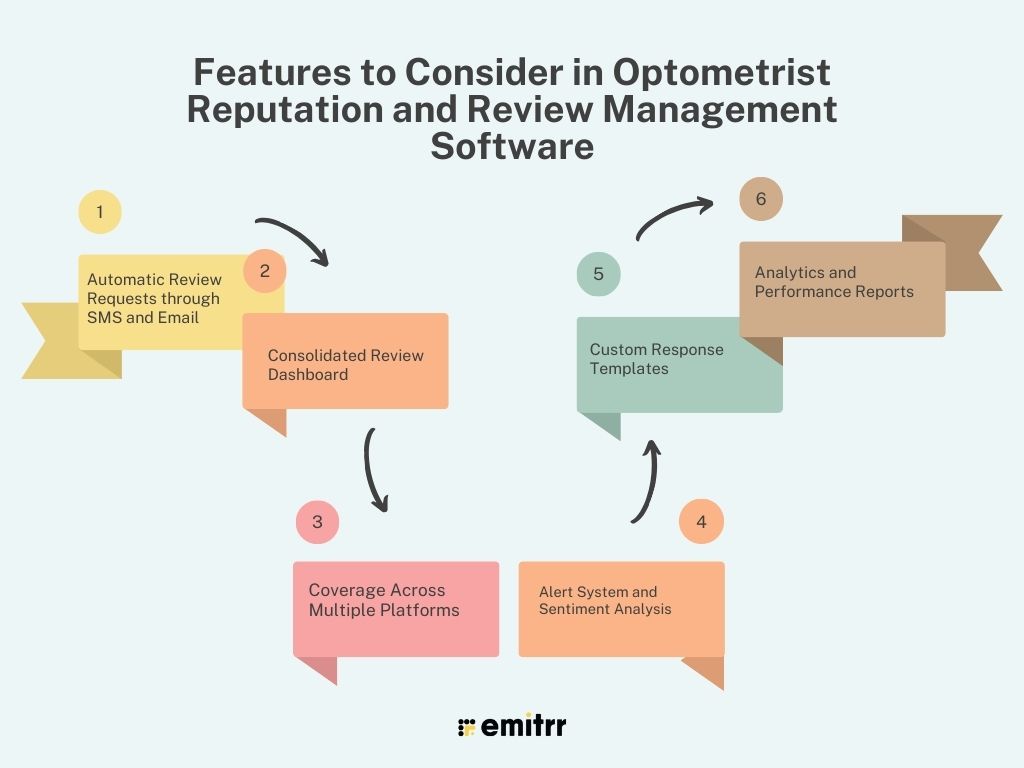
Automatic Review Requests through SMS and Email
A quick, straightforward request for feedback from a patient can drive review volume higher. When a memory is fresh, immediately after an eye exam or lens fitting, the patient is more likely to offer insightful remarks. Effective tools allow automatic scheduling of those requests and allow you to tailor them for a more personal touch. Birdeye, Podium, Doctible, and Weave each have this capability and assist practices in gaining more feedback without adding workloads.
Consolidated Review Dashboard
Instead of bouncing between Google Business Profile, Yelp, Healthgrades, and other directories, your team can manage everything from a single, streamlined dashboard. You’ll see new reviews as they come in, know exactly where they were posted, and respond immediately. Birdeye and ReviewTrackers focus on providing one interface that brings clarity to what could otherwise feel like chaotic feedback streams.
Coverage Across Multiple Platforms
Prospective patients search a variety of review websites. Some will consider two or three before selecting a practitioner. That means your technology needs to post and manage reviews on the complete spectrum, such as Google, Yelp, Facebook, Healthgrades, and specialty health listings. Podium touts its direct connection to Google Business Profile, while Birdeye focuses on a broad review network that reaches social media and specialty health listings.
Alert System and Sentiment Analysis
Overlooking a 1-star review that sits unread for days can do long-term harm. The top systems offer real-time notifications for new feedback so your staff can act quickly. Some do more, employing sentiment analysis to identify patterns in feedback—whether it’s complaints about wait times, compliments on employee courtesy, or compliments on optical choice. Birdeye employs AI to condense sentiment trends, while ReviewTrackers prioritizes strong alerting and reporting capabilities.
Custom Response Templates
Contacting patients following a review is sensitive. Employees require instruction on how to communicate in a way that sounds sincere and sympathetic without disclosing any information that might violate HIPAA. Response templates are useful for that purpose. Standard responses can be prepared, edited, and approved ahead of time. Podium and Birdeye both provide libraries of response templates, so the responses remain standardized and compliant regardless of who sends them.
Analytics and Performance Reports
Feedback is not only for responding. It’s information. Great tools provide greater insight into how your clinic is doing over time; review volume over time, average rating, response time, the sites that send most feedback, and even more detailed keywords. Birdeye analytics enable teams to identify trends between locations or providers. ReviewTrackers offers comparable reporting to assist clinics in taking action on feedback instead of merely collecting it.
Security and compliance needs
Online review management for an eye care clinic is more than just taking feedback. Patient data protection is in the picture, and all contact has to be compliant with strict healthcare laws. The correct software not only protects information but also provides your staff with assurance to interact publicly without putting compliance at risk.
HIPAA compliance for privacy of patient data
Any practice that touches protected health information has to make sure that internal procedures and vendor applications comply with the safeguards of HIPAA. Those include administrative, physical, and technical safeguards which maintain patient information safe. If a review workflow captures identifying information, messages, or visit notes, the vendor is considered a business associate and has to sign a Business Associate Agreement in order to formalize their duty of care for that information.
End-to-end encryption for communications
The HIPAA Security Rule demands robust safeguards around the way information is transmitted and stored. Encryption is not specifically required, but it is generally known to be the most secure method for protecting PHI. Selecting a platform that secures data in transit and at rest guarantees that patient messages and review responses are kept confidential from the point of sending through the point of storage.
Secure data storage and access control
Sensitive data must never be available to people who don’t have a need for it. Secure systems employ role-based access, individual logins, session timeouts by themselves, and audit logs to monitor who views PHI. Prior to signing up with a tool, ensure that the vendor is able to document those controls and define where your clinic’s data resides.
Audit trails and consent management
Each access to PHI should have a resulting record. Audit trails indicate who accessed, changed, or distributed sensitive information and when. This history is essential in both compliance audits and internal analysis. For review requests and messaging, consent tracking confirms that patients have provided consent for the clinic to communicate, avoiding both legal risk and reputational risk.
Compliance with local regulations and healthcare standards
HIPAA is not the sole rulebook. There are local laws and professional standards as well. The Office for Civil Rights has cautioned healthcare providers about inadvertently disclosing PHI in public review responses. Training workers on compliant communication and utilizing pre-approved templates can avoid disclosures that can harm trust or evoke penalties.
Integrations necessary in optometry workflows
A reputation management solution becomes much more powerful when it integrates with systems you already have. Integration avoids duplicate work and provides a smoother experience for patients and staff.
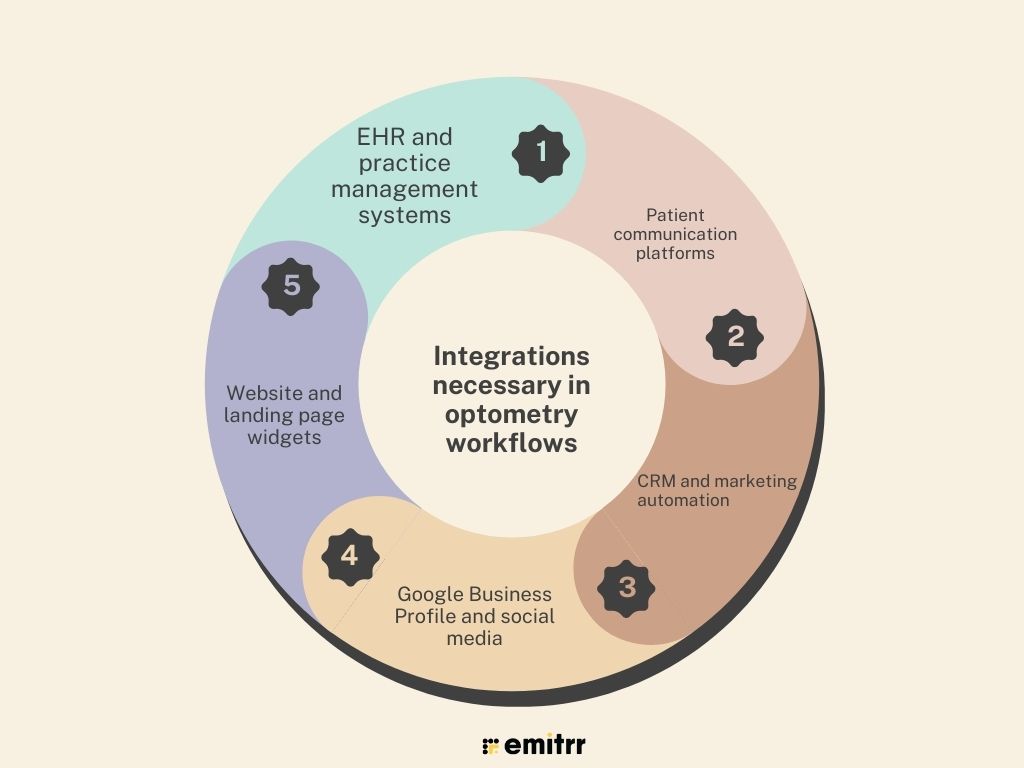
EHR and practice management systems
For optometry clinics, integration with systems like RevolutionEHR, Eyefinity, and Crystal Practice Management ensures that data remains consistent across reviews, billing, and appointments. A few providers, such as Weave and Doctible, come with in-built integrations to these systems, so that information gets passed on seamlessly without entry being done manually.
Patient communication platforms
If your clinic already employs a specialized communication tool such as Weave for texting and calls, your reputation management software must be compatible with it or at least coexist without interference. Supported API integrations synchronize patient records, messages, and reviews.
CRM and marketing automation
Such practices take feed data and inject it into larger marketing activities, including email nurture streams or patient retention programs. ReviewTrackers and Birdeye offer export functionality and integrations that are part of multi-location marketing platforms.
Google Business Profile and social media
Native Google Business Profile integration facilitates response to reviews, clinic information updates, and messages to patients in one platform. Scheduling of posts to Facebook or other networks on supported platforms ensures that your online presence is maintained without extra logins.
Website and landing page widgets
Having reviews show up on your website increases transparency and can increase search rankings. Most vendors provide embeddable widgets that display first-party reviews in a visually appealing and SEO-optimized manner to visitors.
How reputation and review platforms benefit optometrists
Investing in a well-designed platform does more than save time. It becomes a central driver of patient engagement, clinic efficiency, and competitive advantage.
Saves time with automation
Automated review invites, and reminders minimize the time employees spend on doing it manually. A unified dashboard enables teams to respond promptly to feedback even from multiple locations.
Boosts patient review quantity and quality
Requesting at the optimal time, for example, shortly after the appointment, raises the chances of genuine and considered reviews. This continuous stream enhances search visibility as well as patient confidence.
Boosts local SEO and online presence
Search engines benefit companies with steady, up-to-date, and well-moderated reviews. Publishing your chosen first-party feedback on your website also gives structured data that enhances your local search visibility.
Enhances patient trust and conversion rates
Patients tend to seek patterns in reviews. A high average rating, new comments, and competent responses reflect a reputable and book-worthy clinic.
Turns feedback into actionable insights
Advanced software can scan review sentiment and keyword trends, enabling you to detect potential problems in scheduling, wait time, or service quality. This turns anecdotal feedback into quantifiable chances for improvement.

How to select the correct review and reputation management software for optometrists
Choosing the best software entails aligning its capabilities with your clinic’s organization, workflow, and compliance requirements.
Determine your clinic’s unique needs
Begin with an honest evaluation of your practice size, number of providers, and current technology stack. This aids in identifying must-have features like location tagging or role-based permissions.
Assess user friendliness and learning curve
A clean, intuitive interface eases adoption for your team. User reviews on respected sites like G2 and GetApp may speak to how various tools function in real-world use.
Test for healthcare-specific features
Make sure the vendor is HIPAA-aware and will execute a Business Associate Agreement. Capabilities such as privacy-safe reply templates and PHI-reducing workflows are essential for healthcare environments.
Address pricing and scalability
Pricing usually is based on the number of locations, users, or messages sent out. Although public listings can provide estimates, a custom quote ensures you understand the investment.
Examine customer support and onboarding
Good onboarding makes your clinic see value quickly. Public comments and vendor case studies can show how quickly a company responds when there are problems.
Best Optometrist Reputation and Review Management Tools
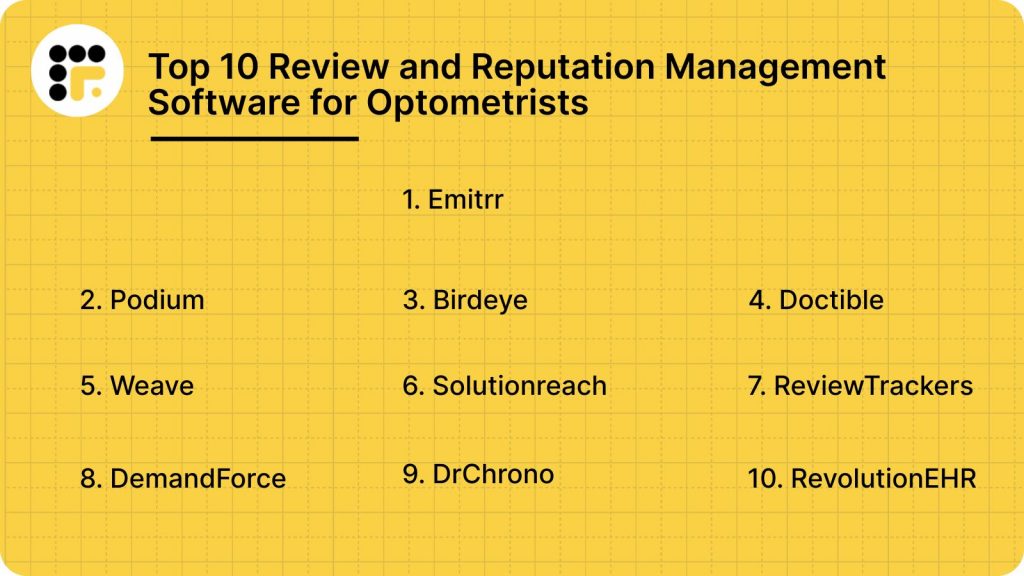
Selecting a reputation and review management tool is like trying on prescription-free glasses; they all appear to be the same until you try them out for distinctiveness. Whatever tools other healthcare professionals employ, optometrists have unique requirements: HIPAA compliance, integration with eye care practice software, and a workflow that can be adapted around busy clinic days. A closer examination of the most relied-upon solutions for managing patient reviews and establishing a reputation that attracts the right patients.
- Emitrr
- Podium
- Birdeye
- Doctible
- Weave
- Solutionreach
- ReviewTrackers
- DemandForce
- DrChrono
- RevolutionEHR
1. Emitrr
What is Emitrr?
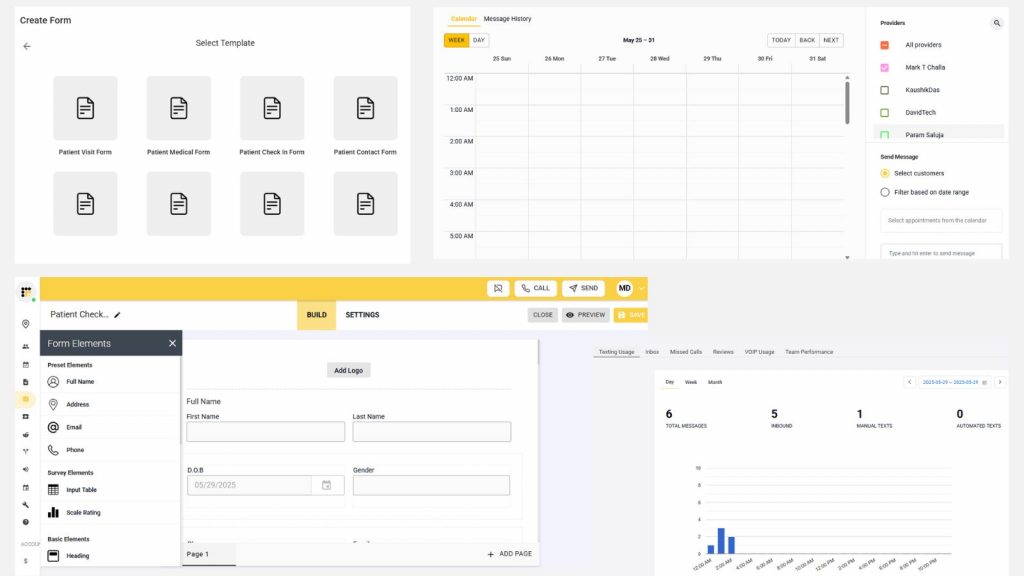
Emitrr is a reputation and communication platform specifically for healthcare that streamlines review harvesting, aggregates feedback, and offers HIPAA-capable patient engagement. Optometry practices were initially targeted, so manual review invitations were not needed and large EHRs were seamlessly integrated. It helps practices drive positive reviews while staying compliant with patient privacy laws. Its ease of use is built into the interface so that teams can quickly start using it without a lot of onboarding.
Emitrr Features
- Auto Review Invites: Invites reviews via SMS, email, or both right after patient visits. Time can be optimized for higher engagement.
- Multi-platform Review Capture: Offers capture on Google, Facebook, Healthgrades, and other top review platforms, enabling more extensive online presence.
- Unified Dashboard: Presents all reviews in one place to track, filter, and respond easily without the need for platform switching.
- Real-time Alerts: Sends real-time alerts upon new reviews going live so clinics can respond in a timely manner.
- Sentiment Analysis: Automatically detects the tone of the reviews to assist with response prioritization and trend identification on patient feedback.
- Customizable Templates: Pre-approved, HIPAA-compliant response templates that can be customized before sending.
- Secure Patient Messaging: In-built two-way text messaging with end-to-end encryption for appointment reminders and patient follow-up.
- Analytics Dashboard: Monitors review expansion, average scores, and response times to determine campaign effectiveness.
- Multi-location Management: Provides centralized management of numerous clinics with unique performance tracking for each.
- EHR Integration: Connects with EHR programs such as RevolutionEHR and Eyefinity to automate review request intake without human data entry.
Emitrr Pros
- HIPAA compliance with healthcare-focused workflow
- Rapid setup and intuitive interface for non-technical staff
Emitrr Cons
- Limited brand recognition compared to Podium or Birdeye
- Advanced analytics an option on higher plans only
Emitrr Ratings & Reviews
- G2: 4.9/5
- Capterra: 4.9/5
“The customer service team is truly top notch, the product has been very well received by our team members, and its very easy and quick to use. Overall its been a perfect experience.”
“We have success with SMS marketing and the review feature that allows us to manage all our reviews from different platforms in one place.”
Emitrr Pricing
- Begins at $149/month, with bespoke options for multi-location clinics.
Emitrr Integrations
- RevolutionEHR
- Eyefinity
- Crystal Practice Management
- Google Business Profile
- Healthgrades
- Mailchimp
2. Podium

What is Podium?
Podium is a communication and reputation tool with powerful text-based interaction capabilities. Although not health-oriented, its auto-review request SMS and multi-platform monitoring feature make it the default selection for optometry clinics wishing to expand their online presence.
Podium Features
- Auto-review invitation SMS that goes out immediately after patient visits.
- Google and Facebook review gathering directly from SMS messages.
- Shared inbox for SMS, webchat, and social media messages.
- Analysis to monitor review response rates and increase.
- Secure payment collection through SMS.
Podium Pros
- Quick and efficient SMS engagement
- Simple-to-use, clean dashboard
Podium Cons
- Not solely healthcare-focused
- Additional setup necessary for HIPAA compliance
Podium Ratings & Reviews
- G2: 4.6/5
- Capterra: 4.6/5
“The interface can be a little overwhelming at times.”
“They have a huge lack of transparency. They are willing to lie to you to onboard and try to keep your business. They will make HUGE mistakes like porting away your personal number with NO accountability or concerns for your business. Wasted countless hours during set up and after trying to use their platform all while being charged for services not used.”
Podium Pricing
- Pricing starts at $289/month.
Podium Integrations
- Google Business Profile
- HubSpot
- Shopify
- Certain healthcare EHR systems through API.
3. Birdeye

What is Birdeye?
Birdeye provides a comprehensive review management platform with strong marketing features for patient recruitment. Its multi-location feature and harvesting of feedback from tens of sites make it worthwhile for expanding optometry practices.
Birdeye Features
- Systematic solicitation of reviews through SMS and email.
- Centralized monitoring of 200+ site reviews.
- AI-based sentiment analysis for trend in feedback.
- Review site widgets to display patient testimonials on sites.
- Multi-location reporting and analytics.
Birdeye Pros
- Extensive review platform coverage
- Powerful analytics and reporting features
Birdeye Cons
- May be overwhelming for small clinics
- More expensive than one-location solutions
Birdeye Ratings & Reviews
- G2: 4.8/5
- Capterra: 4.8/5
“When messaging a guest through the chat, pictures are slow to load.”
“Everything. They should not even be in business. Customer Service? Poor. Technology? Poor. Innovation? 5 years behind.”
Birdeye Pricing
- Pricing is available on request.
Birdeye Integrations
- Healthgrades
- EHR systems through API
- Salesforce
- HubSpot
4. Doctible

What is Doctible?
Doctible is designed specifically for healthcare practices and integrates patient communication with reputation management. Its automated processes lighten staff workload and enhance patient satisfaction scores.
Doctible Features
- Automated review requests after visits.
- HIPAA-compliant messaging platform.
- Custom patient feedback surveys.
- Website integration for reviews display.
- Multi-location management dashboard.
Doctible Pros
- Healthcare-specific compliance
- Easy automation setup
Doctible Cons
- Limited integrations beyond healthcare
- Fewer advanced analytics than competitors
Doctible Ratings & Reviews
- G2: 4.7/5
- Capterra: 4.7/5
Doctible Pricing
- Pricing starts from $199/month.
Doctible Integrations
- RevolutionEHR
- Crystal Practice
- Google Business Profile
- Facebook.
5. Weave
What is Weave?
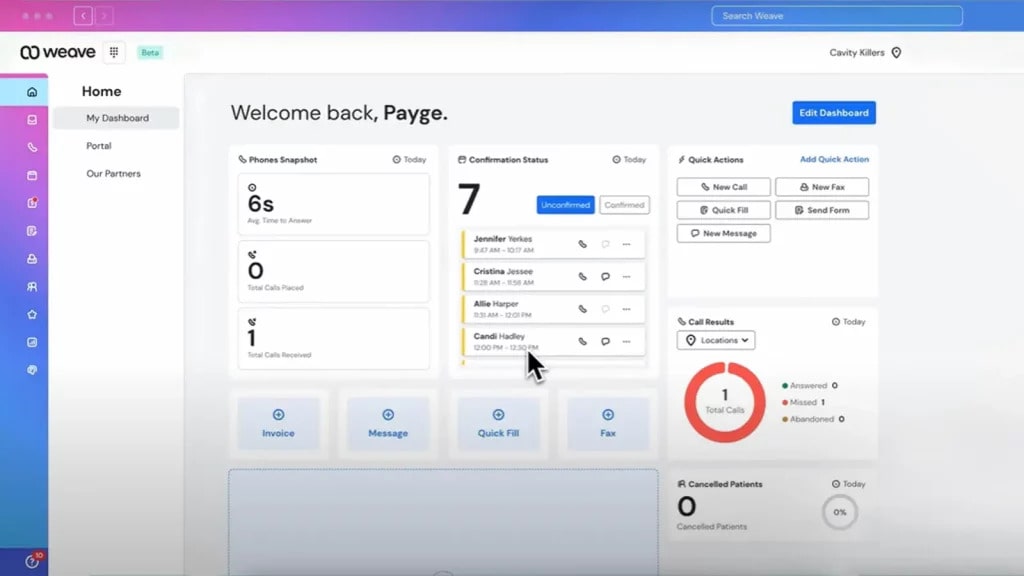
Weave is an all-in-one patient communication platform with up-to-date review management too. It’s particularly great for practices who desire phone, text, and review management under one subscription.
Weave Features
- Text or email review request.
- Call and text management from a single application.
- Payment collection features.
- Single review monitoring.
- Automated recall of patients.
Weave Pros
- Packages several communication tools
- Easy-to-use interface
Weave Cons
- No major cons, actually.
- More costly for smaller practices
Weave Rating & Reviews
- G2: 4.6/5
- Capterra: 4.5/5
“With Weave, it’s just a nightmare with the customer service and support. And guess what, any settings or setup you want to change, you only have to go through their customer support because whenever you make changes from their web portal, none of it gets actually reflected.”
“I don’t love that it does not directly attach to the medical record”
Weave Price
- Pricing starts from $399/month.
Weave Integration
- AdvancedMD
- Booker
- Cloud9Software
- CurveDental
6. Solutionreach
What is Solutionreach?
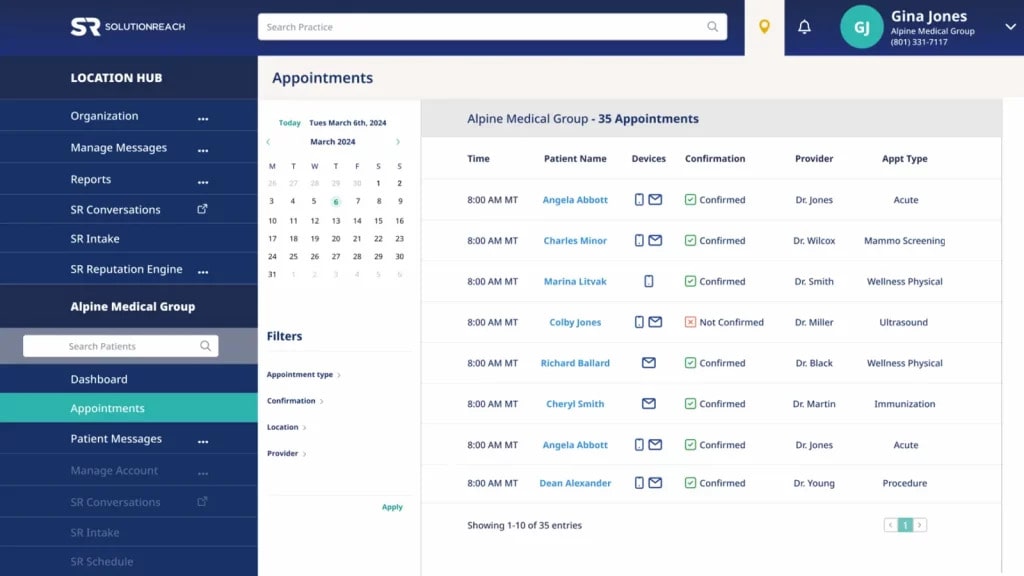
Solutionreach is a complete patient engagement platform that integrates reputation tools for reminders, messaging, campaigning, and review collection for any size of clinic.
Solutionreach Features
- Sends automatic review reminders via text or email with easily customizable templates to fit your brand voice.
- Manages appointment reminders, recalls, and surveys in one solution to enhance patient retention.
- Offers batch messaging and access via a mobile app for easy reach and monitoring on multiple sites
- Consolidates reputation metrics and feedback tracking in addition to communications tools.
- Detection powered by AI helps highlight reviews that need immediate attention and automate response processes
Solutionreach Pros
- Intense healthcare focus with rich communications features
- Efficiently scales for multi-location practices.
SolutionReach Cons
- The user interface may appear old-fashioned to some
- Customer support and billing practices get mixed reviews
Solutionreach Ratings
- G2: 3.9/5
- Capterra: 3.8/5
“NOT fully compatible with Dentrix,( even though they said they were). Can not use all the features.”
“Inability to see provider details with the schedule on the app.”
Solutionreach Pricing
- Priced at approximately $329 per month with tiered plans (Essentials, Plus, Enterprise) depending on feature needs
Solutionreach Integrations
- Kareo
- Athenahealth
- NextGen
- Epic
- OfficeMate
7. ReviewTrackers
What is ReviewTrackers?
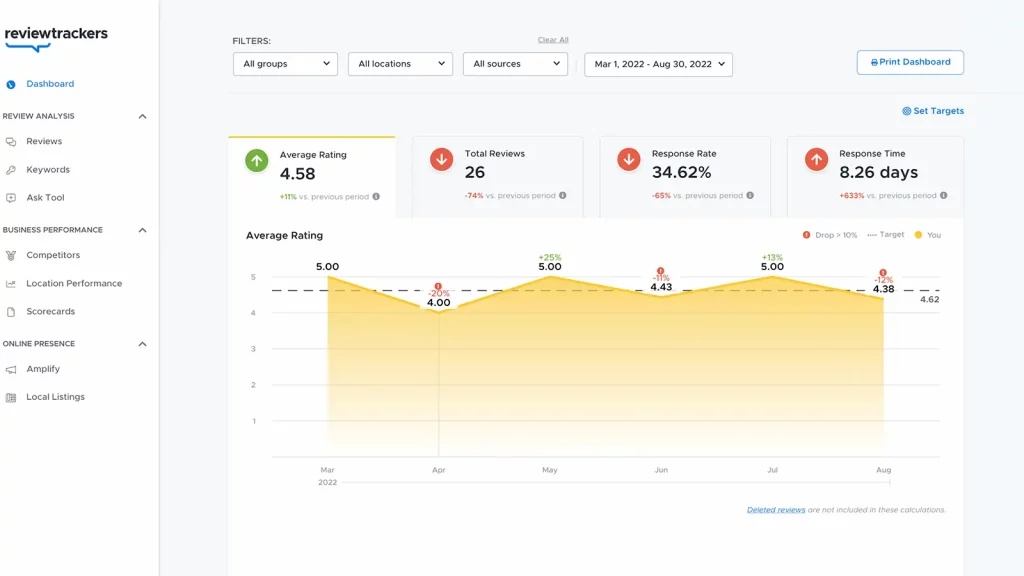
ReviewTrackers is a reputation engine that brings reviews from anywhere in the marketplace and provides actionable reports for multi-location healthcare teams.
ReviewTrackers Features
- Pulls patient feedback from Google, Yelp, and industry directories in one dashboard.
- Notifies teams when new reviews are being posted so they can reply right away.
- Supports location-based reporting and general trend tracking.
- Identifies top themes via keyword-based insights and filtering.
- Exports reviews and stats to feed CRMs or marketing dashboards.
ReviewTrackers Pros
- Top visibility across review sites.
- Robust analytics ideal for larger groups of clinics.
ReviewTrackers Cons
- Lacks messaging and appointment workflows.
- Pricing details are proprietary and requests a quote.
ReviewTrackers Ratings & Reviews
- G2: 4.6/5
- Capterra: 4.7/5
“Pricing details can vary depending on the size and needs of a business, which may not be ideal for smaller businesses with tight budgets.”
“My biggest pain points have to do with the platform cache. If I refresh my browsers, new reviews don’t show up until I navigate to one of the other tabs, and then go back to the reviews page. Another pain point is that I set up immediate notifications when we get reviews, but when i get a notification that a new Yelp review has been submitted, I won’t see it in ReviewTrackers for almost 24hrs. “
ReviewTrackers Pricing
- Pricing is available on request.
ReviewTrackers Integrations
- Hootsuite
- Zapier
- Google My Business
8. DemandForce
What is DemandForce?
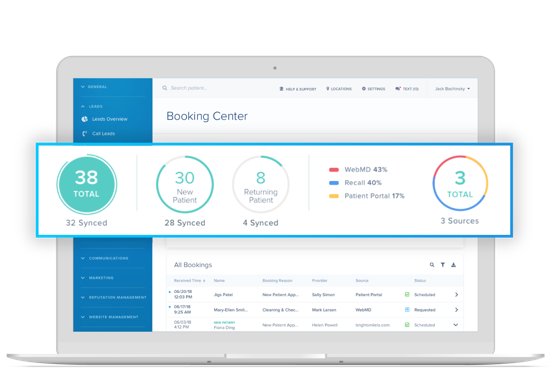
DemandForce offers an integrated patient engagement solution that brings together messaging, reminders, marketing, and reputation tools ideally suited to small and mid-size clinics.
DemandForce Features
- Sends review requests automatically and tracks patient feedback on leading sites.
- Sends email and SMS recall and appointment reminders.
- Offers online scheduling and campaign management to further business growth.
- Comes with marketing tools for newsletter and promotion.
- Monitors response performance with core analytics.
DemandForce Pros
- All-in-one full-featured platform.
- Well-established brand among healthcare communities.
DemandForce Cons
- Reported issues with user experience and transparency of pricing.
- Pricing can be volatile depending on the bundle and size of users.
DemandForce Ratings & Reviews
- G2: 3.3/5
- Capterra: 3.7/5
“Integration into our EHR and the service we received following our decision to discontinue trialing their software during the evaluation period we were given.”
“There wasn’t a way to block off appointment times so clients would frequently request appointments during lunch hours or surgery blocks. It also had tons of bugs and would constantly unsync with our practice software.”
DemandForce Pricing
- Pricing is available on request.
DemandForce Integrations
- AllScripts
- AdvancedMD
- Athenahealth
- DrChrono
- KareoEHR
- NextGen
9. DrChrono
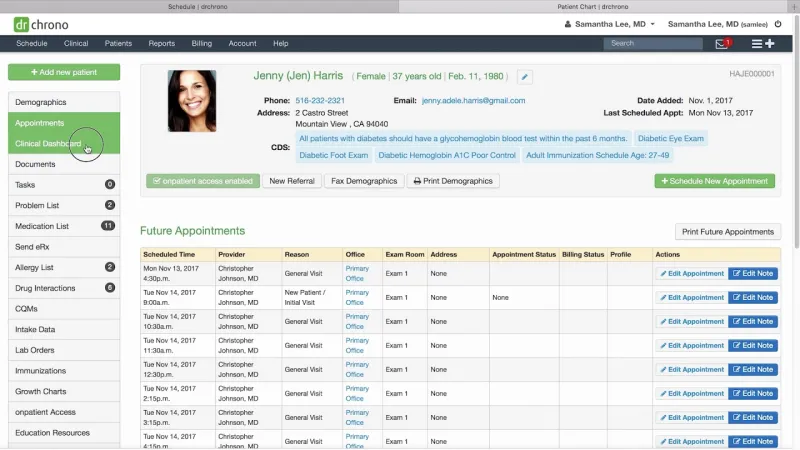
What is DrChrono?
DrChrono is a highly featured cloud EHR with an add-on marketplace, so adding reputation and review capabilities as an overlay is a possibility.
DrChrono Features
- Detailed appointment scheduling, charting, and telehealth functionality.
- OnPatient portal provides messaging and patient engagement functionality.
- Marketplace supports integration with tools that automatically send review requests.
- Features pre-built custom workflows that correspond to multi-specialty clinics.
- Sticks to core clinical and administrative functionality in a single platform.
DrChrono Pros
- Highly featured EHR platform with high flexibility.
- Enterprise-level for multi-discipline groups.
DrChrono Cons
- Not strictly reputation management-centric.
- Review automation requires third-party software and add-ons.
DrChrono Ratings & Reviews
G2: 3.5/5
Capterra: 4.0/5
“The cost is high, integration of several tools is complex, the sync is missing. Complex to use overall.”
“Some of the settings are hard to find but once you get it set up it runs smoothly and makes billing and coding easy.”
DrChrono Pricing
- Price available on demand.
DrChrono Integrations
- Health Gorilla
- Lifepoint
- Nimblr
- Ambra Health
10. RevolutionEHR
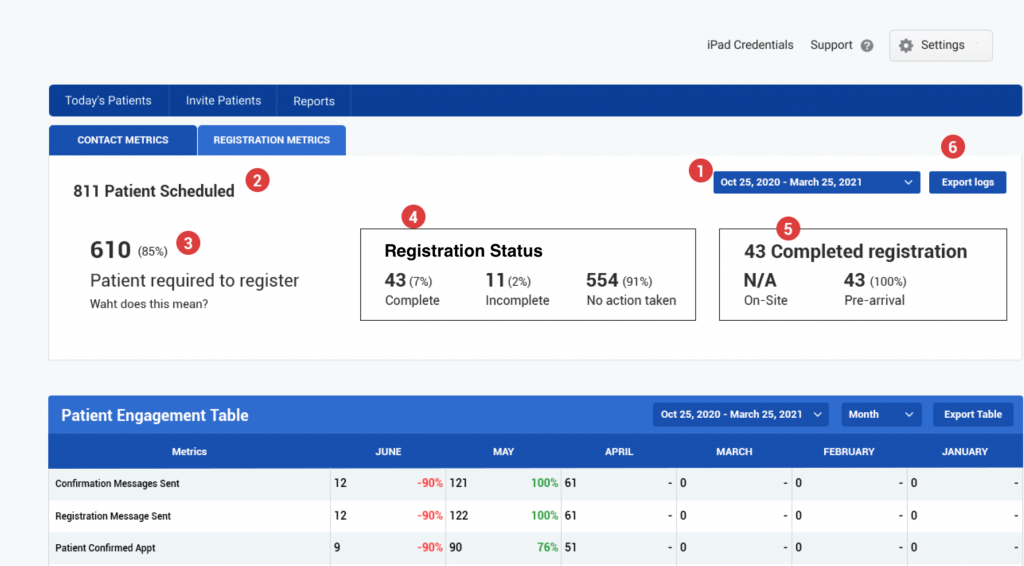
What is RevolutionEHR?
RevolutionEHR addresses optometry-specific practice management needs, with built-in modules and integrations ideal for stacking review strategy.
RevolutionEHR Features
- Handles patient scheduling, billing, and clinical management.
- Offers reporting and dashboards for clinic performance tracking.
- Supports messaging patients through optional add-ons.
- Integrates with leading reputation tools to auto-review workflows.
- Optometry compliance and workflow-centric.
RevolutionEHR Pros
- Designed specifically for optometry clinics.
- Active user base and training support.
RevolutionEHR Cons
- Review management is an add-on module.
- Requires separate reputation tool to auto-review workflows.
RevolutionEHR Ratings & Reviews
G2: 4/5
Capterra: 4.5/5
“All of the updates during business hours cause a lot of downtime with the software.”
“Listen to the requests of the doctors. Stop only offering new “fee” additions. Why would I pay for a feature when you do not have a stellar base product? If they would personally call back and talk to your clients, NOT JUST DOING SURVEYS.”
RevolutionEHR Pricing
- Pricing starts at $319 per month.
RevolutionEHR Integrations
- Weave
- SolutionReach
Why Emitrr Works Well for Optometrists
Designed with healthcare practitioners in mind
Emitrr is not merely another communication platform. It was designed with regulated healthcare spaces in mind at its foundation, and therefore its features meet the clinics’ and patients’ needs directly. From automated requests for reviews to recall reminders, patient surveys, and a tidied-up inbox keeping front desk staff on track, every aspect is designed to eliminate friction in patient communication while ensuring compliance.
HIPAA-compliant and security mindful
For optometry practices, keeping patient information private is not a choice. Emitrr is designed with HIPAA readiness in mind and actively promotes its preparedness to work with healthcare data. That attention is important since patient reviews, messages, and comments routinely involve protected health information. When considering any vendor, getting a signed Business Associate Agreement (BAA) is a requirement. Emitrr’s commitment to healthcare privacy standards gives peace of mind that communication is both effective and secure.
Seamless with optometry practice software
Optometrists tend to use EHR systems such as RevolutionEHR, Eyefinity, or Crystal PM to operate their practices. Emitrr’s method is integrated with these platforms, allowing automated communication and feedback without altering the way clinical records are handled. With integrations or workflow configurations, it syncs with your current systems so you can gather and respond to patient reviews without introducing additional administrative burden.
Tested results in reviews and visibility
Clinics employing healthcare-ready communication platforms always experience a rise in volume of reviews and quicker responses. Those enhancements enhance local search ranking, more clearly making the practice more visible within the competitive “map pack” listing on Google. Emitrr is among them and has gained prominence for its customer service that responds promptly, supporting the clinics in easily and efficiently implementing the system.
Easy to use with robust support
Regardless of how strong a platform is, adoption is dependent on usability. Emitrr’s user interface is easy for teams to master, and user feedback consistently suggests how quickly its support team can solve problems. That speed keeps the momentum level high during onboarding and avoids the tool being another unused subscription.
What to look for in a demo
Before you sign up, have the vendor take you through the entire review request process, starting from when an exam is finished to when the review goes online. Make sure to ask how PHI suppression is dealt with, if pre-approved response templates are possible, and how alerts are sent. Ensure reporting for both single providers and multiple locations is available. And always examine the vendor’s BAA and security documentation to verify patient information remains safe.
FAQs
When a patient is searching for an eye doctor, the first thing they do is look at Google reviews or Healthgrades-type sites. A good online reputation makes patients feel comfortable scheduling an appointment, and bad or ignored reviews will get them to go somewhere else.
Eye clinics are working with private health information, so discretion is important. Reputation platforms designed for health care (such as Emitrr or Doctible) are made to comply with HIPAA guidelines. That is to say, your data remains confidential, encrypted, and never released in the ways it shouldn’t be.
It sends gentle reminders to patients to leave reviews, brings all feedback into one convenient dashboard, notifies staff when new comments arrive, and even assists in writing responses that come across as caring without compromising patient privacy. It’s having an extra helper dedicated to making patients happy online.
Some of the more popular ones include Emitrr (healthcare-oriented), Podium and Birdeye (good for wide online presence), Doctible (designed for healthcare practices), and Weave (convenient if you would like phones, texts, and reviews all in one). The “best” option will rely on what the clinic requires most.
Reviews are trustworthy. When a clinic requests feedback and responds to patients (good or bad), it indicates they genuinely care. This not only improves search rankings but also makes new patients feel secure in trusting they will be cared for.
Final thoughts
Your online reputation management is usually the very first thing a patient sees of your clinic. In optometry, a process of review and response is no longer a nice-to-have; it’s an essential aspect of operations. The correct platform automates the outreach, ensures HIPAA compliance with communications, aggregates feedback across several directories, and translates that feedback into actionable data.
For a shortlist, look at Emitrr for health-focused communication, Podium or Birdeye for more general reach, and Weave or Solutionreach if you like phones and reminders on the same platform. Whatever your choice, ensure HIPAA compliance, obtain a signed BAA, and have integration with your EHR system. Once installed, have a consistent cadence of ask and respond, because in reputation management, consistency creates visibility, trust, and patient volume.


 4.9 (400+
reviews)
4.9 (400+
reviews)