
Introduction
Running a physician’s office can feel like controlled chaos. Phones keep ringing, patients juggle paperwork, and staff rush to keep things moving. In the middle of it all, doctors often get pulled into tasks that have little to do with care. That’s where AI agents in physician practices step in.
These AI-powered assistants handle the repetitive jobs that weigh clinics down, from scheduling and reminders to answering common patient questions. By using AI-powered automation for physician practices, doctors and staff can focus more on people and less on paperwork. And here’s the best part: these tools aren’t just for hospitals. Even AI in private physician practices can make a big impact, working 24/7 like a tireless virtual assistant.
In this blog, we’ll explore how AI agents are transforming physician practices and changing the way clinics run. From tackling everyday challenges to boosting patient care, you’ll see why they’re becoming must-haves for modern practices.
What Are AI Agents in Physician Practices?
So what exactly are these tools? Think of AI agents in medical practices as smart digital staff members you can assign tasks to. They’re not robots in lab coats, but software that can chat, text, or even talk on the phone with patients. For instance, one might confirm appointments, answer FAQs on your website, or route calls to the right place.
Because they connect with your scheduling and EHR systems, these AI assistants for physicians can do much more than a generic chatbot. They understand healthcare language – terms like “pre-authorization” or “fasting before blood work” won’t confuse them. The role of AI in physician practice management is to keep things accurate, fast, and stress-free.
Importantly, they don’t replace humans. Instead, they act as an extra teammate who never sleeps, never makes a typo, and always follows instructions. That’s why many providers see conversational AI in physician practices as a true partner for smoother workflows and stronger patient communication.
The Challenges with Traditional Physician Practices
Running a practice has a lot of moving parts, and traditional setups come with plenty of pain points. Before we dive into how AI helps, let’s look at the big ones.
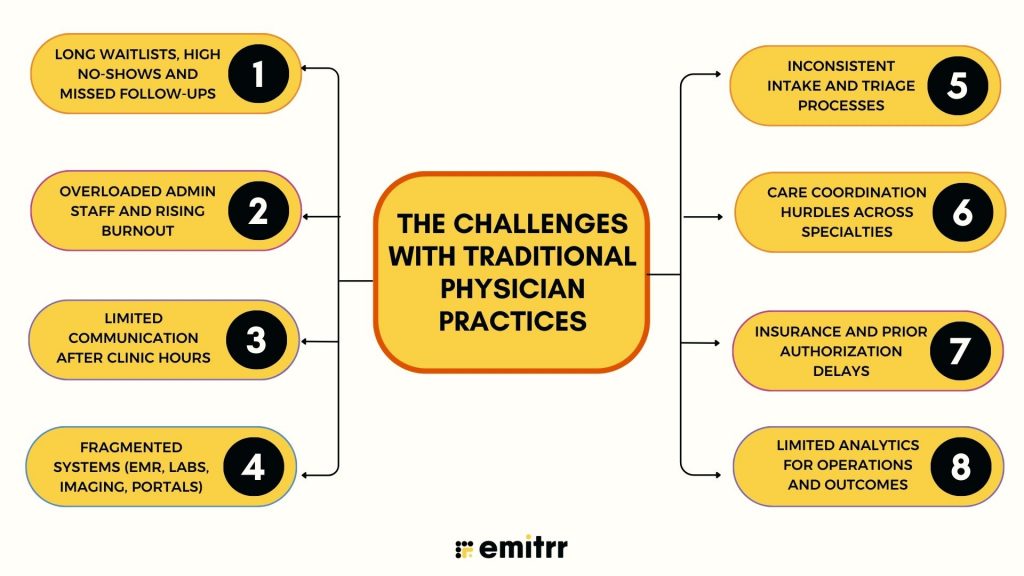
Long waitlists, high no-shows and missed follow-ups
Patients often wait weeks just to see a doctor, frustrating, right? Scheduling is still mostly manual, so last-minute cancellations often leave slots empty. Add no-shows, which can hit 20-30%, and that’s a lot of wasted time and money. Missed follow-ups pile on too, with patients forgetting labs or rechecks without a nudge. Every empty slot is lost care and lost revenue. It’s no wonder calendars feel harder to keep full.
Overloaded admin staff and rising burnout
Front-desk staff juggle nonstop calls, forms, and billing questions. Doctors get stuck in paperwork too, and physician burnout rates keep climbing. When teams are stretched thin, mistakes happen, ever had a message slip through the cracks? High stress often means high turnover, making the cycle worse. Traditional setups rarely leave enough time to finish admin and give patients full attention.
Limited communication after clinic hours
Most offices close at 5 pm, but patient needs don’t stop then. A simple question at 8 pm? Usually it means leaving a voicemail and waiting. Some patients even end up in urgent care when they just needed reassurance. In today’s world of 24/7 service, that feels outdated. Patients notice when they can’t reach you and sometimes they switch to a clinic that’s easier to contact.
Fragmented systems (EMR, labs, imaging, portals)
Data often lives in separate silos — EMR here, lab portal there, scheduling software somewhere else. Staff waste time clicking between systems, re-entering the same info. Ever repeated your medical history three times at the same office? That’s why. Details can get lost, instructions missed, and patients left frustrated. Instead of one smooth flow, it feels like piecing together a puzzle.
Inconsistent intake and triage processes
Every clinic does intake a little differently, which means care isn’t always consistent. Some days you get a quick call back, other days messages pile up. That inconsistency can be risky. What if an urgent case isn’t flagged in time? Paper forms and clunky processes don’t help either. Patients end up unsure if they’ll get timely attention, and staff often scramble with workarounds.
Care coordination hurdles across specialties
Referrals are messy. A primary doctor sends you to a specialist, but almost half the time the info never comes back. Patients become the go-between, repeating details from one doctor to another. That leads to delays, duplicate tests, and sometimes conflicting meds. Closing the loop takes time and effort most practices don’t have. The result? Care that feels fragmented instead of connected.
Insurance and prior authorization delays
Ask any clinic – prior authorizations are dreaded. Teams spend hours each week chasing approvals, holding on phone lines, and filling forms. Patients wait, sometimes give up, or see their care delayed. Even simple eligibility checks can drag on. Doctors often say prior auths are one of the biggest barriers to timely treatment. It’s frustrating for everyone involved.
Limited analytics for operations and outcomes
Many smaller practices run without solid data. Unlike big hospitals, they don’t have dashboards showing no-show rates or patient trends. Decisions get made by gut feel, not facts. For example, you might not realize Monday mornings always have the most cancellations. Or that patients keep calling with the same unanswered questions. Without analytics, it’s like flying blind, you’re moving forward, but not with clear direction.

Benefits of AI Agents in Physician Practices
We’ve talked about the challenges. Now let’s flip it around and see how AI agents in healthcare practices make life easier for doctors, staff, and patients alike.
Shorter wait times, reduced no-shows and automated follow-ups
AI scheduling for physician practices means shorter patient wait times. They aren’t stuck waiting weeks for an appointment. If someone cancels, the AI quickly fills the slot with the next patient in line. No-shows drop too because reminders go out by text, email, or call, and patients can confirm or reschedule with just a quick reply. Follow-ups are easier as well, with nudges like “Don’t forget your blood test” or “Time to book your check-up.” The result? Fuller calendars and patients who actually stay on track with care.
Smarter triage and faster routing of urgent cases
Think of AI triage as a digital nurse that never misses a red flag. Patients answer a few questions, and the AI can tell what’s urgent and what’s routine. A patient with chest pain? Flagged immediately. Someone with a mild rash? Scheduled into the next available slot. Staff save hours chasing messages, and patients feel reassured that their concern is handled quickly. It’s speed and consistency that helps everyone.
Stronger patient engagement between visits
Have you ever left a doctor’s office and felt forgotten until the next appointment? AI-driven patient engagement tools fix that gap. They can check in with a simple “How are you doing?” text or share small care tips between visits. Patients can also text at night and get answers without waiting until morning. These small touchpoints make patients feel supported and more likely to follow their care plan. It builds trust and keeps people connected to the practice.
Better care coordination and closed loops
Referrals don’t have to vanish into thin air anymore. AI agents for healthcare providers can check if patients actually booked with a specialist and follow up for reports afterward. It can also share updates across the care team so everyone’s on the same page. Imagine an AI nudging a specialist’s office for results and sending them straight to the primary doctor. Less chasing, fewer faxes, and smoother care for patients.
Faster prior authorizations and insurance eligibility checks
Prior authorizations can drag on, but AI for physician workflow automation speeds them up. It pulls data, fills forms, and submits them electronically in minutes. It can also check insurance eligibility as soon as a patient books, so there are no last-minute surprises. That means faster approvals, less admin work, and patients getting care on time. No endless hold music, just smoother processes for everyone.
Multilingual access and inclusive communication
Not all patients feel comfortable in English, and you can’t always have staff fluent in every language. AI for doctors and physicians bridges that gap. If a patient texts in Spanish, the AI replies in Spanish. It’s like having a translator available any time of day. For patients, it feels inclusive and personal. For the clinic, it means you can serve more people in your community without extra hires.
Consistent reputation growth with automated reviews
Patients often mean to leave a review but forget. AI for physician-patient communication makes it easy by sending a quick message after every visit: “We’d love your feedback!” Happy patients get nudged to share publicly, while those with concerns get routed privately to staff. Over time, your online ratings grow steadily, giving new patients more confidence to choose your practice. It’s reputation building on autopilot.
Actionable dashboards for continuous improvement
AI virtual assistants for doctors don’t just do the work. They show you how things are going. Dashboards track metrics like no-show rates, call volume, and patient feedback. You might notice Mondays are overloaded or that text reminders cut no-shows by 20%. These insights help you make small tweaks that create big improvements. For many clinics, it’s the first time they’ve had such a clear picture of their operations.
How AI Agents Help in Physician Operations
We’ve covered the “why,” now let’s talk about the “how.” Here’s where AI agents in outpatient care step in to take over the repetitive stuff and make your practice run smoother day-to-day.
24/7 appointment booking and rescheduling
Instead of waiting for office hours, patients can book or change appointments anytime. Midnight? Sunday afternoon? Doesn’t matter. The AI scheduling for physician practices is always on. A patient can text “Need to move my appointment” and get offered new slots instantly. No more lost calls or forgotten callbacks. Receptionists spend less time answering phones and more time helping patients in person. It’s like giving your clinic an always-on scheduler who never gets tired.
Automated reminders for visits, meds, labs, imaging
AI agents take care of reminders so staff don’t have to. Patients get a text like, “You have an appointment with Dr. Smith tomorrow at 3 PM. Reply C to confirm or R to reschedule.” Missed doses or refills? The AI can send a nudge like, “It’s been 30 days since your blood pressure refill. Would you like to request one now?” These little prompts keep patients on track without anyone making dozens of manual calls. The payoff is fewer no-shows and better treatment adherence.
Multichannel engagement (voice, SMS, email, chat)
Everyone has a preferred way to communicate. Some patients love a quick text, others want a phone call, and some still check email. Patient support AI in healthcare practices cover all bases, responding on whichever channel patients use. For example, a teen might confirm by text while their grandparent prefers a call. The best part? Thanks to intelligent automation for medical practices. The AI remembers the context across channels, so a patient can start a chat online and continue by text later. It feels seamless, and nobody’s left waiting.
Smart waitlists and instant fill for cancellations
Cancellations don’t have to mean empty slots. AI can ping patients on the waitlist the moment an opening appears: “We have a 10 AM slot tomorrow. Reply YES if you’d like it.” The first to respond gets it, and the calendar stays full. Patients love the chance to be seen sooner, and clinics avoid losing billable hours. Staff don’t waste time dialing down a list of names, hoping someone picks up. Everyone wins — patients, providers, and the schedule.
Digital intake, e-consent, and pre-visit checklists
Paper clipboards are a thing of the past. AI agents send patients digital forms and consent links before the visit. They can fill them out at home, upload insurance cards, and sign electronically. By the time they show up, everything’s done and in the system. No more rushed handwriting at the front desk or missing forms. Doctors walk in already prepped with complete info, and patients appreciate the smoother check-in.
Insurance eligibility and benefits verification
Instead of staff sitting on hold with insurance companies, the AI can verify coverage automatically. When a patient books, the system checks their plan, co-pay, and deductible status overnight. If something looks off, staff get a heads-up before the visit. That means fewer surprises, smoother billing, and fewer denied claims. Patients also like knowing upfront what to expect financially. It’s one less hassle for everyone.
Review requests and service recovery workflows
After each visit, HIPAA-compliant AI for healthcare providers can send a quick “How was your experience?” message. Happy patients get nudged to leave a public review, while unhappy ones get flagged privately for staff follow-up. This not only builds a steady stream of positive reviews but also helps fix issues before they spiral. It’s like having a smart feedback loop running in the background, keeping your online reputation strong while giving patients a voice.
Patient education micro-lessons and FAQs
AI agents can deliver bite-sized education right to the patient’s phone. For example, someone prescribed an inhaler might get a short video on how to use it correctly. Or a diabetic patient might receive weekly tips about diet and exercise. At the same time, AI for improving patient care in physician practices handles common FAQs like “What’s your address?” or “Do I need to fast for this test?” Patients get answers instantly, and staff don’t repeat themselves all day. It keeps patients informed and saves the clinic time.
Practice analytics, trends, and KPI dashboards
Every interaction the AI handles creates data you can actually use. Dashboards show trends like peak call times, no-show rates, or how many refills were requested. Maybe you discover Fridays have the most appointments or that text reminders cut no-shows by 20%. Insights like these help you adjust and improve without guesswork. It’s like having a bird’s-eye view of your practice, showing exactly where things are working and where they’re not.
Key Features to Look for in AI Agents for Physicians
Thinking about adding an AI agent to your practice? Great. Here’s what actually matters in the real world:
HIPAA compliance, BAA, and PHI encryption
Start here. If the tool touches patient info, it must be HIPAA-compliant, sign a BAA, and encrypt data in transit and at rest. That protects PHI the same way your EHR does. Ask how long they store transcripts and who can see them. Look for audit trails so every access is logged. Bottom line: you should feel 100% safe telling patients their data is locked down.
Robust EMR/PM, lab, imaging, and portal integrations
Integrations turn an AI from “nice chatbot” into a real worker. It should write to your schedule, pull demographics, drop notes/tasks, and fetch lab or imaging updates. That means fewer clicks for your team and no double entry. Ask for a clear list of supported systems and what the integration actually does. The more it plugs into your stack, the more time it saves.
Medical-language models tuned for clinical workflows
You want an AI that “speaks healthcare”. It should recognize drugs, conditions, symptoms in plain language, and common patient phrasing. That reduces silly misunderstandings and unsafe advice. The goal: useful, context-aware answers that fit your clinic workflows. Bonus points if the software uses AI for clinical documentation and charting.
Guardrails, escalation rules, and human-in-the-loop
Safety nets matter. The agent should detect red flags (self-harm, severe symptoms, billing disputes) and route to a human fast. You should be able to set keywords and rules for when to hand off. If the AI isn’t sure, it should say so and escalate, not guess. Clear guardrails keep care safe and patient trust high.
Role-based access, audit logs, and data governance
Not everyone needs to see everything. Role-based access limits who can view transcripts, PHI, and reports. Audit logs let you review exactly what the AI said and who accessed what. You should own your data and be able to export it. Strong governance keeps you compliant and in control.
Reporting dashboards and analytics
If you can’t measure it, you can’t improve it. Look for dashboards that show bookings, no-show rates, response times, common questions, and saved staff hours. You’ll spot patterns fast (e.g., Monday morning cancellations, peak call windows). These insights help you tweak staffing, messages, and workflows. It turns daily interactions into clear, actionable wins.
Flexible pricing and transparent usage metrics
Pick a plan that fits your size and grows with you. Avoid mystery fees and vague “per interaction” bills you can’t track. You should see exactly how many messages, minutes, and bookings you used. Trials or pilots are a plus so you can prove ROI quickly. Value matters more than the lowest sticker price.
Dedicated onboarding, training, and customer support
Great tech still needs great setup. Ask who will configure flows, integrations, and SMS templates with you. Your team should get short, practical training and quick support when something’s off. A responsive account manager beats a generic help center every time. Good onboarding makes adoption smooth and stress-free.
Scalability for solo, group, and multi-location practices
Think beyond today. The platform should handle multiple provider calendars, locations, routing rules, and higher message volumes without slowing down. Check uptime guarantees and how the system scales during Monday morning surges. As you grow, you shouldn’t need to re-platform, just turn the dials up. That’s real future-proofing for your practice.
When to Use Humans Instead of AI in Physician Practices
Well it’s true, the benefits of AI agents for doctors are plenty. But they’re not built to replace the warmth, empathy, and judgement that humans bring to healthcare. Some situations need a personal touch and knowing when to hand things off is key. Here are moments where humans should step in.
Sensitive conversations and shared decision-making
Big, emotional conversations belong to people, not bots. Delivering a tough diagnosis, talking about end-of-life care, or helping a patient weigh treatment options requires empathy and compassion. A doctor can listen, comfort, and understand values in a way AI can’t. AI might prep background info, but for these moments, it should step aside.
First-time visits and relationship building
Trust starts with human connection. On a first visit, patients want to meet their doctor, shake hands, and feel heard. If the first interaction is only with an AI, it can feel cold. AI can collect info or handle patient intake, but the actual relationship building – reading body language, small talk, reassurance, is all about humans.
Escalations, complaints, and service recovery
When something goes wrong, patients want empathy, not canned replies. Whether it’s a billing issue or a long wait, a real person can listen, apologise, and make things right. AI can flag a frustrated patient, but a human needs to de-escalate the situation and rebuild trust.
Chronic or rare disease treatment planning
Complex care isn’t one-size-fits-all. Managing chronic conditions or rare diseases often involves tailoring treatments, adjusting plans, and encouraging patients through setbacks. AI can track data and send reminders, but doctors bring the expertise and emotional support patients rely on over time.
Explaining risks, side effects, or post-care details
Consent and reassurance are human jobs. Patients often ask follow-up questions or need explanations simplified in the moment. A nurse or doctor can rephrase, draw comparisons, and provide comfort that AI simply can’t. Post-procedure check-ins are especially about calming nerves and answering “Is this normal?” questions.
Social needs, mental health, and crisis situations
When patients reveal emotional struggles, social hardships, or crises, it’s time for humans to take over. AI might flag certain words, but only trained professionals can provide real support, resources, and crisis intervention. These situations need compassion and nuanced judgement that only people can deliver.
Real-World Implementations of AI Agents in Physician Practices
AI agents aren’t just buzzwords anymore. They’ve already helped with digital transformation in physician practices in clinics of all sizes. Here are some practical ways physician practices are using AI in outpatient care today.
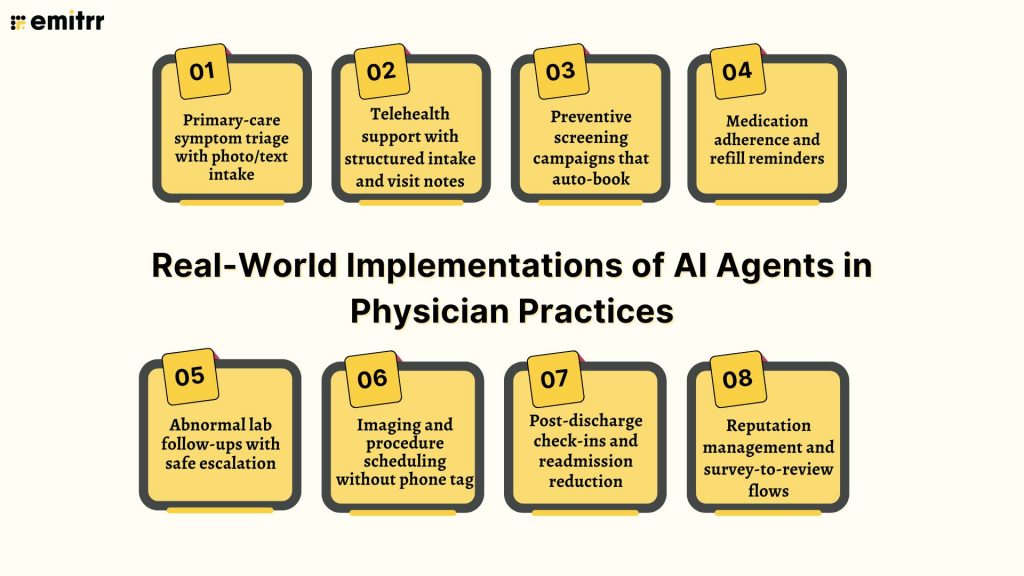
Primary-care symptom triage with photo/text intake
Patients can now describe their symptoms or upload a photo before ever stepping into the clinic. An AI agent asks a few quick questions, sorts the case as urgent or routine, and prepares a summary for the doctor. This saves time and helps catch red flags early. Some practices even resolve minor issues without a visit by guiding patients to self-care or pharmacies. It’s like having a virtual nurse available 24/7 to point people in the right direction.
Telehealth support with structured intake and visit notes
Before a video consult, AI can gather the patient’s history and share a neat summary with the doctor. During the call, AI transcribes and organizes notes in real time, so doctors can focus on the conversation. Afterward, patients get a plain-language recap of instructions. This helps patients remember what was said and keeps doctors from drowning in documentation.
Preventive screening campaigns that auto-book
Instead of mailing letters, AI agents can text patients who are due for screenings. For example: “You’re due for a mammogram. Want to book next week?” Patients reply, and the AI schedules the appointment right away. It’s proactive, simple, and boosts preventive care rates without adding to staff workload. Clinics can even spread out outreach to avoid getting swamped.
Medication adherence and refill reminders
AI agents check in on whether patients are taking their meds as prescribed. If someone misses doses, the system sends tips or alerts staff to follow up. When refills are due, AI can nudge patients to request them with a single tap. Consistent reminders mean better adherence, fewer gaps in treatment, and healthier patients overall.
Abnormal lab follow-ups with safe escalation
AI agents monitor incoming lab results and flag abnormal ones. A patient with high cholesterol might automatically get a message to schedule a follow-up, while critical results are escalated straight to the doctor. This prevents important labs from slipping through the cracks and ensures patients always hear back promptly.
Imaging and procedure scheduling without phone tag
Instead of endless back-and-forth calls, AI can book imaging or procedures directly with patients. As soon as a doctor orders a scan, the patient gets a message with available slots and books instantly. Reminders and prep instructions go out automatically, cutting delays and making sure patients are ready for their appointments.
Post-discharge check-ins and readmission reduction
After a hospital stay or surgery, AI agents check in regularly: “How are you feeling? Any fever or pain?” Patients reply, and if something seems off, staff are alerted right away. This simple follow-up can prevent complications and reduce readmissions. Even when patients are fine, they feel cared for knowing the clinic is watching out for them.
Reputation management and survey-to-review flows
AI makes it easy to gather feedback after each visit. Happy patients get nudged to leave a public review, while unhappy ones are flagged for a personal follow-up. Practices using this approach see steady growth in positive reviews and fewer negatives slipping online. Over time, this builds trust with new patients and keeps current ones feeling valued.
How Does Emitrr Help Physician Practices with an AI Agent?
Emitrr works like a tireless extra team member for your practice – answering calls, scheduling, reminding patients, and even helping with billing tasks. Here’s how it makes life easier:
- HIPAA-compliant messaging: Keeps every call, text, and form secure with strict privacy safeguards.
- 24/7 virtual AI receptionist: Answers calls and chats any time, books appointments, and ensures patients never hit voicemail.
- Online scheduling & rescheduling: Patients can self-book or change appointments instantly through text, chat, or voice.
- Automated reminders: Sends texts, calls, or emails to reduce no-shows, with one-tap confirmations or reschedules.
- Smart waitlists: Fills cancelled slots in minutes by instantly notifying patients who want earlier appointments.
- Digital intake & e-consent: Sends secure links for forms and consents before visits, saving staff time and avoiding paper clutter.
- Automated review requests: Sends timely nudges for positive reviews, boosting your online presence without staff effort.
- Insurance verification & prior auth help: Automatically checks eligibility and preps prior auth forms so care isn’t delayed.
- Broadcast campaigns: Runs bulk messages for recalls, vaccine drives, or promotions, with personalization built-in.
- Two-way texting: Handles routine patient queries and passes on complex ones, keeping communication simple and quick.
- Virtual phone assistant: Answers FAQs in a natural voice and routes calls smoothly to staff when needed.
- Internal team tasks: Creates tasks or notes when patients need follow-up, ensuring staff stay aligned.
- EMR & calendar integration: Syncs directly with over 500+ systems to avoid double-booking and keep data unified.
- Analytics dashboard: Shows real-time numbers on bookings, reminders, reviews, and staff time saved.
- Scalable for any size: Works just as well for solo clinics as it does for multi-location practices.
- Top-rated support: Dedicated onboarding, training, and 5/5-rated customer service whenever you need it.
Future Trends in AI-Powered Physician Practices
The future of AI in healthcare is closer than you think. Here are a few trends already starting to take shape in physician practices:
- Plain-language visit summaries: Generative AI turns clinical notes into simple, friendly summaries with clear next steps and reminders. Patients actually read and follow the plan.
- Wearables + home devices: AI pulls in data from BP cuffs, CGMs, watches, and apps to spot trends and nudge patients (and your team) before problems spike.
- Predictive risk signals: Early warnings for flares, exacerbations, or likely readmissions so you can act proactively, not reactively.
- Patient journey maps & outcomes: Auto-built timelines that show where patients stall (labs, refills, follow-ups) and what steps boost results for each condition.
- Smarter scheduling ops: No-show prediction, auto double-confirm for high-risk slots, and dynamic templates that adapt to demand in real time.
- Agentic care coordination: AI that “takes initiative”, shares notes across specialties, books referrals, tracks reports, and flags conflicts to your team.
- Faster admin writing: Drafts prior-auth letters, patient instructions, and appeal templates in seconds for quick review and send.
Frequently Asked Questions
Emitrr is designed to be simple. A short onboarding shows staff how to monitor, hand off, and adjust settings, and most are comfortable in days.
Yes! Emitrr AI syncs across all sites and providers. It follows rules you set and prevents double-booking.
They’re available 24/7 by text, voice, email, or chat. Patients get reminders, quick answers, and follow-ups without waiting on hold.
Platforms like Emitrr are built with encryption, audit logs, and BAAs. PHI is secure end-to-end, just like with an EHR.
Not at all! Infact, small clinics also see big boosts – fewer missed calls, lower no-shows, and round-the-clock coverage without hiring more staff.
Automated reminders, one-tap rescheduling, and smart waitlists to fill last-minute cancellations keep your schedule full!
Conclusion
AI agents are already proving themselves in physician practices by handling the everyday grind so staff can breathe easier and patients feel more supported. They cut no-shows, smooth out scheduling, keep patients engaged, and even chase down labs or reviews without needing human effort!
Having said that, the real magic is balance. Doctors and staff keep the personal, human side of care, while AI takes care of the repetitive tasks that used to drain time and energy. The result? Happier patients, less burnout for your team, and a practice that runs more efficiently every day.
This isn’t about replacing people. It’s about making the human side of medicine stronger. If you’re curious to see just how seamless it can be, book a demo with Emitrr AI today and experience how easy it is to get started!


 4.9 (400+
reviews)
4.9 (400+
reviews)