
Introduction
The consulting industry is evolving rapidly, yet firms still face persistent challenges, managing high client expectations, responding quickly to queries, scaling communication across multiple accounts, and making sense of large volumes of data to offer strategic insights.
These pressures can lead to inefficiencies, missed opportunities, and slower decision-making.
This is where Artificial Intelligence (AI) is becoming a game-changer.
AI is transforming consulting by streamlining repetitive tasks, automating client communication, analyzing data at scale, and offering real-time actionable insights. Rather than replacing human consultants, AI complements their expertise, allowing teams to focus on high-value strategy, relationship building, and problem-solving.
The result? – More efficient workflows, smarter recommendations, and a significantly improved client experience.
Industry Challenges in Consulting Communication
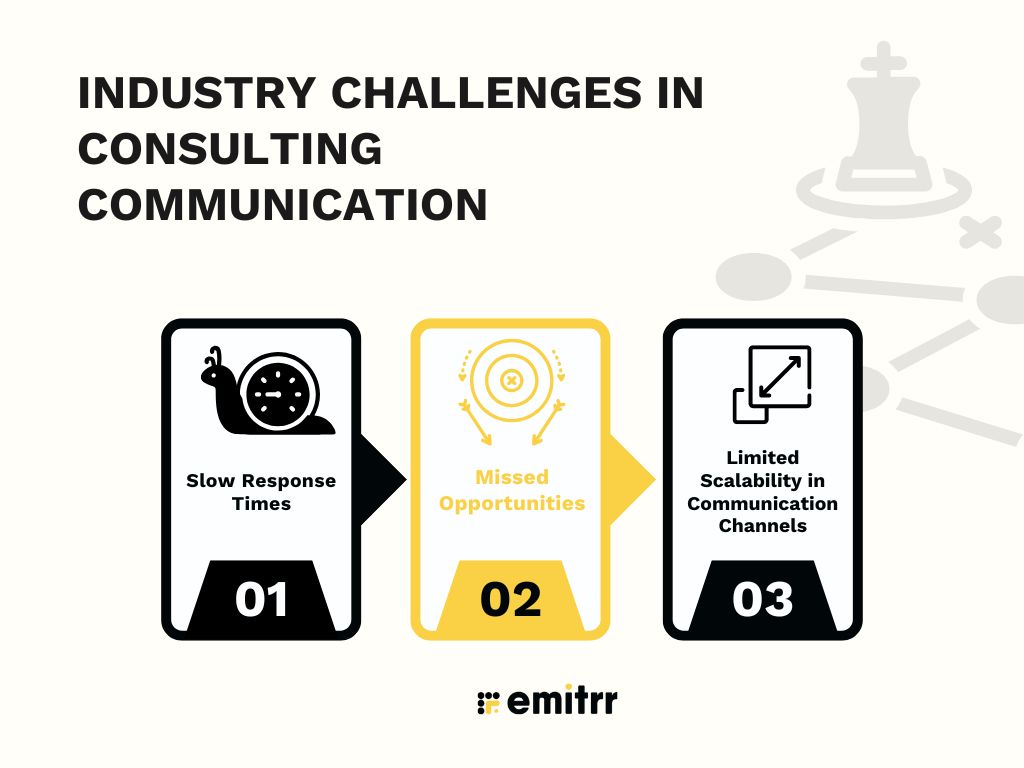
In the fast-paced and competitive consulting world, communication plays a vital role in maintaining client relationships. However, there are several pain points that consultants face when trying to communicate with clients:
Slow Response Times
- In a traditional consulting setup, consultants often rely on manual methods to respond to client queries, emails, phone calls, or in-person meetings. These methods can lead to delayed responses, which frustrate clients and potentially cause missed opportunities.
- Time-sensitive inquiries, such as project updates, changes in deadlines, or urgent client requests, can get delayed, leading to dissatisfaction and potentially harming the reputation of the consultancy.
Missed Opportunities
- Consultants may miss critical follow-ups or opportunities due to the reliance on manual communication. For instance, manually tracking client responses or scheduling meetings can lead to missed calls, overlooked opportunities, or miscommunication.
- This can affect the ability of a consultant to act on real-time feedback, adjust strategies quickly, or provide value-added insights promptly.
Limited Scalability in Communication Channels
- As consulting businesses grow, managing communication with an increasing number of clients can become more complex and time-consuming. Traditional communication tools struggle to scale effectively.
- Manual systems cannot handle large volumes of inquiries or track client communication history seamlessly, which reduces overall efficiency.
Current Approaches and Their Limitations
While traditional methods of communication (manual calls, emails, and scheduling) have been the backbone of consulting for years, they often fall short in addressing modern business needs:
- Manual Calls
- Manual calls are time-consuming and can only handle a limited number of clients at a time. As client needs increase, consultants face difficulties managing the volume of calls required.
- In many cases, the availability of consultants to make calls or answer them is limited by their schedule, resulting in missed opportunities to connect with clients.
- Manual calls are time-consuming and can only handle a limited number of clients at a time. As client needs increase, consultants face difficulties managing the volume of calls required.
- Emails
- Although email is an essential tool, it comes with several limitations. First, emails may not always receive a prompt reply, especially for clients who are busy or prefer real-time communication.
- Additionally, the reliance on emails can lead to important information getting lost in a cluttered inbox, delaying decision-making or follow-ups.
- Although email is an essential tool, it comes with several limitations. First, emails may not always receive a prompt reply, especially for clients who are busy or prefer real-time communication.
- Scheduling Challenges
- Traditional scheduling methods often involve back-and-forth emails or phone calls to find a suitable time for meetings. This can be frustrating for both clients and consultants, resulting in wasted time and inefficient use of resources.
- For consulting businesses handling a large number of clients, manual scheduling becomes increasingly difficult to manage effectively, leading to potential scheduling conflicts, forgotten meetings, or missed appointments.
- Traditional scheduling methods often involve back-and-forth emails or phone calls to find a suitable time for meetings. This can be frustrating for both clients and consultants, resulting in wasted time and inefficient use of resources.
- Lack of Personalization
- Many traditional communication methods lack personalization at scale. A client may receive generic emails or calls, which do not take into account their unique history, preferences, or previous interactions.
- Personalized communication, which is crucial for building strong client relationships, is often neglected due to the time constraints and manual effort involved in tailoring each interaction.
- Many traditional communication methods lack personalization at scale. A client may receive generic emails or calls, which do not take into account their unique history, preferences, or previous interactions.

How AI Enhances Communication: Texting and Calling
The communication challenges consultants face—slow responses, scheduling conflicts, limited personalization—can be significantly reduced with the strategic use of AI.
AI-powered chatbots, virtual assistants, and automated calling/texting systems provide faster response times, improved accuracy, and 24/7 availability. These tools can handle FAQs, automate follow-ups, book appointments, and analyze sentiment using Natural Language Processing (NLP), creating more intelligent and responsive client interactions.
AI’s Impact on Consultant-Client Interactions
- Efficiency: By reducing the time spent on routine communication tasks, AI enables consultants to focus on high-value, strategic work.
- Personalization: AI systems use historical data and interaction patterns to customize messages and recommendations for each client.
- Accessibility: AI tools are always available, ensuring clients can receive assistance or updates anytime, regardless of time zones or working hours.
What is AI in Consulting?
AI in consulting refers to integrating machine learning, NLP, automation, and predictive analytics to improve business decision-making, client engagement, and operational efficiency. Consulting firms leverage AI to analyze market trends, optimize workflows, and enhance client communication.
Key applications of AI in consulting include:
- Data-Driven Decision-Making: AI-driven insights help consultants make more informed strategic recommendations.
- Automated Client Interaction: AI chatbots and virtual assistants handle FAQs, schedule meetings, and streamline onboarding.
- Predictive Analytics for Market Insights: AI identifies trends and provides forecasts based on historical data.
- AI-Powered Communication: AI automates messaging, emails, and calls, ensuring seamless consultant-client interactions.
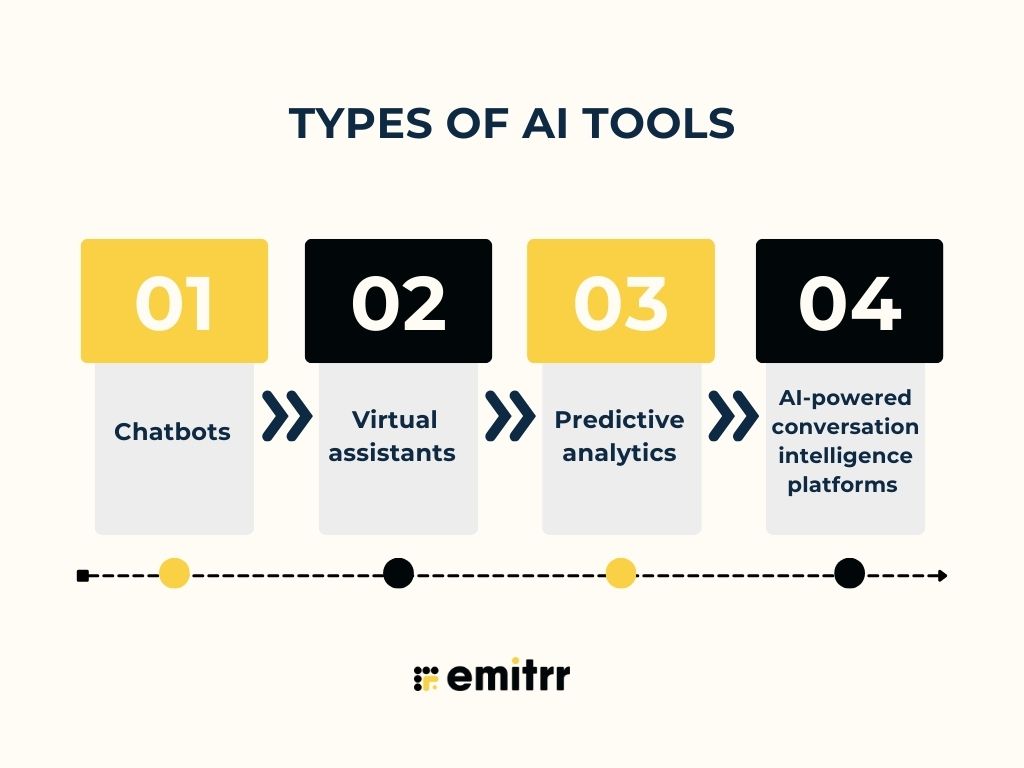
Types of AI tools
Chatbots
AI-powered chatbots enhance communication by handling inquiries, scheduling meetings, and resolving common client concerns instantly.
Advanced chatbots like Emitrr, Drift, and Intercom leverage Natural Language Processing (NLP), enabling AI to understand and respond to human language, to provide human-like responses. Emitrr also provides powerful CRM integrations and automated follow-up workflows, allowing consultants to maintain seamless client relationships.
Example: A consulting firm uses Emitrr’s AI chatbot to automate appointment scheduling and client onboarding, reducing manual workload.
Virtual assistants
Virtual assistants like Google Assistant, Siri, and Amazon Alexa help consultants manage their schedules, set reminders, and retrieve key client data using voice commands. These tools reduce administrative burdens and improve efficiency.
Example: A business consultant uses Google Assistant to pull up previous meeting notes before a client call.
Predictive analytics
AI-driven analytics tools like IBM Watson Analytics, Salesforce Einstein, and Microsoft Azure AI help consulting firms analyze industry trends, predict client needs, and create data-backed strategies.
Example: A consulting firm uses Salesforce Einstein to analyze customer data and provide tailored recommendations for financial planning.
AI-powered conversation intelligence platforms
AI-driven conversation intelligence platforms analyze call and text transcripts to extract insights, detect client sentiment, and improve communication strategies. Also, many AI-powered conversation intelligence platforms have the ability to create summaries of client conversations, allowing consultants to quickly review important details.
Example: A consulting firm integrates Gong.io to analyze sales calls and improve pitch strategies based on AI-generated insights.
How These AI Tools Address Consulting Challenges
- Time-consuming manual client communication → AI chatbots for automated responses
- Inefficient scheduling → AI-powered virtual assistants
- Difficulty in tracking client preferences → AI-driven CRM integration
- Lack of predictive insights → AI-powered analytics
- Understanding client sentiment → Conversation intelligence platforms
Data Security Considerations
These AI systems also utilize robust security measures, including encryption and secure data storage, to ensure client information remains confidential.
AI-powered texting, calling, and analytics tools help firms enhance efficiency, personalization, and scalability in client communication. AI is no longer a futuristic concept in consulting—it’s a strategic necessity.
AI-Based Communication vs Traditional Methods
AI-driven communication is transforming client interactions through increased responsiveness, automation of repetitive tasks, and individualized engagement. This is how it is different from conventional ways:
AI-powered chatbots for instant responses and automated client support
- Traditional Methods: Client support depends on human agents to respond to queries in work hours, resulting in possible delays.
- AI-Based Methods: AI chatbots use Natural Language Processing (NLP) to interpret and answer client questions in real-time, 24/7. In contrast to rule-based chatbots that need precise query matching, AI chatbots understand different phrasings and give correct answers.
Benefit: Businesses have reported up to an 80% reduction in customer support response times after implementing AI chatbots, significantly enhancing customer satisfaction and operational efficiency
AI-driven voice assistants for seamless scheduling and follow-ups
- Traditional Methods: Scheduling meetings and follow-ups typically involve back-and-forth communication, consuming valuable time.
- AI-Based Methods: Voice-based assistants such as Siri and Google Assistant can automatically schedule tasks, remind, and handle follow-ups using voice instructions, minimizing manual coordination.
Benefit: Companies utilizing AI tools have experienced a 45% reduction in call handling times, streamlining administrative tasks, and allowing consultants to focus more on strategic activities
Personalized AI-driven communication vs. traditional manual methods
- Traditional Methods: Personalization uses manual data analysis and segmentation that may take considerable time and result in human error.
- AI-Based Methods: AI applications scan client information to provide personal messages and product recommendations in real-time. Such machine-based analysis enables dynamic personalization based on individual client activities and inclinations.
Benefit: Businesses implementing AI-driven personalization have seen a 15% increase in customer retention, highlighting the effectiveness of tailored communication strategies.
Real-world use cases of AI-enhanced communication
- Healthcare Sector: AI-driven scheduling tools manage patient appointments and follow-ups efficiently, reducing administrative overhead and improving patient satisfaction.
- Consulting Firms: AI-powered analytics provide more profound insights compared to traditional data analysis methods, enabling consultants to deliver more accurate and strategic recommendations to clients.
Benefit: The integration of AI in customer service has led to a 35% reduction in operational costs and a 30% increase in customer satisfaction, demonstrating AI’s versatility in enhancing communication across various industries
By integrating AI into communication strategies, organizations can overcome the limitations of traditional methods, resulting in more efficient, responsive, and personalized client interactions.
Key Benefits of AI in Consulting Communication
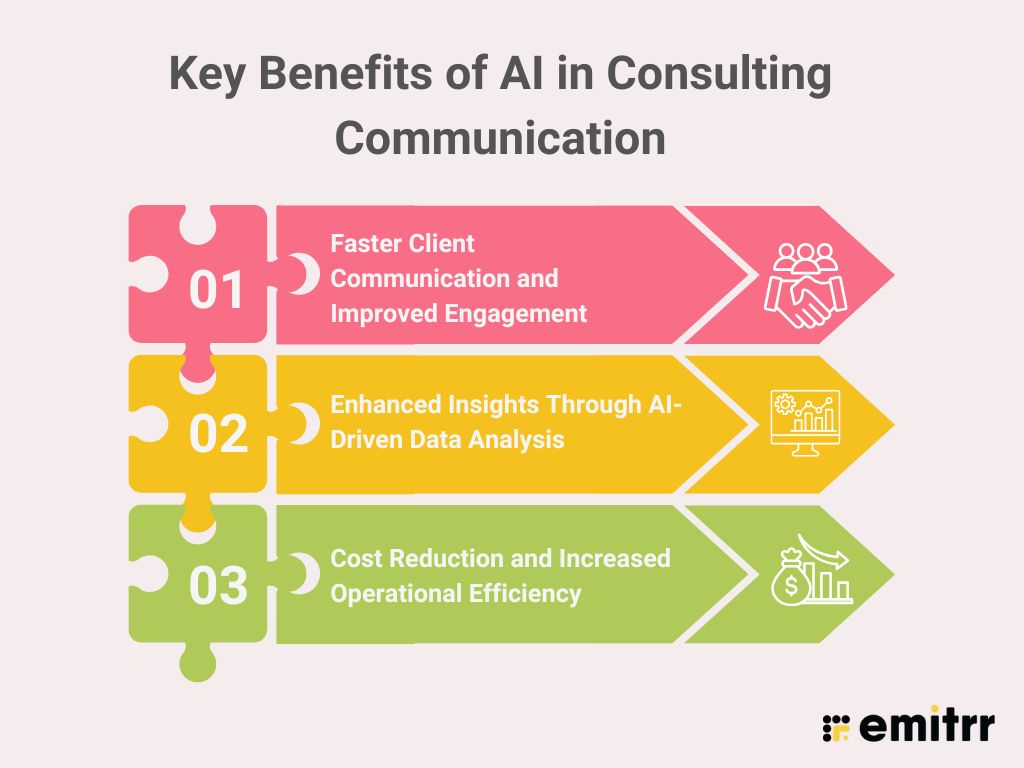
Faster Client Communication and Improved Engagement
- Chatbots and virtual assistants powered by AI facilitate immediate responses to client questions, providing constant availability. This translates into enhanced engagement, faster response time, and an improved client experience.
- Quick client communication and enhanced engagement result in higher client satisfaction and better client relationships.
Enhanced Insights Through AI-Driven Data Analysis
- AI tools scan conversations and interactions to reveal trends, inclinations, and pain points. These are used by consultants to make their approach more personalized, anticipate client expectations, and make strategic decisions based on knowledge.
Cost Reduction and Increased Operational Efficiency
- Through automated processes of mundane tasks like appointment scheduling, query management, and follow-ups, AI minimizes manual labor. This enables consulting teams to concentrate on strategic activities and boosts overall productivity, cutting down operational expense.
- The AI systems also enable consulting firms to quickly scale their communication with clients, without having to quickly scale their people.
Where Human Expertise Remains Indispensable
While artificial intelligence (AI) has transformed various aspects of business operations, certain domains continue to rely heavily on human expertise. Areas such as trust-building, complex problem-solving, and emotional intelligence in negotiations are irreplaceable by AI.
Trust-building and long-term client relationships
- Human Connection: Establishing and maintaining trust is fundamental in client-consultant relationships. Clients seek advisors who demonstrate integrity, competence, and genuine concern for their interests. Human qualities like empathy, authenticity, and vulnerability are crucial in building this trust.
- Personalized Engagement: For instance, being authentic and sharing relevant personal experiences fosters genuine connections with clients, which is essential for long-term partnerships. Consultants that take the time to deeply understand a client’s business, and personal goals, build stronger relationships.
- Beyond Data: Trust is not built through data points, but through consistent, reliable, and empathetic interaction.
Benefit: These human interactions foster loyalty and long-term relationships, which are the cornerstones of successful consulting practices.
Complex problem-solving requires human intuition and strategic thinking
- Nuanced Understanding: Complex business challenges often demand nuanced understanding and strategic foresight that extend beyond data analysis. Human intuition plays a critical role in navigating ambiguous situations where data may be incomplete or inconclusive.
- Strategic Foresight: Strategic thinking involves not only analyzing current scenarios but also anticipating future implications and crafting innovative solutions. This requires human creativity and the ability to connect seemingly disparate pieces of information.
- Human Judgment: Consultants are often called upon to make decisions where there are no clear, data-driven answers.
Benefit: Human expertise allows for the creation of innovative, adaptable, and ethically sound solutions that AI cannot replicate.
Emotional intelligence in negotiations and high-stakes decision-making
- Emotional Acumen: Negotiations and high-stakes decisions are inherently human-centric processes, where understanding and managing emotions are pivotal. Emotional intelligence enables individuals to remain composed, empathetic, and responsive during negotiations.
- Active Listening and Empathy: Recognizing one’s emotional triggers and practicing active listening can lead to more favorable outcomes. For example, staying calm under pressure and managing feelings effectively sets a positive tone, leading to smoother and more productive discussions.
- Reading Between the Lines: Human consultants can pick up on subtle emotional cues that AI might miss, allowing them to adjust their approach accordingly.
Benefit: Human emotional intelligence leads to stronger client relationships and better negotiated outcomes.
While AI enhances efficiency in many areas, the human elements of trust-building, intuitive problem-solving, and emotional intelligence remain indispensable in professional settings, particularly in consulting. The human element is what makes a consultant a trusted advisor, not just a data provider.
Why Your Consulting Business Needs AI-Powered Communication
24/7 availability with AI chatbots and virtual assistants.
AI-powered communication tools such as chatbots and virtual assistants ensure your consulting firm remains accessible to clients around the clock. These tools can handle routine queries, book appointments, and collect client data without human intervention — freeing up consultants for more strategic tasks.
- Fact: According to Salesforce, 64% of customers expect real-time responses, and AI chatbots are key to meeting this expectation.
- Example: Emitrr provides AI chatbots that engage with clients after business hours, increasing accessibility and reducing lead loss.
- Benefit: Delivers continuous support, improves client satisfaction, and ensures no potential client goes unheard.
Improved client experience through faster query resolution.
Clients value fast and consistent communication. AI tools powered by Natural Language Processing (NLP) significantly reduce response time while maintaining the accuracy and tone required in professional communication.
- Fact: IBM reports that AI chatbots can resolve up to 80% of routine customer queries without human involvement.
- Example: A consulting firm using AI chatbots can handle frequently asked questions instantly, helping clients feel supported and understood at all times.
- Benefit: Increases client satisfaction and loyalty while lowering response time and operational load.
AI-powered insights for strategic planning and decision-making.
Beyond communication, AI tools analyze interaction data to deliver actionable insights. These insights help consultants better understand client needs, forecast trends, and personalize service offerings.
- Fact: According to McKinsey, data-driven organizations are 23 times more likely to acquire customers and 19 times more likely to be profitable.
- Example: Salesforce and Gong.io analyze customer interactions to identify engagement gaps, improve messaging, and forecast future client behavior.
- Benefit: Enables strategic, data-backed decisions that improve retention and drive business growth.
How Different Consulting Teams Benefit from AI
Artificial Intelligence (AI) is transforming many aspects of consulting, improving efficiency and effectiveness in many teams. This is how various consulting divisions can use AI
1. Sales & Business Development:
AI-Generated Leads and Automated Follow-Ups:
AI tools can automate the identification of high-quality prospects and streamline follow-up processes, allowing sales teams to focus on closing deals.
- Lead Generation: AI platforms scan large sets of data to detect potential customers who display behaviors that signal interest. For example, IBM emphasizes that AI can effectively locate and qualify leads, speeding up the sales pipeline.
- Automated Outreach: Some company tools make multichannel campaigns easier, automating follow-ups and outreach, so prospects are engaged consistently.
- Example: A consulting firm uses AI-powered lead generation tools to identify companies that have just received funding and are scaling. They then use AI-powered outreach tools to automate the first contact.
Benefit: Improved lead quality and optimized sales process with higher conversion rates.
2. Client Support:
AI Chatbots for Real-Time Assistance:
Adopting AI chatbots in client support allows instantaneous, 24/7 resolution of queries with improved client satisfaction and lower response times.
- Immediate Responses: Chatbots powered by AI give instant responses to frequent client inquiries, cutting down on wait times and improving the overall client experience. Few chatbots are capable of offering human-like dialogues, releasing human agents for more complicated tasks.
- Proactive Engagement: Few platforms provide proactive support, solving possible issues before escalation, making clients feel appreciated and cared for.
Benefit: Enhanced client satisfaction through prompt and consistent service, freeing human agents to address more intricate issues.
3. Market Research & Strategy
AI-Driven Data Analysis for Client Trends:
AI augments market research by analyzing large volumes of data to reveal trends and insights, guiding strategic decisions.
- Trend Identification: AI software can scan market information to detect patterns that are emerging, giving consultants useful insights into client strategy.
- Competitive Analysis: AI allows quick competitor analysis, which helps consultants compare client performance against industry benchmarks.
- Example: A consulting firm employs AI to track social media, industry reports, and financial news, to produce in-depth market analysis reports for clients
Benefit: More accurate and timely market insights, resulting in strategic planning and a competitive advantage.
4. HR & Operations
AI in Recruitment and Internal Communication:
AI automates HR functions, from talent acquisition to employee communications, increasing operational effectiveness.
- Recruitment: AI helps screen resumes, select candidates that match the job best, and even forecast candidate success.
- Internal Communications: AI-based platforms can scan employee sentiment from internal surveys and communications channels, detecting issues and opportunities for morale improvement.
- Example: An AI solution helps a consulting firm analyze employee complaints and find potential avenues for improving company culture
Benefit: More effective HR operations and enhanced employee morale, resulting in greater retention and more unified workplace environment.
It is also worth noting that all of these AI systems employ state-of-the-art data encryption, and security protocols, to keep all client, and employee data, private and secure
Common Concerns About AI
1. Will AI replace human consultants?
This is one of the most frequent concerns. The reality is that while AI can automate repetitive, data-heavy tasks, it cannot replace core consulting functions such as strategic thinking, decision-making in ambiguity, relationship management, and ethical judgment. AI is best viewed as a collaborative tool that enhances human productivity rather than replacing it.
Fact: A study by PwC found that while AI may automate certain tasks, it will augment 38% of jobs in the professional services sector by 2030.
2. The role of AI as a collaborative tool.
AI tools are designed to support consultants by handling tasks such as lead generation, data processing, and follow-ups. This allows professionals to focus more on high-value activities like strategic planning and client interaction.
Consultants who adopt AI as a productivity partner, rather than a threat, can significantly improve their effectiveness.
3. Security concerns: AI compliance with GDPR, HIPAA, and encryption.
AI systems that handle sensitive client information must comply with data protection laws such as GDPR, HIPAA, or CCPA. Leading AI vendors build platforms with strong encryption, secure access protocols, and transparent data practices.
Choosing AI tools that are built with compliance in mind is crucial to maintaining client trust.
4. AI’s accuracy and the need for human oversight.
While AI can analyze data and make recommendations quickly, it is still prone to bias or errors if not properly trained or supervised. Human review is essential to validate outputs and ensure alignment with client goals and context. In consulting, final decision-making should remain human-led, with AI serving as a decision support system.
AI should not be seen as a replacement but as a tool that empowers consultants to deliver faster, smarter, and more personalized services. When used responsibly—with compliance, transparency, and oversight—it can significantly enhance the capabilities of a modern consulting practice.
Use Cases of AI-Powered Communication for Consultants
Merging AI-powered tools in consulting practices can enhance efficiency and client interaction dramatically. Following are primary areas where AI can be leveraged optimally:
1. AI-Powered Calling and Texting for Consultants
- Automated Follow-Ups Based on Chatbot Interactions: AI-based platforms can schedule and send automated follow-up messages following client interactions to ensure timely communication and maintain client relationships.
- AI-Generated Reminders for Meetings: AI-enabled tools can set reminders for meetings automatically, making it easier for consultants to manage their schedules and avoid missing appointments.
- AI-Powered Text Messaging for Quick Client Updates: AI-based text messaging software allows consultants to send timely and useful updates to clients, enhancing communication effectiveness.
2. AI-Driven Analysis of Call Transcripts for Key Insights
- Conversation Intelligence Platforms: AI-driven conversation intelligence platforms can record and analyze phone calls and offer insights into client emotions, topics of frequent discussion, and areas of focus..
- Enhanced Training and Performance: By going through AI-based analyses, consulting teams are able to detect best practices and areas of improvement, resulting in more efficient client interactions.
- Sentiment and Keyword Extraction: The platforms also have sentiment analysis that enables consultants to measure client moods and shape their communication according to it and keyword extraction so that they may find key issues in a speedy manner
3. AI in Proposal Drafting and Contract Negotiations
- AI-Assisted Contract Management: AI-based contract management software may pull out relevant information from supplier contracts and agreements, making contract review easier and saving time involved in contract analysis.
- Proposal Generation: Artificial intelligence software can be used to draft proposals by studying client information and successful proposals in the past, guaranteeing consistency and applicability in new documents.
- Personalized Proposals: AI tools can also generate tailored proposals, by employing client information and information from past successful proposals, to provide the greatest probability of success. AI can also retrieve key information points from previous successful proposals, so consultants can quickly develop new proposals
4. Consulting Tool Integrations with AI
- CRM Enhancements: Linking AI with Customer Relationship Management (CRM) tools can automate the entry of data, deliver predictive analysis, and offer insights into client behavior, enabling more customized delivery of services.
- Workflow Automation: AI can integrate diverse consulting tools and automate mundane functions like scheduling, synchronizing data, and generating reports, thus improving overall operational effectiveness.
By adopting these AI-powered solutions, consulting firms can streamline operations, enhance client interactions, and maintain a competitive edge in the industry.
Human vs. AI Operational Output Comparison
| Feature | Human Consultant | AI System |
| Response Time | Varies based on workload; typically hours to a day for follow-ups | Instant or within seconds for standard queries |
| Scalability | Limited by team size and working hours | Highly scalable; can handle thousands of interactions simultaneously |
| Personalization | Deeply personalized with emotional context and experience | Data-driven personalization based on behavior, preferences, and patterns |
| Data Analysis Speed | Slower; requires manual effort and review | Rapid; can analyze large datasets in real-time |
| Availability | Limited to business hours or scheduled engagements | 24/7 availability through chatbots and virtual assistants |
How to Implement AI in Your Consulting Business
1. Assess current communication workflows and identify gaps.
Start by mapping out how your team currently interacts with clients—identify areas where delays, inefficiencies, or repetitive tasks occur. This helps you pinpoint where AI can make the most impact.
2. Select AI-powered communication tools (e.g., Emitrr).
Select communication tools that align with your goals—such as AI chatbots for customer support, voice assistants for scheduling, or platforms like Emitrr for automated messaging and follow-ups.
3. Train teams to work alongside AI solutions.
Introduce AI as a collaborative partner, not a replacement. Train your team to effectively use AI tools, interpret AI-generated insights, and step in where human judgment is required.
4. Monitor AI-driven performance and optimize processes.
Track key performance metrics—such as response times, client satisfaction, or reduced workload—and refine your workflows based on AI-driven results and feedback.
5. Ensure compliance with security and data protection standards.
Ensure that any AI solution you adopt complies with relevant data protection regulations (e.g., GDPR, HIPAA). Secure client data with encryption, role-based access, and regular audits.
Why Emitrr is the Ideal AI Communication Platform for Consultants
Emitrr is purpose-built for consulting firms seeking to streamline client communication, automate operations, and scale without compromising on personalization. Here’s how it delivers measurable value:
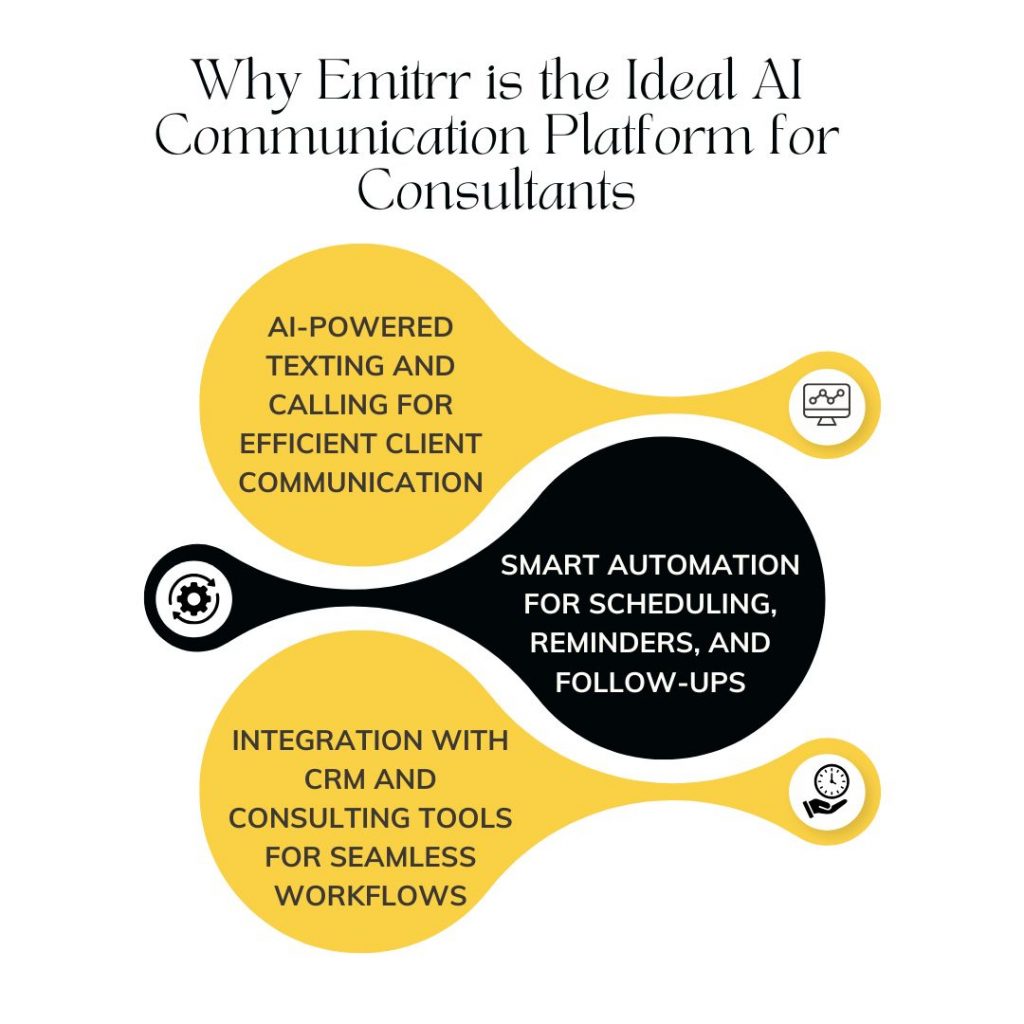
AI-Powered Texting and Calling for Efficient Client Communication
Emitrr automates routine client interactions such as appointment confirmations, inquiry handling, and follow-ups—freeing up your consultants to focus on high-value advisory work.
- Respond instantly to client queries
- Send automated texts and calls, reducing manual outreach
- Maintain a professional presence, even after hours
Smart Automation for Scheduling, Reminders, and Follow-Ups
Never miss a touchpoint. Emitrr intelligently manages the client journey through:
- Automated appointment scheduling and confirmations
- Timely, personalized reminder messages
- Behavior-based follow-up triggers to re-engage leads or clients
Integration with CRM and Consulting Tools for Seamless Workflows
Emitrr connects seamlessly with popular CRM platforms like Salesforce and HubSpot, ensuring all your client data and conversations live in one place.
- Real-time syncing of communication history
- No more data silos—enable consistent, informed engagement
- Streamlined workflows across your entire consulting stack
Key Emitrr Features Beneficial for Consulting Firms
Emitrr isn’t just automation—it’s designed to grow with your firm
- AI-Generated Follow-Up Recommendations
- Multi-Channel Messaging: SMS, phone, and email—managed from one dashboard
- Custom Templates: Ensure consistency while saving time
- Real-Time Analytics: Track engagement, measure performance, and optimize
- Enterprise Scalability: Handle hundreds of clients effortlessly
Emitrr transforms client communication into a competitive advantage, making your consulting firm faster, smarter, and more responsive without the need for additional headcount.
The Future of AI in the Consulting Industry
AI-driven predictive consulting for proactive decision-making.
As AI evolves, consulting firms will shift from reactive solutions to proactive, data-driven recommendations. Predictive analytics can identify patterns and forecast client challenges before they occur, helping consultants offer smarter, faster decisions backed by real-time data modeling and trend analysis.
AI-human collaboration for more strategic advisory roles.
Rather than replacing consultants, AI will augment their capabilities. Routine tasks like data collection, reporting, and first-level client interactions will be handled by AI, freeing consultants to focus on complex strategic thinking, innovation, and relationship management. This hybrid model enhances both productivity and value delivery.
For example, AI can analyze vast amounts of market data to identify potential risks and opportunities, while human consultants use their strategic thinking and relationship-building skills to develop and implement tailored solutions for clients.
Ethical considerations in AI adoption.
As AI adoption grows, firms must address ethical concerns around data privacy, transparency, and bias in algorithmic decisions. Responsible AI use involves aligning technology with compliance standards (like GDPR or HIPAA) and maintaining clear boundaries between automation and human judgment
AI as an enabler, not a replacement.
AI will be a powerful enabler, streamlining operations, improving decision-making, and enhancing client engagement. But the human touch will remain irreplaceable in areas like trust-building, critical thinking, and navigating emotionally nuanced situations.
Frequently Asked Questions
AI is designed to enhance, not replace, human consultants. While it automates repetitive tasks and offers data-driven insights, human expertise is still essential for strategic thinking, complex problem-solving, and relationship-building.
Leading AI communication tools comply with major data protection standards like GDPR, HIPAA, and use encryption protocols to ensure data privacy and security. However, firms need to vet tools for compliance and maintain oversight.
Tools like Emitrr (for automated client communication) are popular for AI-enhanced communication, analytics, and automation. The best tool depends on your firm’s size, needs, and existing tech stack
AI improves responsiveness, offers real-time support, and enables personalized communication by analyzing client interactions. It ensures no query goes unanswered, even outside business hours, enhancing the client experience significantly.
AI tools help smaller firms reduce manual workload, improve efficiency, and scale operations without increasing headcount. Many platforms offer flexible pricing, making AI adoption accessible even for boutique firms.
Conclusion
As consulting firms are subjected to mounting pressures for speed, customization, and productivity, AI-driven communication has emerged as a strategic imperative. From streamlining follow-ups to optimizing client engagement and providing data-driven recommendations, AI enables consultants to do more, more accurately, and with less human effort.
Emitrr is a robust AI-powered communications platform aimed at streamlining client contact, automating boring work, and blending smoothly with your consulting practices. Regardless of whether you are a person consulting firm or a large business, Emitrr helps you grow without burning your fingers, so your clients have a great experience, they know you’re all about.
Ready to modernize your communication? Explore how Emitrr’s AI can transform your consulting practice today.

 4.9 (400+
reviews)
4.9 (400+
reviews)