
 4.9 (400+
reviews)
4.9 (400+
reviews)
Like any other sector, even healthcare is changing. FAST. So now, AI for medical device companies is no longer just a fancy tech term. It’s helping these businesses build better products, save time, cut down on manual work, and offer better care for patients.
A recent report from MarketsandMarkets says AI in healthcare could grow to over $110 billion by 2030.
Where will that growth come from? The AI medical device world. All thanks to tools like predictive analytics, real-time monitoring, and smarter ways to diagnose and treat patients.
But wait, it’s not just about making medical devices. AI is also helping with day-to-day business tasks like automating messages to customers, improving sales planning, and staying on top of compliance.
And the good news is, even smaller, local companies can now tap into this technology. AI isn’t just for the big players anymore.
In this blog, let’s look at how AI is changing things for medical device companies, where it’s making the biggest impact, and why it might be the right time for your business to get on board.
Let’s break it down.
Understanding AI in Medical Device Companies
Before we talk about how AI is helping medical device companies, let’s quickly go over what AI actually means here.
In simple words, AI (Artificial Intelligence) is when computers or machines can “think” a little like humans. They learn from data, spot patterns, make guesses or predictions, and help make decisions
For medical device companies, AI isn’t just about machines taking over. It is about smart technology that helps to make better devices and improve how things work.
Some main types of AI being used in this space:
- Machine Learning (ML): This is the most common type of AI. It helps devices get smarter over time by learning from data. For example, a wearable device that tracks heart rate can spot trends and give better insights the more it’s used.
- Computer Vision: This helps machines “see” and understand images, like X-rays or MRIs. It’s used in imaging tools and even during surgeries to help doctors make quicker, more accurate decisions.
- Natural Language Processing (NLP): NLP allows AI to understand and respond to human language. It’s what powers tools like chatbots or systems that can read medical notes. Emitrr uses this to make patient communication faster and easier.
- Predictive Analytics: Basically, with the right data, AI can predict when a machine might need maintenance, spot high-risk patients early, or even help with market planning.
Benefits of AI for medical device companies
AI is becoming a real game-changer for medical device companies. Surgery, device manufacturing, or even in customer service, AI is helping companies work faster, smarter, and offer better care.
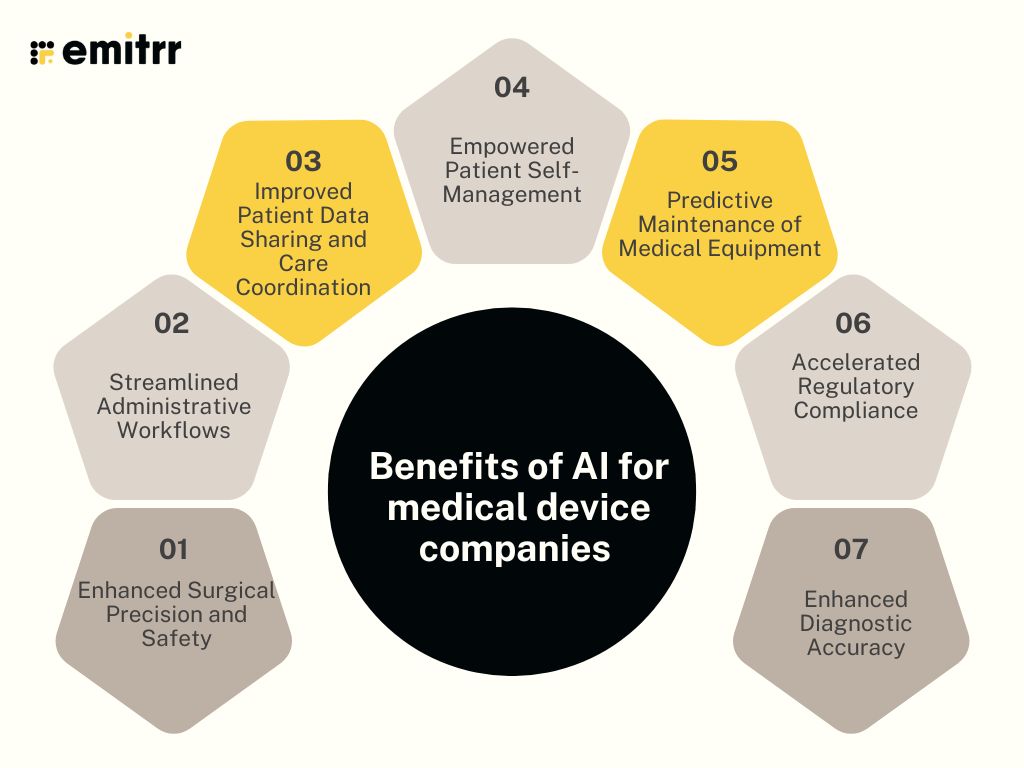
Here are some of the biggest ways AI is making a difference:
Enhanced Surgical Precision and Safety
AI tools like robotic surgery systems and real-time imaging help doctors make more precise movements during surgery. These tools give instant feedback, help plan better cuts, and reduce the chances of mistakes.
Research shows surgeries done with AI assistance can lead to 25% fewer complications compared to traditional methods.
Streamlined Administrative Workflows
It’s not just about high-tech equipment. AI is also making life easier in the back office. It can handle repetitive tasks like inventory checks, billing, and appointment scheduling. This saves time and reduces human errors.
Many companies now use smart platforms to manage communication, support, and follow-ups. For eg, Emitrr helps automate text messaging for reminders, updates, and even collecting feedback without staff needing to send each message manually.
Improved Patient Data Sharing and Care Coordination
One big problem in healthcare is disconnected information. AI helps bring all patient data together and makes it easier to share securely with hospitals and care teams.
Smart devices can now send real-time updates to doctors like a patient’s heart rate or oxygen level, so they can take action quickly. Plus, with AI analyzing the data, providers can spot health risks early and offer more personalized care.
Empowered Patient Self-Management
People want more control over their health these days, and AI helps them do that. Think of wearables that track your steps, appointment scheduling softwares, heart rate, or blood sugar. These tools give real-time feedback, which helps patients stay on track with their health goals.
So when a study says that AI-powered glucose monitors or fitness trackers can help people manage chronic conditions from home, and this has been shown to cut down hospital visits by up to 20%, we know it is true.
Predictive Maintenance of Medical Equipment
Medical devices need to work perfectly, especially in emergencies. And guess what, AI can help predict when a machine might break down.. before it actually does!
AI can check data from sensors and usage patterns and can flag issues way early. So, this saves time, money and keeps things running smoothly.
Accelerated Regulatory Compliance
Following government rules (like FDA guidelines) can be complicated and slow. AI can help speed things up by handling the paperwork, checking for errors, and making sure everything stays compliant.
Some companies even use AI to help prepare documents for approval, which can cut down the time it takes to get a product to market by up to 80%, according to McKinsey.
Enhanced Diagnostic Accuracy
AI is also helping doctors spot health issues earlier and more accurately. With enough training data, AI tools can scan X-rays, blood tests, or even voice recordings to find problems that a human might miss.
There is one study from Google Health that showed that AI used in breast cancer screening reduced false positives by 5.7% and false negatives by 9.4%
We can certainly say that these tools not only support clinicians but also enable medical device companies to embed intelligence directly into their products. Great revolution, isn’t it?

Features to Look for in an AI Platform for Medical Device Companies
Now, when we talk about rapid adoption of AI in the medical device sector, it is important to choose the right AI platform because how well a company adapts to changing market demands and regulatory landscapes.
Here are the must-have features to look for when evaluating an AI platform for medical device companies:
Seamless Integration with Existing Systems
Most medical device companies already use a mix of tools like CRMs, ERPs, and different hardware systems. Your AI platform should easily connect with what you already use, without breaking anything or needing a complete overhaul.
Look for platforms that can:
- Connect with Electronic Health Records (EHRs)
- Use HL7/FHIR standards for easy healthcare data sharing
- Sync with IoT-enabled medical devices
This kind of smooth setup means your data moves freely, you save time on manual work, and you get up and running faster.
Strong Data Management and Security
AI systems are only as good as the data they use, and in healthcare, that data must be handled with the utmost care. For AI for medical device companies, robust data management and security are non-negotiable.
A strong AI platform should offer:
- End-to-end encryption for data in transit and at rest
- Role-based access controls
- Compliance with data privacy regulations like HIPAA, GDPR, and local equivalents
- Scalable data storage that can manage structured and unstructured data sources
Healthcare is under constant threat from data breaches, so your AI platform should make security a top priority.
Scalability and Flexibility
Your company might start with one AI project, but the goal is to grow. That’s why your platform needs to scale with you and adapt to different types of work in operations management.
The right AI tool will let you:
- Start small (e.g., pilot programs or single device lines) and expand
- Adjust to seasonal or market-based demand
- Customize algorithms to your device’s specific use case or clinical needs
You shouldn’t feel boxed in. Flexibility now means better results later.
Real-Time Analytics and Decision Support
One of the biggest advantages of AI is how quickly it can make sense of large amounts of data. Your platform should offer real-time dashboards and insights that help you make faster, smarter choices.
Features to look for include:
- Real-time dashboards and visualization tools
- Predictive analytics for early intervention or maintenance
- Alerts and automations like decision triggers for clinical or business workflows
Enabling immediate responses to data patterns or anomalies, real-time AI solutions help reduce risks and drive continuous improvement across the value chain.
Regulatory Compliance Support
Healthcare rules can be complex and time-consuming to manage. The good news? AI can help simplify the process by keeping track of documentation and flagging anything that might cause problems.
Look for AI platforms that offer:
- Built-in compliance reporting templates
- Version control and audit trails
- Tools to assist with Good Machine Learning Practice (GMLP) and ISO standards
Some platforms even alert you if something might not meet regulatory standards so you can fix it early and avoid bigger issues later.
Top Use Cases of AI For Medical Device Companies
AI is making a big impact across the medical device industry. From helping doctors make quicker diagnoses to taking care of back-end tasks, it’s improving how devices work and how companies operate.
The most common and useful ways AI is being used today in the medical industry are:
Enhanced Diagnostic Imaging
AI can now look at medical images (like X-rays or MRIs) and spot issues such as tumors or fractures faster and sometimes more accurately than humans. These smart tools highlight anything unusual and give doctors a second opinion in real-time, which helps catch problems early and reduces mistakes.
In fact, studies show AI performs just as well or better than radiologists in about 87% of imaging tasks.
Predictive Maintenance of Medical Equipment
Nobody wants medical equipment to stop working during critical moments. AI helps monitor machines and predict when a part might break or need servicing before it actually happens.
This leads to:
- Less unplanned downtime
- Safer treatment environments
- Longer-lasting equipment
It’s a win-win for both patients and providers.
Personalized Patient Monitoring
Wearables and remote health devices have become smarter thanks to AI. They can now offer tailored insights based on each person’s health data.
Examples:
- AI-powered ECG monitors that catch irregular heartbeats
- Smart glucose monitors that give insulin suggestions
- Post-surgery sensors that alert if something’s wrong
These tools help people stay on top of their health and reduce trips to the hospital.
Streamlined Clinical Trials
We all know it, clinical trials are time-consuming, expensive, and complex for most of us. AI simplifies and accelerates the process by:
- Finding the right patients using medical records
- Predicting results based on past data
- Collecting and analyzing info automatically
Did you know, AI can cut clinical trial costs by up to 30% through better protocol design and faster recruitment?
Automated Administrative Tasks
Medical device companies have a lot of tiring admin work behind the scenes. AI helps by automating repetitive tasks so teams can focus on more important work.
Here’s what AI can handle:
- Scheduling & reminders: Tools like Emitrr send out automated texts to patients, helping reduce no-shows.
- Billing & claims: AI checks codes, insurance info, and flags issues to help speed up payments.
- Inventory: AI can track and predict inventory needs to avoid overstocking or running out.
- Data entry & document handling: AI pulls and sorts info from paperwork, saving hours of manual work.
- Regulatory docs: It can auto-generate reports and check for compliance with rules like HIPAA or FDA guidelines.
- Customer support: AI chatbots answer questions, track orders, and solve issues quickly, 24/7.
How AI is changing the working of Medical Devices
If you think AI is just improving what medical devices do, you’re WRONG. It is changing how they work from the inside out. Devices are getting smarter, more interactive, and more helpful for both doctors and patients.
Here’s how:
Transition to Smart Devices
Older medical devices followed fixed instructions. Newer, AI-powered ones can think and respond based on the data they collect.
Smart devices can:
- Track real-time health data
- Make decisions on their own (like adjusting medication)
- Send helpful alerts or insights
For example, modern insulin pumps can now adjust doses automatically by reading blood sugar levels. Isn’t that a big step forward in personalized, real-time care?
Integration with Telemedicine
Telemedicine is here to stay, and AI is helping devices work smoothly with it. Now, medical devices can connect with doctors and care teams remotely.
What this means is:
- Devices send live data (like heart rate) to doctors
- AI spots problems early and gives alerts
- Patients get instant advice or updates
This is a game-changer for people managing long-term conditions or recovering at home.
Dive Deeper: A Practical Guide to HIPAA Telephone Rules
Adaptive Learning Capabilities
AI-powered devices don’t stay the same, they learn and get better with use. As more data is collected, these tools improve how they work.
Some examples:
- Wearables that better detect heart problems over time
- Diagnostic tools that get more accurate with each scan
- Smart prosthetics that adjust to how someone walks
This kind of learning helps make care more personalized and effective.
Enhanced User Interfaces
AI also makes devices easier to use. With voice commands, natural language input, and better design, both doctors and patients can interact with devices in more intuitive ways.
This means less frustration, faster learning curves, and a smoother overall experience.
So, in essence, if you see, AI for medical device companies is not just about backend intelligence, it’s about creating a smoother, safer experience at every touchpoint.
Challenges and Concerns around AI-Enabled Medical Devices
While AI for medical device companies unlocks enormous potential, it also introduces a new class of risks that executives, engineers, and regulators must confront. Below are the most pressing challenges keeping med-tech leaders up at night.
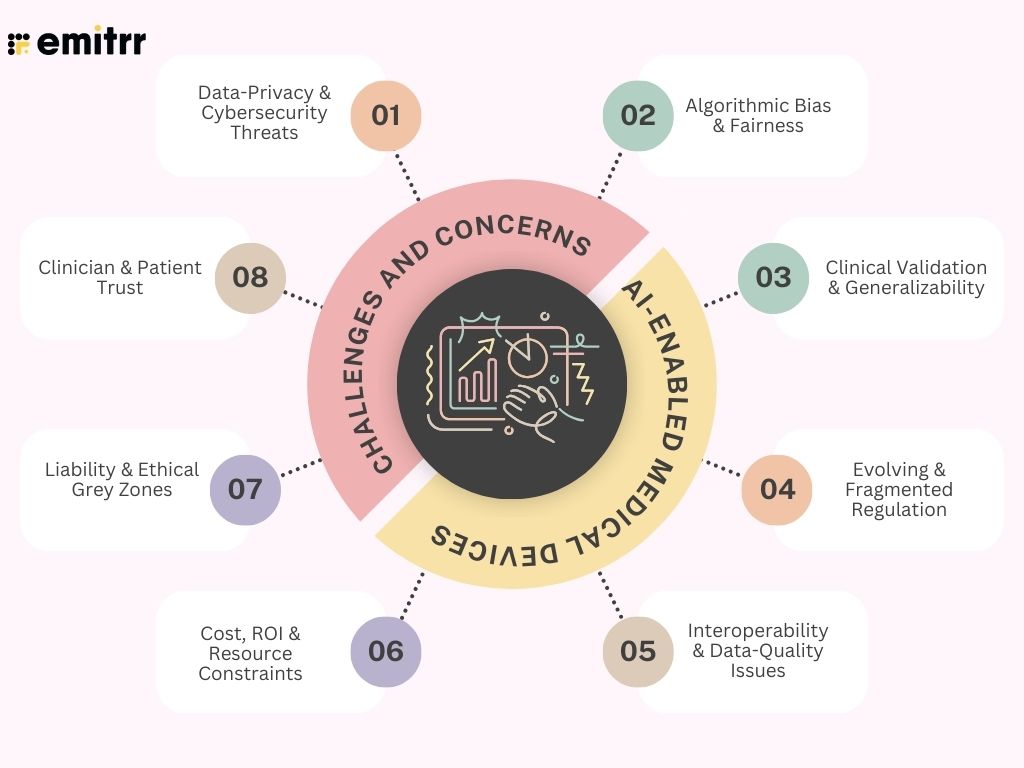
1. Data-Privacy & Cybersecurity Threats
Connected devices are a magnet for attackers. Since 2009, U.S. healthcare providers have reported 6,759 breaches of 500 records or more, exposing more than a billion patient files HIPAA Journal. In January 2024, federal watchdogs warned that legacy MRI machines, infusion pumps, and even home-use devices can be hijacked, calling medical-device cyber-risk “a real Achilles’ heel” Axios.
The FDA’s 2024 cybersecurity guidance now requires every new submission to include a “software bill of materials” and a remediation plan, yet most devices already on the market fall outside the rule’s scope U.S. Food and Drug Administration. Securing PHI at rest, encrypting telemetry in transit, and providing over-the-air patching are quickly moving from nice-to-have to regulatory necessity.
2. Algorithmic Bias & Fairness
Rapid growth has outpaced transparency. A 2024 scoping review of 692 FDA-cleared AI devices found that only 3.6 % reported race/ethnicity data and just 0.9 % disclosed socioeconomic variables, raising serious equity concerns Nature. Under-representation means an algorithm that performs well in one population may mis-classify another, widening health-outcome gaps rather than closing them.
Boards are responding with bias-mitigation checkpoints, diverse training sets, model explainability, and continuous post-market surveillance, to ensure devices work for every patient.
3. Clinical Validation & Generalizability
The FDA’s public database listed 903 AI/ML-enabled devices by August 2024, up from fewer than 200 in 2018 JAMA Network. Yet many cleared products still rely on single-site, retrospective datasets. Without prospective, multi-center trials, clinicians struggle to judge how well an algorithm will perform in different hospital workflows or patient demographics.
Medical-device makers must invest in external validation, real-world evidence collection, and adaptive “learning” protocols to keep models accurate after deployment.
4. Evolving & Fragmented Regulation
Regulators are racing to keep up. In November 2024, the FDA’s Digital Health Advisory Committee held its first hearing on generative-AI devices, signaling that new guidance is imminent on continuous-learning systems and post-market model updates U.S. Food and Drug Administration. At the same time, the EU’s AI Act and MDR create parallel, but not identical, requirements.
For global manufacturers, harmonizing submissions across jurisdictions, maintaining auditable change logs, and monitoring local privacy laws can add months to launch timelines.
5. Interoperability & Data-Quality Issues
AI thrives on clean, standardized data, yet device telemetry often arrives in idiosyncratic formats. Lack of HL7 FHIR adherence and inconsistent timestamping force providers to build costly integration layers before insights can flow into the EHR. Poor data hygiene also degrades model performance, increasing false alerts and clinician fatigue.
6. Cost, ROI & Resource Constraints
Building and maintaining an AI-enabled product is capital-intensive, cloud hosting, cybersecurity hardening, and FDA-class documentation all push costs above those of traditional devices. Smaller firms may struggle to prove ROI when reimbursement pathways for AI-powered services (e.g., CPT® codes) are still emerging. These cost, scalability, and reimbursement challenges increasingly influence how investors approach valuing AI startups in the medical device space, particularly when assessing defensible IP, regulatory readiness, and long-term ROI.
7. Liability & Ethical Grey Zones
Who is responsible when an autonomous imaging algorithm misses a tumor or a closed-loop insulin pump overdoses a patient, the manufacturer, the clinician, or the software vendor? Existing product-liability doctrines were written for static hardware, not self-learning code. Insurers are already drafting new policies that shift risk back onto device makers unless they provide robust human-override mechanisms.
8. Clinician & Patient Trust
Finally, adoption hinges on confidence. ECRI placed “AI without proper governance” at the top of its 2025 health-tech hazards list, citing the danger of deploying poorly vetted models in clinical care Healthcare IT News. Clear explainability, intuitive user interfaces, and rigorous user training are essential to winning over skeptical physicians and ensuring patients feel safe.
How AI-Based Communication In Medical Device Companies Differ From Traditional Communication
In an industry where precision and timing are everything, the way medical device companies communicate, with patients, providers, and internal teams can make or break operational efficiency and brand trust.
Traditionally, communication in this space has relied heavily on manual processes: phone calls, emails, printed documentation, and siloed CRM updates.
But with the rise of AI for medical device companies, communication is becoming faster, smarter, and far more personalized.
Here’s how AI-based communication stacks up against traditional methods and why the shift is transforming medtech businesses.
From Static to Dynamic Messaging
Traditional communication in medical device companies typically involved one-size-fits-all messaging. Whether it was a product update, patient follow-up, or regulatory alert, the message went out in bulk, often with minimal personalization.
AI-powered communication, however, uses data-driven insights to tailor each interaction:
- Appointment reminders are customized based on patient behavior and preferences
- Product alerts are segmented based on user role (clinician vs technician)
- Marketing messages (eg: marketing for plastic surgeons) are dynamically adjusted using real-time engagement data
This personalization boosts engagement and ensures that communication isn’t just heard, but actually acted upon.
From Manual Outreach to Intelligent Automation
In the past, following up with healthcare providers, service technicians, or distributors often meant hours of calls, emails, and data entry. Not only was this time-consuming, but it also left room for delays and human error.
Today, AI for medical device companies enables:
- Automated follow-ups after service appointments
- Trigger-based communication (e.g., an alert if a device isn’t functioning properly)
- AI-powered chatbots that can instantly respond to common inquiries from patients or staff
Platforms like Emitrr, for example, are enabling medtech companies to automate 2-way SMS communications, keeping customers engaged without the overhead of a full support team.
From Reactive Support to Proactive Engagement
Traditional customer communication is often reactive, waiting for someone to report a problem before acting. This leads to service bottlenecks and a poor end-user experience.
With AI, communication becomes predictive and proactive:
- Devices can alert users and service teams before a failure occurs
- AI assistants can check in with patients post-surgery or during device trials
- Feedback loops are closed automatically, helping teams identify issues early
This shift from support to engagement not only strengthens customer loyalty but also reduces operational costs.
From Disconnected Silos to Centralized Intelligence
In traditional communication models, marketing, sales, support, and compliance teams often worked in disconnected silos. Messaging was inconsistent, and insights from one channel rarely informed others.
AI brings centralized communication intelligence by:
- Syncing conversations across SMS, email, and web chat into one platform
- Automatically tagging, classifying, and prioritizing support tickets
- Integrating with CRMs and device management systems to ensure context-rich interactions
This centralized model improves both response quality and decision-making across departments.
From Gut Feel to Data-Driven Strategy
One of the most important distinctions between traditional and AI-based communication is the ability to measure what works and optimize it in real time.
AI tools offer:
- Real-time analytics on open rates, response times, and sentiment
- A/B testing of messages to see what drives higher engagement
- Predictive insights to guide outreach strategies and timing
For medical device companies, this means communication is no longer a guessing game, it’s a measurable, strategic asset.
Where Does AI Overtake Humans for Medical Device Companies
When it comes to efficiency, scale, and data processing, there are several key areas where AI for medical device companies significantly outperforms human capabilities.
While human oversight remains essential, AI has proven to be more consistent, faster, and more accurate in specific functions, helping companies streamline operations and make smarter decisions.
- Data analysis at scale: Humans are simply not built to analyze the vast amounts of structured and unstructured data that today’s medical devices generate. AI can rapidly sift through terabytes of imaging data, sensor inputs, and patient records to detect patterns, generate insights, and even flag anomalies in real-time, something that would take human analysts days or weeks to accomplish.
- Diagnostic accuracy in imaging: AI has shown exceptional performance in radiology and pathology. While radiologists still play a critical role in final decisions, AI can reduce error rates and improve early detection far beyond what unaided human review can achieve.
- Predictive analytics and early risk detection: AI systems can use historical and real-time data to forecast equipment failure, patient deterioration, or even trial dropout risks with high precision. Human intuition may detect trends, but AI does it earlier, with more accuracy, and without cognitive fatigue.
- Automation of repetitive administrative tasks: Scheduling, billing, document management, and regulatory reporting are all areas where AI-enabled platforms outperform humans in speed and reliability. These tasks, while essential, are labor-intensive and prone to human error. AI not only handles them faster but also learns and optimizes over time, drastically reducing the need for manual intervention.
- 24/7 customer support and engagement: AI-driven chatbots and virtual agents can handle a high volume of customer interactions at any hour, without burnout. Unlike humans, AI doesn’t need breaks or sleep, and it can maintain consistency in tone, accuracy, and speed, even when scaling to thousands of interactions simultaneously. This ensures uninterrupted service, particularly important for medical device companies that operate globally.
- Regulatory compliance tracking: Compliance in the medical device industry is an ever-evolving landscape. AI systems can monitor policy changes, update documentation templates, and flag gaps in real time. Humans may overlook subtle regulatory shifts, but AI can continuously scan and apply relevant updates without manual effort, making the process more reliable and audit-ready.
- Supply chain forecasting and optimization: While experienced supply chain professionals offer valuable judgment, AI brings mathematical precision to forecasting and inventory management. By analyzing historical demand, seasonal trends, and current logistics data, AI can recommend optimal stock levels, prevent shortages, and reduce wastage at a scale no human planner could match.
In all these areas, AI for medical device companies doesn’t just match human performance, it enhances and surpasses it. However, the goal isn’t to replace people; it’s to enable them to work smarter by offloading tasks that machines do better, faster, and more reliably.
The future lies in a hybrid model where AI augments human intelligence, allowing medical device companies to deliver safer, more efficient, and more innovative healthcare solutions.
Why Do Medical Device Companies Need AI?
Medical device companies are under immense pressure to innovate faster, operate more efficiently, and deliver better outcomes while staying compliant with evolving regulatory standards. It’s a tall order. And this is precisely where AI for medical device companies steps in, not as a luxury, but as a necessity.
AI helps bridge the growing gap between rising expectations and limited human and technical resources. From research and development to post-market surveillance, artificial intelligence enables medtech firms to make smarter decisions, reduce costs, and respond faster to both patient and market needs.
One of the biggest reasons medical device companies need AI is the explosion of data.
Devices now generate more data than ever, ranging from real-time vitals and imaging scans to usage logs and user feedback. Extracting actionable insights from this massive volume of information manually is not only inefficient, it’s impossible.
Speed to market is another critical driver. Traditional product development cycles can stretch across years, especially with regulatory complexities involved. AI accelerates this process by enabling faster prototyping, simulating clinical trials, and automating compliance documentation.
There’s also the issue of workforce strain. Regulatory staff, R&D teams, and customer service departments are increasingly burdened with repetitive, low-value tasks. AI reduces this burden by automating functions like document management, compliance tracking, and patient communication.
Moreover, AI supports precision medicine and personalized care – something that is becoming increasingly important in patient-centered healthcare. AI-powered devices can learn from individual user behavior, adapt their functions in real time, and even offer predictive alerts, significantly improving safety and clinical outcomes.
Finally, regulatory bodies like the HIPAA, FDA and EMA are not just accepting AI, they’re building frameworks to encourage its responsible use. Medical device companies that integrate AI early are better positioned to navigate future compliance landscapes and take advantage of emerging opportunities, such as real-world evidence (RWE) and adaptive learning systems.
In essence, AI for medical device companies isn’t just about automation or efficiency. It’s about staying relevant, responsive, and resilient in a rapidly transforming industry. Companies that embrace AI today are laying the foundation for smarter, safer, and more sustainable innovations tomorrow.
The future of AI for Medical Device Companies
As artificial intelligence continues to evolve, the future of AI for medical device companies is shaping up to be more transformative than ever. What began as an experimental tool for automation and efficiency is now becoming the backbone of innovation in the medtech industry.
From clinical breakthroughs to entirely new business models, the next phase of AI integration promises to redefine how medical devices are developed, deployed, and experienced.
One of the most exciting frontiers is the rise of adaptive, self-learning medical devices.
These systems don’t just perform tasks, they evolve. AI algorithms will increasingly be able to learn from every patient interaction, updating themselves in real-time to deliver more accurate diagnostics, personalized treatments, and predictive insights.
We’re also going to see tighter integration between AI-enabled devices and telemedicine platforms. As remote care becomes the norm, smart devices that can communicate directly with care teams, transmit real-time data, and offer autonomous support will be in high demand.
Regulatory landscapes will continue to mature to accommodate AI’s fluid nature. The FDA, EMA, and other global authorities are already drafting frameworks to support “Software as a Medical Device” (SaMD) and “Predetermined Change Control Plans” (PCCPs), allowing AI-based devices to evolve post-approval with less red tape.
For medical device companies, this means a future where innovation doesn’t stop at launch, it continues throughout the product lifecycle.
On the operational side, AI will drive deeper automation across the value chain, from supply chain forecasting and quality control to compliance reporting and customer engagement.
Trust, transparency, and ethical AI will become non-negotiable. The companies that succeed will be those that not only develop powerful AI tools but also ensure they are explainable, bias-free, and aligned with patient safety standards. AI ethics committees, continuous model validation, and patient consent protocols will become integral parts of every product roadmap.
Lastly, the future holds immense potential for collaborative ecosystems, where medical device manufacturers, software developers, healthcare providers, and regulators work together to co-develop AI-driven solutions.
Open APIs, interoperability standards, and shared datasets will help fuel this collaborative innovation, leading to faster breakthroughs and more meaningful impact.
What Makes Emitrr the Best AI Tool For Medical Device Companies
As the adoption of AI continues to reshape the medtech landscape, AI for medical device companies is no longer a futuristic concept, it’s a present-day necessity.
To stay ahead, companies need intelligent platforms that simplify operations, streamline communication, and scale customer engagement efficiently. This is exactly where Emitrr stands out as a game-changing AI solution.
Emitrr is more than just a communication tool, it’s an all-in-one AI-powered platform designed to meet the real-world needs of modern medical device companies. Whether you’re dealing with complex workflows, patient follow-ups, or distributor coordination, Emitrr helps automate it all with precision and ease.
Here’s why medical device companies are choosing Emitrr:
- AI-Powered Communication at Scale: Emitrr allows businesses to automate scheduling, follow-ups, reminders, and more, reducing manual workload and improving patient and partner engagement. With AI-driven workflows, your team spends less time chasing tasks and more time delivering value.
- Seamless CRM Integration: No need to change the tools you already trust. Emitrr integrates with over 500+ CRMs, ensuring smooth deployment across your existing tech stack. This makes onboarding frictionless and allows for fast scalability.
- Trusted by 1000+ Businesses: Emitrr is already trusted by more than 1,000 customers across healthcare and local service industries. It’s a proven solution with a track record of driving real, measurable results.
- 5-Star Support That Sets the Bar: Our customer support is consistently rated 5/5 by clients. From setup to scaling, our team is always by your side to ensure your success with the platform.
- The Ultimate Toolbox for AI-Driven Growth: Emitrr brings together four essential pillars for business enablement:
- Communication: Automate messages, calls, and texts.
- Automation: Let AI handle repetitive tasks and reminders.
- Digitization: Convert manual operations into efficient digital workflows.
- Phone Systems: Manage calls seamlessly through a powerful telephony interface.
- Communication: Automate messages, calls, and texts.
Introducing AI-Based Text Enhancements
With our recent deployment update, Emitrr now offers advanced AI text enhancement features, making it easier than ever to communicate with clarity and empathy especially in high-stakes industries like healthcare and medical devices.
These new features help you craft smarter messages, faster:
- Help Me Write: Simply input a prompt and let AI generate a professional, clear message instantly.
- Enhance Tone:
- Make it Crisp: Tighten and streamline your message for direct, no-nonsense communication.
- Make it Empathetic: Add warmth and a human touch to sensitive messages , perfect for patient or partner interactions.
- Make it Crisp: Tighten and streamline your message for direct, no-nonsense communication.
- Suggest a Reply: Stuck on what to say next? Emitrr recommends context-aware replies in real time, based on the latest message in your conversation.
These AI writing tools are now live in production and are exclusively available on our Professional plans. They’re especially valuable for teams handling support, onboarding, or high-volume communication, helping you respond better, faster, and more thoughtfully.
Emitrr offers exactly what AI for medical device companies should: efficiency, intelligence, and dependability. From automation to AI-enhanced messaging, Emitrr gives you the tools to do more with less effort and greater impact.
FAQs
AI helps medical device companies improve diagnostics, automate workflows, reduce human error, and speed up regulatory compliance, all of which are vital for staying competitive and innovative in healthcare.
Common use cases include diagnostic imaging, predictive maintenance, patient monitoring, clinical trial automation, and customer communication tools like AI-driven chat and scheduling.
Emitrr provides an AI-powered communication platform that automates scheduling, follow-ups, patient engagement, and now includes smart writing features, helping medical device companies streamline operations and scale with ease.
Yes, AI-powered medical devices are subject to regulatory oversight. Agencies like the FDA are developing frameworks to evaluate and approve AI-driven technologies, ensuring safety, transparency, and efficacy.
Absolutely. With platforms like Emitrr offering scalable and easy-to-integrate AI solutions, even smaller companies can enhance efficiency, reduce overheads, and improve customer experience without large investments.
Conclusion
AI is no longer just an emerging trend, it’s a core driver of innovation, efficiency, and growth in the medtech space. From improving diagnostic precision to automating complex workflows, AI for medical device companies is fundamentally changing how these organizations operate and deliver value.
As the industry continues to evolve, the need for smart, scalable solutions will only grow stronger. That’s where platforms like Emitrr come in, offering AI-powered tools that help medical device companies streamline communication, enhance customer engagement, and stay ahead of the curve. Book a demo today!