
 4.9 (400+
reviews)
4.9 (400+
reviews)
Introduction
Artificial Intelligence (AI) is gradually taking over the centre of healthcare, primary care clinics. These are the most frequently visited points in the medical system, where a wide range of patient needs are managed with usually limited resources. AI gives the potential to change the whole scene by allowing clinicians to provide smarter, more efficient, and equitable care. It ranges from AI decision support to clinical and routine task automation, where human judgment is augmented, not replaced, as AI nicely ties in with the primary care goal, metaphorically: better outcomes, higher value, and improved experiences for both patients and providers. Indeed, it is in line with the “Quadruple Aim”: improvement of patient care, cost reduction, and patient and provider experience enhancement.
Benefits of AI in Primary Care Clinics
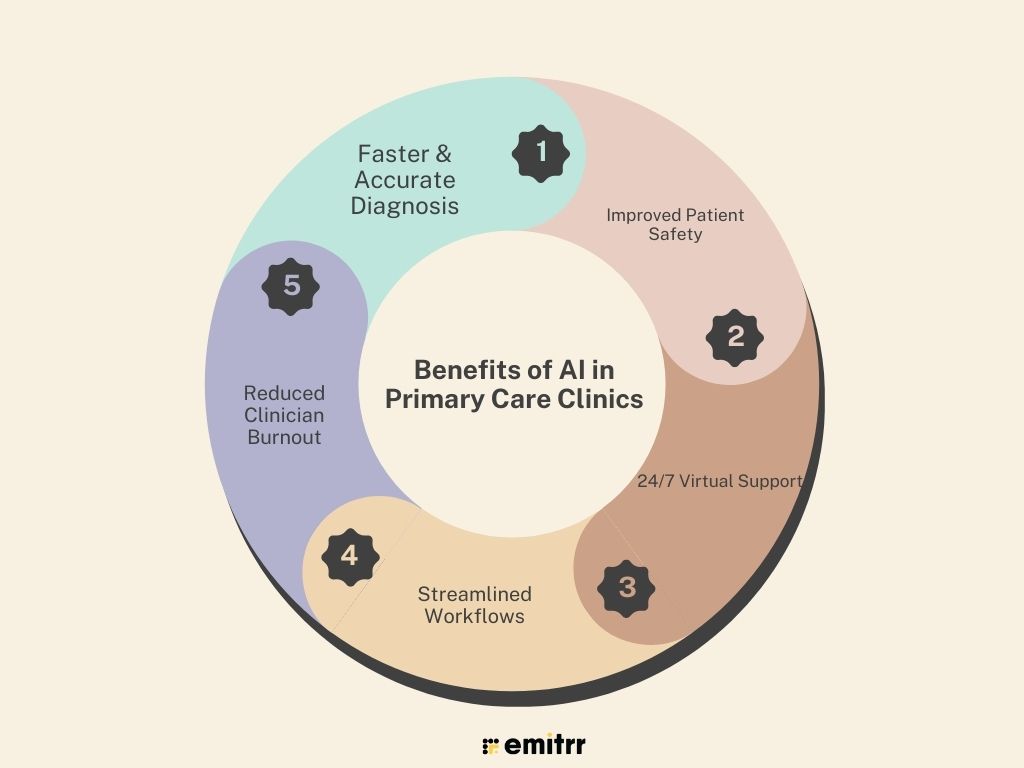
Faster & Accurate Diagnosis
An AI system, especially those utilising predictive analytics or large language models, can quickly analyse symptoms, lab results, and medical histories, leading to the identification of patterns faster than humans can. The practical application is through tools such as “AI Consult,” a platform implemented in clinics in Kenya, which not only considerably lowered the rates of misdiagnosis by 16% and of mistreatment by 13% but also proved to be a reliable and effective everyday care assistant.
The AI system accurately diagnosed up to 85.5% of complex cases from the New England Journal of Medicine. This accuracy was over four times higher than the average of 21 experienced physicians who participated in the study, who achieved a mean accuracy of only 20%.
Improved Patient Safety
To begin with, AI is not limited to the facilitation of rapid diagnoses only. The technology can be a “co-pilot” for the medical staff, guiding them in case of a possible discrepancy or incomplete information. Research and practical experiments provide the opening to the AI-powered clinical decision support system to deliver the highest efficiency in connection with the extreme cases, such as adverse drug events that can occur at any time, and in providing a simple and fast documentation process through the auto-charting function, greatly reducing transcription errors and increasing data uniformity.
24/7 Virtual Support
AI virtual assistants, chatbots, and triage tools equip patient support, which is available 24 hours a day. In this way, care is delivered even outside the usual clinic hours. For instance, Cedars-Sinai’s CS Connect, a program developed in partnership with K Health, is an AI virtual care platform that runs the intake, symptom evaluation, and treatment suggestions by itself while staff members concentrate on treatment.
Streamlined Workflows
Artificial intelligence is the secret weapon that helps streamline the numerous administrative routines related to medicine, including note-taking, chart documentation, billing, and data entry. AI-powered “medical scribes” do the job of listening and recording during interactions, and afterwards, they automatically create structured notes, thus saving clinicians the time that would have been used for documentation and helping them to focus on the patients. In actual deployments, professionals experiencing heavy workloads report that the use of AI yields less administrative burden, alongside the reporting of satisfaction with AI assistance.
Reduced Clinician Burnout
One of the major reasons for clinician burnout is the excessive administration of tasks. Just like in the case of AI medical scribes, which are responsible for patient visit transcription and thus free the clinician for other duties, the doctor is given the possibility to take a step back, reduce their tiredness, and get back to patient interaction. Reports pinpoint that AI-assisted documentation relief comes along with job satisfaction for health care workers and the improvement of the work-life balance position, which is a very important factor for the sustainability of health systems.
Use Cases of AI in Primary Care
AI-Powered Triage & Virtual Assistants
AI-powered chatbots and voice assistants enable patients to explain their symptoms and get initial guidance, along with the preliminary report that is necessary before the doctor can meet the patient. At the same time, these tools are capable of scheduling patients, providing self-care advice, and opening physicians’ time for other tasks. For instance, it has been demonstrated that systems like Babylon Health’s AI triage solution bring about the efficiency of primary care consultations.
Predictive Analytics
One of the roles of AI is to deeply analyse patients’ histories, lab results, and lifestyle data to predict early symptoms of chronic diseases like diabetes, hypertension, or cardiovascular diseases. It means that by clinics that take preventative action through acquiring the resources they need to treat the at-risk patients, AI in hospitals will lessen long-term expenses and healthcare costs.
AI for Documentation
Physicians are required to spend a significant amount of time each day on medical documentation. AI-powered tools, like natural language processing (NLP) dictation software, have the capability to create visit summaries, prescriptions, and reports automatically. This decreases paperwork, allowing clinicians to dedicate more time to patient care.
Patient Engagement
AI chatbots and personalised health reminders keep patients engaged outside the clinic. From medication adherence reminders to lifestyle coaching, these tools increase compliance and improve overall health outcomes.
Administrative support
AI are used to schedule, bill, and check insurance. Automated systems minimise the waiting time for customers, cut down on human errors and ensure that the overall patient experience in primary care clinics is excellent.

Challenges of AI Adoption for Primary Care Clinics
Ensuring HIPAA Compliance and Patient Data Privacy
Primary care clinics have to make sure that AI solutions follow HIPAA regulations (in the U.S.) or equivalent global privacy laws. The main reason why AI adoption is still hindered is that protective measures for health data are the major obstacles to the implementation of AI in healthcare.
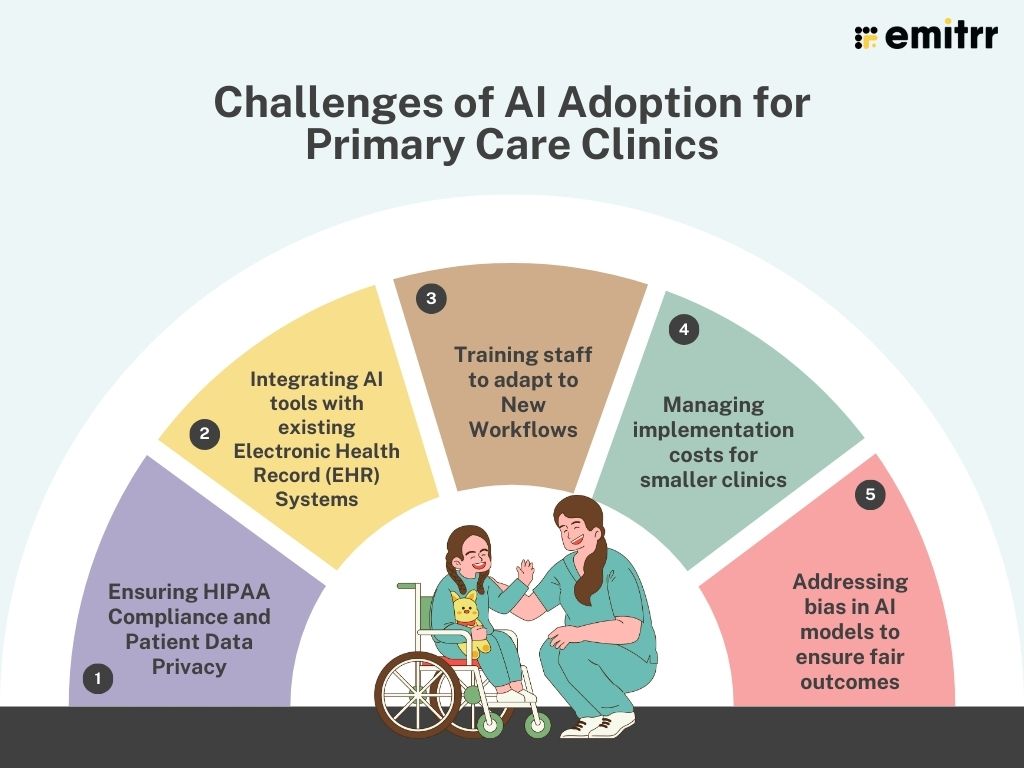
Integrating AI tools with existing Electronic Health Record (EHR) Systems
Most clinics are still operating with electronic health records (EHRs) that are either old or fragmented. The process of integrating AI tools into these systems without upsetting the workflows can be complicated and expensive.
Training staff to adapt to New Workflows
For AI to work effectively and efficiently, clinicians, as well as healthcare staff, need to change the way they work. Adoption without proper training can be a slow process and might not bring all the benefits that are expected.
Managing implementation costs for smaller clinics
Big healthcare systems can take whichever AI projects they want without needing to worry about the costs. On the other hand, small primary care clinics are often put in a position where they cannot afford the software, infrastructure, or training that is required to start the AI project. The availability of AI solutions that are affordable and scalable is of vital importance if the technology is to be adopted by a wider audience.
Addressing bias in AI models to ensure fair outcomes
Artificial intelligence models are fairly limited in their performance by the data they were built. When training data lacks diversity, the AI systems can provide biased results, which may lead to incorrect diagnosis and treatment of certain medical conditions in the least represented groups in the dataset.
How AI-Based Communication in Primary Care Differs from Traditional Communication
AI Communication
- 24/7 Availability
Chatbots, smart reminders, and voice agents are on the job all the time.
- Personalized Engagement
Automated SMS and intelligent follow-ups are customising communication for each patient.
- Efficiency
No-shows are reduced, response times are improved, and patient outreach becomes consistent.
Example: Platforms such as Emitrr – HIPAA Compliant Patient Communication Software, which is a software that helps clinics automate reminders, scheduling, and follow-ups.
Traditional Communication
- Limited Hours
Patients have access to the clinic only during working hours.
- Resource Heavy
Manual phone calls and reminder systems require staff time and effort to operate them.
- Higher Missed Appointments
The chain of events that eventually leads to no-shows and poor follow-ups usually starts with delayed responses.
Example: Appointment reminder cards or manual phone calls made by staff.
| Feature | AI Communication | Traditional Communication |
| Availability | 24/7 availability (chatbots, smart reminders, SMS) | Limited to clinic hours |
| Speed | Instant response at any time | Slower, staff-dependent for responses |
| Personalization | Tailored messages & timely reminders | Generic/manual reminders |
| Scalability | Can handle 1000s of patients at any point in time | Limited by staff capacity and the ability to handle the pressure |
| Staff Burden | Reduces workload, prevents burnout of the staff | High workload, time-consuming |
| Appointment Outcomes | Fewer no-shows, better engagement | More missed appointments due to the unavailability of staff |
Where Does AI Overtake Humans in Primary Care Clinics?
Handling large datasets and detecting disease patterns
AI is capable of gathering diverse sources of patient data – such as lab results, medical histories, imaging, and wearable device readings – at an unimaginable speed compared to humans. It thus makes early identification of patterns and risk factors for diseases such as diabetes, heart disease, or cancer, which are difficult to find in manual reviews.
Automating repetitive tasks like documentation, scheduling, and billing
Routine administrative and operational tasks, including appointment scheduling, billing, documentation, and insurance verification, can be completed using full automation. As a result, the system eliminates human error, optimises workflows, and the clinicians get to devote their time to patient care rather than paperwork.
Providing instant responses to patient inquiries
AI-assisted chatbots and virtual assistants are always ready to reply to the patient’s questions without delay, to take charge of the situation when complaints are given, to give necessary instructions, or to guide patients to the appropriate department. This system improves patient service, reduces waiting times, and enables timely access to care, with an ambulance to the rescue if it is after-hours clinic emergencies.
Continuous monitoring through connected devices
Connected devices and wearable health trackers can provide real-time data to AI systems. This allows continuous monitoring of patient vitals, early warning for deteriorating conditions, and timely alerts to both patients and clinicians, improving preventative care and reducing hospitalisations.
Where Do Humans Overtake AI in Primary Care Clinics?
Building empathy and trust with patients
Health care is not just data; it is about human beings. Trust and rapport are built by clinicians with patients, giving them emotional support and reassurance, which AI can never duplicate. For patient compliance and loyalty, this human bond is of great importance.
Handling complex, ambiguous medical cases
The combination of multiple symptoms, co-morbidities, and rare diseases makes the medical condition complex. Besides, the human clinicians, through their instincts, experience, and background knowledge, can figure their way through these complicated situations, whereas AI may be limited in predictions or may even give ambiguous ones.
Applying ethical and cultural context to care decisions
Ethical issues, patient preferences, and cultural context are often involved in decisions made by primary care. Interpretation of subtle differences is a task for human clinicians, as they cannot be done by AI models, which are limited by their training data; hence, the care provided is the one that reflects responsibility, equity, and is tailored to the individual.
Making holistic assessments beyond raw data
People can consider the patient as a whole, including lifestyle, social determinants of health, mental well-being, and long-term implications of treatment. AI can recommend several lines of treatment, but the actual healthcare professionals will make the final decision, taking into account all the patient’s requirements that may not be obvious from the raw data.
Why Primary Care Clinics Need AI
Managing Growing Patient Loads
With the decrease in the number of doctors and the increase in the number of patients, the primary care clinics have got the short end of the stick. By utilising AI tools, patients can be sorted by the severity of their conditions, employees may be relieved from administrative burden, and thus the flow of the clinic or hospital will be done without putting the staff under pressure and stress.
Supporting Preventive and Chronic Care
The major chronic diseases that are diabetes, high blood pressure, and congestive heart failure require constant surveillance and intervention before the disease progresses. AI can scrutinise healthcare records to spot possible diseases early, recommend preventive ways, and help in long-term disease keeping, thus improving patient outcomes.
Controlling Rising Healthcare Costs
Among the factors that cause healthcare costs to rise are administrative overhead, repeated tests and inefficiencies in the workflow. AI can greatly reduce the number of unnecessary expenditures and help improve clinic efficiency by automating documentation, scheduling, billing, and follow-up.
Meeting Patient Expectations
The present-day patients expect a digital-first and on-demand healthcare that includes instant appointment scheduling, reminders, virtual consultations, and timely responses to queries. Communication platforms powered by AI, like chatbots, automatic SMS, and voice assistants, allow clinics to deliver these expectations without quality of care being compromised.
Why Emitrr AI is the Best AI Tool for Primary Care Clinics
Primary care clinics have to deal with ever-increasing patient loads, the plethora of administrative tasks, and the essential need for timely communication. Emitrr AI is a one-stop solution that can automate communication, simplify operations and improve patient care.
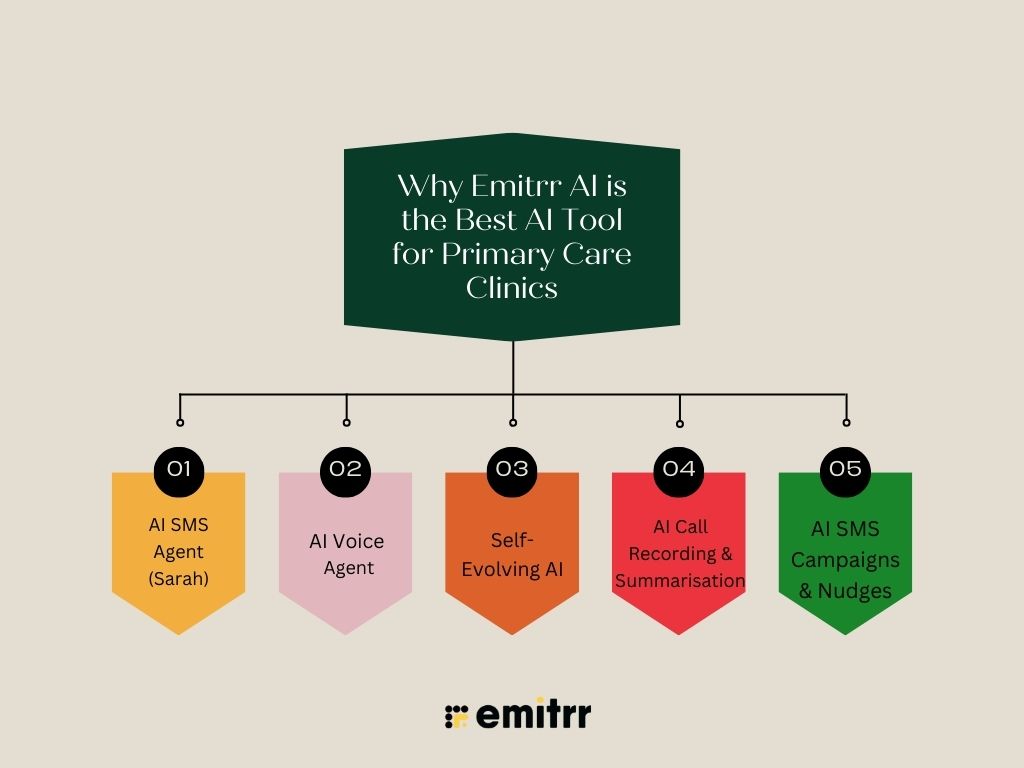
AI SMS Agent (Sarah)
The intelligent SMS agent named Sarah from Emitrr efficiently manages appointment bookings, rescheduling, reminders, and patient inquiries exclusively through text messages. She can serve multiple patients simultaneously; thus, the number of missed appointments decreases and the follow-up efficiency improves.
AI Voice Agent
Emitrr’s voice agent undertakes the tasks of answering the incoming calls, booking or rescheduling appointments, sharing updates, and responding to FAQs without waiting time or voicemails. Therefore, clinics can avail 24/7 support without staff efforts going up.
Self-Evolving AI
With every interaction Emitrr gets, it learns and improves its responses over time. It does so without any manual updates or retraining. Hence, the conversations with patients get to be more intelligent and natural, and the number of communication errors is reduced.
AI Call Recording & Summarisation
While all calls are recorded securely, the summaries are automatically generated. Staff can stay on the same page with patient communication without allocating extra time for manual documentation.
AI SMS Campaigns & Nudges
Emitrr automates patient engagement with the help of personalised SMS campaigns and nudges. Thus, from follow-ups to preventive care reminders, clinics can efficiently maintain continuous communication with their patients.
Key Benefits for Clinics
- Reduced No-Shows: Automated reminders, combined with follow-ups, increase the attendance rate at appointments.
- Improved Response Times: Patients receive timely answers to their questions and are also notified of scheduling requests.
- 100+ Hours Saved Monthly: By automation, the staff has less repetitive work and more time for patient care.
- Scalable Support: The number of patients you can attend to increases without the need of having a bigger team.
Watch how businesses like yours save time and costs with Emitrr AI –
Future of AI in Primary Care Clinics
1. Integration with Electronic Health Records (EHRs)
Artificial intelligence is changing EHRs, so they are no longer just places to store data, but intelligent systems that adapt to the situation. The process of documentation can be handled by AI; at the same time, it can alert to probable complications and even provide decision support. Without a doubt, AI is one of the key enablers of clinical and operational excellence, as it empowers the use of data and analytics to manage quality and efficiency, in addition to reducing clinician burnout and patient dissatisfaction through optimised clinical workflows. The information provided by the computer will be current, and as a result, the doctor will be able to make the best decision possible.
2. Real-Time Predictive Analytics
The use of AI-powered predictive analytics makes the process for medical professionals a lot easier in regards to the anticipation of patient needs as historical and real-time data are analysed. One of the benefits of the proactive approach is the prevention of chronic diseases effectively, the treatment plan is done in a personalised way, and the resource use is performed in an optimal way. As a result, patient care and operational effectiveness will be enhanced.
3. Generative AI for Patient Education
Generative AI models have brought a change in patient education as they now design the content as per the patient’s needs and make it easier to understand. The new software can provide explanations on the requested matter, can answer all the patient’s questions and can even deliver information administered through the patient’s culture; thus, patients are empowered and can actively contribute to their healthcare journey.
4. Remote Monitoring and Telehealth Expansion
By combining AI with remote patient monitoring (RPM) and telehealth, the platforms are made available to a larger audience, as those in areas with limited access to medical services. AI algorithms analyse information collected from the wearable devices and the necessary equipment to detect the earliest symptoms of illnesses; thus, the aid is provided at the right time and hospital re-admissions are decreased.
5. Focus on Ethical, Equitable, and Transparent AI Adoption
As AI is deeply intertwined with healthcare, the first and foremost thing is making sure that AI is used ethically. This involves being open about how the artificial systems arrive at their conclusions, identifying as well as rectifying any biases that might exist in an algorithm and making sure all community groups have equal access to AI tools designed to facilitate healthcare. Establishing clear roles for accountability and incorporating diverse AI models are essential steps towards the socially responsible use of AI in primary care settings.
FAQs
One of the areas where AI significantly helps is in clinical decision support, patient triage, predictive analytics, documentation, appointment scheduling, and administrative tasks. The technology also facilitates patient engagement and care delivery by powering chatbots, virtual assistants, and remote monitoring.
Indeed, AI, when realised by platforms such as Emitrr that are HIPAA-compliant, facilitates the secure handling of patient data, the encryption of communication, and the overall observance of privacy laws.
Not really. AI takes care of efficiency, decision-making, and task automation, but it still lacks the necessary empathy, complex diagnostics, ethical judgment, and holistic care, which is why humans are still needed.
The list of challenges affecting healthcare AI implementation is led by concerns about the compatibility of AI systems with EHR, training of the staff, product cost, the risk of algorithmic bias, as well as the trust of the patients and their privacy.
AI clinics are capable of bringing down the rate of no-shows, saving over 100 hours a month, raising the speed of response, streamlining administrative workflows, and growing patient support without hiring more staff, thus creating both operational and financial benefits that are measurable.
Conclusion
Artificial intelligence is fundamentally changing from a mere futuristic portrayal to a real-life, primary care clinic-saving tool. Through the use of AI-powered systems, clinics can streamline the workflow and thus save valuable physician time, simultaneously increasing patient engagement and satisfaction. As a result, all healthcare providers, together with patients, enjoy the benefits of the technology revolution.
A clinic cannot miss the opportunity to go for an AI-powered communications platform if it wants to optimise its resources. An AI-powered message platform can work miracles with an overcrowded appointment calendar by allowing patients to schedule, reschedule, or cancel appointments of their own, thereby drastically cutting the number of no-shows. It is not the aim of AI to take the place of doctors but to become their assistant so as to give them more time to focus on complex medical cases and meaningful doctor-patient interactions.
Experience the AI wonders with Emitrr that will make you the pioneer of efficient and patient-friendly primary care.