
 4.9 (400+
reviews)
4.9 (400+
reviews)
Introduction
Hiring teams are under pressure. From endless resume screening to delayed candidate follow-ups and messy scheduling coordination, manual tasks are eating up time that should be spent on high-value work. Traditional automation has helped a little, but it’s not enough anymore. VoIP for recruiters needs something smarter, more proactive, are now essential.
That’s where AI agents are making a real difference. They’re not just automating tasks; they’re running them end to end. Whether engaging candidates, scheduling interviews, or filtering resumes, AI agents are stepping in to handle the heavy lifting, so teams can focus on strategy.
In this blog, we’ll break down what recruiters are struggling with, how AI agents are solving these issues, real-world use cases, and what this shift means for recruitment operations.
What’s Broken in the Current Recruitment Model?
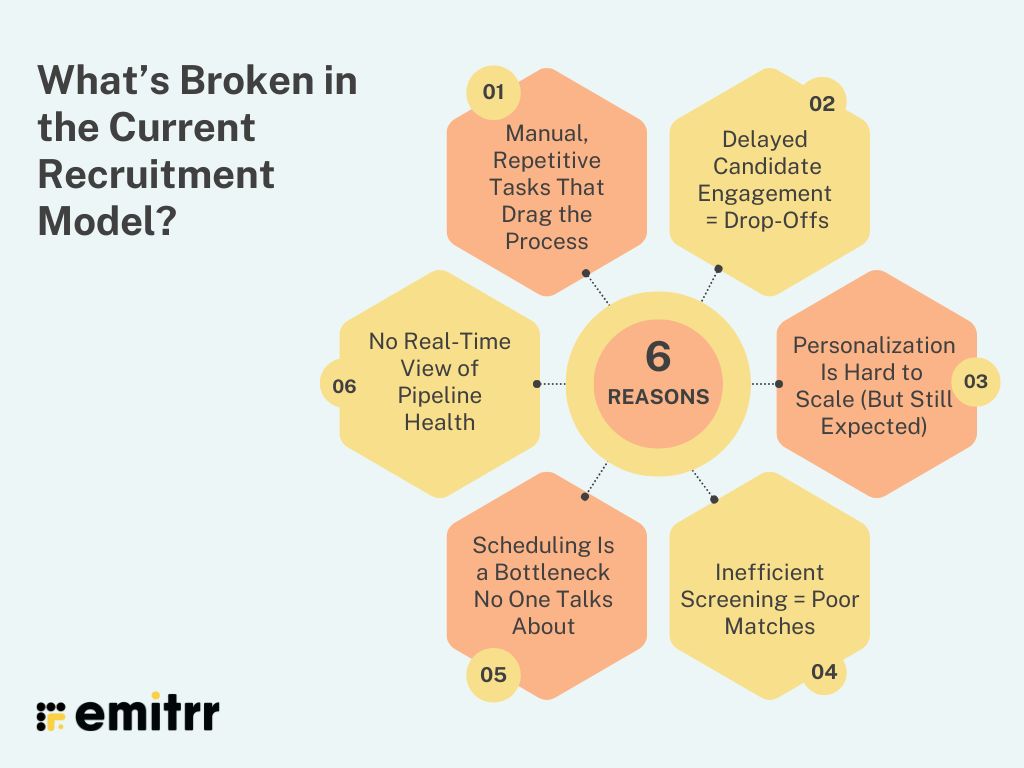
Despite all the tech now available, many recruitment teams still follow outdated and fragmented processes. These models drain time, slow down hiring, and result in poor-quality matches, something no business can afford, especially in fast-moving markets. That often comes down to unclear role requirements and limited visibility into what skills you already have. A simple skills matrix for role requirements helps map competencies and spot gaps before you scale hiring. Engaging an executive career specialist can help identify these inefficiencies and implement targeted strategies to attract top-tier talent.
Here’s a closer look at the roadblocks slowing recruitment down:
1. Manual, Repetitive Tasks That Drag the Process
Recruiters spend too much time on low-value admin work:
- Uploading resumes to the ATS
- Updating candidate records
- Writing emails and logging follow-ups
This work is necessary, but it’s time-consuming and repetitive. It delays candidate engagement and forces recruiters into a reactive mode. In industries where speed is everything, even a few days’ delay can cost you top talent.
2. Delayed Candidate Engagement = Drop-Offs
Job seekers expect quick, smooth communication. But overloaded recruiters often can’t reply in time. The result:
- Candidates feel ignored
- Drop-off rates rise, especially in high-demand roles like tech or healthcare.
- Offers get accepted elsewhere.
Delayed engagement creates a poor first impression and pushes good candidates away.
3. Personalization Is Hard to Scale (But Still Expected)
Candidates want emails that reflect their background and show you understand their goals. But when recruiters are handling 100+ applicants:
- Generic email templates become the default
- Communication feels cold and robotic
- Employer branding takes a hit
Without automation, scaling personalization isn’t feasible—and it shows.
4. Inefficient Screening = Poor Matches
Most teams rely on keyword searches or basic resume scans. That leaves a lot of strong candidates out of the mix.
The problem?
- ATS filters often miss context and nuance
- Manual reviews can’t scale
- Good candidates get overlooked
This leads to mismatched hires, slower ramp-up, and higher attrition.
5. Scheduling Is a Bottleneck No One Talks About
Coordinating interviews between candidates, recruiters, and hiring managers is harder than it looks:
- Days wasted syncing calendars
- Delayed feedback or missed follow-ups
- Silent gaps that frustrate candidates
These small delays pile up and often cost you strong candidates.
6. No Real-Time View of Pipeline Health
Most teams lack real visibility into their recruitment funnel:
- Where are candidates dropping off?
- Which channels are working?
- Are key roles stuck in limbo?
Without real-time insights, issues only get spotted when it’s already too late.
How AI Agents Are Changing the Game
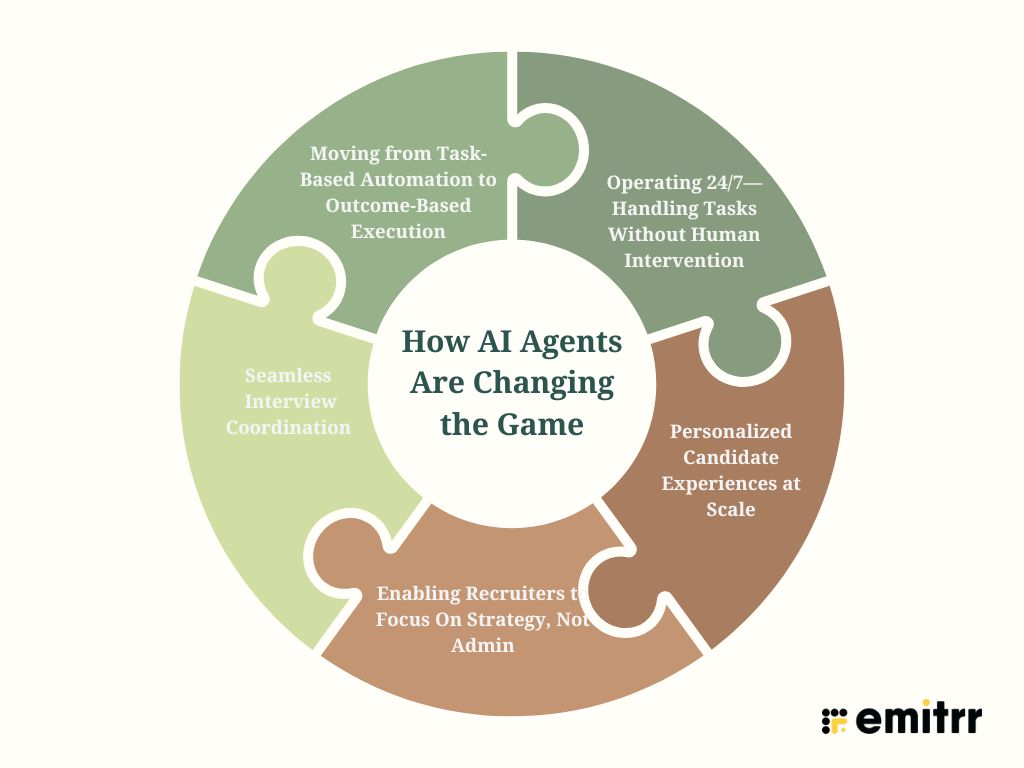
Traditional automation tools are rule-based—they execute fixed instructions without adapting to the situation. That means they can send a follow-up email, but can’t tell if the candidate needs a reminder or a nudge. The result? A rigid, disconnected experience.
AI agents change that. They learn from interactions, understand context, and respond in ways that feel timely and relevant, not robotic.
Moving from Task-Based Automation to Outcome-Based Execution
Legacy automation stops at tasks—send an email, log an update, move a candidate. But the why behind the task is often ignored. AI agents are built to deliver actual results by offering benefits such as:
- Fewer bottlenecks: If feedback from a hiring manager is pending, the agent follows up till it’s received.
- Smarter actions: Rather than sending a reminder blindly, the agent checks if the candidate has opened previous emails or taken any action.
- Continuous optimization: Agents track outcomes like time-to-hire and drop-off rates and adjust communication frequency or timing accordingly.
Operating 24/7—Handling Tasks Without Human Intervention
Candidates expect answers now, not 48 hours later. Waiting creates uncertainty and increases the chance of drop-offs. AI agents solve this by:
- Handling FAQs instantly, from job role clarifications to next-step queries
- Sharing timely updates on application status, interview schedules, or pending actions
- Escalating exceptions (like repeated no-shows or inactivity) to recruiters automatically
That kind of always-on support builds trust and keeps candidates engaged, especially during critical decision windows.
Personalized Candidate Experiences at Scale
Mass hiring usually comes at the cost of personalization. With AI agents, you don’t have to choose. Here’s how AI agents make each candidate feel seen:
- Uses name, job role, and previous interactions to tailor responses
- Adjusts tone and frequency of communication based on behavior
- Sends relevant nudges (e.g., reminders for assessments, links to role-specific FAQs)
- Flag high-intent candidates based on interaction patterns for recruiter follow-up
This level of personalization—without additional manual work—makes your hiring experience stand out, even at scale.
Enabling Recruiters to Focus On Strategy, Not Admin
Recruiters spend too much time updating CRMs, writing follow-ups, or tracking down feedback. With AI agents, those repetitive tasks are fully automated:
- Interview coordination, feedback loops, candidate nudges—all handled by AI
- Data is automatically updated in your ATS/CRM
- Exceptions escalated only when human input is needed
This lets recruiters focus on what moves the needle: sourcing great candidates, running strategic hiring campaigns, and improving the employer brand.
Seamless Interview Coordination
Coordinating interviews manually is time-consuming and error-prone, especially when calendars clash or reschedules are frequent.
AI agents simplify this entire workflow by:
- Syncing with calendars to suggest optimal interview slots automatically
- Handling rescheduling without human intervention
- Sending real-time confirmations and reminders to both candidates and interviewers
- Following up post-interview to collect feedback and move candidates ahead
This reduces delays, avoids back-and-forth emails, and keeps the hiring pipeline active without recruiter intervention.
How to Implement AI Agents in Your Recruitment Strategy
When implemented right, AI agents can significantly reduce drop-offs, speed up hiring cycles, and boost candidate satisfaction. But getting it right requires a strategic, phased approach. Here’s how to get started:
Identify Workflow Gaps and Candidate Drop-Off Points
Start with an honest review of your current hiring process. Where are the delays happening? Which stages are repetitive or inconsistent? What’s causing candidate churn?
Some common red flags include:
- High drop-off rates after the initial screening
- Delays in interview scheduling
- Inconsistent follow-ups with candidates
- Recruiters spending hours manually parsing resumes or writing emails
This step isn’t just diagnostic—it gives you clarity on where AI can take over routine work, letting your team focus on conversations and decisions that need a human touch.
For example, if you’re consistently seeing drop-offs between screening and scheduling, that’s a clear signal that an AI scheduling agent could create a more responsive and seamless experience.
Choose Recruitment-Focused AI Agents
Not all AI tools are created equal. What you need are agents trained on recruitment workflows— AI agents like Emitrr that understand the context of hiring and can interact with both candidates and internal systems naturally.
When evaluating AI agents, look for:
- ATS/CRM integration: Can it plug into your existing stack and fetch candidate or job data on its own?
- Conversational ability: Does it communicate clearly across channels like email, SMS, and chat?
- Smart resume parsing: Can it extract the right information from resumes and match them with job roles?
- Candidate support: Can it handle multilingual conversations or respond to common queries in real-time?
- Analytics readiness: Does it give you real-time insights into funnel drop-offs or candidate engagement trends?
This step ensures you’re not just adding AI for the sake of it—you’re building the foundation for a smarter, more scalable hiring engine.
Train Your Recruiters to Work With AI, Not Around It
Your recruiters are still the drivers of your hiring strategy, but they need to understand how to collaborate with AI agents to get the best results.
Here’s what that might look like in practice:
- Interpreting AI-generated insights: Agents can flag sentiment from candidate conversations or recommend top resumes, but your team needs to decide how to act on that data.
- Customizing outreach prompts: Recruiters should be able to tweak the tone, content, and timing of messages the agent sends.
- Refining workflows: Based on how agents perform over time, your team can suggest refinements, s—like adding screening questions or changing follow-up intervals.
With the right training, your recruiters can move away from being task managers and become strategic decision-makers who focus more on candidate experience, hiring velocity, and quality.
Set Up Continuous Measurement and Optimization
You’ll only know if your AI agents are working if you’re measuring the right things. Don’t just count messages sent or resumes parsed—look at the real impact.
Key metrics to track include:
- Time-to-hire: Are roles being filled faster than before?
- Response and engagement rates: Are more candidates responding to outreach and moving forward in the funnel?
- Conversion from offer to join: Are drop-offs after offer acceptance going down?
- Manual hours saved: Are recruiters spending less time on scheduling, filtering, and chasing?
Over time, these metrics will help you refine agent behavior, adjusting tone, timing, or workflow triggers to improve outcomes.

The Future of AI Agents and Technology in Recruitment
As hiring processes become more competitive and candidate expectations evolve, recruitment teams are rethinking how they manage speed, scale, and candidate experience. AI agents are moving from experimental tools to essential components of modern recruitment operations—and what lies ahead will shape how companies attract and retain talent in the long run.
Here are some of the major shifts we can expect:
Autonomous Recruitment Processes
We’re moving toward recruitment models where AI agents aren’t just supporting tasks, but managing entire hiring workflows autonomously. These agents will:
- Source candidates based on job descriptions and historical hiring data
- Screen applicants using structured criteria, reducing bias and improving consistency
- Coordinate interviews by syncing with recruiters’ calendars and candidate availability
- Offer basic onboarding information and handle pre-employment paperwork
The ability of AI agents to take over high-volume, repeatable tasks across the hiring funnel can help businesses scale recruitment without constantly increasing headcount.
More Personalized Candidate Experiences
AI in recruitment is no longer just about automation; it’s about personalization at scale. Advanced AI agents will:
- Tailor responses based on candidate history and role preferences
- Send reminders and updates at the right time, across channels (SMS, email, chat)
- Answer FAQs in real time, reducing uncertainty and wait times
- Adjust tone and message structure depending on where the candidate is in the process
Proactive Talent Pipelining
AI agents will start playing a more predictive role in hiring, rather than just being reactive. They’ll help businesses:
- Anticipate hiring needs based on growth trends, seasonality, and historical data
- Maintain active candidate pools, even when positions aren’t immediately open
- Re-engage past applicants when a matching role opens up
- Provide alerts when top talent becomes available in the market
This shift turns recruitment from a reactive function into a strategic one, where businesses are always prepared with qualified talent.
Seamless Integration with HR Systems
The future of AI recruitment will rely heavily on how well AI agents integrate with existing systems, like applicant tracking systems (ATS), customer relationship management (CRM) tools, payroll, and onboarding platforms.
When these agents can pull and push data across tools:
- Recruiters don’t need to jump between platforms
- Candidate information is up-to-date and accessible in real time
- Follow-ups and reminders can be automated based on system triggers
- Hiring workflows become smoother and less error-prone
FAQs
AI is utilized in talent acquisition to automate repetitive tasks, enhance candidate engagement, and improve decision-making through data analytics.
AI can be employed to source candidates, screen resumes, schedule interviews, and provide personalized communication, thereby streamlining the recruitment process.
The best AI tool depends on organizational needs. Platforms like Emitrr offer comprehensive solutions that integrate seamlessly with existing HR systems.
AI analyzes employee data to predict turnover risks, identify engagement drivers, and recommend personalized development plans, aiding in talent retention.
AI agents use machine learning algorithms to assess resumes, evaluate candidate fit, and rank applicants based on predefined criteria, enhancing screening efficiency.
AI agents facilitate onboarding by providing new hires with necessary information, scheduling training sessions, and answering common queries, ensuring a smooth transition.
AI agents can be programmed to focus on objective criteria, minimizing unconscious bias. However, it’s essential to ensure the training data is diverse and representative to avoid perpetuating existing biases.
AI agents can identify skill gaps, recommend personalized learning paths, and track progress, facilitating continuous talent development.
AI agents integrate through APIs and data connectors, enabling real-time data exchange and cohesive workflow management across HR platforms.
Conclusion: Scale Your Hiring Process with Emitrr
AI agents are reshaping the recruitment landscape, driving efficiency, precision, and a more personalized experience. By automating routine tasks, AI enables recruiters to focus on strategic decisions that make a real impact. This shift not only accelerates hiring processes but also enhances the candidate experience, fostering stronger talent relationships.
With platforms like Emitrr leading the charge, AI-powered tools are optimizing recruitment workflows from start to finish. If you’re aiming to lower hiring costs, reduce time-to-hire, and improve the overall candidate journey, now is the perfect time to integrate AI into your talent acquisition strategy.
Book your free Emitrr demo today and see how AI can transform your recruitment process.