
 4.9 (400+
reviews)
4.9 (400+
reviews)
Introduction
Effective communication keeps a healthcare network alive and thriving. In single-site practices, conversations can happen naturally among team members. Add two, three, or ten locations, and the story changes. Miscommunication can creep in quickly, threatening consistency, patient satisfaction, and compliance.
In this article, we’ll examine proven strategies for improving communication across multi-location clinics, supported by examples, real-world data, and a few practical tools you can use immediately.
Quick Highlights
- Miscommunication arises from inconsistent processes and scattered tools
- Standard governance improves clarity and accountability
- Unified systems keep teams aligned across locations
- Consistent documentation ensures accuracy and compliance
- Regular training strengthens collaboration
- KPIs help track and fix communication gaps
- Automation and AI reduce manual effort and missed messages
- Centralized communication improves patient experience
- Regular audits prevent breakdowns
- Emitrr streamlines and unifies communication across locations
Why Multi-Location Clinics Struggle with Communication
According to a study, nearly 48% of business owners experience miscommunication several times a day, and every single one reports it at least weekly. When that pattern extends across multiple medical sites, the fallout multiplies fast. Patients receive different answers depending on where they call, documentation styles vary, and policies drift apart from the organization’s core protocols.
Common causes include:
| Challenge | Description | Impact on Clinics |
| Inconsistent processes | Each location develops its own way of operating. | Lack of standardization confuses staff and patients. |
| Poor feedback systems | No formal method to escalate or resolve communication breakdowns. | Issues repeat instead of being fixed. |
| Overloaded staff | Teams juggle high workloads and scattered communication across channels. | Messages are lost or misinterpreted. |
| Fragmented tools | Different systems for chat, EHR, and reporting. | Incomplete or delayed information sharing. |
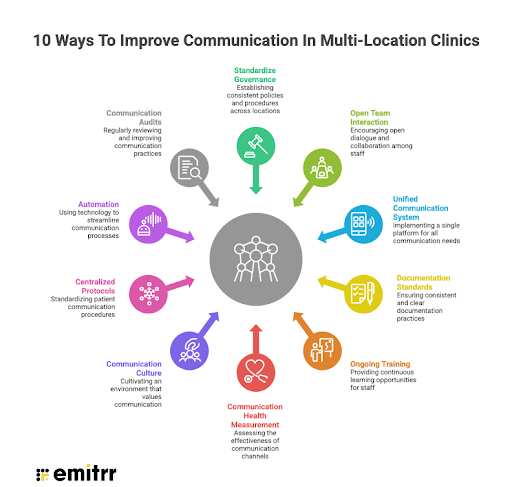
10 Ways To Improve Communication In Multi-Location Clinics
As clinics expand across locations, communication becomes more complex and harder to control. Below are 10 practical, proven ways to bring clarity, consistency, and coordination across every site in your network.
1: Standardize Governance and Structure
The foundation for reliable communication is clear authority. Stability in multi-location operations depends on consistent governance and supervision standards.
Key actions:
- Create and publish a delegation matrix detailing who manages what at every level.
- Define escalation pathways for clinical questions, HR concerns, and patient complaints.
- Appoint a site communication lead who reports to a central coordinator.
Example:
A regional dermatology group implemented a tiered supervision model where every nurse practitioner knows exactly who to contact for order verification. Within months, compliance errors dropped 22%.
2: Encourage Open Team Interaction
It is emphasized that no manual can replace conversation. Clinics need structured dialogue at every level, such as weekly leadership calls, monthly all-staff check-ins, and cross-site learning sessions.
Consider integrating these formats:
- Case collaboration huddles: Teams share lessons from complex patient interactions.
- Rotating leadership stand-ups: Site managers present updates and discuss operational roadblocks.
- Peer-exchange chat channels: Instant platforms for inter-site questions.
Real scenario:
A physical therapy network in three states launched a 15-minute daily “morning sync” across Zoom. Clinicians found early clarification of the day’s patient list reduced duplicate charting by 30%.
3: Use Unified Communication System
Email alone cannot support real-time healthcare dialogue. A single, integrated communication hub, one that merges secure messaging, patient collaboration, and internal alerts, gives teams a common language.
Practical recommendations:
- Consolidate to a HIPAA-compliant texting software integrated with your EHR.
- Set visibility rules so team members can see updates relevant to their function.
- Track conversation threads related to patient care directly within records.
4: Build Consistency Through Documentation Standards
Audits often reveal how easily documentation drifts between sites. Charting standards should not be negotiable.
Checklist for consistency:
- Enforce uniform SMS templates for healthcare and medical forms.
- Set time targets for chart closure (e.g., 24 hours after visit).
- Monitor compliance through centralized reporting dashboards.
By equalizing documentation habits, staff gain clarity, and administrators obtain faster insights into trends such as delayed follow-ups or missed signatures.
5: Invest in Ongoing Training and Feedback
Training is most effective when treated as a continuous conversation rather than an annual event. Host scenario-based workshops focused on real communication issues, such as how to clarify ambiguous orders or manage inter-site disagreements.
According to Medical Economics, recurring cross-departmental sessions improve collaboration and increase employee retention. The reason is simple: when people feel connected, they stay.
Tip: Wrap meetings with a feedback loop. Ask every participant to share one confusion point or success story from their experience that week. Document themes and readdress them in future sessions.

6: Measure Communication Health
To truly manage communication, you need to measure it. Consider tracking the following key performance indicators (KPIs):
| KPI | Metric Definition | Ideal Target |
| Message response time | Average time to acknowledge internal messages. | <1 hour during business hours |
| Handoff completion rate | Percentage of transitions logged correctly. | ≥95% |
| Cross-site meeting attendance | Percentage of staff joining required sessions. | ≥90% |
| Error recurrence | Number of repeated issues after resolution. | <10% |
Analytical dashboards spotlight whether teams are slipping into silence or keeping workflows transparent.
7: Foster a Culture That Values Communication
Technology and training are useless if the culture dismisses communication as “extra work.” Leadership must model open, respectful dialogue, where every site’s opinion is valued.
Culture example:
A large primary-care organization celebrated “Communication Champions” quarterly and staff who improved inter-site collaboration. This recognition encouraged others to prioritize clarity and consistency.
8: Centralize Patient Communication Protocols
When patient communication varies across locations, trust erodes quickly. A centralized approach ensures that no matter which clinic a patient interacts with, the experience remains consistent.
Key actions:
- Create standardized scripts for common interactions like appointment confirmations, billing queries, and follow-ups.
- Define tone and response guidelines for SMS, calls, and emails.
- Use shared templates for patient education and discharge instructions.
Example:
A multi-location dental chain standardized its appointment reminder scripts and reduced no-show rates by 18% while improving patient satisfaction scores.
Learn how to keep your schedule full at your healthcare practice and reduce no-show rates in this video:
9: Leverage Automation to Reduce Communication Gaps
Manual communication processes often break down at scale. Healthcare automation can eliminate repetitive tasks and ensure that critical updates are delivered on time without relying on human follow-through.
Where automation helps most:
- Automated appointment reminders and rescheduling alerts
- Internal notifications for lab results or urgent updates
- Task assignments and follow-up triggers
Real scenario:
A cardiology network automated post-visit follow-ups and internal alerts for abnormal test results. This reduced missed follow-ups by 25% and improved care coordination across sites.
10: Conduct Regular Communication Audits
Even well-designed systems degrade over time. Regular audits help identify breakdowns before they affect patient care or compliance.
Audit checklist:
- Review message response times across locations
- Analyze recurring communication errors or delays
- Evaluate tool usage consistency among teams
- Gather staff feedback on communication bottlenecks
Insight:
A healthcare group conducting quarterly communication audits discovered that one location relied heavily on informal messaging. After aligning it with standardized tools, response efficiency improved by 35%.
How Emitrr Powers Communication in Multi-Location Clinics
Managing communication across multiple clinic locations becomes significantly easier when systems, workflows, and conversations are unified. Emitrr helps healthcare practices centralize communication, reduce manual effort, and ensure consistency across every site.
Here’s how Emitrr strengthens communication across multi-location clinics:
Unified Inbox Across Locations
- Manage patient conversations from all locations in one centralized, intuitive dashboard
- Route messages to the right team or location without confusion
- Maintain full visibility into ongoing interactions
Healthcare Compliance
- Secure HIPAA-compliant communication
- Protect patient data while enabling fast, real-time communication
- Maintain audit trails for every interaction
Automated Workflows and Alerts
- Automate appointment reminders, follow-ups, and internal notifications
- Trigger alerts for missed messages, urgent updates, or patient responses
- Convert missed calls into instant text responses to ensure no patient inquiry is lost
- Use an AI SMS agent for healthcare to handle routine queries, responses, and follow-ups automatically
- Reduce dependency on manual communication processes
What happens after a missed call across your multi-location clinic, and should you rely on an AI receptionist or a smarter AI agent?
Internal Team Collaboration
- Enable staff to communicate across locations through a single platform
- Share updates, patient notes, and tasks without switching tools
- Support multiple languages to improve coordination across diverse teams
- Use speech-to-text to quickly capture and share updates without manual typing
- Improve coordination between the front desk, clinical, and admin teams
Smart Routing and Assignment
- Automatically assign conversations based on location, department, or role
- Ensure no message is missed or delayed
- Improve response time and accountability
Integration with Existing Systems
- Sync communication with EHR and practice management systems
- Connect seamlessly with 500+ integrations such as Athenahealth, DrChrono, Orthotrac, and more
- Keep patient data and conversations connected in one place
- Eliminate fragmented tools and duplicate work
Analytics and Performance Tracking
- Track response times, message volumes, and team performance
- Identify communication gaps across locations
- Make data-driven improvements to workflows
Consistent Patient Experience
- Standardize messaging templates across all locations
- Ensure patients receive the same quality of communication everywhere
- Build trust with clear, timely, and professional interactions
Frequently Asked Questions
Communication becomes complex due to inconsistent processes, fragmented tools, and lack of standardized protocols across locations, leading to delays, errors, and poor patient experience.
Clinics can standardize communication by implementing unified systems, consistent documentation practices, clear governance structures, and shared communication protocols across all sites.
Tools like HIPAA-compliant messaging platforms, centralized dashboards, automation systems, and EHR-integrated communication solutions help streamline communication and reduce gaps.
Emitrr centralizes communication, automates workflows, enables team collaboration, integrates with EHR systems, and ensures consistent, secure messaging across all clinic locations.
Summary
Improving communication in multi-location clinics is not a one-time project. It is an ongoing system of structure, transparency, and engagement. Standardized governance creates order. Digital tools like Emitrr keep messages unified, automate workflows, and connect teams across locations. Continuous meetings and training strengthen relationships.
When every location speaks the same operational language, patients notice the difference. Accuracy improves, waiting times shorten, compliance risks drop, and employees feel part of one cohesive team.
Clear communication is not just an administrative goal; it is a clinical responsibility that directly influences patient outcomes and business success. To experience this in action, schedule a free demo with Emitrr today.