
 4.9 (400+
reviews)
4.9 (400+
reviews)
Introduction
Running a healthcare practice today is more complex than ever. Providers are expected to deliver exceptional patient care while juggling administrative tasks, managing billing processes, ensuring compliance, and maintaining seamless communication, all at the same time.
Without the right systems in place, this often leads to staff burnout, inefficient workflows, revenue leakage, and poor patient experience. This is exactly where eClinicalWorks comes in.
As one of the most widely used electronic health record (EHR) systems, eClinicalWorks helps healthcare providers streamline operations, digitize patient data, and improve both clinical and financial outcomes.
But what exactly does eClinicalWorks do, and how does it help your practice grow? In this comprehensive guide, we’ll break down core features of eClinicalWorks, how it supports the entire patient journey, its benefits and limitations, and how to unlock even more value with better patient communication.
So let’s get started!!
What is eClinicalWorks?
eClinicalWorks is a cloud-based healthcare software platform that combines multiple essential systems into one unified solution. Instead of using separate tools for scheduling, documentation, billing, and patient communication, healthcare providers can manage everything from a single platform.
Core Components of eClinicalWorks
- Electronic Health Records (EHR)
- Practice Management (PM)
- Revenue Cycle Management (RCM)
- Patient Engagement Tools
- Telehealth and Remote Monitoring
What Does eClinicalWorks Actually Do?
At its core, eClinicalWorks is an all-in-one electronic health record (EHR) and practice management software designed to streamline every stage of the patient journey, from the first touchpoint to post-care engagement and payments.
Instead of relying on disconnected tools for scheduling, documentation, billing, and communication, healthcare providers can manage everything within a single, centralized system. The result? Better efficiency, fewer errors, and a significantly improved patient experience.
How eClinicalWorks Works in Real Life
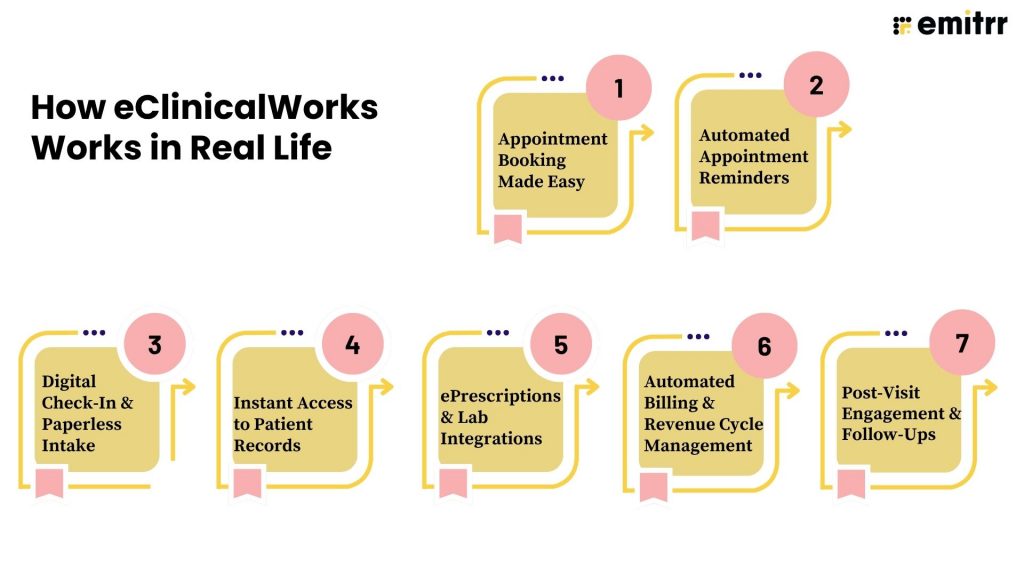
Here’s what a typical patient journey looks like when powered by eClinicalWorks:
Appointment Booking Made Easy
Patients can book appointments through online portals or mobile access, reducing front-desk workload and improving accessibility. Practices can manage schedules, provider availability, and appointment types in real time.
Automated Appointment Reminders
The system automatically sends SMS, email, or voice reminders, helping reduce no-shows and keeping patients informed without manual follow-ups.
Digital Check-In & Paperless Intake
Patients complete forms, insurance details, and consent documents digitally before arrival, eliminating paperwork and speeding up in-clinic workflows.
Instant Access to Patient Records
Providers can view complete medical histories, past visits, medications, allergies, and lab results in one place, enabling faster and more informed clinical decisions.
ePrescriptions & Lab Integrations
Prescriptions are sent electronically to pharmacies, and lab orders are transmitted directly to diagnostic centers, reducing delays, errors, and administrative burden.
Automated Billing & Revenue Cycle Management
From coding to claims submission and payment tracking, the platform automates the entire billing process, improving accuracy and accelerating reimbursements.
Post-Visit Engagement & Follow-Ups
After the visit, patients receive follow-up reminders, care instructions, and engagement messages, ensuring better adherence and long-term care continuity.

Core Features of eClinicalWorks (Detailed Breakdown)
Electronic Health Records (EHR)
At the center of eClinicalWorks is its EHR, the place where every piece of patient information comes together.
Instead of switching between systems or relying on fragmented records, providers get a single, complete view of the patient. Medical history, allergies, medications, lab results, and treatment plans are all stored in one centralized system, making access quick and reliable.
What makes the experience smoother is how the system adapts to clinical workflows. Providers can document visits using structured templates, reducing repetitive work while maintaining consistency. Tools like voice recognition and AI-assisted documentation further simplify note-taking, especially during busy clinic hours.
Key capabilities include:
- Centralized digital patient records
- Customizable clinical documentation templates
- Voice recognition and AI-assisted note-taking
- E-prescribing with direct pharmacy integration
- Lab ordering within the platform
- Secure cloud-based access across locations
All of this works together to reduce time spent on documentation and improve the accuracy and availability of patient data.
Practice Management (PM)
The Practice Management module handles the operational side of running a healthcare practice, everything that happens before and after a patient sees the provider.
From scheduling appointments to managing front-desk workflows, this module ensures that daily operations don’t become chaotic. Staff can view provider availability in real time, making it easier to schedule appointments efficiently and avoid overbooking or gaps.
Patient intake is also simplified. Instead of manual forms and repetitive data entry, the system allows for structured registration and smoother onboarding. Insurance verification happens early in the process, reducing billing issues later.
Core functionalities include:
- Online appointment scheduling with real-time calendar visibility
- Digital patient registration and intake workflows
- Automated insurance eligibility verification
- Staff task and workflow coordination
By organizing these moving parts, the PM module helps create a more predictable and controlled operational environment.
Revenue Cycle Management (RCM)
The Revenue Cycle Management system ensures that the financial side of the practice runs as efficiently as the clinical side.
It begins with translating clinical services into accurate billing through proper coding. Once claims are generated, they are submitted electronically and tracked throughout the reimbursement process.
What sets this system apart is its ability to identify and address issues. Denied or delayed claims are not just flagged; they can be analyzed so practices understand the root cause and take corrective action.
Key components include:
- Medical billing and coding support
- Electronic claims submission and tracking
- Denial management and resolution workflows
- Financial reporting and performance analytics
With better visibility into revenue operations, practices can reduce delays, improve collections, and maintain healthier cash flow.
Patient Engagement Tools
Patient expectations have changed; they now expect the same convenience from healthcare that they get from other digital services. eClinicalWorks addresses this with a range of patient engagement tools.
The patient portal acts as a central access point where patients can view their health records, check lab results, and communicate with providers. This reduces dependency on phone calls and improves transparency.
At the same time, simple features like online booking and automated appointment reminders remove friction from everyday interactions. Patients can schedule appointments, request prescription refills, and stay informed without needing constant staff assistance.
Key features include:
- Patient portal for records, communication, and updates
- Online appointment scheduling
- Prescription refill requests
- Automated appointment reminders
- Mobile access through patient apps
These tools make interactions smoother and more consistent, improving the overall patient experience.
Telehealth & Virtual Care
Healthcare delivery is no longer limited to in-person visits, and eClinicalWorks supports this shift through its telehealth capabilities.
Providers can conduct video consultations directly within the platform, making it easier to handle follow-ups, routine visits, and non-emergency care remotely. This reduces the need for physical appointments while maintaining continuity of care.
Remote patient monitoring adds another layer by allowing providers to track patient health data over time, particularly for chronic conditions.
Key capabilities include:
- Video-based virtual consultations
- Integrated scheduling for telehealth visits
- Remote patient monitoring (RPM)
- Secure communication channels for virtual care
This flexibility allows practices to extend care beyond clinic walls while maintaining efficiency.
e-Prescribing (eRx)
eClinicalWorks includes a robust e-prescribing (eRx) system that allows providers to send prescriptions electronically directly to pharmacies. This reduces errors associated with handwritten prescriptions and speeds up the medication process. It also includes drug interaction alerts, helping providers avoid potentially harmful combinations, and offers seamless integration with pharmacies for a more efficient prescription workflow.
Reporting & Analytics
Data-driven decision-making is a major advantage of eClinicalWorks. Its reporting and analytics tools provide detailed insights into both clinical and financial performance. Practices can generate financial reports to track revenue, analyze patient insights to improve care delivery, and use operational analytics to identify inefficiencies. It also supports compliance reporting, helping organizations meet regulatory requirements.
AI & Automation Features
eClinicalWorks incorporates AI and automation to reduce the burden of repetitive administrative tasks.
One of the most impactful features is the AI-powered medical scribe, which assists in converting conversations into structured clinical notes. This significantly cuts down documentation time.
Automation also plays a role in handling routine workflows—whether it’s sending reminders, updating records, or triggering follow-up actions. Predictive analytics further enhances decision-making by identifying patterns and potential risks within patient data.
Key features include:
- AI medical scribe for automated documentation
- Virtual assistant tools for routine tasks
- Predictive analytics for data-driven insights
- Workflow automation across administrative processes
These capabilities allow practices to operate more efficiently without increasing staff workload.
Population Health Management
Population health management shifts the focus from individual patient visits to broader health trends across groups of patients.
With this feature, providers can identify high-risk patients, track chronic conditions, and monitor overall health outcomes more effectively. It enables a more proactive approach, where care is planned and managed rather than only delivered when issues arise.
The system also helps identify care gaps, such as missed screenings or delayed treatments, allowing providers to intervene early.
Key functionalities include:
- Risk stratification to prioritize patient care
- Chronic disease tracking and management
- Preventive care insights and alerts
- Quality reporting aligned with MIPS and HEDIS
This approach supports better long-term outcomes by focusing on prevention and continuous care rather than reactive treatment.
AI and Workflow Automation
Automation and AI are transforming healthcare operations, and eClinicalWorks incorporates both to reduce inefficiencies. Features like AI-powered documentation minimize manual data entry, while automated workflows handle repetitive administrative tasks such as appointment confirmations and follow-ups. This reduces the burden on staff and allows them to focus on higher-value activities.
Impact: This improves operational efficiency, reduces administrative workload, and saves significant time across the organization.
Benefits of Using eClinicalWorks
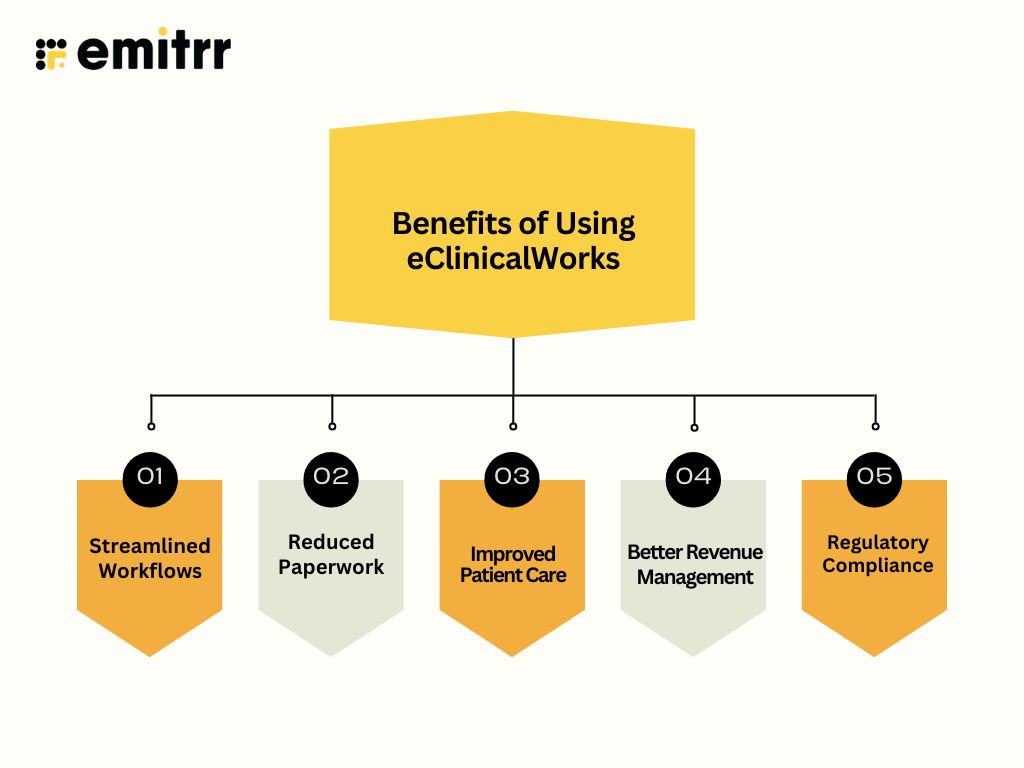
- Streamlined Workflows: eClinicalWorks connects clinical, administrative, and billing processes into one system, reducing manual handoffs. This leads to faster operations, fewer errors, and better coordination across teams.
- Reduced Paperwork: Digital records and automated documentation eliminate the need for paper-based processes. This saves time, reduces storage needs, and minimizes the risk of lost or incomplete records.
- Improved Patient Care: Providers get instant access to complete patient histories, lab results, and treatment plans. This enables quicker decisions, more accurate diagnoses, and a better overall patient experience.
- Better Revenue Management: Integrated billing and RCM tools streamline claims, payments, and follow-ups. This helps reduce denials, improve cash flow, and ensure more consistent revenue collection.
- Regulatory Compliance: Built-in compliance features help practices adhere to standards like HIPAA. This ensures patient data security while reducing the risk of legal or financial penalties.
How Emitrr Enhances eClinicalWorks
While eClinicalWorks efficiently manages clinical and operational workflows, real-time patient communication and engagement often remain limited. This is where Emitrr steps in to enhance and extend its capabilities.
Where eClinicalWorks Falls Short
Despite its strengths, eClinicalWorks has limitations in communication. Inbound calls often lack real-time patient context, requiring staff to manually search for details. Communication is mostly one-way, and automation is limited, making patient follow-ups inconsistent. Additionally, patient communication is not deeply tracked within records, leading to fragmented visibility.
What Emitrr Adds
Real-Time Patient Context on Incoming Calls
Emitrr automatically pulls patient and appointment details during incoming calls, giving staff instant context without switching screens. This reduces call handling time and eliminates repetitive questions. As a result, conversations become faster, more personalized, and more efficient.
Schedule-Driven Automation (Powered by ECW Data)
Emitrr uses eClinicalWorks schedule data to trigger automated workflows like reminders, confirmations, and follow-ups. This ensures timely and consistent communication without manual effort. Practices can also run recall and reactivation campaigns automatically, improving patient engagement at scale.
Two-Way Messaging Synced with Appointment Status
Emitrr enables two-way texting based on real-time appointment status, allowing patients to respond instantly. Unlike one-way reminders, this creates real conversations between patients and staff. It improves response rates, boosts engagement, and helps reduce no-shows.
Write-Back to Patient Records in eClinicalWorks
Emitrr ensures all communication is written back into eClinicalWorks, keeping records centralized. Conversations are stored as documents or PDFs within patient charts. This provides a complete communication history, supporting compliance and better continuity of care.
Two-Way Patient Messaging
Unlike basic notification systems, Emitrr enables real-time, two-way conversations with patients. Patients can reply to messages, ask questions, or confirm appointments directly via SMS. Staff can manage all conversations from a centralized inbox, ensuring nothing gets missed. This creates a more interactive and responsive patient experience.
Schedule-Driven Automation
Emitrr uses appointment data from eClinicalWorks to automate key patient touchpoints like reminders, confirmations, and follow-ups. Instead of relying on staff to manually reach out, communication is triggered automatically based on the schedule. This ensures patients are always informed and engaged at the right time. As a result, practices can significantly reduce no-shows and improve operational efficiency.
Missed Call-to-Text Automation
If a patient’s call goes unanswered, Emitrr automatically sends a follow-up text message to re-engage them. This helps practices recover missed opportunities without requiring manual callbacks. Patients can respond via text, making it easier to continue the conversation. This simple feature can significantly improve lead capture and responsiveness.
Frequently Asked Questions
eClinicalWorks is an all-in-one healthcare software that helps manage electronic health records (EHR), scheduling, billing, and overall practice operations.
Yes, but its communication capabilities are relatively basic and often limited to notifications or portal-based interactions.
Emitrr enhances eClinicalWorks by adding advanced communication features like two-way texting, automated reminders, missed call-to-text, and real-time patient engagement.
Yes, Emitrr integrates with eClinicalWorks to sync appointment data and write communication records back into patient charts.
No, Emitrr is not a replacement. It works alongside eClinicalWorks to enhance patient communication and engagement.
By automating reminders, confirmations, and follow-ups, Emitrr ensures patients stay informed and are more likely to attend their appointments.
Conclusion
eClinicalWorks is more than just an EHR; it’s a comprehensive healthcare management platform that brings together clinical, administrative, and financial workflows into one system.
From managing patient records to optimizing billing and enabling telehealth, it helps practices operate more efficiently and deliver better care.