
 4.9 (400+
reviews)
4.9 (400+
reviews)
Introduction
Despite the rapid digitization of healthcare, faxing continues to play a critical role in the exchange of medical information. From sending patient records and prescriptions to sharing insurance documents and referrals, fax remains deeply embedded in healthcare workflows due to its simplicity, reliability, and long-standing legal acceptance.
However, there’s a common misconception that faxing is inherently secure and automatically HIPAA compliant. This belief can be risky. While traditional faxing methods were once considered secure due to point-to-point transmission, modern threats, human errors, and evolving compliance standards have changed the landscape.
Today, simply using a fax machine or fax service does not guarantee compliance. Healthcare organizations must ensure that their faxing processes meet strict regulatory standards designed to protect sensitive patient data.
In this blog, we’ll break down what makes a fax service HIPAA compliant, provide a complete compliance checklist, and share practical guidance to help you securely manage fax communications in your organization.

What Is HIPAA Compliance in Faxing?
Understanding HIPAA Basics
The Health Insurance Portability and Accountability Act (HIPAA) is a regulatory framework designed to protect sensitive patient data and ensure privacy in healthcare communications. Any system or process that involves patient information must comply with HIPAA requirements.
At the center of HIPAA is Protected Health Information (PHI), any data that can identify a patient and relates to their health condition, treatment, or payment details. This includes names, medical records, test results, insurance information, and more.
HIPAA compliance is governed by three key rules:
- Privacy Rule: Defines how PHI can be used and disclosed, ensuring patient confidentiality
- Security Rule: Establishes safeguards (administrative, physical, and technical) to protect electronic PHI
- Breach Notification Rule: Requires organizations to notify affected individuals and authorities in case of a data breach
Together, these rules ensure that healthcare organizations handle patient data responsibly and securely.
Why Faxing Falls Under HIPAA
Faxing falls under HIPAA because it is commonly used to transmit documents that contain PHI. Whether it’s a patient’s lab results, referral notes, or billing information, fax communications often involve highly sensitive data.
HIPAA regulations apply to all entities involved in handling this data, including:
- Healthcare providers (clinics, hospitals, dental practices)
- Insurance companies and payers
- Business associates (third-party vendors like fax service providers)
This means that both the sender and the fax service provider share responsibility for ensuring that PHI is transmitted securely and handled in a compliant manner.
Is Faxing Still HIPAA Compliant in 2026?
The short answer is: Yes, faxing can still be HIPAA compliant, but only when proper safeguards are in place.
Traditional fax machines were originally considered secure because they transmitted data over dedicated phone lines. However, they come with significant risks today, such as unauthorized access, misdirected faxes, and a lack of audit controls.
On the other hand, online or cloud-based fax services have modernized the process by introducing advanced security features like encryption, access controls, and activity tracking.
Here’s how they differ:
- Traditional fax machines:
- Manual processes
- Limited security controls
- Higher risk of human error and physical exposure
- Online/cloud fax services:
- Automated and digital workflows
- Built-in security features (encryption, authentication)
- Better visibility and control over data
When comparing manual vs digital processes, digital faxing clearly offers stronger compliance capabilities. However, even cloud fax solutions must be properly configured and managed to meet HIPAA standards.
HIPAA Fax Compliance Checklist
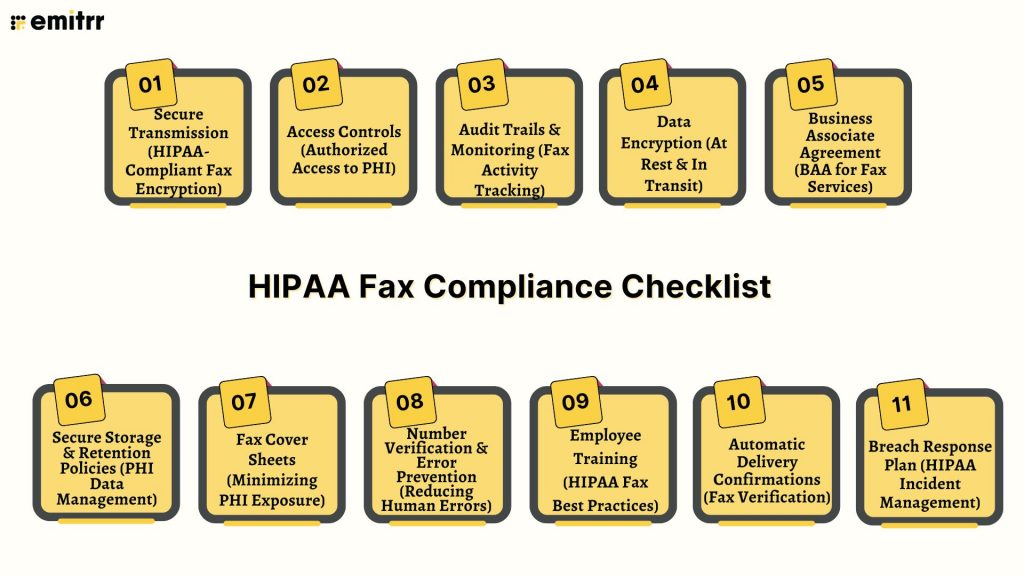
To ensure your fax service is truly HIPAA compliant, it must follow a set of security, privacy, and administrative safeguards designed to protect Protected Health Information (PHI). Below is a simplified and easy-to-understand breakdown of each requirement, along with why it matters.
Secure Transmission (HIPAA-Compliant Fax Encryption)
A HIPAA-compliant fax service must protect data while it is being sent. This is done using encryption protocols such as TLS or secure fax servers. In simple terms, encryption ensures that even if someone tries to intercept the fax during transmission, they won’t be able to read it. This is especially important for online fax services and cloud faxing, where data travels over the internet.
Access Controls (Authorized Access to PHI)
Not everyone in your organization should have access to faxed documents. HIPAA requires strict access controls to limit exposure of sensitive data.
This includes:
- Unique user logins (no shared accounts)
- Role-based permissions (access based on job role)
- Multi-factor authentication (MFA) for added security
These measures ensure that only authorized personnel can view or send PHI, reducing the risk of internal data breaches.
Audit Trails & Monitoring (Fax Activity Tracking)
A HIPAA-compliant faxing system should maintain detailed records of all fax activities. This includes tracking details such as who sent or received the fax, date and time (timestamps), and delivery status (successful or failed). These audit logs create accountability and are essential during HIPAA audits or investigations, helping you prove compliance.
Data Encryption (At Rest & In Transit)
HIPAA requires that PHI be protected both:
- In transit (while being sent)
- At rest (while stored in the system)
This means your fax service should encrypt stored documents in secure cloud storage or servers. Even if a system is hacked, encrypted data remains unreadable, ensuring data security and HIPAA compliance.
Business Associate Agreement (BAA for Fax Services)
If you’re using a third-party fax service provider, they must sign a Business Associate Agreement (BAA). A BAA is a legal contract that ensures the vendor follows HIPAA regulations, protects PHI, and takes responsibility in case of a breach. Without a BAA, your faxing process is not HIPAA compliant, even if the technology is secure.
Secure Storage & Retention Policies (PHI Data Management)
A compliant fax system must securely store documents and define how long they are kept. Best practices include controlled access to stored files, defined retention periods based on regulations, and automatic deletion of outdated documents. This reduces unnecessary exposure of PHI and ensures proper data lifecycle management.
Fax Cover Sheets (Minimizing PHI Exposure)
HIPAA- Compliant Fax cover sheets act as the first layer of protection. They should:
- Include a confidentiality disclaimer
- Contain minimal or no sensitive patient data
If a fax is sent to the wrong recipient, the cover sheet helps prevent immediate exposure of PHI and supports HIPAA privacy compliance.
Number Verification & Error Prevention (Reducing Human Errors)
One of the biggest risks in faxing is sending information to the wrong number. A HIPAA-compliant fax solution should include:
- Pre-saved and verified contact lists
- Confirmation prompts before sending
- Delivery verification alerts
These features significantly reduce human error, which is the leading cause of fax-related HIPAA violations.
Employee Training (HIPAA Fax Best Practices)
Even the most secure system can fail if employees are not properly trained. Staff should be educated on HIPAA compliance requirements, secure faxing procedures, and how to handle and report incidents. Regular training ensures that your team understands how to safely manage PHI and HIPAA-compliant fax workflows.
Automatic Delivery Confirmations (Fax Verification)
A compliant fax system should provide delivery confirmations for every transmission. This helps in ensuring the fax reaches the correct recipient, identifying failed or delayed transmissions, and maintaining proper documentation for compliance. These confirmations act as proof of secure communication.
Breach Response Plan (HIPAA Incident Management)
Even with strong safeguards, breaches can happen. That’s why HIPAA requires a clear breach response plan.
This plan should include:
- Immediate steps to contain the breach
- Notification procedures for affected parties
- Proper documentation and reporting
How Emitrr Ensures HIPAA-Compliant Faxing
Emitrr simplifies HIPAA-compliant communication by offering a secure, all-in-one platform designed specifically for healthcare providers.
Built-In Compliance Features
Emitrr’s cloud-based fax solution includes essential compliance capabilities such as secure fax transmission, role-based access controls, and detailed audit logs. These features ensure that every interaction involving PHI is tracked, protected, and compliant with regulations.
Advanced Capabilities
Beyond faxing, Emitrr enhances operational efficiency through seamless EMR/EHR integrations, automated workflows, and a centralized communication dashboard. This allows healthcare teams to manage all patient interactions from fax to messaging in one secure environment.
Why It Stands Out
Emitrr is designed with both compliance and usability in mind. Its intuitive interface reduces the risk of human error, while its robust security infrastructure ensures that sensitive patient data is always protected. By combining multiple communication channels into a single platform, Emitrr helps healthcare providers streamline operations without compromising on security.
Frequently Asked Questions
Faxing can be safer when proper safeguards are in place, but modern encrypted email solutions can also meet HIPAA compliance requirements.
Yes, any service provider that handles PHI must sign a Business Associate Agreement.
They can be compliant if they include essential features like encryption, access control, and audit trails.
Yes, but only if strict physical, administrative, and technical safeguards are implemented.
Human error, especially sending sensitive information to the wrong recipient, is the most common risk.
Conclusion
Faxing continues to be a vital part of healthcare communication, but it is not automatically HIPAA compliant. Without the right safeguards, faxing can expose sensitive patient information and lead to serious compliance risks.
By following a structured compliance checklist and implementing strong security measures, healthcare organizations can safely continue using fax as part of their workflow.
However, the future of secure communication lies in modern, cloud-based fax solutions that offer built-in compliance, automation, and enhanced security.If you’re looking for a reliable and secure way to manage patient communication, Emitrr provides a HIPAA-compliant platform that combines faxing, texting, and automation in one place, helping you improve efficiency while staying fully compliant. Book a demo today to see how it can transform your workflow