

Introduction to Patient Acquisition
Patient acquisition is the amalgamation of all the strategies a healthcare practitioner implements to attract new patients to their practice. It is the very initial step that marks the patient journey, which is further followed by connecting with the patients, converting them, and retaining them.
If you are a healthcare provider, then acquiring new patients must come as a challenge to you on and off. While you already have a base of patients who come to you whenever they need care, what about the patients who are looking for a top healthcare provider that can solve their problems and provide excellent care? But first, we need to address one question:
Why do Patients Switch Healthcare Practices?
Did you know that as of May 2022, there are a total of 1,073,616 active Physicians in the US?
Now imagine the options that the US population is presented with every time they search for a healthcare provider or a service in their area.
While these are the stats of the whole of the US, there are hundreds of practitioners in each city, which means that the people of the US have ample options to choose from. Even if they avail of service from one practitioner and don’t like the experience, they can simply switch to another.
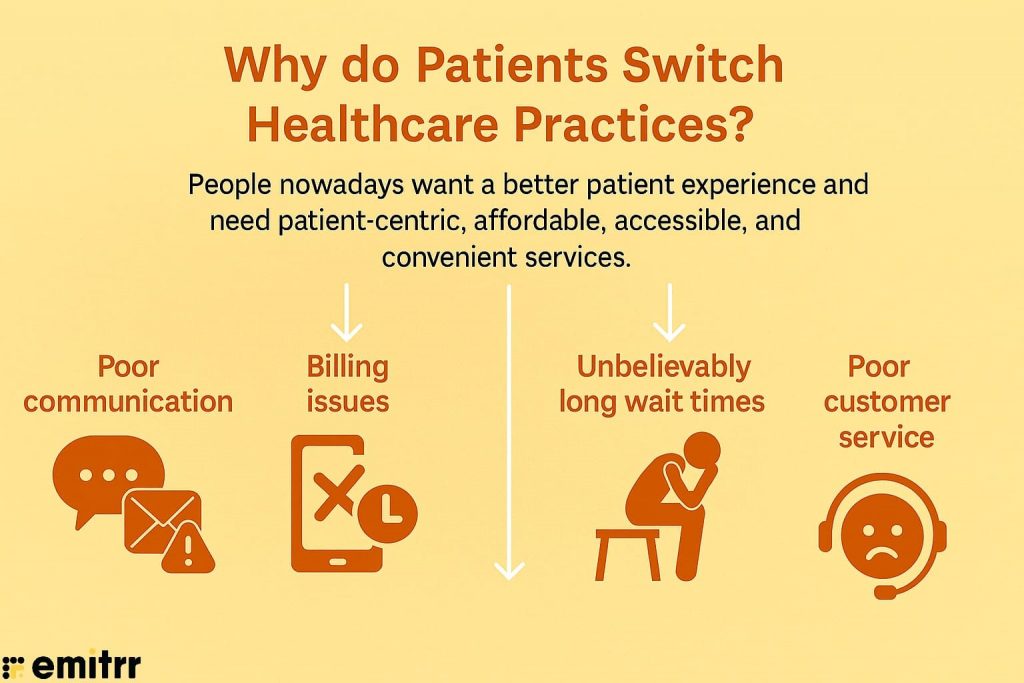
But why does the switch happen?
People nowadays want a better patient experience and need patient-centric, affordable, accessible, and convenient services. A study in 2021 revealed that nearly 33 percent of patients would switch to a healthcare practice that encompasses modern communication tools such as text messaging and automated reminders.
Here’s mainly why people switch practices:
- Poor communication
- Billing issues
- Unbelievably long wait times
- Lack of proper technology
- Poor customer service
In order to ensure that patients don’t leave your practice for a better alternative, you need to keep these pointers in mind and ensure that patient retention is not a problem for you before you start exploring opportunities for new patient acquisition.
What is Patient Acquisition?
Patient acquisition refers to acquiring more patients for your healthcare practice or medical clinic by implementing different kinds of patient acquisition strategies. These strategies can include both offline and online efforts that help you convert a potential patient into a paying one. Acquiring patients is extremely important for healthcare practices to grow their revenue, practice size and overall reputation in the healthcare industry.
Patient acquisition strategies have evolved immensely in 2025, and today, it’s not limited to just handing out flyers. Having a digital presence, implementing digital marketing for patient acquisition, understanding patient journey mapping, and implementing healthcare mobile marketing are all ways you can and should do to remain competitive.

Why is New Patient Acquisition Important?
Let us say that you have a current base of 100 patients who visit your practice whenever they need any healthcare service. How often do those patients visit you: weekly? Monthly? Quarterly?
Well, there is no guarantee or a fixed duration for a patient to visit you. They will make a visit only when it’s required. Since you cannot expect your existing patients to visit you every four days, how is it that you maintain a steady inflow of patients? It’s simple, by acquiring more patients.
New Patient acquisition is important as it keeps your practice running even if your existing patients aren’t visiting you often. While you can retain your existing patients, you can implement healthcare marketing strategies to ensure that you tap the enormous pool of potential people that can visit your practice and constantly keep your schedule full.
Having talked about the importance of patient acquisition, it is also essential that we address the challenges that make patient acquisition a tough nut to crack.
New Patient Acquisition Funnel: Explained
New Patient acquisition funnel refers to the various stages that a patient goes through till they finally decide to choose you as their healthcare provider. This funnel essentially maps the patient’s journey right from- discovery to booking their first appointment.

It is important to understand the new patient acquisition funnel so that:
- You can analyze how patients discover you and evaluate you.
- Identify patient drop-off points
- Fix or optimize your marketing or patient acquisition strategy
Here’s a 6-stage Patient Acquisition Funnel
1. Awareness
The first stage of patient acquisition is awareness. Here, the patient becomes aware that you exist. They probably saw an Ad, landed up on your website, saw your Google listing, heard word of mouth, got referred, etc.
2. Patient Interest
The next stage is patient interest. Now that the patient has discovered you, they will start researching. They will check your website to understand if you offer the service they need. They will check your Google listing and your credentials. They will read patient testimonials and check reviews on healthcare review sites like Healthgrades, Yelp for Healthcare, Google reviews, etc.
3. Consideration
Next, they will compare your reviews and services with other providers. The patient will compare you on the basis of convenience, expertise, services, and insurance acceptance. For this, they may look for clear insurance and pricing information on your website, get in a webchat conversation, or refer to comparison guides.
4. Patient Intent
Once the patient is satisfied with the above step, they will decide to take action now. For this, they will look for an appointment booking option (preferably on your website). They might also decide to call you for an appointment, or they might self-schedule an appointment (if you offer this convenient option).
5. Patient Conversion
At this stage, the patient has booked an appointment with you. However, if you snooze, you lose here. Cancellations and no-shows are very common in healthcare, so make sure to send fast follow-ups and reminders, pre-visit instructions, or give patient portal access to ensure they actually show up to your clinic.
Support better patient engagement with ready-to-use HIPAA-compliant patient texting SMS templates. Download the templates now!
6. Patient Retention/Patient Loyalty
You have successfully acquired a new patient, but is patient acquisition enough? No, you have to think about patient retention/patient loyalty as well. For this, make sure the patient’s first visit goes well and their experience with you is excellent. Send post-appointment patient follow-ups, gather patient satisfaction surveys, and send annual patient recalls to boost patient retention as well.
Each funnel of patient acquisition is equally important, so having metrics to measure the drop-off points and understanding each funnel in depth is essential.
Common Pitfalls of Traditional Patient Acquisition Strategy
Traditional patient acquisition strategy involves acquiring new patients via non-digital marketing methods and getting them onboard via paper form submission. As per Business Wire, today, 80% of patients prefer digital communication and booking channels, and to attract new patients and grow your medical practice, you need to switch to online patient acquisition strategies.
Let us take a look at some common pitfalls of traditional patient acquisition strategy:
- Calling for appointment booking: If the only way patients can book appointments with you is via phone calls, then it is a big problem. Everyone procrastinates, and calling to book an appointment sometimes feels like quite a task, even if it’s not.
- Inconvenience in appointment booking: Traditional patient acquisition strategy involves patients making a call to book appointments. Patients may procrastinate or forget their appointments, especially for non-urgent medical cases, making this way of appointment booking extremely unreliable.
- No confirmation or reminders sent: Traditional methods of appointment booking require your patients to save details of their next visit in a diary or their calendar. Without any confirmations or reminders from your end, they might forget about their appointments, leading to a no-show.
- Too much paperwork for staff: Maintaining paperless records of appointments and reminders could lead to missed opportunities, forgetfulness, and time consumption. Additionally, storing patient health information securely in a physical format may require following a lot more protocol.
- Neglecting digital patient experience: No booking channels and clunky and outdated websites can frustrate patients and make them leave before they even book a visit.
- Compliance issues: Traditional patient acquisition strategy may fail to account for HIPAA and advertising regulations, leading to hefty fines.
Ensure patients receive clear guidance, even when you can’t answer. Download voicemail greetings templates for doctors now!
How to Improve Patient Acquisition in Healthcare? 7 Lesser-Known Ways
Here are some lesser-known ways and insights into improving patient acquisition in healthcare:
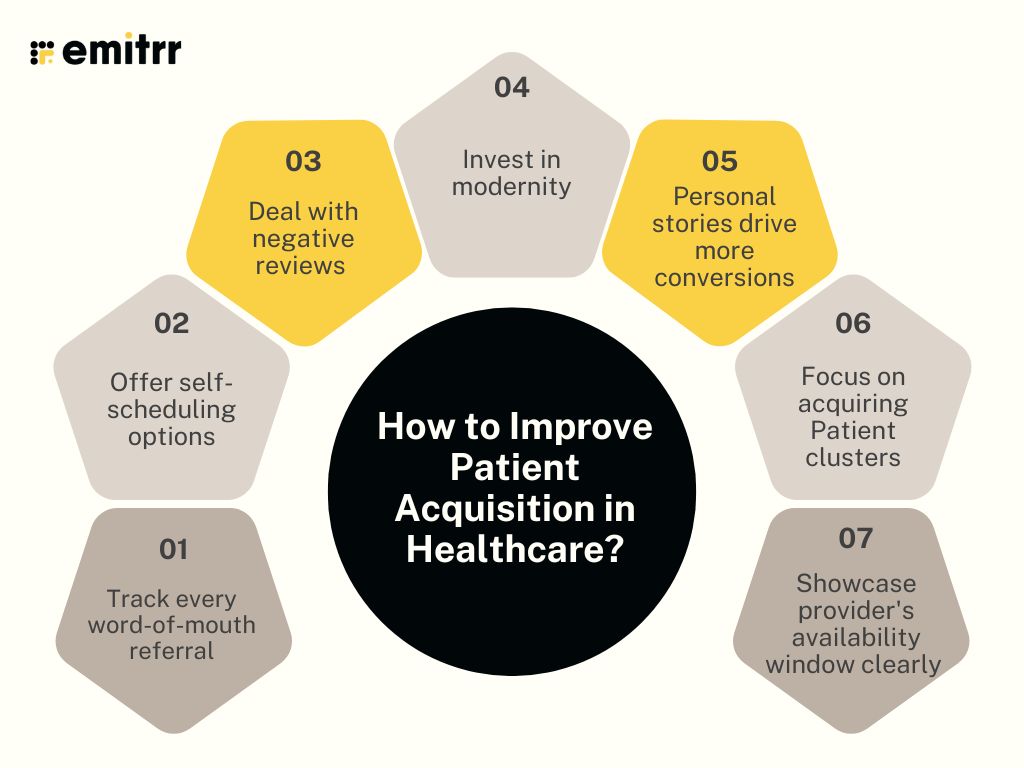
Track every word-of-mouth referral
Many healthcare practitioners under-measure patient word-of-mouth referrals. They don’t realize how a casual- “Oh, I go to them, they are good” pushes patients to the consideration stage directly. In spite of this, no system measures this properly. Post-appointment, consider sending an SMS to your patients asking them to share your information with someone who may need care. Even a 5% response rate could help you attract a lot of new patients.
Offer self-scheduling options
Many healthcare providers think offering just digital booking convenience is enough. However, research shows patients want to see the full range of available slots and feel like they can choose the best available provider themselves rather than just booking quickly. Start offering self-scheduling options with tags like “Earliest,” “Most Popular,” “Recommended by Dr. X, etc., to create a sense of choice for patients.
Deal with negative reviews
Many healthcare providers think negative reviews deter only a few potential patients; however, the impact of negative reviews can be exponential. One negative review out of five total reviews can reduce the click-through rate by 30-40%, even if the other four reviews are positive. Hence, always pay attention and always respond to negative reviews, even if there are a few.
Invest in modernity
Today, patients choose to prioritize providers who appear up to date regardless of differences in clinical quality. For example, a plastic surgery clinic that puts up a “Virtual Tour of Our Facility” video on their website saw 23% more appointment requests. So invest in modernity, showcase photos, virtual tours, and videos, and offer digital patient intake forms to boost patient acquisition.
Personal stories drive more conversions
If your testimonial or website page shows stats (95% success rate) rather than a personal story (I got my life back), you are losing out. Personal stories drive more conversions than stats, so feature short videos of patient stories or testimonials on the first page of your site and appointment landing pages.
Focus on acquiring Patient clusters
Acquiring patient clusters is way more profitable than acquiring single patients. Patients often arrive in groups- with family, community groups, and caregivers. Switch to household-level marketing. Advertise with “We care for the whole family” to acquire multiple patients at once.
Showcase provider’s availability window clearly
Many providers think that patients want the “soonest available” provider when, in reality, they prefer appointments outside of work hours or during the weekends. Start showcasing clear evening and weekend slots on your website and see how it boosts your patient acquisition rate.
Challenges Pertaining to Patient Acquisition

What is Patient Acquisition Cost?
Patient Acquisition Cost is the cost you incur to get a new patient onboard. From reaching out to that person to persuading him/her to avail your services, how much you spend in the form of money, resources and time; is what patient acquisition cost tells you. Patient Acquisition Cost includes:
- Marketing expenses
- Overhead costs
- Taxes
- Wages
How to Calculate Patient Acquisition Cost
Calculating your Patient Acquisition Cost is important as it gives you insights into the strategies that are working well for you and the ones that you need to discontinue. The calculated costs help you understand how much you’re investing to grow your medical practice and how is it that you should be directing your marketing spend.
Here’s an example:
Let’s say that the following is the cost for each of these parameters:
Marketing expenses = $20000
Overhead costs = $5000
Taxes = $5000
Wages = 30000
Number of patients acquired = 250
So now, the patient acquisition cost will be the sum of marketing expenses, overhead costs, taxes, and wages; divided by the number of patients acquired.
PAC = ($20000+$5000+$5000+$30000) / 250 = $240
This means that $240 is the cost of acquiring every new patient. So, let’s say that a patient, who visits you for the first time, generates an income of $100, then you will start gaining profit during the patient’s third visit.
Comparing Patient Acquisition Cost to Patient Lifetime Value
How much a patient is willing to pay for your services throughout his association with your practice is called Patient Lifetime Value. It is an important metric as it helps you understand how much ROI (Return on Investment) you get on acquiring a new patient.
PLV answers your question with respect to translating patient acquisition costs into long-term gains. For you to be able to maximise profits, there needs to be a margin between your patient acquisition cost and patient lifetime value. The greater the margin, the better return you get.
Let’s calculate patient lifetime value:
For example, you run a dental practice. Each average patient visits you 4 times a year, generating an income of $150 per visit. Let’s say that the patient stays with your practice for 5 years. The lifetime value of your patient will be a product of the number of visits (N), the income per visit (I), and the duration (Y). In this case,
PLV = N X I X Y = 4 X $150 X 5 = $3000
This means that an average patient pays $3000 throughout their association with your healthcare practice.
Key Differences Between Patient Acquisition and Patient Retention

Here are the key difference between Patient acquisition vs Patient retention:
Patient Acquisition:
- Focuses on gaining new patients
- Generally more expensive to do (due to marketing and sales costs)
- Typically less difficult to implement compared to retention
- Customer Acquisition Cost Formula:
Cost of marketing and sales divided by the number of customers acquired.
Patient Retention:
- Focuses on developing better relationships with existing patients
- Usually more cost-effective over time
- Often more challenging to implement effectively
- Customer Retention Rate Formula:
(Customers at the end of a period minus new customers) divided by the customers at the beginning.
Top 10 Patient Acquisition Strategies
Now that you have a foundational understanding of patient acquisition, here are some key strategies that will help you acquire new patients.
Run Advertisements
There is no running away from paid ads, Google, Facebook and Instagram ads are a great way for you to attract new patients.
It’s a great way to constantly build your database once you have enough people that know about your business and are willing to receive business communication from you via email and SMS you can continually move people through your funnel and gain more patients.
Create Content that is SEO-friendly
In a world wherein content reigns supreme, you must also make use of this dynamic and utilize content to promote what you do. The best part about content creation is that it is free of cost and an organic way to acquire more patients.
All you need to do is become more active on your Website, Linkedin, Healthgrades, Google my business page or wherever else your audience spends time you can also choose a platform that aligns with your available bandwidth the best.
The idea is to position yourself as a thought leader on these various platforms and back that up with useful, engaging and SEO-friendly content on your website.

Focus on Reviews
Google Reviews constitute an important factor for people to make their purchase decisions, and in your case, reviews from your existing patients can be the path for you to attract new patients.
Whenever a person looks for medical care, they often do a Google search of the service required and then make their decision by analyzing reviews for each of the medical practices or healthcare providers online. The one with the best reviews and star ratings usually wins the race.
So, make sure that you garner as many reviews as possible from your existing and past patients, to be able to present your business in a positive light and make it more credible, needless to add you’ll always show up on the top slots for local searches.
With Emitrr’s online reputation management capability, you can send automatic review requests to your patients and also customize those requests as per your requirements. Also, you can easily manage all the reviews that you garner from different platforms under one roof.
Be active on Social Media
With 5.04 people using social media at present, it is imperative that you have the relevant social media strategies in place to attract that huge customer base. Social media is an opportunity for you to be discovered and to create a good first impression.
Connect with your audience with images, informative videos, fun quotes, and everything else that defines what you do, and how you’re different from others.
Use Email and SMS Marketing
Email marketing is a great communication tool to promote your medical practice and keep your customers informed about any developments or new additions to your services.
With email marketing, you can connect with people at your convenience and convert them into your customers.
You can use SMS to engage with your audience and share special offers etc. to drive in more patients.
Pro tip – Combining Email and SMS communication with paid ads is a great way to convert more patients
Keep an Eye on your Competitors
Just like you, there must have been other healthcare practitioners who are making just the amount of effort to acquire more customers. How are you different from them?
Do a competitor analysis, and see the gaps in their offerings. Make use of those gaps to highlight how you’re better so that your potential customers can be transformed into loyal patients.
Focus on Psychographic Market Segmentation
In order to reach out to a broader audience base, you need to move beyond just age, gender, and health concerns. What are the patient’s priorities in life? What are their goals and beliefs? How can you help them fulfil those priorities?
Think about it and carve your strategies to show that you really care. Your deep interest in their motivations and beliefs will make you more connected with them and will set your practice apart from the competition.
Invest in Print Ads
While Digital Ads can add ample value to your online reputation, it is important that you also tap other forms of media such as print to get your name out. This physical outreach can help you make your way to an audience that is not digitally inclined.
With this, you can make sure that you reach out to people with different interests, preferences, and backgrounds.
Offer Educational Content
As a healthcare practitioner, your job is to not just treat patients, but also educate people on leading a healthy life.
In an era where searching for every small health issue on Google directs you to the possibility of having cancer; it is important that people know to get medical information through a trusted source.
Be that trusted source and assist people with their health concerns, not just in your clinic but online as well.
Focus on Patient Retention too
Merely acquiring patients shouldn’t be your point of focus. If people are entering the doors of your clinic and leaving without turning back, there is something wrong with your strategies. When you acquire a new customer, make the extra effort to retain that customer. Follow patient retention strategies to ensure that you do not lose out on steady revenue.
Grab our free patient texting SMS templates and start sending reminders, follow-ups, and updates that actually get responses.
Difficult patient interactions are inevitable. This video shares practical tips for handling them professionally.
Why Choose Emitrr for New Patient Acquisition?
In a world where healthcare practitioners face cutting-edge competition, how is it that you plan to rise above?
Emitrr can help you achieve your customer acquisition and retention goals through capabilities that keep you close to your patients. With its features such as business messaging, online scheduling, appointment reminders, webchat to text, reviews & reputation management, and text message marketing; you can easily acquire more patients and build lasting relationships with them.
Emitrr is one of the best acquisition solutions, and businesses that use it as their one-stop portal report a 30 percent increase in their customer base. The efficient interface allows for easy integration with your CRM and also helps you grow your reviews and enhance your online reputation.
With Emitrr’s capabilities, you can ensure that you don’t miss calls, track and manage reviews across multiple platforms, follow up with your patients with utter ease, and efficiently maintain a database of your patients.
So what are you waiting for? Book a demo and stay one step ahead of your competitors.
Check out this video and see how you can automate Patient recall with Emitrr:
Patient acquisition Case Study Example
Citryn Marketing is a well-known marketing and web development organization, focused on healthcare. Citryn wanted a way to help their healthcare customers with not just websites and digital marketing but also with healthcare-specific needs like generating reviews, communicating with patients, and ensuring new patient acquisition and retention. As a high-touch organization, they needed a platform that could help them with the patient journey from end to end, as well as a modern, HIPAA-compliant solution that could reach out to their customer’s patients via their preferred method –text– and integrate easily with their current tech stack.
Citryn implemented Emitrr Interactions in September 2020 for its single-location and multi-location clients. When patients would visit the website, they could initiate a webchat query that was converted into a text message, giving the clients an opportunity to continue the conversation even if they patients dropped off the website.
In just 8 months, Citryn has grown to over 30 locations offering digital patient engagement and reputation management services through Emitrr and is able to achieve its patient acquisition and retention goals.
- 3-minute average response time
- 1500+ new reviews
- 2000+ leads through webchat
Read more about their journey here.
Frequently Asked Questions
Patient acquisition refers to acquiring new patients, whereas patient retention refers to building patient loyalty by offering a great experience to your patients.
Patient retention involves building lifetime patient loyalty and acquisition involves gaining new patients. In order to run a successful hospital, both patient retention and acquisition should be taken care of.
You can utilize software like Emitrr to simplify patient acquisition. Emitrr is a complete healthcare communication and engagement software that comes with features like mass texting, text message campaigns, etc., that can help you with patient acquisition.
Patient acquisition success can be measured by six key metrics, including: Conversion rate, patient acquisition cost, Patient lifetime value, patient retention rate, website traffic, social media, and engagement.
Emitrr offers a reliable AI tool for patient engagement. With Emitrr’s AI capability, you can automate responses to website chat, send automated texts upon missed calls, and set up a virtual receptionist for making appointments for medical practice growth.
Patient acquisition specialist can be either a person or a tool that can help you in acquiring new patients for your medical practice and in generating more revenue thereby.
Patient retention refers to the ability of medical healthcare providers to keep their patients engaged and satisfied so that they keep coming back and choosing them over other healthcare providers always.
There are many ways to increase patient volume in clinics; you can create a website and optimize it, run paid ads on Google, use social media channels, or use patient acquisition tools like Emitrr.


 4.9 (400+
reviews)
4.9 (400+
reviews)