
Texting for pharmacy is increasingly used to share updates, reminders, and refill information with patients. Compared to phone calls and voicemails, text messages are faster to deliver and easier for patients to respond to, while reducing avoidable workload for pharmacy staff.
However, many pharmacy teams are unsure what pharmacy texting includes, when it should be used, and how it fits into everyday operations.
This guide explains what pharmacy texting is, why it matters, common use cases, best practices, compliance considerations, and challenges to consider, helping pharmacies understand how texting supports modern patient communication.
AI Summary
- Pharmacy texting is used to send refill reminders, pickup notifications, appointment updates, and follow-ups.
- Prescription text messages are typically faster to read and respond to than phone calls or voicemails.
- Common benefits include reduced inbound calls, quicker patient responses, and more consistent communication.
- HIPAA-compliant pharmacy texting requires patient consent, limited use of PHI, and secure messaging systems.
- Texting is most effective when automated and integrated into existing pharmacy workflows.
What is Texting for Pharmacies?
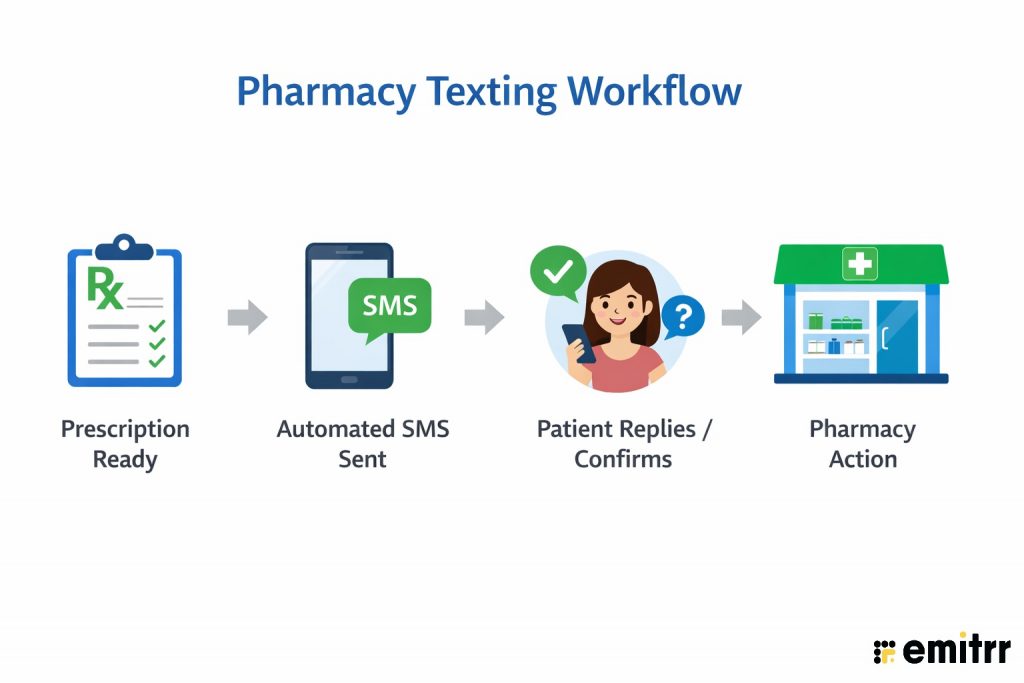
Texting for pharmacy refers to the use of SMS or secure messaging to communicate with patients about prescription status, refills, appointments, and care updates. Unlike phone calls, text messages are typically read within minutes and don’t require staff availability at the moment of delivery.
Most pharmacy texting systems support:
- Automated outbound pharmacy messages
- Two‑way patient replies
- Message templates
- Consent and opt‑out management
- EHR/EMR sync
Is Texting HIPAA‑Compliant for Pharmacies?
Yes, texting for pharmacies can be HIPAA‑compliant when done correctly. The key is how messages are sent and what information they include.
Key Compliance Requirements:
- Patient consent: Patients must explicitly opt in to receive texts.
- Minimal PHI: Avoid including detailed medical information in messages.
- Secure systems: Pharmacy messages should be sent through HIPAA‑compliant platforms, not personal phones.
- Opt‑out management: Every patient must be able to stop Pharmacy messages easily.
TCPA Considerations:
In addition to HIPAA, pharmacies must comply with TCPA rules, which govern consent, message frequency, and opt‑out language.
Why is HIPAA-Compliant Texting Important for Pharmacies
HIPAA-compliant texting allows pharmacies to communicate faster with patients while keeping protected health information secure. It enables safe sharing of refill reminders, prescription text message updates, and pickup notifications, without the risks that come with regular SMS or unsecured messaging.
Texting also helps pharmacies meet modern patient expectations for quick, convenient communication. Instead of long hold times or missed calls, patients get timely updates in a format they already use and trust.
Most importantly, compliant texting improves accessibility. It supports patients who prefer written communication, have hearing or speech limitations, or need quick updates during busy schedules, while ensuring the pharmacy stays fully compliant and protected.

Top Benefits of Texting for Pharmacy Communication
Let’s delve in and understand how texting helps pharmacies operations and strengthens the patient-pharmacy relationship:
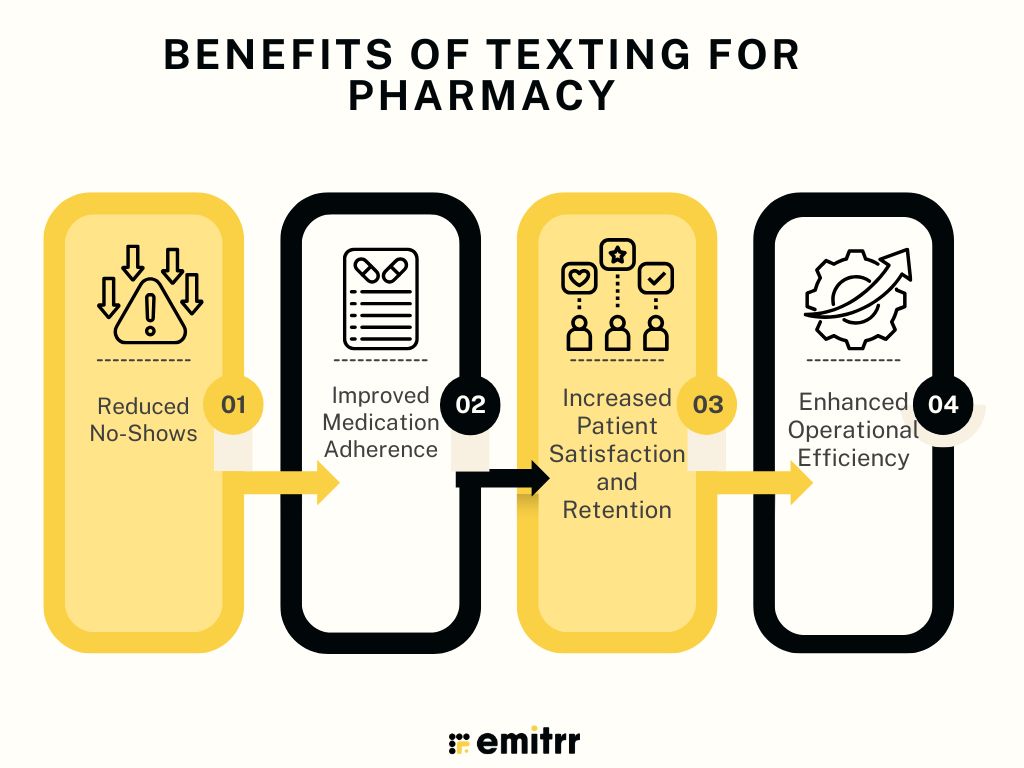
Reduced No-Shows
Appointment no-shows aren’t just a scheduling nuisance; they disrupt the workflow, waste valuable staff time, and delay care for others. Text-based appointment reminders are a simple, effective fix. A brief, friendly reminder the day before or even an hour before helps keep patients on track. And if they can’t make it, a quick reply allows staff to adjust the schedule accordingly. Over time, this leads to smoother operations and better resource management.
Improved Medication Adherence
Taking medication on time, every time, is essential for effective treatment, but it’s also one of the biggest challenges in patient care. Automated text reminders can help pharmacies gently prompt patients to take their medication or pick up a refill before they run out. These refills and medication reminders reduce the risk of skipped doses or therapy interruptions. So even without calling the pharmacy, patients can stay on course with their treatment. Better adherence means better health outcomes and fewer complications.
Increased Patient Satisfaction and Retention
When patients feel cared for beyond the pharmacy counter, they’re more likely to stay loyal. Secure texting for healthcare enables personalized prescription refill alerts, timely updates, and quick responses that give patients a real sense of connection and attentiveness. That kind of engagement translates into higher satisfaction, repeat visits, and positive word-of-mouth, especially valuable in a competitive landscape where patients have many choices.
Enhanced Operational Efficiency
Texting benefits patients and streamlines pharmacy operations. Another such service is that of AI in pharmacy today. Automating routine communications like prescription pick-up, refill, or pharmacy text alerts confirmations reduces pharmacy staff’s workload. Instead of spending time making calls or following up manually, they can focus on what matters most: counselling patients, managing prescriptions, and delivering better care. Plus, with fewer incoming calls and missed appointments, the entire workflow becomes more predictable and less reactive.
Want to take pharmacy communication to next level? Consider adding AI voice agent to your workflow. Watch this video to learn more:
Practical Use Cases of Texting for Pharmacy
Below are several practical, real-world use cases that show how texting can be a game-changer in pharmacy settings.
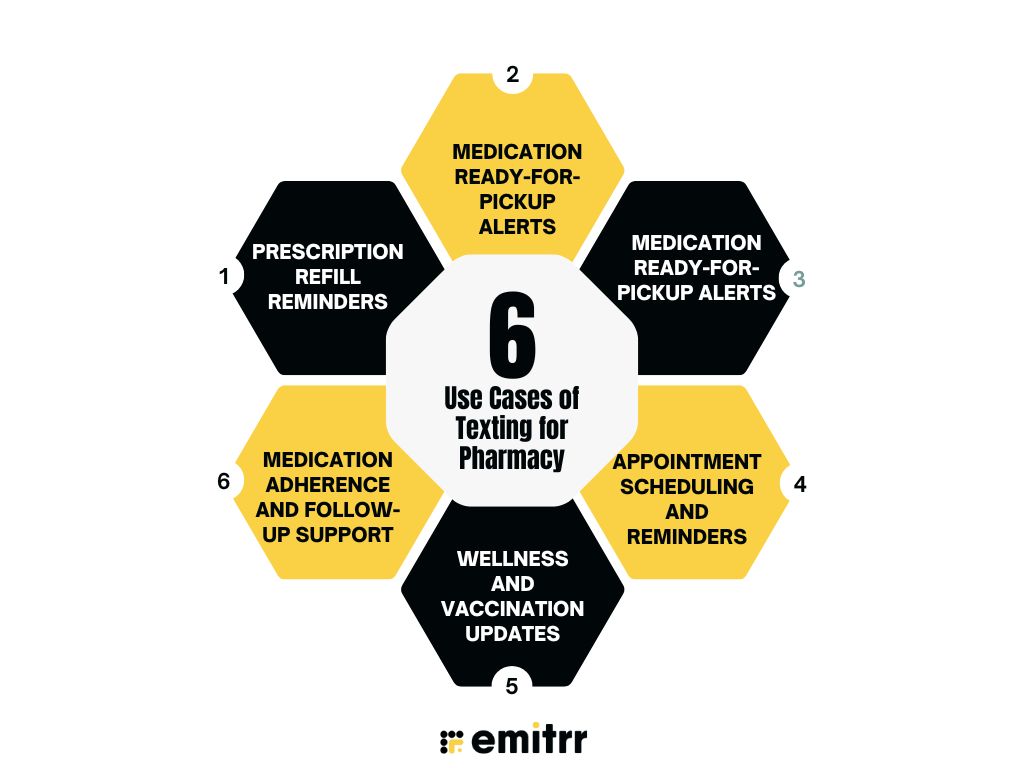
Prescription Refill Reminders
With automated text reminders, pharmacies can gently nudge patients when it’s time to reorder, eliminating gaps in treatment.
A simple Rx refill reminder message like, “Hi David, your prescription for Metformin is due for a refill. Reply YES to confirm,” can be all it takes to keep someone on track. It reduces last-minute rushes and helps the pharmacy prepare refills in advance, creating a smoother workflow for both sides.
Medication Ready-for-Pickup Alerts
No one enjoys standing in line, wondering if their prescription is ready. Quick pharmacy text alerts, such as, “Your prescription is ready for pickup at XYZ Pharmacy,” not only save the patient a phone call but also help manage foot traffic more effectively. Patients can plan their visits better, staff can spend less time fielding status update calls, and everyone walks away a little less stressed. It’s a win-win situation for service and efficiency.
Appointment Scheduling and Reminders
Pharmacy appointment scheduling, from flu shots to medication consultations, are becoming more common, but keeping schedules full and on time is a challenge. Texting makes appointment management seamless. Patients can receive booking confirmations, reminders a day before, and even a final nudge an hour ahead. These small steps lead to fewer no-shows, better time management, and more predictable workflows for the pharmacy staff.
Wellness and Vaccination Updates
Pharmacies are increasingly playing a central role in preventive care, and texting is a great way to spread the word. Whether it’s flu season, a new COVID booster, or an upcoming blood pressure screening event, a simple pharmacy message like, “Free flu shots available this week, walk in or reply to book,” can drive foot traffic and promote community wellness.
It’s a subtle yet powerful way to position your pharmacy as more than just a place for prescriptions, as a proactive health partner. This can also be considered an efficient way to promote the pharmacy.
Medication Adherence and Follow-Up Support
Sometimes, filling a prescription is just the beginning. What happens after the patient goes home? Text check-ins a few days after pickup can ask, “How are you feeling after starting your new medication?” or “Any side effects you’d like to report?”
These small, caring touches open the door to two-way communication. They not only improve adherence but also help catch issues early, offering better outcomes and demonstrating genuine care.
Promotional Offers and Loyalty Programs
Texting is also a powerful marketing tool when used wisely. Informing patients about discounts, seasonal sales, or loyalty program perks keeps them engaged and encourages repeat visits. A targeted message like “Earn double points this weekend on all wellness products” feels personal and timely. The key is to balance promotional messages with useful health-related content to maintain trust and avoid overcommunication.
Two‑Way Patient Questions
Two-way secure texting for healthcare allows patients to ask simple questions, like pickup timing, refill status, or insurance confirmation, without tying up phone lines. Staff can respond when available instead of handling repetitive calls, reducing interruptions and workload.
What Are the Best Practices for Pharmacy Messaging
Texting can be a powerful tool for pharmacies, but only when used thoughtfully and responsibly. To make the most of HIPAA compliant secure text messaging solutions, you must follow a set of best practices. Here’s what every pharmacy should keep in mind when texting patients:
Always Get Patient Consent
Patients deserve the right to choose how they want to be contacted, and giving them that choice upfront sets the tone for a more transparent, trustworthy relationship. So always make sure that the patient has opted for the text message service. Whether it’s during prescription drop-off, online registration, or a verbal conversation at the counter, obtaining that clear “yes” ensures that you’re communicating ethically and responsibly.
Keep Pharmacy Messages Concise, Relevant, and Timely
Long, cluttered pharmacy messages tend to get skimmed or skipped entirely. That’s why secure texting for healthcare works best when messages are short and focused. Well-crafted prescription text messages should deliver value in a few seconds: a quick refill reminder, or a gentle nudge about an upcoming appointment. And timing matters too.
Sending a 9 p.m. message about a pickup may feel intrusive, while a well-timed morning reminder can help patients plan their day. Good timing and clarity go hand-in-hand when it comes to effective communication. This is where AI in healthcare texting adds another layer of precision. AI tools can help craft patient-friendly messages, adjust tone, and optimize delivery times so communication feels natural and relevant.
Watch the video below to see how AI is shaping the future of healthcare communication:
Use Personalization for Better Engagement
Personalized pharmacy messages always work better than a generic message that screams zero empathy. Something as simple as addressing the patient by name or mentioning the medication they’re picking up can make a message feel more human. For example, “Hi Meera, your refill for Metformin is ready for pickup at XYZ Pharmacy” sounds far more thoughtful than a generic alert. These small touches show that your pharmacy sees and values the individual, not just the prescription. Such sentiments can add to the number of reasons why it will create a loyal patient base.
Ensure HIPAA Compliance and Secure Messaging
Any communication involving personal health information must be handled with care, and that includes text messaging. To stay compliant with HIPAA and other healthcare privacy standards, use a HIPAA-compliant secure text messaging that encrypts data and limits access to authorized staff only.
Provide Opt-Out Options for Users
Just as patients have an opt-in option, they should also have the option to opt out. With time, their preference might change, or maybe they just won’t receive the updates for a while, and their choice must be respected. That kind of respect is essential to maintaining a long-term, positive relationship.
Challenges of Texting for Pharmacy & How to Overcome Them
While texting offers numerous benefits for pharmacies, it doesn’t come without its fair share of challenges. Implementing a text communication strategy in a healthcare setting requires thoughtful planning, proper tools, and a commitment to maintaining both compliance and patient trust.
Here’s a breakdown of the key hurdles pharmacies may face along the way.
Ensuring HIPAA Compliance
One of the biggest concerns when it comes to healthcare communication is protecting patient privacy. Pharmacies must use HIPAA-compliant messaging to ensure any texts sent meet regulatory requirements. Meaning no sensitive health information should be shared unless the message is encrypted and secure. It’s not enough to simply send a text reminder; it must be done in a way that respects and safeguards the patient’s health data.
Managing Opt-Ins and Opt-Outs Effectively
Texting is not a one-size-fits-all service. Patients have different preferences when it comes to how they want to be contacted, and pharmacies must have a clear process in place for managing who has opted in to receive texts and who hasn’t. This means tracking consent accurately, making it easy for patients to update their preferences, and respecting opt-outs immediately.
Without a proper system in place, it becomes far too easy to send messages to someone who hasn’t agreed to receive them, which can lead to complaints, reputational damage, or even legal trouble.
Avoiding Message Fatigue and Overcommunication
If patients start receiving multiple messages a day, or even several a week, they may begin to ignore them altogether. Worse, they might opt out entirely. The challenge lies in sending the right messages at the right time. Pharmacies must walk the line between being helpful and intrusive. Each message should have a clear purpose, whether it’s a reminder, an update, or an alert, and should add value to the patient’s experience, not clutter their phone.
Integrating Texting with Existing Pharmacy Software
To enhance and improve the operations of texting, it must work along with the pharmacy’s current systems, like their POS software, CRM, or medication management tools. Without seamless integration, texting becomes just another disconnected task, requiring manual entry, duplicate work, and constant toggling between platforms.
This not only slows things down but also increases the risk of mistakes. Pharmacies need a texting solution that plugs seamlessly into their workflow, so that sending a refill reminder or appointment confirmation is as simple as checking a box.
Handling Two-Way Communication at Scale
One of the biggest advantages of texting is its potential for two-way communication, but that can quickly become overwhelming without the right tools. It’s one thing to send out hundreds of reminders. It’s another to manage all the replies, questions, and rescheduling requests that come flooding back. Pharmacies need either a dedicated team to manage incoming messages or smart automation that can categorize, prioritize, and respond to common queries. Without a system to manage the scale, what starts as a helpful service can quickly spiral into chaos.
How to Set Up SMS for Pharmacy Using Emitrr
Using pharmacy texting software may sound technical at first, but with a platform like Emitrr, it’s surprisingly simple. Emitrr is built with healthcare needs in mind, offering features that help pharmacies connect with patients securely, efficiently, and is a complete AI-powered HIPAA-compliant instant messaging solution.
Here’s a step-by-step walkthrough to help you get started with SMS for your pharmacy using Emitrr.
Step 1: Sign Up and Configure Your Emitrr Account
To begin, head over to Emitrr’s website and create your pharmacy account. The setup process is intuitive even for non-tech-savvy users. Once your account is live, you can customize it to match your pharmacy’s workflows and branding. The platform is thoughtfully designed for healthcare professionals, so it naturally aligns with the daily demands of a pharmacy. Plus, from day one, you can feel confident knowing all communication is HIPAA-compliant.
Step 2: Emitrr integrates with Pharmacy Management Systems (PMS), EHRs, etc., so patient data can be synced.
Before you send out a single message, it’s essential to make sure your patient list is organized and compliant. Gather your patients’ mobile numbers and confirm that each person has given their clear, written consent to receive SMS communications from your pharmacy. Once that’s in place, you can upload the contact list to Emitrr in just a few clicks. It makes it easy to manage opt-ins and keeps track of consent logs to protect both your patients and your business. Also, it integrates with Pharmacy Management Systems (PMS), EHRs etc, so patient data can be synced.
Step 3: Set Up Automation Workflows for Reminders & Pharmacy Text Alerts
Now for the automation. With Emitrr, you can set up smart workflows that automatically send messages based on triggers you define. For example, you might create an automation to remind patients three days before their prescription runs out, or notify them the moment a medication is ready for pickup. These workflows save your pharmacy team members valuable time while ensuring patients stay engaged and informed. It’s like having a digital assistant working in the background 24/7.
Step 4: Personalize Message Templates
A personal touch goes a long way. Emitrr allows you to build message templates that are both professional and personal. You can include the patient’s name, specific medication details, pickup times, or even friendly notes of encouragement. Customizing your messages not only boosts engagement but also shows patients that your pharmacy sees them as individuals, not just names on a list. Once templates are created, they’re easy to reuse and adapt.
Step 5: Track Performance with Real-Time Analytics
Once your messages are rolling out, it’s time to measure their impact. Emitrr’s analytics dashboard offers clear insights into message delivery rates, open rates, response times, and more. This data helps you understand what’s working and where adjustments might be needed. Over time, you’ll be able to fine-tune your approach to get even better results, whether it’s improving adherence, reducing missed appointments, or just creating a smoother workflow for your team.
Purpose-Built for Healthcare and HIPAA-Compliant
Emitrr isn’t just another communication tool; it’s designed specifically for healthcare professionals, with privacy and security at its core. Every message sent through Emitrr adheres to HIPAA regulations, so your patients’ information stays protected. That peace of mind is invaluable, especially when handling sensitive medical data. With the best HIPAA-compliant messaging practice like Emitrr, pharmacies can confidently step into the digital age of communication without sacrificing compliance or patient trust.
Proven Results of Adopting Emitrr
Texting isn’t just convenient. It’s transforming how pharmacies connect with their patients. And it’s not just theory; real pharmacies using Emitrr are seeing real, measurable improvements. From reducing no-shows to boosting prescription refills, the results speak for themselves.
Here’s a closer look at how Emitrr has made a difference:
Niagara Falls Urgent Care: Streamlining Operations
Before using Emitrr, the team at Niagara Falls Urgent Care was bogged down with manual calls and follow-ups. Staff were stretched thin, and patient communication often fell through the cracks. With Emitrr’s automation, they were able to replace over 90 manual tasks, everything from appointment reminders to check-ins, saving countless hours. The best part is that the patients appreciated it and noticed it. They appreciated the quick updates and smooth communication, and the clinic staff could finally focus more on care and less on admin work.
Pinnacle Medical Group: Enhancing Online Reputation
Pinnacle Medical Group’s goal was to get more feedback and improve its online presence. Using Emitrr’s automated review requests, they tripled their number of Google reviews. That helped build trust with new patients and let their happy customers do the talking. A simple follow-up text after an appointment made all the difference.
Animal Wellness Center: Reducing No-Shows
Animal Wellness Center struggled with appointment no-shows. But once they started sending friendly automated text reminders, the difference was immediate. Missed appointments dropped by 60%, which meant a more efficient schedule and fewer disruptions to the day. This resulted in boosting the staff morale and helping to monitor people.
Moreover, Emitrr also has AI-powered text enhancement, which helps generate a message from scratch with a single input and an efficient prompt. By adjusting the tone, you can easily make it crisp and empathetic. These kinds of features have made Emitrr a top-rated texting for pharmacy platform.
FAQs
Yes, as long as the text messages follow HIPAA guidelines, such as obtaining patient consent and using secure messaging platforms that encrypt data and ensure privacy.
Pharmacies can send refill reminders, pickup alerts, appointment reminders, medication adherence tips, health promotions, and emergency updates.
Absolutely. Pharmacies must obtain explicit patient consent before sending any text messages to ensure compliance with HIPAA and TCPA regulations.
Text messages have a 98% open rate, while emails have about 20%, making SMS a more effective and immediate communication channel for pharmacies.
Yes, timely SMS reminders can significantly improve medication adherence and reduce no-shows for pharmacy consultations or vaccine appointments.
Key features include HIPAA compliance, message automation, two-way texting, integration with existing pharmacy systems, and analytics for performance tracking.
Yes, costs vary by provider and features, but many offer scalable plans that are affordable for both independent and chain pharmacies, with high ROI from improved patient retention.
Conclusion
Thus, texting for pharmacy is no longer optional, it’s a reliable way to close communication gaps, boost refill adherence, and keep patients engaged. With the right approach and hipaa compliant texting apps, pharmacies can improve health outcomes while reducing the daily burden on staff. Platforms like Emitrr make this transition simple by combining secure texting, refill reminders, and patient alerts in one place.
Ready to see how it can work in your pharmacy? Book a demo with Emitrr today and discover how effortless, HIPAA-compliant messaging can transform patient communication.


 4.9 (400+
reviews)
4.9 (400+
reviews)