
Introduction
Ever tried booking a dermatology appointment only to be told the next slot is weeks away? Or called your clinic after hours with no luck? That’s the reality many patients face in traditional setups.
Now imagine an assistant who never sleeps, answers every call, books appointments instantly, and even reminds patients about follow-ups! Sounds unreal right? That’s exactly how AI agents are transforming dermatology practices. From streamlining schedules to improving communication and patient care, AI in dermatology is changing the game for both doctors and patients.
What Are AI Agents in Dermatology?
Imagine a patient texting your clinic at 10 p.m. to reschedule their skin check. Instead of waiting for a callback, AI agents for dermatologists instantly offer a new slot, confirm it, and update the calendar. That’s how AI agents in dermatology work.
They’re smart virtual assistants built for healthcare. From chatbots answering patient questions to algorithms scanning skin images or automated appointment reminders, these agents run on artificial intelligence and don’t need constant supervision. Unlike old-school bots, they actually understand intent. If someone says, “I can’t make my appointment,” the AI acts – finding a new time and confirming it on the spot.
For dermatology practices looking for a more dedicated solution, a virtual assistant for dermatologists can help handle routine patient communication, scheduling, reminders, and administrative tasks.
In simple terms, AI agents in dermatology clinics are like tireless teammates. They take over routine admin and follow-ups so your staff can focus on patients. They don’t replace dermatologists, but they make the whole practice run smoother, freeing humans to deliver the care and empathy only they can.
The Challenge with Traditional Dermatology Practices
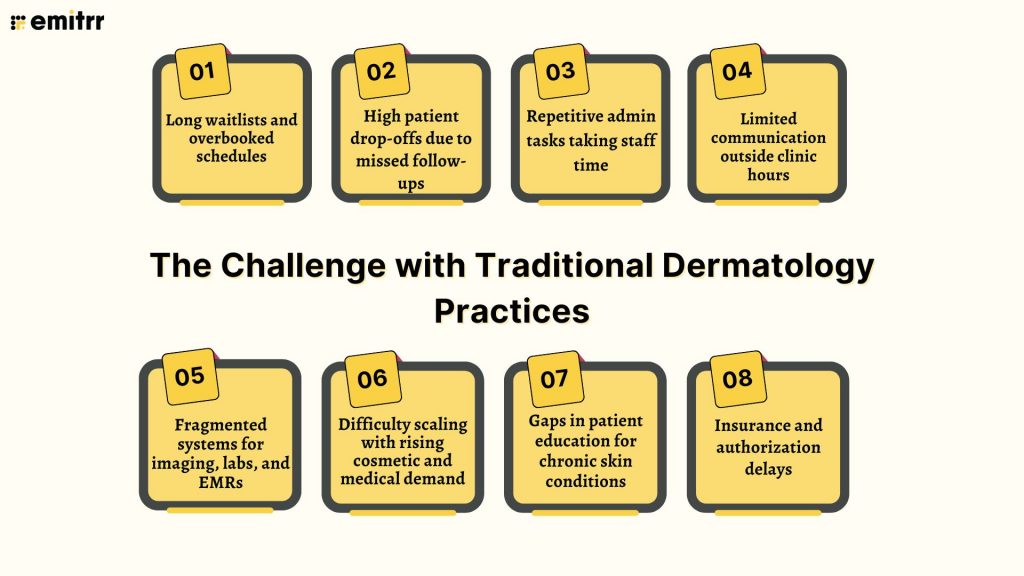
Running a dermatology clinic isn’t easy. Patients want quick access, staff get buried in admin work, and systems don’t always talk to each other. Let’s look at the common struggles that make traditional setups tough, and why many clinics are now leaning on AI tools for dermatologists.
Long waitlists and overbooked schedules
Dermatology clinics often find themselves stretched thin. Demand keeps piling up, but the number of available slots doesn’t grow at the same pace. To manage, many doctors double-book or squeeze in extra patients, which leads to rushed visits and staff stress. The backlog doesn’t just hurt patients, it throws off the clinic’s daily flow and makes scheduling chaotic. Serious cases can get delayed, while minor consults clog the calendar. Traditional scheduling systems simply aren’t built to handle this kind of pressure.
High patient drop-offs due to missed follow-ups
Follow-up visits are easy to miss. A patient told to come back in three months may forget or never reschedule. Studies show nearly one in three dermatology patients skip their appointments, and many don’t return at all. That means lost revenue for the clinic and poor health outcomes for patients. Manual reminder calls aren’t reliable in busy offices. Without automated patient follow-up software, patients often slip through the cracks.
Repetitive admin tasks taking staff time
Dermatology offices run on a mountain of paperwork, phone calls, and data entry. Staff spend hours scheduling, answering the same insurance questions, or updating EMRs. One survey found medical staff spend over 30 hours a week just on admin. This takes time away from patient care and quickly leads to burnout. Highly trained staff end up acting like clerks instead of focusing on what matters. The traditional model is both inefficient and draining.
Limited communication outside clinic hours
Most clinics close at 5, but patient needs don’t. Someone with an eczema flare at 8 PM or a simple post-procedure question on a Saturday can’t reach anyone. Many dermatology patients try to book appointments after hours, yet many practices only offer voicemail. That means missed bookings and anxious patients. On-call systems exist, but they’re not built for routine questions. Patients today expect 24/7 access, and traditional practices just don’t deliver.
Fragmented systems for imaging, labs, and EMRs
Dermatology care involves images, lab results, notes, and treatment records. In many clinics, these live in separate systems that don’t sync. Staff often waste time copying information from one place to another. Important details get missed, like a lab report not showing up in the EMR. Patients sometimes have to repeat their history because systems don’t share data. This patchwork setup slows down decisions and increases the chance of errors.
Difficulty scaling with rising cosmetic and medical demand
Demand for dermatology is booming – skin cancer checks, chronic conditions, and cosmetic treatments are all on the rise. But scaling a practice is tough when there aren’t enough dermatologists to meet demand. Hiring staff or opening new locations is costly and slow. Many clinics end up prioritizing cosmetic visits, leaving fewer slots for medical care. The result is longer waitlists and overstretched staff. Traditional methods make it hard to grow without losing quality.
Gaps in patient education for chronic skin conditions
Conditions like acne, eczema, and psoriasis need more than prescriptions, they require education and follow-up. But clinic visits are short, and patients often leave unsure about how to use their medications or avoid triggers. A good chunk of patients fail to follow treatment plans correctly. Without reminders or extra support, flare-ups become common. Many turn to the internet for advice, which isn’t always accurate. Traditional models don’t give patients the ongoing guidance they need.
Insurance and authorization delays
Insurance approval is one of the biggest headaches in dermatology. So many treatments need prior authorizations that can take days or even a few weeks. Staff spend hours every week filling forms, faxing documents, and calling insurers. Many doctors report it’s one of the top causes of burnout. For patients, these delays are frustrating and can worsen their conditions while they wait. Traditional manual processes make insurance tasks slow and stressful.

Benefits of AI Agents in Dermatology Practices
Traditional clinics face big pain points. That’s why AI agents are becoming the go-to solution for dermatologists. They handle the messy, repetitive stuff while improving patient experience at every step. Let’s break down the biggest wins.
Shorter wait times with automated scheduling
Hate those endless waitlists? Patients do too. With AI-powered dermatology automation, schedules stay fluid and efficient, reducing patient wait times. If someone cancels, AI chatbots for dermatology practices can instantly ping the next person on the list and fill that spot. No phone tag, no wasted time. The result? Fewer delays, fuller calendars, and much happier patients.
Early detection through AI-supported image analysis
Dermatology is visual, and AI is built for pattern recognition. Agents can scan photos of moles or rashes and flag anything that looks risky. Think of it as an extra set of eyes, catching what might otherwise be missed. Wouldn’t you want a system that can spot trouble early? This makes AI in dermatology patient care proactive, not just reactive.
Proactive reminders reducing no-shows
We all forget stuff, patients included. AI agents send timely text reminders, email, or call, so fewer people skip appointments. If someone can’t make it, the AI offers a quick reschedule. That’s intelligent automation for healthcare specialists at work. Imagine cutting no-shows in half just with smart nudges. It keeps schedules tight and patients on track.
Stronger patient communication and follow-up
Good communication builds trust, right? AI agents help by giving instant, consistent answers across SMS, email, or calls. Patients don’t wait on hold for simple questions. Follow-ups become automatic: “How’s your skin reacting to the new cream?” or “Here’s your after-care tip sheet.” This kind of clear, steady contact makes patients feel supported between visits.
Reduced staff burnout with automation
Front-desk staff shouldn’t feel like robots. By offloading repetitive admin to AI, humans get to focus on patients instead of endless data entry. Less burnout, fewer mistakes, and way better morale. Imagine finishing the day on time instead of drowning in paperwork. That’s what AI for dermatology practice management delivers. Your team stays fresher and patients notice the difference.
Boosted clinic reputation with automated review collection
Reviews matter, and they matter a lot! AI agents can politely nudge happy patients to share their experience online. Every SMS review request goes out at the perfect time, so nothing slips through. More positive reviews build credibility and attract new patients. Isn’t it easier to let AI do the asking instead of awkwardly reminding people in person?
Higher patient satisfaction with clear, consistent updates
When patients feel informed, they feel cared for. AI agents make sure updates, reminders, and instructions are always accurate and consistent. No mixed messages, no confusion. Patients love knowing their clinic is responsive, even at midnight. Over time, this level of attentiveness boosts loyalty, referrals, and overall satisfaction.
How AI Agents Help in Dermatology Operations
AI in dermatology practices isn’t theory, it’s daily support! Let’s see how these agents actually make the work smoother.
24/7 appointment booking and rescheduling
Open all day, every day. That’s the promise. An AI for dermatology scheduling and follow-ups lets patients book or reschedule the moment they think of it. No voicemails. No hold music. Wouldn’t you rather capture that 10 p.m. booking than lose it to tomorrow? With AI, every empty slot is an opportunity filled, and patients love the freedom to choose their own time. It’s like having a front desk that never sleeps.
AI triage for skin concerns before consultations
Think of it as smart sorting. Patients answer a few questions, upload a photo, and the agent prioritizes next steps. That’s AI in skin disease detection plus AI in dermatology diagnosis and patient support working together. High-risk cases get fast-tracked. Minor issues get smart guidance. Want fewer bottlenecks and safer triage? This is how. It means urgent problems don’t sit on the back burner, and dermatologists get a clearer picture before the patient even walks in.
Automated patient reminders for treatments and follow-ups
Missed visits sink schedules. AI nudges patients with timely texts, emails, or calls, and offers instant rescheduling. It also checks in on meds, labs, and series-based treatments. That’s real benefits of AI agents in dermatology you can feel. Wouldn’t a steady flow and fewer gaps help your week? Think of it as a digital safety net, making sure patients don’t forget, drift away, or drop off their care plan entirely.
Multichannel engagement through calls, SMS, and email
Patients pick the channel, AI keeps the conversation seamless. Call, text, or email – same context, same clarity. Quick answers, clear instructions, zero runaround. That’s AI-driven patient experience in dermatology in action. Imagine how much time would you save if FAQs never hit the front desk! It’s a single system that talks everywhere, so patients feel supported no matter how they reach out.
Streamlined cosmetic dermatology package promotions
Stop blasting, start targeting. AI finds the right patients and pings them with relevant offers at the right time. Two-way texting handle questions and convert interest into bookings. It’s personalized, not pushy. Want your promo calendar to fill itself? With AI nudges, your cosmetic side of the business keeps growing while staff focus on care.
Back-office automation for billing and insurance
Let the agent verify eligibility, prep prior auths, and scrub claims. Fewer errors, faster submissions, clearer answers to “Why was I billed?” It routes tricky cases to humans and closes the easy ones on its own. That’s smooth revenue cycle support without extra headcount. Who said billing has to be painful? With an AI-powered behind-the-scenes billing virtual assistant, you can keep the cash flow steady with fewer headaches.
Patient surveys and feedback loops managed by AI
Ask short questions in patient satisfaction surveys, get fast answers. AI spots such trends, flags low scores for quick recovery, and nudges happy patients toward reviews. Over time you learn what patients love and what to fix. Isn’t that the kind of loop every clinic needs? Instead of guessing what’s working, you get real-time feedback that drives real improvements.
Cost savings & revenue optimization
Fewer no-shows, fuller days, cleaner claims. Automation trims admin hours and scales without adding staff. More kept appointments and smarter recalls lift revenue. That’s AI for dermatology scheduling and follow-ups paying for itself. So are you ready to grow without the growing pains? Think of it as efficiency that translates directly to dollars – smoother operations mean better margins without cutting corners.
Key Features to Look for in AI Agents for Dermatology
Not every AI tool is built for healthcare. Dermatology clinics have unique needs, so if you’re thinking about adding AI, here are the features that really matter.
HIPAA compliance and secure image handling
Let’s be honest, patients won’t trust your clinic if their data isn’t safe. Any HIPAA-compliant AI solution for dermatologists should lock down sensitive info with encryption, access controls, and audit logs. Dermatology often involves storing and sharing images of lesions or procedures, so the system must keep those secure too. Think encrypted uploads, safe storage, and no leaks. Wouldn’t you want peace of mind knowing a biopsy photo won’t end up in the wrong hands? Security is non-negotiable.
Integration with EMR and dermatology imaging systems
The best virtual assistants for dermatology clinics don’t live in silos. They should connect with your EMR, imaging systems, and lab portals so everything stays in sync. Imagine this: a patient cancels, the AI updates the EMR instantly, and the slot shows as open for another booking. Or the AI pulls in a pathology result and shares it with the right doctor automatically. No more duplicate data entry, no more dropped balls. Smooth integration saves time and headaches.
AI trained for skin-related language and workflows
Generic chatbots miss the nuances of dermatology. A strong conversational AI in dermatology practices knows what “irregular mole” or “Accutane” means and can respond accordingly. It should understand both medical terms and the everyday words patients use, like “zit” or “rash flare.” Would you really want an AI that treats all questions the same way? Tailored training means smarter replies, fewer mistakes, and workflows that actually fit dermatology care.
Adaptive learning to handle dermatology-specific FAQs
Your practice evolves, and your AI should too. Maybe patients start asking about a new cosmetic laser or seasonal skin issues your AI should learn and adapt quickly. Some systems even flag questions it couldn’t answer so you can update it. That’s real patient engagement automation in dermatology, keeping the agent relevant and helpful at all times. The last thing you want is an AI stuck with outdated info. Adaptive learning makes sure it stays sharp.
Multilingual support for diverse patient bases
Not every patient is comfortable communicating in English. A good AI should switch languages seamlessly so patients feel understood. Picture a Spanish-speaking patient texting in, and the AI replying in Spanish right away, it builds trust instantly. This is one of the simplest yet most powerful ways to broaden your reach. Even if your staff isn’t bilingual, the AI bridges the gap. That kind of accessibility really sets a clinic apart.
Dashboard insights into patient trends and treatment adherence
It’s not just about answering questions – it’s also about learning from the data. A smart AI should offer dashboards showing patient trends, no-show rates, common FAQs, and even adherence patterns. Imagine spotting a spike in eczema queries every winter or seeing which reminders lead to more follow-up bookings. These insights help you act faster and smarter. It’s like having an extra advisor that quietly keeps tabs on the pulse of your practice.
Scalability for single-practice and multi-location clinics
Whether you’re a solo dermatologist or running multiple clinics, your AI should scale with you. It needs to handle more patient volume, multiple calendars, and even route calls across locations. Why invest in something you’ll outgrow in a year? Look for cloud-based platforms that expand effortlessly as your clinic grows. Scalability ensures your AI agent remains a long-term partner, not a short-term fix.
When to Use Humans Instead of AI in Dermatology
AI agents in medical specialties like dermatology can do a lot. But let’s be real, they’re not a replacement for human expertise or empathy. There are moments when patients need a person, not a program. Here’s where the human touch matters most.
Sensitive conversations around cosmetic procedures
Talking about cosmetic treatments often goes beyond the surface. Patients may be opening up about self-esteem, body image, or big life events like wanting to look their best for a wedding. Would you trust a chatbot to handle that? Probably not. These chats need empathy, reassurance, and genuine human connection. AI can handle the scheduling or FAQs, but when emotions run deep, humans are irreplaceable.
Complex diagnoses requiring visual and clinical judgment
The role of AI in dermatology is to assist, not replace, the dermatologist’s trained eye. Many skin conditions look alike, and it takes years of experience to spot subtle differences. AI might flag something as “probably fine,” but a doctor might notice something concerning in context. Humans can connect the dots across symptoms, history, and physical exam in a way AI can’t. For tricky or rare cases, human judgment wins every time.
Building trust during first-time patient visits
First impressions matter. A new patient wants to meet their dermatologist face-to-face, not just a virtual assistant. That first conversation is where trust and comfort are built. A smile, some reassurance, and listening to concerns, these are human strengths. Once that relationship is formed, AI in skin care clinics can support with reminders and follow-ups, but the welcome should always be personal.
Escalations or complaints that need empathy
When a patient is upset, they need to feel heard by a real person. Imagine getting a canned AI response after saying, “I’m unhappy with my last visit.” Would that calm you down? Probably not. Humans can apologize sincerely, show empathy, and adapt in real time. Complaints are opportunities to rebuild trust, and that requires a caring human voice.
Treatment planning for chronic or rare skin diseases
Conditions like psoriasis or rare autoimmune skin disorders involve complex, evolving treatment plans. AI can pull up guidelines, but it can’t factor in lifestyle, preferences, or those gut instincts doctors get from experience. Patients often have tons of questions and need reassurance about risks, side effects, and options. That back-and-forth discussion belongs with the dermatologist. AI is great for reminders, but humans guide the bigger picture.
Explaining side effects or post-procedure care in detail
After a procedure, patients want clear, personalized instructions. Sure, AI can send a list of “dos and don’ts,” but what if someone asks, “Is this redness normal?” That’s where a nurse or doctor steps in. Humans can rephrase, clarify, and reassure in ways AI can’t. Post-procedure chats often ease anxiety, and that kind of comfort comes best from a real person.
Guiding patients through emotionally charged conditions (like acne or alopecia)
Skin issues can cut deep emotionally. A teen with acne or an adult with hair loss may feel discouraged, anxious, or even embarrassed. AI can’t hand them a tissue, share encouragement, or remind them they’re not alone. Dermatologists often play the role of both doctor and coach here. Their compassion can make patients stick with treatment and feel hopeful. Emotional care is human territory, not AI’s.
Real-World Implementations of AI Agents in Dermatology
AI is already widely being used for dermatology clinic digital transformation. It’s making dermatology settings faster, smoother, and more patient-friendly. Here are some real ways AI in dermatology practices is transforming things right now.
AI-powered triage tools identifying high-risk lesions
AI can scan photos of skin spots and quickly sort which ones look harmless and which need urgent attention. This means serious cases get seen faster, while mild ones don’t clog up the schedule. Patients spend less time worrying and more time getting the right care. For clinics, it ensures doctors focus on the patients who truly need them most. Over time, this leads to fewer delays and better health outcomes.
AI assistants supporting teledermatology consults
When patients book online visits, AI can step in before the doctor does. It collects basic details, checks that photos are clear, and organizes everything into a simple summary. By the time the dermatologist joins, the telehealth visit is smoother and shorter. Patients feel attended to right away, instead of waiting in silence. It makes virtual visits more personal and efficient at the same time.
Clinics using AI to manage cosmetic treatment promotions
Cosmetic services often depend on timing and reminders. AI can gently nudge patients when it’s time to book their next session or let them know about new packages. It can even answer common questions and help schedule consults instantly. The result is fuller calendars and steady cosmetic revenue without staff spending hours on calls. It keeps patients engaged and interested in your services without feeling pressured.
Feedback collection and online reputation managed by AI
AI can send every patient a short survey after their visit. Happy patients are encouraged to leave reviews, while less happy ones are flagged for follow-up by staff. This not only builds a stronger online reputation but also helps clinics spot and fix common problems. Over time, it means more positive reviews and happier patients. Clinics that stay on top of feedback build trust and attract more new patients.
Automated refill and prescription reminders for chronic skin meds
For patients on long-term treatments, missing a refill can disrupt progress. AI can track timing and send reminders when it’s time for the next prescription or lab test. Patients stay on track, and doctors see fewer gaps in care. Simple reminders make a big difference in outcomes. It also gives patients peace of mind that their care is being monitored closely.
AI reducing backlog in high-demand dermatology centers
Busy clinics often struggle with long waitlists. AI helps by handling appointment requests quickly and keeping schedules full. It can also sort urgent cases from routine ones, so doctors see the right patients at the right time. This reduces backlog and shortens wait times for everyone. Patients notice the faster access and are more satisfied with the clinic overall.
AI systems improving patient education through plain-language summaries
Medical notes can be confusing for patients. AI can turn complex instructions into easy, everyday language. For example, “apply cream twice daily” is much clearer than medical jargon. Patients leave with guidance they actually understand, which improves treatment results. Better education means patients feel more confident managing their skin care at home.
How Does Emitrr Help Dermatology Practices with an AI Agent?
Running a dermatology practice can feel like juggling non-stop. The phones keep ringing, patients need reminders, cosmetic clients want follow-ups, and insurance tasks pile up fast. Emitrr takes that load off your team. It works like a smart virtual receptionist and patient communication assistant, handling the busywork so you can focus on patients. Here’s how it makes a difference for dermatology clinics:
- 24/7 live call handling: Patients never hit voicemail. Emitrr’s AI answers calls anytime, books appointments, and shares clinic info instantly.
- Instant appointment booking & changes: Patients can text or call to reschedule, and Emitrr updates your calendar on the spot. No back-and-forth, no gaps in the schedule.
- Automated reminders & confirmations: Personalized texts and calls keep no-shows down. Patients confirm or reschedule with a quick reply.
- After-hours texting and chatbot: Even at 10 PM, patients can ask questions or request info. Emitrr replies right away, keeping your clinic “always open.”
- Lead capture and conversion: New patient inquiries don’t wait for office hours. Emitrr chats, answers basics, and guides them to book, turning interest into appointments.
- FAQ offloading: “What’s your address? Do you take insurance?” – Emitrr handles these repeat questions automatically, freeing staff to focus on in-clinic patients.
- HIPAA-compliant encrypted messaging: Every text, call, or chat stays private and safe. You can share updates or send secure links without worry.
- Integration with EHR and systems: Emitrr syncs with your calendar and EMR so everything stays organized. No double-bookings or extra data entry.
- Smart call routing and voicemail triage: Urgent calls get directed to the right person, while routine queries stay with the AI. Patients reach the right help faster.
- Review generation on autopilot: After each visit, Emitrr automatically asks happy patients for reviews. Your online reputation grows without extra effort.
- Two-way patient texting: Patients can text your main number with questions or updates. Emitrr replies instantly or loops in staff if needed.
- Recall and re-engagement: Emitrr tracks who’s due for follow-ups and sends gentle reminders, keeping your calendar full and patients on track with care.
- Bulk messaging & campaigns: Need to reschedule a day’s worth of patients or promote a skincare event? Emitrr sends personalized messages to everyone at once.
- Call summaries & analysis: Every call is transcribed and logged. You can review what patients ask most and spot trends that need attention.
- Scales with your practice: Whether you’re a solo dermatologist or running multiple clinics, Emitrr adapts and grows with you.
Emitrr can basically be your clinic’s always-on assistant. It books and reschedules, sends reminders, collects reviews, and even handles marketing. Moreover, it’s affordable, scales with your needs, and comes backed by responsive customer support.
Future Trends in AI-Powered Dermatology Care
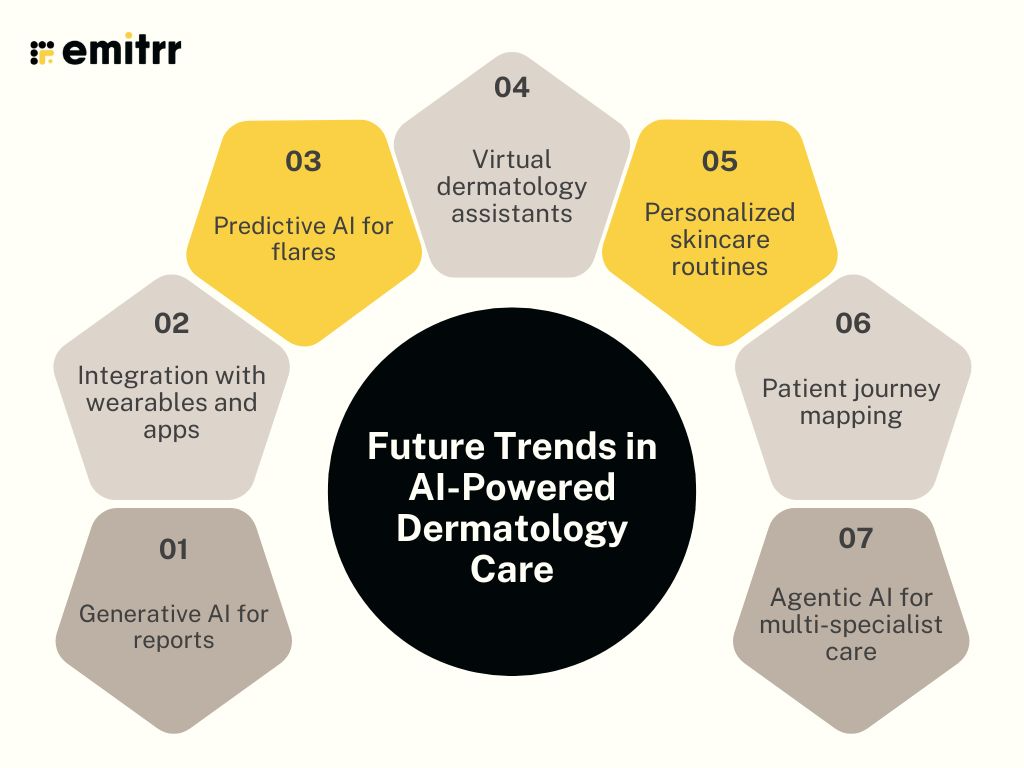
The integration of AI into dermatology is evolving rapidly. As technology advances, we can anticipate several trends that will further transform skin care practices and patient experiences. Here are some exciting future directions for AI in dermatology:
Generative AI for reports
In the near future, AI could take complex medical notes and biopsy reports and turn them into plain, easy-to-read summaries. Instead of patients leaving confused, they’ll walk away with clear instructions they can actually follow. Imagine a pathology report explained in simple words rather than medical jargon. This not only boosts patient understanding but also helps them stick to treatment. AI could even answer common follow-up questions in everyday language, making care more transparent.
Integration with wearables and apps
AI is likely to link up with skin health wearables and smartphone apps. Think of a UV sensor that tells patients it’s time for sunscreen, or an acne tracker that notices a flare-up starting. The AI agent could nudge patients before small issues become big ones. This makes dermatology care more proactive, not just reactive. By pulling in data from daily life, the AI can give patients timely, practical advice that fits into their routine.
Predictive AI for flares
Instead of waiting for a flare-up, AI could predict when one is coming. For example, it might notice a psoriasis patient’s symptoms always get worse in winter and recommend preventive care ahead of time. Or it could see patterns in acne breakouts tied to stress or lifestyle. These insights let dermatologists act before the condition worsens. Predictive care helps patients avoid discomfort and gives clinics a way to deliver more personalized, preventive medicine.
Virtual dermatology assistants
Telehealth will get even more support from AI. During video visits, a virtual assistant could highlight spots on the skin that need closer attention. It might also transcribe notes in real time and send a simple care plan to the patient right after the call. This saves the doctor time and gives patients instant clarity. Over time, these assistants could even handle minor skin concerns on their own, making access to care easier worldwide.
Personalized skincare routines
The skincare industry is already huge, and AI is about to make it smarter. By analyzing skin type, photos, and lifestyle data, AI could create routines that are truly tailored to each person. No more guessing which cream or cleanser will work, it’s all based on patterns and outcomes from similar patients. Over time, these recommendations get even better as the AI learns what products actually help. Patients feel supported with clear, custom advice rather than trial and error.
Patient journey mapping
AI can pull together images, lab results, and treatment histories into one easy-to-follow timeline. Both the doctor and patient can see progress clearly, whether acne has improved by 70% in six months or when a flare tends to happen. This helps doctors fine-tune treatment and gives patients encouragement as they see their results. It also predicts next steps based on patient journey patterns from similar cases. The end result is care that feels more transparent and motivating.
Agentic AI for multi-specialist care
Many skin conditions overlap with other fields, like rheumatology or oncology. Agentic AI could act as a coordinator between specialists, making sure everyone is on the same page. For example, it could flag that a psoriasis patient needs a rheumatology referral or ensure all doctors get biopsy results at the same time. This avoids delays and confusion. Patients feel supported by a connected care team rather than juggling separate providers on their own.
Frequently Asked Questions
They’re smart virtual assistants that automate scheduling, reminders, and patient communication, while also supporting diagnosis with image analysis.
Yes. AI can flag suspicious lesions with high accuracy, helping dermatologists prioritize urgent cases.
Emitrr lets patients text, call, or chat anytime. It replies instantly with consistent, accurate information and makes rescheduling seamless.
Healthcare-focused AI platforms like Emitrr use encryption and secure data handling to keep all patient information safe.
Absolutely. Whether you’re a solo dermatologist or run multiple clinics, Emitrr scales to fit your needs without extra hassle.
Conclusion
AI agents are changing how dermatology practices work – cutting down waitlists, automating routine tasks, and keeping patients engaged long after they leave the clinic. They give staff a breather and patients a better, more connected experience.
The best part? AI doesn’t replace human care. It amplifies it. Dermatologists stay focused on diagnoses and empathy, while AI quietly handles the heavy lifting in the background. The result is a clinic that feels smoother, smarter, and more patient-friendly.
Ready to see how this could work for your practice? Book a demo with Emitrr AI today and experience the difference it can make in the dermatology care you provide!

 4.9 (400+
reviews)
4.9 (400+
reviews)