
Introduction
Handling phone calls can really shape a customer’s experience – for better or worse. Picture this: someone calls your business with a billing question. They get stuck in a long phone menu, finally reach a person…only to hear, “Oops, wrong department.” Then they get transferred again, or the call drops. That’s frustrating. And it could cost you a customer.
That’s where AI call routing helps. In this blog, we’ll break down what automated intelligent call routing actually means, how it solves common phone issues, and why it matters for your business. We’ll talk about the problems with old-school systems, how can AI enhance call routing, and how to set it up the right way. By the end, you’ll know how to make every call smoother, for your customers and your team!
What Is AI-Powered Call Routing?
What is intelligent routing? It’s like having your smartest team member answering calls 24/7. When someone calls, AI listens to what they need, figures out who’s the best person to help, and sends the call there instantly. No need to press 1, then 4, then 3…and so on.
Think of it like this: you walk into a hotel, and instead of waiting at the front desk, someone greets you by name, hands you your room key, and you’re all set. That’s how intelligent routing works – no wait, no confusion, just smooth service.
Callers simply say what they need. The system understands them, remembers past calls, and makes smart decisions to help fast. It’s like a super-friendly virtual receptionist who knows your customers and never takes a break.
The Challenge with Traditional Call Routing
Traditional call routing, like old-school phone trees and basic call distributors, has several major pain points:
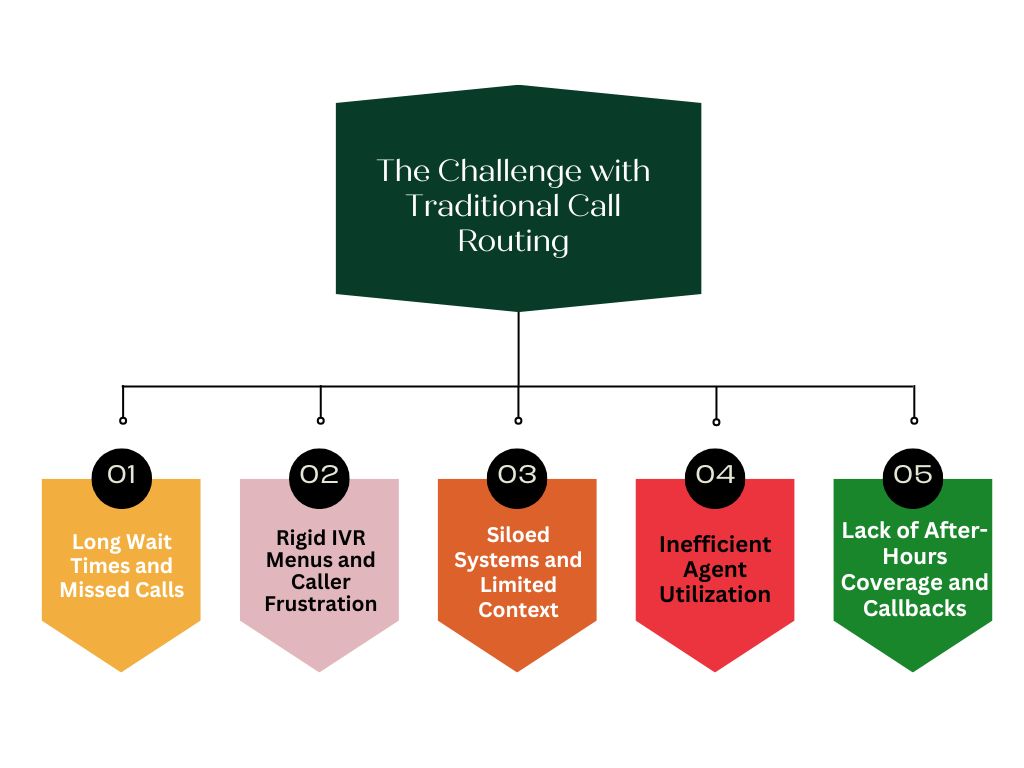
Long Wait Times and Missed Calls
Nobody likes waiting on hold. Yet with basic systems, customers often sit in long queues listening to hold music. It’s no surprise many give up. One study found only about 26% callers wait on hold for more than 5 minutes. Every minute a customer waits increases the chance they’ll abandon the call and maybe never call back! Long waits translate to missed calls and lost business.
Rigid IVR Menus and Caller Frustration
“Press 1 for this, 2 for that…” Old-fashioned IVRs force callers through rigid menus, which often leads to frustration. If your issue doesn’t fit the options, you’re stuck. Many customers have a bad IVR experience because the menu is too complicated or too long. Callers often start pressing “0” or shouting “agent” out of frustration. Rigid menus make for a poor first impression, people feel like the company is hard to navigate and is not listening to their actual needs.
Siloed Systems and Limited Context
In many traditional setups, the phone system isn’t connected to your customer databases. That means when a call finally reaches an agent, the agent has no background info. They often have to ask the caller to repeat information the company already has on file. Customers hate repeating themselves. Over 70% get frustrated when they have to re-explain an issue or feel a company doesn’t have their info. If a customer gets transferred from one team to another, the new agent often has no idea what was already discussed. It’s like starting the call all over again. Without shared systems, everything feels disconnected, and the call takes longer than it should.
Inefficient Agent Utilization
Without intelligent routing, calls are often distributed suboptimally. Some agents get overloaded with high call volumes while others sit idle, simply because the system isn’t smart about load balancing or matching the right agent to the right call. Also, all agents may be handling general calls even if some have specialized skills that are underused. The result: agents aren’t as productive as they could be, and customers might not get the best person to help them on the first try. An inefficient system can cause higher labor costs and agent burnout for those who are constantly swamped.
Lack of After-Hours Coverage and Callbacks
Traditional phone systems typically don’t handle off-hours well. If a customer calls at 7 PM and your office is closed at 6, they’re likely to just get voicemail. There’s often no option for a callback or any form of service until the next business day. This means potential new customer calls go unanswered, and existing customers with issues can’t get help when they need it. In today’s 24/7 world, not having any support after hours or at least an automated way to request a callback can hurt your reputation. At best, the customer will call again later; at worst, they might move on to a competitor who is available.
Benefits of AI in Call Routing
Now let’s see how applying AI can tackle those challenges and improve the call experience:
Faster Help, Fewer Transfers
AI-powered call routing helps callers talk to the right person right away. It listens to what they need and sends them to the best match — whether that’s a team member or a quick self-service option. So no more jumping between agents or repeating the same issue. Most problems get solved in one go, which saves everyone time and keeps things smooth for both your team and your customers.
Fewer People Hanging Up
Nobody likes waiting on hold forever. AI helps reduce hold times by quickly sending calls where they need to go. It can also offer callbacks if the wait is too long. This lowers your abandonment rate — fewer callers hang up and leave. When people get help fast, they’re more satisfied. It shows your business values their time, which builds trust.
Cut Costs Without Cutting Service
AI can handle simple questions or gather info before sending a call to a human. This takes pressure off your agents and makes them more productive. Your team can handle more calls with fewer people. That means less hiring and lower costs. And because calls are handled faster and better, your cost per call also goes down.
You’re Always “Open”
AI is always on – day or night. It can pick up calls, take messages, or send them to the right person, even at 2 AM. So your customers never hit a dead end, and your business feels reliable and responsive, no matter the time. It’s an easy way to stay connected without needing someone on the clock 24/7.
Smarter Over Time
AI doesn’t just work, it learns. It keeps track of calls, common questions, busy times, and which agents solve what problems best. Over time, it adjusts to improve how calls are handled. You also get reports and insights to help you plan staffing, training, or changes. It’s like having a system that keeps getting better at supporting both your customers and your team.

How AI Enhances Call Routing and What It Actually Does
AI isn’t just one trick, it’s a bunch of smart tools working together to make call routing faster, easier, and way more helpful. Here’s how:
Intent Detection and Natural Language Understanding
AI can understand callers in their own words using natural language understanding (NLU). Instead of forcing people through rigid menu options, the system listens to what they say (e.g., “I need to reset my password”) and interprets the intent behind it. This makes the experience conversational and user-friendly. Callers don’t have to learn your menu structure – they just speak naturally, and the AI figures out what they need and routes them accordingly. It vastly reduces misrouting compared to old touch-tone menus.
Skills-Based and Attribute-Based Routing
AI doesn’t just match calls to any available agent, it thinks smarter. It checks who’s good at what like tech issues, languages, or past experience. So if someone has a tech problem, AI sends them straight to the right expert, not just whoever’s free. It’s like a smart matchmaker for calls. Customers get help faster, and no one gets passed around.
Predictive Routing Using Past Outcomes
AI can also learn from historical data to improve routing decisions. Predictive dialer and routing analyzes past call outcomes to predict which agent or strategy is likely to work best for a new call. In some advanced systems, this includes predictive behavioral routing – matching customers and agents by personality or communication style for better rapport. Essentially, the system isn’t stuck with static rules. It continuously adjusts who gets the call based on what’s proven to yield the best results.
Priority and VIP Routing
Not every call is the same and AI gets that. It can spot VIP customers or urgent issues and move those calls to the front. So if an important client calls, they don’t have to wait. Or if someone’s reporting a serious problem, AI can send it straight to a supervisor. It’s like giving the red carpet treatment to calls that really can’t wait.
Sentiment and Urgency Detection
Beyond the content of the call, AI can gauge a caller’s tone and urgency. Through sentiment analysis, the system listens for stress or frustration in a customer’s voice. If it detects an upset customer or sees words like “angry” or “cancel” being used, it can route that caller to a retention or resolution specialist right away. Similarly, urgent language like “ASAP” or an alarmed tone can trigger an emergency response path. This kind of emotional intelligence means the AI can respond appropriately to angry or distressed callers – for example, bypassing normal queues or assigning the call to an agent skilled in de-escalation. It adds a layer of care so that sensitive situations get handled with priority and empathy.
Real-Time Queue Optimization and Callbacks
AI is great at managing call queues on the fly. It doesn’t just put everyone on hold in a fixed order it constantly reshuffles and reprioritizes based on urgency and caller type. If wait times get long, it can offer a callback instead of making people sit on hold. It can also handle voicemail triaging, sorting through voicemails, spotting urgent ones, and pushing them to the right agent fast. That way, high-priority messages don’t sit in the queue for hours. The result? Shorter waits, faster follow-ups, and way fewer frustrated callers.
Context-Passing Across Channels (Omnichannel)
AI-powered routing doesn’t operate in isolation, it connects with your other channels. If a customer interacted with your company through chat or email and then calls, the AI can pull up that context and pass it to the agent. For example, “Emily” might call and the agent sees notes that she was chatting about a billing issue earlier. The customer doesn’t have to repeat herself because the AI has maintained the context across channels. This omnichannel awareness makes the experience seamless. A customer can jump from a chatbot to a phone call, and the person on the other end already knows what’s going on. It saves everyone time and shows the customer that your business remembers their situation no matter how they reach out.
Multilingual Routing and Real-Time Translation
AI can tell what language someone is speaking and connect them to an agent who speaks it too. No need to press buttons or choose from a menu. If no one’s available, some systems can even translate in real time. So callers get help in the language they’re most comfortable with, and your team can assist more people without needing a huge multilingual staff.
Fraud/Spam Detection and Risk Scoring
AI is great at spotting shady calls. It looks for patterns like repeat calls from strange numbers and blocks or flags them before they reach your team. If something feels off, it can send the call for review or ask extra questions. It’s like a smart filter that keeps your lines clear and your agents focused on real customers.
Agent Assist and Next-Best-Action During Live Calls
AI can be a quiet helper during live calls. While your agent talks, the AI listens in and shows helpful info like answers, steps, or next moves. It might even suggest things like “offer a discount” if it senses a chance to keep the customer. After the call, it can fill out notes or summaries. It’s like having a smart sidekick that handles the details so your team can focus on the customer.
Here is how healthcare practices are using AI for their calling needs:
Key Features to Look For in AI Call Routing
When evaluating an AI-driven call routing solution, keep an eye out for the following essential features:
Secure and Compliant Setup
First things first, security matters. Your call routing system should protect customer data with strong encryption and proper access controls. It should also follow industry rules like HIPAA or GDPR. Think of it like locking your front door and setting the alarm, just in tech form! It also makes sure the system is reliable. You don’t want the system going down in the middle of a busy day. When customers trust you with their info, you want to make sure it stays protected.
Plug-and-Play Integrations
Your AI should work well with the tools you already use like your CRM or helpdesk. It should pull up customer info and update things on its own. That way, agents don’t have to keep switching between screens. Everything they need shows up in one place. It saves time and makes calls go smoother for everyone.
Easy Call Flow Builder
You shouldn’t need tech help to make small changes. A good AI system lets you set up call flows with simple drag-and-drop tools. Want to change where calls go after hours? You can do it in a few clicks. It’s easy, like moving blocks around. No coding, no stress. Anyone on your team can do it.
Helpful Dashboards and Reports
Your system should show you what’s working and what’s not. Built-in analytics can track wait times, missed calls, customer feedback, and more. Over time, you’ll spot patterns and know where to improve. It’s like having a bird’s-eye view of your whole call process, super handy for making smarter decisions. And if your team is falling behind somewhere, you’ll know before it becomes a problem.
Smooth Hand-Off to Humans
Sometimes, a person needs to step in. Your AI should make that handoff smooth. It should send over the caller’s info so agents don’t have to ask the same questions again. Supervisors should also be able to jump in or monitor when needed. It keeps the experience human, even when AI is involved. Nobody likes repeating themselves, this makes the transition feel seamless and thoughtful.
Scales As You Grow
Whether you have 5 people or 500, your system should grow with you. Cloud-based AI phone systems can handle extra call volume, new locations, or remote agents without breaking a sweat. It means you won’t outgrow your setup anytime soon. As your business expands, your phone system keeps up, no stress! You don’t have to rebuild everything from scratch just because you got busier, it’s already built to flex with you.
When to Keep Humans in the Loop
There are times and certain scenarios where only AI isn’t the right fit to enhance customer experience. Here’s when it’s better to bring in a human help.
For Sensitive or Emotional Calls
If someone’s dealing with tough news, like a medical issue or a personal loss, they want to talk to a human, not a bot. AI just can’t match empathy. In these moments, kindness and care matter more than speed. A human voice can comfort, listen, and guide someone through the situation in a way tech simply can’t.
For Complicated or Oddball Requests
Let’s face it, not every call fits into a neat little box. If a customer asks for something unusual or out of the ordinary, a human is better equipped to figure it out. AI handles the common stuff well, but weird or tricky cases often need creative thinking. That’s where people shine. They can bend the rules when needed and find workarounds AI wouldn’t catch.
For Escalations or Complaints
When a customer’s upset, they usually want to talk to someone who gets it. A person who can say “I hear you” and actually do something about it. AI can route them, sure. But the tough conversation needs that human touch. Agents can apologize, offer solutions, or de-escalate tense situations in real time. It can be the difference between a lost customer and a saved one.
For VIPs and First-Time Callers
High-value customers and brand-new callers deserve a little extra attention. AI can welcome them, but many businesses prefer to connect these folks to a live agent quickly. It shows you care and makes a great first impression. Whether it’s a long-time client or someone calling for the first time, giving them a personal touch can go a long way in building loyalty.
Best Practices for Implementing AI Call Routing
To make the most of AI call routing, you need a clear plan. Here’s how to set it up for long-term success:
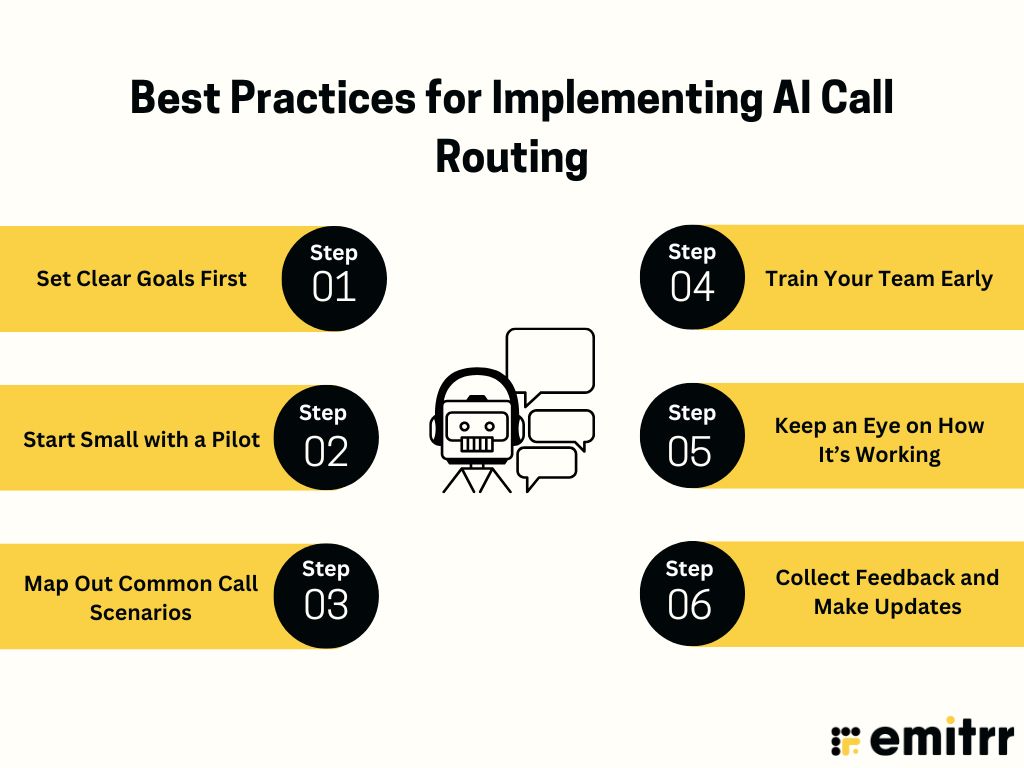
Set Clear Goals First
Start by defining what you want to improve. Do you want faster call handling, fewer transfers, or higher customer satisfaction? Pick 1–2 clear outcomes and set simple targets. This gives you a way to measure success and see if the system’s working. Without clear goals, it’s hard to know if your investment is paying off. So lay the foundation before you dive in.
Start Small with a Pilot
Don’t try to launch AI everywhere at once. Start with a small group. Maybe one team, one department, or only after-hours calls. This gives you time to test things, catch mistakes, and learn what needs improvement. It’s easier to make changes when fewer people are affected. Once things work smoothly, you can expand it step by step with more confidence.
Map Out Common Call Scenarios
Look at the top reasons people call your business. Build your AI to understand those needs and respond to them, like routing billing calls to the finance team or helping with password resets. Think of it like training the system for the most common conversations. When the AI can handle those smoothly, it takes pressure off your team. You’ll get faster responses and fewer misrouted calls.
Train Your Team Early
Your agents need to understand how the AI fits into their workflow. Teach them how the system works, when it’ll hand off calls, and what info comes with it. Let them know the AI is there to help, not replace them. Share a few quick wins or examples to build trust. When your team feels confident, they’re more likely to use the system well and help it succeed.
Keep an Eye on How It’s Working
Once your AI is live, don’t “set it and forget it.” Check your wait times, call volumes, how often people get transferred and overall customer journey. Listen to sample calls and see where things can be improved. This helps you spot what’s working and what needs a fix. With regular check-ins, you can keep improving over time, it’s not a one-time setup.
Collect Feedback and Make Updates
Ask customers and agents how things are going. Was the AI helpful? Did the call go to the right place? Use that feedback to update the system, fix gaps, or add new scenarios. This keeps the AI in tune with what’s really happening. The more you learn and adjust, the better the system will get over time.
How Emitrr Improves Call Routing
Here’s how Emitrr makes AI-powered call routing actually work for your team and your callers:
Smart IVR That Understands You
Forget those long “press 1 for this, press 2 for that” menus. Emitrr uses a smart voice system where callers can just say what they need in plain language. The AI understands and sends the call to the right place, fast. So instead of guessing what button to press, callers just speak like they normally would. It feels more natural and less frustrating. That makes for a better first impression.
Matches Calls by Skills and Priorities
Emitrr connects to your CRM, so it knows who’s calling and why. Let’s say a VIP customer calls in, Emitrr can spot that and move them up the line or match them to your best agent. It also matches callers based on what they need and who on your team is best equipped to help. This helps solve problems quicker and on the first try. It keeps your team sharp and your customers happy.
No More Waiting on Hold
Nobody likes waiting forever on the phone. Emitrr can offer callers a callback instead of holding, they press a button, and your system calls them back when it’s their turn. And after hours? The AI steps in to answer basic questions, take messages, or book a callback for the next day. So your business is always “on” without needing someone at the desk 24/7. You don’t miss leads or frustrate your customers.
Helps Your Agents While They Talk
While your agent is on a call, Emitrr quietly listens and helps behind the scenes. It can show useful info or next steps on the agent’s screen in real time. When the call ends, it can write up a summary or log notes automatically. That means less typing and more talking. Your team can focus on the customer, and not worry about the admin work.
Everything in One Inbox
Whether someone calls, texts, or messages, it all shows up in one place. Emitrr keeps all channels together in a single inbox. So if a customer texted earlier and now calls, your agent can see the full conversation history. There’s no switching tabs or asking the customer to repeat themselves. It’s all connected, all in one view.
Live Data You Can Actually Use
Emitrr gives you a dashboard that updates in real time. You can see how many calls are coming in, how long people are waiting, and how your team is doing. It can spot and reduce issues quickly like long patient wait times before they become bigger problems. And when you want to dig deeper, you’ve got reports, call logs, and recordings to back you up. It’s like having a pulse on your phone system 24/7.
Future Trends in AI Call Routing
Looking ahead, here are some ways AI may further transform call routing and customer service:
AI That Handles the Whole Journey
In the future, AI won’t just route the call, it might handle the entire conversation from start to finish. Think of it like a smart helper that can solve common problems without needing a human. If the issue gets tricky, it still knows when to bring in a real person. But for everyday stuff like checking order status or booking appointments, AI might take care of it all. This could free up your team and make things faster for customers.
Reaching Out Before the Customer Does
AI won’t just wait around for calls, it’ll start reaching out first. Let’s say there’s a delay or an outage, AI could call or text your customers to update them right away. That way, people don’t need to call in and ask what’s going on. It reduces the number of incoming calls and keeps customers in the loop. Being proactive builds trust and shows that your business is on top of things.
Your Voice Becomes Your ID
Soon, AI might recognize people just by their voice. So instead of answering security questions, callers could be verified instantly as soon as they speak. This makes the call faster and more secure. Plus, with info from your CRM, the AI can greet them by name and offer help based on their history. It feels personal and saves everyone time.
Smarter Support with Generative AI
Imagine AI that listens in on calls and gives your agents helpful tips in real time. It might suggest what to say, pull up answers, or guide the agent during a tricky conversation. This tech could also help train new team members using practice calls or instant coaching. It’s like having a smart co-pilot on every call. As AI gets better, your agents get even more support, without losing the human touch.
Frequently Asked Questions
Yes. AI routes calls faster and can offer callbacks, so callers aren’t left waiting or hanging up before getting help.
It looks at what the caller needs, checks who’s available, and matches them with the best agent based on skills or past interactions. This smart matching is how to avoid routing calls to the wrong person. No more bouncing around or starting over.
Emitrr’s AI systems are built for businesses that follow strict data privacy and security standards, making them suitable for industries like healthcare and finance.
Most businesses can get started in just a few hours. A simple setup or pilot can be launched without complex IT work.
Absolutely! Emitrr AI can answer calls after hours, take messages, provide basic help, or even schedule callbacks when your team is available.
Emitrr connects directly with your current systems, syncing data and ensuring your team has full caller context without switching tools.
Conclusion
AI-powered call routing is changing the game for customer service. It helps even small businesses deliver faster, smoother phone support by reducing wait times, resolving issues more quickly, and freeing up your team from tedious tasks. By blending smart automation with the human touch where it counts, companies can boost customer satisfaction and efficiency at the same time.
Since the phones aren’t going away, making the call experience better is a smart investment to differentiate your business. Adopting AI call routing now can give you a competitive edge in responsiveness and service quality. So if you’re curious to see it in action, book a demo with Emitrr to see how AI can transform your call handling! Your customers and your team will thank you!

 4.9 (400+
reviews)
4.9 (400+
reviews)