
 4.9 (400+
reviews)
4.9 (400+
reviews)

Introduction
If you’ve been nodding all along, it’s time to make AI your ally.
AI, or Artificial Intelligence, is nothing short of a “watershed” in the history of customer service technology, helping call centers do away with manual labor, poor quality of interactions, slow response times, and agent burnout. The technology is doing all the heavy lifting for the modern-day contact centers, while allowing humans to focus on relentless innovation.
We, at Emitrr, have come up with a comprehensive, no-fluff guide on “AI in Call Centers” that explains:
- How is AI transforming call centers?
- What should businesses do to integrate AI in call centers?
- Can AI fully replace agents in customer contact centers?
- And a lot more!
So, if you’ve ever wondered how AI can impact your call center’s bottom line and how you should adopt it, this is your cue to bookmark our guide.
What is an AI Call Center?
At its core, an AI-based call center deploys AI at the forefront of its operations to:
- Handle routine queries without human help.
- Reply to customers super fast, keeping context in mind.
- Keep agents free for strategic priorities.
- Spot patterns through data that humans usually miss.
- Work 24/7 without crashing out.
Banking on new-age technologies like machine learning (ML) that learns from data, natural language processing (NLP) that makes sense out of human chatter, and predictive analytics that diagnose patterns and guess what’s coming next, an AI contact center takes business-to-customer interactions to a new stratosphere.
Unlike traditional call centers that are characterized by long waiting times, uninspired conversations, guesswork, and overwhelmed agents, AI call centers make engagement smarter, smoother, and more human (even if they are NOT).
Global businesses are increasingly waking up to call center AI solutions, with adoption skyrocketing like never before. In 2025, the global call center AI market is projected to hit over $2 billion, growing at a jaw-dropping 23.8% CAGR between 2025-2030. This growth can be attributed to call centers craving efficiency and customers needing instant gratification.
Let’s quickly unbox this revolution and explore what call center challenges AI is solving.

The Evolution of Call Centers: Traditional Call Centers vs. AI-Driven Solutions
Traditional call centers relied heavily on human agents to handle all customer interactions. These setups had limitations, such as long wait times, inconsistent service quality, and high operational costs. AI in call centers has emerged as a transformative solution, automating tasks and optimizing customer service.
Traditional call centers primarily relied on manual processes, where human agents answered inquiries, resolved complaints, and processed transactions. This setup often led to inefficiencies due to human error, varying skill levels, and workload fluctuations. The introduction of AI technologies has provided businesses with an opportunity to streamline operations and provide a more seamless customer experience.
Importance of AI in Contact Centers
AI is changing call center operations by making them more human-centric, paving the way for improved customer experiences. Here’s the proof – the global call center AI market was valued at $2 billion in 2024 and is projected to hit $7.08 billion by 2030 – an exponential growth of 23.8% CAGR.

80% of contact centers are already using AI-based technologies and changing the way customers and call center agents interact. The reason is that customers are increasingly looking forward to instantaneous and effortless AI in customer service experiences without human intervention when it comes to handling customer inquiries.
The shift in desire pushes businesses to satisfy customers with instant responses so they don’t get frustrated without personalized support. AI call centers deliver slashing average handle times by implementing
- Cloud-based solutions for enhanced scalability
- Chatbots and virtual assistants to improve basic call center functions
- Voice recognition systems for real-time assistance
- Self-help tools like speech analytics to expand service capabilities
The outlook is clear: AI isn’t a trend—it’s the future, propelling a bold era by tackling complex customer interactions with finesse and arming agents with real-time insights to deliver spot-on solutions.
Businesses that lean into AI-powered call centers will be able to unify every touchpoint – voice, chat, and email proactively when handling complex queries using real-time data insights while empowering call center agents with problem-solving responses that hit the mark every time.
What Makes AI Call Centers Different?
Unlike traditional setups, where human agents handle every query, AI-driven call centers integrate advanced technologies that allow businesses to automate, analyze, and optimize their customer support systems. These innovations ensure faster response times, better accuracy, and a more personalized customer experience. For instance, many of these solutions include an automated answering service, which handles routine inquiries instantly and frees human agents to focus on complex cases.
1. Machine Learning (ML) – Continuous Improvement Over Time
- AI systems don’t just follow fixed rules; they learn from past customer interactions and improve over time.
- ML models identify patterns in customer inquiries, helping refine automated responses and agent recommendations.
- Over time, these systems become better at predicting customer needs and offering more accurate solutions.
2. Natural Language Processing (NLP) – Understanding and Responding Like a Human
- NLP allows AI to interpret human language in a way that feels natural and conversational.
- It helps AI-powered chatbots and virtual assistants understand different accents, slang, and contextual meanings.
- This technology ensures that customers don’t feel like they’re talking to a machine but rather to an assistant who understands their needs.
3. Voice Recognition – Transforming Spoken Interactions into Actionable Insights
- AI-powered voice recognition transcribes and analyzes customer conversations in real-time.
- It detects customer intent, urgency, and even sentiment, helping businesses offer proactive support.
- This is particularly useful for call monitoring, compliance tracking, and training human agents.
4. Sentiment Analysis – Understanding Emotions Behind Words
- AI can analyze the tone, pitch, and choice of words to determine a customer’s emotions.
- If a customer sounds frustrated, the system can escalate the call to a human agent for a more empathetic resolution.
- Sentiment analysis helps businesses measure customer satisfaction and improve service quality.
5. Intelligent Call Routing – Directing Calls to the Right Agent
- Instead of relying on standard IVR (Interactive Voice Response) menus, AI uses data-driven call routing.
- It directs calls based on customer history, past interactions, and the complexity of the query.
- This ensures that customers are connected to the most qualified agent or chatbot for a quicker resolution.
6. Predictive Assistance – Solving Problems Before They Happen
- AI can anticipate customer needs based on past interactions and behavioral data.
- For example, if a customer frequently asks about their account balance, the system can automatically display that information when they call.
- This reduces the need for repetitive inquiries and enhances customer satisfaction.
7. Multichannel Integration – Providing Seamless Support Across Platforms
- Unlike traditional call centers that rely solely on phone calls, AI-driven contact centers integrate with chat, email, and social media.
- Customers can start a conversation on one platform and continue it on another without repeating themselves.
- This creates a seamless, omnichannel experience for modern customers who expect flexibility.
8. Cost Efficiency – Reducing Operational Expenses Without Sacrificing Quality
- AI handles routine queries, reducing the need for a large human workforce.
- Automated systems minimize the risk of human error, improving accuracy and efficiency.
- Businesses can scale their customer service operations without dramatically increasing costs.
Core Components of AI in Call Centers
AI has transformed call centers by enabling faster, smarter, and more efficient customer interactions. But what makes AI-powered call centers so effective? Let’s break down the core components in simple terms so that anyone can understand how they work and why they matter.
1. Natural Language Processing (NLP)
Natural Language Processing (NLP) is the technology that allows AI to understand and interpret human language. It enables AI-powered chatbots and virtual assistants to communicate in a natural and human-like way.
Why It’s Important:
- Customers no longer have to repeat themselves or struggle with robotic responses.
- AI can quickly understand customer concerns and provide relevant solutions without human intervention.
- NLP improves over time, learning from past interactions to become smarter and more accurate.
Example:
- Amazon Alexa and Google Assistant use NLP to understand and process voice commands, allowing users to ask questions, set reminders, or control smart home devices.
- Banking Chatbots like HDFC’s EVA or SBI’s SIA use NLP to help customers check their account balance, report lost cards, or inquire about loan eligibility—all without speaking to a human.
2. Machine Learning and AI Algorithms
Machine Learning (ML) is a type of AI that helps computers learn from past experiences and make better decisions over time.
Why It’s Important:
- Reduces human errors by providing accurate and consistent responses.
- Helps agents by suggesting the best possible responses based on similar past cases.
- Increases efficiency by automating repetitive queries so that human agents can focus on complex problems.
Example:
- Netflix’s Recommendation System: Similar to how Netflix suggests movies based on past viewing habits, AI in call centers learns from previous customer interactions to suggest the best responses to agents or resolve issues automatically.
- Fraud Detection in Banking: AI-powered call centers in banks like HSBC and Citibank use machine learning to detect fraudulent transactions. If a suspicious pattern is identified, the AI can trigger an automated call to verify the transaction with the customer.
3. Voice Recognition and Analysis
Voice recognition allows AI to transcribe, analyze, and understand spoken conversations. It helps detect customer emotions, urgency, and key issues in real-time.
Why It’s Important:
- Improves call routing by sending customers to the right agent based on their tone and query.
- Helps businesses identify unhappy customers before they escalate issues.
- Automates call summaries, reducing the need for agents to log call details manually.
Example:
- Apple’s Siri and Google’s Voice Search: They use voice recognition to convert speech into text and analyze user intent, enabling hands-free assistance.
- Sentiment Analysis in Call Centers: Companies like Emitrr, Verizon, and AT&T use AI-powered voice analysis to detect customer emotions. If a caller sounds frustrated, the system can escalate the call to a human supervisor for faster resolution.
Challenges Faced by Contact Centers and How AI Solves Each of Them
Call centers have faced a laundry list of operational challenges—until AI leapt in and changed the status quo. Here’s what keeps managers up at night, plus how AI is saving the day.
High Agent Burnout & Turnover
Contact centers face a persistent challenge with agent burnout, as repetitive tasks and emotionally charged customer interactions drain morale and drive staff to leave. This turnover disrupts operations and inflates recruitment costs, straining resources.
AI addresses this by automating routine inquiries—such as account queries or basic troubleshooting—through intelligent customer service chatbots, allowing agents to focus on higher-value, complex issues.
Real-time AI coaching tools further support agents by offering contextual guidance during calls, enhancing their ability to resolve cases effectively. By alleviating monotony and fostering professional growth, AI transforms the agent experience, promoting retention and building a more resilient workforce.
Operational Bottlenecks & Inefficiencies
Outdated systems and manual processes often cripple contact centers, creating bottlenecks that slow service delivery and escalate operational costs. Agents lose valuable time navigating cumbersome interfaces or rerouting misdirected calls, thus undermining productivity.
AI streamlines these workflows with advanced automation, enabling precise call routing to connect customers with the right agent instantly. Predictive tools also anticipate demand surges, optimizing staff schedules to align with peak periods.
This shift to smarter operations minimizes disruptions, reduces overhead, and ensures a seamless service experience, empowering businesses to operate with greater agility and control.
Limited Service Availability & Slow Response Time
Today’s customers expect immediate support, but constrained hours and lean staffing models leave many contact centers unable to meet this demand, risking client frustration and churn. AI resolves this with round-the-clock virtual assistants and chatbots that handle routine queries, like order updates or policy clarifications, without human involvement. These tools deliver swift resolutions, ensuring accessibility even during off-hours.
By extending service availability and accelerating response times, AI helps enterprises maintain customer satisfaction and loyalty, reinforcing their reputation as responsive partners in a competitive market.
High Call Abandonment Rates
Extended hold times during peak periods often lead customers to disconnect, resulting in missed opportunities and weakened relationships. Sudden call volume spikes exacerbate this, overwhelming agents and degrading service quality.
AI mitigates these risks by deploying virtual assistants to manage overflow and using intelligent routing to pair callers with available agents quickly. Sentiment-aware systems also prioritize urgent cases, ensuring timely attention for frustrated clients.
This proactive approach keeps customers engaged, preserves revenue potential, and strengthens trust, delivering measurable value to the bottom line.
Reactive Issue Detection & Escalation
Too many contact centers react to problems only after they’ve escalated, consuming resources and eroding customer goodwill. This after-the-fact approach misses opportunities to address concerns early.
AI redefines this dynamic with predictive analytics that identify emerging issues—such as recurring service disruptions—before they spiral. Automated alerts enable teams to reach out proactively, perhaps notifying a client about a delivery issue with a ready solution.
By anticipating and resolving problems upfront, AI reduces escalations, enhances customer confidence, and frees agents to focus on strategic priorities.
Handling Irate, High-Tension Customer Interactions
Managing upset customers tests even the most skilled agents, as heightened emotions demand deft handling to avoid further conflict. Without proper support, these interactions can falter, damaging relationships. AI empowers agents by analyzing caller sentiment and directing complex cases to seasoned professionals equipped for de-escalation.
During conversations, AI suggests tailored responses to defuse tension and resolve issues effectively. This intelligent assistance ensures that challenging interactions end on a positive note, reinforcing client trust and positioning the contact center as a reliable partner.
Fragmented Multi-Channel Experiences
Modern customers engage across email, chat, social platforms, and voice, but siloed systems often force them to restart their queries with each switch, breeding frustration. AI bridges these gaps by integrating channel data into a cohesive view, giving agents full context of prior interactions.
When a client moves from a social media message to a call, the conversation continues seamlessly, with no need to repeat details. This unified approach streamlines service delivery, elevates customer experiences, and drives satisfaction, helping businesses stand out in a crowded marketplace.
Generic, One-Size-Fits-All Interactions
Generic responses no longer suffice in a world where clients expect interactions that reflect their unique needs, and falling short risks losing their loyalty. Manual personalization, however, is resource-intensive for high-volume centers.
AI solves this by leveraging customer insights—such as purchase patterns or preferences—to craft relevant, individualized responses in real time.
For instance, it might prompt an agent to offer a targeted solution based on a client’s history. This level of customization deepens engagement, fosters long-term relationships, and gives enterprises a competitive edge.
Insufficient Agent Training and Upskilling
New agents often grapple with intricate systems, and inadequate training leads to mistakes that frustrate customers and slow operations. Ongoing skill gaps further hinder performance. AI revolutionizes training with interactive platforms that simulate real-world scenarios, enabling faster mastery of tools and protocols.
During live interactions, AI provides instant feedback, suggesting refinements to tone or approach. This continuous learning environment equips agents to perform confidently, reduces errors, and enhances service quality, ensuring contact centers deliver consistent value to clients.
Weak Data Privacy and Security Measures
Rising data privacy concerns make customers cautious about sharing information, and regulatory missteps can lead to costly penalties and reputational harm. Contact centers, entrusted with sensitive data, face heightened scrutiny.
AI bolsters protection with real-time encryption and automated monitoring to detect compliance risks, such as mishandled personal details. It also conducts proactive audits to prevent breaches before they occur.
By embedding robust security and adherence to standards like GDPR, AI instills customer confidence and shields businesses from legal and financial risks, ensuring trust remains intact.
Benefits of Contact Center AI
AI has changed the way modern call centers operate these days. Let us explore the key advantages of integrating contact center artificial intelligence with your existing systems:

- Improved Customer Experience (CX): AI in call centers can help businesses offer 24×7 support and response to frequently asked questions, helping improve their experience with your service.
- 24/7 Availability: Unlike human agents, AI in call centers can be available 24/7 without any added cost of hiring more agents to cover night shifts.
- Improved Agent Productivity: AI-powered tools like Emitrr can help enhance a team’s productivity by offering smart features like call pop, smart call routing, IVR, automated responses, etc.
- Sentiment Analysis & Real-time Insights: Some advanced AI tools can now even do sentiment and emotional analysis to alert supervisors in case of negative sentiment or escalation risks.
- Omnichannel Support: AI can be integrated with multiple communication channels, be it SMS, email, calls, etc., helping automate and simplify all channels of customer communication.
- Reduced Call Center Costs: By automating repetitive tasks like scheduling bookings/appointments, answering FAQs, checking order status, etc., contact center AI solutions can reduce the cost of hiring large support teams.
- Smarter Call Routing: AI contact center platforms can analyze incoming calls and connect the caller to the best or most qualified agent as per the Cx query, helping them get faster resolution.
- Conversation Insights: Contact center AI can analyze a large volume of customer-agent calls and help identify customer sentiments, trends, expectations, etc., for improved customer service.
- Personalization at Scale: AI can also analyze customer preference, history, behavior, etc,. at scale and help offer tailored product recommendations and even predict responses based on past interactions.
- Automated Call Monitoring: Some AI call center solutions come with smart call monitoring that helps in flagging positive and negative interactions, helping team leaders or quality analysts identify areas of improvement.
Types of AI Solutions in Call Center
AI’s an excellent cut-out for call center transformation. The technology brings forth a collective of tools that can transform call centers into smarter, more efficient operations. Here’s a closer look at how the key players in the sector are driving this change today.

Chatbots and Virtual Agents
These are the workhorses of the modern AI call centers, tirelessly handling basic to intermediate inquiries via text or voice, 24/7. Whether it’s sharing the order status at midnight or scheduling a callback, chatbots and virtual agents keep the lights on when human agents clock out. For any growing company, using a chatbot for small businesses can significantly reduce support load while maintaining responsiveness. Powered by natural language processing (NLP), they’re evolving beyond scripts into conversational AI agents that can reason and make decisions independently, resolving up to 80% of routine queries.
Conversational AI and IVRs
Conversational AI and interactive voice response (IVR) systems use NLP to understand natural speech, making them far smarter than their old-school counterparts. They chat with callers like a human would, guiding them through options or routing them to the right department—all without a keypad. These systems can significantly slash call handling times by responding in real time, while ensuring seamless handoff to agents when needed.
Sentiment Analysis Tools
Ever wonder how a caller feels as he talks about what bothers him? Sentiment analysis tools decode tone, word choice, and even pauses to gauge emotions (whether he’s delighted or ready to rage). These AI-backed tools sense and flag anything going awry, letting agents adjust their approach or escalate to a supervisor. Besides, they help analyze post-call data too, spotting trends and helping reshape approaches to customer service. It’s a goldmine for coaching agents and improving service, ensuring every interaction ends on a high note.
Predictive Analytics
Predictive analytics works as a compass, guiding call centers towards the right path. By extracting historical data, it helps forecast call volumes, pinpoint busy hours, and even predict customer churn risks. Predictive analytics also aids in staffing, knowing when to bring in reinforcements. It further anticipates customer needs, like suggesting upsells based on past behavior. This proactive edge helps managers optimize resources, reduce wait times, and keep service levels steady.
Intelligent Call Routing
AI in call routing matches each customer with the best agent based on skills, past interactions, or even personality fit. AI helps tap into caller data, like issue type or language, to ensure a quick, accurate handoff while also ensuring real-time agent availability and expertise, boosting first-call resolution rates. The result? Faster fixes, happier customers, and agents who feel equipped to boost satisfaction scores.
Automated Ticketing Systems
AI-driven Automated Ticketing Systems drive a step-change in the productivity of call centers. These tools use NLP and machine learning technologies to sort and prioritize customer queries, assigning tickets to the right agents and ensuring meaningful, data-led solutions. The whole process cuts down the slog, speeds up customer service efficiency, and lets agents handle the complex stuff, all while ensuring workflow optimization.
Best Practices for Implementing AI in Contact Centers
Positive AI implementation in contact centers requires a bit of planning and execution. Here are the some best practices to keep in mind when implementing AI in call centers:

1. Define your clear goals & objectives for your call center
Before implementing AI for contact centers, identify what you want to achieve. Is it to reduce call volume, improve first-call resolution, lower handling time, boost CSAT score, etc? Ensure that the artificial intelligence call center solution you choose is able to help you out with your main objectives.
2. Start small
Don’t buy an enterprise-level AI contact center solution at once; begin with low-risk, high-impact use cases such as answering FAQs via chatbot, call routing automation, and appointment scheduling with AI tools like Emitrr, and then add more features as you scale. You can use performance data and feedback to expand into more complex scenarios like real-time agent assistance or predictive analytics.
3. Choose the right AI for call centers
When looking for the best contact center AI tool, consider natural language processing (NLP) capabilities, integration with your CRM, ticketing, and telephony systems, multilingual support capabilities, real-time analytics, and reporting features to get the best out of your new system.
4. Offer call center agent training and change management strategies
Train your team to work with AI confidently and responsibly. When you introduce new AI tools, make sure your call center agents get the right support to learn how to use them. Change can be tough, so give your team the reassurance and guidance they need. Remind them that AI is here to help, not replace them. This is also a great time to refresh important skills, like clear communication and using tech tools, so your team feels stronger, not sidelined.
5. Ensure data privacy and security
Keep customer data safe and be open about how you use it. When using AI in your call center, it’s important to follow privacy rules and protect customer information with strong security measures. Just as important, be honest with your customers. Let them know what data you’re collecting, why you need it, how it’s being used, and how long you’ll keep it. This builds trust and shows your customers you respect their privacy.
6. Regularly monitor & optimize
AI needs continuous tuning; you cannot set it and forget it. So, with the help of your contact center AI, track metrics such as deflection rate, resolution time, CSAT, etc., analyze conversation transcripts, update training data and intents, and optimize the system as and when needed for the best results.
7. Test your contact center AI before full rollout
Before rolling out your new AI contact center solutions, pilot them with a small group or single channel. Look for any unexpected friction points, edge cases, customer confusion, or drop-offs, and then, based on your learning, fine-tune the system before broader deployment.
Ways to Use AI in Contact Centers
From helping agents with better responses to predicting call volume, contact center artificial intelligence tools can do so much. Take a look at these:
Let AI Handle Complex Issues
Modern AI assistants are more advanced than old-school bots. They can solve a wide range of customer problems on their own. These tools understand what customers are feeling, recognize voices, and can even route calls to the right team automatically.
Keep an Eye on Call Quality
AI in contact centers helps managers review calls more easily and thoroughly.
- Call transcripts: They create written versions of calls so managers can read through them.
- Assess agent performance: AI can review calls based on your service standards, helping managers spot where things can be improved.
- Offer quick insights: AI can look through call transcripts in bulk to spot patterns, track performance, and understand common problems or customer preferences.
Speed Up Call Wrap-Ups
By automating call transcriptions and summaries, AI in call centers can even help in speeding up call wrap-ups for agents.
- Call summaries: AI tools can listen to live or recorded calls and create clear summaries that highlight key points, like customer issues and any follow-up actions needed.
- Call transcripts: AI-powered systems can turn spoken conversations into written text, giving you a complete or nearly word-for-word record of each call.
Give Agents Real-Time Help with AI Copilot
Contact center AI tools like AI Copilot can support agents during live calls immensely. They can listen to calls in real-time, pull up helpful info from past chats, customer history, or your help center, and suggest what to say next. This means agents can stay focused on the customer instead of jumping between tools or screens.
AI for Call Centers Offers Better Self-Service Options
AI-powered call centers can help customers help themselves. With smart tools like AI-powered help centers, customers can find answers to common questions without waiting on hold. At the same time, your team can also benefit from faster access to up-to-date info.
Real-Time Voice Coaching for Agents
AI can listen in on live calls and give agents on-the-spot tips, like suggesting a better tone, reminding them to pause, or warning if the customer is getting frustrated. This helps improve soft skills and emotional intelligence during the call.
Contact Center AI can Auto-Fill CRM Entries
Instead of having agents type out notes, AI can extract key data from conversations and auto-fill forms, fields, or CRM entries, helping your team improve accuracy and save precious time.
AI-Powered Forecasting & Scheduling
Using historical call volumes, current data, and seasonal trends, AI can forecast busy times and help managers plan better staffing, reducing wait times and agent burnout. This is especially useful for enterprise-level contact centers that see heavy call flow often.
Automating Email, SMS & Social Media Replies
AI-powered tools like Emitrr can craft personalized replies to SMS, emails, tweets, or Facebook messages, saving agents from handling repetitive messages manually. It can also tag or categorize messages for faster triage.
Set up Conversational IVR
Modern voice systems can make customer calls feel more natural and less frustrating.
Instead of pressing buttons to get help, callers can simply speak in their own words. These smart voice tools understand what people are saying and guide them to the right solution without needing any rigid menus. They can also recognize a caller’s voice to confirm their identity and even handle simple requests automatically, so customers don’t always need to speak to an agent.
Case Studies: Successful Implementations of AI Call Centers
Many industries have successfully adopted AI-driven call center solutions, streamlining customer service and improving efficiency. Here’s how AI has transformed customer interactions in different sectors:
Telecommunications Industry
In the fast-paced telecom sector, customer inquiries range from billing issues to network troubleshooting. A leading telecom provider integrated AI-powered call center solutions, significantly improving customer experience:
- Reduced call waiting times by 60% – AI quickly identified customer concerns and directed them to the right department, eliminating long hold times.
- Enhanced issue resolution rates – AI chatbots efficiently handled common issues like bill payments, data usage inquiries, and troubleshooting, reducing the need for human intervention.
- Personalized plan recommendations – AI analyzed customer usage patterns and suggested the most suitable data or calling plans, leading to higher customer satisfaction.
This automation not only improved response times but also allowed human agents to focus on complex technical issues, ensuring a smoother customer experience.
E-commerce Sector
With millions of orders placed daily, e-commerce companies rely heavily on customer support to handle inquiries efficiently. A global e-commerce giant leveraged AI-driven contact centers to enhance customer interactions:
- Predictive analytics for product recommendations – AI analyzes past purchases and browsing history to offer tailored product suggestions, increasing sales.
- Automated order tracking and return requests – Customers could check their order status or initiate returns without waiting for a live agent. AI-powered chatbots provided instant responses, improving convenience.
- 24/7 customer support – AI ensured round-the-clock assistance, handling a high volume of queries and reducing response times.
By automating these processes, the e-commerce platform improved customer satisfaction while reducing the workload for human agents.
Banking and Finance
In the banking sector, security and efficiency are top priorities. A major financial institution adopted AI-powered call center technology to enhance customer service and fraud prevention:
- Automated customer inquiries – AI quickly addressed common banking questions, such as balance checks, transaction history, and loan eligibility, reducing operational costs.
- Enhanced fraud detection – AI analyzed transaction patterns and flagged suspicious activities in real-time, helping prevent unauthorized transactions and improving security.
- Seamless customer authentication – AI-driven voice recognition technology enabled secure and hassle-free authentication, reducing reliance on passwords and verification questions.
This AI integration not only streamlined banking operations but also strengthened trust and security for customers.
Learn more about what our customers have achieved through Emitrr:
Integrating AI with Existing Call Center Infrastructure
AI is revolutionizing customer service, but businesses must integrate it strategically to maximize its benefits. A smooth transition requires evaluating current operations, selecting the right AI tools, and training staff for effective collaboration.
Assessing Current Operations
Before implementing AI, businesses need a clear understanding of their current call center setup. This includes analyzing:
- Call volume and customer inquiries – Identifying common queries that AI can handle, such as FAQs or account-related questions.
- Bottlenecks in customer service – Pinpointing areas where AI automation can reduce wait times and enhance response accuracy.
- Existing technology stack – Ensuring AI can integrate smoothly with CRM systems, databases, and communication tools.
A thorough assessment helps businesses determine where AI can add the most value without disrupting operations.
Selecting the Right AI Technology
Not all AI call center solutions are created equal. Businesses must choose AI tools based on their unique needs:
- Chatbots for handling common inquiries – Ideal for order tracking, appointment scheduling, and troubleshooting.
- Sentiment analysis AI – Helps detect customer emotions in real-time, allowing agents to intervene when needed.
- Multilingual AI support – Essential for global businesses catering to diverse customers.
By selecting the right AI software, companies can improve efficiency without compromising the human touch.
Training Staff for Seamless Integration
AI isn’t a replacement for human agents—it’s a powerful assistant. To ensure smooth collaboration:
- Agents should understand how AI works – Training sessions should teach staff how AI processes queries and when to step in for complex cases.
- A blended AI-human approach is key – AI handles routine queries, while human agents focus on problem-solving and customer relationships.
- Ongoing AI training keeps agents updated – As AI capabilities evolve, regular training ensures seamless teamwork between humans and machines.
When employees and AI work together, customer service becomes more efficient and personalized.
Can AI Replace Call Center Agents?
It’s a question keeping all professionals across multiple industries up at night, let alone call center agents. So, here’s the answer: not entirely!
AI in call centers will be a productivity driver, handling a chunk of tedious tasks and managing basic interactions while allowing humans to focus on other important, business-critical priorities. It’ll free agents from the routine, soul-crushing tasks by driving automation and data in.
For example, AI-powered IVR systems resolve calls without human input, and sentiment analysis tools gauge frustration with accuracy, routing high-stakes calls to agents who can de-escalate. This slashes wait times and cuts costs by automating low-level tasks.
However, it’s important to understand that AI can’t replicate the empathy of an agent calming an upset customer or the creativity needed to solve a one-off issue. Customers still want a human for sensitive matters like billing disputes or product complaints. Agents also bring cultural context and persuasion skills—like upselling during a call—that AI hasn’t quite nailed yet.
The real magic will happen when AI and agents team up to improve customer service. AI can flag a customer’s history, and a human agent can leverage it to dig up more relevant, relatable solutions. This synergy can transform in-house operations significantly, leading to faster resolutions, happier customers, and better customer experiences.
AI is here not to replace humans but to shift job roles. Low-skill positions tied to repetitive tasks are at risk, with many processes becoming automated. Meanwhile, the demand for tech-savvy agents who can handle complex cases or manage AI systems is rising.
- So, can AI replace agents? No.
- But, can AI replace humans who don’t know AI? Yes.
AI is here to take on the monotonous work, letting humans focus on what they do best: connecting, solving, and building trust. The catch? Businesses need to lean in, train staff, integrate tech smartly, and keep the human touch alive.
The Future of AI in Call Center Technology: Trends and Predictions
As AI technology evolves, call centers will continue to transform, offering even more intelligent and seamless customer experiences. Here’s what the future holds:
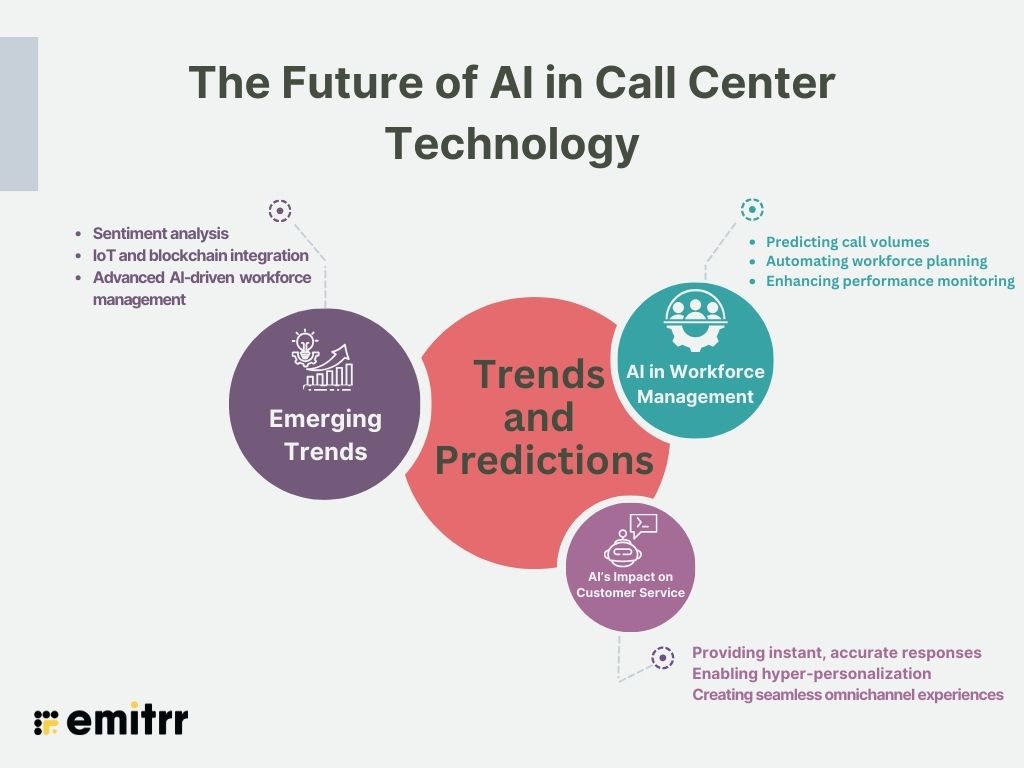
Emerging Trends
Several cutting-edge technologies will shape the next generation of AI-powered call centers:
- Sentiment analysis – AI will become even better at detecting emotions in customer conversations, allowing companies to provide more empathetic responses.
- IoT and blockchain integration – AI will work with IoT devices to gather real-time data, while blockchain will enhance data security and transparency.
- Advanced AI-driven workforce management – AI will predict call volumes and optimize agent schedules, reducing downtime and improving efficiency.
These advancements will lead to smarter, faster, and more secure customer interactions.
AI in Workforce Management
One of AI’s biggest advantages is its ability to optimize call center staffing:
- Predicting call volumes – AI will analyze historical data to anticipate peak call times, ensuring adequate staffing.
- Automating workforce planning – AI-driven tools will schedule shifts more efficiently, reducing agent fatigue and improving service quality.
- Enhancing performance monitoring – AI will track call handling times and customer satisfaction metrics, helping managers make data-driven decisions.
This shift will result in better resource allocation and improved overall productivity.
AI’s Impact on Customer Service
AI will continue to redefine customer service by:
- Providing instant, accurate responses – AI will reduce wait times and offer solutions in real-time.
- Enabling hyper-personalization – AI will analyze past interactions to offer tailored recommendations and support.
- Creating seamless omnichannel experiences – AI will unify communication across phone, chat, email, and social media, ensuring customers get consistent service no matter where they reach out.
As AI technology advances, businesses that embrace these innovations will gain a competitive edge by delivering superior customer experiences.
How to Implement AI in Call Centers?
Adopting AI isn’t a gear ready to pull. It requires a phased approach, a future-backed strategy, and a clear vision. Here’s how to implement and maximize its value.
1. Define Clear Goals Aligned with Business Needs
Start by identifying what you want. Clear objectives set the groundwork for AI implementation that aligns with your business priorities. For instance, if you’re looking for a 20% uptick in first-call resolutions, make tech choices that hit the hammer right on the head.
2. Ensure Seamless Integration with Existing CRM Systems and Workflows
AI should enhance, not disrupt, your current setup. Assess your business readiness, get your data backed up, and start integrating with your CRM and other systems to ensure a seamless bottom line. Avoid the “patchwork” approach that leaves agents confused and stalls processes.
3. Continuously Optimize Based on Performance Insights and Feedback Loops
AI isn’t “set it and forget it.” Regularly review performance data, steer, and adjust. If bots stumble on certain queries, tweak their scripts. This ongoing refinement keeps AI sharp, adapting to evolving needs and delivering consistent results.
4. Balance Automation with Human Interaction
Automation excels at speed, but empathy is human territory. Use AI for routine tasks, while reserving agents for complex, emotional calls. Striking this balance maintains customer trust, ensuring they feel heard, not just processed, during sensitive situations.
5. Focus on Personalization
Generic service wouldn’t make a cut in today’s experience economy. Customers want to feel a sense of belonging. Tap into the AI potential to analyze caller preferences and tailor responses to fill all sorts of glaring voids. A bot addressing a repeat caller by name or recalling their last issue builds rapport, turning transactions into connections that boost loyalty.
6. Train Your Agents
AI is a tool, not a replacement. Agents must stay ahead of it and need to master it. Offer training on using real-time prompts or interpreting analytics. A quick course can turn skeptics into advocates, enabling a conducive environment for collaboration and enhancing their skills and confidence on calls.
7. Integrate AI with Existing Systems
Smooth transitions between AI and agents are a lifeblood for any call center in the business. Link chatbots to your phone system so they can hand off calls with full context—no repeating frustrations for customers. This integration cuts delays, reduces errors, and keeps interactions flowing seamlessly from bot to human.
8. Ensure Data Privacy
Customer data is core-critical, and AI should handle it securely. Encrypt info, comply with regulations like GDPR or CCPA, and limit access. A breach could tank trust and invite fines, so prioritize robust security measures to protect both your business and your clients.
Cost Considerations of AI for Contact Center Integration
For businesses exploring conversational AI to enhance customer service or streamline operations, the financial commitment hinges on a blend of strategic choices and operational needs.
Whether you’re a mid-sized firm seeking to boost efficiency or an enterprise aiming for seamless customer experiences, costs vary based on how the solution is built, deployed, and tailored to your goals.
Unlike rigid and one-size-fits-all tools, conversational AI offers flexibility, but the price reflects the sophistication and scope of your vision. From ready-to-use platforms to bespoke systems, the investment is shaped by factors that balance immediate needs with long-term value, ensuring your contact center or service team delivers standout results without breaking the budget.
What Drives the Cost of Conversational AI?
- Solution Type: Custom vs. Pre-Built – Choosing between a tailored AI system and an out-of-the-box platform sets the financial tone. Custom solutions, designed to fit your unique workflows, demand more upfront effort from developers, while pre-built options offer quicker deployment at a lower entry point, ideal for businesses prioritizing speed.
- System Integration – Linking AI to existing tools—like CRM platforms, ticketing systems, or telephony—can complicate implementation. The more systems you connect, the greater the coordination required, impacting the overall investment as you align AI with your tech ecosystem.
- Ongoing Refinement – AI thrives on learning, and keeping it sharp means regularly fine-tuning its responses to handle new customer queries or industry shifts. This continuous improvement, while essential for accuracy, adds to the long-term cost but ensures the system evolves with your business.
- Deployment Approach – Cloud-hosted AI often provides cost flexibility with scalable resources that adapt to demand, though computing needs can influence expenses. On-premise setups, by contrast, involve heavier initial infrastructure costs but may appeal to firms prioritizing control over data.
- Feature Set – Robust capabilities—like omnichannel support, real-time analytics, or multilingual processing—elevate the price but unlock richer customer interactions. Basic setups cost less but may lack the depth needed for complex enterprise demands, so aligning features with goals is key.
- Scale of Use – The number of users or volume of customer interactions shapes costs, as platforms often adjust pricing based on activity levels. High-traffic contact centers may face steeper fees, but this reflects the value of handling thousands of queries effortlessly.
- Tailoring to Your Brand – Personalizing AI to reflect your company’s tone or specific processes requires extra effort, from coding unique workflows to embedding industry-specific knowledge. This customization drives costs but ensures the AI feels like an extension of your team.
- Pricing Structure – Some providers offer a fixed-cost purchase for predictable budgeting, while subscription models provide scalability and regular updates, spreading expenses over time. Each approach suits different priorities, letting you balance flexibility with financial clarity.
Conversational AI spans a spectrum of solutions, from lightweight tools for small teams to enterprise-grade platforms powering global contact centers. Basic setups might handle simple chats or FAQs, while advanced systems tackle voice interactions, customer service escalations, or integrated analytics.
The investment reflects your ambition—whether it’s deflecting routine inquiries to free up agents or delivering personalized experiences across channels. By carefully weighing deployment type, feature needs, and integration scope, businesses can align costs with outcomes, ensuring AI drives efficiency, customer satisfaction, and growth without unexpected financial strain.
How Emitrr’s AI Agent Can Help Transform Your Call Center Operations
Emitrr can be a trusted AI agent in your corner, streamlining operations and elevating customer service. Designed to tackle everyday challenges in the customer service sector, it blends automation with data and smart insights. Here’s how it can transform your call center operations.

Automates Routine Queries
Emitrr’s AI Agent handles appointment bookings and basic inquiries 24/7 at a relentless pace. By managing tasks across channels like SMS or voice, it frees your team to focus on more complex, innovative tasks. It’s an always-on assistant ensuring nothing goes unanswered, day or night.
Boosts Call Efficiency
Emitrr, as one of the most powerful call center AI solutions, comes equipped with predictive dialing abilities. It connects agents only to live callers, skilling voicemails and busy signals. This helps eliminate idle hours, letting agents handle more calls in less time. Paired with intelligent routing, it ensures customers reach the right person pronto.
Personalized Follow-Ups
Emitrr’s AI sends tailored text reminders, review requests, or follow-ups based on customer interactions. It helps in multiple ways, like sending a custom appointment nudge to a patient who might have missed it or prompting client feedback automatically. As another plus, it integrates with your CRM to personalize outreach without agent effort, boosting engagement and keeping customers in the loop.
Offers Insights
Delving deep into call data, Emitrr’s AI delivers performance metrics and sentiment analysis, giving you actionable advice for training or strategy shifts. From improving agent scripts to identifying service pages, these insights help streamline your call center into a customer service powerhouse.
Captures Missed Calls
Emitrr’s AI doesn’t let leads slip. It auto-texts customers with options to reschedule or get a callback. This feature turns potential losses into opportunities, retaining clients who might’ve walked away. With customizable responses, it keeps your business responsive and connected, even when lines are busy.
Key Features That Set Emitrr Apart
- AI-Powered Smart Conversations – Emitrr uses Natural Language Processing (NLP) to understand customer queries and provide context-aware, human-like responses.
- Automated Call Handling – Emitrr can answer, route, and resolve customer queries automatically, minimizing wait times and enhancing efficiency.
- Multilingual Support – Businesses can communicate with customers in their preferred language, making service more accessible and inclusive.
- Omnichannel Integration – Emitrr connects seamlessly across phone, SMS, email, and chat platforms, ensuring consistent and unified customer interactions.
- Advanced Call Analytics & Reporting – Gain real-time insights into customer interactions, identify common pain points, and optimize customer service strategies.
- Automated Appointment Scheduling & Reminders – Reduce no-shows and streamline scheduling with AI-driven appointment confirmations and follow-ups.
- AI-Powered Lead Qualification – Emitrr identifies high-value leads, prioritizing them for human agents while automating routine inquiries.
- Robust Data Security & Compliance – Built with encryption and GDPR/CCPA compliance, ensuring customer data remains secure.
- CRM & Business Tool Integrations – Seamlessly integrates with Salesforce, HubSpot, Zendesk, and other CRM systems for smooth workflow automation.
- 24/7 Availability Without Extra Staffing Costs – Unlike human call centers that require additional staffing, Emitrr provides round-the-clock support without added expenses.
- Automated Surveys & Feedback Collection – Emitrr proactively gathers customer feedback, helping businesses improve service quality.
With its powerful automation, smart analytics, and seamless integrations, Emitrr ensures efficiency without compromising on customer experience.
Frequently Asked Questions
Chatbots, conversational IVRs, sentiment analysis, predictive analytics, and intelligent routing lead the pack. One of the industry-leading AI tools is Emitrr’s AI Agent which automates responses and enhances routing. Tools like that of Emitrr help chatbots cut wait times while ensuring smart routing, boosting efficiency and customer satisfaction.
No, AI will never fully take over humans. It’ll act as a “crutch,” supporting rather than replacing. It’s expected to handle most routine tasks soon and help address opportunities that might otherwise go unnoticed. Human agents will remain essential for empathy and complex issues, maintaining a balanced approach.
AI automates basic queries, offers personalized responses, and analyzes call data for strategic remediation. It speeds up service, predicts customer needs, and offers 24/7 support, making interactions efficient, tailored, and cost-effective for businesses.
The roadmap is easy but requires tactical steps and a clear vision. Set distinct goals, identify the right tech stack, prepare for integrations, and train agents. Start small and then refine with data. Balance automation with human touch for personalized, efficient call center operations.
AI enhances customer satisfaction by automating routine tasks, enabling 24/7 support, and personalizing interactions with customer data. Smart call routing reduces wait times, while consistent omni-channel service improves experiences. Real-time analytics refine service quality, boosting loyalty. However, over-automation may feel impersonal, so balancing AI with human interaction is key.
Implementing AI in call centers faces challenges like integrating with legacy systems, ensuring data privacy, and training agents. High costs, maintaining AI accuracy, and scalability are other significant hurdles. Customer acceptance and ethical concerns, such as job displacement, also arise, giving decision-makers a tough time. The solution lies in strategic planning that is essential to balance automation and human touch.
AI reduces agent burnout by automating repetitive tasks, providing real-time support and suggestions, and optimizing call routing to match skills. It manages high call volumes, offers knowledge resources, and improves scheduling, allowing agents to cut stress and focus on meaningful work.
AI call routing systems feature ML for smart distribution, predictive analytics for call patterns, and personalization using caller data. They also include NLP for intent understanding, CRM integration, continuous learning, real-time analytics, and multi-channel support, ensuring efficient, tailored call handling and reduced wait times.
AI handles complex queries using data, NLP and machine learning to understand nuances, analyzing data for personalized responses. It leverages knowledge bases and escalates to agents with context when needed. Continuous learning and CRM integration ensure effective resolutions. Having said that, human oversight still remains vital for empathy.
Parting Thoughts
AI is driving a 360-degree change in call centers by offloading repetitive tasks and ramping up efficiency. However, the technology has its share of drawbacks. Businesses often appear dubious about AI adoption due to privacy and compliance concerns. Many also face cultural resistance, as some believe it’s here to replace humans.
The future lies in a smart partnership—AI handling the routine, while human agents bring empathy, critical thinking, and robust security defenses. Together, they can create faster, friendlier, and more effective customer experiences. Book a demo to know how Emitrr AI can transform your call center.