
 4.9 (400+
reviews)
4.9 (400+
reviews)

Let’s be realistic, AI in healthcare is changing rapidly. From electronic prescriptions to robotic-assisted surgeries, technologies that sounded like something out of science fiction a few years back are now standard practice. Artificial intelligence (AI) is at the forefront of that change. But whereas much has been said about its application in radiology or oncology, one area quietly catching up is optometry.
If you have recently seen an eye doctor, you may have noticed some small changes, such as faster diagnoses, fewer waiting times, and even electronic reminders. Those small gains usually originate from behind-the-scenes automation and smart systems, hand in hand with your optometrist.
What is thrilling is that AI isn’t an optional upgrade. In eye care, it’s beginning to really make a difference in how we identify disease, map out treatment, and care for patients. And while some high-tech gear winds up locked in hospitals, many of these AI-enabled solutions are available to small and mid-sized practices as well.
What is AI in Optometry?
At its essence, AI in optometry means employing computer systems that are able to “learn” from information in order to aid in eye examinations, disease diagnosis, patient interaction, and administrative tasks.
Now, this doesn’t mean robots replacing optometrists. Think of it more like a very fast assistant who’s good at spotting patterns. The kind that can go through thousands of eye scans in a short time, looking for signs of trouble and then flagging the ones that need a closer look.
Let’s consider the human eye for a moment. It’s a small, fragile organ, but full of intricacy. It can reflect not only visual issues but also underlying medical conditions, from diabetes to high blood pressure. A lot of serious eye diseases, such as glaucoma or macular degeneration, can start covertly. No pain. No warning. Just gradual damage that becomes visible only when it is already developed.
Historically, detecting those problems early has been largely the practitioner’s eye (literally, pun intended), experience, and time with the patient. But now, that is becoming more difficult. More patients. More screens in our lives. More prolonged eye strain. And, sometimes, fewer minutes per appointment.
That is where technology, and especially AI, comes in as a useful ally. It’s not taking over for human expertise. Rather, it assists optometrists by doing tasks that are tedious, repetitive, or reliant on intensive data analysis. That frees up the human expert to do what counts most, such as consulting with patients, discussing choices, and providing care with a human touch.
In this article, we are going to walk through how AI is shaping the future of optometry in practical, real-life ways. We will talk about tools that can analyze retinal scans in seconds, systems that predict disease risks based on past records, and even virtual assistants that handle follow-ups so clinic staff don’t have to.
But we will also go beyond the tech itself. You will see how these changes impact patients, practitioners, and small clinics. And to ground it in reality, we will look at Emitrr, which is a modern platform helping optometry clinics bring intelligent, automated care to their everyday operations.

Key Use Cases of AI in Optometry
AI may sound like the exclusive domain of high-tech labs or sci-fi hospitals, but in the world of eye care, it’s surprisingly becoming commonplace. Clinics are employing it not for show, but for actual results. Here is how it’s quietly making a difference.
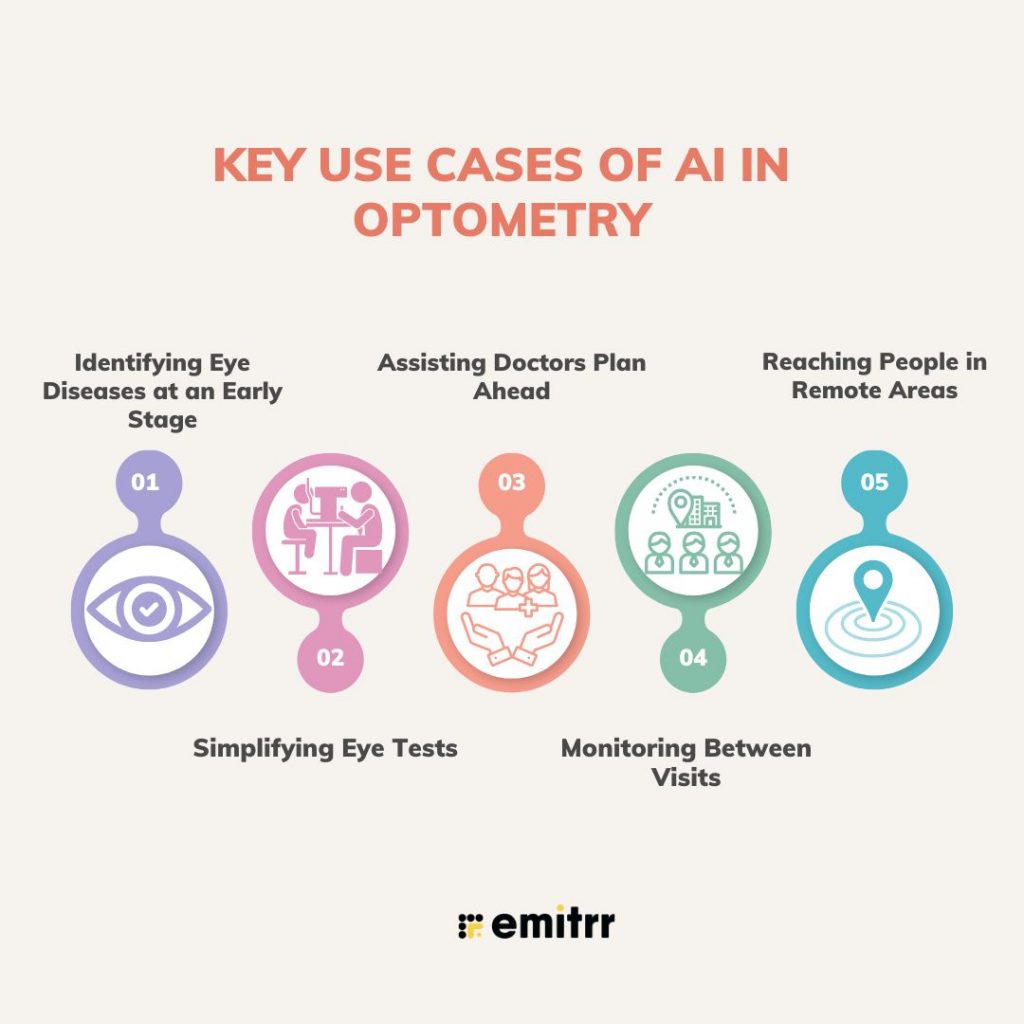
1. Identifying Eye Diseases at an Early Stage
One of the optometry industry’s greatest challenges is that diseases like glaucoma or diabetic retinopathy insidiously arrive with no apparent symptoms. Before the patient even realizes something is amiss, the damage might be permanent. AI solutions get ahead of this by detecting the slightest telltale signs, such as vessel or retinal tissue changes, that are imperceptible to the naked eye. That earlier detection can save time and preserve eyesight.
2. Simplifying Eye Tests
Recall that eye chart we all had to read? It still gets the job done, but AI has enabled it to be streamlined. These days, some systems adapt the test while you are taking it, depending on your response. It is akin to a test that hears you live. That is particularly beneficial for children who get sidetracked or elderly people who tire more easily when undergoing lengthy tests.
3. Assisting Doctors Plan Ahead
Suppose a person has mild evidence of age-related macular degeneration. That is not the whole picture. With AI, physicians can examine patterns from comparable cases and have a sense of how rapidly the condition is likely to progress. That allows the physician to more actively prepare for treatment and discuss what to anticipate.
4. Monitoring Between Visits
Patients with long-term conditions require regular check-ups, but life tends to get in the way. AI solutions support clinics in keeping on top of this by automatically monitoring patient information and even sending out reminders should someone miss a critical scan. It’s a gentle reminder to maintain care continuity without using memory or keeping track manually.
5. Reaching People in Remote Areas
It can be hard in rural communities to get to an eye doctor regularly. That is where AI-powered portable imaging equipment comes in. A technician will take a photograph of the eye and transmit it digitally. The AI makes a first pass, and a qualified optometrist makes the final decision. It’s bringing quality care closer, without requiring a full clinic on the premises.
Benefits of AI in Optometry
On its face, AI sounds like it is all about machines. But in reality, it is about creating an easier experience for the patient and giving optometrists the freedom to do what they love best. Here’s how it works on both sides of the examination room.

1. Increasing Accuracy
Even expert optometrists sometimes miss the early warning signs of disease. AI, however, does not fatigue or get distracted. It can examine and contrast thousands of eye scans to identify anything abnormal. It is like having a second pair of extremely sharp eyes assisting the specialist.
2. Smoother Day-to-Day Operations
Managing bookings, reminders, follow-ups, and file updates is a time-sucking activity that takes hours each week. Most clinics now employ AI-driven products to take care of this in the background. That translates to fewer no-shows, less desk confusion, and more time for actual patient engagement.
3. An Improved Patient Experience
Individuals enjoy swift, transparent, and empathetic care. AI can facilitate that by accelerating results and automating messaging. Patients are better educated, less anxious, and more likely to return for routine check-ins.
4. Assisting Staff to Do More
Clinic workers tend to do a lot of juggling, such as answering phones, processing intake forms, and dealing with wait times. AI technology assists now with tasks such as taking patient histories or sending appointment links. That frees up staff to have more space to do what matters most, like getting patients to feel welcome and cared for.
5. Smarter Treatment Options
Not all patients react the same way to treatment. Some artificial intelligence devices consider an individual’s past health, past reactions, and even risk factors, giving physicians a more tailored view of what may be best. It is not a guess; it is informed care based on actual data.
Challenges and Ethical Considerations
As thrilling as AI is, it’s not a silver bullet. There are very real things we need to consider, particularly when we are handling sensitive health data and personal decisions regarding someone’s vision.
1. Safeguarding Patient Information
To function effectively, AI systems tend to require access to medical records, scans, and other personal information. That is why clinics must ensure any system they deploy is secure and adheres to suitable data protection guidelines. Trust in healthcare takes a long time to build and is instantly lost.
2. Judgment Still Belongs to Humans
AI may assist in identifying trends or alerting to suspicious results, but it cannot substitute years of med-school training or that intuition a doctor develops from a patient interview. The human specialist is always the one who should be making the final call, not the program.
3. Just Access to Technology
Not all clinics can install the best-of-breed AI tools. Rural clinics and small practices might be lagging. That is why they must become easier to use and less expensive, so all patients will be able to take advantage of them.
4. Staying Current
Healthcare is not static. What we learn about diseases and treatment evolves year by year. So do guidelines. If an AI product is not updated regularly, it may result in outdated recommendations. Clinics must ensure their tech is keeping up with the science.
5. Setting the Right Expectations
AI can be a huge assist, but it is not magic. Patients may get “AI-assisted care” and anticipate instant results or flawless outcomes. It is crucial to explain that AI is an assisting tool, not a replacement for actual clinical judgment or individualized care.
Why Emitrr is the Best Platform for AI in Optometry?
In AI in optometry, the discussion is usually full of tech speak and convoluted solutions that seem better for big hospitals than for ordinary clinics. This is where Emitrr excels. It doesn’t only discuss innovation; it applies it to the front desk, waiting room, and exam chair.
Whether you are an independent optometrist or one of an expanding practice, Emitrr introduces the type of automation and assistance that aligns with the day-to-day rhythm of eye care. Let’s see why Emitrr is making waves in the world of optometry.
1. AI-Driven Virtual Assistant
Picture having a receptionist who works 24/7 without ever taking coffee breaks or days off. That is essentially what Emitrr’s AI assistant does, but better, because it does multiple things at once.
- Scheduled Appointment Management: Patients book, cancel, or reschedule appointments online, never having to call the clinic. Emitrr sees the flow through and sends out confirmations in seconds.
- Follow-up Reminders: Say goodbye to missed appointments and time-consuming reminder calls. Emitrr sends computerized SMS, email, or voice reminders as per each patient’s choice.
- Reduces No-Shows: By keeping patients up-to-date and reminded, clinics notice a significant reduction in no-shows, which helps improve revenue and patient retention.
It provides your front-desk staff with some breathing room to attend to in-person interactions, while in the background, things are running like clockwork.
Check out this video to know more about Emitrr’s AI agent:
2. Smart Patient Triage: Real Answers, Real Fast
Every clinic knows the deluge of questions received daily. “Do I need a referral?” “Is this insured?” “What are you open on Saturdays?”
Emitrr applies Natural Language Processing (NLP) to read and respond to patient queries, not with generic auto-responses, but with real, relevant, and useful answers.
- Guides Patients to the Correct Services: When someone says “blurry vision” or “diabetes,” Emitrr can route them to the correct exam or specialist.
- Personalized Responses: You can train the AI to sound like your clinic’s voice and policies, so responses don’t sound robotic.
- Accessible on Multiple Channels: Whether patients text, message you through Google, or chat from your website, Emitrr’s got you covered.
The result of this is fewer calls, fewer missed details, and quicker assistance for each patient question.
3. Seamless EHR Integration: No Extra Clicks, No Lost Data
One of the greatest nightmares about any new software is getting it to get along with what you already have. Emitrr eliminates that by providing seamless integration with most optometry-specific EHR systems.
- Real-Time Syncing: Appointment scheduling, patient alerts, and follow-up remarks are instantly synced into your system.
- Fewer Human Mistakes: Since there is less re-typing, there is also less opportunity for human error.
- Improved Workflow for Physicians: Physicians enter the exam room with current information, enabling them to make quicker, better-informed decisions.
It is not simply convenience; it is about speed, accuracy, and limiting provider and staff burnout.
4. 24/7 Patient Engagement
Patients now demand responsiveness. Emitrr provides your practice with the ability to remain available and assistive, even after hours.
- After-Hours Support: A patient sending a message at 10 PM regarding dry eye symptoms will not be forced to wait until morning to receive a response or schedule an appointment.
- Automated FAQs & Education: Emitrr can provide informative content, such as post-visit instructions or responses regarding insurance, depending on the question that the patient is asking.
- Two-Way Communication: You can receive follow-ups, confirm appointments, and templates for the same, or even receive updates, all without clogging your phone lines.
That consistent, considerate communication earns patients’ trust and keeps them returning.
5. HIPAA-Compliant and Secure by Design
When you are working with sensitive health information, particularly vision-related diagnostic tests and patients’ medical histories, security isn’t a choice.
Emitrr is built HIPAA-compliant from the ground up:
- Encrypted Communication Channels
- Secure Data Storage
- Audit Trails and Access Logs
- Role-Based Access for Staff
You can use Emitrr with confidence knowing your patients’ information is safeguarded and your practice complies with regulations.
A Few More Reasons Emitrr Excels in Optometry
- Analytics & Reporting Included: Want to see your no-show rate? Or how many patients answered follow-up messages? Emitrr offers you neat, easy-to-read reports that enable you to adjust workflows and become more efficient.
- Multichannel Communication: Patients aren’t in the same place. Emitrr reaches them through SMS, voice, email, web chat, and even Google Business Messaging, meeting patients where they are.
- Learns Over Time: Emitrr’s AI never remains the same. It becomes wiser with each use, learning from previous interactions to treat patients even better moving forward.
Emitrr isn’t just a tool; it’s a team member. Being an optometry clinic owner is not all about diagnosing eye issues; it is all about juggling schedules, developing connections, and providing great care without sacrificing your well-being. Emitrr fills in as an actual support system, handling the mundane tasks and allowing your staff to have the time and room to concentrate on what truly counts, assisting individuals in seeing clearly.
How does AI-based communication in Optometry Differ From Traditional Communication?
We all know the traditional communication flow, such as phone calls, voicemails, sticky notes, and occasional patient portal messages. It’s functional, but it can also feel a bit clunky and inconsistent. Enter AI-based communication, which takes the mess out of the message.
Personalization That Feels Personal
AI solutions don’t respond with boilerplate messages. They use information from the patient’s record, past visits, medications, or even language preference, to tailor messages. A patient with a dry eye history, for example, won’t receive boilerplate care advice; they will receive condition-focused advice.
Instant Replies, No Waiting
AI doesn’t need to check the schedule or finish helping another patient first. It’s available 24/7. If someone texts at midnight to ask if it’s okay to wear contacts after dilation, the answer is immediate and accurate.
Always Consistent
Regardless of being the first or last patient seen for the day, the response tone and accuracy are the same. That consistency is what establishes credibility and avoids confusion caused by human error or miscommunication.
Minimizes Staff Burnout
Instead of responding to the same five questions each day, “Do you accept this insurance?” “What’s your consultation fee?” Your staff can use their time for more meaningful interactions. AI does the mundane so that humans can focus on the interpersonal.
Engages Patients Where They Are
Text, web chat, voice assistants, even Google Business Messages. AI can respond across all channels. No more phone tags or missed messages that arrive after hours.
Download ready-to-use voicemail scripts for appointments, after-hours calls, and prescription updates—built for eye care clinics.
Where Does AI Overtake Humans In Optometry?
Let us give credit where credit is due. AI is incredibly efficient in some respects. It doesn’t get tired, doesn’t miss a step, and can do what may take a human hours in seconds.
1. Analysis of Images at Scale: AI can scan thousands of OCT and fundus images in mere minutes, highlighting even the most minor of abnormalities. It’s like giving your diagnostic machine a turbo-charged pair of eyes.
2. Admin Like a Pro: From appointment reminders to patient tidying, AI takes away the human factor of error and keeps things moving with efficiency without the usual back-and-forth.
3. Predicting the Future: AI can spot trends in large data sets that can predict whether a condition like glaucoma will worsen quickly or remain stable. That makes treatment proactive instead of reactive.
4. Recalls and Follow-Ups: Must remind patients to come back for annual exams or schedule follow-ups for surgical follow-up examinations? AI can do that all without anyone needing to lift a finger.
5. Learning from Every Interaction: With machine learning, the more that AI processes, the smarter it gets. It learns over time what the unique requirements of your clinic and patients are and fine-tunes everything from triage to patient education.
Where Do Humans Overtake AI In Optometry?
There is all the praise that AI deserves, but there are areas where it simply can’t match human experience and compassion.
1. Emotional Intelligence
When someone hears, “You may be losing vision,” it’s not a technical issue. It’s an emotional experience. Only a human can offer the sensitivity and reassurance needed to guide a person through it.
2. Managing the Grey Areas
AI is great with data, but not every optometry is black and white. Symptoms may be undefined, and patients won’t always define them clearly. A seasoned physician can read tone, body language, and inconsistency; things AI just can’t pick up.
3. Ethical Decision-Making
Deciding whether or not to delay a procedure or how to break bad news is more than clinical data. It requires human ethics, values, and sometimes even intuition.
4. Building Trust Over Time
Human relationships matter in medicine. A smile, a little humor to ease someone’s anxiety, or remembering the name of a patient’s child; these small human interactions build loyalty and trust that no AI can replicate.
5. Improvising on the Fly
Pre-programmed rules and logic trees are what regulate AI. Switch on a timer when something does go wrong, whether a faulty machine or a wrong patient reaction.
Why Does Optometry Need AI?
Let’s face it, optometry today isn’t what it used to be. With rising patient volumes, more complex vision disorders, and an increasing demand for personalized care, optometrists are stretched thin. Most days, it’s not just about prescribing glasses anymore. It’s about diagnosing early-stage diseases, educating patients, handling paperwork, managing follow-ups, and trying to do it all without missing a beat.
That is exactly where AI becomes a powerful ally.
Efficiency Where It Matters
Every minute saved with automation, whether it’s scheduling appointments or reviewing images, means more time for meaningful patient interaction. AI doesn’t just move faster, it helps clinics handle more patients without compromising quality.
Accuracy in Diagnoses
Many eye conditions, like diabetic retinopathy or macular degeneration, have subtle early signs that even experienced optometrists may occasionally miss. AI offers a second set of “eyes,” analyzing scans and data for micro-patterns invisible to the human eye. That leads to quicker, more confident diagnoses.
Smarter, Data-Driven Decisions
AI tools are not just reactive; they are predictive. By reviewing patient history and massive datasets, they help clinicians anticipate potential issues and plan preventive care strategies. That means fewer medical surprises down the line.
Stronger Patient Relationships
When communication becomes faster, clearer, and more personalized through AI-driven systems, patients feel valued. They appreciate timely reminders, instant replies, and tailored post-visit instructions. It’s like having a responsive care team available around the clock.
Adaptability and Scalability
Whether you’re a solo optometrist or managing multiple locations, AI tools are designed to scale with your needs. As your patient base grows, your tech infrastructure can grow with it, without the added stress on staff or resources.
The Future of AI in Optometry: What’s Next?
So, where is all of this heading? The short answer: toward a more connected, personalized, and accessible future in eye care.

Generative AI in Vision Care
Generative AI isn’t just about writing emails or making art; it’s beginning to show real promise in customizing care plans. Imagine software that can design individualized vision therapy exercises based on a patient’s unique visual needs, or even suggest custom eyewear designs based on facial structure and prescription strength. These aren’t distant dreams; they are already in development.
Teleoptometry + AI: Care Without Borders
Rural and underserved areas often lack full-time access to eye care. But with AI-enhanced teleoptometry, a simple mobile eye test can capture data, send it to the cloud, and receive an AI-analyzed report within minutes. Doctors can then consult remotely and offer real-time guidance with no physical clinic required.
AI-Assisted Surgery
AI is also finding its place in the operating room. During laser surgeries or other corrective procedures, AI could provide real-time intraoperative insights, helping surgeons make precise decisions on the fly. Think of it as a GPS for the eyes during surgery, minimizing risk and improving outcomes.
Wearable Tech Meets AI
Smart glasses and AI-powered contact lenses may one day monitor eye health in real time. We’re already seeing experiments with devices that can track intraocular pressure or detect sudden shifts in vision, alerting both the patient and their provider before things escalate.
FAQs
AI is used in diagnosing eye diseases, automating administrative tasks, conducting vision tests, and predicting treatment outcomes.
No. AI supports optometrists by enhancing their capabilities, but human expertise is still vital for patient care.
Yes, when used correctly. Platforms like Emitrr comply with healthcare standards and deliver high accuracy in tasks like image analysis.
Emitrr offers automated communication, smart scheduling, 24/7 patient support, and EHR integration, all while being HIPAA-compliant.
Many platforms, including Emitrr, offer scalable pricing models to make AI accessible even for smaller practices.
Final Thoughts
AI isn’t a futuristic concept anymore; it’s already here, quietly reshaping how optometrists care for patients and how patients experience that care. Whether it’s managing appointments, analyzing eye scans, or crafting personalized treatment strategies, AI is helping optometry practices do more with less stress.
And platforms like Emitrr are leading the way, making high-quality automation tools available even to smaller practices. They are proving that you don’t need a massive budget or a tech degree to harness the power of AI.
At the end of the day, this isn’t about replacing the human touch. It’s about freeing up humans to do what they do best, which is connect, care, and make decisions that truly improve lives.
The future of eye care is looking bright. And with AI in the picture, we might just see it more clearly than ever before.