
 4.9 (400+
reviews)
4.9 (400+
reviews)

Introduction
Tracking patient engagement KPIs helps you understand how patients interact with your practice across booking, communication, and follow-ups.
Every step in the patient journey leaves a signal. Some patients confirm appointments quickly, respond to reminders, and return for future visits. Others delay, miss appointments, or stop engaging altogether. These patterns often go unnoticed without proper tracking.
Patient engagement KPIs bring these behaviors into focus. They show where patients stay engaged, where they drop off, and what needs attention. With the right data, you can improve communication, reduce no-shows, and create a more consistent patient experience.
Read on to find out how to track patient engagement KPIs and turn insights into better patient outcomes.
What Are Patient Engagement KPIs?
Patient engagement KPIs (Key Performance Indicators) are measurable metrics that track how actively patients interact with your healthcare services across their journey. These KPIs reflect behaviors such as appointment scheduling, communication responsiveness, treatment adherence, and follow-up participation.
In simple terms, patient engagement KPIs answer this question:
“How involved are patients in their own care and communication with your practice?”
These metrics convert everyday patient actions into actionable data that helps improve patient experience and outcomes. For example, if 100 SMS appointment reminders are sent and only 60 patients confirm, your confirmation rate is 60%. This indicates a potential gap in communication effectiveness and highlights an area that needs improvement.
Tracking these behaviors is critical because engagement directly impacts outcomes. Studies show that engaged patients are 2.5x more likely to follow treatment plans, which leads to better health results and fewer hospital visits. By monitoring these KPIs, healthcare providers can identify gaps, improve communication strategies, and create a more consistent and patient-centered experience.
Some Examples of Patient Engagement KPIs:
- Appointment booking rate
- Appointment confirmation rate
- No-show rate
- Patient response rate to messages
- Follow-up adherence rate
- Patient retention rate
- Portal or app usage rate
Why Tracking Patient Engagement KPIs Is Important
Tracking patient engagement KPIs is essential because it directly impacts patient outcomes, operational efficiency, and revenue stability.
Here’s why it matters:
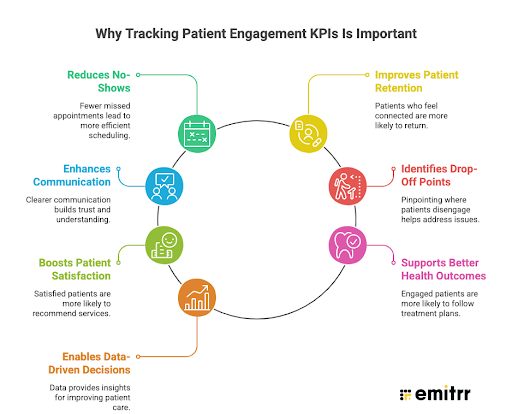
- Reduces No-Shows: Tracking confirmation and reminder response rates helps identify gaps in communication. Clinics using automated reminders have been shown to reduce no-shows by up to 30%.
- Improves Patient Retention: Monitoring repeat visit rates helps you understand if patients are returning or dropping off. A 5% increase in patient retention can boost revenue by 25–95%.
- Enhances Communication Effectiveness: KPIs like response rate and message open rate show whether your communication channels (SMS, email, calls) are working.
- Identifies Drop-Off Points: Engagement metrics reveal where patients disengage, whether it’s after booking, post-visit, or during follow-ups.
- Boosts Patient Satisfaction: Patients who receive timely reminders and easy communication options report higher satisfaction and trust.
- Supports Better Health Outcomes: Engaged patients are more likely to follow treatment plans, attend follow-ups, and stay proactive about their health.
- Enables Data-Driven Decisions: Instead of relying on assumptions, practices can use real data to optimize workflows and patient experience.

Common Challenges in Tracking KPIs
Tracking patient engagement KPIs sounds straightforward in theory, but in practice, many healthcare providers struggle due to operational, technical, and behavioral barriers.
Disconnected Data Across Systems
Patient engagement data often lives in multiple tools EHR systems, appointment schedulers, communication platforms, and billing software. When these systems don’t communicate with each other, it becomes difficult to build a complete picture of patient behavior. A patient might book an appointment through one platform, receive reminders from another, and respond through a third, making it challenging to accurately measure engagement without integrating these data points.
Limited Real-Time Visibility
Many practices rely on delayed reports instead of real-time tracking. This lag means issues like declining confirmation rates or rising no-shows are identified only after they’ve already impacted operations. Without immediate visibility, teams miss the opportunity to intervene at the right moment, such as adjusting reminder timing or switching communication channels.
Over-Reliance on Manual Tracking
Manual tracking through spreadsheets or fragmented reporting systems is still common, mostly in smaller practices. This approach not only consumes time but also increases the risk of inaccuracies. Even small inconsistencies in data entry can lead to misleading insights, making it harder to trust KPI trends or take confident action.
Inconsistent Definitions of KPIs
Different teams within the same organization may interpret engagement metrics differently. What one team considers a “confirmed appointment” might differ from another’s definition, especially when confirmations come through multiple channels like SMS, calls, or online portals. This lack of standardization leads to inconsistent reporting and makes it difficult to compare performance over time.
Varying Patient Communication Preferences
Not all patients engage with healthcare providers in the same way. While some prefer digital channels like SMS or apps, others rely on phone calls or in-person interactions. When engagement tracking is focused only on digital touchpoints, a significant portion of patient activity may go unrecorded, creating blind spots in the data.
Compliance and Privacy Constraints
Healthcare data is highly regulated, and compliance requirements such as HIPAA restrict how patient information can be collected, stored, and analyzed. These limitations can slow down the adoption of advanced tracking tools or integrations, particularly when practices are cautious about maintaining data security and patient confidentiality.
Is your texting HIPAA-safe or risky? Watch this video on HIPAA-compliant texting to keep your patient communication secure and compliant
Difficulty Measuring True Engagement
Not all engagement is easily quantifiable. A patient may receive and read a reminder but choose not to respond, or may intend to follow a treatment plan without actively interacting with the provider. These passive behaviors are harder to capture, which means engagement metrics don’t always tell the full story.
7 Essential KPI’s to Track Patient Engagement in 2026
Tracking patient engagement in 2026 goes beyond basic appointment data. Modern healthcare practices need to understand how patients interact across the entire journey from booking to follow-ups and long-term retention.
The most effective KPIs are those that not only measure behavior but also reveal where patients drop off and what actions can improve engagement. By focusing on the right metrics and tracking them consistently, practices can reduce no-shows, improve communication, and drive better health outcomes.
Below are the 7 most essential patient engagement KPIs and how to track them effectively.
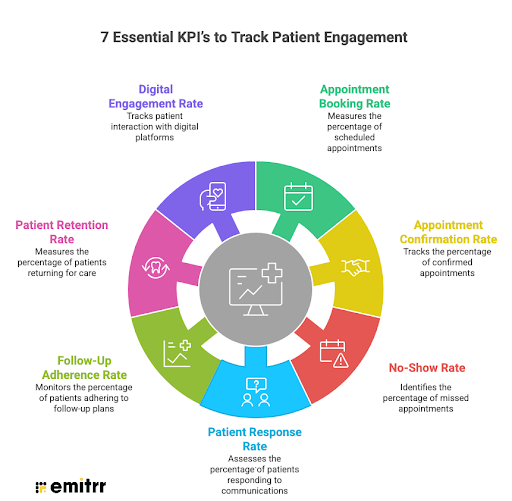
1. Appointment Booking Rate
What it measures: The percentage of patients who successfully book an appointment after visiting your website, calling, or receiving a reminder.
Why it matters: A low booking rate often indicates friction in the scheduling process or lack of timely follow-up.
How to track it:
- Track total appointment booking attempts vs. completed bookings
- Use scheduling software or online booking tools
- Monitor conversion rates from website forms, calls, or SMS links
Formula:
Booking Rate = (Total Appointments Booked ÷ Total Booking Attempts) × 100
2. Appointment Confirmation Rate
What it measures: The percentage of patients who confirm their appointments after receiving reminders.
Why it matters: Higher confirmation rates directly correlate with lower no-show rates.
How to track it:
- Use automated SMS, email, or voice reminders
- Track confirmations through replies, clicks, or system updates
- Monitor confirmation trends by channel
Formula:
Confirmation Rate = (Confirmed Appointments ÷ Total Reminders Sent) × 100
3. No-Show Rate
What it measures: The percentage of patients who miss scheduled appointments without prior notice.
Why it matters: No-shows lead to revenue loss and wasted staff time.
How to track it:
- Compare scheduled appointments vs. attended visits
- Use appointment management systems to log attendance
- Analyze patterns by time, day, or patient segment
- Use patient recall systems to identify patients who frequently miss appointments and re-engage them with reminders or rescheduling prompts
Formula:
No-Show Rate = (Missed Appointments ÷ Total Scheduled Appointments) × 100
Want to keep your schedule full and reduce no-shows? Watch this quick video to learn how you can minimize gaps and maximize patient attendance
4. Patient Response Rate
What it measures: How often patients respond to messages such as reminders, follow-ups, or care instructions.
Why it matters: It reflects how effective your communication channels are.
How to track it:
- Track replies to SMS, emails, or chat messages
- Use communication platforms with built-in analytics
- Measure response time as well as response frequency
Formula:
Response Rate = (Total Patient Responses ÷ Total Messages Sent) × 100
5. Follow-Up Adherence Rate
What it measures: The percentage of patients who complete recommended follow-ups, such as revisits, tests, or treatments.
Why it matters: Strong follow-up adherence is directly linked to better health outcomes.
How to track it:
- Track patients who were advised follow-ups vs. those who completed them
- Use EHR systems or automated recall systems
- Set reminders for pending follow-ups
Formula:
Follow-Up Rate = (Completed Follow-Ups ÷ Recommended Follow-Ups) × 100
6. Patient Retention Rate
What it measures: The percentage of patients who return for future visits over a given period.
Why it matters: Retention indicates trust, patient satisfaction, and long-term engagement.
How to track it:
- Track repeat visits within a defined time frame (e.g., 6–12 months)
- Use patient records to identify returning vs. new patients
- Monitor churn (patients who don’t return)
Formula:
Retention Rate = (Returning Patients ÷ Total Patients) × 100
7. Digital Engagement Rate
What it measures: How actively patients use digital tools like patient portals, apps, or online communication channels.
Why it matters: Digital engagement is a key indicator of modern patient interaction and convenience.
How to track it:
- Monitor logins, clicks, and interactions on portals or apps
- Track link clicks in SMS or email campaigns
- Use analytics dashboards in communication tools
Formula:
Digital Engagement Rate = (Active Users ÷ Total Patients) × 100
Best Practices to Improve Patient Engagement KPIs
Improving patient engagement KPIs requires a combination of better communication, smarter systems, and patient-centric processes. The goal is to make it easy for patients to interact with your practice at every step of their journey.
Here are the most effective best practices:
- Automate Appointment Reminders and Follow-Ups
Use SMS, email, or voice reminders to prompt patients about upcoming visits and pending follow-ups. Automation ensures consistency and reduces missed communication, leading to higher confirmation rates and fewer no-shows. - Use Multi-Channel Communication
Patients respond differently to different channels. Offering SMS, email, calls, and chat ensures you reach patients where they are most comfortable, improving response rates and overall engagement. - Simplify the Booking Process
Make appointment scheduling quick and accessible through online booking links, mobile-friendly forms, and one-click confirmations. Reducing friction directly improves booking rates. - Personalize Patient Communication
Tailor messages based on patient history, preferences, and visit type. Personalized reminders and follow-ups feel more relevant and increase the likelihood of patient response and adherence. - Track and Optimize Communication Timing
Analyze when patients are most likely to respond and schedule messages accordingly. Identifying the optimal time to send reminders such as a day before and a few hours prior to the appointment acts as a best practice for appointment reminder strategies. When reminders are sent at the right time, patients are more likely to confirm, reschedule if needed, and show up, significantly improving confirmation rates and reducing no-shows. - Enable Two-Way Communication
Allow patients to reply, ask questions, or reschedule easily. Two-way communication builds trust and keeps patients actively engaged instead of passively receiving information. - Leverage Data for Continuous Improvement
Regularly review KPI dashboards to identify trends and gaps. If response rates drop or no-shows increase, adjust strategies quickly based on real data. - Encourage Digital Engagement
Promote the use of patient portals, apps, and digital medical forms for easy access to health records, communication, and scheduling. This improves convenience and long-term engagement. - Segment Patients for Targeted Outreach
Group patients based on behavior, demographics, or visit history. This allows you to send more relevant messages, improving engagement across different patient segments. - Reduce Wait Times and Improve Experience
Reducing patient wait times is essential to delivering a smooth in-clinic experience and keeping patients engaged. When appointments run on time and patients are seen without long delays, it builds trust and satisfaction. On the other hand, extended wait times or disorganized workflows often lead to frustration and drop-offs. By optimizing scheduling, managing patient flow efficiently, and minimizing delays, practices can improve overall experience, increase retention, and encourage patients to stay actively engaged with their care. - Educate Patients About Their Care
Share clear instructions, reminders, and educational content that helps patients understand their treatment plans. Informed patients are more likely to follow through. - Integrate Systems for a Unified View
Connect your EHR, communication tools, and scheduling systems to track engagement seamlessly. A unified system ensures accurate KPI tracking and better decision-making.
How Emitrr’s AI Simplifies Patient Engagement KPI Tracking
Emitrr powers healthcare practices with AI automation and HIPAA-compliant patient communication, making it easier to track, manage, and improve patient engagement KPIs without manual effort.
Tracking patient engagement KPIs manually can quickly become overwhelming when patient communication data is scattered across multiple systems and requires constant monitoring. Emitrr eliminates this complexity by bringing together secure patient communication, automated workflows, and real-time analytics into one unified platform.
Instead of relying on spreadsheets or disconnected tools, Emitrr enables healthcare providers to track, analyze, and optimize patient engagement KPIs in real time, while ensuring every interaction remains compliant, consistent, and patient-centric.
Here’s how it works:
Centralized Dashboard for All KPIs
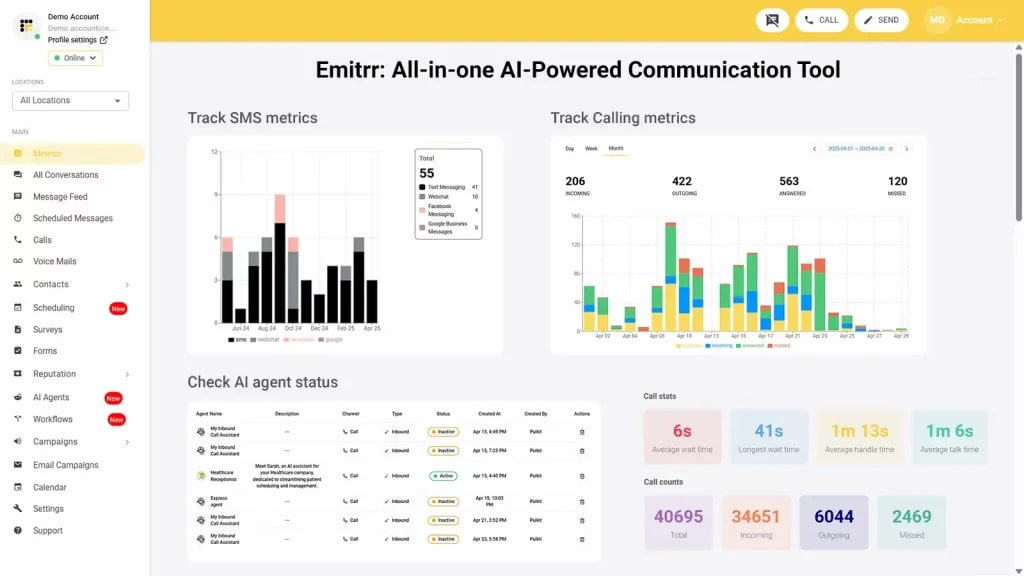
Emitrr brings all your patient engagement data into a single, unified dashboard. From appointment confirmations and no-shows to response rates and follow-ups, everything is tracked in one place. This eliminates the need to manually combine data from different systems and gives you a clear, real-time view of patient behavior.
Automated Appointment Reminders and Confirmations
Emitrr uses AI-driven automation to send reminders via SMS, email, or voice. Patients can confirm, cancel, or reschedule with a simple response.
This directly improves:
- Confirmation rates
- Response rates
- Reduction in no-shows
By tracking these interactions automatically, you always have accurate KPI data without manual effort.
Real-Time Engagement Tracking
Emitrr tracks patient interactions as they happen whether it’s a message reply, a link click, or a confirmation.
This allows your team to:
- Identify engagement gaps instantly
- Adjust communication strategies quickly
- Prevent issues before they impact operations
Intelligent Follow-Up Automation
Missed follow-ups are one of the biggest gaps in patient engagement. Emitrr automates follow-up reminders based on visit type, treatment plan, or timing. Additionally, the missed-call text back feature ensures that any missed patient calls are instantly followed up with an automated message, helping re-engage patients and capture missed opportunities.
Patients receive timely nudges, which improves:
- Follow-up adherence rates
- Patient retention
- Continuity of care
Two-Way Communication with AI Assistance
Emitrr enables seamless two-way communication, allowing patients to respond, ask questions, or reschedule without friction.
AI helps categorize and manage these interactions, ensuring:
- Faster response times
- Better patient experience
- Higher engagement levels
Watch how Emitrr’s AI agent turns texting into effortless automation
Smart Insights and Performance Analytics
Emitrr doesn’t just collect data it turns it into actionable insights. The platform highlights trends such as declining response rates or increasing no-shows, helping you take proactive steps.
Instead of guessing what’s wrong, you get clear signals on:
- Which communication channels work best
- When patients are most responsive
- Where drop-offs are happening
Seamless Integration with Existing Systems
Emitrr integrates with your existing EHR and practice management systems, ensuring data flows smoothly without disruption.
This means:
- No duplicate data entry
- Consistent and accurate KPI tracking
- A complete view of patient engagement
Scalable Automation for Growing Practices
As your practice grows, manually tracking KPIs becomes harder. Emitrr scales effortlessly by automating workflows and maintaining consistent communication across a larger patient base.
Whether you manage hundreds or thousands of patients, your KPIs remain:
- Accurate
- Up-to-date
- Actionable
If you want to improve patient engagement without chasing spreadsheets or juggling multiple tools, it’s time to make the switch. With Emitrr, you can automate patient communication, track KPIs effortlessly, and fill your schedule fully HIPAA-compliant. Book a free demo with Emitrr AI today and see how simple patient engagement becomes with the right system.
Key Takeaways
- Patient engagement KPIs help you understand how patients interact with your practice across booking, communication, and follow-ups
- Tracking the right KPIs allows you to identify gaps, reduce no-shows, and improve patient retention
- Core metrics like booking rate, confirmation rate, response rate, and follow-up adherence provide a complete view of engagement
- Consistent tracking turns patient behavior into actionable insights instead of guesswork
- Common challenges like disconnected systems and manual tracking can limit KPI accuracy and visibility
- Using automation and integrated tools makes KPI tracking more accurate, efficient, and scalable
- Timely and personalized patient communication plays a major role in improving engagement metrics
- Reducing patient wait times and simplifying processes directly improves patient experience and retention
- AI-powered platforms like Emitrr help centralize data, automate workflows, and provide real-time insights
- The right strategy and tools can turn patient engagement into better outcomes, higher satisfaction, and practice growth
Frequently Asked Questions
Patient engagement KPIs are metrics that track how patients interact with your practice—like attending appointments, responding to messages, or using digital tools.
No-show rate, patient retention, and satisfaction scores are the most important as they directly impact revenue, experience, and long-term growth.
Track key KPIs weekly for quick actions and review overall performance monthly to spot trends and improvements.
Automation captures data in real time, reduces manual work, and provides instant insights through dashboards and reports.
Practices use communication platforms, CRMs, and analytics tools to track interactions, feedback, and overall engagement.
Use reminders, enable two-way communication, personalize messages, and follow up consistently to improve engagement.