
 4.9 (400+
reviews)
4.9 (400+
reviews)
Introduction
Every healthcare practice deals with two important processes before a patient receives care: referral intake and patient intake. These terms often sound similar, which leads many clinic teams to treat them as the same process. In reality, they occur at different stages and involve different information.
If the difference between these two still feels unclear, this guide walks through each process in simple terms so you can understand how they work and where they fit in the patient journey.
What is Referral Intake?
Referral intake is the process healthcare practices follow when a patient is sent to them by another provider for specialized care. Instead of collecting information directly from the patient first, the clinic initially receives medical details from the referring provider.
During referral intake, the receiving practice reviews referral documents such as diagnosis notes, test results, treatment history, and insurance information. After reviewing the referral, the clinic contacts the patient to schedule an appointment and continue with the patient intake process.
For example, a primary care physician may notice symptoms that require evaluation by a cardiologist. The physician sends the patient’s records and referral notes to the cardiology clinic. The cardiology office reviews the referral, verifies the information, and then contacts the patient to schedule the visit.
Referrals can come from different sources. Some patients are referred directly by providers through formal referrals for doctor networks. In other cases, patients may discover a specialist through recommendations from friends or family, which often happens through word-of-mouth referrals.
In simple terms, referral intake focuses on receiving and organizing referrals from other providers so that the patient can be scheduled for specialized care.

What is Patient Intake?
Patient intake refers to the process a healthcare practice uses to collect essential information from a patient before the appointment takes place. This information typically includes personal details, medical history, insurance information, medications, allergies, and consent forms. The goal of the patient intake process is to ensure the provider has all necessary details before the consultation begins.
Traditionally, patient intake happened at the front desk, where patients filled out paperwork in the waiting room. Many clinics now use online patient forms, which patients can complete from home before arriving for the appointment. This approach improves efficiency and contributes to reducing patient wait time, since staff already have the patient’s information ready in the system.
For example, consider a patient visiting an orthopedic clinic for knee pain. Before the appointment, the clinic sends a link to digital intake forms asking about the patient’s injury history, current medications, and insurance details. By the time the patient arrives, the clinic staff and physician already have this information available. The visit can start faster because the intake process has already been completed.
In simple terms, patient intake prepares the clinic for the patient visit by collecting the medical and administrative details needed for proper care.
Referral Intake vs Patient Intake: Key Differences
Both processes collect information for a patient visit, yet they happen at different points in the workflow and involve different participants.
Referral intake focuses on communication between healthcare providers. Patient intake focuses on collecting information from the patient. To understand how these two processes differ in timing, purpose, and the type of information collected, take a look at the table below.
| Aspect | Referral Intake | Patient Intake |
| When it happens | Before scheduling the patient | Before the appointment |
| Who sends the information | Referring provider or clinic | Patient |
| Main purpose | Review referral and determine eligibility for care | Collect patient history and administrative details |
| Typical documents | Referral forms, clinical notes, and test results | Medical history forms, insurance information, and consent forms |
| Who manages it | Referral coordinators or front desk teams | Front desk staff or intake coordinators |
| Example | A dentist refers a patient to an oral surgeon | The patient fills out medical forms before the oral surgery visit |
Referral Intake Process: Step-by-Step Guide
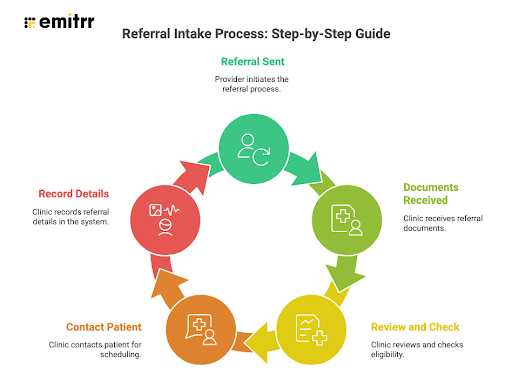
Referral intake follows a structured process that begins when a healthcare provider sends a patient to another clinic or specialist. Each step ensures the receiving practice has the correct medical information before scheduling the patient. This process also helps clinics organize incoming referrals and confirm whether the patient can be treated at the facility.
Step 1: Referral is sent by the provider
The process starts when a provider decides a patient needs specialized care. The referring clinic sends referral documents that may include diagnosis details, treatment notes, test results, and patient demographics.
For example, a pediatrician may refer a child to an ENT specialist after repeated ear infections. The pediatric clinic sends the referral along with medical history and previous treatment notes.
Step 2: Referral documents are received by the clinic
The receiving clinic collects the referral documents through electronic systems, fax-based referral intake, or secure communication channels. Staff members confirm that the referral includes all necessary medical information.
If any details are missing, the clinic may contact the referring provider to request additional documentation.
Step 3: Referral review and eligibility check
Clinic staff reviews the referral to determine whether the patient’s condition matches the services offered at the practice. Insurance coverage and provider availability may also be reviewed during this stage.
For example, if a patient is referred to a gastroenterology clinic for digestive issues, the staff checks that the referral includes relevant lab reports and notes from the referring physician.
Step 4: Patient is contacted for scheduling
Once the referral is reviewed and approved, the clinic contacts the patient to schedule an appointment. At this stage, the patient is informed about appointment availability and any preparation instructions.
Step 5: Referral details are recorded in the system
The clinic stores referral details in its records so staff and providers can access them later. This ensures the specialist has the necessary background information when the patient arrives.
At this point, the patient usually moves to the next stage of the journey, which is the patient intake process.
Patient Intake Process: Step-by-Step Guide
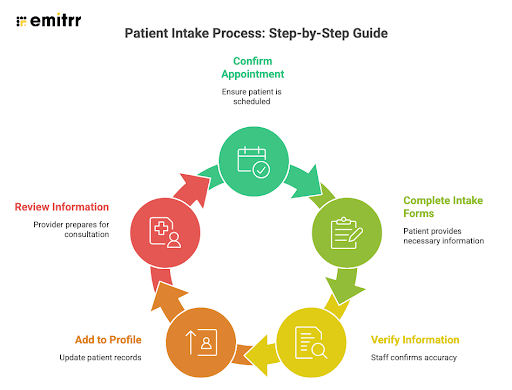
The patient intake process begins after an appointment has been scheduled. It focuses on collecting personal, medical, and administrative information directly from the patient before the consultation. This ensures the provider understands the patient’s background before beginning treatment.
Step 1: Appointment confirmation
Once the appointment is scheduled, the clinic confirms the date and time with the patient. The patient may receive instructions about completing intake forms before the visit.
For example, a patient scheduling an eye exam at an ophthalmology clinic may receive a confirmation message along with intake forms asking about vision issues and past eye conditions.
Step 2: Patient completes intake forms
The patient fills out forms that include contact information, medical history, medications, allergies, and insurance details. These forms may be completed digitally before the visit or at the clinic reception desk.
Step 3: Information verification by staff
Clinic staff reviews the submitted forms to ensure all required information is included. They may confirm insurance coverage and verify patient details before the appointment begins.
For example, if a patient lists medications for high blood pressure, the clinic records this information so the provider can review it before the consultation.
Step 4: Records are added to the patient profile
All intake information is entered into the clinic’s EHR (Electronic Health Record) system as part of the patient’s record. This ensures the provider has access to the patient’s background information during the visit.
Step 5: Provider reviews information before the consultation
Before seeing the patient, the provider reviews the intake details. This helps them understand the patient’s symptoms, past health information, and current medications so the appointment can focus directly on diagnosis and treatment.
Best Practices for Managing Referral Intake and Patient Intake
Managing referral intake and patient intake efficiently keeps the patient communication organized from the moment a referral is received to the time the patient arrives for care. Below are key practices healthcare teams can follow to keep these processes structured and consistent.
Standardize Referral Documentation
Referral information should follow a consistent structure, so clinic staff can quickly review and process incoming referrals. Standardized referral forms ensure that important details such as diagnosis notes, patient demographics, insurance information, and clinical records are always included.
Having a defined format for referrals reduces missing information and improves the speed at which referrals are reviewed and scheduled. This also supports more effective healthcare referral management, since organized referral data is easier to track and process.
Use Digital Intake Forms for Patients
Digital intake forms simplify the process of collecting patient information before the appointment. Instead of relying on paper forms at the clinic reception desk, patients can complete their details electronically before their visit.
Online medical forms capture essential information such as contact details, medical background, medications, and insurance data. Practices rely on patient intake software to distribute these forms, store responses securely, and organize patient information in one place.
Watch this video to learn how HIPAA-compliant digital intake forms improve clinic workflows
Integrate Intake Information with EHR Systems
Referral and intake information should be connected directly to the clinic’s Electronic Health Record system. When patient information flows into the EHR automatically, providers can review referral notes, intake forms, and administrative details from a single patient record.
This integration keeps patient records accurate and reduces manual data entry. It also ensures providers have access to relevant patient details before the consultation begins.
Establish Clear Referral Tracking
Clinics receive referrals from multiple sources, which makes it important to track each referral throughout the workflow. Referral tracking ensures staff can see whether a referral has been received, reviewed, scheduled, or completed.
A structured tracking system improves coordination between clinics and referring providers while preventing referrals from being overlooked.
Build Structured Workflows for Multi-Location Practices
Healthcare organizations operating across multiple locations often face additional complexity when managing referrals and patient intake. Referrals may arrive at different clinics, and staff must determine the appropriate location or provider for the patient.
Structured workflows help teams route referrals correctly, coordinate scheduling between locations, and maintain consistent intake procedures across all facilities. These processes are particularly important in referral intake in multi-location healthcare practices, where centralized coordination improves efficiency and patient access to care.
How Emitrr Simplifies Referral and Patient Intake
Managing referrals and patient intake manually often means staff spend hours calling patients, checking referral details, confirming insurance information, and coordinating appointment schedules. This slows down the intake process and creates extra workload for referral coordinators and front desk teams.
Emitrr addresses these challenges by acting as an AI-powered front desk that manages patient communication and scheduling automatically. It communicates with patients, coordinates scheduling, and keeps referral updates organized so patient flow continues smoothly. By automating these steps, clinics can move patients from referral to appointment faster while reducing the number of manual tasks staff need to handle.
Below are the ways Emitrr streamlines referral intake and patient intake
- AI Virtual Receptionist for Patient Conversations: Emitrr includes an AI virtual receptionist that handles incoming patient messages, appointment requests, and common questions through messaging. Patients can interact with the system just as they would with a front desk team.
- AI Scheduling Assistant for Appointment Booking: Emitrr uses an AI scheduling assistant that communicates with patients through SMS to coordinate appointment bookings. Patients can select their preferred location, review available time slots, and confirm appointments through simple messaging conversations.
Watch a quick video of Emitrr’s AI scheduling assistant in action
- Two-Way Patient Communication: Clinics can communicate with patients through two-way texting, making it easy to respond to appointment questions, intake reminders, or referral updates without relying on phone calls.
- Digital Patient Intake Forms: Practices can send online intake forms directly to patients after scheduling. These forms collect contact details, insurance information, and health-related information before the visit, so staff already have the necessary details when the patient arrives.
- Automated Appointment Reminders: Emitrr sends automated reminders before appointments so patients remember their visits and complete intake forms ahead of time.
- Centralized Referral Coordination: Clinics can manage incoming referrals in one organized system. Referral information, scheduling status, and patient communication can all be tracked in the same workflow.
- HIPAA-Compliant AI Communication: All patient conversations handled through Emitrr run through a HIPAA-compliant AI agent. This ensures patient communication and intake data remain secure and compliant with healthcare privacy requirements.
- Automated Referral Status Updates: Referring providers receive automatic updates when referrals are received or scheduled. This keeps provider communication organized and reduces manual follow-ups.
Frequently Asked Questions
Referral intake involves receiving and reviewing patient referrals sent by another healthcare provider, while patient intake focuses on collecting personal, medical, and insurance information directly from the patient before their appointment.
No. Referral intake only occurs when a patient is sent to a specialist or another healthcare provider by a referring physician. Patients who book appointments directly usually go straight to the patient intake process.
Patient intake typically collects details such as contact information, insurance data, medications, allergies, consent forms, and other health-related information needed before the consultation.
Referral intake ensures that specialists receive the correct patient information and clinical details from the referring provider before scheduling the appointment. This helps coordinate care and prevents delays in treatment.
Practices can streamline these processes by using digital intake forms, organized referral tracking systems, and automated communication tools to manage patient information and scheduling efficiently.
Yes. Many healthcare practices now use digital platforms and AI-powered communication systems to automate appointment scheduling, patient messaging, and intake form collection. This reduces administrative workload and improves patient communication.
Summary
Referral intake and patient intake both play important roles in the healthcare workflow, but they occur at different stages of the patient journey. Referral intake begins when a provider sends a patient to another clinic or specialist, while patient intake focuses on collecting the patient’s details, insurance information, and health background before the appointment.
When these processes are organized with clear workflows, clinics can manage referrals more efficiently, keep patient communication structured, and ensure providers have the information they need before the visit. Schedule a free demo to see how Emitrr AI can streamline referral intake, patient intake, and patient communication for your practice.