
 4.9 (400+
reviews)
4.9 (400+
reviews)

Introduction
Managing referrals is a key part of running a healthcare practice. Every referral represents a patient who needs timely care and clear communication. A smooth intake process helps ensure that no patient is missed and no delay affects treatment.
Many practices still rely on manual steps. Referrals come through fax, email, or phone calls. Staff must review documents, verify details, and follow up with patients. This can take time and may lead to errors or missed information.
A well-defined referral intake workflow brings structure to this process. It helps teams stay organized and move each referral forward with clarity. It also improves coordination between staff, providers, and referring physicians.
In this guide, you will learn how a step-by-step referral intake workflow works. You will also see common challenges and simple ways to improve efficiency. By the end, you will have a clear path to build a faster and more reliable referral process.
Workflow at a Glance
- Centralize all referrals to improve visibility and avoid missed cases
- Standardize the intake process to ensure consistency across teams
- Verify patient and insurance details early to prevent delays
- Respond to referrals quickly to improve conversion rates
- Prioritize referrals based on urgency and care needs
- Automate routine tasks to reduce manual workload
- Use Emitrr to automate patient communication and scheduling
- Enable patient self-scheduling to speed up appointment booking
- Send timely reminders to reduce no-shows
- Align workflows across locations for better coordination
- Track referral status in real time to avoid bottlenecks
- Improve communication with patients and referring providers
- Monitor performance regularly to optimize the process
What Is a Referral Intake Workflow in Healthcare?
A referral intake workflow is the process a healthcare practice follows after receiving a patient referral. It covers every step from the moment a referral arrives to the point when the patient is scheduled and ready for care.
This workflow ensures that all required details are captured and verified. It includes reviewing clinical information, confirming patient data, checking insurance, and assigning the right provider. Each step helps move the referral forward in a structured way.
A clear workflow reduces confusion for staff. It helps teams know what to do at each stage. It also improves coordination between front desk staff, care teams, and referring providers.
An effective referral intake workflow leads to faster scheduling, fewer errors, and a better patient experience.
Step-by-Step Referral Intake Workflow for Healthcare Practices
A structured referral intake process helps practices manage referrals for doctors in a consistent way. It reduces delays, improves tracking, and ensures every patient moves forward with clarity.
This is even more important for referral intake in multi-location clinics where coordination across teams is required.
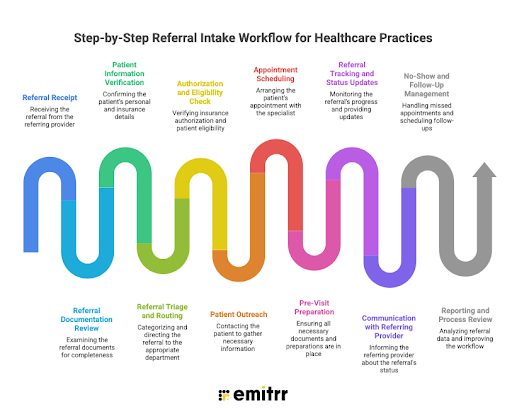
1. Referral Receipt
Referrals can come from many sources, such as fax, email, EHR systems, phone calls, or even word-of-mouth referrals. Each referral must be captured and logged as soon as it is received.
For example, a specialist clinic may receive a fax referral from a primary care physician and an online referral through Athenahealth Patient Portal on the same day. Both need to be recorded with time and source details.
This step creates the foundation for effective referral management and ensures no referral is missed.
2. Referral Documentation Review
Once received, the staff reviews the referral to check if all required information is included. This may include diagnosis details, reason for referral, clinical notes, and referring provider information.
For example, if a cardiology referral is missing test reports or ECG results, staff must flag it and request the missing documents before moving forward.
This step prevents delays later in the workflow and supports accurate patient intake.
3. Patient Information Verification
Patient details are verified to ensure accuracy. This includes name, phone number, date of birth, and insurance information.
For example, if a patient’s insurance ID is incorrect, it can delay authorization or billing. Staff must confirm eligibility with the payer before proceeding.
Accurate data at this stage improves both referral management and billing outcomes.
4. Referral Triage and Routing
Referrals are assessed based on urgency and specialty needs. In many practices, systems can also triage patient requests before staff logs in, which helps prioritize cases early. Patients are then routed to the appropriate provider or department.
For example, an urgent neurology referral for severe symptoms should be prioritized over a routine consultation. In multi-location clinics, the patient may also be assigned to the nearest available location.
This step ensures timely care and proper resource allocation.
5. Authorization and Eligibility Check
Some referrals require prior authorization from the insurance provider. Staff initiates the request and track approval status.
For example, imaging services like MRI scans often need pre-approval. If authorization is delayed, the appointment cannot be scheduled.
Managing this step properly helps avoid last-minute cancellations and improves the overall patient intake experience.
6. Patient Outreach
The patient is contacted to inform them about the referral and guide them through the next steps.
For example, a staff member may call the patient to explain why they were referred and what to expect during the visit. In some cases, text messages or emails are also used for faster communication.
Clear outreach improves patient engagement and increases the chances of appointment conversion.
7. Appointment Scheduling
Appointments are scheduled based on provider availability and patient preference.
For example, a dermatology clinic may offer multiple time slots across locations. In referral intake in multi-location healthcare practices, scheduling systems help match patients with the most convenient site.
Efficient scheduling is key to converting referrals into completed visits.
8. Pre-Visit Preparation
Before the appointment, all required documents and records are gathered. Patients receive instructions for their visit.
For example, a patient scheduled for a diagnostic test may need to fast for a few hours. Sending clear instructions helps avoid rescheduling.
This step ensures that the visit runs smoothly and supports better clinical outcomes.
9. Referral Tracking and Status Updates
Each referral is tracked through defined stages such as received, pending review, scheduled, and completed.
For example, a referral dashboard can show which referrals are waiting for authorization and which are ready for scheduling.
Strong tracking systems improve visibility and make referral management for healthcare more efficient.
10. Communication with Referring Provider
The referring provider is updated when the referral is received and after the patient visit.
For example, a specialist may send a consultation report back to the primary care doctor with findings and next steps.
This communication builds trust and encourages more referrals for doctors over time.
11. No-Show and Follow-Up Management
Missed appointments are tracked and followed up on quickly.
For example, if a patient does not show up, staff can send a reminder text or call to reschedule. This helps recover lost opportunities and ensures continuity of care.
12. Reporting and Process Review
Practices review key metrics such as referral volume, conversion rates, and turnaround time.
For example, if many referrals are delayed at the authorization stage, the process can be adjusted to improve speed.
Regular review helps optimize referral management and supports long-term growth, including more word of mouth referrals from satisfied patients.

What Are the Common Bottlenecks in Referral Intake?
Referral intake often breaks down due to gaps in process, communication, or systems.
These challenges can slow down operations and affect conversion from referral to visit.
Identifying these bottlenecks is the first step toward improving efficiency and outcomes.
- Incomplete referral information: Missing clinical notes, diagnosis details, or provider information can delay the next steps. Staff often need to follow up before moving forward.
- Manual data entry and scattered sources: Referrals coming from fax-based referral intake, email, and phone require manual entry. This increases the workload and chances of errors.
- Slow insurance verification and authorization: Delays in eligibility checks or prior approvals can hold up scheduling and impact timelines.
- Lack of real-time referral tracking: Without clear status visibility, referrals can get lost or stuck between stages.
- Inefficient patient outreach: Missed calls or delayed communication can reduce response rates and slow down scheduling.
- Poor coordination across teams or locations: In multi-location setups, a lack of centralized systems can lead to confusion and duplication of work.
- No standardized workflow: Different staff members may follow different steps, which creates inconsistency in referral management.
- Limited follow-up on pending referrals: Referrals that are not actively tracked may never convert into appointments.
- No-show and drop-off issues: Patients may not show up due to a lack of reminders or unclear instructions, affecting the overall patient journey.
- Lack of performance tracking: Without monitoring key metrics, practices struggle to identify gaps and improve the intake process.
What Are Best Practices for Optimizing Referral Intake Workflow?
A well-optimized referral intake workflow improves speed, accuracy, and coordination across teams. It helps convert more referrals into visits and creates a better experience for both patients and providers. The right approach also supports patient satisfaction and long-term practice growth.
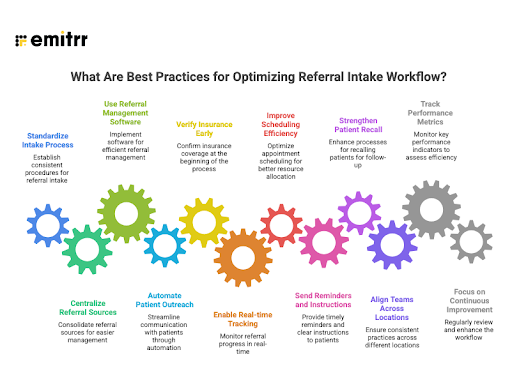
Standardize the Intake Process
Every referral should follow a defined set of steps. This creates consistency across staff and locations and reduces confusion in daily operations. It also improves overall referral management and makes onboarding new staff easier.
Centralize Referral Sources
Managing referrals from fax, email, and phone in separate systems slows down work. Bringing everything into one platform improves visibility and ensures no referrals are missed.
Use Healthcare Referral Management Software
Technology helps automate intake, tracking, and communication. Healthcare referral management software reduces manual work and allows teams to focus more on patient care.
Automate Patient Outreach
Quick communication improves conversion. Automated calls, texts, or emails help connect with patients faster and move them through the process efficiently.
Verify Insurance Early
Checking eligibility and authorization at the start prevents delays later. This step plays a key role in reducing patient wait times and avoiding scheduling issues.
Enable Real-time Referral Tracking
Tracking referrals at every stage helps teams stay informed. It allows quick action when delays occur and improves workflow transparency.
Improve Scheduling Efficiency
Matching patients with the right provider and location speeds up access to care. This also enhances patient satisfaction and ensures better use of available slots.
Send Reminders and Clear Instructions
Automated appointment reminders help minimize no-shows. Clear instructions prepare patients for their visit and reduce last-minute cancellations.
Strengthen Patient Recall Processes
Following up with patients who miss or delay appointments ensures referrals are not lost. A strong patient recall system supports continuity of care.
Align Teams Across Locations
Consistent workflows across all locations reduce confusion and duplication. This is essential for smooth referral intake in multi-location clinics.
Track Performance Metrics
Monitoring referral conversion rates and turnaround times helps identify gaps. Data-driven insights support better decision-making.
Focus on Continuous Improvement
Regular process reviews help refine workflows over time. Small improvements can lead to better efficiency and long-term growth.
How Does Emitrr AI Automate Referral Intake Workflows?
Managing referrals and patient intake manually often means staff spend hours calling patients, checking referral details, confirming insurance information, and coordinating appointment schedules. This slows down the intake process and creates extra workload for referral coordinators and front desk teams.
Emitrr AI addresses these challenges by acting as an AI-powered front desk that manages patient communication and scheduling automatically. It communicates with patients, coordinates scheduling, and keeps referral updates organized so patient flow continues smoothly. By automating these steps, clinics can move patients from referral to appointment faster while reducing the number of manual tasks staff need to handle.
Below are the ways Emitrr streamlines referral intake workflows:
- AI Virtual Receptionist for Patient Conversations: Emitrr AI includes an AI virtual receptionist that handles incoming patient messages, appointment requests, and common questions through messaging. Patients can interact with the system just as they would with a front desk team.
- AI Scheduling Assistant for Appointment Booking: Emitrr AI uses an AI scheduling assistant that communicates with patients through SMS to coordinate appointment bookings. Patients can select their preferred location, review available time slots, and confirm appointments through simple messaging conversations.
Watch a quick video of Emitrr’s AI scheduling assistant in action:
- Two-Way Patient Communication: Clinics can communicate with patients through two-way texting, making it easy to respond to appointment questions, intake reminders, or referral updates without relying on phone calls.
- Digital Patient Intake Forms: Practices can send online intake forms directly to patients after scheduling. These forms collect contact details, insurance information, and health-related information before the visit, so staff already have the necessary details when the patient arrives.
- Automated Appointment Reminders: Emitrr AI sends automated reminders before appointments so patients remember their visits and complete intake forms ahead of time.
- Centralized Referral Coordination: Clinics can manage incoming referrals in one organized system. Referral information, scheduling status, and patient communication can all be tracked in the same workflow.
- HIPAA-Compliant AI Communication: All patient conversations are handled through a HIPAA-compliant AI agent. This ensures patient communication and intake data remain secure and compliant with healthcare privacy requirements.
- Automated Referral Status Updates: Referring providers receive automatic updates when referrals are received or scheduled. This keeps provider communication organized and reduces manual follow-ups.
- Automated Patient Chart Creation Readiness: Emitrr AI integrates with your EHR workflow to ensure only complete referrals move forward. Once referral coordinators create a patient chart with basic details such as name and date of birth, Emitrr AI checks whether required fields, such as phone number, address, and insurance, are available. Only fully ready cases are picked up for the next step, which improves data accuracy and reduces back-and-forth.
- Intelligent Referral Filtering: Emitrr AI automatically filters out incomplete or invalid referrals. Cases with missing insurance or contact details are not pushed into scheduling. This ensures staff and systems focus only on referrals that are ready to convert into appointments.
- AI-Led Patient Scheduling from Chart Creation: The moment a patient chart is created with complete information, Emitrr initiates patient outreach. It contacts the patient through SMS, asks for the preferred location, and enables patient self-scheduling by offering the earliest available slots. If the patient is not available, alternate options are shared in the same conversation.
- Automated Provider Assignment: Based on the patient’s selected location and time slot, Emitrr AI automatically assigns the right provider. This removes manual coordination and ensures efficient use of provider schedules.
- Faster Referral-to-Appointment Conversion: By removing manual steps and delays, Emitrr AI helps move patients from referral to scheduled appointment much faster. This improves overall efficiency and increases completed visits.
- Automated Referral Lifecycle Closure: After scheduling is completed, referral status updates are handled automatically. Referring providers receive updates, and the referral is moved out of the active queue into the patient record.
Frequently Asked Questions
The goal is to move patients from referral to scheduled appointment in a structured and timely way. It ensures all required information is verified and no referrals are missed.
Practices can improve conversion by responding quickly, automating patient outreach, and simplifying scheduling. Faster communication leads to higher appointment bookings.
Automation reduces manual work and speeds up processes. It helps staff focus on important tasks and ensures referrals are handled consistently.
Patient self-scheduling allows patients to book appointments through messages at their convenience. This reduces delays, improves response rates, and speeds up the intake process.
Conclusion
A clear referral intake workflow helps practices move patients from referral to appointment with less delay and fewer errors. It improves coordination across teams and ensures every referral is handled with consistency.
By reducing manual steps and using automation, practices can speed up patient intake, improve patient satisfaction, and reduce no-shows. A structured approach also supports better visibility and long-term growth.
If you want to simplify referral management and automate scheduling, schedule a free demo with Emitrr AI for your practice today!