
 4.9 (400+
reviews)
4.9 (400+
reviews)
Introduction
Hospitals have traditionally used landlines and traditional PBX systems to control internal and external communications. But these systems are now becoming viewed as inflexible, costly, and challenging to maintain, particularly as the healthcare environment changes.
The transition to VoIP voice solutions is now critical. In the post-pandemic era, hospitals saw their highest-ever influx of remote consultation and telemedicine services. Keep reading to know more!
Importance of VoIP for Hospitals
Successful communication within hospitals is a matter of life and death. Whether it is organizing emergency response, informing patient status, or managing administrative inquiries, time is of the essence.
Old-school communication technologies such as PBX systems and analog landlines are not only antiquated but also have some serious limitations. They are:
- Highly costly to install and maintain
- Difficult to scale with expanding departments
- Difficult to integrate with electronic health systems
VoIP for healthcare addresses these issues by establishing a centralized, web-based communication network that caters to all departments, from admissions through the ICU.
Major benefits:
- Mobility: With hospital phone systems, physicians can make and take calls on wireless devices, whether they are in the building or out.
- Quicker Triage: With VoIP for hospitals, nurses and triage staff can call up the proper people immediately.
- Better Coordination: HIPAA-compliant VoIP helps in instant communication, allowing for smooth handoffs even between departments.

Benefits of VoIP for Hospitals
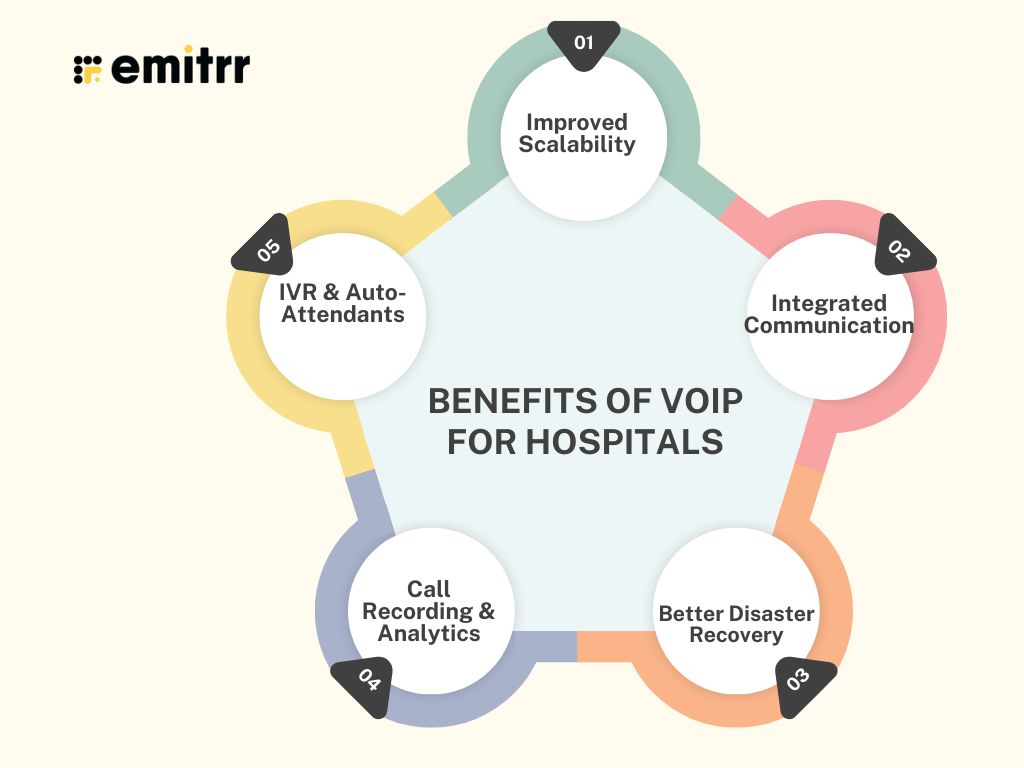
Deploying VoIP for healthcare environments provides a broad range of operational, financial, and service-related benefits. Starting with cost savings to enhanced patient communications, here are ways hospitals are positively impacted by the move to VoIP:
Best VoIP Systems Improve Scalability
As hospitals grow, new wings, departments, or even satellite facilities, VoIP for hospitals enables them to grow with ease without investing in additional physical lines. Administrators can add or remove users, numbers, or extensions instantly via an online console. This flexibility enables the hospital phone system to grow along with hospital needs, without expensive reconfigurations.
Medical Office Phone System Offers Integrated Communication
Existing VoIP for hospital technology is easily integrated with critical healthcare systems such as Electronic Health Records (EHRs), Customer Relationship Management (CRM) systems, and hospital helpdesks.
Such integration offered by best VoIP systems provides a more efficient workflow (e.g., automatically calling up a patient’s record on receipt of a call, or logging call notes into a case management system). Hospital phone system eliminates administrative tasks and improves efficiency and patient satisfaction.
Medical Office Phone System Provides Better Disaster Recovery
Hospitals can’t afford communication shutdowns during a crisis. VoIP healthcare solutions are typically cloud-hosted with built-in redundancy and geographic failover options. With HIPAA-compliant VoIP, when there is a local outage or catastrophe, calls will automatically be directed to cell phones, backup phone numbers, or remote staff. HIPAA-compliant VoIP also offers automated backup regularly, meaning nothing and no communication records are ever lost.
Medical Office Phone System Offers Robust Call Recording & Analytics
Call recording capability is essential for healthcare regulatory compliance, conflict resolution, and employee training. Hospitals can record calls with patients or between staff, securely store them, and use recordings for quality assurance.
Advanced call analytics offered by hospital phone systems provide insights into call volume, response time, abandoned calls, and agent performance, allowing management to streamline operations and improve patient service levels.
Medical Office Phone System Offers IVR & Auto-Attendants Features
Interactive Voice Response (IVR) and auto-attendants computerize the task of handling incoming calls. Instead of having every call go through a clogged receptionist, patients are guided to the appropriate department or service through voice instructions or keypad entries.
This feature offered by hospital phone systems reduces wait times and ensures more urgent calls reach the appropriate staff members sooner, which improves efficiency and patient satisfaction.
Also, you can watch this video to understand pros and cons of VoIP in detail to make an informed decision:
Use Cases of VoIP for Hospitals
Best VoIP for medical offices has revolutionized hospital communication by providing flexible, cost-efficient, and highly integrated solutions.
Whether it’s linking departments within, serving patients after hours, or handling emergency alerts, VoIP for hospitals responds to the complex and fast-paced requirements of healthcare environments.
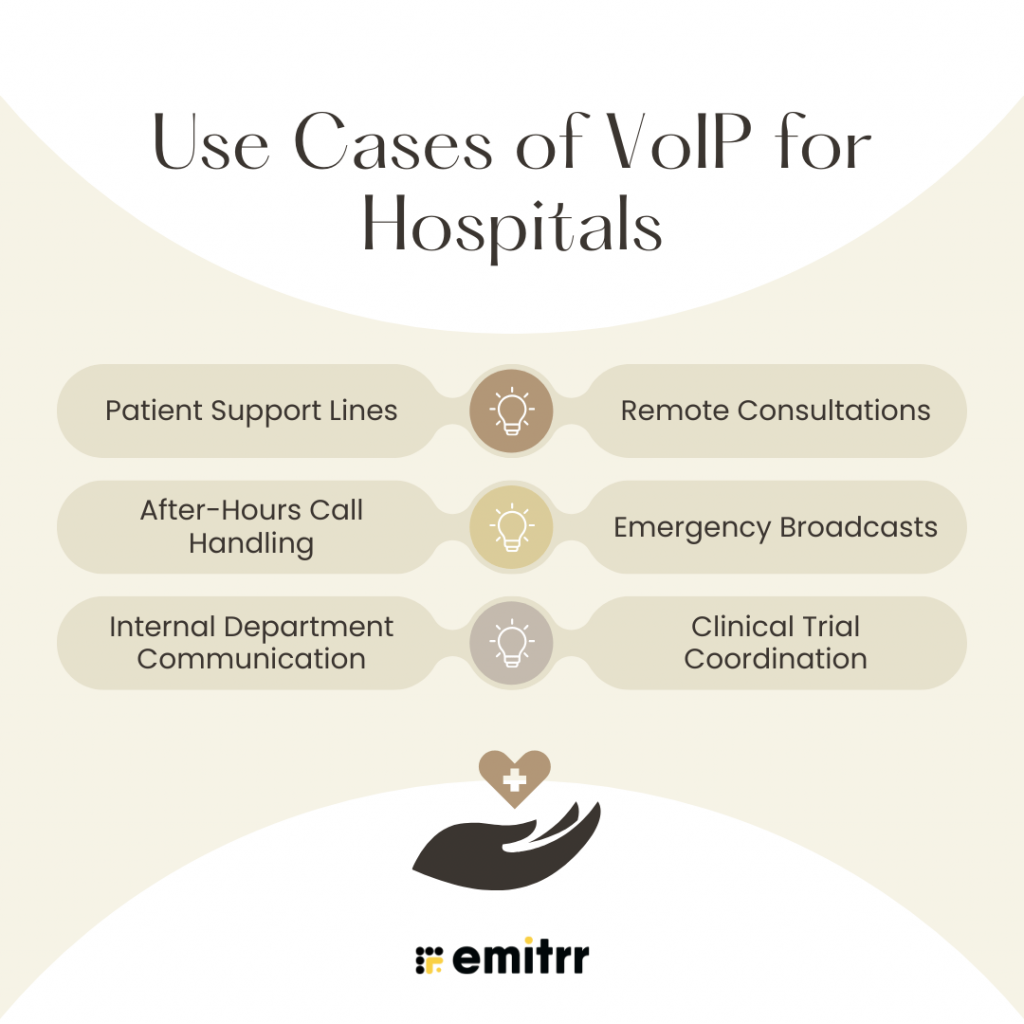
Some major use cases of VoIP for hospitals are:
Best VoIP Systems for Patient Support Lines
VoIP for healthcare facilitates centralized, easy-to-maintain phone numbers for addressing patient inquiries, appointment scheduling, prescription refill requests, and emergency support. With medical office phone system, calls can be forwarded intelligently to the relevant departments, avoiding confusion and enabling timely responses with fewer call transfers.
Best VoIP System Manages After-Hours Call Handling
With the best VoIP for medical offices, hospitals can install after-hours call forwarding, voicemail-to-text, or automated voice responses to guarantee that no patient question goes unanswered. With a medical office phone system, on-call physicians and nurses can be contacted through mobile integration, providing 24/7 patient care without the need for physical presence.
Best Phone System for Medical Office Supports Internal Department Communication
With a medical office phone system, hospital departments like labs, billing, reception, and nursing can communicate directly through extensions. This dispenses with dependency on external lines, facilitates quick decision-making, and enhances coordination, key for real-time collaboration in busy hospital settings.
Medical Office Phone System Offers Remote Consultations
VoIP for hospitals enables secure voice communication for remote consultations, integrating seamlessly with telemedicine platforms. With a phone system for healthcare, physicians can discuss cases, diagnose symptoms, and provide advice on encrypted channels, delivering accessible healthcare to rural or mobility-impaired patients from any internet-enabled device.
Best Phone System For Medical Office Supports Emergency Broadcasts
VoIP for healthcare solutions enables administrators to initiate instant voice alerts to groups of people or whole departments in the event of an emergency. Phone systems for healthcare help in the quick mobilization of staff in emergency situations such as fire drill, mass casualty, or outbreak of infectious disease, improving response time and coordination.
Phone System For Medical Office Helps In Clinical Trial Coordination
VoIP phone systems for healthcare offer secure, recorded communications between researchers, coordinators, and clinical trial subjects. With HIPAA-compliant VoIP, all interactions can be tracked, which facilitates compliance with regulatory requirements. With HIPAA-compliant VoIP, updates can be rapidly shared, visits scheduled, or protocols discussed without delays or breakdowns in communications.
Recommended for watching:
Best Practices for VoIP in Hospitals
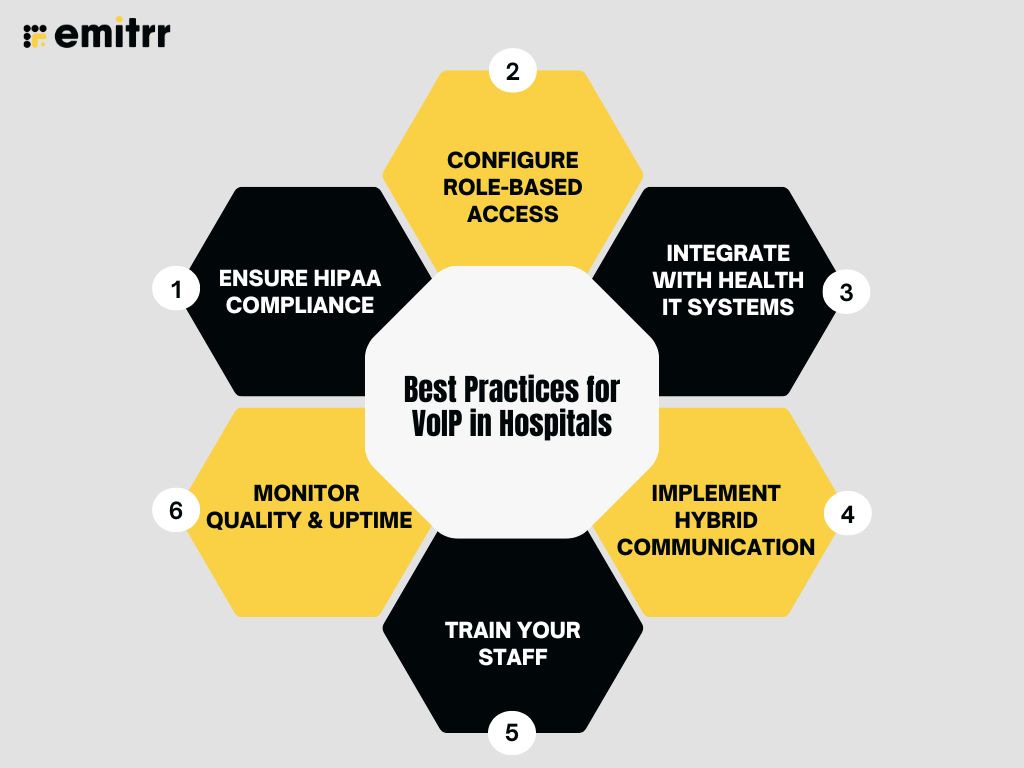
Adhering to best practices guarantees peak performance, security, and regulatory compliance, maximizing HIPAA-compliant VoIP benefits, and improving hospital communication. These include:
Ensure HIPAA Compliance While Using Phone System For Medical Office
Make sure your VoIP phone system for healthcare is completely compliant with HIPAA regulations, securing patient data during transmission. With phone systems for healthcare, this becomes important to ensure privacy protection and prevent possible legal issues, ensuring communications meet healthcare confidentiality standards.
Configure Role-Based Access
With phone systems for healthcare, you need to enforce role-based access controls to limit sensitive call logs, recordings, and system settings based on staff roles. This discourages unauthorized access to confidential patient data and supports compliance with privacy laws.
Integrate with Health IT Systems
Choose healthcare VoIP systems that easily integrate with Electronic Health Records (EHRs) such as Epic or Allscripts and Customer Relationship Management (CRM) software such as Salesforce Health Cloud. This provides a single workflow, enhancing operational efficiency and data accuracy.
Implement Hybrid Communication
Combine the VoIP phone system for healthcare with SMS for primary functions such as appointment reminders, reminders, and alerts. The hybrid method expands communication reach, providing patients with information in their preferred medium, ultimately enhancing engagement and minimizing missed appointments.
Train Your Staff For Cloud Phone System For Healthcare
Offer thorough training across departments to introduce staff to phone systems for healthcare, call procedures, and etiquette. Trained staff ensure the hospital phone system is used optimally, minimizing errors, enhancing customer service, and optimizing hospital communications.
Monitor Quality & Uptime
To effectively manage phone systems for healthcare industry, you need to continuously monitor the quality of calls and maintain uptime at all times by installing failover systems. Employ specific monitoring software to catch problems early before communications are lost, so high levels of service are maintained throughout the hospital network.
VoIP Challenges for Hospitals
While VoIP phone systems for healthcare are several times better than traditional telephony, hospitals will have to deal with challenges such as:
Cloud Phone System For Healthcare Depends On Internet
VoIP requires a good-quality and fast internet connection. For HIPAA-compliant VoIP, hospitals may require upgradation of the network infrastructure in order to achieve quality voice communication, since failure would directly cause disruption of patient care as well as administrative activities.
Healthcare Phone Systems Are Prone to Security Threats
VoIP healthcare solutions are prone to various security risks, including phishing as well as unsolicited calls. For phone systems for healthcare industry, hospitals must use high-quality firewalls, encryption, and live monitoring to secure the sensitive data of patients as well as avoid the unauthorized exposure of communications.
Ensuring Uptime
Hospitals operate 24 hours a day, 7 days a week, and healthcare VoIP systems must be able to provide uninterrupted uptime. For this purpose, redundancy, failover procedures, and disaster recovery protocols must be enforced so that there is no disruption of communications when needed most.
Ensure Regulatory Compliance While Using a Healthcare Phone System
For phone systems for healthcare industry, hospitals must ensure that their VoIP phone systems for healthcare are HIPAA- and TCPA-compliant. Proper configuration, documentation, and periodic auditing must be implemented to preserve patient confidentiality and protect against litigation.
Staff Adoption & Training
The implementation of the best VoIP for medical offices may be greeted with skepticism by the staff who are used to traditional healthcare phone systems. VoIP phone systems for healthcare require the right change management, training, and support to ensure smooth uptake and realize the potential of the new system.
Legacy System Integration
Integration of the best VoIP for medical offices with legacy healthcare phone systems may be complex. Special development efforts may be necessary for hospitals to enable smooth interoperability between new VoIP technology and existing PBX or analog communication equipment, which can be expensive.
How to Install VoIP for Hospitals with Emitrr
Emitrr provides the best VoIP for medical offices that is ready for healthcare, which is capable of addressing the specific communication requirements of hospitals, such as integrated text messaging, alerts, reminders, and efficient management of communications. It offers an efficient solution to enhance operational efficiency and patient care while maintaining HIPAA compliance.
Emitrr’s capabilities include:
- VoIP Calls and Call Recording: Emitrr, the best VoIP for medical offices, offers high-quality VoIP calls with call recording, ensuring compliance, training, and secure, traceable patient communications.
- Text Messaging and Automated Replies: Emitrr facilitates text messaging with auto-responses, enhancing communication effectiveness by providing instant responses, reminder notifications for appointments, and vital alerts.
- Reminders and Alerts: Emitrr, the best HIPAA-compliant VoIP sends automated reminders and notifications for appointments, follow-ups, and urgent alerts, minimizing missed appointments and improving patient engagement.
- CRM/EHR Integrations: Emitrr, the best VoIP phone systems for healthcare, is also integrated with EHR/CRM systems such as Epic and Salesforce, allowing for effortless communication between the VoIP platform and patient records for better care.
- AI integration: Create SMS and other responses with Emitrr’s AI agent.
See what more Emitrr’s AI agent can do:
Setup Steps
- Select a Plan & Number of Users: To harness the power of HIPAA-compliant VoIP, you need to pick a plan that suits the hospital’s size and communication requirements. Emitrr has scalable pricing, so hospitals of any size can select an optimal package to meet their user needs.
- Connect to EHR/CRM: Integrate Emitrr, the best phone system for medical offices, with the current EHR/CRM infrastructure, allowing seamless synchronization of patient information and communication records. This improves workflow effectiveness and provides real-time synchronization of hospital phone systems.
- Configure Call Flows & IVRs: Personalize call flows and IVR systems to direct patients to the relevant departments effectively. Auto-attendants can save handling time and human error, enhancing general call management.
- Allow Call Recording & Voicemail: Make call recording available to comply with healthcare legislation, offering quality assurance and liability for lawyers. Voicemail capability allows patients to leave a message when staff are unavailable, improving accessibility of the service.
- Onboard & Train Staff: To train on the phone system for the medical office, provide employees with a clear understanding of the new healthcare VoIP system through extensive training. Emitrr, the best phone system for medical offices, offers tools to train employees on call feature usage, managing alerts, and facilitating a seamless adoption process.
Frequently Asked Questions
Yes, VoIP can be HIPAA-compliant when configured correctly to meet privacy and security standards for healthcare communication.
Yes, VoIP can fully replace landlines, providing a comprehensive communication solution for all hospital departments.
Emitrr includes failover routing, mobile forwarding, and backup systems to ensure communication continuity during internet disruptions.
VoIP platforms use encryption, access control, and security protocols to meet HIPAA standards, ensuring patient conversations are secure.
Yes, VoIP platforms support softphones, mobile apps, and web-based dashboards, providing flexibility for staff to communicate from any device.
Implementation typically takes a week, depending on the system’s complexity and integrations with existing hospital infrastructure.
Hospitals should use VoIP instead of traditional phone lines as VoIP offers cost savings, scalability, advanced call management features, better mobility for staff, and integration with hospital management systems.
Yes, if you choose a provider like Emitrr that offers HIPAA-compliant VoIP with encryption, secure data storage, access controls, and a signed Business Associate Agreement (BAA).
Many VoIP systems, like Emitrr, get integrated with EHR/EMR platforms, allowing staff to access patient records, call history, and appointment details directly from the phone interface.
Conclusion
VoIP for hospitals is not just a technical enhancement but a mission-critical communication upgrade.
Hospitals that adopt VoIP benefit from lower costs, higher agility, scalable infrastructure, and better patient engagement. Whether telemedicine, billing, or emergency communication, VoIP delivers seamless integration and performance.
Emitrr provides a healthcare phone system that meets regulatory requirements, supports remote and in-hospital staff, and ensures high-quality patient experiences.
Ready to modernize your hospital communication? Schedule a demo with Emitrr today and experience the complete upgrade your hospital deserves.