
Introduction
Call screening is a business phone system feature that helps you identify, filter, and prioritize incoming calls before answering them. Instead of picking up every call blindly, businesses can see who is calling, understand the purpose of the call, and decide whether it needs immediate attention.
Call screening helps businesses intelligently manage incoming calls, reduce interruptions, and improve customer experience, not just filter unwanted callers.
Yes, this sounds important. But how does it actually help in real life?
Imagine you’re in a crucial meeting with your client or team. Your phone rings, and you might think who it may be. When you pick up the call, your meeting is already disturbed, and the moment is gone!
Most businesses deal with dozens of unwanted calls every single day, which means wasted time, broken focus, and missed real opportunities.
28% of the 46.75 billion unknown calls analyzed were identified as spam or fraud, marking an increase from 24% in 2022. This data shows why a structured screening process is essential for business continuity and revenue protection. Here, call screening software changes the game that lets you;
- Identify callers
- Block spam calls
- Prioritise essential conversations
In this blog, we’ll break down what call screening really means, how it works, why businesses rely on it, best practices, future trends, and how tools like Emitrr support smarter call screening without making things complicated.
AI Overview
Call screening is a business VoIP phone system feature that helps identify and filter incoming calls before they are answered. It allows businesses to block spam and robocalls, prioritize high-intent customers, and route calls using AI call screening software. Modern call screening for businesses improves productivity, reduces interruptions, and delivers a better customer experience.
What Is Call Screening and Why Do Businesses Use Call Screening Software?
So, what does call screening actually mean?
When your phone rings, you won’t know who is on the other end. It can be anyone: a high-value customer, routine inquiry, customer support, pesky telemarketer, etc.
Call screening is the method by which a business phone system evaluates an incoming call before it connects, helping decide whether to accept, block, verify, or route the call appropriately.
Call screen technology solves this problem and saves time, as it is the first defense against irrelevant and unwanted spam calls. It shows the caller’s name, number, and reason for calling before you answer.
It makes it so simple for you, just like a spam folder in our email inbox.
Call screening is not just about blocking spam calls. It is about making sure important callers never get ignored while unnecessary calls never interrupt your team.
Struggling with spam calls and poor call screening? Watch this video to understand the pros and cons of VoIP:
How Did Call Screening Evolve?
Call screening is not a new technology, but it has undoubtedly become more intelligent, which seems new to us; let’s understand how it has become more brilliant over time. Earlier, one could set up call screening on your landline for better call control, but it had its limitations.
To define call screening in short, it is knowing prior to who is calling you!
Caller ID
In the early days, there were caller IDs, the first form of call screening. Before picking up the call, we could see who was calling with their name and contact number. Indeed, it has its limitations, and due to this, various questions arose, such as what if the number was unfamiliar to us or spoofed? Ultimately, it was a waste of time!
Block Lists and Whitelist
After the landline telephones at our house, there was a widespread use of mobile phones, a convenient option for everyone to use even when they were out of their house. The call screening that came with the mobile phones was a feature of blocking and allowing contacts. Users can easily block unwanted numbers, ensuring only trusted callers can get through.
Community-Driven Screening
Users could share the information or block spam, unwanted sales calls through online databases. This was done through community-driven platforms that identified and blocked the suspicious caller.
The AI and Machine Learning Era
Here is the most brilliant move in the evolution of call screening. The integration of AI and machine learning. As easy as it can get, it is considered the turning point in call screening technology. It has advanced identification capability by analyzing the calling patterns and detecting robocalls and spam calls in real time. The outcome was more innovative, faster, and more accurate results in call screening that prevented threats.
Third-Party Apps and Cloud Solutions
Third-party applications and cloud solutions then evolved with the demand in the market. It provided multiple features like real-time alerts and user-generated feedback. Cloud solutions offer features like overall call management for business systems, blocklist types, detailed analytics on call patterns, and customized solutions according to business needs.
Why Do You Need Call-Screening Technology?
Most businesses do not struggle with too few calls. They struggle with too many unnecessary ones. A reliable call screening system helps businesses reduce wasted time, protect agents from spam, and prioritize real customer conversations.
Without call screening software, teams spend valuable time answering spam, internal transfers, or calls that go nowhere. By knowing all those points, you’ll then know what call screening means to your business and why it’s so important!
- Lost productivity due to irrelevant calls
- Missed opportunities from ignoring unknown numbers
- Poor customer experience from delays and misrouting
Call screening is not just about blocking spam; it’s about prioritizing business-critical interactions while reducing interruptions and improving operational efficiency.
This is where an innovative software solution like Emitrr steps in. Emitrr doesn’t just screen calls; it empowers businesses to take control of their communication. With real-time caller identification, spam filtering, and intelligent call routing, Emitrr ensures that every call is handled correctly.
This is why call screening for businesses has become a necessity, not a nice-to-have feature.
A Simple Example to Explain It All
You are running a small dental clinic in your city and are open to taking appointments over the phone. With screening phone calls technology, you can figure out who is calling. With the guesswork, you’ll pick up unwanted calls or sometimes lose the patient’s important call, leading to a problem.
With a structured screening process, urgent patient calls get prioritized while spam is filtered, improving both productivity and customer satisfaction.

How Does Call Screening Work for Businesses? Real Call Screening Examples
In simple terms, call screening works by reviewing caller details before the call reaches your team, helping businesses decide the best next step within seconds.
Let’s break it down step-by-step and learn how to screen a call using advanced phone features and how to set up call screening.

Step 1: Receiving the Caller’s Number
When a call comes in, your phone system captures the inbound number and the call. This is the foundation for identifying the caller and determining how to handle the interaction. Setting up call screening is the most convenient way to avoid wasting time on unwanted calls, so it is most important to know what a call screen means to businesses. Because public phone digits frequently act as primary gateways to digital accounts, understanding what can someone do with your phone number highlights why filtering out unauthorized inbound traffic is so vital for modern security.
The system captures the inbound number and call metadata. This forms the foundation for identifying and handling the call.
Step 2: Identifying the Caller’s Name
The number is checked against a CNAM database to retrieve the caller’s name, if available.. If it matches, then it will display the particular name.
For instance, if the number belongs to John from the office, you’ll instantly know it is a work call from the office, not a spam one.
The system checks the number against a Calling Name (CNAM) database to find the associated name. If it’s a match, the name is displayed. If it’s a match, the name is displayed. Using Batch Append, you can efficiently look up multiple numbers at once to retrieve their associated names.
Step 3: Prompting for the Caller’s Name
If the number is unidentified, the system politely asks the caller to state their name before connecting. This reduces fake or low-intent calls.This is mainly from the unlisted number. When a customer calls from an unlisted number, the call screening feature plays a polite message that says, “Give your name after a beep.” When the caller tells their name, it plays their name before connecting.
This ensures that no spam calls are attended to.
Step 4: Checking for Spam or Robocalls
The system checks the number against spam databases and AI models. Known spam numbers are blocked automatically. The system can block or warn the number if it’s a spam caller. There are a few spam contact numbers, for example, +98765″3210; the system will recognize it as a flagged robocall number from a scam database.
Instead of ringing, the call is auto-blocked, saving you the hassle.
Step 5: Automated Responses
Businesses can set automated messages for meetings, after-hours, or holidays, keeping callers informed without disrupting workflows.
A client may call during your lunch hours or during an important meeting, where you can simply put a message saying, “We’re currently unavailable and will get back as soon as possible.” This ensures that critical callers are kept from thinking you are not getting back to them.
Step 6: Forwarding to Live Agents
If the caller passes all filters, the call gets redirected to the right person responsible for interacting with the caller. The agent can see the caller’s name, number, and purpose on their screen to prepare them for the call in real time.
This process helps businesses avoid blind call handling and reduces time wasted on low-intent or spam calls.
Key Features Of Call Screening Systems
Before choosing any call screening solution, tool, or platform for your business, it is crucial to know the features that should be included. These tools are not just responsible for blocking unwanted calls, but it does a lot more. Streamlining the workflows to improve efficiencies in the business also boosts the customer experience.
Advanced call screening systems combine caller ID, CNAM lookup, call filtering, spam detection, and VoIP call handling to manage incoming calls efficiently. Let’s understand the importance of “must-have” features!
1. Real-Time Caller Identification
Only use a call screening solution with the real-time caller identification feature. Before you answer, this feature will provide the essential details such as name and contact number. It will identify the contact from the caller ID system databases and validate it.
Why is this feature essential?
Imagine you receive a call without knowing who is on the other end, and it wastes your time. Still, with this feature, you can instantly see whether it is your top-tier client, an employee from the office, a family member, or a salesperson and marketer. Moreover, it prevents you from wasting time on calls, letting you prioritize the calls that matter the most. This helps agents prepare for the conversation instead of reacting mid-call.
2. Spam and Robocall Detection
Databases and AI algorithms would be working alongside spam detection. Those databases would tag the spam numbers and eliminate the robocalls.
Why is this feature essential?
You’re managing multiple tasks, and a spam call disrupts your focus. With spam detection, your system intercepts these calls before they reach you, saving time and protecting your productivity.
3. Custom Call Routing
This feature allows the business to determine precisely how calls are handled based on predefined rules. Calls can be routed to specific departments or even sent to voicemail, blocked altogether.
Why is this feature essential?
Imagine a customer calling to ask about their bill. Custom routing ensures they get routed automatically to the accounts team, whereby they would be attended to faster and more effectively.
4. Whisper Announcements
This calls out the caller’s name or purpose before connecting to the called party; it is like a heads-up for an answering agent.
Why is this feature essential?
Think of a named take call by a VIP customer. Whisper announcements will enable the agent to take a call and ensure the conversation is smooth and personalized.
5. Voicemail Screening and Transcription
Voicemail screening allows for previewing messages, while voicemail transcription lets you convert voicemails to text forms to scan the content immediately.
Why is this feature essential?
Try to imagine this. So you are in a meeting and missed a call; instead of listening to your voicemail, you simply read a transcription and decide to listen to it immediately.
Here’s a quick video on 3 essential things to know about voicemail transcription!
6. Blocklists and Allowlists
Blocklists will block unwanted numbers, and allowlists will allow your essential contacts to reach you.
Why is this feature essential?
Imagine blocking persistent robocalls, but your repeat customers always get a relaxed tone. This feature gives you complete control over who gets through.
7. IVR (Interactive Voice Response) Integration
IVR enables callers to browse different options and helps route the calls themselves toward the required person or department.
Why is this feature essential?
Suppose your support line is receiving a considerable number of inquiries. With IVR, customers can choose “Press 1 for Sales” or “Press 2 for Support,” reducing manual routing and saving your team time.
8. Call Recording
The call recording feature records incoming calls for subsequent playback for training purposes, quality assurance, and records.
Why is this feature essential?
Suppose the customer calls up to deny something said over the call. More than likely, a recording will sort it out.
9. Personalized Messages
This feature allows you to set personalized text messages for your callers, such as after-hours notifications or holiday greetings.
Why is this feature essential?
Customer Called Off-Hours, and then Receives: “Thank you for calling. Our company is closed, and no one will return your call tomorrow.” Custom messages with customers are professional and keep them informed.
10. Analytics and Reporting
Advanced call analytics in call-screening services include monitoring the volumes and frequencies of spam and agents’ behavior.
Why is this feature essential?
Imagine having insights like “Spam calls are down 40% this month” or “Peak customer call times are between 3 PM and 5 PM.” Analytics can help smooth out workflows and improve service quality
11. AI Call Screening
AI call screening goes beyond static rules by analyzing caller behavior, speech patterns, and intent in real time. Instead of relying only on blocklists, AI continuously learns from new spam patterns, making business call screening more accurate over time.
Call screening is not about answering fewer calls. It is about handling the right calls better.
What Problems Does Call Screening Actually Solve?
By now, we know how call screening is so important. It offers various advantages for businesses that improve efficiency, customer satisfaction, and overall communication management. To keep it short, a call screening service helps identify and manage unwanted calls.
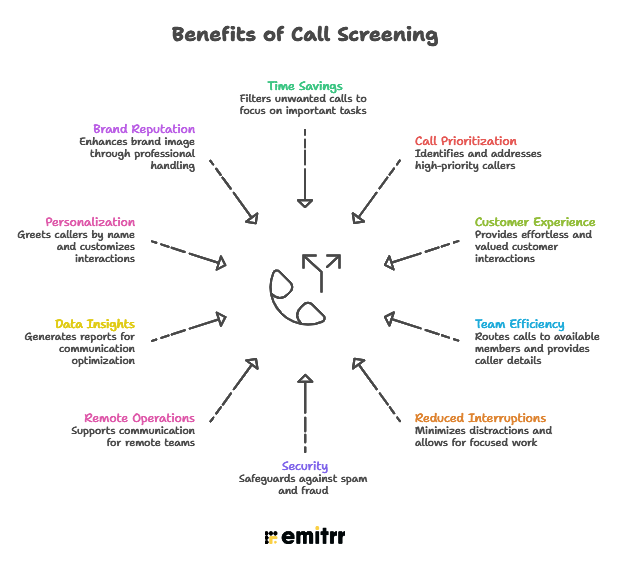
Here are some key benefits that you should know about;
1. Saves Time and Boosts Productivity
- Spam, robocalls, and irrelevant inquiry calls are away from you and are automatically filtered so that you can focus on important tasks without any disruption.
- It automatically routes calls to the correct and relevant department, so no time and effort is wasted. In a way, Automatic call screening filters calls without manual intervention.
2. Prioritizes Important Calls
- It can identify the high-priority callers, such as topmost clients and urgent customer queries, ensuring they are addressed in real-time.
- Reduces the risk of missing out on essential opportunities and gets your work done instantly.
3. Improves Customer Experience
- One of the best solutions it provides is that it allows for an effortless customer experience where customers feel informed and valued. With the help of preset and customized messages, customers can learn about the company’s status to raise their expectations to that level.
- Eventually, it minimizes the frustration caused by the long waiting times and misdirected calls.
4. Enhances Team Efficiency
- Automatically screens and routes calls to available team members, balancing workloads.
- Provides caller details in advance, enabling agents to prepare for interactions and respond more effectively.
5. Reduces Interruptions and Distractions
- This saves from spammers reaching office employees, and one gets a distraction-free, centered workplace.
- This enables voicemail screening and transcription for non-urgent matters, letting teams prioritize tasks.
6. Increases Security and Reduces Fraud
- It disregards spam calls as numbers are cross-checked against spam databases.
- It safeguards confidential business communication against phishing attempts or fraudsters.
7. Supports After-Hours and Remote Operations
- Automatically sends calls to voicemail or alternative numbers at non-business hours.
- It promotes smooth communication with VoIP for remote teams through customizable routing and call-handling rules.
8. Provides Data and Insights
- It generates detailed reports regarding call volumes, patterns, and spam activity to help optimize communication strategies.
- It helps identify peak calling times, ensuring better staffing and resource allocation.
9. Personalizes Caller Interactions
- Caller ID and whisper announcements let the agents greet the customers by name, personalizing their responses.
- Customizable IVR menus improve callers’ ease of usage in some countries.
10. Improves Brand Reputation
- A professional and efficient call-handling process gives the customer or client a good impression.
- All of these communications reflect a commitment of corporate organizations toward quality and reliability.
Call Screening vs Call Blocking vs Call Routing
| Feature | Call Screening | Call Blocking | Call Routing |
| Removes spam | ✅ | ✅ | ❌ |
| Identifies intent | ✅ | ❌ | |
| Routes calls | ✅ | ❌ | ✅ |
| Improves CX | ✅ | ❌ | ✅ |
Challenges For Call Screening And How To Overcome Them?

1. Legitimate calls get mis-blocked
The problem is that sometimes a valid call may get marked as spam, which creates issues regarding missed opportunities or angry clients.
Solution:
- Use advanced call screening solutions that contain reliable databases.
- Implement an allowlist feature that allows only known contacts.
- There is monitoring of blocked calls and updating the rules accordingly.
2. Dealing with Peak Calls
Challenge: Sorting and prioritizing thousands of daily calls is overwhelming for organizations that receive that number daily.
Solution:
- Using a goal or urgency can be practical for automated call routing.
- Integrate the IVR system to control calls through interactive voice response without human intervention.
3. Poor Spam Detection
At least basic call screening systems have already become inadequate for keeping up with spammers’ ever-changing tactics to breach their filters.
Solution:
- Invest in AI-driven call-screening tools that learn and evolve with time to recognize new spam patterns.
- It utilizes real-time spam databases for timely identification.
4. Low accuracy in caller identification
Problem: The system can be troublesome during proper identification in cases of uncertainty, resulting in confusion or unnecessary delay.
Solution:
- Choose a call screening application that accesses extensive CNAM databases. Use features such as caller prompts for name identification when the identifier is unclear.
5. Advanced System Configuration
Implementing a call screening system can be challenging, mainly for smaller businesses with scarce resources.
Solution:
- Use a user-friendly site, preferably with a guided setup like Emitrr.
- Recruit service providers who will provide support for onboarding and training employees.
Future Trends In Call Screening
Call screening is one of the most wanted features and solutions needed in any business size, may it be small or large. Let’s understand the future trends in call screening that we will be seeing in the coming years.
- AI-Powered Screening:
Such uses sophisticated AI algorithms, which further enhance the probability of correctly identifying calls coming from fraudsters or spam callers.
- Voice Biometrics:
Voice verification software that authenticates calls and makes systems more secure.
- Real-Time Threat Analysis:
Dynamic databases update in real-time to block newly identified spam and scam calls immediately.
- Personalized call handling:
It is personalized screening settings that follow the preference and call history of every user.
- Multi-Channel Screening:
Single-level screening for calls, texts, and other forms of communications to protect the organization from end-to-end.
- Integration with Smarter Devices:
Compatibility with a smartphone, virtual assistant, and IoT devices for screening of calls.
- Privacy-Focused Features:
More emphasis on protecting user data and ensuring compliance with privacy regulations.
- Crowd-Sourced Reporting Improvement:
Improvement of user-driven feedback systems that can make spam and fraud reporting tools more effective.
- Advanced VoIP Screening:
Specialized solutions to tackle spam calls over VoIP systems as their adoption increases.
- Proactive blocking with predictive analytics:
It uses predictive analytics to block calls before they reach the user.
Why Do Customers Choose Emitrr For Call Screening?
With smart features and an easy-to-use dashboard, Emitrr helps your team save time and keeps your customers happy. Platforms like Emitrr make this process easier by combining call screening, smart routing, and AI-based call handling in one system.
Here’s what makes Emitrr stand out:
- Stay Connected Anywhere: Use Emitrr’s cloud phone system on your desktop or app. Make and take calls from anywhere—no need to be tied to a desk.
- Easy Team Communication: Quickly reach your teammates with direct dial extensions, keeping everyone in sync.
- Smart Call Handling: Impress your customers with advanced features like call routing, call queues, extensions, and easy call transfers.
- Record and Improve: Record calls, take notes, and track call quality to make sure your service keeps getting better.
- More Than Just Calls: Combine phone calls with texting, group chats, web chat, and automation to manage all your customer communication in one place.
- Never Miss a Call: If you miss a call, Emitrr automatically sends a text to the customer so you don’t lose touch.
- Texting Made Easy: Customers can reply to your marketing texts, and their responses go straight to your inbox so you can follow up right away.
- Track Call Performance: See reports for incoming, outgoing, and missed calls by day, week, or month to keep track of how you’re doing.
- See Team Stats: Check metrics like total answered calls and average call duration to understand and improve your team’s performance.
Emitrr saves time, improves team productivity, and helps you get more leads with its simple, smart features.
Key Features of Emitrr VOIP
- Call forwarding: Call forwarding helps redirect an incoming call to another extension or device.
- Users & extensions: Add, remove, assign, or edit extensions and determine the call-forwarding behavior of different users.
- Call recording: Record phone calls for quality checks and adherence purposes.
- Toll-free numbers: Let your customers call you for free.
- Call disposition: Label calls and add tags as per the call’s outcome.
- Call pop feature: Access call history and information of the caller during a live call to offer a customized experience with call pop.
- IVR menu customization: Create your custom IVR menu with options to delete, edit, etc., as per your business needs.
- Missed call text: Send automated text SMS to callers whose calls go unanswered.
- Mobile & Desktop app: Access your small business phone system on your desktop, mobile, laptop, etc., for greater flexibility.
- Multi-location management: Manage and track the performance of your small business operations across multiple locations.
- Simultaneous & sequential calls: Determine if the calls should go to your team in a sequence or simultaneously.
- CRM integration: Integrate with your existing CRM software to access caller information faster.
- Set maximum caller wait time in queue: Set the maximum time callers need to wait for an available member.
- AI feature (Upcoming): Emitrr is also currently building AI features that will come in handy in improving call communication.
- Voicemail to text: Convert voice calls into text to save time.
Other communication features
- Two way texting
- Group texting
- Inbox management
- Message transfer and more
What Makes Emitrr Stand Out?
Seamless Communication: Emitrr integrates directly with CRM/EHR/EMR/PMS, allowing you to call, text, and manage workflows all in one place without leaving the CRM. This streamlined approach enhances team efficiency and reduces time spent toggling between different software.
Enhanced Collaboration: During live calls, team members can access key information like caller details, tickets, deals, and lifecycle stages, ensuring they’re always equipped with the context needed to provide personalized and effective customer service.
AI-Powered Contact Center: Emitrr offers an intelligent contact centre solution with features like IVR (Interactive Voice Response), call routing, power dialling, workflow integrations, and an AI receptionist that can handle routine inquiries, book appointments, and guide callers efficiently. These features optimize operations and ensure a smooth, high-performing communication experience.
Watch how Emitrr’s AI agent Sarah helps:
Fully Scalable Solution: Whether you’re handling 50 or 500+ calls per day, Emitrr scales with your business. Power dialling and dynamic list building ensure your sales team can efficiently manage high volumes of calls without compromising quality.
Compliance-Centric Design: Emitrr ensures that your SMS campaigns are fully compliant with regulations like 10DLC, so you can confidently engage with customers while adhering to legal requirements.
Omnichannel Communication: Emitrr supports mobile, desktop, and click-to-call apps, enabling your team members to engage with customers seamlessly across all devices, improving collaboration and communication consistency.
Friendly Interface: This is said to be a friendly site because its interface is user-friendly, whereby people can easily navigate within it. New users can easily navigate through multiple features of the Emitrr and run the business efficiently.
Responsive Customer Support: The customer service team of Emitrr is very responsive, with excellent responses, making them address queries at a rapid pace.
Frequently Asked Questions
Screening a call means identifying the caller and deciding whether to answer, block, or forward the call.
On a landline, call screening involves using caller ID or pre-set filters to identify incoming calls and decide if they should be answered.
Call screening involves checking caller information (like caller ID), listening to a voicemail preview, or using automated systems to identify and filter calls.
The purpose of screening calls is to prioritize important calls, avoid spam or unwanted calls, and manage time efficiently.
Screening a call is the process of evaluating an incoming call to determine its priority or relevance before answering.
Call screening works by displaying caller ID, using voicemail transcription, or deploying automated systems that ask callers to identify themselves before the call connects.
The goal of screening calls is to reduce interruptions, manage call flow, and ensure only relevant or important calls are answered.
Call screening and call routing solve different problems, though they often work best together.
– Call screening decides whether a call should reach your team at all. It checks who’s calling and why. This helps filter out spam calls, robocalls, telemarketers, and low-intent inquiries before they interrupt your staff.
– Call routing, on the other hand, decides where the call should go. Once a call is approved, routing sends it to the right department, person, or location based on rules like business hours, keypress input, or caller intent.
No, not when it’s set up correctly. Modern call screening is designed to protect your team from spam and low-intent calls without creating friction for real customers. Legitimate callers are usually asked a quick question or prompted to state their reason for calling, which helps move their call forward faster.
AI call screening improves call handling by understanding caller intent instead of relying on fixed rules or menus. AI listens to what the caller says, analyzes intent in real time, and decides the next best action. It help businesses handle more calls without increasing workload by reducing interruptions, prioritizing important calls, and keeping call flows natural and conversational.
Conclusion
Call screening is one of the best features because it eliminates unwanted calls in the business, which can save your time from unwanted efforts in picking up sales or spam calls.
In this case, you might get confused in choosing the right solution. It stands out as the reliable partner for your business that streamlines call screening and boosts overall customer interactions. With the automation and personalized touch, it can also enhance the customer experience.
Discover how Emitrr can elevate your business communication today, start simplifying your interactions right away! Book a demo now!!


 4.9 (400+
reviews)
4.9 (400+
reviews)