
Introduction
Today, orthopedic clinics are no longer just for joint replacements and fracture care, but also for patient communication centers. One of the lesser-appreciated points is that orthopedic practices have become highly dependent on texting for post-operative updates and rehab check-ins that allow them to reduce in-clinic visits and recover faster.
Text reminders to perform exercises and rate their pain following surgery are associated with fewer complications and higher satisfaction. Such workflows, well served by reliable VoIP for medical offices, do a lot to lessen the burden on staff and help in improving finances.

Overview of VoIP Providers for Orthopedics
What is VoIP?
Voice over Internet Protocol (VoIP) is the term for cloud-based phone systems that allow voice calls to be transmitted over the Internet. In comparison to traditional phone lines, VoIP provides enhanced flexibility, cost savings, and feature-rich communication solutions designed for today’s clinics.
Watch this short video to learn more about VoIP:
Why are Orthopedic Workflows Unique?
Orthopedic clinics have some of the more complex communication needs in clinics, and VoIP provides a valuable solution in that regard. Orthopedic clinics receive high call volumes as patients are calling to schedule, ask post-op questions, and schedule physical therapy.
For multi-locational orthopedic practices, there is also the need to have seamless call routing across multiple sites. However, many orthopedic clinics manage after-hours triaging for injuries or complications, which requires reliable call forwarding to on-call staff. Not to mention, patient journeys can be lengthy, with rehab and follow-ups, therefore, a communication solution like VoIP allows orthopedic clinics to communicate in a timely, accurate, and compliant way.
Key Outcome
When an orthopedic clinic makes the move to VoIP it makes the move to a more timely, clear, and safe communication. With this, it enhances the overall patient experience, reduces the burdens on clinic staff, and optimizes the operational processes.
What to Look for in an Orthopedic VoIP Provider
The right VoIP provider for orthopedic clinics is one that offers to meet specific needs that directly address the specialized needs of bone and joint care.
Essential Communication Tools
- HD Call Clarity: So that you can have great calls about complicated medical requirements.
- Single Platform: Voice, video, SMS and fax all in one location.
- Auto-Attendant (IVR): Pre-programmed routing (e.g., appointments, billing, post-op care).
- Smart Call Routing and Call Forwarding: Will ensure the appropriate orthopedic professional is answering the call.
- Voicemail Transcription: The voicemail will be in writing for you to skim, so you can provide a quicker response.
Patient-Focused Features
- Automatic Call Reminders: Reduces no-shows with voice/SMS.
- Missed Call Texts: Engages patients even when calls are missed.
- EHR Click-to-Call: Places calls with patient context transferred.
- Encrypted SMS/MMS: Secure text/image sharing (for example wound updates) to stay HIPAA-compliant.
Ensure every caller feels informed and guided. Download voicemail greeting templates for orthopedic practices now!
Efficiency Tools
Call Recording & Analytics: For compliance, QA, and professional development.
Inside Messaging: Improve instant working together discussion.
Queue Management: Decreases patient wait times and augments patient satisfaction.
Mobility Support
- Mobile Access & Softphones: Allowing staff to receive calls from anywhere.
- Remote Full Functionality: Works from any location, allowing long-term clinic administration without a physical visit to the clinic.

Security & Compliance Requirements
For a medical office VoIP, security and HIPAA compliance are a must-have. Safeguarding patient health information (PHI) is the highest priority.
- HIPAA Compliant: In any case, the VoIP provider needs to be HIPAA compliant, protecting PHI rigorously with encryption and access management to protect information.
- Signed BAA: A signed BAA is essential, it is a legal certainty defining the provider’s responsibility for protecting PHI.
- Security Features: End-to-end encryption, MFA, audit logs, disaster recovery, and secure data centres are useful security features.
- Certifications: SOC 2 Type 2 and HITRUST are good indicators of enterprise-level security and compliance.
Necessary Integrations to Look For in a VoIP software for Orthopedic clinics
The real power of VoIP for orthopedic clinics is its ability to fully integrate with other common clinical systems.

- EHR/PMS (Epic, Athenahealth, eClinicalWorks, NextGen): Fully integrating with your EHR allows for a click-to-call from the patient record, automatic call logging into the patient chart, and screen pop-ups with patient information when the clinic receives an incoming call. This provides immediate context for your staff.
- Patient Platforms: Integrating with online scheduling, patient portals, and reputation management platforms gives patients a complementary experience from booking to review.
- Billing Tools: Integration with a billing application enables payment follow-ups to occur automatically, easily gives phone pay options to the patient, and allows the clinic to streamline the financial inquiry process.
- Other Applications: Integrating with generic business applications such as CRMs (Customer Relationship Management), calendars for appointments (Google/Outlook), and internal chat will maximize overall clinic productivity and alignment.
How VoIP Helps Orthopedic Clinics
The following are several advantages of using VoIP for orthopedic clinics going beyond the usual calls.
- Automated Communication: Simplifies confirmations, follow-ups, and notifications resulting in better-informed patients and reduced no-shows.
- Increased Productivity: Save time on admin responsibilities and team communication with auto-attendants, voicemail-to-text, and call routing.
- Improved Patient Experience: Missed call texts, and secure SMS features make sure there is no stranded call and keep the patient satisfied.
- Telehealth Ready: Facilitates virtual visits, remote evaluation, and mobility.
- Cost & Scalability: Lowers phone bill and scales with practice size with no expensive hardware.
How to choose the right VoIP Software for Orthopedic Clinics?

Selecting the best VoIP provider for orthopedic clinics takes some planning.
- Determine Your Needs: Identify the approximate volume of communication, how many users, any necessary integrations, and your budget.
- Confirm Compliance: Verify full compliance with HIPAA, executed BAA, and read through a list of security measures.
- Integrations: Verify that the VoIP integrates into your EHR, billing, scheduling, etc.
- Scalability & Uptimes: Choose a vendor if possible that has a high level of uptime (99.99%) and room to grow.
- Support & Training: Look for a vendor that: provides 24/7 support, onboarding, and training, and can be contacted using multiple service channels.
- Test & Review: Use the demo and review all available comments from other users, especially your peers.
- Understand Pricing: Ensure that there is a clear pricing structure and clarify any additional costs.
Top 10 VoIP Providers for Orthopedics
Here is a list of top VoIP software providers who can provide for the special communication requirements of orthopedic clinics.
1. Emitrr
Overview:
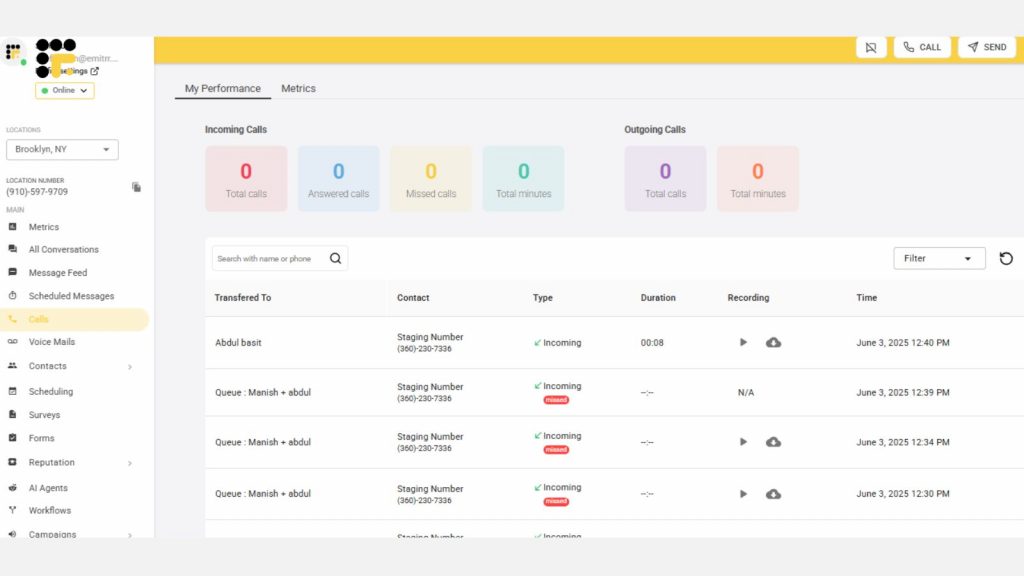
Emitrr is a VoIP and messaging platform specifically designed for healthcare, and is HIPAA compliant (they offer a Business Associate Agreement). Emitrr partners with patients to drive unified communications for modern clinics, Profitability Growth practices (patient-centred), and Super Responsiveness to modern patients’ needs.
Features:
- Single, easy-to-use dashboard for calls, texts, and voicemail management.
- Customizable auto attendants (IVR) and smart call routing.
- Voice-to-text voicemails for a true voicemail trail.
- Unique missed call and text reply automations.
- Automatic appointment reminders (text/voice).
- Flawless EHR/PMS integrations (1000+ integrations with: Athena Health, Epic, eClinicalWorks, NextGen).
- Smart AI functions also add productivity boosting tech such as predictive call handling.
- Scalable multi-site support.
- It is accessible across platforms (mobile, desktop, web) for remote and in-clinic use.
- Quick onboarding and easy-to-use interface.
- Call Recording (Cross-device compatible)- [with permission control].
- Advanced call analytics and reporting.
Pros:
- Developed specifically for health care and orthopedic practices to ensure applicability.
- HIPAA-compliant VoIP backed by a signed (BAA) around confidentiality, along with a host of HIPAA-compliant data & analytics.
- Quick onboarding allows for fast implementation and easy staff training for rapid adoption. High uptime of 99.99% and super clear calls.
- Clear and transparent pricing with no surprises.
- Emphasizing unified communications and proactive patient communications.
- Excellent customer service, helpful, interested, and knowledgeable staff in the orthopedic clinic.
Cons:
- Several of the more advanced features are in active development, and there is a roadmap for improving healthcare-specific capabilities.
Pricing:
From $30/month per user.
Rating:
4.8/5
Integrations:
- Zapier
- HubSpot
- Mailchimp
- AthenaHealth
- Curve Hero
- Denticon
- Dentrix
- Dentrix Ascend
- Dentrix Enterprise
- Dolphin
- DrChrono
- Eaglesoft
- eClinicalWorks
- OpenDental
- Orthotrac
- Practiceworks
- Kareo
- Acuity Scheduling
- HousecallPro
- Slack
- And many more…
Support Channels:
Email, Chat, Phone, and a dedicated onboarding specialist.
2. RingCentral
Overview:
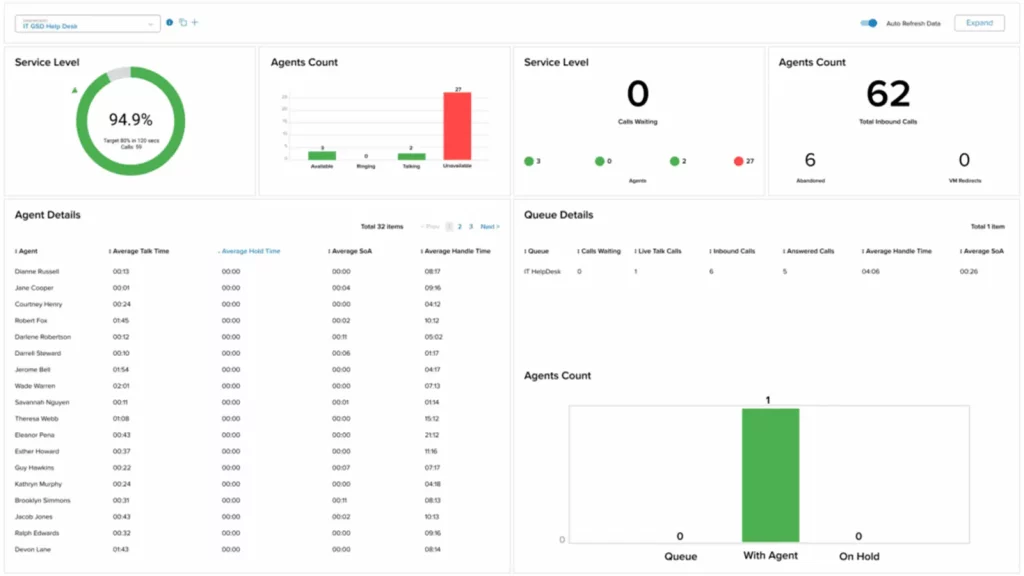
RingCentral is a leading provider of Unified Communication as a Service (UCaaS), with a comprehensive platform with VoIP, video conferencing, and team messaging. RingCentral is designed with healthcare in mind. They offer HIPAA compliance and support Business Associate Agreements (BAAs). RingCentral is a great choice for practices that want a communications solution that is secure and unified. It stands out for robust innovation, reliability, and scalability.
Features:
- Strong call management (auto-attendant, call forwarding, IVR).
- Video conferencing for telehealth and team meetings.
- Business SMS/MMS on desktop or mobile.
- Integrations with many business apps, even some healthcare CRM.
- Analytics and reporting.
Pros:
- Comprehensive feature set for a unified communications solution.
- High reliability and uptime.
- Good security and HIPAA compliance with BAA.
- Scalable, works for practices of any size and with large orthopedic groups.
Cons:
- Can be higher priced than niche providers, especially for advanced plans.
- Healthcare-specific integrations may require buying a higher-tiered plan or custom development.
- Interface (especially for video) can be overwhelming for a small practice at first.
Pricing:
(Estimated $20-$50+ per user/month, varies by plan and users)
Rating:
4.2/5
Integrations:
Salesforce, Microsoft 365, Google Workspace, some healthcare CRM/EHR systems.
Support Channels:
Phone, Chat, and online knowledge base; support is available 24/7.
3. Nextiva
Overview:
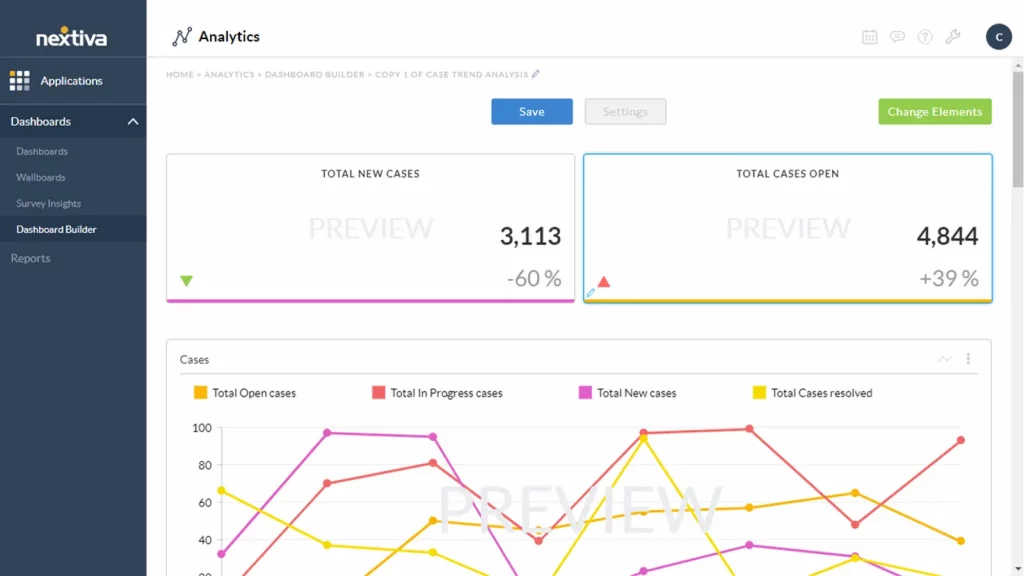
Nextiva is a VoIP service that offers an added customer experience and analytics requires a unique emphasis on user experience using its “Amazing Service” platform. Nextiva supports healthcare operations through the tools that streamline communications, both internally and externally. With advanced analytics and automation, Nextiva supports healthcare operations and improves workflows. It stands out for simplicity, reliability, and excellent support.
Features:
- Unlimited calling in the USA and Canada.
- Voicemail to email/text.
- Auto-attendant / advanced call flows.
- CRM integration for customer (patient) context.
- Detailed and accurate call analytics and reporting.
Pros:
- Great focus on customer support.
- Reliable call quality/uptime.
- Great for multi-site orthopedic practice because of the scalability.
- Offers HIPAA compliance with BAA.
Cons:
- Some of their more advanced healthcare-specific features sometimes use a workaround or have to be integrated separately.
- Pricing for complete comprehensive packages can be high.
- Mobile app functions sometimes get mixed reviews.
Pricing:
(Estimate: $20-$40+ per user/month based on plan/users)
Rating:
4.5/5
Integrations:
Salesforce, Zendesk, Outlook, and limited health systems (you will want to check the specific EHRs).
Support Channels:
24/7 phone, chat, and email.
4. Dialpad

Overview:
Dialpad takes users from VoIP, video meetings, and messaging, and drives productivity and insights with its advanced AI capabilities. Dialpad’s AI tools and services help teams better serve customers through AI-powered call transcriptions, call summaries, and real-time coaching. With features that meet HIPAA compliance, this product works with healthcare practices. Dialpad excels in the utilization of smart communication tools as well as a modern user interface.
Features:
- Real-time AI-enabled micro-transcription of calls.
- Real-time AI coaching and sentiment analysis.
- VoIP phone, video meetings, and messaging.
- Auto-attendant /call routing that is customizable.
- Integrates with business and some healthcare applications, etc.
Pros:
- Very powerful AI features that help manage calls and derive insights.
- User-friendly interface.
- Very good for orthopedic remote work or hybrid teams.
- HIPAA compliant including BAA.
Cons:
- While AI functions are very powerful, there can be a learning curve.
- While offering some basic healthcare features, it doesn’t provide the same level of specialization as some healthcare-only providers.
- Video meeting invite limits can be lower if on the lowest base plans.
Pricing:
(Estimated: $15– $45+ per user per month, varies by plan and users)
Rating:
4.4/5.
Integrations:
Salesforce, G Suite, Microsoft 365, some EHRs, etc. (Confirm specific integrations).
Support Channels:
Web, email, tiered phone support.
5. 8×8

Overview:
8×8 is a global provider of UCaaS. It emphasizes an all-in-one solution that provides voice, video, chat, and contact center services. It fulfills a high level of scalability while providing reliability. For multi-location orthopedic clinics looking for unified and secure communications, 8×8 is a great tool. 8×8 provides seamless and secure communications across all channels.
Features:
- Unlimited calling in many countries.
- Advanced call handling (IVR, queues, call monitoring).
- Includes video conferencing and team messaging.
- Contact center capabilities for larger clinics or centralized scheduling.
- Detailed analytics and reporting.
Pros:
- Strong, enterprise-level features for complicated communication needs.
- High uptime and large scale.
- Exceptionally good security and HIPAA compliance with BAA.
- Worth considering if you are a large and growing orthopedic practice.
Cons:
- It can be more complex and complicated to set up and manage in smaller organizations.
- Pricing may be higher for comprehensive solutions.
- Some of the features may take a learning curve.
Pricing:
(Estimation: $24-$60+ per user/month, depends on plan and users):
Ratings:
4.5/5
Integrations:
Salesforce, Microsoft Dynamics, Zendesk, and integrations through custom API developing for healthcare systems.
Support Channels:
24/7 through phone, chat, and online.
6. Vonage

Overview:
Vonage is an ultra powerful cloud communications platform with VoIP, UC (Unified Communications), and Contact Center products all with robust APIs for custom integration similar to Twilio. Available HIPAA compliant scalable solutions servicing businesses of all sizes. It works well with communications workflows because it is flexible and has developer-friendly tools. This makes Vonage well-suited for telehealth and health plan communications.
Features:
- More than 50 standard calling features (call forwarding, voicemail, etc.)
- Team messaging capabilities and video conferencing
- Customizable call flows, and auto-attendant
- API library to develop a unique integration for healthcare
- Mobile and desktop applications
Pros:
- Offers a high level of customization through APIs, which is helpful for unique orthopedic workflows, there are limitless possibilities.
- Can be scaled for clinics of any size.
- HIPAA compliance and provide a Business Associate Agreement
- Reliability is great
Cons:
- Customization does come with some developer resources depending on the project, but it has plenty of standard features, which are easy to deploy.
- Might be an extra fee for some advanced features or integration
- The tiered pricing structure is somewhat complicated
Pricing:
(Estimated: $14 – $40+, per user/month based on plan and features)
Rating:
4.1/5
Integration:
Salesforce, Microsoft Dynamics, Google Workspace, and more flexible API’s available for EHR/PMS-related enhancements
Support Channels:
Phone support, Chat support, 24/7 support, & online knowledge base.
7. Spruce Health
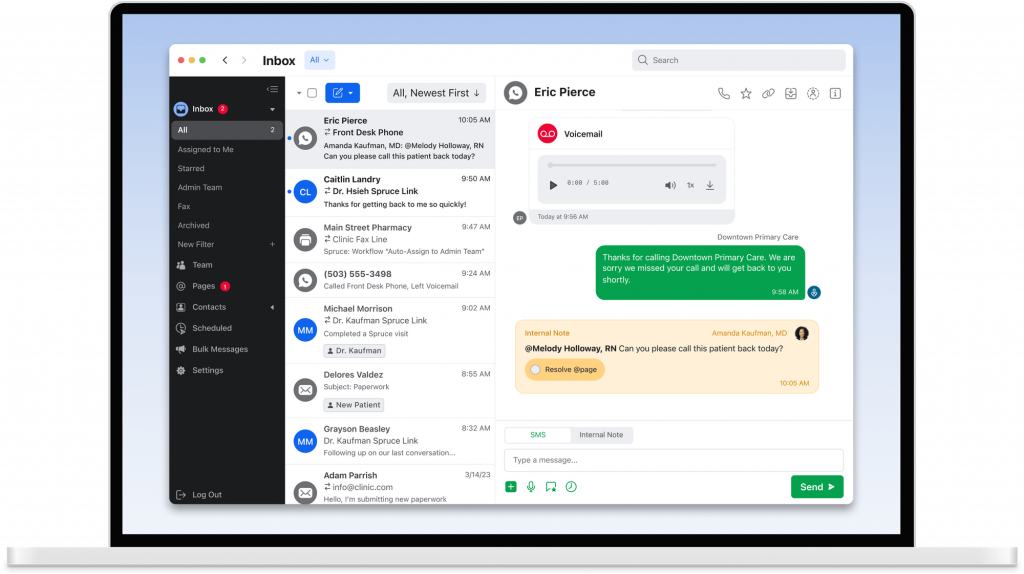
Overview:
Spruce Health is a complete package for healthcare providers, offering VoIP, secure messaging, and telemedicine features, all on the same HIPAA-compliant service. It consolidates patient-communication tools in one place and simplifies life for clinics and solo practitioners. Sleek mobile and desktop apps, allow providers to manage patient care from anywhere. Spruce also includes the kind of advanced workflows of interest to modern doctors, including automated messaging and custom inboxes.
Features:
- HIPAA-compliant secure messaging and calling.
- Auto-attendant and customizable phone trees.
- Telehealth video visits.
- Internal messaging and task management for your team.
- User-friendly for patients (patients can communicate without the app for basic features).
Pros:
- Purpose-built for healthcare for automatic compliance and new features.
- Easy to use for both clinics and patients.
- No long-term contracts available.
- Strongly focused on secure and unified communication for the patient.
Cons:
- It may not have the advanced general business features that larger general UCaaS providers have.
- EHR/PMS integrations should be viewed based on your specific connection (integration).
- Better suited for smaller to mid-sized practices.
Pricing:
(Estimate: $25-$50+ per user/month – estimate based on plans)
Rating:
4.5/5
Integrations:
Depends on EHR/PMS but many hold up through direct connections or API, usually limited integration to all systems.
Support Channels:
Email, in-app support, and knowledge base.
8. Ooma Office

Overview:
Ooma Office is an affordable VoIP solution ideal for small businesses, like offices within a healthcare facility. It has all the basic features you need in a phone system, such as call routing, virtual receptionist, and voicemail-to-email, and can be HIPAA-compliant for an additional fee. It’s a trusty solution for practices that want non-ephemeral but secure communication.
Features:
- Unlimited calling in the US, Canada, Mexico, and Puerto Rico.
- Virtual receptionist (auto-attendant).
- Call forwarding, voicemail, and call parking.
- Mobile app that grants remote access.
- Desktop app with softphone capabilities.
Pros:
- Economically suited to smaller orthopedic practices.
- Rapid set up and management.
- It is a dependable service and one can hear everything properly in the call.
- Offers a HIPAA-mode/BAA for compliance.
Cons:
- Considerably less sophisticated advanced UCaaS features than enterprise offerings.
- EHR/PMS collaboration may be more limited or involve third-party tools.
- May not scale as easily for large, multi-location orthopedic groups.
Pricing:
(Estimate: $19.95-$30+ user/month)
Rating:
4.6/5
Integrations:
Salesforce, Google, Microsoft 365, and a general API for others.
Support Channels:
Phone, chat, email, and an online knowledge base.
9. Phone.com

Overview:
Phone.Com is a VoIP solution tailored with a plethora of features designed specifically for medical practices, such as call handling, video calling, and texting. It has a HIPAA Mode to protect sensitive information and provides Business Associate Agreements (BAAs) to meet compliance requirements. The flexibility and scalability of the platform make it a good fit for small to mid-sized healthcare providers. Intuitive interface and pricing – It has an easy-to-understand UI and pricing.
Features:
- More than 50 advanced features (including a variety of call routing, call queues, voicemail-to-email).
- Business SMS/MMS.
- Video conferencing.
- Customizable auto-attendant.
- Virtual faxing.
Pros:
- Highly customizable feature set.
- Affordable pricing for core VoIP needs.
- To set up and manage; very easy for non-tech users.
- Includes HIPAA mode and BAA for compliance.
Cons:
- Some advanced healthcare integration may be less native.
- Call quality can vary based on the internet connection.
- It may not be recommended for very large or complex orthopedic groups.
Pricing:
Estimated-$15-$30+ per user per month, based on features
Ratings:
3.8/5
Integrations:
Provides basic integrations with CRM and has APIs available for custom needs.
Support Channels:
Phone, chat, email, tickets.
10. RingRx
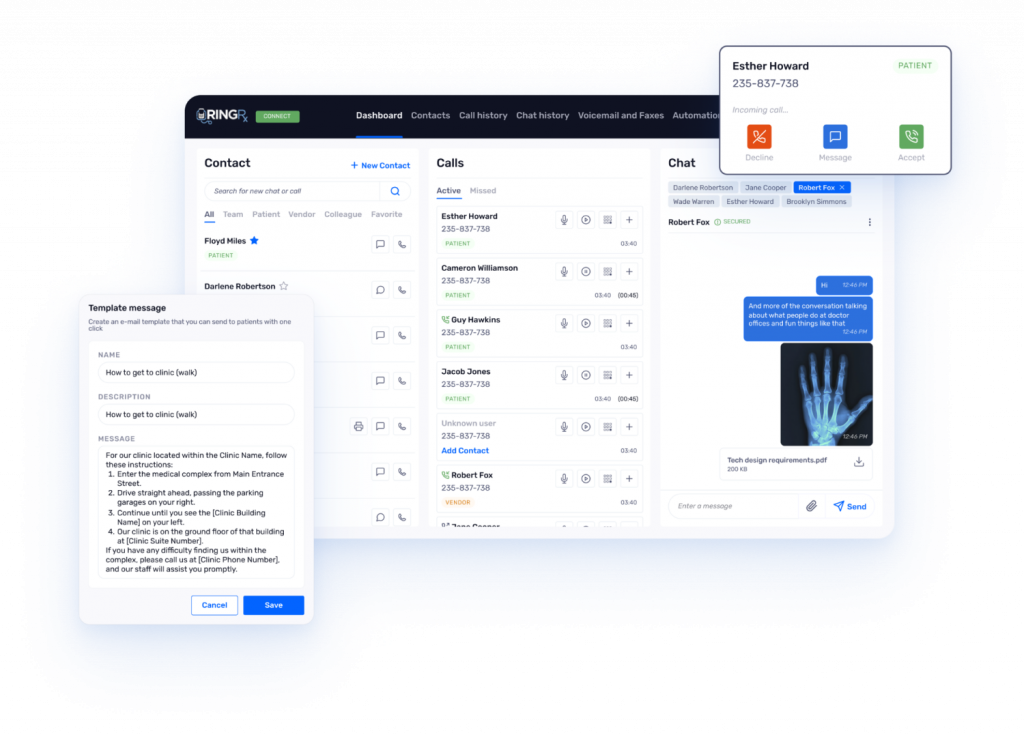
Overview:
RingRx is dedicated to healthcare VoIP services and was designed from the ground up to support HIPAA compliance. The system provides safe, two-way communication specific for physicians and clinics, and staff along with integrated faxing, voicemail, and EHR connectivity. The service makes it easy to comply with regulations and stay in touch with auto attendant, call logs, and encryption. Because it is a use case specific to healthcare, patient interactions are as simple as they are secure.
Features:
- HIPAA-compliant voicemail, text, and fax.
- Secure patient messaging.
- Easy to customize call flows and call scheduling.
- Voicemail to text/email.
- Integrations with EMR/EHR system features.
Pros:
- A platform specifically built for healthcare with a focus on compliance and clinical workflows.
- Industry-leading security measures for patient data.
- Great features for managing when physicians are on-call.
- Positive reviews in use case, and their relevance to medicine.
Cons:
- Fewer general business features compared to the broader UCaaS platforms.
- Pricing will likely be above what you pay for other non-healthcare-focused VoIP providers.
- Integrations will be limited to common EHRs, which will require verification.
Pricing:
(Estimated: $15-$25+ per user/month)
Rating:
4.7/5
Integrations:
EMR or EHR system (verify specific EMR/EHR or use API)
Support Channels:
Phone, email, and online resources.
Why Emitrr Is the Top Choice Among VoIP Providers for Orthopedic Clinics
Emitrr is built specifically for healthcare and is the best option for orthopedic clinics that want to modernize their clinic communication.
- Full PHI Protection: Emitrr is HIPAA-Compliant, ensuring your PHI is protected with encryption, audit logs, and a signed business associate agreement (BAA).
- Orthopedic-Ready: Emitrr’s features are adaptable to clinical workflows for scheduling, pre-op and post-op care, and rehabilitation.
- Unified Dashboard: Manage calls, texts, and voicemails all on one easy-to-use platform.
- Automatic Automation Tools: Emitrr automatically sends out reminders, follow-ups, and notifications to lessen the burden of having to remember when to send something.
- EHR Integration: Integrates easily with more than 1,000 systems like Epic, Athenahealth, and NextGen.
- Remote Access: Use your clinic’s number from any device anywhere; it makes tele-health and on-call support easy.
- Super Quick Onboarding: Onboarding can happen quickly with no or very little IT involvement.
- Simple Pricing: No hidden fees with easy per-user pricing.
- AI Features: Provides predictive call processing, voice-to-text, as well as intelligent analytics.
- Reliable & Scalable: Offer a 99.99% uptime promise and can expand with your clinic.
Frequently Asked Questions
Ans: Increased efficiency and communication with patients, such as reminders, and smart routing.
Ans: Most providers have 99.99% uptime and call rerouting to limit interruptions, which makes it very dependable.
Ans: It automates both SMS and voice reminders to reduce no-shows and free up staff time.
Ans: Absolutely, and with VoIP apps they can take calls and texts from any device with internet access.
Ans: BAA is a Business Associate Agreement that legally binds the provider to protect PHI and follow HIPAA laws. This is necessary for any medical VoIP service.
Ans: Most onboarding takes a few days with minimal appointments disrupted.
Ans: With the top providers, such as Epic, Athenahealth, and eClinicalWorks, etc, one can easily integrate with EHR systems.
Conclusion
Orthopedic clinics can’t get by with phones; they need a smart, compliant communication platform in 2025.
“VoIP brings today’s healthcare organizations the ability to make patient outreach more efficient, clear, and smooth running, and scalable as they expand.” In the best options, Emitrr has proven to be a great HIPAA-compliant, feature-packed platform for healthcare.
Ready for your clinic to have better communication? Schedule a demo and see the future of orthopedic patient care.


 4.9 (400+
reviews)
4.9 (400+
reviews)