
Introduction
Have you heard about AI agents in hospitals? They’re basically smart digital assistants helping hospitals run. No scrubs, no stethoscope, but they’re busy behind the scenes (and sometimes right in front) making life easier for patients and staff. From managing appointments to keeping an eye on patient vitals, these AI agents are becoming a big part of AI in hospital management today. In fact, hospitals around the world are starting to rely on them to handle routine tasks, answer questions, and even watch for emergencies.
Sounds a bit futuristic? It’s happening now! Surveys show 94% of healthcare organizations see AI as core to their operations, and 86% are already using it in some capacity. AI-powered hospital automation is really changing how healthcare works.
So let’s break down what these AI agents really are, the role of AI in hospitals, and what to consider when using one. By the end, you’ll see how AI agents are transforming hospitals and why that matters for all of us.
What Are AI Agents in Hospitals?
Hospitals today are under pressure. Staff are stretched thin, patients wait too long, and systems don’t always “talk” to each other. That’s where AI agents for hospitals come in. AI agents in hospitals are like smart assistants built into the system. They can schedule appointments, monitor patients, route calls, and even scan medical data in the background. Instead of just following a script, they use conversational AI in hospitals to actually learn and make decisions.
Why does this matter? Because traditional hospital systems face real challenges: burned-out staff, long patient wait times, messy EHR setups, privacy concerns, and endless admin work. Add limited patient engagement after hours, and it’s clear why a fresh solution is needed. That’s where the benefits of AI agents in healthcare stand out. They catch patient changes faster, smooth out scheduling, take admin pressure off staff, and keep communication running 24/7. They can also lower costs, improve compliance, and build patient trust.
In short, AI agents in hospital workflows act like extra team members who never clock out. They handle the routine work, keep systems connected, and free up doctors and nurses to focus on what really matters — patient care!
The Challenge with Traditional Hospital Systems
Why did these AI agents even become a thing? Traditional hospital systems come with plenty of challenges. Hospitals are busy, high-pressure places, and the same problems seem to pop up again and again. Let’s talk about a few big ones:
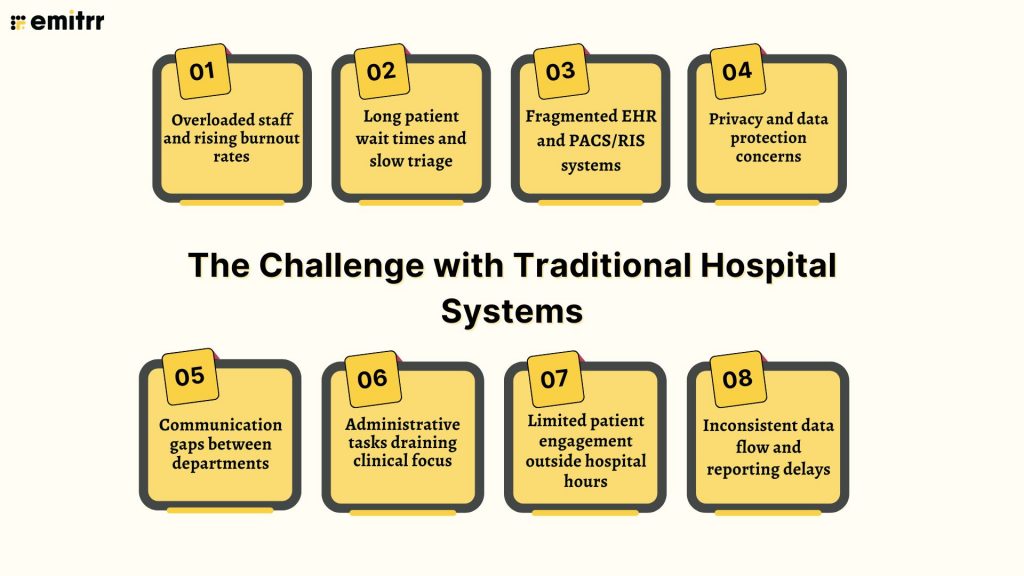
Overloaded staff and rising burnout rates
Hospitals are often short on staff, and the people there — nurses, doctors, support teams — end up juggling way too much. It’s no surprise that burnout kicks in, that “I just can’t keep up” feeling. In fact, nearly half of U.S. physicians reported at least one symptom of burnout in 2023. That’s huge! When staff are overworked, they’re not only unhappy, but it can also affect patient care quality.
Long patient wait times and slow triage
If you’ve ever sat in an emergency room for hours, you know this one. It’s not uncommon for patients to wait a very long time before being seen or admitted. Traditional processes can be slow. From check-in at the front desk to a nurse figuring out who needs help first, to finally getting a bed or seeing a doctor, every step can drag. For patients, that wait is frustrating, and in serious cases, those delays can even be risky.
Fragmented EHR and PACS/RIS systems
Hospitals rely on many software systems – electronic health records (EHR) for patient info, PACS for imaging (like X-rays and MRIs), RIS for radiology scheduling, etc. Often, these systems don’t talk to each other well. Data gets siloed. A doctor might have to manually pull info from three different places to get the full picture of a patient. That wastes time and can lead to errors if something is missed. It’s like having pieces of a puzzle scattered all over.
Privacy and data protection concerns
Hospitals handle some of the most sensitive info out there — your health records, personal details, insurance, all of it. The problem? Older systems aren’t always built to keep up with today’s security needs. That’s why you keep hearing about data breaches or ransomware attacks in the news. With so much moving online, keeping everything safe and HIPAA-compliant has become a huge challenge. One slip-up can be a huge deal in healthcare.
Communication gaps between departments
Ever had to repeat your medical history to five different people in the same hospital? Maybe the lab knows your test results, but the nursing station hasn’t seen them yet. Or radiology finished your scan, but your doctor is still waiting for the report. Communication delays or gaps mean care isn’t as smooth as it should be. Important info can fall through the cracks, or you get asked the same questions over and over.
Administrative tasks draining clinical focus
Hospital staff don’t just do medical work. They drown in paperwork and data entry. Nurses spend time filling forms, updating charts, and handling insurance queries. Doctors type up notes and billing codes late into the night. All these admin duties take time away from patient care. It’s not exactly what most clinicians had in mind for their career, and more screen time often means less time providing care.
Limited patient engagement outside hospital hours
Once a patient leaves the hospital or clinic, it often feels like the support stops right there. Need help after hours? Chances are, the phones go to voicemail. Got a question on Saturday? You’ll probably be told to wait until Monday. Traditional systems weren’t built to keep the conversation going outside of scheduled visits, and that leaves patients feeling stuck. It’s a gap in care that can be frustrating at best and risky at worst.
Inconsistent data flow and reporting delays
A lot of decision-making in hospitals relies on reports, whether it’s the daily report of new admissions, or a weekly summary of infection rates, or flagging urgent patient follow-ups. If data entry is slow or reports are only generated infrequently, leaders are often reacting to old information. It’s like driving using your rearview mirror. By the time an issue is identified (say, an increase in post-surgery infections), it’s already been a problem for a while.
All these challenges show why hospitals need support. Clinical AI assistants step in to handle routine tasks, watch data nonstop, and improve patient care.

Benefits of AI Agents in Hospital Operations
Implementing AI agents in hospital operations can address many of the issues above and bring a bunch of advantages. Here are some of the big benefits of AI agents in healthcare settings like hospitals:
Faster detection of critical patient changes
AI agents can monitor patient data 24/7 and immediately flag if something’s off. For example, an AI system watching vital signs might catch a drop in oxygen or a spike in heart rate and alert staff within seconds. That means quicker intervention. In a busy ward, nurses can’t watch every heartbeat or lab result in real time – but an AI can. This early warning system can literally save lives by catching deterioration or emergencies faster than traditional monitoring.
Improved scheduling and reduced bottlenecks
AI can work wonders for the flow of patients. By analyzing appointments, admissions, and discharges, it can optimize schedules so that resources are better used. Fewer empty slots, fewer overbooked times, and smarter voicemail triage can all reduce the jams where everyone seems to be waiting. Faster throughput means you spend less time in the waiting room, and the hospital can treat more people efficiently.
Lower admin burden for frontline staff
An AI agent can take over a lot of the paperwork and routine tasks that bog down doctors and nurses. It can transcribe notes, fill forms, send insurance info, you name it. By acting as AI agents for hospital administration tasks, they basically serve as extra support staff dedicated to repetitive, mundane tasks. These AI agents for hospital staff support translate to happier nurses and doctors. As they get to focus more on direct patient care and less on staring at a screen. When the admin load lightens, so does staff stress and burnout risk.
Always-on patient communication and reminders
Unlike human staff, AI agents don’t work 9-to-5. They’re available 24/7. Hospitals can use AI to keep an open line of communication with patients at all times. Need to send a medication reminder at 8 PM? AI can do it. Patient has a question at 2 AM about fasting before surgery? An AI chatbot can answer. This “always there” communication means patients feel supported even after hours. It also helps with things like appointment reminders or follow-up care instructions, which can improve adherence and reduce no-shows or complications.
Consistent, error-free documentation
Humans may get tired and make mistakes at times. AI systems, on the other hand, will document the same way every time and won’t forget steps. If an AI agent is logging patient information, it’ll use the correct format and fill all required fields. This consistency leads to cleaner data. When documentation is accurate and standardized, it prevents a lot of downstream errors. For instance, if every patient discharge summary has all the right info, the next provider (or the patient) won’t be left guessing about follow-up instructions or medication doses.
Reduced operational costs and resource waste
This one’s big for hospital administrators. AI agents in hospital operations help cut costs by reducing no-shows, optimizing staffing, and handling routine queries without extra overtime. Smarter workflows also mean fewer delays and redundant tests. In fact, AI-powered automation could save U.S. healthcare an estimated $9.8 billion every year!
Stronger patient satisfaction and trust
When patients get answers right away, whether it’s through a chatbot or without being stuck on hold they feel heard. And if the hospital checks in with them after a visit, even with a quick automated message, they feel cared for. Over time, that consistency builds trust. Every time the info is clear and reliable, people start trusting the whole system more. That’s how AI agents help boost patient satisfaction — by making the experience smoother and friendlier from start to finish.
Support in maintaining compliance standards
Hospitals have to follow a ton of regulations and standards. HIPAA-compliant AI solutions for hospitals can be a big help in maintaining these standards. They can automatically log actions (great for audit trails), ensure forms have all necessary fields completed, and even detect if a process isn’t following protocol. By keeping an unblinking eye on processes, AI acts like a safety net that catches compliance issues before they become big problems.
In a nutshell, AI for hospital efficiency and productivity means doing things faster, smarter, and at lower cost. It frees up humans for real caregiving and complex decisions.
How AI Agents Help in Hospital Operations
From the moment a patient contacts the hospital to the time they’re treated and billed, an AI agent can step in at various points:
24/7 triage and symptom monitoring
Imagine a digital triage nurse who never sleeps. With AI for hospital scheduling and triage, patients can chat or call at any hour, describe symptoms, and get guidance on what to do next. Some systems even connect with wearables to track vitals. If a patient’s blood pressure drops at 4 AM, the AI flags it instantly and alerts staff. That kind of always-on support means critical issues don’t wait for morning rounds.
Real-time alerts for deteriorating patients
This is where AI-driven hospital decision-making really shines. AI agents can watch patient data nonstop and catch things a human might not notice right away, like the early signs of sepsis. If something looks off, the system sends a quick alert: “Hey, check Room 12 now.” Nurses don’t have to dig through charts or wait for rounds. The warning comes straight to them. Catching problems this early can stop small issues from turning into full-blown emergencies.
Automated appointment booking and rescheduling
No more endless phone tag. AI agents can book, cancel, or reschedule appointments over text or phone in seconds. Patients type, “I need to move my appointment,” and the AI offers new slots and updates the schedule automatically. It even answers simple follow-up questions like, “Do I need a referral?” This blend of automation and conversation makes AI for hospital scheduling a real time-saver for staff and patients alike.
Patient outreach via SMS, calls, and portals
After a visit, patients might get a quick follow-up text: “How are you feeling today? Reply 1 for better, 2 for same, 3 for worse.” That’s AI in healthcare communication at work. If someone replies “3,” the system can trigger a call or suggest a return visit. AI also sends out reminders for meds, vaccines, or upcoming checkups. These simple nudges keep patients engaged and supported long after they’ve left the hospital.
Smart billing, insurance, and compliance updates
Billing and insurance don’t have to be headaches. AI agents can send polite reminders, answer common coverage questions, and flag pre-authorization needs before they become issues. They can also check eligibility during patient check-in to make sure compliance forms are completed on time. By handling these repetitive tasks, the AI cuts down on errors and delays. That means fewer claim denials and less time wasted on paperwork.
Intelligent task routing to the right teams
Think of AI as a traffic cop for hospital requests. A patient asks about surgery prep? The AI routes it straight to the surgical team, not the general desk. Internally, if a doctor orders an X-ray, the radiology team gets pinged automatically. Translators, labs, or pharmacy requests get sent to the right person without delay. This keeps workflows smooth and avoids messages getting lost in someone’s inbox.
Data consolidation across hospital systems
Hospitals often juggle multiple systems that don’t talk well to each other. AI agents can pull lab results, imaging reports, past visit notes, and even call transcripts into one summary for the doctor. They can also update details like a new address across all systems at once. This kind of digital health transformation with AI ensures consistent information everywhere. For staff, it means less hunting through screens and more focus on patients.
These AI virtual assistants in healthcare are like diligent helpers keeping an eye on things and handling the busywork, which lets the hospital staff focus on actual patient care.
Key Features to Look For in Hospital AI Agents
When evaluating AI agents for hospital administration or clinical support, it’s important to know what features really matter. Here are some key features and qualities to look for:
HIPAA compliance and data security
First things first – security. Any AI touching patient information has to be rock solid. That means message encryption, strict access controls, and logging every move. Look for HIPAA-compliant AI solutions for hospitals, and always check if the vendor signs a BAA. In healthcare, privacy isn’t a nice extra — it’s the baseline.
Seamless EHR, PACS, and RIS integration
An AI agent is only as good as the systems it connects with. If it can’t update your EHR, pull lab results, or book an appointment in your scheduler, it’s basically running solo. The best AI agents in hospital workflows slide right into your existing setup, so when the AI acts, the update shows up in the right place automatically. No double work, no extra clicks. Just seamless.
Multilingual and multi-channel communication
Hospitals serve everyone, so your AI should too. A grandma may want a phone call, her grandson might prefer a text. Your AI system should handle both without blinking. And it shouldn’t just stick to English. A good AI agent offers multiple languages across SMS, calls, email, and even WhatsApp. This flexibility makes AI in healthcare communication feel inclusive and accessible.
Self-learning and adaptive conversation flow
No one likes a bot that repeats itself like a broken record. A good AI learns from every interaction and adjusts. If a patient changes the topic mid-conversation, it shouldn’t freeze. It should flow. That’s the magic of self-learning and adaptive conversations. Over time, the AI feels less like a script and more like a real helper.
Transparent training to reduce bias
Bias in healthcare AI can be dangerous. That’s why hospitals should ask vendors how the AI was trained, what data it used, and how it avoids blind spots. If an AI only learned from one group, it may struggle with others. A transparent vendor can explain the “why” behind each answer. Clear training practices make patients and staff trust the system more.
Staff-friendly dashboards and analytics
Staff should never feel locked out of what the AI is doing. Dashboards make it easy to see how many chats or calls it handled, common patient questions, or where it needed human help. Analytics help spot trends, like a flood of refill requests every Monday morning. And if the AI struggles mid-convo, staff should be able to step in instantly. Easy, simple, staff-first.
Scalability for large hospital networks
Hospitals grow, and your AI should grow with you. Maybe you start with cardiology scheduling, then want to expand to radiology or ER. A scalable AI handles the jump without crashing. Cloud-based systems usually shine here, scaling resources as usage doubles or triples. Think of it as an AI that grows alongside your hospital network.
By checking for these features, you’ll increase the chances of picking an AI agent that actually delivers value in a hospital setting.
When to Choose Humans Over AI Agents
Hospitals are fundamentally about caring for people, and sometimes people need people. There are moments in healthcare that call for a human touch, no matter how smart the AI in hospital patient care is. Here are situations where you’d want a real human in the loop or taking charge:
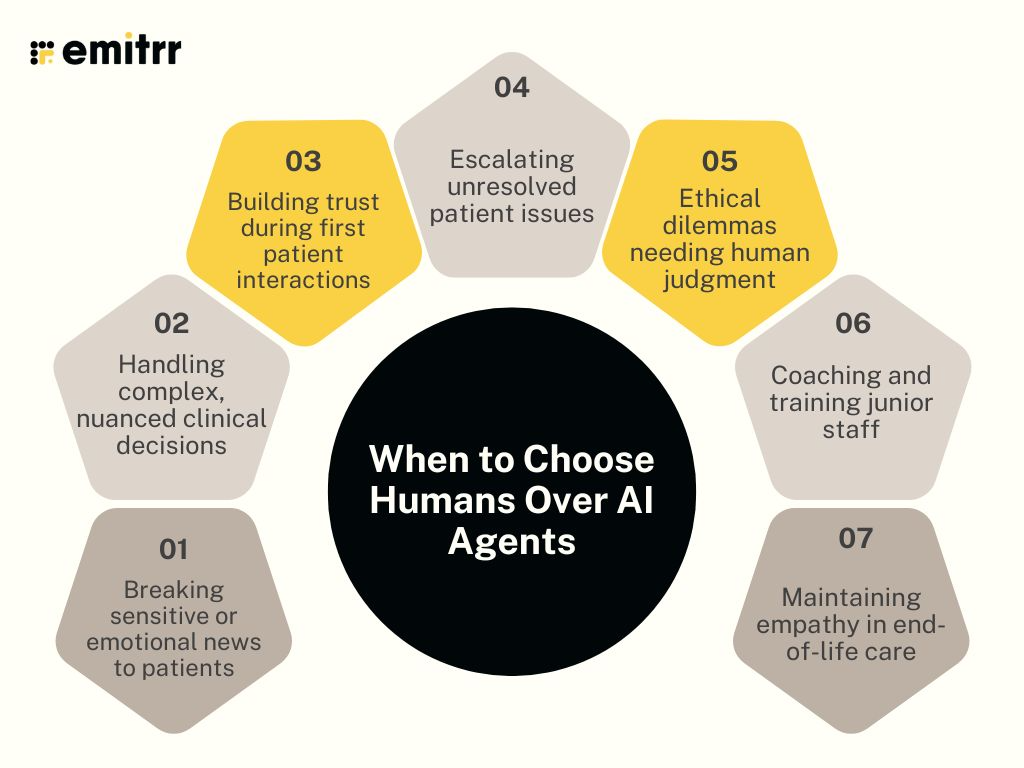
Breaking sensitive or emotional news to patients
Some conversations are just too human to hand off. Delivering a cancer diagnosis or telling a family about a loss requires empathy, compassion, and presence. Doctors and counselors can read emotions in real time and provide comfort. An AI might sound polite, but it can’t hold someone’s hand or share in their grief. These moments belong to humans.
Handling complex, nuanced clinical decisions
Medicine isn’t always black and white. When test results conflict or rare conditions overlap, decisions aren’t just about data. They involve intuition and judgment. Clinical AI assistants can provide support, but they don’t capture the nuance of balancing risks, patient preferences, and ethics. If it’s a tough call like surgery vs. medication, you want a human leading the decision. AI’s role here is backup, not captain.
Building trust during first patient interactions
First impressions matter. When someone walks into a hospital, they want to feel seen and cared for. A friendly smile or calm voice builds trust in a way an AI intake bot never could. Sure, AI can handle registration and patient forms, but the first hello should still come from a human. AI should support, not replace, that initial human connection.
Escalating unresolved patient issues
We’ve all been stuck yelling “representative!” at an automated phone system. Hospitals can’t afford that frustration. If an AI agent gets stuck, say with a tricky insurance question, it should hand off to a human smoothly. And that handoff needs context so the patient doesn’t start over from scratch. Good AI agents know when it’s time for the human staff to step in.
Ethical dilemmas needing human judgment
Healthcare sometimes involves decisions that go far beyond data, like end-of-life care, organ allocation, or tough consent issues. These aren’t yes/no answers for a machine. They require compassion, legal awareness, and moral reasoning. Humans are required and must always lead when ethics and public trust are on the line.
Coaching and training junior staff
AI can drill facts or simulate scenarios, but it can’t mentor. A seasoned nurse showing a trainee how to comfort a patient or a surgeon offering pointers in the OR, that’s real teaching. Junior staff also learn soft skills by watching how seniors interact with patients and colleagues. Those human touches, encouragement, and lived lessons can’t be programmed.
Maintaining empathy in end-of-life care
Hospice care is as much emotional as it is medical. Patients and families often need someone to listen, hold their hand, or sit quietly in the room. AI might track meds or automate updates, but it can’t share in the emotional weight. Compassion and presence are what people remember most in these moments. That’s why end-of-life care must always remain human-led.
While AI-driven hospital decision-making and automation can handle a lot, humans are irreplaceable. Especially for anything requiring empathy, complex judgment, or personal connection. The best approach is not AI versus humans, but AI with humans.
Best Practices for Implementing AI Agents in Hospitals
Bringing AI into a hospital is a bit of a journey. To make sure it succeeds, you should approach it thoughtfully. Here are some tips and best practices if you’re implementing an AI agent at your hospital:
Define clear goals and metrics
Before you roll out an AI agent, know exactly what you want it to do. Is the goal to reduce patient wait times, reduce no-shows, or answer after-hours calls? Setting measurable targets helps everyone stay on the same page. It also makes it easy to track if the system is actually working. Without clear goals, success is hard to measure.
Start small with a pilot
Don’t flip the switch across the whole hospital on day one. Pick one department or task, like appointment scheduling in radiology, and test the waters. A pilot lets you see how patients and staff interact with the AI. You’ll catch issues in a safe, small-scale setting before expanding. It’s a low-risk way to build confidence.
Get buy-in from staff early
Staff might be skeptical of new tech or worried about job security. Bring them into the conversation from the start. Show how the AI will actually make their lives easier by taking repetitive tasks off their plate. Ask for their input on which tasks slow them down. When people feel heard, they’re far more open to change.
Ensure data integration and IT readiness
An AI agent isn’t useful if it doesn’t connect to your systems. Check with IT to make sure it can plug into your EHR, scheduling tools, and lab software. Confirm the data flow is secure and compliant. Also, think about hardware needs like VOIP phones or network capacity. Smooth integration means less friction once you go live.
Train the AI (and your staff)
AI comes pre-trained, but it needs fine-tuning for your hospital. Feed it FAQs, protocols, and terminology so it speaks your language. Simulate real scenarios to see how it responds. At the same time, train staff on how to monitor and guide it. When both sides, the AI and the peopl,e are trained, the system works smoothly.
Maintain human oversight
Even the smartest AI needs supervision. Set up a process for staff to review a sample of interactions regularly. If the AI struggles, staff should be able to step in right away. Clear escalation rules (“Speak to human” triggers a handoff) are a must. Oversight ensures safety, accuracy, and patient trust.
Monitor performance and gather feedback
Track the numbers: Is the AI answering calls faster? Is it hitting your goals? But also ask people. Patients and staff can tell you how the system feels in real use. Sometimes the data looks good, but the experience isn’t. Combining metrics with feedback gives you the full picture.
Iterate and improve
Launching AI isn’t the finish line. It’s the start of constant improvement. Maybe the chatbot sounds too formal, or the alert system is too sensitive at night. Tweak and adjust as you go. AI learns over time, but it still needs guidance. Regular reviews keep the system sharp and useful.
Focus on patient and staff experience
Tech is only valuable if it helps people. Keep checking whether patients feel supported and staff feel less stressed. If the AI feels cold or annoying, scale it back or adjust how it’s used. If staff feel nagged, change the settings. Always design around human needs. The AI should fit the people, not the other way around.
With good planning, communication, and a willingness to adapt, you can avoid common pitfalls and really harness the AI’s potential.
How does Emitrr help hospitals with AI agents?
Emitrr acts like a smart, always-on AI powered receptionist for hospitals. It takes care of calls, texts, and routine tasks so staff can focus more on patient care.
- No more missed calls: Emitrr picks up every call, 24/7, so patients never hit voicemail or get stuck waiting.
- Instant text replies: If staff miss a call, Emitrr shoots back a quick missed call text back to keep the conversation going.
- Easy scheduling: Patients can book, confirm, or reschedule appointments by text or phone without any phone tag.
- Automated follow-ups: After a visit, Emitrr sends friendly check-ins or reminders to reschedule missed appointments.
- Smart routing: Billing questions go to billing, urgent issues go to nurses — no bouncing around departments.
- Always learning: Emitrr gets better with every chat or call, improving answers over time.
- Consistent and friendly: Patients get clear, professional responses every time, without slip-ups.
- Less work for staff: By handling FAQs and routine queries, Emitrr frees staff to focus on real patient care.
- Works everywhere: Calls, texts, chats, or emails — Emitrr is available across channels.
- Natural conversations: The AI understands context and phrasing, so it feels more like chatting with staff.
- Smooth integrations: Emitrr plugs into EMRs and scheduling systems to keep info updated automatically.
- HIPAA-compliant AI agent: Patient data is safe, Emitrr is designed with healthcare compliance in mind.
- Scales with growth: Whether you’re a small clinic or a big network, Emitrr handles the load.
- Fair pricing: Built to be affordable for both small clinics and large hospitals, so you don’t need a massive IT budget to get started.
- Reliable customer support: Emitrr’s team is quick to respond, whether you need setup help or troubleshooting along the way.
Future Trends in AI-Powered Hospital Care
As AI technology advances, its role in hospitals is only going to grow. Here are some exciting future trends in AI-powered hospital care that people are looking forward to:
Agentic AI for care pathways
Think of AI as a case manager that doesn’t miss a beat. It could map out a patient’s hospital journey from tests to consults to follow-ups and adjust things in real time. No more delays because someone forgot to schedule the next step. Everything is coordinated automatically, making care faster and smoother.
Syncing with wearable data
Wearables like smartwatches and glucose monitors are everywhere now. Soon, AI agents in hospitals could tap into that data to spot problems before they blow up. Imagine your hospital AI getting an alert from your Fitbit that your heart rhythm looks off and sending you a nudge to check in. It shifts care from reactive to proactive.
Predictive equipment maintenance
Nothing derails care like a broken MRI machine. AI can use sensor data to predict when equipment is about to fail. Instead of fixing things after they break, hospitals can schedule maintenance before downtime happens. That means fewer canceled scans, safer care, and lower repair costs.
Generative AI for patient-friendly reports
Medical jargon can feel like another language. Generative AI could turn a dense discharge summary into something clear and friendly, written in plain English. Patients would know exactly what happened and what to watch for at home. It could even answer simple follow-up questions without a doctor needing to type it all out.
Multilingual, culturally smart agents
Hospitals serve patients from every background, and AI is getting good at speaking their language literally. Future AI agents might switch between languages on the fly and adjust tone based on cultural context. That means more patients feel heard and respected, even if human translators aren’t available.
Proactive patient outreach
Instead of waiting for patients to call when something’s wrong, AI could check in first. It might nudge high-risk patients during flu season, remind diabetics to log their blood sugars, or ping someone overdue for a checkup. It’s like having a friendly virtual health coach making sure no one slips through the cracks.
Hospitals in the future may run quite differently, with AI coordinating a lot of the logistical and even some clinical aspects, and humans overseeing and handling the deeply human elements of care. We’re basically talking about a digital health transformation with AI at the core!
Frequently Asked Questions
AI agents in hospitals are like smart virtual assistants. They handle tasks such as scheduling, triage, answering questions, and even monitoring data. Think of them as extra team members that work 24/7 to support staff and patients.
Yes, the good ones are built to be HIPAA-compliant. They use encryption, access controls, and follow strict rules to protect patient data. Hospitals still need to vet vendors carefully, but secure AI agents are safe to use.
Definitely. Emitrr takes on routine calls, texts, and scheduling so staff can focus on patients. That means shorter waits for patients, less admin stress for staff, and fewer chances of burnout.
Yes, Emitrr connects with EHRs, scheduling tools, billing systems, and more. It updates records in real time, so staff and AI are always working off the same information.
Humans are essential for empathy, complex decision-making, sensitive conversations, and hands-on care. AI supports the team, but the human connection in healthcare can’t be replaced.
Yes, Emitrr is cloud-based and scales easily. Small clinics can start with a few features, while large hospital networks can expand across departments and locations without a hitch.
Conclusion
AI agents are basically taking the repetitive stuff off hospital staff’s plates. They’re not here to take over, they’re here to back you up. Imagine a helper that never gets tired: it books appointments, answers calls, sends reminders, and shouts for help if something urgent pops up. That way, doctors and nurses can spend their time doing what really matters – caring for people.
For patients, it feels smoother and faster. No more waiting forever for a callback or feeling lost in the system. For staff, it’s fewer headaches and more time to breathe. AI in hospital patient care is all about making life easier for everyone. And with Emitrr, you don’t have to imagine it – you can see it for yourself. Book your free demo today and see how much lighter your day can feel!

 4.9 (400+
reviews)
4.9 (400+
reviews)