
 4.9 (400+
reviews)
4.9 (400+
reviews)
Introduction: Beyond First Principle: The Invisible Impact of AI Chatbots in Hospitals
Hospitals are not just places that treat patients; they are living, breathing ecosystems of coordination chaos. Every day, administrators and clinicians coordinate tasks from admissions, triage, billing, discharges, follow-ups, insurance queries, and maintain compliance under tight regulatory constraints like HIPAA and GDPR. The system is pulling at the seams, and we see the cracks in the form of long patient wait times, overworked call centers, delayed payments, as well as high levels of stress from hospital staff.
This is where the AI chatbot for hospitals arrives as the “digital front desk.” Think of an AI virtual assistant for hospitals that is available around the clock, managing patient queries, booking appointments, responding to billing requests and conducting some initial symptom triage.
The effect is no longer theoretical; it’s quantifiable:
- 30-40% reduced administrative burden, freeing up more staff time for patient-facing care.
- Enhanced communication led to up to a 20-25% higher patient satisfaction scores.
- Regulators are beginning to recognize that HIPAA-compliant AI chatbot platforms can be a useful solution if the mini-app meets certain requirements for compliance and security.
In other words, AI chatbots in hospitals are not some kind of luxury at some point in the future. They are fast becoming a key part of AI-powered hospital automation, changing the patient experience from clutter to clarity.
What is an AI Chatbot for Hospitals?
An AI chatbot for hospitals is a dedicated conversational AI for hospitals to automate the conversation between a patient, staff, and healthcare systems. Unlike generic bots, these bots are designed to handle sensitive medical and financial data while being HIPAA compliant.
Key features:
- Integration with EHR/HIS systems (Epic, Cerner, Meditech) for ensuring that workflow updates are streamlined
- NLP to read medical terminology and manage patient sentiment,
- Omnichannel access via SMS, chat, or voice to communicate with the patient, in the format they prefer
- Ability to automate workflows covering appointments, billing, triage,
- AI chatbots for hospitals are not simply virtual assistants; they are chatbot solutions for hospitals that balance operational productivity with empathetic patient engagement.
Why Do Healthcare Providers Need an AI Chatbot?
Challenges Faced by Hospitals:
- Administrative Overload: Research indicates that front-office staff spends 25% of their day on the phone. Frequentl,y these calls are from patients, looking for answers to the same trivia, again and again.
- Long Wait Times: The reality for patients is that while they are reaching out for help, they often have to endure long holds or have a delay in receiving an answer.
- Information Accessibility: Families and visitors often struggle to gain timely access to billing information, visiting hours or directions about care.
- Revenue Cycle Gaps: Billing inquiries, followed by payment delays, produce revenue leakage.
Solutions given by AI Chatbots to Hospitals:
- 24/7 Scalability: An AI Chatbot can generate responsive and accurate answers to patient questions at any time of the day, and when combined with virtual call answering, there will be lower wait times and call volume.
- Automated Workflow: The operational workflows of pre-registration, verification of insurance and appointment booking can be automated.
- Patient Experience: Enhanced patient experience can be achieved with tailored messaging that alleviates anxiety and fosters adherence.
- Revenue: An AI Chatbot for hospital administration can communicate payment reminders to patients as well as determining the current status of their accounts.
An AI-powered customer help tool for hospitals does a lot more than save time! Healthcare providers need to appreciate and understand the revenue savings and smart targeted patient messaging that builds trust before patients even arrive at their hospital or clinic.
Types of AI Chatbots for Hospitals
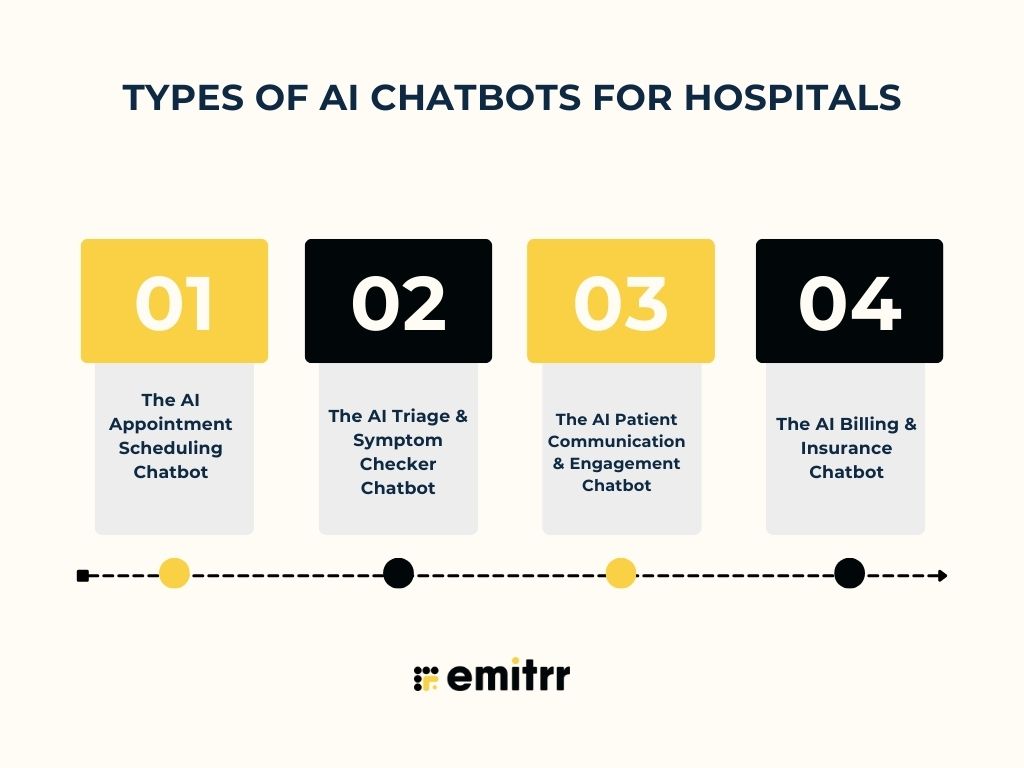
1. The AI Appointment Scheduling Chatbot
- Overview: In addition, it suggests appointment dates/times, verifies insurance info, and confirms EHR slot.
- Example: Patient books an appointment via SMS; AI Chatbot confirms instantly.
- Benefits: The efficiency of the hospital system; patients can engage anytime, decreased no-show rates, and staff are able to take breaks!
2. The AI Triage & Symptom Checker Chatbot
- Overview: Uses guided questions to work through each symptom.
- Example: Patient is presenting with chest pain; chatbot determines patient should go to urgent care and provides directions to the facility.
- Benefits: Improves safety, decreased unnecessary ER visits.
3. The AI Patient Communication & Engagement Chatbot
- Overview: Used throughout the care journey.
- Example: Sends pre-op instructions, sends reminders after discharge, and sends patient satisfaction surveys.
- Benefits: Increases patient compliance with pre- and post-op instructions, decreased readmission rates.
4. The AI Billing & Insurance Chatbot
- Overview: An AI chatbot for medical billing utilizes automation to field billing inquiries and payment inquiries.
- Example: Patient inquires about the bill; chatbot explains billing charges and provides a link to make a payment.
- Benefits: Faster collection times, fewer phone calls to patient families, and transparent information on bill pricing.
Essential Features to Consider in an AI Chatbot for Hospitals
When judging the effectiveness of an AI virtual assistant for hospitals, some features are simply non-negotiable.
- AI Features: Advanced NLP/ML that comprehends human language and gets better with every interaction.
- HIPAA Compliance & Data Security: Built this way, HR Leaders can enforce BAA and have security controls.
- Integration with EHR: Native links to Epic/Cerner/Meditech so that workflows can update automatically.
- Natural Language Processing (NLP): Translates medical terminology and colloquialism (e.g., “tummy hurts” → abdominal pain).
- Voice-Activated Features: Ideal for clinical applications and for use by patients and staff.
- Personalized Chat Flows: Custom routes (radiology vs orthopedics) for more relevance.
- Detailed Analytics & Reporting: Follow volumes, top intents, and ROI to constantly improve performance.
- Human Handoff: Can be escalated to humans with context and history included.
Integration & Compliance Requirements
Integration:
- APIs to EHR, HIS, and Patient Portals are critical. One chat should update EHR, schedule visits, and send instructions, creating one source of truth that eliminates siloes and manual errors.
Compliance:
- Compliance is mandatory, not optional. Select a HIPAA-eligible service that will sign a BAA with end-to-end encryption, stringent access controls, and full audit trails that protect PHI and track account access.
To support seamless integrations and HIPAA-compliant workflows, here are must-have downloadable medical form PDFs that help unify communication, referrals, and documentation across care teams:
Selecting the Right AI Chatbot for Hospitals
Choose your chatbot strategically, and ensure it matches your specific needs.
- Determine Your Goal: You want to lessen front-desk work, make access more convenient, or speed the revenue cycle, and use that to guide features.
- Evaluate Integration Requirements: Identify current EHR/HIS systems; validate direct, in-product integrations.
- Focus on Compliance & Security: Demand BAA, evidence health care compliance and a strong security stance.
- Verify Scalability: It should be capable of scaling from a single department to an entire enterprise network.
- Request a Demo: Validate with real use cases, not a brochure, before you buy.
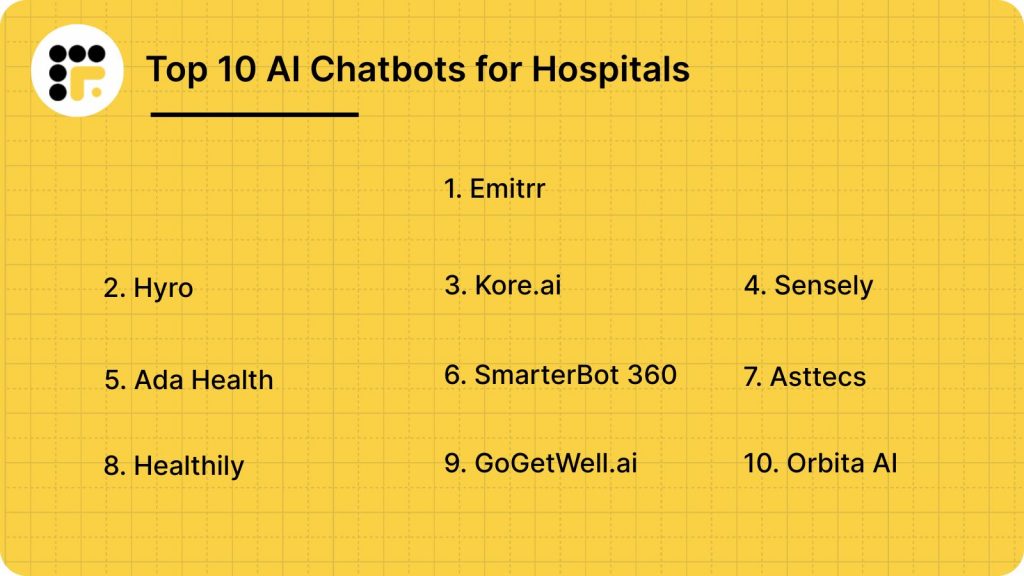
Top 10 AI Chatbots for Hospitals
1. Emitrr
Overview:
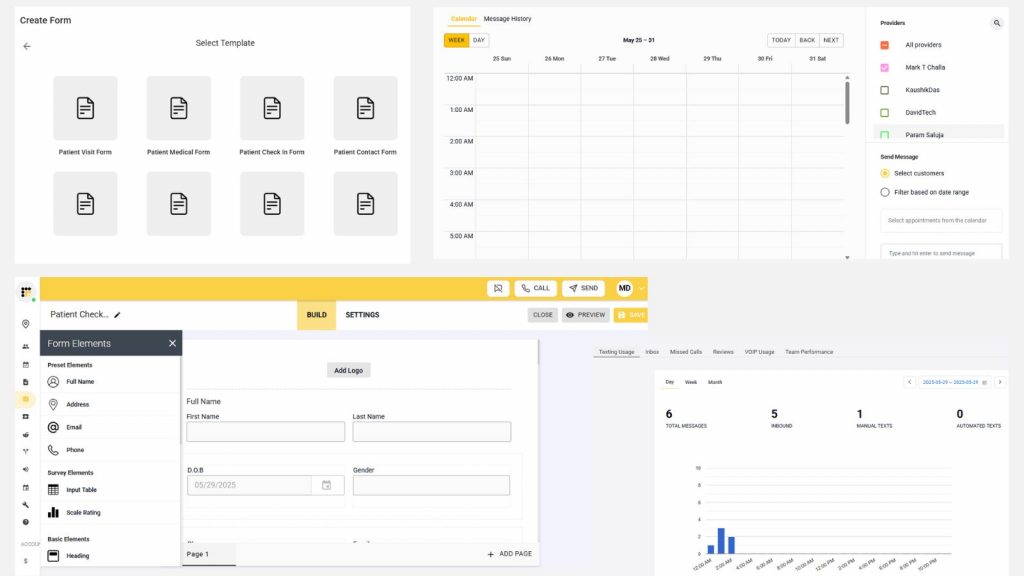
Emitrr is a comprehensive communication and engagement platform that provides AI-enhanced workflows for patient and staff communication. Emitrr is designed for hospitals and health systems, functioning as a single assistant with communication channels covering chat, voice, scheduling, triage, and analytics. Emitrr can scale up as an enterprise system trusted by healthcare professionals with its scalability, multiple integrations, and dependable customer support.
Features of Emitrr:
- AI Patient Experience: Starts engagement with patients right away via texting, offering effortless communication.
- Custom Chat Flows: Build unique conversational pathways for any healthcare chatbot use case.
- Voice Bot: Can book appointments and collect symptoms by speaking naturally.
- All-in-One Medical Assistant: Engagements, appointment reminders, and follow-ups all on the same platform.
- AI Call Management: Acts as a smart front desk to handle and manage patient calls.
- Virtual Reception and Two-Way Texting: Handle inbound questions and have conversations in real time.
- AI Triage Automation: Takes care of patient intake and case management automatically.
- Analytics and Scalable Communication: Analyze performance and scale communication with patients.
- 500+ Integrations: With leading CRM, EHR, and practice management systems.
Pros of Emitrr:
- Cancels scheduling, follow-ups, and reminders, and reduces human interactions while automating processes (manual workload saved is extreme!)
- Easily brings together multiple communication options and areas with one dashboard.
- Goes to work almost instantly, integrating with your current EHR and tech stack is seamless.
- Existing solution used by more than 1000+ health care businesses and providers.
- Outstanding ratings for customer service with a consistent good review.
Cons of Emitrr:
- Some advanced features are still underway.
Emitrr Pricing:
Assumed: tiers–Basic, Professional, Enterprise
Emitrr Reviews:
4.8/5
Emitrr Support Channels:
Live chat, email, telephone, dedicated account management, and onboarding support.

2. Hyro

Overview:
Hyro provides conversational AI for large hospital systems and health organizations. What makes them unique is that they use a dynamic conversational AI model, which means the model simply needs to observe hospital content (websites, documents, knowledge bases) to know and automatically consume the information and update itself. Thus, it allows for rapid deployment without the need for intensive training.
Features of Hyro:
- Self-Learning AI: Ingest and update existing internal data sources iteratively.
- AI Call Management: Automates call deflection and routing for better efficiency.
- Voice-Enabled Virtual Agents: Offers call center and IVR functionality using natural language.
- Multiple Use Cases: Answers FAQs, schedules appointments, and performs directional assistance.
- No-Code AI Editor: Build and change conversational flows without programming skills.
- EHR and CRM Integrations: Connects to best-in-class healthcare and enterprise platforms.
- Analytics Dashboard: Provides actionable insights into how and how often it was used and performance insights.
Pros of Hyro:
- It is very fast to implement thanks to its automated ingestion.
- Handles complex, unstructured data effectively.
- Big emphasis on healthcare enterprise and large enterprise implementations.
- Eliminate the requirement for manual updating and maintenance.
Cons of Hyro:
- Primarily a solution for enterprise-level healthcare organizations, which may not fit a smaller hospital or clinic model
- Implementation of customized content that is highly specific to data primed non-publicly may need to build it out with extra work.
Hyro Pricing:
Hyro’s pricing is customized based on the size of the implementation and related use cases.
Hyro Reviews:
4.7/5
Hyro Support Channels:
Hyro has dedicated account management, online documentation, and technical support.
3. Kore.ai

Overview:
Kore.ai provides an enterprise-grade, no-code development platform for complex conversational AI solutions for healthcare. Its platform is highly scalable and able to create sophisticated virtual assistants for various hospital departments, including patient support, billing automation, and internal knowledge repositories for staff. Kore.ai has a strong reputation as a leader in the conversational AI space.
Features of Kore.ai:
- Best-in-Class No-Code AI Agent Builder: Build and manage sophisticated AI agents without writing a single line of code with an easy-to-use no-code platform that is built for healthcare.
- Omnichannel Communication: Engage patients and staff through voice, chat, email, and SMS in one platform and one engagement.
- Healthcare-Specific Natural Language Processing & Machine Learning: Objective-driven natural language processing or NLP will understand complex medical terminology and very specific patient inquiries.
- Built-in Analytics & Reporting: Exhaustive dashboards containing important metrics reviewing engagement, inquiry trends, and overall ROI from your AI chatbot
- HIPAA-Grade Security & Compliance: Rigorous data protection aligned with HIPAA, along with other healthcare guidelines, to protect sensitive patient data.
- Endless Enterprise Integrations: Seamlessly integrate with hundreds of possible enterprise systems, including EHR, to create workflows and ensure documentation is accurate.
Pros of Kore.ai:
- No-Code AI Builder: Develop, deploy, and manage intelligent AI agents without technical expertise.
- Omnichannel: Voice, chat, email, and SMS are handled as one platform.
- Advanced NLP & ML: Designed for healthcare to recognize medical language.
- Built-In Analytics: Advanced reporting and performance dashboards.
- HIPAA-Grade Security: Fully HIPAA-compliant framework for handling sensitive healthcare information.
- Enterprise Integrations: Hundreds of integrations with EHRs and enterprise systems.
Cons of Kore.ai:
- Hard to use for non-technical or non-team users.
- Very expensive and costly to scale up.
Kore.ai Pricing:
Custom enterprise pricing depending on the project.
Kore.ai Reviews:
4.6/5
Kore.ai Support Channels:
Dedicated support team, online knowledge base, and professional services.
4. Sense.ly

Overview:
It aims to develop an “empathy-driven virtual nurse” avatar focused on patient engagement and remote patient monitoring. It’s not the only Healthtech service aiming to deliver personal and compassionate support. Its platform is tailored to give a personal approach to supporting patients; therefore, it is particularly well-suited to hospitals that have patients who need to be walked through post-discharge care, managing chronic diseases, or personalized health coaching.
Features of Sense.ly:
- Virtual Nurse Avatar: Empathy-driven and patient-friendly user interface for routine care interaction.
- Remote Patient Monitoring: Collection and tracking of patient health information.
- Reminders: Automation of medication and appointment reminders.
- Patient Education: Symptom checkers and patient educational needs.
- Video & Voice Communication: Live and interactive engagement capabilities.
- EHR Integration: Automated logging of patient interactions into electronic health records.
- HIPAA-Compliant Messaging: Secure and private communication capabilities.
Pros of Sense.ly:
- High engagement and patient-friendly interface.
- Great for increasing patient satisfaction and adherence.
- Emphasis on patient monitoring and proactive care.
- Reduces manual patient check-ins, allowing other clinical staff to focus on other aspects of care.
Cons of Sense.ly :
- Primarily focused on patient engagement, less on administrative functions (e.g., billing or general hospital FAQs)
- It will not be as good a fit for hospitals that do not focus on remote or post-discharge patient care.
Sense.ly Pricing:
Custom pricing.
Sense.ly Reviews:
4.3/5
Sense.ly Support Channels:
Email, phone, and online support resources.
5. Ada Health

Overview:
Ada Health has created a global health company by providing a powerful AI-driven symptom assessment and care navigation platform and API. While Ada is fundamentally a consumer-facing product, its clinically validated AI is equally suited to enable hospitals to help their patients triage symptoms before their visit in order to avoid unnecessary appointments and direct them to a suitable care location.
Features of Ada Health:
- AI Symptom Assessment: Clinically-validated and personalized health insights.
- Care Navigation Chatbot: Guides patients on what to do next and when to access care.
- Telemedicine Enablement: Seamless connection with virtual care platforms.
- Multi-Language Capabilities: Addresses broad patient populations around the globe.
- Validated Medical Knowledge Library: Continuously updated and evidence-based medical knowledge.
- HIPAA-Compliant: Ensures safe use of patient health data.
- Patient-Friendly Design: Simple, intuitive user design for all users.
Pros of Ada Health:
- Proven and trusted medical AI knowledge base
- Very effective for triaging patient inquiries and reducing non-urgent call volume
- Strong multi-lingual capabilities for a global outreach
Cons of Ada Health:
- Not designed for hospital administrative functions (scheduling, billing, etc.)
- The primary user interface is not complex enough to make it useful for specific business use cases.
Ada Health Pricing:
Custom pricing for enterprise solutions
Ada Health Reviews:
4.6 /5
Ada Health Support Channels:
Email support; enterprise solutions available with service packages.
6. SmarterBot 360

Overview:
SmarterBot 360 is a HIPAA-compliant AI chatbot platform for creating, generating leads, servicing customers, and booking patient or customer appointments in the healthcare space. The customization of the no-code advanced chatbot platform and the solutions can be customized for a medical company’s clinic or fit the needs of a medical device company.
Features of SmarterBot 360:
- HIPAA-Compliant Platform: Comes with a Business Associate Agreement (BAA).
- No-Code Builder: Fast deployment with drag-and-drop chatbot development.
- Scheduling Automation: Automate appointment booking and reminders.
- Secure Data Collection: Provides encrypted forms for safe patient entry.
- System Integrations: Integrates with EHRs, CRMs, and other applications.
- AI-Driven Conversational Flows: Maneuvers patients easily with decision trees.
- Analytics Dashboard: Monitor performance and patient touchpoints.
Pros of SmarterBot 360:
- Strong HIPAA compliance makes it a comfortable, compliant choice for the healthcare industry.
- Easy to build, and the no-code builder enables speed to deploy anything!
- End-to-end flow leads to customer support.
- Affordability compared to small to medium-sized companies.
Cons of SmarterBot 360:
- Not as many robust enterprise options as larger platforms, including voice assistance.
- More focused on clinically based feature set and needs, compared to complex technical support on a device.
SmarterBot 360 Pricing:
Tiered pricing based on usage and features.
SmarterBot 360 Reviews:
4.2/5
SmarterBot 360 Support Channels:
Online documents, support through email, and live chat.
7. Asttecs

Overview:
Asttecs has multiple communication solutions, one of which includes the medical chatbot designed with hospitals in mind to maximize patient experience and efficiency in administrative duties. Their chatbots are focused on providing 24/7 coverage with customizable features to address the needs of anything from a small clinic to a large health system.
Features of Asttecs :
- 24/7 Coverage: Enhanced accessibility for patients provides healthcare staff with much-deserved relief.
- Customizable for Use: Ideal for appointment scheduling, medication reminders, and symptom assessments.
- Multilingual: Language should never create barriers to access to health care. Our Chatbots provide multilingual capability to serve clients with various languages and dialects.
- EMR Integrated: Our Chatbots provide uninterrupted access to integrated EMRs, ultimately allowing providers to use accurate information when delivering patient care.
- Appointment Scheduling: The chatbot technology allows patients to check on appointment availability and schedule appointments trauma-free, while reducing administrative burden.
- Medical Information: Our Chatbots educate patients and expose them to accurate and current medical information so they can make informed decisions about their health.
- Health Tips and Reminders: The Chatbot allows you to promote healthier lifestyles while tracking treatment plans with automated reminders for medications.
- Healthcare FAQs and Education: Our Chatbots provide helpful healthcare FAQs and so much more educational material that makes it safer for patients to make informed health decisions.
Pros of Asttecs :
- Great emphasis on multilingual availability, which is essential for diverse patient groups.
- Adjustable for several clinical applications.
- Provides no-frills necessities, including 24/7 access and EMR integration.
Cons of Asttecs :
- Not as well-known or fully-featured as some of the more dedicated platforms.
- Details for some enterprise-grade features and case studies may not be available.
Asttecs Pricing:
Tailored pricing depending on the implementation.
Asttecs Reviews:
4.1/5
Asttecs Support Channels:
Online documentation, email, and telephone support.
8. Healthily

Overview:
Healthily is a healthcare AI chatbot that offers symptom checking and health information. They began as a consumer-facing app. However, now their clinically-backed AI engine is being utilized by hospitals as part of a full patient’s ‘digital front door’. Their platform has the unique ability to combine a self-care library along with a powerful AI to engage users and guide them to the right care setting.
Features of Healthily:
- AI-driven Symptom Checker: Enter symptoms and receive a personalized triaging recommendation
- Medical Library: Clinically verified health information and self-care strategies.
- Care Navigation: Ability to integrate with a hospital system that would guide users to specific departments or providers.
- Security and Privacy: All user data will be securely maintained and private, complying with data protection legislation.
- Health Assessments: Ability to tailor health assessments and risk analysis tools to users.
Pros of Healthily:
- Clinically-backed, trusted AI-symptom checking has tremendous value.
- Patients receive accurate health information and self-care strategies.
- It can help reduce inappropriate clinical visits.
Cons of Healthily:
- More of a symptom-checking/health information service than broad administrative options, such as scheduling and billing.
- Need to custom-integrate to deliver full value in a hospital’s ecosystem.
Healthily Pricing:
Custom enterprise pricing.
Healthily Reviews:
4.5/5
Healthily Support Channels:
Email and professional services.
9. GoGetWell.ai

Overview:
GoGetWell.ai is a patient engagement solution that provides conversational AI that engages patients throughout their healthcare journey. Specifically, GoGetWell.ai automates the outreach, education and follow-up components for the patient. They strive to enhance the patient experience through reaching their goal of an improved patient outcome and satisfaction by ensuring that every patient feels cared for and informed from pre-visit through post-discharge to the next visit and beyond.
Features of GoGetWell.ai:
- Automated Patient Journeys: Builds automated communication channels for unique patient populations in each care setting.
- Digital Patient Check-ins: Automates pre-visit intake forms and wait-list check-ins.
- Secure Two-way Message: Provides secure messaging between patients and staff.
- Automated Follow-Ups/Reminders: Provides appointment reminders, medication reminders, post-discharge instructions, and more.
- Interoperability with EHRs: Connects to existing systems to pull and push patient information.
Pros of GoGetWell.ai:
- Great overall focus on automating the entire patient journey, not just a single touchpoint.
- Works great at reducing readmission rates while improving adherence to care plans.
- Very patient-centric and design-oriented platform.
Cons of GoGetWell.ai:
- It is less of a chatbot in terms of live, real-time conversations and more of a fully automated patient engagement system.
- Will most likely need to invest in customization to conform to the needs of specific hospital workflows.
GoGetWell.ai Pricing:
Custom enterprise pricing.
GoGetWell.ai Reviews:
4.4/5
GoGetWell.ai Support Channels:
Use dedicated account management and technical help.
10. Orbita AI

Overview:
Orbita AI is a conversational AI platform specifically designed for healthcare. Orbita focuses on “digital front door” solutions that assist patients in getting to the right care, further manage patient engagement, and facilitate access to information. The platform is designed for enterprise-level use and is HIPAA-compliant, with a strong emphasis on patient outreach.
Features of Orbita AI:
- AI Virtual Assistants: Unified access for web and mobile patients.
- Pre-Built Use Cases: Provider search, appointment requests, FAQs, etc.
- Symptom Checker: Patients navigate care based on clinical data.
- Live Agent Escalation: Smooth handoff for complex questions to staff.
- System Integrations: Connects with EHRs, CRMs, hospitals, etc.
- Voice & Chat Capabilities: Omnichannel engagement for patients.
Pros of Orbita AI:
- Excellent for patient acquisition and engagement activities at the “front door” of the hospital.
- Strong emphasis on the patient journey and proactive outreach.
- Supported on an extensive user activity and usage model on a federated platform.
- HIPAA-compliant and secure.
- Will provide unique insights on patient needs and behaviors.
Cons of Orbita AI:
- Not as complete in the feature set compared to larger and more generalized platforms.
- In a secure custom implementation within the workflow of a complex hospital pathway.
Orbita AI Pricing:
Custom pricing based on scope & complexity.
Orbita AI Reviews:
4.4/5
Orbita AI Support Channels:
Dedicated support team, online documentation, and professional services.
Why Emitrr Is the Best AI Chatbot for Hospitals
While there are many platforms with compelling features, Emitrr is unique in its flexibility, integration, and holistic view of the problem of hospitals. Hospitals using Emitrr can step beyond the traditional automation solution and get a full AI chatbot for a hospital management solution.
- AI Call Handling & Virtual Receptionist: Emitrr is a 24/7 receptionist, and it answers FAQ, routes calls, handles voicemails, and converts conversations into transcripts. Emitrr increases appointment bookings by 70% and reestablishes recovery opportunities for 60% of missed calls through rapid two-way texting, ideal for an AI chatbot for hospital call center automation.
- Two-Way Text Messaging & AI Messaging: Hospitals are able to communicate from the primary business line through either 1:1 or group SMS. A missed call is converted to a text chat immediately, which guarantees engagement and fulfills the purpose of a hospital chatbot for patient support.
- Workflow Automation: Emitrr automates reminders, scheduling, rescheduling, follow-up, and review, and up to 90% of no-shows are eliminated. Emitrr converts form entry to live text conversation, providing more time for staff to complete surprise chores or surgeries.
- AI Triage & Contextual Answering: Embedding natural language processing (NLP), Emitrr parses patient questions, invokes smart routing, or FAQ management, enabling clinical staff to concentrate on patient needs and high-priority mission cases.
- Analytics & Insights: Hospitals have actionable data insights in reports on call quality, message performance, automation efficacy, as well as transcription summaries for compliance.
- Integrates with Top Tools: Emitrr is integrated with 500+ CRMs, EHRs, and scheduling tools, ensuring seamless workflows without data silos.
- Compliant & Trusted: With all the boxes checked for HIPAA-compliance and 1,000+ healthcare businesses trusting our platform, Emitrr is both secure and reliable, and backed by an incredible support team.
- The All-in-One Unified Communication Toolkit: There are no segmented tools; all calls, SMS, reminders, forms, scheduling, reviews, reputation management, and everything are in one dashboard! This platform reduces cost while increasing efficiency by providing customization, feedback, and performance for every department.
FAQs
Ans: Of course, most trusted AI chatbot options for hospitals are HIPAA compliant, with BAAs, end-to-end encryption, and guaranteed access controls for patient data.
Ans: To be human assistants by performing repetitive administrative tasks and addressing repetitive questions so clinical professionals can spend the bulk of their time on patient care.
Ans: Most might use secure APIs to connect to systems like Epic or Cerner, providing real-time updates to appointments, billings, and patient encounters.
Ans: Return on Investment for hospitals can include increased efficiencies of operations, an upward call volume, reduced patient no-shows, quicker patient remittance, and a great upward satisfaction with patient experience.
Conclusion
Since AI chatbots should no longer be considered optional, they are a necessary tool that will help with hospital management. The efficiencies of workflows, workloads of workers, and patient experience are all benefits AI chatbots will bring to managing hospital patients going forward.
Emitrr shows that a good hospital AI chatbot can lead to a solution that integrates automated engagement and compliance altogether. The hospitals that choose to implement AI hospital chatbots at this time will not only improve provider workflow, but also more satisfied patients and better margins.
Are you eager to see how Emitrr AI fits your use case? Book a quick demo and get a tailored solution!