
Introduction
Running a pediatric clinic is fulfilling, but it gets overwhelming fast. The phone is always buzzing with parent questions, missed appointments throw the day off, and staff end up buried in forms. Lately, many clinics have started exploring AI agents in pediatric clinics to ease these pain points. Think of these AI “virtual assistants” as extra hands in your clinic. They pick up calls, lock in appointments, and send reminders, and unlike people, they never get tired. That’s the digital transformation in pediatric care tech stepping in to handle the routine so your team can focus on the kids.
So, keep reading to explore how AI agents are transforming pediatric practices day by day. We’ll also discuss the challenges clinics face, the benefits of using AI, real-world examples of AI at work, and tips for adopting this technology. By the end, you’ll see that conversational AI-powered automation for pediatric practices isn’t some far-off idea. It’s already here, and it can feel like a real lifesaver for you, your team, and the families who count on your clinic!
What Are AI Agents in Pediatric Practices?
Let’s make this simple. AI agents in hospitals and clinics are like having an extra pair of hands in your clinic that never get tired. They’re software-driven helpers powered by artificial intelligence that can answer calls, send texts, or even chat on your website.
Think of them as AI assistants for pediatricians. A parent calls about their child’s cough? The agent can ask a few quick questions to check if it sounds urgent. A vaccine appointment coming up? It’ll shoot out a friendly reminder. And because it’s a HIPAA-compliant AI chatbot for pediatric practices, families know their information is safe.
It’s kind of like having the world’s most reliable receptionist. Always calm, always available, and already trained on the questions parents ask most – fevers, rashes, and appointments. That’s conversational AI in pediatrics. It steps in for the routine stuff, so your staff can focus on what really needs the human touch.
The Challenges with Traditional Pediatric Systems
Even the best clinics hit roadblocks. Phones ring nonstop, appointments go unused, staff drown in paperwork, and parents need constant reassurance. Traditional workflows make these challenges even harder to manage.
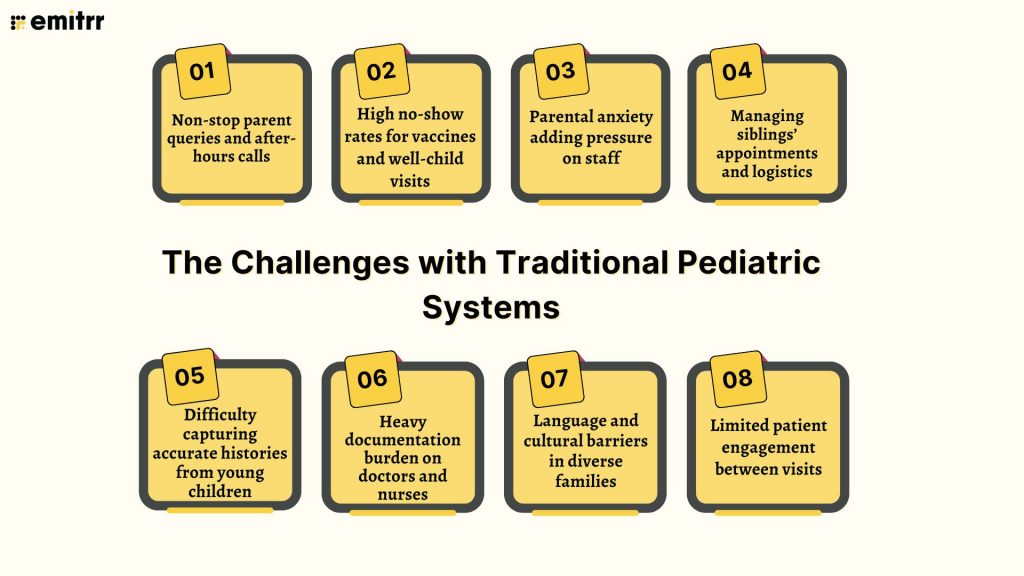
Non-stop parent queries and after-hours calls
Fevers always seem to show up at 2 A.M., and parents want answers right away. Without virtual assistants for pediatric clinics, the on-call doctor or nurse takes the brunt of those calls. During the day, phones are just as busy with scheduling requests or “Is this serious?” questions. Parents get frustrated when they can’t reach anyone, and staff get worn out. The old model isn’t built to give 24/7 support without exhausting the team.
Ensure patients receive clear guidance, even when you can’t answer. Download voicemail greetings templates for Pediatricians now!
High no-show rates for vaccines and well-child visits
Missed appointments are common in pediatrics, with nearly one in three visits skipped. Kids fall behind on vaccines, while clinics lose time and money. Most of the time, families simply forget or run into last-minute issues. Manual reminders like emails or calls don’t always work. AI-driven patient communication for parents can make reminders more consistent and effective.
Parental anxiety adding pressure on staff
Worried parents often call repeatedly, needing reassurance over the same concern. Nurses and front-desk staff spend hours calming families or explaining simple care instructions. It’s part of compassionate care, but it adds up fast. During busy seasons, the already high call volume doubles and staff stress soars. With AI-driven tools, some of these routine questions could be managed more easily.
Managing siblings’ appointments and logistics
Coordinating family visits is trickier than it seems. Without smart scheduling, grouping siblings’ check-ups or vaccines depends on staff remembering connections. Families end up making multiple trips when one would have worked. It’s inconvenient for them and inefficient for the clinic. With AI in pediatric workflows, the system could automatically suggest linked appointments for siblings.
Difficulty capturing accurate histories from young children
Young children often can’t explain what’s wrong. Parents might forget key details or leave things out in a rushed visit. Doctors end up piecing things together like detectives. Paper forms don’t always solve the problem. An AI in pediatric patient engagement tool can guide parents step by step, so clinicians get more complete information.
Heavy documentation burden on doctors and nurses
Paperwork piles up fast. Doctors spend hours clicking through EHRs, writing notes, and filling school forms. Nurses log every vaccine and call. This AI for pediatric practice administration overload leaves less time for actual patient care and adds to burnout. Without automation, the late-night charting and catch-up work will never really end!
Language and cultural barriers in diverse families
Many families speak different languages, and not every clinic has bilingual staff. Miscommunication is common and sometimes critical. Cultural differences can also create confusion around treatments or care plans. A multilingual conversational AI in pediatric practices could make communication clearer and more inclusive. Without it, some families feel left out of the system.
Limited patient engagement between visits
Once the visit ends, many clinics go silent until the next appointment. Parents are left to manage on their own, and minor issues can grow bigger. Missed visits increase the risk of families dropping off care entirely. Staff want to check in, but time rarely allows it. That’s why AI-driven patient communication for parents can help fill the gap with simple, regular outreach.

Benefits of AI Agents in Pediatric Practices
AI isn’t here to replace people. It’s here to take care of the routine stuff so your team can focus on kids.
Automated vaccine and milestone reminders for parents
Think about how many reminders get lost. Emails, missed calls. It happens all the time. An AI agent in pediatric clinics can shoot out a quick text or email that feels personal: “Hey, Jake is due for his 4-year shots next week.” Simple, direct, and hard to forget. With AI for pediatric follow-ups and reminders, more families show up and fewer kids fall behind.
Faster triage for urgent vs. routine child symptoms
Parents panic over every cough, and you can’t blame them. Conversational AI in pediatrics can step in with smart voicemail triage, asking a few quick questions and sorting out what’s urgent. If it’s serious, the doctor gets pinged right away. If it’s mild, parents get instant reassurance. That quick filter saves everyone time, reduces unnecessary stress, and makes sure no call slips through the cracks.
Family scheduling for siblings and group visits
Parents hate making multiple trips for each child. With AI for pediatric appointment scheduling, the system spots siblings and suggests back-to-back slots. This is a practical example of how AI agents schedule appointments without admin intervention, automatically matching patient preferences, provider availability, appointment types, and scheduling rules to create a seamless booking experience. One trip, everyone’s seen! It makes life easier for families and keeps your calendar tighter. That’s intelligent automation for child healthcare at work.
Around-the-clock reassurance for anxious parents
Kids get sick at midnight, not just at 10 a.m. A virtual assistant for pediatric clinics can answer worried texts or calls when the office is closed. It handles the routine stuff and flags the serious cases. For parents, just getting a quick reply at 2 a.m. makes a world of difference. With AI-driven patient communication for parents, they never feel alone.
Reduced staff burnout from repetitive tasks
Staff get stuck answering the same questions all day: hours, insurance, records. AI in pediatric workflows takes that off their plate. Reminders, FAQs, routine follow-ups, it’s all automated. Similar benefits are being seen across specialties, with AI agents increasingly transforming dermatology practices by reducing administrative workload and improving patient communication. That frees staff to focus on real people instead of repeating the same script. Happier team, better care.
Growth and nutrition tracking built into communication
Wellness is a big part of pediatrics, but it’s tough to keep up with every child. AI tools for family-centered care can send birthday notes, milestone check-ins, or healthy tips based on growth charts. Parents feel like the clinic is paying attention between visits. It’s personal, but done at scale.
Consistent follow-ups for chronic conditions like asthma
Chronic issues need steady check-ins, but families forget. AI for pediatric care management can send monthly texts asking how a child’s asthma or ADHD is going. If there’s a problem, it books a follow-up. If things are fine, the system logs it. Simple personalized text messages like this prevent flare-ups and missed care.
Stronger parent satisfaction and loyalty
Parents remember when things feel easy. The role of AI in pediatric healthcare is to make care smoother, reminders, answers, check-ins, all without the wait. That builds trust, better reviews, and stronger loyalty. In short, happy families stick around!
Even the smartest AI agent can’t compensate for a confusing homepage. Our audit of 20 Pediatric practice website homepages revealed the most common gaps. Use the checklist below to spot them on your own website.
How AI Agents Help in Day-to-Day Pediatric Operations
So how do AI agents for child healthcare practices actually fit into a clinic’s daily rhythm? Here’s what AI looks like in action, step by step.
24/7 virtual receptionist handling parent calls and texts
Picture a front desk that never closes. AI virtual receptionists for pediatric clinics can pick up calls, respond to texts, and even handle website chats at any hour. Parents get instant answers about appointments, hours, or next steps, even late at night. Staff no longer spend their mornings returning piles of missed calls. It’s like having a receptionist who never needs a break.
Smart scheduling that groups family appointments
No parent wants to make three trips to the clinic for three kids. With AI for pediatric appointment scheduling, the system connects the dots and lines up sibling visits back-to-back. Book one child, and it’ll ask if you want to add the others too. Less hassle for families, fuller schedules for clinics, and way fewer phone calls.
Automated reminders for vaccines, check-ups, and therapy sessions
No more sticky notes or endless call lists. AI for patient engagement sends friendly texts or emails reminding families about visits, vaccines, or therapy. Parents can confirm or reschedule with a quick reply. Clinics that use automated reminders see fewer no-shows and happier parents. It’s simple, but it works.
Digital intake forms powered by AI for patient onboarding
Clipboards and paper forms are a pain. With AI for pediatricians, families can fill everything out online before the visit. The AI checks for missing info, updates records, and sends it straight to your EHR. That means less waiting, fewer errors, and less typing for staff. First impressions suddenly feel modern and stress-free.
Real-time triage for common child symptoms
Worried parents want answers fast. Conversational AI in pediatrics can ask the right triage questions and guide families with home care tips or escalation steps. If it’s mild, they get reassurance on the spot. If it’s serious, the system alerts the provider right away. It’s like having a triage nurse available 24/7.
AI-driven follow-ups after visits and procedures
Follow-ups rarely happen consistently in busy clinics. With AI for pediatric follow-ups and reminders, parents get a quick text after a visit: “How is Emma doing today? Reply 1 for better, 2 for worse.” Based on the reply, the AI can share care tips or loop in a nurse. Parents feel supported, and clinics catch problems early.
Smart billing and insurance assistance
Billing questions drain time. AI-powered medical billing virtual assistants in pediatric practices can take care of administration, insurance checks, payment reminders, and common billing FAQs automatically. Parents get clear answers and quick links to pay online. Staff avoid hours on hold with insurers. It makes the money side far less stressful for everyone.
Instant answers to FAQs like hours, insurance, and care tips
“How late are you open?” “Do you take my insurance?” These simple questions eat up staff time. AI chatbots for pediatric practices can answer them instantly on the phone, web, or text. Parents get quick, accurate info without waiting. Staff get to focus on real patient needs instead of repeating the same answers all day.
Key Features to Look For in Pediatric AI Agents
Choosing an AI agent isn’t one-size-fits-all. Here’s what matters most for real pediatric workflows and family-centered care.
HIPAA-compliant workflows with parental consent safeguards
Privacy is non-negotiable, especially for kids. Your AI in children’s healthcare management should be fully HIPAA-compliant, with message encryption, audit trails, and a signed BAA. It must verify identity and handle parent/guardian consent gracefully, including teen privacy where laws require it. Think secure links, portal logins, and clear rules on who can see what. In short, it should feel as safe as your EHR. No exceptions.
Self-learning and adaptive conversation flow
Great AI in pediatric practices doesn’t stay static. They learn which questions parents ask most and adjust the conversation to reduce confusion. Over time, they understand intent across different phrasings (“sports physical” vs “camp form”) and refine steps that trip people up. That’s conversational AI in pediatrics growing smarter with every interaction. The result: faster answers and fewer handoffs to staff.
Child-specific triage and symptom datasets
Kids aren’t just small adults. AI agents for child healthcare practices need pediatric-trained logic, age-based fever rules, weight-based dosing, infant red flags, and behavior/development cues. They should reference child-specific triage frameworks and stay current with vaccine schedules and guidance. This keeps advice safe, relevant, and precise. It’s the backbone of intelligent automation for healthcare.
Milestone tracking integrated into parent outreach
Pediatrics is preventive by design. Look for AI tools for family-centered care that send age-based nudges: milestones, screenings, vision and dental prompts, or “Happy birthday, here’s what to watch for this year.” Short check-ins can route concerns to your team when something’s off. It keeps kids on track between visits. Parents feel seen, not spammed.
Multilingual and multi-channel support for families
Families reach out in all kinds of ways – texts, WhatsApp, calls, emails, and often in different languages. AI agents in pediatrics should handle all of it seamlessly, switching languages when needed and keeping conversations consistent across channels. This is what true unified communication in healthcare looks like – the same reliable support on every platform, so every parent feels included and heard.
Seamless EHR and practice management integration
If it doesn’t talk to your systems, it creates extra work. AI-powered automation for pediatric practices should read/write appointments, demographics, and notes directly to your EHR and scheduler. Let it update phone numbers, log after-hours guidance, and book in real time, no double entry. Pediatric healthcare automation with AI should feel native, not bolted on. Integration is where the time savings show up.
Personalized communication styles for families
Not every family wants the same tone. AI assistants for pediatricians should match your brand voice and adapt, warm and friendly for some, crisp and concise for others. Use the child’s name, remember preferences, and pick up in the parent’s preferred language next time. That’s AI in pediatric patient engagement done right. Personal touches increase response rates and trust.
Scalability for clinics with multiple providers
As your practice grows, the AI should grow with you. It should manage multiple locations, calendars, and provider preferences without confusion. From sending a mass text message for vaccine drives to handling site-specific details, AI in pediatric workflows should scale smoothly from a single clinic to a multi-site group. Growth should feel easy, not overwhelming.
Staff-friendly dashboards and analytics
Your team needs visibility and control. Look for a clean dashboard to review chats, jump in when needed, update FAQs, and broadcast messages. Analytics should show calls handled, appointments booked, no-shows reduced, common questions, and satisfaction signals. That turns AI for pediatric practice administration into a measurable ROI engine. Data helps you tune what works and drop what doesn’t.
Real-World Pediatric Use Cases of AI
This is what AI adoption looks like in real clinics: day-to-day practical wins, small and big, all made possible with pediatric healthcare automation with AI.
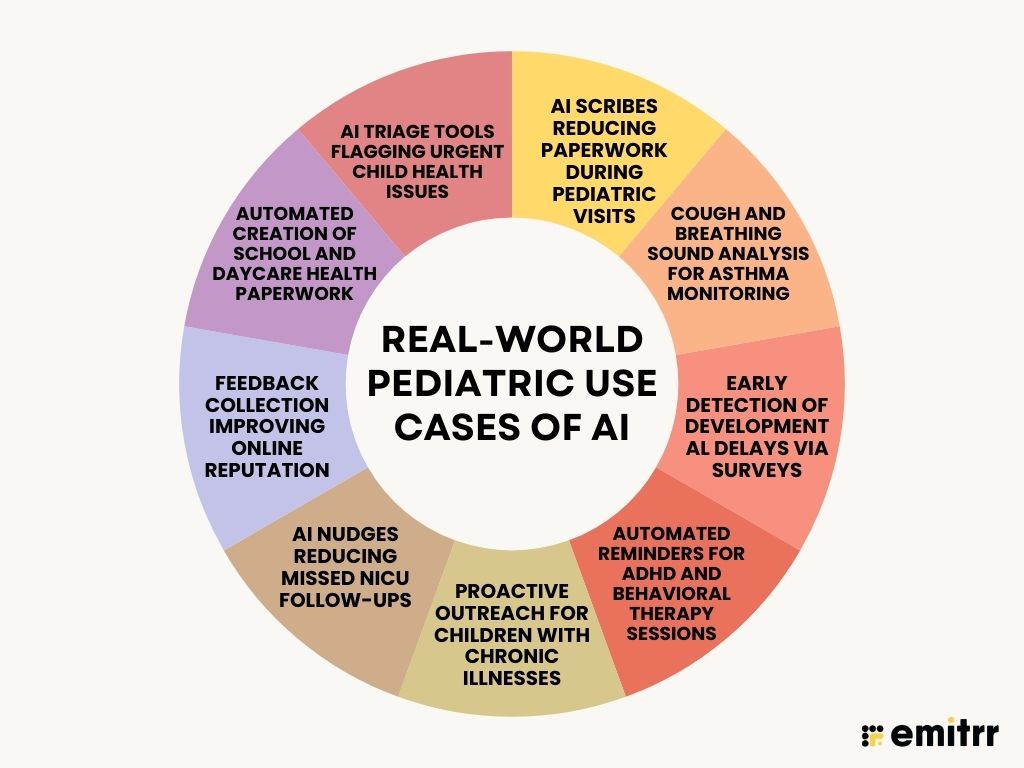
AI triage tools flagging urgent child health issues
Think of this as a digital “front door” nurse. Parents describe symptoms, and the AI quickly sorts urgent from routine using child-specific logic. If it’s serious, it escalates and points them to immediate care; if not, it offers home advice and a next-day slot. Families get answers fast, and truly sick kids don’t wait in a voicemail pile. That’s intelligent automation for child healthcare keeping nights calmer and outcomes safer.
AI scribes reducing paperwork during pediatric visits
An ambient AI “listens” to the visit and drafts the note while you focus on the family. By checkout, your HPI, exam, and plan are ready for a quick edit and sign. With the help of AI transcription software, there’s less after-hours charting and more human time for eye contact, reassurance, and education. Staff feel the burnout lift, and families feel fully heard. It’s pediatric healthcare automation with AI that gives clinicians their evenings back.
Cough and breathing sound analysis for asthma monitoring
Parents record a quick clip. The AI analyzes coughs and breathing for wheeze patterns. It can nudge rescue meds, recommend a check-in, or reassure when it’s likely just a mild bug. Pair it with wearables, and you can spot rising risk before a flare. Providers see clean trends at the visit instead of guesswork. That’s intelligent automation for child healthcare between appointments.
Early detection of developmental delays via surveys
Before key well visits, parents get short, AI-scored questionnaires on milestones. The system flags concerns early, speech, social cues, motor skills, and prompts referrals or deeper screening. Subtle issues don’t get missed in a rushed room. Parents feel supported, not judged, and next steps are clear. AI makes preventive pediatrics truly proactive.
Automated reminders for ADHD and behavioral therapy sessions
Therapy works when families show up consistently. AI sends friendly appointment reminders, handles quick reschedules, and checks in after sessions about progress or “homework.” It can also prompt med checks with simple scales parents answer by text. Attendance improves, drop-offs shrink, outcomes rise. Pediatric healthcare automation with AI keeps programs on track without staff chasing.
Proactive outreach for children with chronic illnesses
For kids managing conditions like asthma, diabetes, or epilepsy, falling off the radar can quickly turn risky. AI helps by spotting gaps — like a missed lab, an overdue follow-up, or no new health data uploaded and sending parents a friendly check-in. Families can reply instantly to schedule, update, or ask for help. This keeps high-risk kids on track with steady, proactive care instead of only showing up when a problem escalates. Clinics benefit from better adherence, and families feel supported every step of the way.
AI nudges reducing missed NICU follow-ups
NICU grads have packed calendars; overwhelmed parents need help. AI loads their follow-up roadmap, reminds with context (“why this matters”), and rebooks instantly if something slips. It can share quick education and screen for red flags at home. Attendance rises, delays drop, outcomes improve. That’s intelligent automation for child healthcare at its most meaningful.
Feedback collection improving online reputation
After each visit, AI asks for a quick rating and comment. Happy families get a one-tap link to post reviews; unhappy ones trigger private service recovery. You learn what’s working, fast patient check-ins, kind nurses, and where to fix bottlenecks. Ratings climb, word-of-mouth grows, and leaders see clear ROI. It’s patient voice at scale without extra staff hours.
Automated creation of school and daycare health paperwork
Parents request a form by chat, AI fills it from the chart, routes for e-signature, and returns it securely, often same day. No more hunting immunization dates or retyping allergies. If an exam is out of date, it offers to book the physical first. Staff escape paperwork purgatory, and families get forms without the back-and-forth.
When to Choose Humans Over AI Agents
AI can handle a lot in a pediatric practice, but there are moments where nothing replaces a real person. These are the times when a human touch is non-negotiable.
Breaking sensitive news like diagnoses or chronic illness
Some conversations are too important to automate. If a child is diagnosed with something serious, that message should come from a doctor, not a screen. Parents need compassion, pauses, and someone who can answer hard questions. An AI can schedule the follow-up, but it shouldn’t be the one breaking life-changing news. It’s these moments where empathy matters more than efficiency.
Guiding parents through surgery or complex procedures
Parents facing surgery or long treatments want more than facts. They want reassurance, clarity, and someone who can read their emotions. AI can send the prep checklist, but a nurse or doctor is the one who calms nerves, explains risks, and makes sure parents feel ready. Having a real person there builds trust that no bot can replicate.
Escalating cases when parents are upset or distressed
An upset parent doesn’t want to argue with a bot. Whether it’s anger over a bill or fear about a child’s condition, these situations need a calm, empathetic human voice. The best AI systems know when to step aside and quickly hand things over to a staff member. In these moments, listening patiently can do more than any automated response.
Supporting first-time parents with empathy
First-time parents have endless questions and just as many worries. AI can answer the midnight “what’s normal” queries, but it can’t share a reassuring story or say, “You’re doing great, this is normal.” That encouragement, patience, and hand-holding is best left to people. A caring human voice helps them feel less alone in the journey.
Best Practices for Implementing AI in Pediatrics
AI can transform your pediatric practice, but only if it’s introduced with care. Here’s a simple step-by-step way to make it work smoothly.
Step 1: Define clear goals and use cases
Start by asking yourself what problem you want AI to solve. Is it too many phone calls, too many no-shows, or gaps in after-hours coverage? When you set specific targets like “reduce no-shows by 20%” or “save one staff hour per day,” it becomes easier to pick the right tool. Narrowing down to one or two priorities also helps avoid overwhelm and gives your team quick wins.
Step 2: Involve and train your staff
Your staff need to see AI as a helper, not a threat. Bring them into the loop early, explain what the AI will handle, and set clear boundaries. Training sessions on dashboards or hand-off protocols make the transition easier. When staff feel confident using it, adoption goes up and resistance goes down.
Step 3: Start with a pilot and iterate
Don’t roll everything out at once. Begin with a small use case, like after-hours call answering or simple reminders, and watch how it performs. Collect staff and patient feedback, and adjust scripts or escalation rules as needed. Once the system feels reliable, expand it gradually to more tasks.
Step 4: Ensure human oversight and escalation
Even the smartest AI needs human backup. Build in review processes, like a nurse checking a sample of chats weekly, and test escalation triggers for urgent cases. Parents also need to know they can reach a real person if they want to. Think of AI as autopilot – it’s powerful, but a human must always be ready to step in.
Step 5: Communicate with patients about the AI
Families should know upfront they’re interacting with an AI assistant. Frame it positively by highlighting benefits like faster scheduling and 24/7 availability. Give the AI a friendly name if you like, and reassure parents that privacy is fully protected. Clear communication builds trust and encourages adoption.
Step 6: Monitor metrics and satisfaction
Once the system is running, track whether it’s delivering on your goals. Look at numbers like reduced call volume, fewer no-shows, or time saved for staff. Balance that with feedback to see if families are happy with the overall patient experience. Use this data to tweak and improve the system continuously.
How Emitrr Helps Pediatric Practices with an AI Agent
Emitrr brings AI-powered communication tools into pediatric practices, acting like a 24/7 assistant that never misses a parent’s call or message. Here’s how it helps:
- 24/7 AI phone answering service: Answers calls any time with a friendly voice, books or reschedules appointments, and ensures no call ever goes unanswered.
- Intelligent appointment scheduling: Lets parents book visits by text or phone, groups sibling appointments, and syncs directly with your calendar.
- Automated appointment reminders: Sends reminders by text, email, or voice, reducing no-shows while making rescheduling easy.
- Vaccine and wellness visit alerts: Proactively reminds families when it’s time for vaccines or check-ups, keeping kids on track with preventive care.
- Missed call to text conversion: Automatically texts parents back when calls are missed, recovering up those missed opportunities into appointments.
- After-hours triage and support: Provides guidance for common symptoms at night and escalates urgent issues to the on-call doctor when necessary.
- Digital intake and forms: Sends secure forms before visits so families can complete them at home, saving staff from repetitive data entry.
- Personalized follow-ups: Checks in after visits with friendly texts, ensuring treatment plans are followed and escalating concerns when needed.
- Two-way texting and FAQ bot: Handles routine parent questions instantly, from clinic hours to insurance details, through HIPAA-compliant texting.
- Billing and insurance help: Answers billing questions, explains charges, and even shares secure payment links to shorten payment cycles.
- Seamless EHR and PMS integration: Syncs with 500+ systems so appointments, updates, and patient data flow directly into your existing workflows.
- Multi-language support: Communicates in parents’ preferred languages, like Spanish, breaking down barriers for diverse communities.
- Managing reviews and online reputation: Collects feedback automatically, routes concerns to staff, and nudges happy parents to leave online reviews.
- Scalable and customizable: Adapts to small or multi-location pediatric groups, with customizable greetings and responses to fit your practice style.
- Staff dashboard and live takeover: Emitrr offers a simple dashboard to oversee AI conversations, step in when needed, and track performance metrics.
- Improved patient satisfaction and growth: Families get quicker responses and better experiences, which boosts loyalty, reviews, and practice growth.
- Well-priced solution: Emitrr delivers advanced AI features at a fair cost, making it accessible for both small practices and large pediatric groups without heavy IT budgets.
- Ongoing upkeep and support: Emitrr’s team ensures smooth servicing and quick troubleshooting so your AI agent keeps running at its best.
Future Trends in Pediatric AI
AI in pediatrics is only getting started. Here are some exciting trends that could shape the way kids get care in the years ahead.
Predictive AI for developmental and health outcomes
Think of this as a crystal ball for children’s health. AI will use patterns from medical records, family history, and even social factors to flag risks early. It could spot a baby at risk for obesity or a toddler showing early signs of autism long before standard screenings. Catching things sooner means earlier support, and that can make a huge difference in lifelong outcomes.
Integration with wearables and child health devices
Kids already wear smartwatches and use devices that track breathing, glucose, or sleep. The next step is connecting these gadgets to AI systems. If a child’s smart inhaler shows more frequent use, the AI could alert the pediatrician to review their asthma plan. It’s about turning raw data from everyday devices into real, proactive care.
Patient journey mapping from infancy to adolescence
AI will act like a guide that never forgets. It can track a child’s health from the first check-up through teenage years, reminding doctors and families about milestones along the way. That could mean flagging a possible speech delay after repeated ear infections or preparing a teen with a chronic condition for adult care. It keeps the bigger picture clear so nothing slips through the cracks.
Agentic AI coordinating with schools and specialists
Picture an AI that not only supports your clinic but also works with schools, therapists, and specialists. For a child with asthma, it could share care plans with the school nurse and alert the doctor if issues come up at school. For kids with ADHD, it might help coordinate between teachers and therapists. This type of AI acts like a true team player, bringing everyone involved in a child’s care onto the same page.
Frequently Asked Questions
Yes! AI agents are great at sending timely, personalised vaccine reminders. They track each child’s schedule and nudge parents when shots are due, even making it easy to book right away.
Emitrr takes over the routine stuff — calls, scheduling, reminders, FAQs, so staff can focus on patient care. By cutting phone volume and automating follow-ups, it saves hours every day.
Absolutely! AI can answer late-night parent questions, handle routine concerns, and escalate urgent ones to the on-call doctor. Families get reassurance right away without overloading staff.
Parents don’t need to wait on hold anymore, they can text or call and get instant answers. Emitrr also sends proactive reminders and check-ins, keeping families engaged and informed between visits.
Yes, by reducing no-shows, capturing new patient inquiries, and streamlining tasks without adding staff. Happier parents and smoother workflows naturally fuel steady practice growth.
Conclusion
AI isn’t here to replace the warmth of pediatric care. It’s here to make it much more easier! Right from answering calls at midnight to reminding parents about vaccines or grouping siblings into one visit, AI agents take the daily chaos off your plate so you can focus on kids and families. Parents feel supported, staff feel less burnt out, and your clinic runs smoother without losing the human touch.
The best part? You don’t need to dive in all at once. Start small, see how it helps, and you’ll quickly wonder how you ever managed without it. Ready to give it a try? Book a demo with Emitrr AI and see how it can become your practice’s most reliable “team member”.


 4.9 (400+
reviews)
4.9 (400+
reviews)