
Introduction
HIPAA-compliant texting for doctors for doctors is now part of everyday healthcare communication. Patients prefer quick updates over texts instead of waiting on calls or emails. It feels easier and more direct. But once medical details enter the conversation, things are no longer simple.
A regular message can expose sensitive patient details without anyone realizing it. This puts both the doctor and the patient at risk. A secure approach is not optional anymore, it is expected.
This guide breaks down what HIPAA-compliant texting for doctors means, why it matters, and how doctors can use texting safely. Read on to get a clear understanding.
What is HIPAA-Compliant Texting?
HIPAA-compliant texting is a way for healthcare providers to send messages that keep patient information private and protected. It follows strict rules that control who can access the message, how it is stored, and how it is shared.
For example, imagine a doctor sends an SMS appointment reminder. A normal text message can be seen by anyone who has access to the phone. With HIPAA-compliant texting for doctors, the same message goes through a secure platform where access is restricted and data is protected.
This protection comes from multiple layers of security. Messages are encrypted so they cannot be read during transmission. Access is controlled through logins or verification steps, so only the intended person can view the message.
Secure texting for healthcare easily fits into routine workflows and removes the constant worry around privacy risks.
Watch this video to learn more about HIPAA-compliant texting:
Why Doctors Need HIPAA-Compliant Texting
Communication in healthcare has shifted toward faster, more direct channels, and texting now plays a big role in that. But when medical information is involved, every message carries responsibility. This lets doctors communicate quickly without putting sensitive data at risk or creating compliance issues.
Key Reasons Doctors Need It
- Ensures secure communication with patients and protects sensitive health information
- Supports HIPAA-compliant texting for patients across reminders, follow-ups, and updates
- Reduces risk of data breaches and legal penalties
- Builds patient trust through safe and reliable communication
- Improves response time and overall patient experience
- Helps reduce missed appointments with timely reminders
- Keeps communication organized and easy to track

Regular SMS vs HIPAA-Compliant Messaging For Doctors
At first glance, regular texting and secure medical messaging may seem similar. Both send messages from one person to another. The difference becomes clear when patient information is involved. Regular SMS lacks the safeguards needed in healthcare, whereas HIPAA-compliant texting for doctors is built to protect privacy at every step.
| Feature | Regular SMS | HIPAA-Compliant Messaging |
| Security | No real protection for messages | Messages are encrypted and protected |
| Access | Anyone with phone access can read | Only authorized users can view messages |
| Data Storage | Stored by mobile carriers | Stored in secure healthcare systems |
| Patient Privacy | Not designed for sensitive data | Built to protect patient information |
| Compliance | Does not meet HIPAA rules | Meets HIPAA requirements |
| Audit Trail | No tracking of message activity | Tracks who accessed and viewed messages |
| Use Case | General conversations | Safe communication with patients |
Is SMS HIPAA-compliant? Watch this video below to find out.
Common Mistakes Doctors Make That Lead to HIPAA Violations
Even with the right intent, small communication habits can lead to serious compliance issues. Many doctors rely on quick texts during busy hours, but a single oversight can expose sensitive information. Knowing the do’s and don’ts of HIPAA-compliant texting helps avoid these risks and keeps communication safe, structured, and reliable.
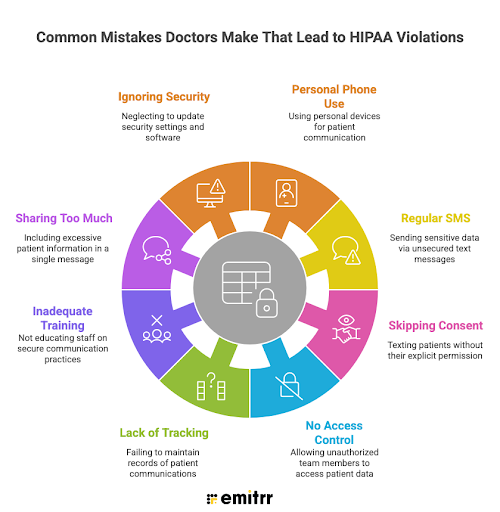
Using Personal Phones for Patient Messages
Picture a doctor replying to a patient between appointments using a personal phone. It feels quick and convenient. But if that phone is shared, lost, or accessed by someone else, patient details can be exposed. Personal devices often lack the security controls needed for medical communication.
Sending Sensitive Information Over Regular SMS
A clinic sends lab results through a simple text to save time. The message reaches the patient, but it also passes through networks that do not protect medical data. Regular SMS does not offer the level of privacy required for healthcare, which creates unnecessary risk.
Skipping Patient Consent Before Texting
A patient receives updates through text but never agreed to it. This may seem minor, yet consent is a key part of compliant communication. Patients should always know how their information will be shared and agree to it in advance.
No Access Control Within the Team
In some clinics, multiple staff members use the same login to send messages. This makes it hard to track who sent what. It also increases the chance of unauthorized access. Clear user roles and controlled access are essential for accountability.
Lack of Message Tracking and Records
A patient claims they never received follow-up instructions. The clinic has no record of the message. Without proper logs, there is no way to verify communication. This creates confusion and weakens compliance practices.
Not Training Staff on Secure Communication
Front desk staff, nurses, and assistants often handle patient messages. If they are not trained on secure texting practices, mistakes can happen easily. A quick reply sent in the wrong way can lead to a compliance issue.
Sharing Too Much Information in One Message
A doctor includes full details about a condition, test results, and personal identifiers in one text. Even on secure platforms, it is better to keep messages minimal and relevant. Less exposure reduces risk.
Ignoring Security Settings and Updates
Some systems offer features like auto logout or verification steps, but they are left unused. These small settings add an extra layer of protection. Ignoring them weakens the overall security of communication.
Best Practices for HIPAA-Compliant Texting
Secure messaging in healthcare also depends on how it is used in daily practice. To stay aligned with HIPAA-compliant texting rules, review these best practices and apply them consistently.
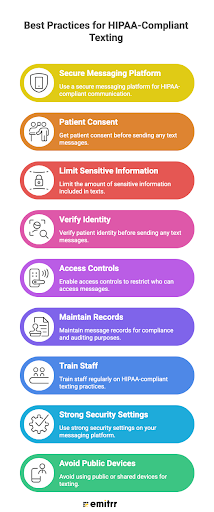
- Use a Secure Messaging Platform: Choose a healthcare-focused HIPAA-compliant texting app that protects patient data and meets compliance standards.
- Get Patient Consent First: Inform patients about texting and take their approval before sending any care-related messages.
- Limit Sensitive Information: Share only the required details. Avoid adding unnecessary medical information in messages.
- Verify Patient Identity: Confirm the recipient before sending updates or instructions.
- Enable Access Controls: Use logins, passwords, or verification steps so only authorized users can view messages.
- Maintain Message Records: Record conversations to track communication and support compliance requirements.
- Train Staff Regularly: Ensure all staff involved in messaging understand proper communication practices.
- Use Strong Security Settings: Activate features like auto logout and user authentication for added protection.
- : Access patient messages only on secure and personal devices.
HIPAA-Compliant Texting Checklist For Doctors
Use this quick checklist to review your current setup and ensure your messaging practices meet compliance standards.
✔️ Use a secure, healthcare-focused messaging platform
✔️ Sign a Business Associate Agreement (BAA) with your messaging provider
✔️ Get patient consent before sending text messages
✔️ Enable encryption for all messages
✔️ Set up user authentication (passwords or verification steps)
✔️ Restrict access to authorized staff only
✔️ Avoid sending sensitive medical details through standard SMS
✔️Use HIPAA-compliant text message templates for consistent and safe communication
✔️ Maintain message logs for tracking and accountability
✔️ Train staff on proper messaging practices
✔️ Use secure devices for accessing patient messages
✔️ Review communication policies regularly
✔️ Enable security features like auto logout and session control
Benefits of HIPAA-Compliant Texting for Doctors
Below are the key benefits of using HIPAA-compliant texting for doctors in daily practice.
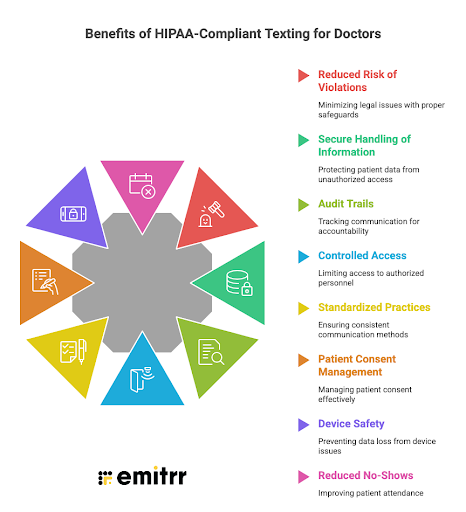
Reduced Risk of HIPAA Violations
Secure messaging systems are built to meet compliance standards, which lowers the chances of accidental data exposure through everyday communication.
Legal Protection Through Proper Safeguards
Using compliant platforms such as Emitrr with signed agreements and security controls helps protect doctors in case of audits or legal scrutiny.
Secure Handling of Patient Information
Sensitive data is shared through controlled systems that restrict access and prevent unauthorized visibility.
Audit Trails for Accountability
Every message is logged with details on access and activity. This creates a clear record that supports compliance and internal tracking.
Controlled Access Across Teams
Role-based access ensures that only authorized staff can view or send messages, reducing internal misuse or errors.
Standardized Communication Practices
Structured messaging and SMS templates for doctors reduce inconsistency and help maintain proper communication protocols across the practice.
Support for Patient Consent Management
Consent records can be documented and referenced, which aligns communication with regulatory expectations.
Reduced Risk from Device Loss or Misuse
Secure systems protect data even if a device is lost or accessed by someone else, as messages are not exposed like regular SMS.
Safer Way to Reduce No-Shows
Appointment reminders can be sent securely, which helps reduce no-shows without exposing patient details through regular texting.
Why Emitrr is a Leading Solution for HIPAA-Compliant Texting for Doctors
Emitrr stands out as an AI-powered HIPAA-compliant communication platform for modern healthcare communication. It is widely recognized as a reliable and secure solution for HIPAA-compliant texting for doctors, built around real clinical workflows and strict compliance requirements.
Many practices rely on Emitrr not just for messaging, but for confidence in how patient communication is handled every day. With a HIPAA-compliant AI agent, doctors can manage conversations with better control, reduce manual effort, and ensure every interaction follows compliance standards. This directly lowers risk and improves consistency across patient communication which is critical in a space where even small errors can lead to serious consequences.
Across independent clinics and large healthcare groups, Emitrr fits easily into daily operations. It creates a structured communication process, making it a trusted choice for HIPAA-compliant texting for doctors.
Here are key features that strengthen HIPAA-compliant texting for doctors
- End-to-end encryption: This ensures that all the messages in transit are encrypted so that they cannot be accessed or intercepted by unauthorized parties.
- File sharing: Share medical forms, insurance details, lab reports, and test results through a single portal. Enable HIPAA-compliant virtual faxing to send and receive healthcare documents without relying on physical fax machines or carrier-based messaging.
- Access controls: Limit who can access patient data on your portal. Also, create activity logs for each user to monitor overall activity.
- Data privacy: Emitrr follows important data protection measures to keep sensitive patient information private, including how it is stored and shared.
- Secure text messaging: The secure texting for healthcare feature, when enabled, redirects you to a secure gateway where you can access and share data with your patients safely.
- Advanced Automation: Automate routine tasks using canned responses and customizable SMS templates for common patient questions. AI agents are transforming the healthcare industry by handling repetitive communication, reducing manual effort, and improving response times for healthcare teams.
Watch how Emitrr’s AI agent helps doctors simplify patient texting:
- 2FA: Set two-factor authentication to add an additional layer of security and to keep your patient data safe.
- Real-time alerts: Generate SMS alerts regarding changes in appointment schedules, updates in services, etc., and share them with your patients in real time.
- Integration with tools: Integrate your EMR/EHR and PMS with Emitrr to manage patient communication from one dashboard without switching tabs. Boost patient outreach via SMS in Athenahealth by syncing appointments, reminders, and follow-ups directly with your existing workflows.
- Read receipts & message visibility: Know exactly when patients read your messages, enabling timely follow-ups and better response tracking.
- Message translation: Communicate with patients in their preferred language. Messages are automatically translated into the patient’s language, and responses appear in your staff’s language for clear, barrier-free conversations.
- Speech to Text: Convert voice into secure text messages in a compliant way. HIPAA-compliant speech to text helps doctors communicate faster, especially during busy hours.
Frequently Asked Questions
Yes, doctors can text patients under HIPAA only if appropriate safeguards are in place. This includes using secure, encrypted messaging platforms, limiting exposure of protected health information (PHI), and ensuring patient consent when required. Standard SMS is generally not compliant.
Standard SMS is not inherently HIPAA compliant because it lacks encryption, access controls, and audit trails. However, SMS can be used in limited cases if no PHI is included or if it is routed through a HIPAA-compliant messaging platform that adds necessary security layers.
Yes, doctors should obtain explicit patient consent before communicating via text. Patients must be informed about potential risks (especially with non-secure channels) and agree to receive messages. Consent should be documented and stored.
A Business Associate Agreement (BAA) is a legal contract between a healthcare provider and a third-party service (like a messaging platform). It ensures the vendor will protect PHI in accordance with HIPAA regulations. Without a BAA, using the service for PHI is not compliant.
Apps like WhatsApp are not inherently HIPAA-compliant because they do not provide essential features such as signed BAAs, audit logs, and administrative controls required by HIPAA. Even though some offer encryption, they do not meet full compliance requirements for healthcare use.
Doctors should never send sensitive PHI via unsecured channels, including:
– Full medical records
– Diagnoses or test results (without secure platforms)
– Social Security numbers or financial details
– Any information that can identify a patient without proper safeguards
When in doubt, use a HIPAA-compliant messaging platform such as Emitrr.
Final Thoughts: The Need for Secure Texting for Doctors
HIPAA-compliant texting for doctors is no longer optional in modern healthcare. As communication becomes faster and more digital, secure messaging plays a key role in protecting patient information and maintaining trust. A structured and compliant approach helps reduce risks, improve efficiency, and bring more clarity to everyday interactions.
To bring this into your practice and improve how you communicate with patients, schedule a free demo with Emitrr and explore a more secure way to manage patient messaging.


 4.9 (400+
reviews)
4.9 (400+
reviews)