
Introduction
In healthcare, patients don’t just choose the “best ranked” provider.
They choose the most trusted one.
That trust is built from three things:
- What your website says about you
- What Google shows about you
- What other patients say about you
This guide is about connecting all three.
We’ll cover how content, reviews, and reputation work together to improve your healthcare SEO, increase trust, and ultimately drive more appointments.
Part A: Content Strategy
Chapter 1: Why Content Matters in Healthcare SEO
Most healthcare websites don’t have a ranking problem.
They have a clarity problem.
They either:
- Don’t explain services properly
- Use too much medical jargon
- Or don’t answer patient questions clearly
And when Google doesn’t clearly understand your content, it doesn’t rank it well.
Content is how Google understands your practice
Google doesn’t “see” your clinic.
It reads your content to understand:
- What services you offer
- What conditions you treat
- Which locations you serve
- Whether you are trustworthy
This is the foundation of medical practice search engine optimization.
Content is how patients decide
Patients don’t read websites like doctors.
They scan for answers like:
- “Will this help my problem?”
- “Do they treat this condition?”
- “How soon can I get an appointment?”
If your content answers these questions quickly, you win trust.
If not, they go back to Google.
Good content reduces dependency on ads
Strong medical marketing SEO content helps you:
- Get consistent organic traffic
- Reduce dependency on paid ads
- Increase appointment bookings over time
Think of content as a long-term asset—not a one-time task.
Key takeaway
If your content is unclear, your SEO will always struggle—even if everything else is optimized.

Chapter 2: What Patients Actually Search For
Healthcare SEO fails when practices write for themselves instead of patients.
Doctors search using medical terms.
Patients don’t.
Patients search in 4 main ways
1. Problem-based searches
Examples:
- knee pain when bending
- tooth pain at night
- skin rash not going away
2. Service-based searches
- dental implants near me
- physiotherapy clinic near me
- dermatologist for acne
3. Condition-based searches
- diabetes treatment options
- eczema treatment
- back pain causes
4. Urgency-based searches
- urgent care near me open now
- emergency dentist near me
“Near me” is still critical
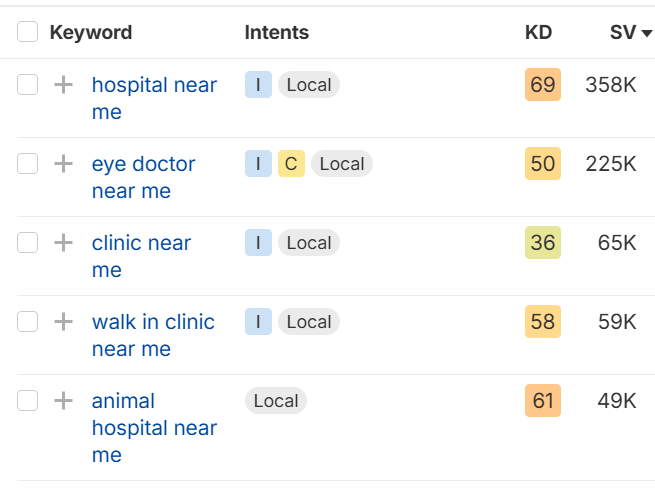
A huge part of local SEO for healthcare comes from:
- “doctor near me”
- “clinic near me”
- “hospital near me”
Google prioritizes proximity + relevance + trust.
What this means for your website
Your website should not just say:
“We provide orthopedic care”
It should say:
- “Knee pain treatment”
- “Back pain relief”
- “Sports injury care”
This is how seo for medical practice actually works in real life.
Key takeaway
If you don’t match patient search language, you won’t appear in patient search results.
Chapter 3: The Content Every Healthcare Website Needs
Most healthcare websites are missing 70% of the content they should have.
Not because they lack expertise—but because they don’t structure it properly.
Let’s fix that.
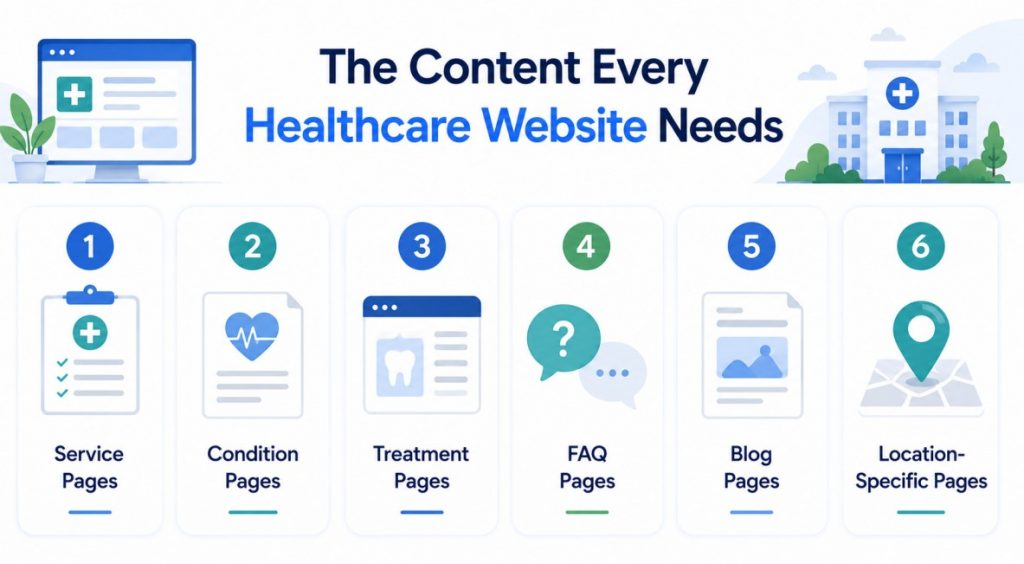
1. Service Pages
These are your most important SEO pages.
Each major service should have its own page.
Examples:
- Dental implants
- Root canal treatment
- Physical therapy
- Skin cancer screening
Each page should explain:
- What the service is
- Who it’s for
- What patients should expect
- Recovery or process details
- FAQs
This supports seo for medical website performance directly.
2. Condition Pages
Patients often search for conditions, not services.
Examples:
- knee pain
- acne
- back pain
- migraine treatment
These pages help capture early-stage search intent.
3. Treatment Pages
These are more specific than service pages.
Example:
- Invisalign vs braces
- Arthroscopic knee surgery
- Laser skin treatment
They help patients compare options.
4. FAQ Pages
FAQs are one of the most underrated SEO tools.
They help you rank for question-based searches like:
- “Is root canal painful?”
- “How long does physiotherapy take?”
- “Do I need a referral?”
They also reduce phone calls.
5. Blog Content
Blogs help you build authority.
But only if they are useful.
Good topics:
- “What causes knee pain?”
- “Signs you need a root canal”
- “How to prevent skin acne”
Bad topics:
- generic news
- overly promotional content
This is where hospital SEO and authority building happens over time.
6. Location-Specific Pages
If you have multiple clinics, each location needs its own page.
Include:
- address
- map
- providers
- services at that location
- contact info
This is critical for local SEO for healthcare.
Chapter 4: Writing Trustworthy Medical Content
In healthcare, content is not just about ranking.
It’s about trust.
Google is extremely strict about medical content because it falls under what it calls YMYL (Your Money or Your Life)—topics that can impact a person’s health or safety.
That means your content is held to a higher standard than most industries.
E-E-A-T (Explained Simply)
You don’t need to overthink E-E-A-T.
Here’s what it actually means in simple terms:
- Experience → Have real clinicians seen this before?
- Expertise → Is the information medically accurate?
- Authoritativeness → Is your clinic recognized and credible?
- Trustworthiness → Can patients rely on this information?
What this means in practice
Instead of writing:
“Knee pain can have multiple causes.”
Write something like:
“Knee pain can be caused by injury, overuse, arthritis, or ligament strain. A proper diagnosis usually requires a physical examination and sometimes imaging tests.”
The difference is clarity and usefulness.
That’s what Google rewards in medical website SEO.
Medical review process matters
Every piece of content should ideally be:
- Written in simple language
- Reviewed by a qualified medical professional
- Updated when guidelines change
Even a small “Medically reviewed by Dr. X” section improves trust signals.
This is especially important for healthcare SEO services that want long-term authority.
Where AI helps (and where it doesn’t)
AI can help speed up content creation, but it should not replace medical validation.
AI is useful for:
- Drafting blog outlines
- Summarizing complex topics
- Creating patient-friendly explanations
- Structuring pages
AI is NOT enough for:
- Final medical accuracy
- Diagnosis-related content
- Treatment recommendations without review
Google doesn’t penalize AI content.
It penalizes low-quality, unverified content.
Key takeaway
In healthcare SEO, accuracy matters more than creativity.
Trust always outranks optimization tricks.
Part B: Reviews & Reputation Management
Now we move from what you say about your practice → to what patients say about it.
In healthcare SEO, this is where rankings, trust, and conversions start to overlap.
Because at the end of the day:
Patients don’t just choose the best-ranked clinic.
They choose the most trusted one.
Want to understand why Google reviews matter so much? This video explains their impact on patient trust and local SEO.
Chapter 5: Why Reviews Matter
When patients search for a doctor or clinic, they rarely make a decision based only on rankings.
They compare:
- Ratings
- Number of reviews
- Recency of reviews
- Real patient experiences
Even if your practice ranks #1, a weaker review profile can push patients to a competitor.
Reviews are both an SEO and trust signal
Google uses reviews to understand:
- How reliable your practice is
- How often patients choose you
- Whether experiences are consistent
But patients use reviews differently.
They look for reassurance:
- “Was the doctor patient?”
- “Did they explain things clearly?”
- “Was the staff responsive?”
- “Was scheduling easy?”
This is where local SEO for healthcare becomes more than just rankings—it becomes perception.
No reviews = invisible trust
Even a highly skilled clinic with no reviews feels uncertain to patients.
The mental model is simple:
No reviews = no social proof = higher risk
That’s why review generation is a core part of medical marketing SEO, not an afterthought.
Key takeaway
Reviews are not optional in healthcare SEO. They are the trust layer that determines whether visibility turns into appointments.
Chapter 6: How to Get More Reviews Ethically
Most patients don’t leave reviews—even after a great experience.
Not because they are unhappy, but because they are busy.
So you need a system.
Ask at the right moment
The best time to request a review is:
- right after a successful appointment
- after treatment completion
- when the patient expresses satisfaction
Timing matters more than wording.
Make it frictionless
If patients have to “go find Google and search for you,” they won’t do it.
You need a direct path.
This is where platforms like Emitrr help healthcare teams automate review requests through SMS or email right after a visit—so patients get a simple link while the experience is still fresh.
Instead of relying on front-desk reminders, the system does it automatically.
Keep it ethical (very important)
Never:
- offer incentives
- pressure patients
- filter reviews before publishing
Authenticity matters more than volume in medical practice search engine optimization.
Example of a good review request
“If you had a good experience today, we’d really appreciate a quick Google review. It helps other patients find us.”
Simple. Human. Effective.
Chapter 7: Responding to Reviews (and HIPAA Considerations)
Responding to reviews is just as important as collecting them.
It shows:
- professionalism
- engagement
- accountability
But in healthcare, it must also follow privacy rules.
Responding to positive reviews
Keep it short and neutral:
“Thank you for your kind feedback. We’re glad you had a positive experience with our team.”
Avoid confirming any treatment details.
Responding to negative reviews
Don’t argue or defend publicly.
Instead:
“We’re sorry to hear about your experience. We take feedback seriously and would appreciate the opportunity to discuss this directly with you.”
Then move the conversation offline.
HIPAA safety (critical)
Never:
- confirm someone was a patient
- mention procedures or treatments
- reference visit history
- acknowledge medical conditions
Even if the patient discloses it, your response must remain neutral.
This applies to all hospital SEO and clinic reputation strategies.
Chapter 8: Review Automation
Manually asking for reviews doesn’t scale.
Especially for multi-location healthcare organizations.
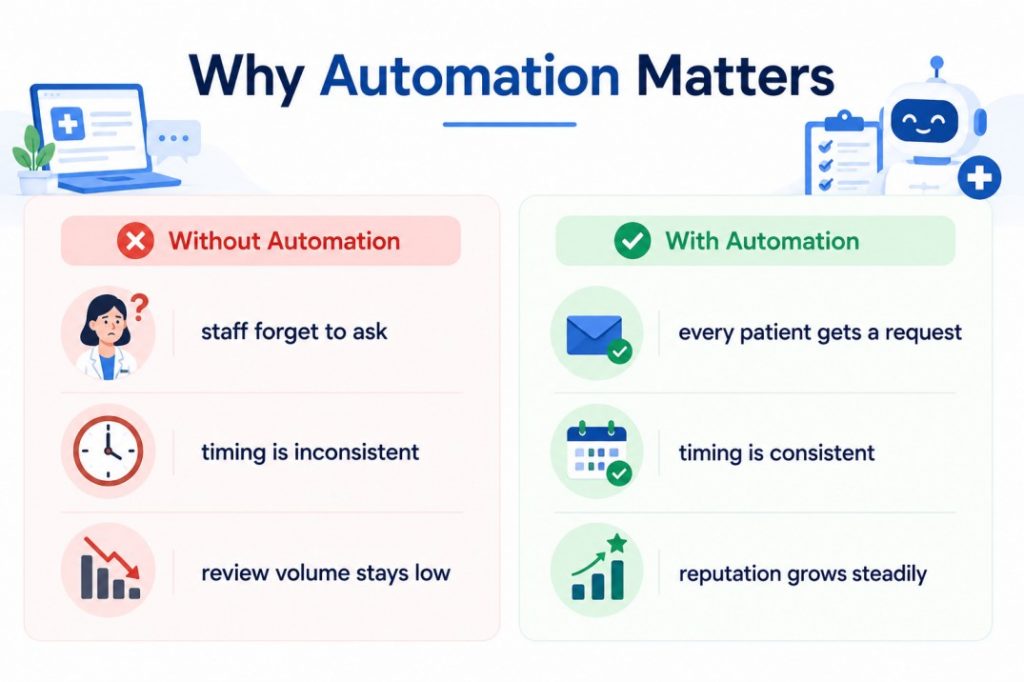
Simple automated workflow
- Appointment completed
- System triggers review request
- Patient receives SMS/email
- Patient leaves feedback in one click
This is where Emitrr plays a strong role—helping clinics automatically send post-visit review requests without relying on manual follow-ups from front desk staff.
The result is a predictable and scalable medical marketing SEO system built on real patient feedback.
Why this matters for SEO
More consistent reviews lead to:
- higher local rankings
- stronger trust signals
- better click-through rates
Google sees activity. Patients see credibility.
Key takeaway
Automation doesn’t just save time—it builds consistency, which directly impacts reputation and visibility.
Chapter 9: Reputation Management Best Practices
Reputation is more than reviews.
It’s the full patient experience reflected online.
Monitor all review platforms
Not just Google:
- Healthgrades
- Practo
- Yelp
Patients don’t differentiate platforms—they just look for patterns.
Maintain consistency everywhere
Your:
- ratings
- responses
- information
should be aligned across platforms.
Act on feedback (this is where real improvement happens)
If multiple patients mention:
- long wait times
- communication gaps
- booking delays
That’s not a review problem.
That’s an operational problem.
Where Emitrr helps
Beyond reviews, many of these issues stem from communication gaps.
Emitrr helps healthcare organizations streamline:
- appointment reminders
- patient messaging
- follow-ups
- missed call recovery
When communication improves, reviews naturally improve too—because patient experience improves.
Key takeaway
Reputation management is not about managing reviews—it’s about improving the system behind them.
Chapter 10: Measuring Success
You can’t improve what you don’t measure.
Key metrics to track
- Total number of reviews
- Average rating
- New reviews per month
- Response rate
- Sentiment trends
What good performance looks like
A healthy healthcare reputation system shows:
- steady flow of new reviews
- consistent 4.5+ rating
- active responses
- improving sentiment over time
Connecting reviews to growth
More reviews → higher trust → better rankings → more visibility → more patients
This is the compounding loop behind healthcare SEO services that actually work.
Final takeaway
Healthcare SEO is not just about visibility.
It’s about becoming the most trusted provider in your area.
And trust is built through:
- content
- patient experience
- and reputation systems that scale

 4.9 (400+
reviews)
4.9 (400+
reviews)