
Introduction
“Do you accept my insurance?” can turn into several tasks before a patient gets an answer. Your team may need to collect plan details, find a suitable provider, locate eligibility information, explain a cost estimate, and arrange an appointment.
When those tasks sit in separate systems, patients call back. Another staff member answers, asks the same questions, and starts searching again.
AI payer calls can reduce this repeated work by collecting patient information, using connected provider and insurance data, and moving the conversation toward a clear next step. The agent can handle routine questions and supported scheduling actions, while staff reviews unresolved insurance or clinical questions.
This guide explains how AI agents handle insurance-related patient calls, where EHR and clearinghouse data are needed, and how Emitrr connects intake, provider matching, scheduling, and follow-up.
AI Summary
- AI agents collect patient and insurance details during conversations.
- Connected provider data supports matching by insurance participation, specialty, location, patient age, and availability.
- Eligibility results come from the EHR or an external clearinghouse. Emitrr does not currently provide native insurance eligibility verification.
- Available insurance results and cost estimates help agents explain the next step.
- Emitrr connects conversational intake, provider matching, supported scheduling, routing, and patient follow-up.
- Staff handles missing results, disputed costs, complex payer issues, and clinical decisions.
What AI Agents Can Handle During Insurance Calls
AI agents for insurance calls help patients with questions about accepted plans, suitable providers, available cost information, and authorization updates. They collect the details needed to handle the request, use information from connected systems, and help patients book an appointment or reach the appropriate staff member.
For example, a parent calling about therapy may need a provider who sees children, accepts a particular plan, and has openings at a nearby location. Conversational AI for healthcare can gather those requirements before searching connected provider and appointment data.
This is a practical use of AI in healthcare: handling routine administrative steps so staff can focus on questions that need further review.
AI insurance inquiry handling also prepares unresolved requests for the right person. If a cost estimate is unavailable, the agent can collect the required information and route the outstanding question to billing.
The agent collects information, communicates confirmed results, and performs configured actions. Coverage and authorization decisions remain with the payer, while clinical decisions remain with the care team. Insurance call automation connects those decisions with the patient’s next step.
Insurance Questions That Create Repeated Work for Practice Staff
Healthcare insurance calls often involve several questions within one conversation. If the first call ends with missing details or an unclear next step, the patient may need to contact the practice again.
“Do you accept my insurance?”
An insurer’s name alone may not answer the question. Participation can depend on the specific plan, provider, location, and service. Staff may need to collect more details before identifying suitable options.
“Which provider can see my child?”
Staff must consider the requested service, patient age, location, insurance participation, and appointment availability together. A provider who participates in the plan may not see children or offer the requested service.
“How much will the visit cost?”
The practice needs current benefit information or an available estimate before explaining likely costs. When that information is difficult to access, staff must arrange another conversation.
“Has my authorization been approved?”
Someone needs to locate the status for the correct request and explain what it means for the appointment. Patients also need to know whether they should call the office, provide information, or wait for another update.
“What happens next?”
Even after receiving an answer, patients may be unsure whether they can book or need to complete another step. A clear instruction helps prevent another call simply to clarify the process.
These gaps create patient insurance callbacks and repeated lookups. A unified communication approach in healthcare helps teams keep conversations and follow-up context accessible as different staff members become involved. Payer communication automation builds on that by connecting each question with available information and an assigned next action.
How an AI Agent Moves an Insurance Inquiry Toward an Appointment
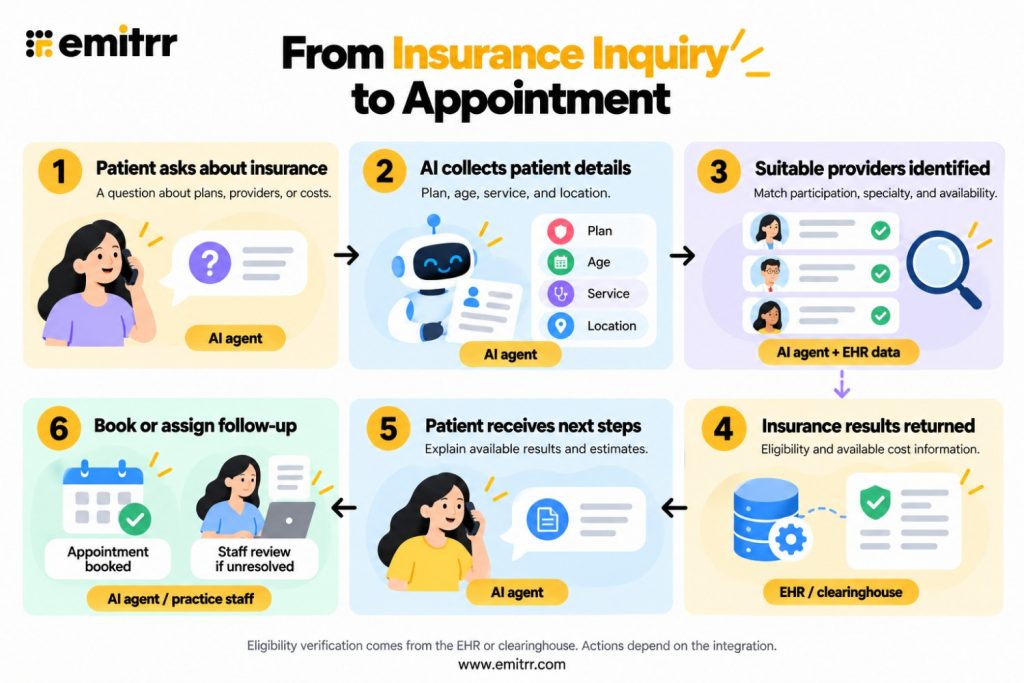
Consider a parent calling about therapy for a 10-year-old with Blue Cross Blue Shield coverage. The agent collects the request, searches suitable provider options, obtains available insurance results through connected systems, and helps the parent take the next step.
Collect the Details Needed to Handle the Request
The conversation begins with patient insurance information collection. The agent asks for the patient’s name, date of birth, location, requested service, age, insurance plan, and relevant care needs. Member and subscriber identifiers may also be needed for the connected insurance workflow.
For the parent seeking therapy, the agent confirms the specific plan rather than recording only the insurer’s name. Unclear names, numbers, or spellings are confirmed before the information is used.
This creates structured patient intake that can support a provider search, insurance inquiry, or staff handoff. If additional documents are required, patient intake automation can connect form requests and missing-information reminders with the details gathered during the call.
Find Providers Who Match the Patient’s Needs
Insurance-based provider matching combines the caller’s requirements with accessible provider and schedule data. Relevant fields can include specialty, service, location, patient population, insurance participation, and availability.
In this example, the agent searches for providers who offer the requested therapy, see 10-year-olds, serve the preferred location, and participate in the specific plan. It can then present suitable providers and available appointment times.
In-network provider matching identifies potential options. The patient’s coverage for the requested service still needs to be checked separately.
AI provider search relies on current provider information. If participation details or age restrictions are missing, staff can review the options before the patient proceeds.
Obtain Available Insurance Results Through Connected Systems
With the required identifiers collected, the workflow can send patient and insurance information to the electronic health record (EHR). The EHR or its connected clearinghouse performs the eligibility lookup and returns the available result.
For the parent on the call, the result may help clarify the next step before booking. Whether that can happen during the conversation depends on the integration’s response time and the information returned.
If the result is delayed or incomplete, the agent can arrange follow-up with the appropriate team. Staff receives the collected details and the outstanding question, reducing the need to restart intake.
Explain the Available Estimate and Next Step
Eligibility result communication gives the patient an explanation based on information returned by the connected system. When a cost estimate is available, the agent can communicate it and ask whether the patient wants to proceed.
Patient cost communication should make clear that out-of-pocket cost estimates may differ from the final amount owed. Final responsibility depends on the patient’s plan, the services provided, and claim processing.
If the estimate is missing or the parent questions the amount, the agent routes the issue to billing. The parent leaves knowing which team will review the question and what happens next.
Book the Appointment or Hand Off the Unresolved Request
When the parent chooses a provider and time, the agent can complete insurance-related appointment scheduling through the connected scheduling workflow. The appointment outcome returns to the EHR where write-back is supported.
If an insurance question still needs review, the agent passes the collected information and unresolved issue to the responsible team. Staff can then continue the conversation with context.
The same connection between patient information and available appointments supports referral scheduling after chart creation, helping practices move an existing referral toward a booked visit.
How Emitrr AI Agents Automate Insurance-Related Calls
Emitrr brings intake, provider search, scheduling, assignment, and follow-up into the patient conversation. EHR-integrated AI agents use the fields and actions available through the connected system, so the workflow reflects the practice’s provider data, scheduling rules, and insurance information.
AI Voice Agent for Patient and Insurance Intake
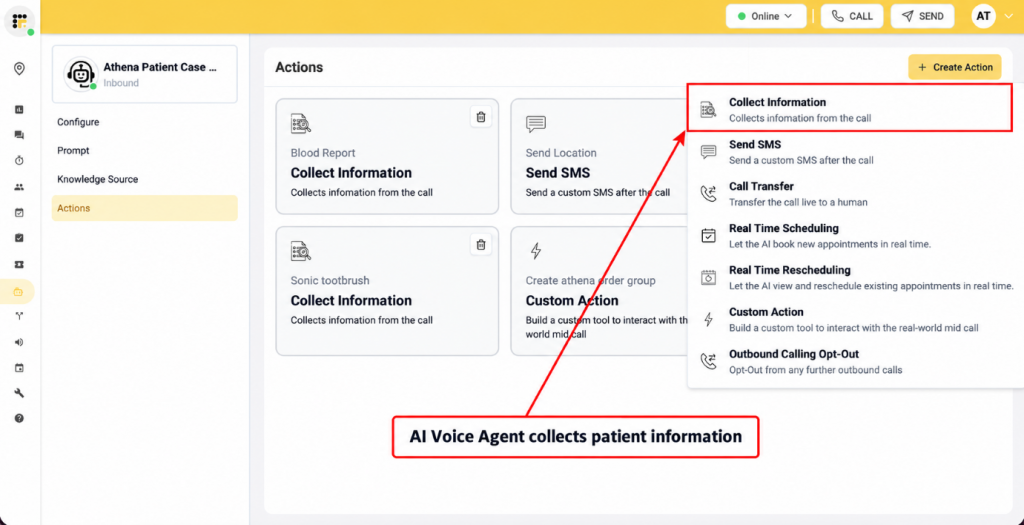
Emitrr’s AI Voice Agent gathers caller information through a natural-language conversation. Questions can capture the requested service, patient demographics, insurance plan, preferred location, and relevant care needs.
This insurance intake automation gives staff a more complete request before they become involved. A coordinator receiving the therapy inquiry can review the child’s age, plan, and location instead of asking the parent to repeat every detail.
Combining AI voice and SMS for patient intake also lets patients provide initial information during the call and complete additional collection steps afterward.
AI call summaries help staff understand what was discussed and which question remains open. Details that were unclear during the call can be checked before the next action.
Provider Matching Through EHR Data
Emitrr uses accessible provider and schedule information to find options that match the patient’s request. Matching can account for insurance participation, specialty, location, patient population, and appointment availability.
For the parent seeking therapy, this means hearing relevant provider options during the conversation instead of waiting while someone searches separate lists. The matching fields must be available and current in the connected source. Accurate plan participation and patient-age information help the agent present useful options, while missing details can be directed to staff for review.
EHR Integration for Insurance Results
Emitrr does not currently provide native insurance eligibility verification. Eligibility checks are handled by the EHR or an external clearinghouse.
Through a supported EHR clearinghouse integration, patient and insurance details can be sent for a lookup, with returned eligibility information or cost estimates made available to the agent. This allows the conversation to continue using source information instead of requiring staff to relay every result manually.
The exchange needs to return the relevant fields quickly enough for the intended workflow. A live conversation requires a faster response than a follow-up message sent later. Available insurance data and scheduling actions vary across EHR integrations. The practice’s EHR, clearinghouse connection, and field access determine which steps can be completed during the call.
AI Scheduling for the Next Appointment
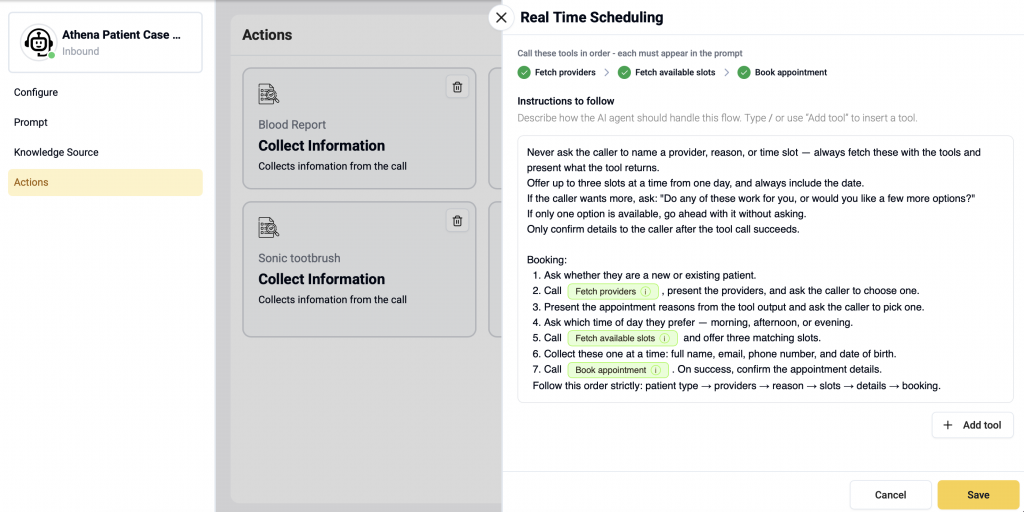
Emitrr can book appointments after patients select a suitable provider and time, where the EHR integration supports booking. Connected online scheduling for healthcare helps turn the patient’s choice into an appointment recorded in the scheduling system.
Patient, provider, appointment, schedule, and intake data can be exchanged through application programming interfaces (APIs) or webhooks. These connections allow systems to share information and send updates when relevant events occur.
For staff, the benefit is a conversation that leads to a recorded booking with the necessary context. The exact information written back depends on the EHR. If booking cannot be completed, staff receives the request for follow-up before the appointment is confirmed to the patient.
Patients and practice managers can also try Emitrr’s AI agent to experience how it handles common inquiries and appointment requests.
AI Tags and Assignment for Unresolved Questions
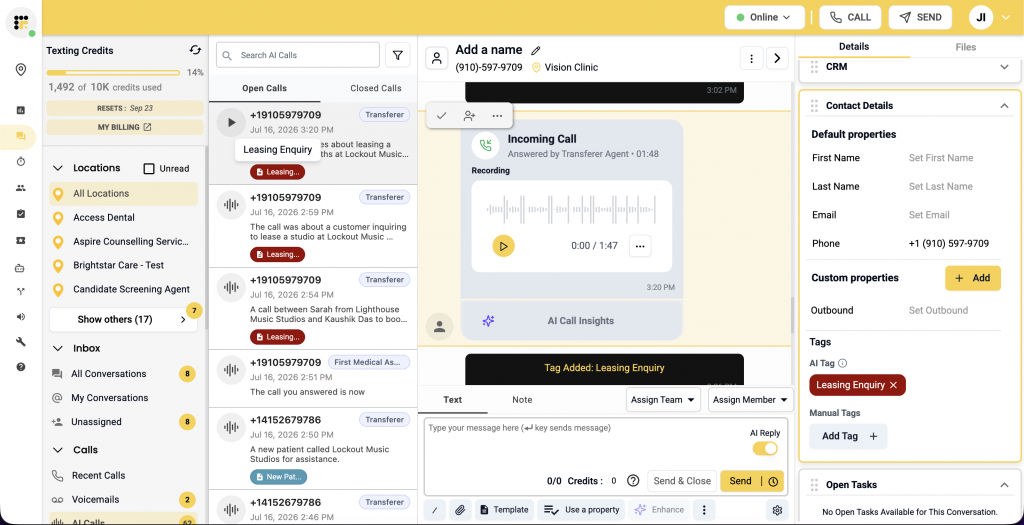
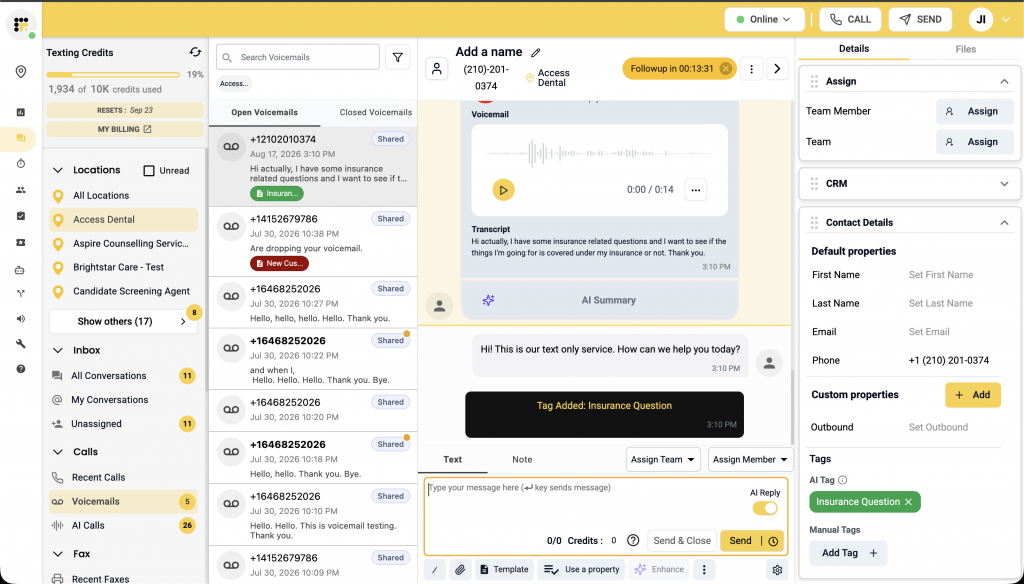
Emitrr’s AI tags categorize conversations by content, helping teams distinguish insurance inquiries, authorization questions, and billing concerns.
Configured insurance inquiry routing directs the conversation to the appropriate team or user. Billing inquiry routing can send a disputed estimate to the people responsible for reviewing costs. When the caller needs a live conversation, call routing helps direct the call to the appropriate department or location.
Assignment gives the request an owner. The patient conversation history helps that person see what has already been collected, which information was communicated, and what still needs attention.
Workflow Automation for Patient Updates
Emitrr supports reminders, confirmations, no-show follow-ups, and configured patient messages after scheduling. Insurance follow-up automation can also use EHR-supplied authorization statuses to send the next instruction.
For practices using a daily Secure File Transfer Protocol (SFTP) feed, patient updates follow the statuses supplied in that file. An approval can trigger a message asking the patient to contact the office, while a case needing attention can trigger an appropriate follow-up instruction.
These prior authorization status notifications reflect the latest received data. With a daily feed, updates follow that daily schedule. Correct patient and request mapping helps ensure each person receives the appropriate message.
After booking, patient appointment reminders give patients the visit details and a clear instruction to confirm or contact the office. Configured workflows can also automate appointment confirmations and reschedules, with appointment updates returned to the scheduling system where supported.
Automated patient follow-up needs a response path. A reply about an estimate or appointment should continue through the appropriate workflow or reach staff for review.
Need to keep patients engaged after booking? Watch this video for practical ways to manage reminders, confirmations, and missed appointments:
Voice-to-SMS Follow-Up
Emitrr connects voice conversations with text follow-up. After gathering initial information, the agent can send a supported form, link, or instruction so the patient can complete the next step after the call.
Voice-to-SMS workflows are useful when a caller needs time to provide additional details or complete a form. The patient can act on the message without keeping the phone conversation open.
Two-way texting gives patients a way to ask a follow-up question in the same communication channel. This two-way patient communication continues through configured workflows or reaches staff when review is needed. Sensitive information should be exchanged through an appropriate supported secure channel.
When the AI Agent Should Hand the Call to Staff
AI call escalation helps patients reach the right person when information is unavailable or the question requires professional judgment. The handoff should include collected details, available results, the unresolved question, and the team responsible for the next action.
| Situation | Why staff is needed | Information to include |
| Unavailable insurance results | The source has not returned a usable result, or required identifiers are missing. | Collected details, missing information, and the outstanding lookup. |
| Coverage or cost disputes | The patient questions the estimate or needs a more detailed explanation. | Available results, the estimate provided, and the patient’s concern. |
| Clinical decisions | Treatment suitability, medical necessity, or clinical documentation requires clinician input. | The patient’s request and the specific clinical question. |
| Complex payer issues | Denial disputes, appeals, or insurer negotiations require specialist review. | Current status, available reference details, unresolved issue, and assigned team. |
For the parent seeking therapy, the handoff should explain whether suitable providers were found, whether insurance results arrived, and what remains unresolved.
The parent also needs a clear instruction. Knowing that billing will review the estimate and contact them is more useful than being transferred without an explanation.
For practices using athenahealth, human handoff for AI voice agents should account for the information staff needs to continue and the conditions that trigger a transfer. Across phone workflows, AI-assisted call routing can help connect callers with an appropriate destination when human help is needed.
What Changes for Staff When Insurance Calls Are Automated
Automated insurance calls help staff receive complete requests and give patients clearer next steps. The work removed depends on the information and actions available through the connected workflow.
- Less repeated intake: The parent’s initial conversation captures the child’s age, requested service, plan, and preferred location. A coordinator can review those details before continuing.
- Fewer routine lookups during conversations: Accessible provider fields and returned insurance information help the agent present relevant options without asking staff to search each system separately.
- More complete handoffs: If the estimate is missing, billing receives that specific question with the available details. Staff can focus on resolving the gap.
- Clearer patient next steps: The parent leaves with a confirmed appointment, a request for additional information, or an explanation of which team will respond.
Staff also needs a record of what was communicated and what happened next. Maintaining an appropriate HIPAA audit trail supports review of relevant system activity. Conversation records, access logs, and EHR write-back should each be checked for the practice’s configuration rather than assumed to be interchangeable.
Practice managers can assess the impact by reviewing repeated callbacks, incomplete handoffs, booking outcomes, and unresolved requests. Those measures help show where AI insurance calls reduce routine work and where better data access is still needed.
Key Takeaways
- Insurance inquiries often combine intake, provider search, insurance information, and scheduling.
- AI agents collect details, communicate available results, and complete supported actions.
- Eligibility information comes from the EHR or an external clearinghouse.
- Integration fields, response timing, and write-back determine which steps can be automated.
- Staff handles unresolved disputes, complex payer questions, and clinical decisions.

FAQs
AI payer calls use AI agents to help handle insurance-related conversations. For a healthcare practice, this can include collecting plan details, finding suitable providers, communicating available results, and arranging scheduling or staff follow-up.
An agent can help patients with accepted-plan questions, provider options, available cost estimates, and authorization updates. Its answers depend on approved practice information and the data available through connected systems.
No. Emitrr does not currently provide native insurance eligibility verification. Through a supported integration, it can exchange information with the EHR and communicate results supplied by the EHR or its clearinghouse.
Yes, when the connected provider data includes insurance participation and the other fields needed for matching. Options can also account for specialty, location, patient age, and availability. Coverage for the requested service is checked separately.
Yes, when a cost estimate is available and the connected scheduling workflow supports booking. The estimate should be explained as an estimate, and the appointment should be confirmed only after the booking succeeds.
The request passes to the appropriate staff member with the collected information and unresolved question. Depending on the setup, this can involve a call transfer, an assigned conversation, or a follow-up request.
Conclusion
AI payer calls can reduce repeated information gathering and help patients move from an insurance question toward an appointment. Reliable source data, connected scheduling, and clear handoffs make that process useful for both patients and staff.
Emitrr brings conversational intake, provider matching, supported booking, routing, and follow-up together. EHRs and clearinghouses supply insurance results, while staff resolves questions that need further review.
Book a demo to explore how Emitrr AI Agents can support your insurance call workflow.


 4.9 (400+
reviews)
4.9 (400+
reviews)