
 4.9 (400+
reviews)
4.9 (400+
reviews)
Introduction
A hospital’s reputation no longer begins in the ER or operating room—it begins online. Reputation and review management for healthcare organizations is the continuous task of monitoring, interpreting, and optimizing the way a hospital is perceived on various online platforms.
Nowadays, patients select hospitals just like they would restaurants or hotels—based on reading online reviews. Sites like Google Reviews, Healthgrades, WebMD, Facebook, Zocdoc, and others are strong opinion leaders dictating a hospital’s public image.
Both positive and negative patient feedback immediately affects hospital operations, the influx of patients, and even clinical outcomes. Every review is a reflection of patient satisfaction, trust, and expectations. This necessitates that hospitals should implement a strategic and proactive approach to reputation management.
Importance Of Reputation and Review Management for Hospitals
Research indicates that over 90% of patients refer to online reviews prior to choosing a healthcare provider. A hospital’s online reputation influences patient trust and decision-making significantly, so healthcare institutions must engage in managing and curating their digital presence.
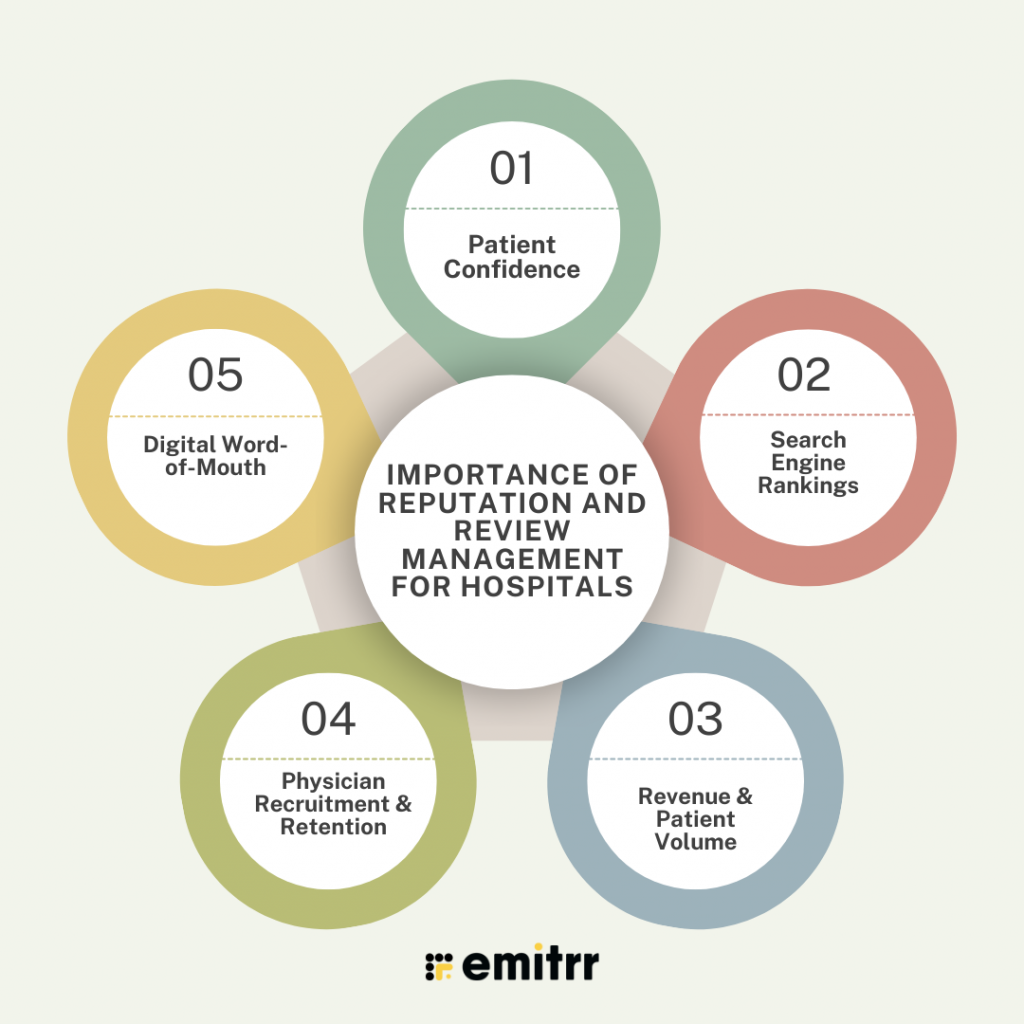
- Patient Confidence: More-starred hospitals evoke higher patient confidence. A rating of 4.5 indicates reliability and quality, motivating patients to select those providers even where clinical outcomes are comparable, increasing total confidence in the facility.
- Search Engine Rankings: Google promotes those hospitals with high-volume positive reviews, getting them further up the results for local searches. Improved reputation results in greater visibility online, which enables potential patients to more easily find and review the hospital when seeking care.
- Revenue & Patient Volume: Improved online ratings result in more patients, which means higher revenue streams. That growth is then reinvested in services and technology, ultimately benefiting patient care and creating a cycle of ongoing improvement and growth.
- Physician Recruitment & Retention: Top-ranked hospitals recruit talented physicians and specialists, who look for credible workplaces. This credibility affects recruitment, fosters cooperation, and promotes retention, making the hospital retain a high level of clinical skills and care provision.
- Digital Word-of-Mouth: Online reviews act as digital referrals, spreading patient experiences rapidly. Positive feedback can reach thousands instantly, influencing decisions far beyond local communities and enhancing the hospital’s reach and credibility through widespread peer recommendations.
Key Elements of Reputation and Review Management for Hospitals
Good reputation management of hospitals is a multifaceted effort, incorporating several tools and techniques to capture, analyze, and address patient feedback from multiple channels to ensure long-term trust and development.
- Online Reviews: Patients essentially use websites such as Google, Facebook, Yelp, Zocdoc, and Healthgrades for selecting hospitals. Reviews on these websites are of particular importance, as they form a first impression and have significant influence on patient choices.
- Net Promoter Score (NPS): NPS captures patient loyalty and satisfaction by inquiring about the likelihood of patients referring the hospital. This in-house measure supports public reviews through actionable insights into patient experience and areas for improvement.
- Survey Tools: Hospitals employ survey tools like Zonka Feedback and Survicate to gather structured, in-depth feedback following visits or discharges. These tools allow the isolation of specific strengths and weaknesses to improve patient care and satisfaction.
- Brand Mentions Monitoring: Monitoring brand mentions on forums, blogs, and social media sites enables hospitals to measure overall patient sentiment outside of formal reviews. Extended listening for this purpose identifies trending issues and opportunities in real time.
- Response Management: Being responsive and empathetic to patient reviews in a timely manner, and remaining HIPAA compliant, instills trust and demonstrates dedication to care for patients. Successful response management can convert negative experiences into positive opinions.
- Review Generation & Automation: Automated review request tools that send review requests through SMS or email maximize patient feedback volume. Regular review collection ensures a strong online reputation and gives constant insight into patient satisfaction patterns.

Challenges in Hospitals’ Reputation and Review Management
While managing a hospital’s online reputation is vital, it comes with unique challenges requiring careful attention, resources, and strategy to navigate legal, operational, and technological hurdles effectively.
- Negative Reviews & HIPAA Compliance: Handling negative feedback involves walking a fine line of transparency versus stringent privacy regulations. Hospitals should not release any protected health information while being sympathetic to the concerns and maintaining legal compliance without betraying the trust of the patients.
- Lack of Dedicated Staff: Most hospitals do not have specialized individuals or departments dedicated exclusively to reputation management. Without dedicated staff, tracking, engaging, and capitalizing on patient feedback is sporadic and less efficient, affecting the overall reputation strategy.
- Inconsistent Review Collection: Multidepartment or multi-location hospitals tend to have disparate patient experiences and feedback collection. This inconsistency produces disjointed data, making it challenging to obtain a consistent view of patient satisfaction organization-wide.
- Fake or Irrelevant Reviews: Competitors or misidentifications at times lead to fake or irrelevant reviews, damaging the credibility of a hospital. It is important to discover and correct these false reviews in a timely manner to ensure trust and provide true patient feedback.
- Siloed Systems for Feedback: Most hospitals gather patient feedback but do not properly integrate or analyze it. Isolated feedback systems and channels keep actionable information out, resulting in lost opportunities for change and eroding the influence of reputation management campaigns.
Best Practices for Hospitals Reputation and Review Management
To establish and maintain a robust online reputation, hospitals need to adopt strategic, ongoing practices that promote patient engagement, prompt response, and ongoing improvement at all touchpointstouch points of care and communication.
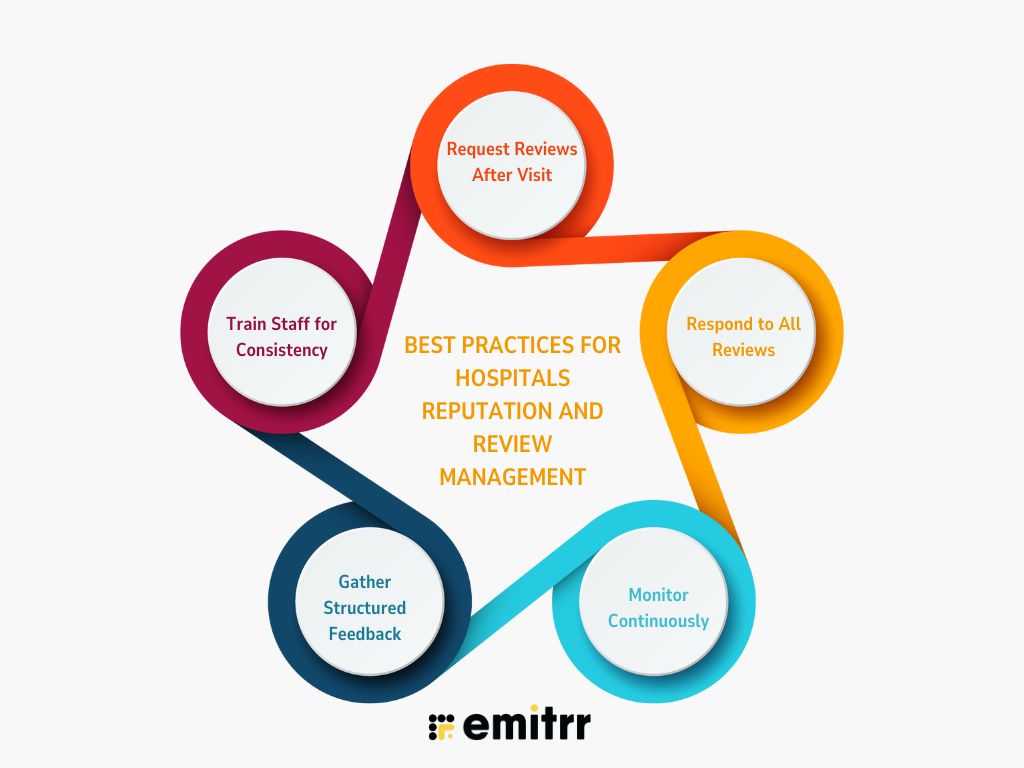
- Request Reviews After Visit: Send review invitations through SMS or email within minutes of patient visits to record new experiences. This anticipatory strategy maximizes review volumes, balances positive and negative comments, and ensures an ongoing, genuine online presence.
- Respond to All Reviews: Reply to all reviews by expressing gratitude to patients for positive ones and responding to complaints in negative ones. Considerate, compassionate responses show the hospital’s investment in patient care and can address problems publicly and privately.
- Monitor Continuously: Monitor reviews and social mentions on all major platforms in real-time. Continuous monitoring enables hospitals to rapidly detect trends, react to feedback, and control their reputation before problems grow and misinformation is spread.
- Gather Structured Feedback: Utilize focused surveys to collect detailed patient experience insights, bringing to light certain pain points or areas for improvement. Structured feedback informs data-driven decisions that enhance service quality and patient satisfaction in the long run.
- Train Staff for Consistency: Make each hospital staff member from front desk to discharge provide a consistent, positive patient experience. Training instills the value of patient interactions and assists in aligning behavior to reputation objectives.
How To Respond To Online Reviews
Responding effectively requires tact, timeliness, and compliance.
- Positive Reviews: For example,
“Thank you so much for your kind words! We’re glad you had a positive experience with our care team.”
- Negative Reviews: For example,
“We’re sorry to hear about your experience. Please contact our patient support team so we can address your concerns privately.”
Some common response templates to help you are:
- Thank You Message: “We appreciate your feedback and look forward to serving you again.”
- Service Recovery: “We strive to offer exceptional care. Please reach out so we can understand and address your concern.”
- HIPAA-Compliant Policy-Based Response: “We take patient privacy seriously and can’t discuss specific details online, but we welcome the opportunity to speak with you directly.”
What Not to Do:
- Never reveal patient information
- Never argue or sound defensive
- Avoid generic or robotic replies—show empathy
How To Improve Online Reputation and Review for Hospitals Using Emitrr
Hospitals wanting to enhance online reputation and review management can significantly gain from Emitrr’s end-to-end AI-based platform that is intended for efficient patient communication and feedback collection with minimal manual intervention.
Automated Collection of Reviews
Emitrr’s automated review collection process occurs immediately after patient interactions through SMS or email. The prompt strategy gathers new, original patient reviews, leading to a significant increase in the number of reviews and a rise in overall ratings.
Multi-Platform Management
Manage your hospital’s presence across all major platforms like Google, Facebook, Zocdoc, and Healthgrades from a single dashboard to ensure uniform monitoring and rapid responses on all channels where patients post their experiences.
HIPAA-Compliant Response Templates
Emitrr offers pre-made response templates that meet HIPAA standards so that hospital staff can respond promptly and professionally without risking patient privacy violations.
Analytics Dashboard
Obtain in-depth insights with an analytics dashboard monitoring review patterns, patient sentiment, and Net Promoter Scores (NPS). These are used by hospital administrators to determine where improvement is needed as well as the efficacy of their reputation efforts.
EHR/CRM Integration
Emitrr is fully integrated with your current EHR or CRM systems to allow personalized and contextual messaging for enhanced patient engagement and satisfaction.
Meet Sarah : Your AI-Powered Communication Assistant
Emitrr introduced Sarah, an intelligent texting assistant designed to take the hassle out of business messaging. Sarah handles all incoming texts in real time with zero manual effort, making communication faster, smarter, and more effective.
Here’s what Sarah brings to hospital reputation management:
- Auto-response to incoming texts: Immediate replies to patient messages without delay.
- AI-crafted, context-aware messages: Smart message creation tailored to the conversation’s tone and urgency.
- Message tuning: Adjusts replies based on patient sentiment to maintain empathy and professionalism.
- Smart rule engine: Routes and filters messages to the right department or staff member instantly.
- Always-on assistance: Never misses a message, ensuring no patient concern goes unanswered.
With Sarah, hospitals can improve response times, enhance patient satisfaction, and maintain a strong, caring online presence effortlessly.
Case Study: Pinnacle Medical Group Saw Growth in Reviews and Online Reputation with Emitrr
Pinnacle Medical Group is a multi-speciality medical practice operating across five locations, offering services including family medicine, urgent care, women’s health, and pediatrics.
Challenge:
The group struggled with their EMR system’s lack of real-time communication and was overwhelmed by patient requests to communicate via SMS. Additionally, they weren’t consistently collecting patient reviews.
Solution:
Pinnacle partnered with Emitrr to automate both patient communication and post-visit review requests via text.
Results:
- 3x increase in reviews
- 90+ new reviews within just 3 days
- Marked improvement in online ratings across all five locations
Emitrr’s automation significantly reduced manual work while boosting visibility, credibility, and patient trust across platforms.
Read the full success story here.
Frequently Asked Questions
Reviews influence patient choices, search engine visibility, and reputation. They reflect real experiences and help others make informed decisions.
After every interaction, automated review requests post-visit ensure regular and consistent feedback.
Yes, as long as the response does not disclose any personal health information and complies with HIPAA.
Flag the review on the platform, respond professionally, and encourage the reviewer to contact your team directly for resolution.
Yes. Tools like Emitrr integrate with major systems to personalize communication and streamline operations.
Conclusion
Patient experiences are now shared publicly and instantly, making a hospital’s online reputation more critical than ever. A single unattended negative review can damage trust, reduce patient visits, and affect long-term growth.
To overcome this, hospitals need structured systems, automation, and consistent review management. Emitrr simplifies the entire process by automating feedback collection, improving star ratings, and helping build a strong, credible online presence rooted in real patient satisfaction. Managing your reputation doesn’t have to be complex.
Take control of your hospital’s online reputation with Emitrr. Schedule a free demo today and see the difference.