

Introduction
A physical therapy clinic runs on repeat visits. A single plan of care can generate ten, twenty, or thirty separate appointments, each requiring its own note, each tied to an authorization that can run out mid-treatment, each needing a home exercise update or a reminder text so the patient actually shows up for visit fourteen of eighteen. An EMR built for a generalist outpatient practice is not built for that rhythm. Choosing an EMR for physical therapists means testing the system against recurring visits, defensible SOAP documentation, outcome measures payers expect, and authorization tracking, not just asking whether it can hold a chart.
Most PT practices only discover the gaps after go-live: a documentation template that does not support functional outcome tools like the FOTO or PSFS, a scheduler that cannot easily rebook a recurring plan of care around a therapist’s caseload, or a billing module that cannot connect units of service back to authorized visit counts. This guide walks through the blockers specific to physical therapy, the features that actually matter, how leading systems compare, and how to structure an evaluation and implementation so the switch does not disrupt patient care.

AI Summary
- Recurring, authorization-tied visits are the defining PT workflow challenge; the EMR must track authorized units or visits against what has been billed, not just hold a chart.
- The most common PT-specific blocker is fragmentation between the EMR, patient texting or reminder tools, and web-based intake forms, which forces staff to re-key data that should flow automatically.
- Documentation quality hinges on PT-specific templates (evaluations, daily notes, reassessments, discharge summaries) with built-in outcome measures, not generic SOAP fields borrowed from primary care.
- Integration diligence matters most around scheduling write-back and forms: verify whether appointment changes and structured intake data actually sync into the chart, or whether they only generate a PDF or a manual task.
- Multi-location and multi-provider PT groups should prioritize provider-specific scheduling and centralized reporting over any single flashy feature, since caseload and location complexity is what breaks generic systems first.
Which EMR for Physical Therapists Is Right for You? TL;DR
| EMR | Best For | Key PT Strength | Potential Limitation |
| SPRY PT | PT clinics looking for an all-in-one platform | PT-specific documentation, AI assistance, scheduling, billing, RCM, and patient engagement | May offer more functionality than smaller practices need |
| WebPT | Established PT practices and growing rehab organizations | PT-focused documentation, scheduling, billing, outcomes tracking, and practice management | Pricing can increase as practices add features and users |
| Prompt EMR | PT, OT, and SLP practices focused on streamlined clinical workflows | Therapy-specific documentation, AI-assisted workflows, scheduling, billing, HEP, and analytics | Primarily focused on rehabilitation workflows |
| athenahealth | Multi-specialty practices and larger healthcare organizations | Broad EHR, billing, scheduling, interoperability, and patient engagement capabilities | Less PT-specific than dedicated physical therapy EMRs |
| AdvancedMD | Practices needing integrated EHR and practice management | Combines clinical documentation, scheduling, billing, reporting, and practice management | PT-specific workflows may require more configuration |
| Strata PT | PT practices seeking integrated EMR and billing | PT-specific documentation, billing, RCM, customizable templates, and reporting | May have less enterprise depth than larger rehabilitation platforms |
| Epic EMR | Hospital systems and large multi-specialty healthcare organizations | Strong interoperability, centralized patient records, documentation, scheduling, and care coordination | More complex and less PT-specific than dedicated PT EMRs |
Key Challenges for Physical Therapy Practices
Fragmented workflows between the EMR, texting tools, and web forms
Many PT clinics run their EMR for documentation and billing, then bolt on a separate texting platform for reminders and a separate web form tool for intake, none of which talk to each other. Staff end up re-entering intake answers into the chart by hand. This matters because PT intake is detail-heavy (mechanism of injury, prior treatment, pain scales, functional limitations), and manual re-entry is where errors and delays creep in. Before buying, verify whether intake form answers can populate structured fields in the chart automatically, or whether they only arrive as a PDF attachment that a staff member has to transcribe.
Manual intake and fragmented patient context
When a new patient’s referral, insurance information, and history arrive through different unconnected channels, the front desk has to assemble a full picture before the first visit. If nothing connects, this is manual work every single time, and it is the first place multi-location PT groups fall behind on schedule.
Multi-step pre-visit and post-visit sequences
A physial therapist plan of care is not a single appointment. Pre-visit reminders, post-visit home exercise instructions, and reassessment prompts ideally follow a sequence tied to the treatment plan, not a single generic reminder. Ask whether the EMR (or a connected communication tool) can trigger different messages at different points in a plan of care, rather than sending the same reminder regardless of visit type.
Scheduling write-back and recurring visits
PT scheduling is built around recurring visits tied to a plan of care, often two to three times a week for six to eight weeks. If a third-party scheduling or communication tool cannot write appointment creation, cancellation, and rescheduling back into the EMR, staff end up managing two calendars. Verify whether write-back is two-way or read-only before assuming a “scheduling integration” solves this.
Recall, reattendance, and no-show follow-up
Attendance drives outcomes and revenue in PT. A missed mid-plan visit that goes unaddressed often becomes a lost patient. Practices should verify whether the EMR or its connected tools can flag no-shows for automatic follow-up and support patient recall campaigns for patients who have gone quiet mid-treatment.
Free-text clinical notes and field-mapping limitations
Some EMRs still lean on free-text SOAP note fields rather than structured, codeable data. This slows documentation and makes it harder to pull clean outcome measure or productivity reports later. Ask to see how a daily note, a re-evaluation, and a discharge summary are actually built during a demo, not just described.
Multi-location scheduling and provider-specific calendars
Once a PT group has more than one clinic, provider calendars, room or equipment availability, and location-specific hours all need to be visible without therapists double-booking across sites. Confirm the scheduling module supports true multi-location logic rather than a single shared calendar with manual filters.
Authorization tracking and billing connection
Visits authorized by a payer are often capped by count or by date. If the EMR does not connect documentation and billing to authorization status, a clinic can keep treating (and billing) past what is authorized without noticing until a denial comes back. This is one of the more expensive blockers in PT if left unaddressed.
Must-Have EMR Features for Physical Therapists
| Feature | Why It Matters Operationally |
| PT-specific documentation templates (evaluation, daily note, reassessment, discharge) | Reduces charting time and supports defensible, payer-ready documentation for recurring visits |
| Built-in outcome measures (FOTO, PSFS, LEFS, DASH, or similar, where supported) | Many payers and MIPS-adjacent programs expect functional outcome tracking; manual tracking is error-prone |
| Recurring appointment scheduling | Matches the actual structure of a plan of care instead of forcing single-visit booking logic |
| Authorization and visit-count tracking | Prevents billing beyond what is authorized and reduces denials |
| Digital intake forms with structured field mapping | Cuts front-desk data entry and speeds up first-visit readiness |
| Patient portal and mobile access | Lets patients view home exercise programs and appointment details, and lets therapists document from the treatment area |
| Billing tied to documentation (charge capture from the note) | Reduces the lag and errors between what was done clinically and what gets billed |
| Reporting on productivity, outcomes, and denials | Needed for both clinical quality tracking and practice-level financial management |
| AI-assisted documentation (where offered) | Can reduce charting time, but should be evaluated for accuracy and specialty-specific template fit, not assumed to work out of the box |
| Provider-specific and multi-location scheduling | Prevents caseload collisions as the practice adds therapists or sites |
Best EMRs for Physical Therapists: Detailed Analysis
- SPRY PT
- WebPT
- Prompt EMR
- Athenahealth
- AdvancedMD
- Strata PT
- Epic EMR
1. SPRY PT
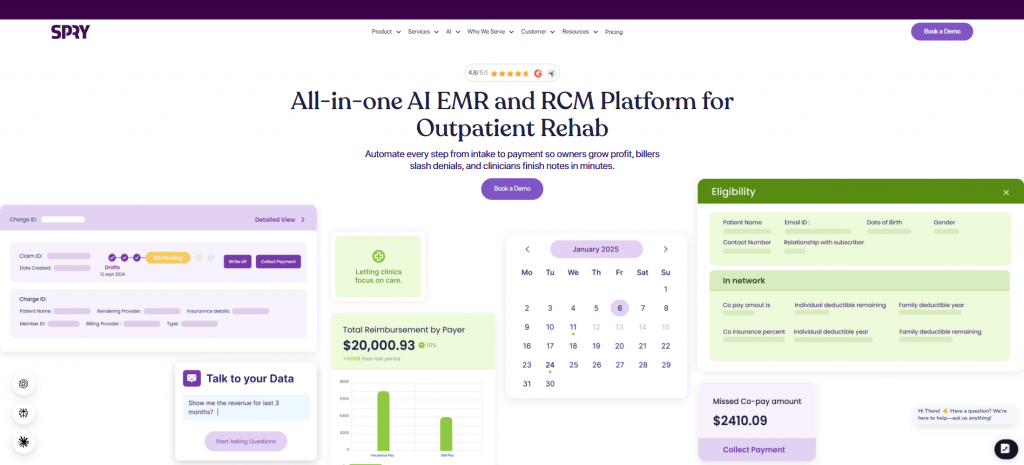
Spry is an all-in-one EMR and RCM platform meant for outpatient rehab. This pt emr software offers a complete toolkit, be it for patient intake, documentation, billing, or engagement. It offers comprehensive features like SOAP and documentation, patient portals, billing, PROMs, HEP, scheduler, and more. The tool allows you to send claims in bulk, reducing no-shows by 30%, supports multi-specialty SOAP workflows, and flags denials and underpayments instantly as well.
However, to get the best results out of this physical therapy emr system, it is recommended to integrate it with Emitrr- a patient communication software. Emitrr integrates with Spry to enable two-way texting and VoIP communication with patients during and after hours. Just like Spry, Emitrr is also AI-focused, and Physical Therapists looking to harness AI should go for this combo to enable 24/7 availability and to automate scheduling, follow-ups, and more.
2. WebPT
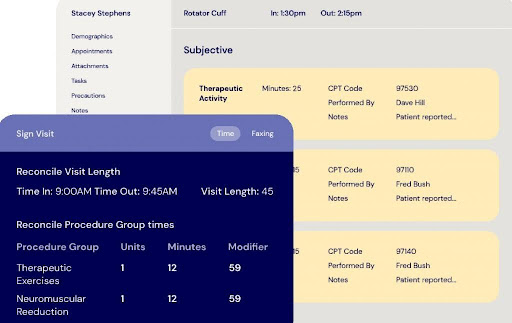
WebPT is one of the most popular emr systems for physical therapy, speech-language pathologists, and occupational therapists, but it’s mainly ideal for outpatient rehab therapy clinics. The software offers features such as templates, built-in alerts, Medicare, and payer-specific compliance tools. It also offers in-house billing services, FOTO integration, and other features like telehealth visits, appointment reminders, and intake forms, making it one of the best physical therapy emr software.
While WebpT can help with documentation, billing efficiencies, and virtual visits, it does not support two-way texting. To get the best out of this software, you should integrate it with Emitrr. Emitrr integrates with WebpT to help prevent missed leads during after-hours, to reactivate patients with drip campaigns, and to boost reputation in the local PT markets with review generation & online reputation management.
3. Prompt EMR

Prompt EMR is an AI-powered EMR software for Physical therapists, occupational therapists, speech therapists, and chiropractors. The platform can be used by right from small startups to enterprise therapists. Prompt EMR combines documentation, scheduling, billing, and patient engagement in a single place with features like AI-powered intake auto-fill, HEP, built-in compliance rules, AI scribing, advanced denial prevention, custom templates, and more.
This pt emr software is ideal for those looking for an AI-driven EMR platform, and to get the best out of it, you can strengthen it with Emitrr’s AI feature set, such as an AI phone system for 24/7 patient engagement, AI text for automating or improving two-way communication with patients, and more.
4. Athenahealth
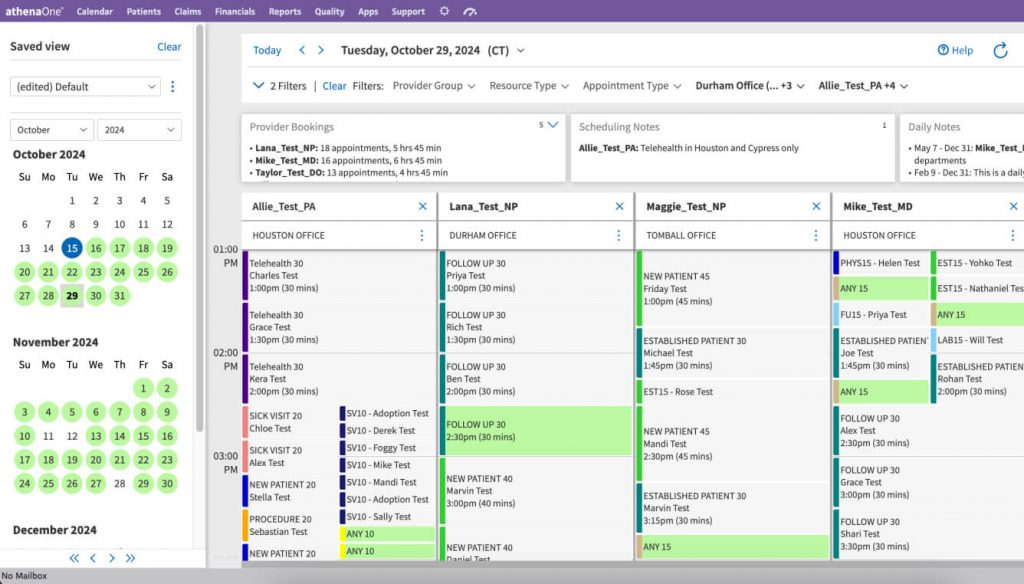
athenahealth is a cloud-based EHR and practice management platform designed for healthcare organizations ranging from independent practices to larger multi-specialty groups. It combines clinical documentation, scheduling, billing, patient engagement, claims management, and interoperability in one platform. For physical therapy practices, it can support core clinical and administrative workflows, although its capabilities are broader than those of PT-specific EMRs.
For PT practices looking to strengthen patient communication alongside athenahealth, integrating it with Emitrr can add two-way texting, VoIP communication, appointment reminders, scheduling, and automated follow-ups. This can help practices reduce manual communication, improve appointment engagement, and maintain consistent patient outreach throughout the care journey.
5. AdvancedMD
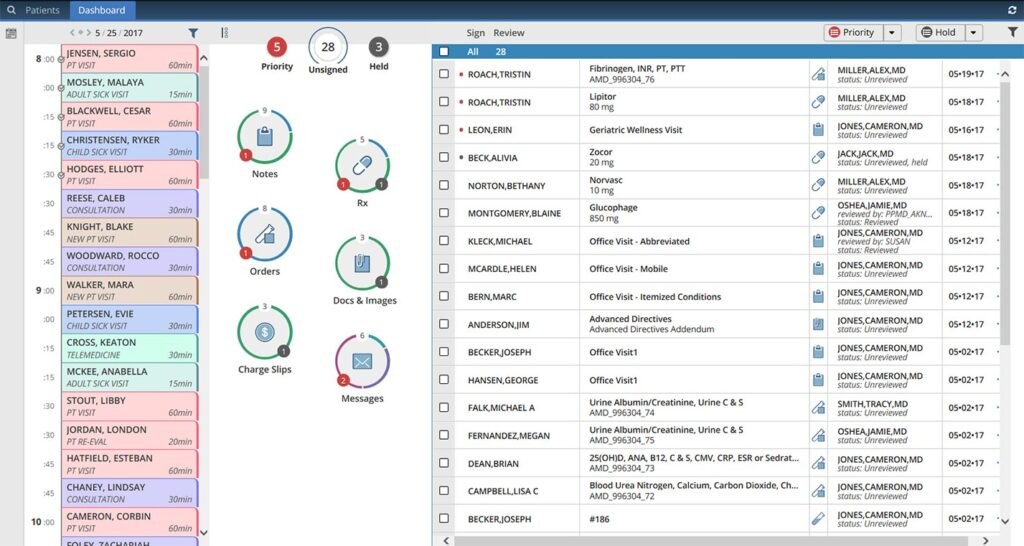
AdvancedMD is a cloud-based EHR and practice management software that combines clinical documentation, scheduling, medical billing, claims management, reporting, and patient engagement. It is designed for medical practices that want their clinical and administrative operations managed through a single system. For physical therapy practices, AdvancedMD can support many day-to-day workflows, but it is less specialized for PT than dedicated platforms such as SPRY PT, WebPT, or Prompt.
Integrating AdvancedMD with Emitrr can extend the platform’s communication capabilities through two-way texting, VoIP, appointment reminders, scheduling workflows, and automated patient follow-ups. This can help PT practices streamline routine communication, reduce manual outreach, and keep patients engaged before and after their appointments.
6. Epic EMR
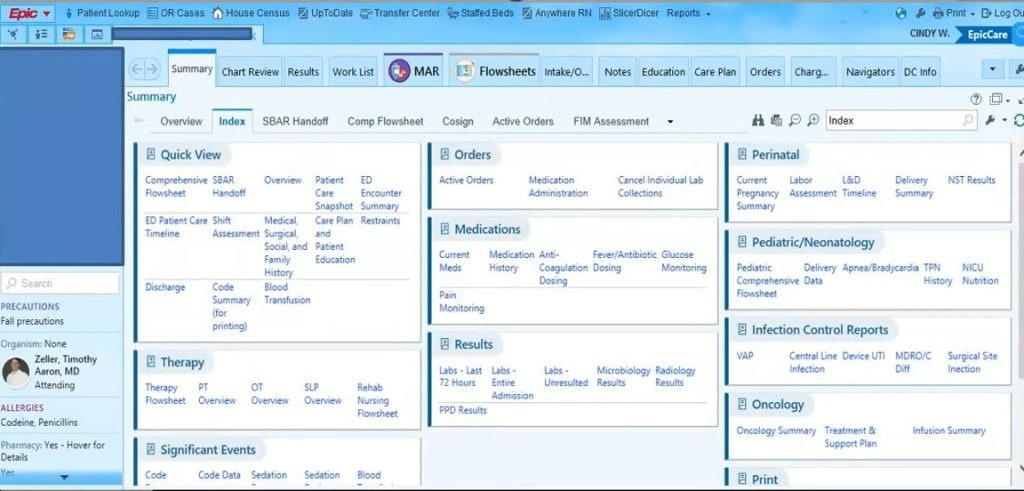
Epic EMR is a widely used healthcare platform that supports physical therapy practices through integrated documentation, scheduling, billing, patient records, and care coordination workflows. Its extensive interoperability capabilities help physical therapists collaborate with referring providers and specialists while maintaining a centralized patient record. The platform is particularly valuable for larger health systems and multi-specialty organizations that need physical therapy services connected to broader clinical operations.
While Epic offers strong clinical and operational capabilities, many practices still face challenges with patient engagement, appointment reminders, and two-way communication. By integrating Emitrr’s HIPAA-compliant texting, automated appointment reminders, and review management tools, physical therapy practices can improve patient adherence, reduce no-shows, and maintain consistent communication throughout the course of treatment.
7. Strata PT

Strata PT is a powerful EMR plus billing software designed for Physical therapists. The software integrates billing, EMR, and revenue cycle management, all in a unified system, and helps PTs achieve the best reimbursement. This physical therapy emr and billing software offers customizable PT, OT, and ST templates, comprehensive reporting tools, and a built-in “Audit Shield” to protect clinics during audits, among other features. Strata PT is excellent for those looking for both billing and documentation efficiency.
Emitrr complements this physical therapy EMR software offering deeper engagement tools like automated reactivation campaigns, missed-call-to-text, review, and online reputation prompts, among others. These are probably the only two systems you need to run your physical therapy clinic like a well-oiled machine.
How Emitrr Works Alongside Your Physical Therapy EMR
Emitrr is not an EMR and does not replace clinical documentation, scheduling logic, or billing inside your PT EMR of choice. It functions as a communication and workflow layer that can sit alongside a PT EMR to help close some of the gaps described in the blockers section above. What Emitrr can actually automate for a given practice depends heavily on whether the underlying EMR supports two-way integration or is more closed.
Unified inbox + EMR sync
Where supported, Emitrr connects to PT EMRs to pull schedules and patient details, so reminders and intake links are sent from the practice number and personalized automatically rather than requiring staff to manually look up appointment information for every message.
Automated pre/post visit cadence
Workflows can send sequenced messages, pre-visit forms, day-of reminders, and post-visit check-ins, with branching logic so a different message goes out depending on visit type (for example, an initial evaluation versus a routine follow-up) rather than sending the same generic reminder to every patient.
Intake capture and digital forms
HIPAA-compliant, signable forms can be sent via SMS link, and responses are tracked and made available to staff. Where the EMR supports structured field mapping, this data can populate the chart directly; where it does not, responses are available as a PDF export for staff to enter manually.
AI call triage for mobile workflows
Voice AI can collect appointment details from calls, such as those coming from schools or daycares coordinating pediatric PT referrals, and send summaries and scheduling links to parents, helping ensure they receive immediate, documented follow-up rather than a missed call with no record.
EMR limitations workaround
Where EMR field mapping is limited, Emitrr logs form responses as PDFs and creates tasks or cases for staff to enter into the EMR manually. This preserves the automation on the communication side without attempting to bypass the EMR’s own clinical data rules, and practices should understand this as a manual handoff rather than true two-way write-back.
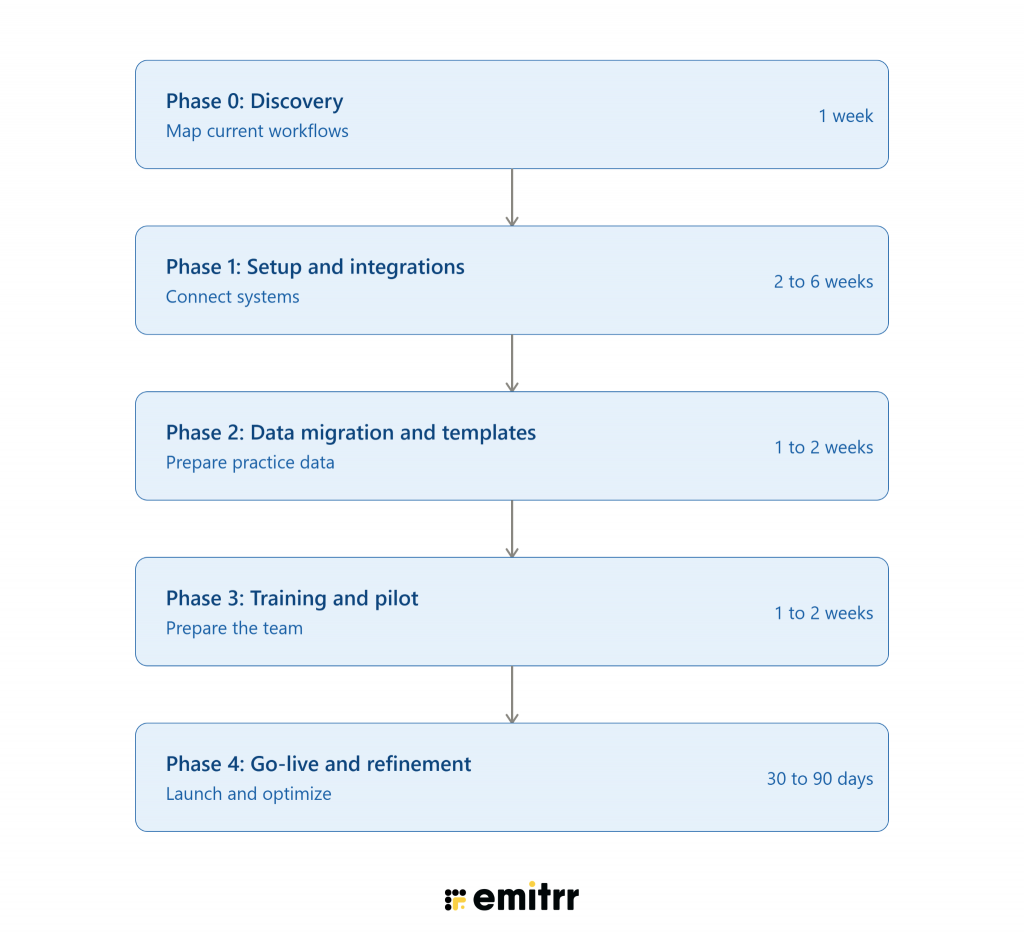
EMR Implementation Roadmap
Key Takeaways
- PT EMR selection should be judged primarily against recurring-visit and authorization-tracking workflows, not generic ambulatory feature checklists.
- The most costly blockers in PT practices tend to come from disconnected intake forms, reminders, and scheduling tools rather than from the core documentation module itself.
- Outcome measure support and PT-specific templates directly affect both documentation speed and payer defensibility.
- Two-way scheduling write-back and structured form-to-chart mapping are the integration details most worth verifying with a live demo, not a sales claim.
- Implementation timelines vary widely based on data volume, location count, and integration complexity, and should be treated as planning ranges rather than guarantees.
Frequently Asked Questions
There is no single best EMR for every PT practice. SPRY PT, WebPT, and Prompt are strong options for PT-specific workflows, while athenahealth and AdvancedMD may be better suited to multi-specialty organizations. The right choice depends on your practice size, recurring-visit workflow, authorization requirements, documentation needs, locations, and integration requirements.
PT EMR pricing varies by vendor and is often based on providers, users, locations, or selected modules. Additional costs may apply for billing or RCM, telehealth, patient engagement, and other add-ons. Instead of comparing advertised prices alone, request a quote based on your practice size and the features and integrations you actually need.
Prioritize PT-specific evaluation, daily note, reassessment, and discharge templates; outcome measures; recurring appointment scheduling; authorization and visit-count tracking; digital intake; billing connected to documentation; HEP and patient portal capabilities; and reporting. During a demo, ask the vendor to show these workflows using a realistic PT plan of care rather than simply listing features.
Authorization tracking is critical because PT treatment often involves a defined number of visits or a specific authorization period. An EMR should make it easy to see authorized visits, visits used, remaining visits, and relevant expiration dates while connecting this information to billing. Strong authorization tracking can help practices identify issues before they result in denied claims or treatment beyond authorization.
Many PT EMRs can integrate with communication platforms, but the depth of integration varies. Before choosing a system, verify whether appointments can sync both ways, whether intake responses can map to structured chart fields, and whether communication history can be associated with the patient record. These details determine whether an integration actually reduces administrative work or simply adds another manual step.
An EMR can support no-show prevention through appointment reminders, scheduling workflows, and patient engagement features, but the effectiveness depends on how the workflow is configured. Practices should look for recurring appointment reminders, two-way communication, automated no-show follow-up, and rebooking workflows that help recover missed visits.
Implementation can take anywhere from several weeks to a few months depending on the number of active patients and plans of care, locations, data migration requirements, template customization, training, and integrations. A practical planning range is roughly one to three months, but practices should confirm the timeline with the vendor based on their specific workflow and migration requirements.
Ask the vendor to demonstrate a complete PT workflow from intake and evaluation through recurring visits, reassessment, authorization tracking, billing, and discharge. Also verify how outcome measures are captured, how recurring appointments are managed, how no-shows are followed up, and whether scheduling and intake integrations provide true two-way write-back or require manual data entry.
Conclusion
Choosing an EMR for physical therapists comes down to how well a system supports the actual rhythm of PT care: an evaluation that sets the plan, recurring visits tied to authorization, documentation that captures outcome measures without slowing therapists down, and communication that keeps patients showing up through the full course of treatment. The challenges that trip up PT practices most often are not missing core features but disconnected pieces, forms that do not map into the chart, scheduling tools that do not write back, and reminder sequences that treat every visit the same. Evaluate vendors against your specific authorization complexity, location count, and integration needs, ask to see PT-specific workflows demonstrated live, and treat implementation timelines as planning ranges that depend on your practice’s actual data and complexity.
Once your EMR is in place, the next opportunity is improving the communication workflows around it. See how Emitrr can integrate with your PT EMR to automate reminders, two-way texting, follow-ups, and patient engagement. Book an Emitrr demo to see how it can fit into your practice workflow.


 4.9 (400+
reviews)
4.9 (400+
reviews)