
Introduction
A patient requests a refill. Hours pass. Then a day. Then two. No update. For clinics, this is just another prescription refill request in the queue. But for patients, it feels like poor service, and it directly impacts patient satisfaction scores in healthcare.
The problem isn’t just volume. It’s how refill requests are handled. Most clinics still rely on manual refill processing, scattered messages, and broken healthcare communication workflows, which quietly slow down the entire medication refill process.
In this guide, you’ll see:
- Where prescription refill delays actually come from
- How they impact patient experience and satisfaction scores
- And how to reduce refill request delays without adding more staff
What Are Prescription Refill Delays in Healthcare?
Prescription refill delays refer to the time gap between when a patient requests a medication refill and when that request is processed and fulfilled. Ideally, the medication refill process should be quick and seamless. But in reality, many clinics face delays ranging from 24 to 72 hours, or even longer, due to inefficient workflows.
These delays typically occur at multiple stages:
- When refill requests come in as unstructured patient messages (calls, voicemails, portals)
- When staff manually interpret and enter data into the system
- When incomplete or incorrect information leads to follow-ups
- When requests get stuck due to EHR workflow inefficiencies
As refill volumes grow, these small delays compound into larger refill request backlogs, making it harder to maintain a fast and consistent prescription refill turnaround time. Understanding where and why these delays happen is the first step toward improving both operational efficiency and patient satisfaction in healthcare.
Common Causes of Prescription Refill Delays in Clinics
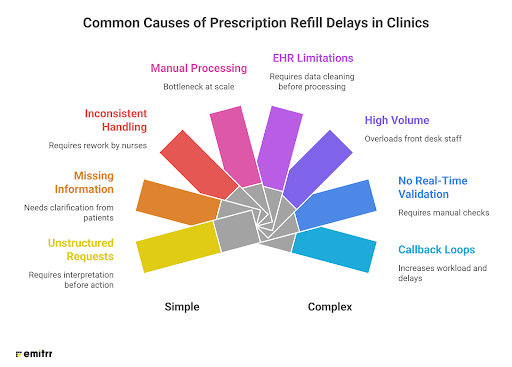
Prescription refill delays rarely come from one issue, they’re usually the result of multiple small breakdowns across the workflow.
Unstructured Refill Requests Across Channels
Refill requests come in through calls, voicemails, SMS, and portals, but most arrive as unstructured patient messages. Staff have to listen, read, and interpret each request before taking action. For example, “I need my BP meds” gives no usable details. This slows down the very first step of the medication refill process.
Missing or Incorrect Medication Information
A large share of prescription refill delays comes from incomplete or wrong details, missing dosage, unclear medication names, or requests for discontinued drugs. Staff often have to call patients back just to clarify basics, increasing refill request delays and turnaround time.
Inconsistent Front Desk Handling
Not all staff handle refill requests the same way. Some create proper refill entries, while others log generic cases. This inconsistency leads to refill request workflow issues, where nurses must later fix or convert requests, adding avoidable delays.
Nurse Rework and Double Entry
When requests are logged incorrectly or incompletely, nurses have to re-enter data, verify details, and decide next steps. This extra layer of manual refill processing slows down approvals and adds unnecessary workload.
Manual Refill Processing and Data Entry
Even with correct information, many clinics still rely on manual entry and routing. Staff have to input data into the system and move requests forward, which becomes a bottleneck at scale and contributes to EHR workflow inefficiencies.
EHR Limitations in Handling Communication
EHRs depend on clean, structured inputs, but refill requests rarely come that way. These electronic health record communication gaps force staff to clean and organize data before processing, slowing down EHR refill request management.
High Refill Volume and Front Desk Overload
Refill requests often make up a large chunk of daily communication. Clinics handling hundreds or thousands of requests monthly face constant front desk communication overload, leading to slower response times and growing backlogs.
See how AI can help reduce high prescription refill calls:
No Real-Time Validation of Requests
Most systems cannot validate requests in real time, whether the medication is active, prescribed by the provider, or eligible for refill. This increases risk and forces manual checks, delaying the medication refill process further.
Callback Loops and Patient Follow-Ups
Because many requests are incomplete or unclear, staff spend a significant amount of time calling patients back. These repeated touchpoints not only delay refills but also increase workload and reduce efficiency.
See more reasons why patients keep calling about prescription refills to understand where the problem lies.
The Hidden Operational Cost of Refill Delays for Clinics
Prescription refill delays don’t just impact patients, they create real operational costs.
Around 30–40% of refill requests need follow-ups, meaning one request often turns into multiple touchpoints, increasing front desk communication overload. At the same time, staff spend 20–30 minutes daily handling refills, much of it on manual refill processing like callbacks and data entry.
In high-volume clinics managing 1,000+ refill requests per month, even small inefficiencies add up to dozens of hours lost monthly, creating backlogs and slowing the medication refill process.
On a broader level, providers already spend 2 hours on admin work for every 1 hour of patient care, and refill-related tasks are a major contributor due to EHR workflow inefficiencies.
In short, refill delays quietly drain time, increase workload, and reduce overall efficiency.
Why Traditional Systems Fail to Prevent Refill Delays
Here are the top reasons why traditional systems fail to prevent refill delays:
EHRs Don’t Structure Communication
Traditional EHRs are not designed to handle unstructured prescription refill requests coming from calls, SMS, or portals. Staff must manually interpret and organize these inputs before processing. This slows down the prescription refill turnaround time and creates inefficiencies in the medication refill process, ultimately affecting patient experience in hospitals and patient satisfaction in healthcare.
Dependence on Manual Workflows
Most clinics rely heavily on manual routing of refill request delays across front desk staff, nurses, and providers. Each handoff adds time and increases the risk of bottlenecks in healthcare workflows. This dependence on manual refill processing limits the ability to consistently improve patient satisfaction and maintain efficient operations.
Lack of Real-Time Intake Validation
EHR systems typically do not validate refill requests at the point of submission. Incomplete or incorrect requests proceed through the system, leading to callbacks and rework. This lack of real-time checks contributes to medication refill delays, longer patient wait times, and negatively impacts patient satisfaction scores collected through patient surveys.
How to Reduce Prescription Refill Delays in Healthcare
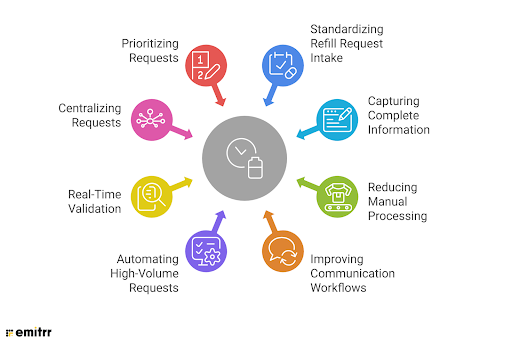
Here are top ways to reduce prescription refill delays in healthcare:
Standardizing Refill Request Intake
Standardize how prescription refill requests come in across calls, SMS, and portals so staff aren’t interpreting unstructured messages. A consistent intake flow reduces refill request delays and improves prescription refill turnaround time.
Capturing Complete Patient and Medication Information Upfront
Capture all key details, patient info, medication name, dosage, and pharmacy, at the time of request. This avoids back-and-forth follow-ups, reduces medication refill delays, and helps improve patient experience healthcare.
Reducing Manual Refill Processing
Reduce reliance on manual entry and routing in the medication refill process. Fewer manual steps means fewer bottlenecks in healthcare workflows, helping clinics process requests faster and improve efficiency.
Improving Healthcare Communication Workflows
Centralize and streamline communication between front desk teams, nurses, and providers. Clear workflows reduce communication gaps in refill workflows and help improve patient satisfaction by speeding up responses.
Automating High-Volume Refill Requests
Automate intake, routing, or use SMS based refill request to reduce prescription refill calls. This reduces workload, minimizes patient wait times healthcare, and helps clinics reduce prescription refill delays at scale.
Adding Real-Time Validation of Requests
Validate requests at the point of submission to ensure completeness and eligibility. This prevents incomplete requests from entering the queue, reducing callbacks and improving prescription refill turnaround time.
Centralizing Multi-Channel Requests
Bring all refill requests into one system instead of scattered channels. A unified view prevents lost messages, reduces refill request backlog, and improves tracking of patient communication delays.
Prioritizing and Routing Requests Efficiently
Route and prioritize requests based on urgency and type. Efficient routing reduces bottlenecks in refill workflow inefficiencies and ensures faster handling of high-priority cases.

Role of Automation in Improving Refill Turnaround Time
Prescription refill delays are rarely caused by a single issue, they usually stem from gaps across intake, communication, and workflow processes. Addressing them requires a structured approach that improves how prescription refill requests are captured, processed, and fulfilled.
AI-Guided Intake
AI can guide patients to submit complete prescription refill requests by asking the right questions upfront. This reduces missing information, minimizes refill request delays, and improves prescription refill turnaround time by ensuring requests are actionable from the start.
See how AI is automating prescription refills:
Multi-Channel Communication
Automation unifies refill requests from SMS, calls, and portals into a single system. This centralization prevents missed messages, reduces patient communication delays, and helps streamline prescription workflows for faster processing.
Create Structured Data
Automated systems convert unstructured inputs into structured data that EHRs can easily process. This reduces manual work, eliminates repeated data entry, and speeds up the medication refill process, helping clinics reduce prescription refill delays efficiently.
See how you can also automate prescription refills with voice AI agents.
How Faster Refill Workflows Improve Patient Satisfaction Scores
Here’s how faster refill workflows improve patient satisfaction scores in healthcare:
Faster Response Leads to Better Patient Experience
When clinics respond quickly to refill requests, patients perceive better care quality. Faster responses improve patient experience in hospitals and positively influence patient satisfaction scores captured through patient satisfaction surveys.
Reduced Patient Wait Times
Efficient workflows and automation significantly cut down patient wait times in healthcare. Shorter waits during the medication refill process directly improve convenience and reduce frustration, leading to better patient satisfaction in healthcare.
Higher Patient Retention and Trust
Consistent and timely handling of prescription refill requests builds trust between patients and providers. Over time, this leads to stronger relationships, improved patient satisfaction, and higher patient retention rates.
Better Care Coordination and Communication
Improved workflows reduce communication gaps in refill workflows, ensuring patients receive timely updates. Better coordination between staff leads to fewer errors, fewer callbacks, and a smoother medication refill process, all of which positively impact patient experience healthcare.
Reduced Administrative Friction
Automation minimizes manual steps, allowing staff to focus more on patient care rather than repetitive tasks. Reduced administrative burden improves efficiency and contributes to better service delivery, which ultimately reflects in higher patient satisfaction scores and improved outcomes.
How Emitrr Helps Reduce Prescription Refill Delays
Emitrr is a healthcare communication and workflow automation platform that helps clinics manage prescription refill requests more efficiently by structuring intake, automating communication, and reducing manual effort across teams. Here’s how it can help reduce prescription refill delays:
AI Intake
Emitrr uses AI-guided intake to collect complete prescription refill requests upfront. By prompting patients for missing details in real time, it reduces incomplete submissions, minimizes refill request delays, and improves prescription refill turnaround time.
Structured Requests
All incoming requests are converted into structured data that is easy to process. This eliminates unstructured messages, reduces manual interpretation, and streamlines the medication refill process, helping clinics avoid refill workflow inefficiencies.
Reduced Callbacks
By capturing accurate information at the source, Emitrr significantly reduces the need for follow-up calls. Fewer callbacks mean less patient communication delays, lower staff workload, and faster handling of refill requests across teams.
Better Refill Turnaround Time
With automation, structured intake, and centralized communication, clinics can process requests faster and more consistently. This improves patient wait times healthcare, reduces prescription refill delays, and supports a smoother patient experience healthcare.
Key Takeaways
- Prescription refill delays are mainly caused by unstructured intake, manual workflows, and communication gaps.
- Improving prescription refill turnaround time requires standardizing intake and capturing complete information upfront.
- Automation helps clinics reduce refill request delays by eliminating manual steps and improving healthcare workflows.
- Faster and structured handling of prescription refill requests directly improves patient satisfaction scores and overall patient experience in hospitals.
- Tools that automate intake and communication can significantly improve patient satisfaction in healthcare while reducing operational burden.
Frequently Asked Questions
Prescription refill requests get delayed due to unstructured intake, missing information, manual processing, and communication gaps between staff. High volumes and inefficient workflows further contribute to refill workflow inefficiencies and longer prescription refill turnaround time.
Refill delays increase patient wait times healthcare, create frustration, and reduce trust in the clinic. These factors negatively affect patient experience in hospitals and are often reflected in lower patient satisfaction scores collected through patient surveys.
On average, prescription refill turnaround time ranges from 24 to 72 hours in many clinics, depending on workload, staffing, and workflow efficiency. Inefficient processes can extend this further, increasing refill request delays.
Clinics can reduce refill request delays by standardizing intake, capturing complete information upfront, reducing manual steps, and improving communication workflows using tools like Emitrr. Automation also helps streamline the medication refill process and improve overall efficiency.
Yes, automation can help clinics improve patient satisfaction by reducing delays, minimizing errors, and ensuring faster responses. Faster handling of prescription refill requests leads to better patient experience healthcare and higher patient satisfaction scores.
Emitrr is a top HIPAA-compliant tool that offer AI-guided intake, structured request handling, multi-channel communication, and workflow automation can help streamline medication refill workflows. These solutions reduce manual effort, improve coordination, and help clinics reduce prescription refill delays effectively.
Conclusion
Prescription refill delays impact patient experience healthcare, increase patient wait times healthcare, and lower patient satisfaction scores. By improving intake, reducing manual steps, and streamlining healthcare workflows, clinics can significantly reduce refill request delays and improve prescription refill turnaround time.
Emitrr helps automate prescription refill requests, making it easier to manage communication, reduce delays, and improve overall efficiency. Book a demo with Emitrr to see how you can streamline refill workflows and improve patient satisfaction.


 4.9 (400+
reviews)
4.9 (400+
reviews)