
Introduction
Ask most front-desk staff what they dread most in a given week, and refill requests usually make the list. Not because the medications are complicated, but because the process around them rarely is one process. It’s a phone call handled one way, a pharmacy fax handled another, and a portal message that sits until someone happens to open that tab.
A prescription refill workflow turns that scattered handling into something repeatable: a defined path a request follows from the moment it arrives until the patient has their medication in hand. When that path is clear, staff know exactly what to check, providers review requests with the context they need, and patients aren’t left calling twice to ask what happened to their refill.
This guide walks through how a prescription refill workflow works, who owns each step, how requests get triaged and approved, what makes controlled substances different, and where the process typically breaks down.
AI Summary
- A prescription refill workflow moves a request through intake, eligibility review, provider approval, pharmacy transmission, and patient notification.
- Refill requests arrive from two different directions, the patient and the pharmacy itself, and practices often need separate handling for each.
- Triage decides which requests can move quickly and which need a closer look, based on visit recency, medication type, and urgency.
- Controlled substances follow a stricter path due to DEA and EPCS requirements, and shouldn’t be handled the same way as routine maintenance medications.
- Most delays come from fragmented intake and incomplete requests, not from the clinical decision itself.
Prescription Refill vs. Renewal: Why the Distinction Changes the Workflow
These two words get used interchangeably, but they trigger different processes.
A refill draws on fills that are already authorized. The prescription is active, the patient has refills remaining, and the pharmacy or patient is simply requesting the next one. In most cases, this can move through the workflow quickly, often without a new clinical decision, because the provider already authorized this exact quantity when they wrote the original prescription.
A renewal happens when there’s nothing left to draw on. The prescription has run out of refills, or it’s expired outright. This isn’t a formality; it typically requires the provider to make a fresh clinical decision about whether the patient should continue the medication, which sometimes means scheduling an appointment before the medication can continue.
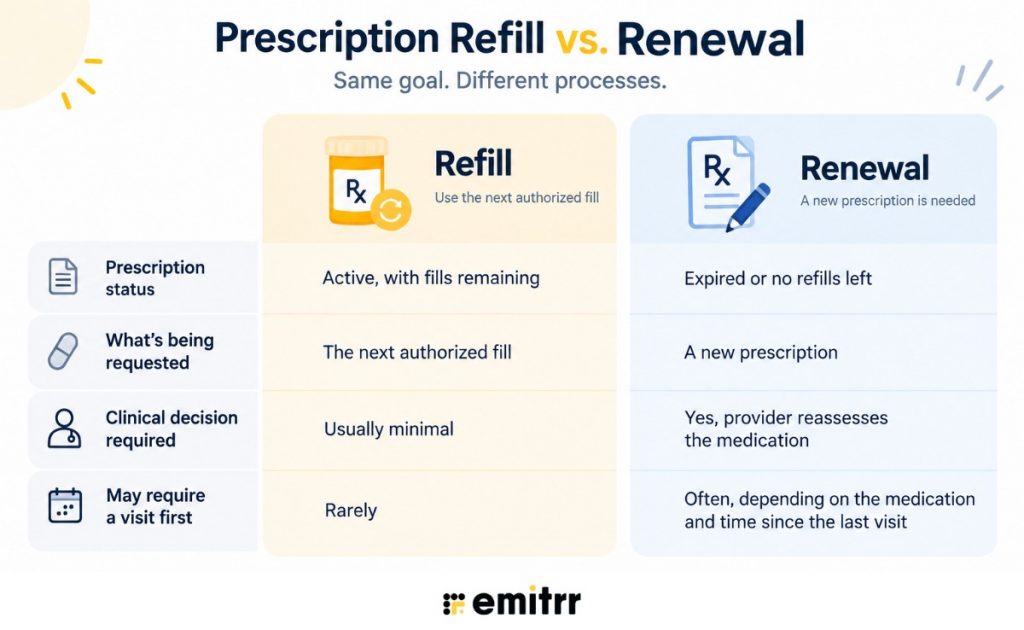
Getting this distinction right at intake matters because it determines which path the request takes next. A refill request mistakenly treated as a routine approval, when it’s actually a renewal with no fills left, is one of the more common ways a request stalls partway through the workflow.
Where Prescription Refill Requests Come From
Refill requests don’t arrive through a single channel, and they don’t always originate with the patient.
Patient-initiated requests come in through a phone call, a text, a patient portal message, or occasionally a walk-in. The patient is asking directly for their next fill, and staff typically start the workflow from scratch: verifying identity, pulling the chart, and checking eligibility.
Pharmacy-initiated electronic renewal requests work differently. When a patient asks their pharmacy for a refill, and the pharmacy’s system shows no fills remaining, the pharmacy sends an electronic renewal request directly to the prescriber, most commonly through Surescripts. This arrives in the practice’s e-prescribing queue or EHR inbox rather than as a phone call, and it already contains structured medication and pharmacy details, since it comes from a standardized transaction rather than a conversation.
Practices generally end up handling these two paths differently, because they enter the workflow at different points:
| Request Source | Patient-Initiated | Pharmacy-Initiated (Electronic Renewal Request) |
| How it arrives | Phone, text, portal, walk-in | E-prescribing network (commonly Surescripts) into the EHR queue |
| Initial data quality | Depends on what the patient provides | Structured, comes with medication and pharmacy details attached |
| First step for staff | Verify identity and collect details | Match to chart and confirm eligibility, less transcription needed |
| Common failure point | Missing or unclear information at intake | Sitting unnoticed in a queue nobody checks regularly |
Knowing which channel a request came through isn’t just administrative trivia. It changes what staff needs to check first and how much verification work is still ahead of them.

The Prescription Refill Workflow, Step by Step
Once a request enters the workflow, whichever way it arrived, it generally moves through the same sequence:
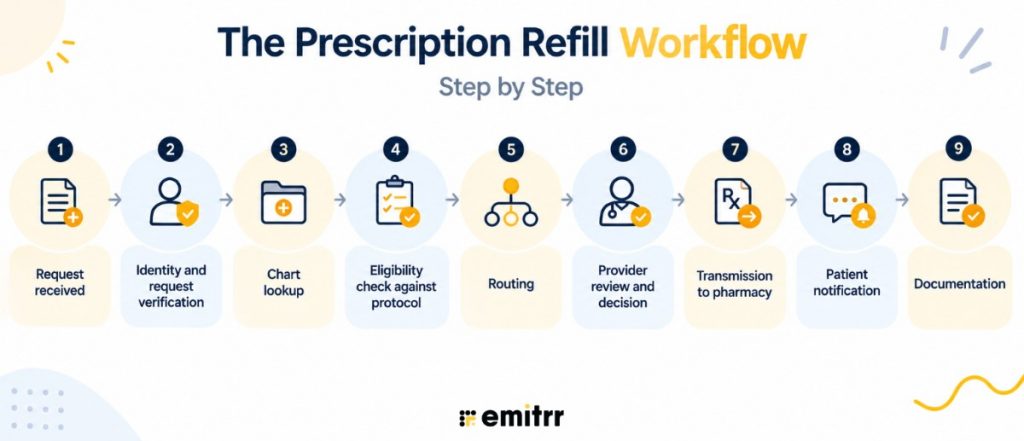
Step 1: Request received. Logged from a call, text, portal message, or pharmacy transmission.
Step 2: Identity and request verification. Confirming the patient’s identity and basic details (name, date of birth, phone number) before anything else happens.
Step 3: Chart lookup. Staff pulls up the medication list, last visit date, and the prescribing provider on record.
Step 4: Eligibility check against protocol. Is the patient within the required visit window, is the medication still active, are labs or monitoring current, is this a controlled substance, does it fall within the provider’s defined limits.
Step 5: Routing. The request goes to the right queue based on rules like medication type (controlled substances to a provider, routine maintenance to a nurse or refill coordinator), the patient’s provider of record, or refill volume that needs a pharmacy coordinator or billing involved for insurance verification, with an escalation path for anything flagged as urgent or unusual.
Step 6: Provider review and decision. The provider approves, modifies, denies, or determines the patient needs to be seen first.
Step 7: Transmission to pharmacy. The approved refill is sent electronically or, less commonly now, by phone or fax.
Step 8: Patient notification. The patient is told the refill was submitted, approved, denied, or needs more information.
Step 9: Documentation. The request, decision, and outcome are logged in the chart, closing the loop.
On paper, this looks clean. In practice, steps 3 and 4 are where most requests slow down, usually because the information needed to complete them wasn’t collected properly at step 1.
Who’s Responsible for Each Step
Refill requests pass through several hands before they’re resolved, and unclear ownership at any point is often what causes a request to sit. For practices handling a high volume of requests, prescription refill software can help organize incoming requests, route them to the appropriate staff, and keep each refill moving through the review process.
| Role | Typical Responsibility |
| Front desk / medical assistant | Receives the request, verifies identity, logs basic details |
| Nurse or refill coordinator | Pulls the chart, checks eligibility criteria, flags anything that needs provider attention |
| Prescribing provider | Makes the clinical decision: approve, modify, deny, or require a visit |
| Pharmacy | Dispenses the approved refill, or sends clarification requests back to the practice if something doesn’t match |
Smaller practices often collapse the first two roles into one person, which works fine at low volume but tends to create backlogs once refill requests pile up alongside everything else that person is handling.
Prescription Refill Request Triage: What Determines Priority and Review Level
Not every refill needs the same level of scrutiny. Triage is what separates a request that can move through quickly from one that needs a provider’s attention before it goes anywhere.
Requests that typically move quickly:
- Medication is active and stable on the chart
- Patient was seen within the required timeframe
- No controlled substance involved
- No pending labs or monitoring requirements
- Dosage and quantity match what was previously prescribed
Requests that typically need a closer look:
- Patient hasn’t been seen within the required window
- Medication is a controlled substance
- Labs or vitals are due or overdue
- The requested dose or frequency doesn’t match the chart
- The medication was recently changed or discontinued
- The request came in as urgent (patient says they’re out today, or the condition is acute rather than chronic)
Urgency and clinical risk are separate things, and triage needs to weigh both. A patient who is genuinely out of a chronic medication today deserves a faster response than a routine renewal with no time pressure, even if neither one raises a clinical red flag.
The Approval Process: What a Provider Checks Before Signing Off
By the time a refill reaches a provider, the goal is that they’re making a decision, not doing detective work. That only happens if the earlier steps did their job.
Before approving, a provider is typically confirming:
- The patient has been seen recently enough to justify continuing the medication
- Nothing in the chart suggests the medication should be changed or stopped
- Any required monitoring (labs, vitals, follow-up visits) is current
- The requested quantity and frequency match what’s clinically appropriate
- No controlled substance or safety flag needs a different process
When intake is incomplete, this step turns into back-and-forth: the provider has questions, sends the request back for clarification, and the whole thing waits for another handoff before it can move forward. This is one of the most common places a “quick refill” turns into a multi-day wait, not because the clinical decision was hard, but because the provider didn’t have what they needed the first time around.
How Controlled Substances Change the Prescription Refill Workflow
Controlled substances don’t just need extra caution. They follow a genuinely different process, and treating them like a standard refill is a compliance risk, not just a workflow inefficiency.
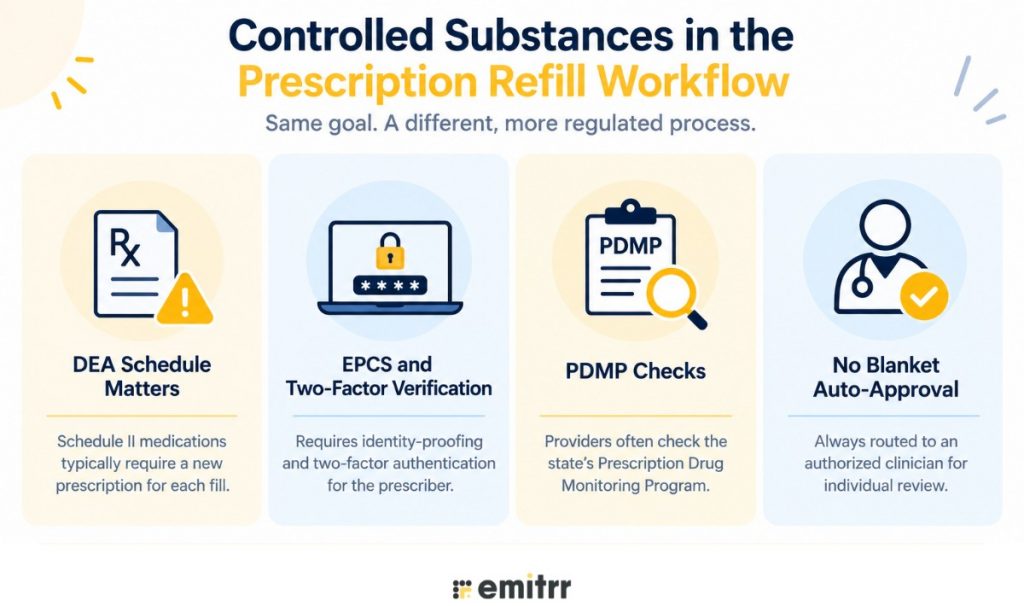
What changes for controlled substances:
- DEA schedule matters. Schedule II medications generally can’t be refilled the way non-controlled prescriptions can; each fill typically requires a new prescription, and electronic transmission has to meet EPCS requirements.
- EPCS and two-factor identity verification. Electronic prescribing of controlled substances requires identity-proofing and two-factor authentication for the prescriber, which is a higher bar than routine e-prescribing.
- PDMP checks. Providers are often expected to check the state’s Prescription Drug Monitoring Program before authorizing certain controlled substance refills, to screen for patterns like early refills or multiple prescribers.
- No blanket auto-approval. Even in practices that streamline routine refills, controlled substances should always route to an authorized clinician for individual review, never move through on a rules-only pass.
If your practice handles any meaningful volume of controlled substance refills, this is the one part of the workflow where “faster” should never come at the expense of “verified.”
Common Prescription Refill Exceptions and How They’re Handled
Most refill requests aren’t complicated. The ones that are usually fall into a predictable set of categories.
| Exception | What Typically Happens |
| Patient overdue for a visit | Refill is held; staff or the system prompts the patient to schedule before the request can proceed |
| Medication discontinued or changed | Request is flagged for provider review rather than approved automatically |
| Prescription expired | Treated as a renewal, not a refill; provider reassesses the medication |
| Insurance or prior authorization required | Request pauses while staff or the patient work through the payer’s requirements |
| Pharmacy can’t process the electronic transmission | Staff follow up by phone or cloud fax to resolve the rejection manually |
| Dose or prescriber mismatch | Request is routed back for clarification before it can move forward |
None of these exceptions are unusual on their own. What causes trouble is when a practice doesn’t have a defined path for handling them, so each one gets solved ad hoc by whoever happens to pick it up.
What Slows Refill Workflows Down in Practice
A few recurring issues account for most of the friction in refill processing:
- Fragmented intake channels. When requests come in by phone, text, portal, and pharmacy transmission, staff have to check multiple places just to know what’s pending, which is the same fragmented communication problem that slows down patient intake more broadly.
- Incomplete requests at submission. A refill request missing the pharmacy name, exact dosage, or a callback number forces staff to pause and chase down details before they can even start the eligibility check.
- Unclear ownership. If it’s not obvious who’s responsible for a given request, it can sit in a shared inbox or queue longer than it should.
- No visibility into what’s pending. Without a clear view of open requests, it’s easy for one to get missed entirely until the patient calls asking what happened, especially when nothing reassigns or escalates a request that’s sat unclaimed in a queue for hours.
Individually, these look like small annoyances. Multiplied across the volume most practices handle weekly, they’re usually the real reason refill turnaround feels slower than it should.
Drowning in refill calls? See how an AI prescription refill agent can cut call volume by up to 40%.
How Automation Helps a Prescription Refill Workflow Hold Up at Volume
A documented process helps, but documentation alone doesn’t prevent the breakdown described above. If every step still depends on a staff member remembering to check the right queue or type in the right field, the process will hold up fine on a slow day and fall apart on a busy one.
This is where prescription refill automation earns its place, not as a replacement for the workflow, but as a way to make it consistent regardless of how many requests come in or who’s covering the front desk that day.
Consistent intake, regardless of channel. Whether a request comes in by phone, text, or a digital form, capturing the same required fields (patient identity, medication, dose, pharmacy, urgency) every time removes the variation that comes from different staff handling requests differently. Digital intake forms and an AI voice agent that handles refill calls both push toward the same outcome: a complete request the first time, instead of a callback to fill in the gaps.
Eligibility checks applied the same way every time. Instead of a staff member manually cross-referencing a printed rule sheet, a rules-based check can confirm visit recency, medication status, and controlled substance flags consistently, so the criteria don’t shift depending on who’s reviewing the request or how busy they are.
Routing that doesn’t depend on someone remembering the rule. Requests can be routed automatically to the right queue or provider based on medication type, urgency, or the prescriber on record, which matters most on the days staff have the least time to sort through a backlog manually.
Fewer status-check calls. A large share of patients keep calling about prescription refills simply because they haven’t heard anything since submitting the request. Two-way texting and automated status updates close that gap by confirming receipt and notifying the patient once a decision is made, without staff having to make a separate call for every update, which is also how SMS-based refill requests cut down phone volume more broadly.
Reminders before patients run out. Automated refill reminders, timed to when a patient is due to run low, reduce the number of same-day, urgent requests that put pressure on staff to skip steps.
What doesn’t change, regardless of how much of the intake and routing is automated, is who makes the clinical call. Approving a refill, especially anything involving a controlled substance or a change to the medication itself, stays with the provider. Automation’s job is to make sure that decision reaches them with complete information the first time, not to decide for them.
Key Takeaways
- A refill and a renewal aren’t the same request, and treating them the same is a common source of delay.
- Refill requests come from both patients and pharmacies, and each entry point needs its own handling.
- Most of the workflow is procedural, but triage and provider approval are where clinical judgment actually applies.
- Controlled substances require a stricter, individually reviewed process due to DEA and EPCS requirements, and should never be auto-approved.
- The biggest source of delay is usually incomplete intake, not the clinical decision itself, which is exactly where consistent, automated capture helps most.
FAQs
A refill uses fills that are already authorized on an active prescription. A renewal is needed when the prescription has expired or has no refills left, which typically requires the provider to make a new clinical decision about whether to continue the medication.
When a patient asks their pharmacy for a refill and none remain, the pharmacy sends an electronic renewal request to the prescriber, usually through a network like Surescripts. It arrives in the practice’s e-prescribing queue with structured medication and pharmacy details already attached, rather than as a phone call.
This depends on the medication, state regulations, and the provider’s own clinical judgment. Non-controlled maintenance medications are often authorized for several refills at a time, while controlled substances, particularly Schedule II medications, generally require a new prescription for each fill rather than a standing refill authorization.
Routine refills are sometimes handled under a provider’s standing protocol by nurses or other clinical staff, depending on practice policy and state scope-of-practice rules. Anything involving a clinical judgment call, a medication change, or a controlled substance needs to go to the prescribing provider or another authorized prescriber.
Controlled substances follow DEA scheduling rules, require EPCS-compliant identity verification for electronic transmission, and often involve a PDMP check before approval. They should always be reviewed individually by an authorized clinician rather than processed through a general refill protocol.
Conclusion
A prescription refill workflow doesn’t need to be complicated to work well. It needs to be consistent: the same information collected every time, a clear path for who reviews what, and a defined process for the exceptions that come up regularly rather than a different answer each time one appears. Get that foundation right, and the parts of the process that actually need automation, like capturing requests completely and keeping patients updated, have something solid to build on.
Book a demo to see how a more consistent refill intake process could work for your practice.


 4.9 (400+
reviews)
4.9 (400+
reviews)